
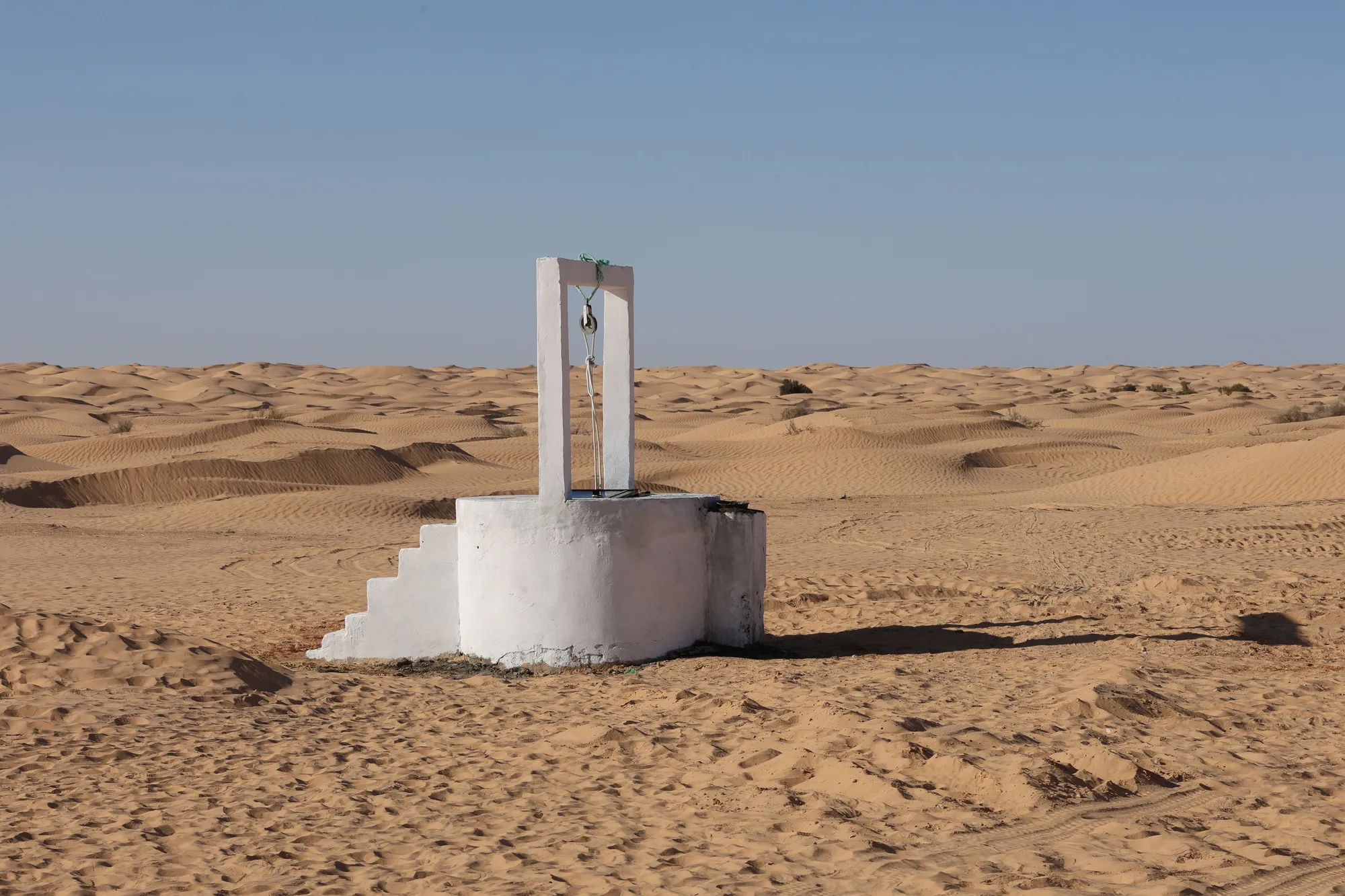
Three Studios Restore a Saharan Well 30 Kilometers from the Nearest Village
In Tunisia's Grand Erg Oriental, a ten-square-meter intervention of masonry, palm wood, and frond hedges sustains nomadic life in the dunes.


Architecture at ten square meters does not typically command attention. But when those ten square meters sit in the dunes of the Grand Erg Oriental, over 30 kilometers from the nearest inhabited settlement, and when they represent the difference between survival and abandonment for shepherds and their herds, the scale of the gesture becomes irrelevant compared to its stakes. Le laboratoire d'architecture, A4 Architecture, and the Bled El Abar Collective have completed Land Of Wells in Kébili Governorate, Tunisia: the restoration of a silted and collapsed desert well using traditional masonry, palm wood, and date palm fronds, materials that have served pastoral nomads along these routes for centuries.
What makes this project worth studying is not formal ambition but operational precision. The well is infrastructure in the most elemental sense: a vertical shaft to water, a trough for camels, goats, and sheep, a shelter for the humans who accompany them, and a windbreak to keep the sand from burying it all again. Every element addresses a specific threat. Every material comes from the site or its immediate ecology. The result is a piece of architecture that argues, quietly but firmly, that restoration of existing nomadic systems is a more responsible act than designing new ones from scratch.
Reading the Desert as a Territory of Infrastructure

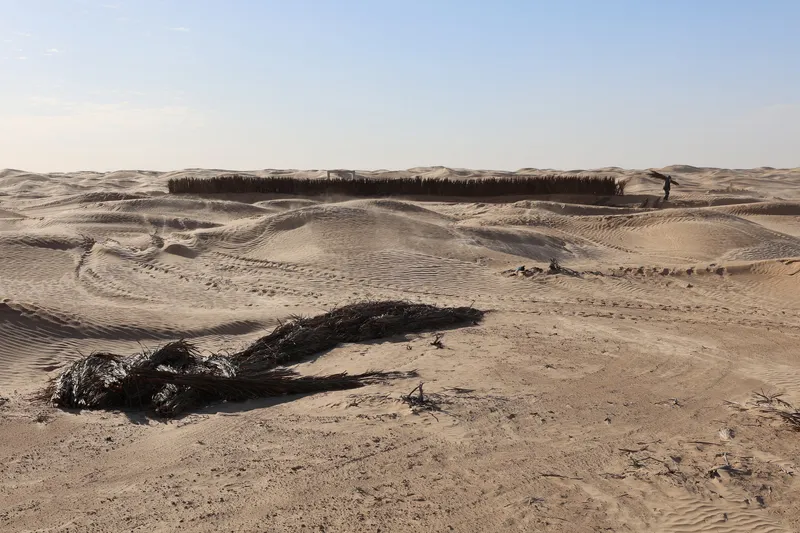

From a distance, the intervention barely registers against the enormity of the dune field. A white portal frame, a line of palm frond fencing, a figure walking a ridgeline. The Grand Erg Oriental is not empty; it is networked by routes that pastoral nomads have used for millennia, connecting water sources across what appears, to an outsider, as undifferentiated sand. The well is a node in that network. Its collapse meant not just the loss of a water point but the severing of a link in a chain of movement that sustains both human and non-human life.
The project's first act was cartographic: understanding the well's position within the larger territorial system before any physical work began. The site had silted up, its masonry had deteriorated, and the trough had been partially buried. Restoration began with excavation, literally digging the well back into existence, before reinforcing its structure with traditional techniques.
Masonry, Plaster, and the Vertical Mark
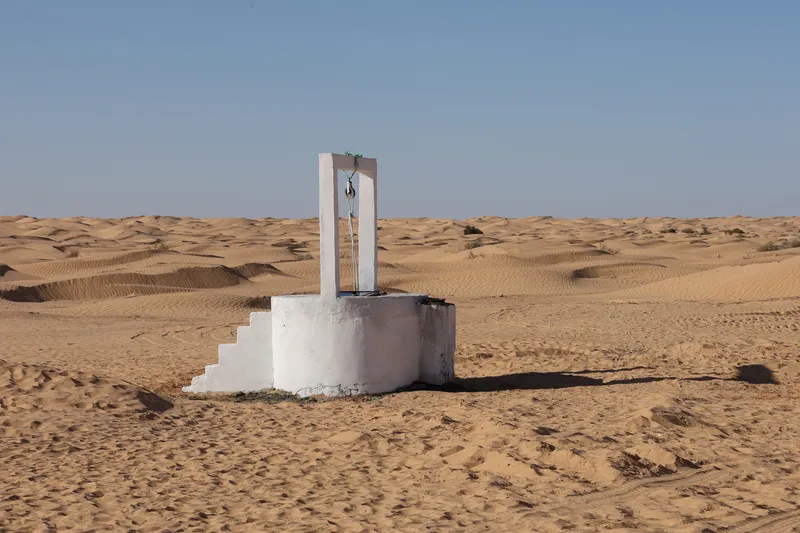
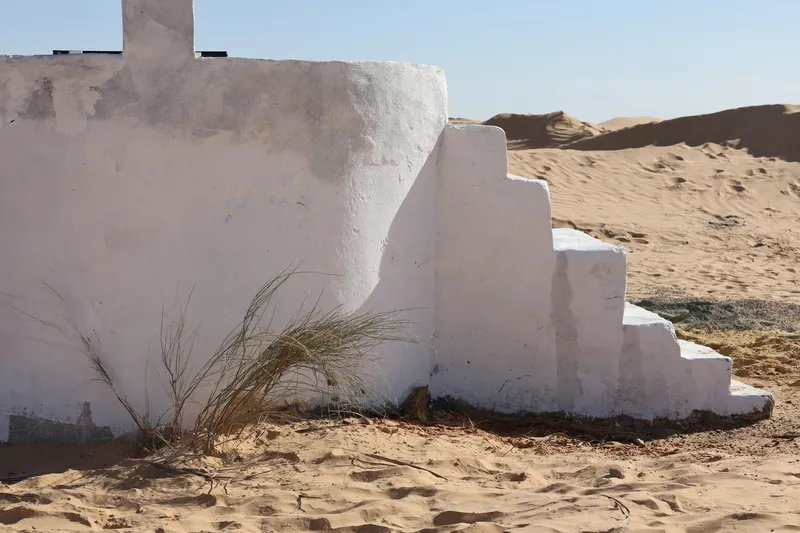
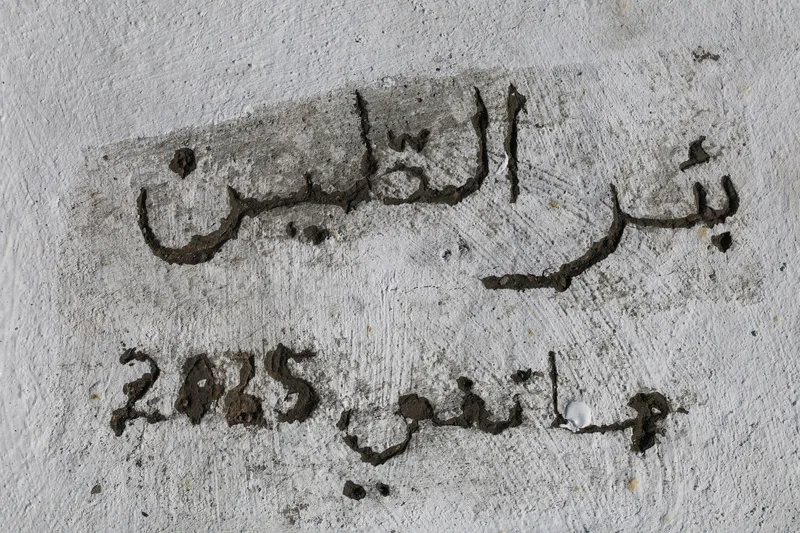
The well itself is a compact masonry tower, white-plastered, rising from the sand like a marker. Its vertical element is both functional and symbolic: it houses the pulley mechanism for drawing water and serves as a landmark visible across the flat terrain. In a landscape without trees or buildings, even a modest vertical structure becomes a beacon. The white plaster finish, common to the region's traditional construction, reflects heat and makes the well identifiable from a distance.
Arabic script and numerals painted directly on the plaster connect the structure to a tradition of marking wells with their names, depths, or dates of construction. The stepped base, partially engulfed by windblown sand and colonized by wild grasses, demonstrates the constant negotiation between built form and desert. Sand does not merely surround these structures; it actively tries to consume them.
The Pulley, the Trough, and the Logic of Use
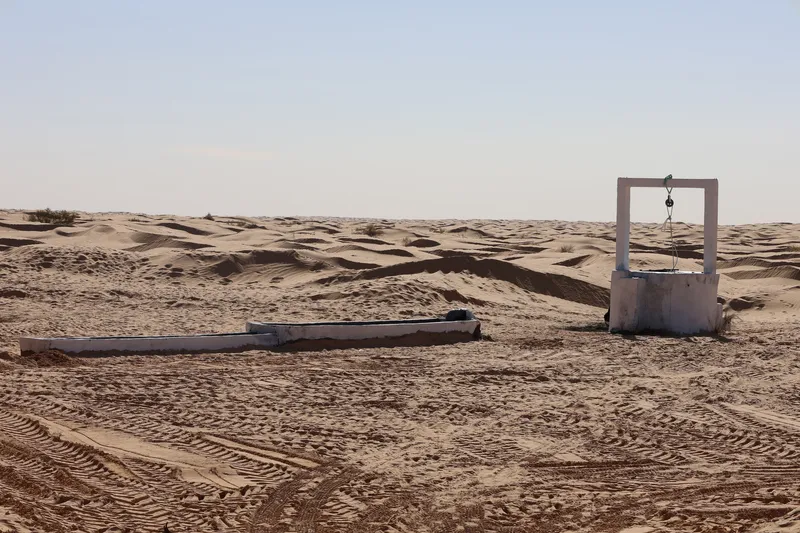

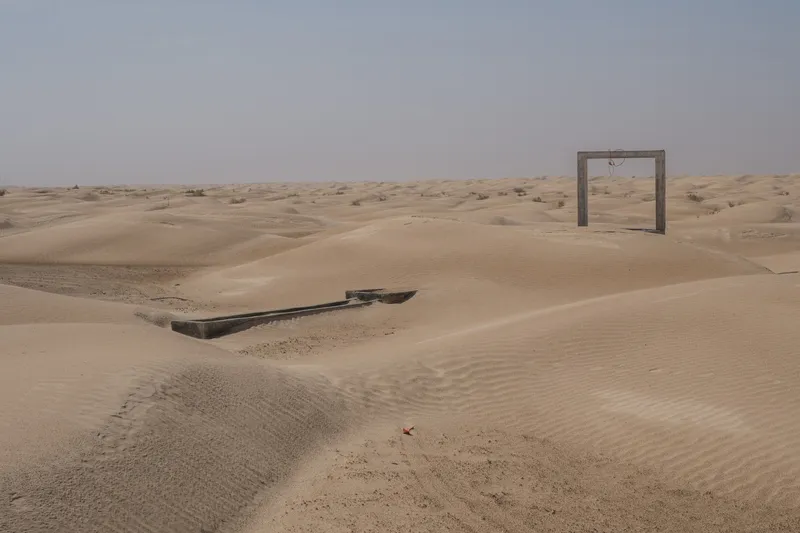
At ground level, the program is blunt: a well shaft, a pulley, a trough. Water is drawn by hand, poured into the trough, and animals drink. The concrete portal frame that crowns the wellhead supports the pulley mechanism and provides a simple structural datum. Blue barrels stored nearby suggest the practical reality of water management in a place where every liter counts. Tire tracks radiating outward from the trough record the patterns of approach, vehicles and animals arriving from multiple directions across the sand.
There is no sentimentality in the design. The trough is concrete, utilitarian, sized for livestock. The portal frame is minimal, painted white to match the well tower. These are not objects designed for publication; they are objects designed to withstand wind, sand, sun, and the hooves of camels.
Palm Frond Hedges as Wind Architecture


The most architecturally interesting move might be the simplest: hedges of dried date palm fronds arranged on earthen berms to deflect sand-laden winds. These are not decorative screens. They are the primary defense against the process that originally destroyed the well. Sand accumulation driven by persistent wind was what silted up the shaft and buried the trough. Without windbreaks, any restoration would be temporary.
The frond hedges work by disrupting laminar airflow at ground level, causing sand to deposit on the windward side of the barrier rather than carrying through to the well. The technique is ancient and requires no imported material: date palms grow in the oases that punctuate this region, and dried fronds are a readily available byproduct. A long white-plastered wall running behind one hedge suggests a layered defense, combining masonry mass with the porous filtration of the fronds. The construction photographs show a tractor alongside the palm frond walls, confirming that the work was executed with a combination of mechanized excavation and hand labor.
Shelter and the Palm Wood Frame
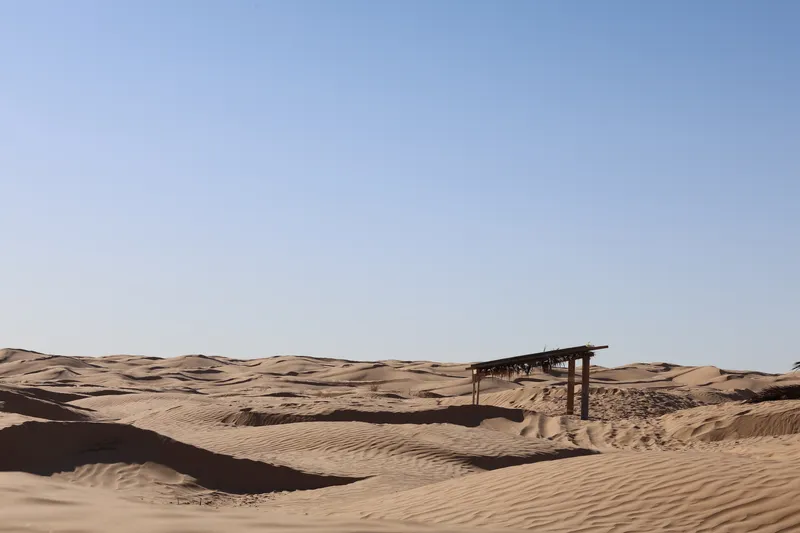

Adjacent to the well, a shelter built from palm wood posts and beams with a thatched roof provides refuge for shepherds. Perched on a dune, open on its sides, it reads as a minimal inhabitable frame, a place to rest during the hottest hours or to wait while animals drink. The material is consistent with the region's construction vocabulary: palm wood trunks as columns and beams, palm fronds or dried grass as roofing.
The shelter's elevation on the dune is strategic. It catches whatever breeze moves across the sand and offers a vantage point over the surrounding terrain. For a shepherd watching a dispersed herd, this matters. The white-painted concrete portal visible in construction photographs frames the well opening below, creating a simple spatial sequence: approach, water, rest.
Domed Earth and Collective Labor
One image reveals a domed earth roof with exposed brick ribs emerging from the sand, workers handling bundles of dried grass on its surface. This is possibly an existing vernacular structure adjacent to the well, or part of the restoration itself. Either way, it demonstrates the construction culture that produced these desert water points: load-bearing masonry domes built without formwork, using brick ribs to guide the curvature, then buried under sand for thermal mass. The technique is structurally efficient and climatically intelligent, maintaining cool interior temperatures through insulation.
The presence of workers in several photographs underscores that this was a community-driven process. Le laboratoire d'architecture, A4 Architecture, and Bled El Abar Collective framed the project as a collaboration with local communities, using existing resources and local knowledge. The architects' role here is less author than coordinator, facilitating the revival of techniques that the community already possesses but that had lapsed as the well fell into disuse.
Plans and Drawings


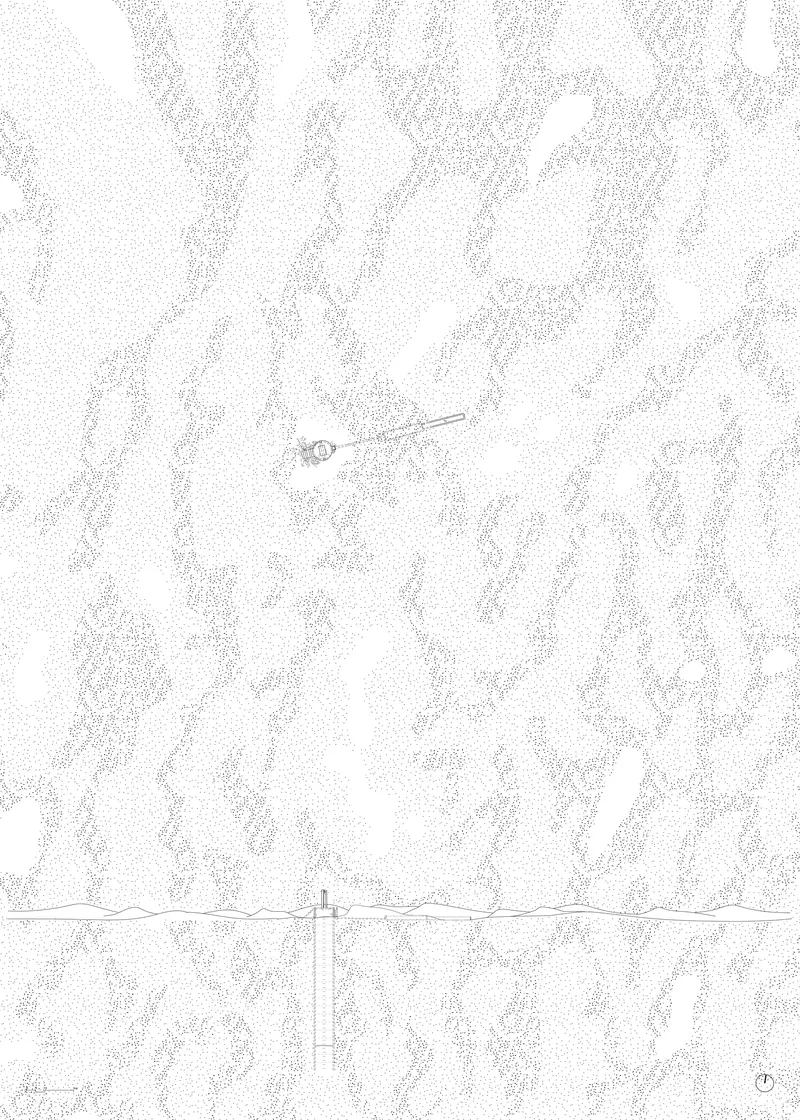
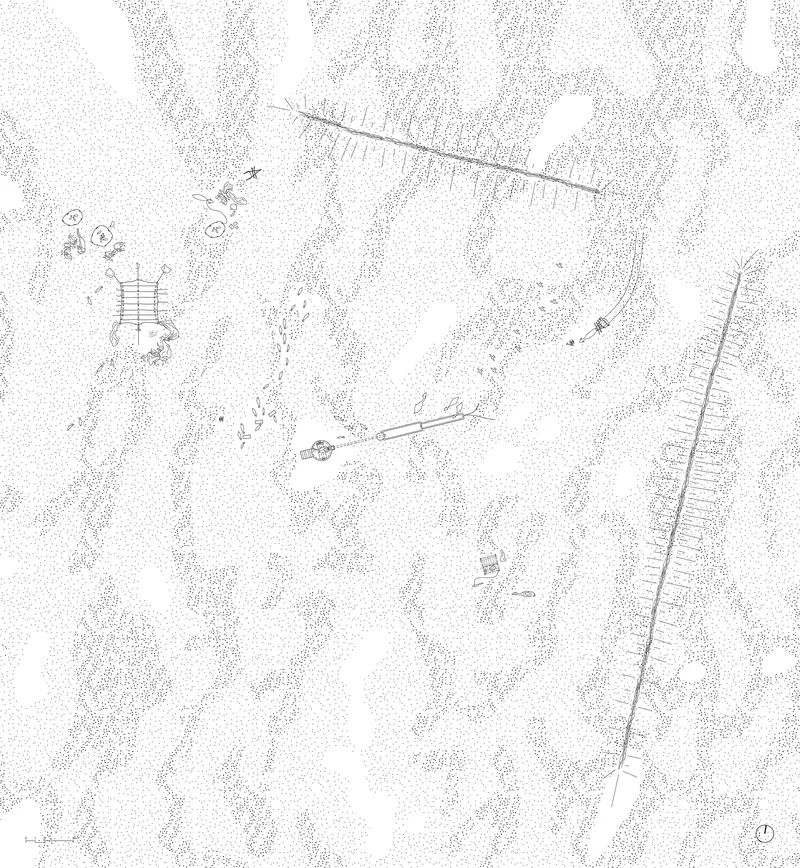


The territorial maps reveal the project's broader ambition. A regional drawing shows scattered well locations marked across the desert, positioning this single restoration within a network of similar infrastructure. A closer map isolates the specific well within its geographic context. The site plan depicts the well, its linear windbreak, and a water channel threading through contoured terrain, making visible the relationship between topography and sand movement that dictated the placement of every element.
The section drawing is the most revealing: it shows the well tower extending deep below grade, the shaft penetrating through sand and substrate to reach the water table far beneath the surface. The horizon line stretches almost flat, emphasizing the vastness of the landscape against the slender vertical of the well. Annotated sketches detail the cylindrical tower, plan layout, and ventilation strategies, confirming that despite the project's modest scale, the design process was rigorous and technically considered.
Why This Project Matters
Land Of Wells is a corrective to the assumption that architecture must be additive. Nothing here was invented. The masonry techniques are centuries old. The palm frond windbreaks are indigenous technology. The pulley system is as basic as water extraction gets. What the three collaborating teams contributed was attention: the cartographic understanding to locate the well within its territorial network, the organizational capacity to coordinate community labor, and the design intelligence to sequence the interventions so that the well would not simply silt up again. In a discipline increasingly obsessed with novelty, this project argues that maintenance is a design act.
It also raises uncomfortable questions about what counts as architecture. Ten square meters, 30 kilometers from the nearest village, built for camels and goats as much as for humans. There is no client brief in the conventional sense, no program beyond survival. Yet the spatial thinking on display, the sectional relationship between shaft depth and tower height, the calibrated placement of windbreaks relative to prevailing wind direction, the territorial mapping that contextualizes one well within a network of dozens, is as sophisticated as anything produced for an urban commission. The desert does not care about your portfolio. It cares whether the well holds water.
Land Of Wells, by Le laboratoire d'architecture, A4 Architecture, and Bled El Abar Collective. Kébili Governorate, Tunisia. 10 m². Completed 2025.
About the Studio
Bled El Abar Collective on Instagram
Follow Bled El Abar Collective's work on Instagram.
instagram.comShare Your Own Work on uni.xyz
If projects like this are the kind of work you want to make, uni.xyz is a place to publish your own, find collaborators, and enter design competitions.



Popular Articles
Popular articles from the community

Pangolin Can Help Mining: Biomimicry Architecture for an Asteroid Mining Habitat
Pangolin Can Help Mining explores biomimicry architecture through a modular 3D-printed habitat designed for asteroid mining and future life.
REBIRTH: Sustainable Architecture Shaped by Community, Resilience and Renewal
REBIRTH uses sustainable architecture, circular design, local materials and shared spaces to restore community, dignity and hope for widows.
EW PARK: Sustainable Architecture Reimagines the Future of Urban Parking
EW PARK reimagines city parking as a modular wooden tower combining automation, solar energy, electric mobility, and adaptable urban design.

The Earth Pod: 3D Printed Homes for Resilient Refugee Communities
The Earth Pod reimagines refugee housing through 3D printed homes made from clay, combining resilience, self-sufficiency, and rapid shelter.

Similar Reads
You might also enjoy these articles

Bao Huynh Watercolor Atelier: A Serene Art Retreat in Hội An
Bao Huynh Watercolor Atelier in Hội An blends multifunctional art spaces, sustainable design, local materials, and family-friendly living in a serene environment.

Atelier Macri Concept Store Interior Design by CASE-REAL
Atelier Macri store features a "ko" counter, walnut wood details, cork displays, blending retail, gallery, and seamless customer experiences.

Manuel Vargas Izquierdo Stadium and High-Performance Sports Center: Architectural Excellence in Jalpa de Méndez
The Manuel Vargas Izquierdo Stadium blends sustainable design, inclusive sports facilities, and cultural-inspired architecture, revitalizing Jalpa de Méndez’s public spaces.

KAKR Buluh Awar Hall: Revitalizing Community and Ecology Through Bamboo Architecture
Community built bamboo hall revitalizes Buluh Awar village, empowering youth, restoring ecology, celebrating vernacular craftsmanship through sustainable architecture and culture.

Explore Architecture Competitions
Discover active competitions in this discipline



The International Standard for Design Portfolios

The Global Benchmark for Architecture Dissertation Awards

The Global Benchmark for Graduation Excellence


Challenge to reimagine the Iron Throne
Comments (0)
Please login or sign up to add comments
No comments yet. Be the first to comment!