
Minji Bakery: A Terracotta Cafe in Vietnam
TT Design built a neighbourhood bakery in Duc Linh, Vietnam, using terracotta, brick, and green concrete around a courtyard with a tree at the centre.

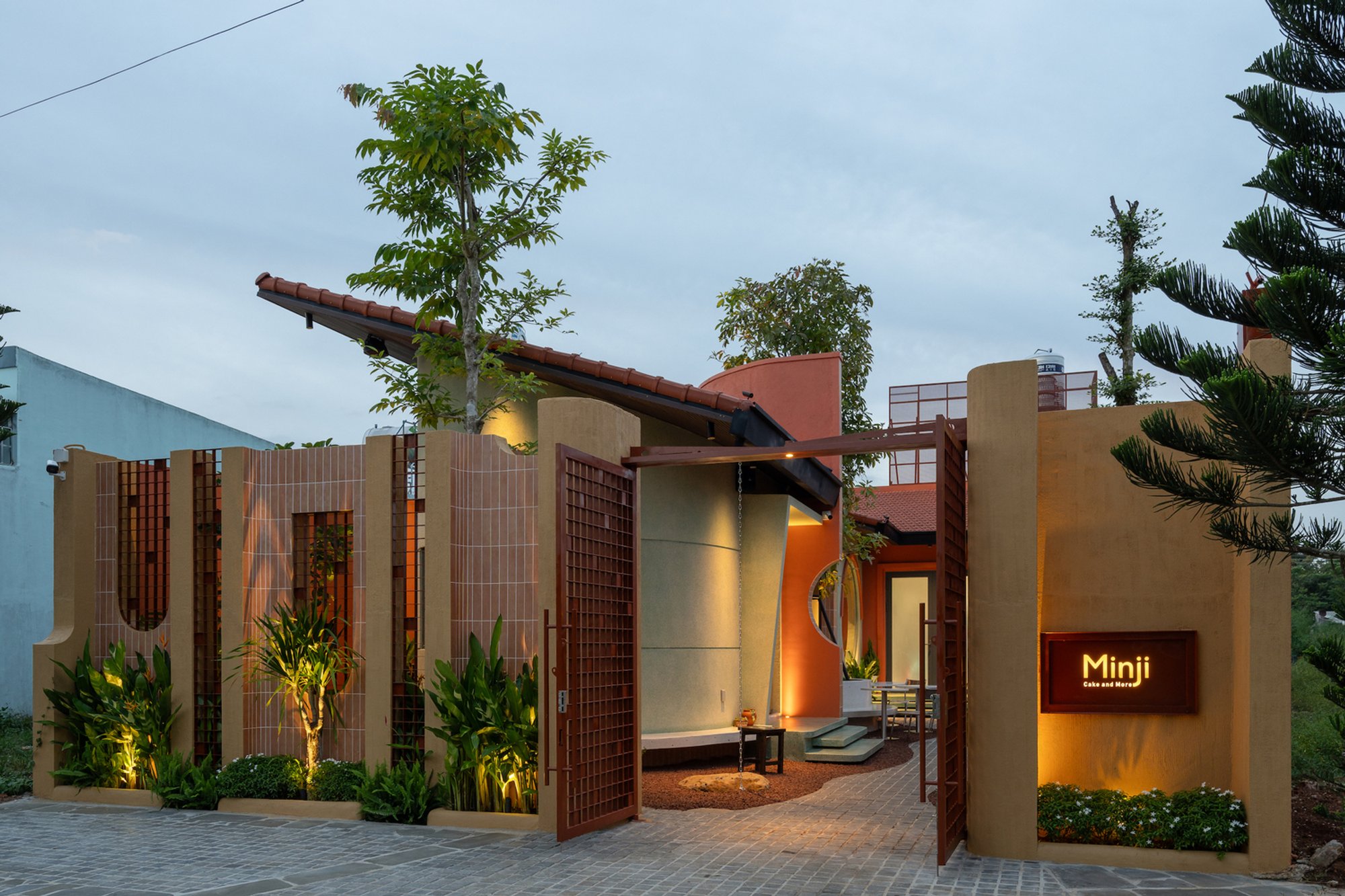
In Duc Linh, a small town in southern Vietnam near the rubber forests, a bakery sits at the edge of a field. Tiem Banh Minji Bakery, designed by TT Design, is a neighbourhood bakery and cafe built from terracotta, brick, green concrete, and clay tiles. The building looks like it grew from the basalt red soil of the site. That is not an accident. The architects chose every material to match the colour and texture of the ground it stands on.
The brief combined two programmes: a family home and a bakery with cafe seating. TT Design separated the two with a courtyard and connected them with a continuous tiled roof. The result is a building where you bake on one side, sit on the other, and look at a tree in the middle.
The Street: Brick Screen and Tiled Roof
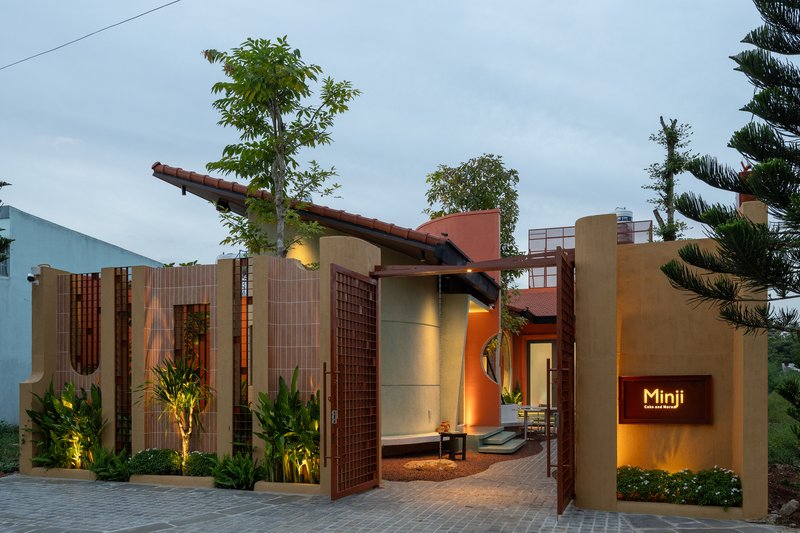
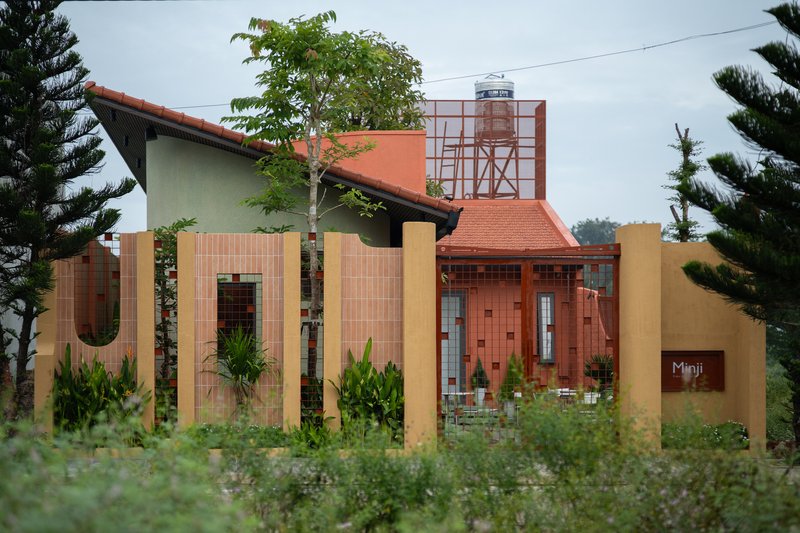
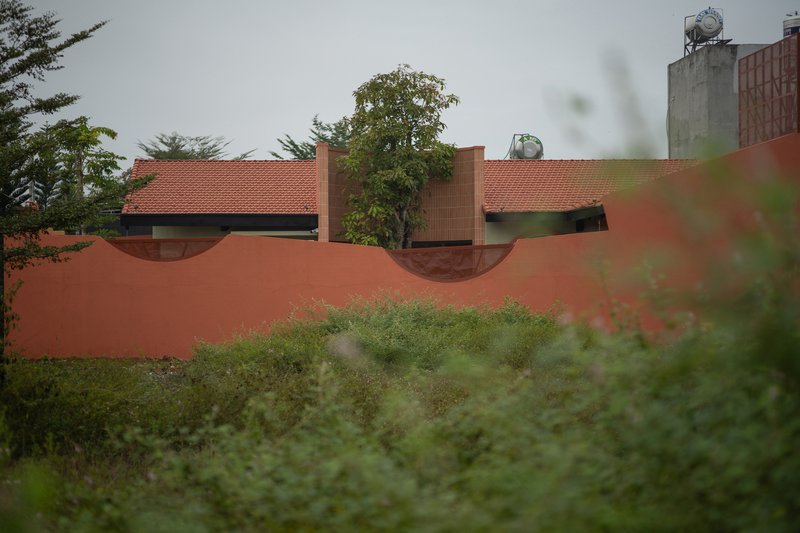
From the street, the bakery presents a row of brick screen fence columns with the Minji sign, trees lit from below, and the warm glow of the interior behind. The boundary wall undulates: its top edge rises and falls in a continuous curve that echoes the roofline behind it. The tiled roof is visible above, broad and low. From the rubber field on the opposite side, the entire composition reads as a terracotta form with a scalloped silhouette sitting low in the landscape.
The Courtyard: Tree, Bench, and Brick
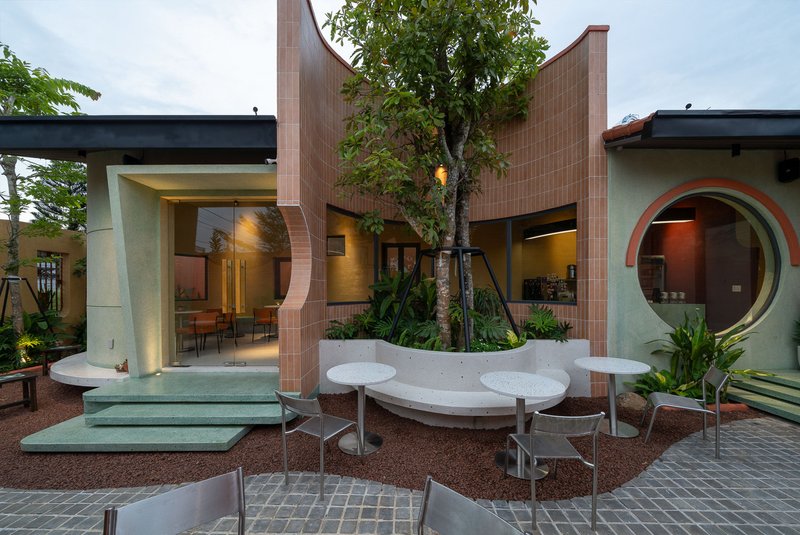
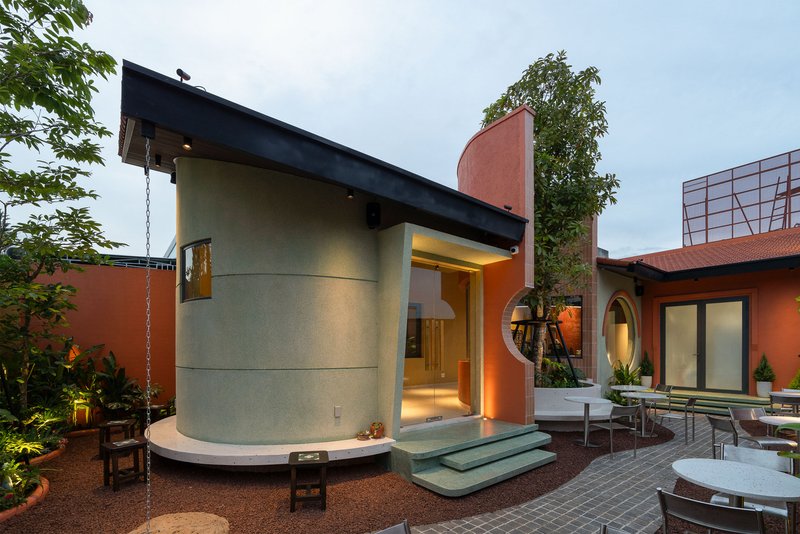
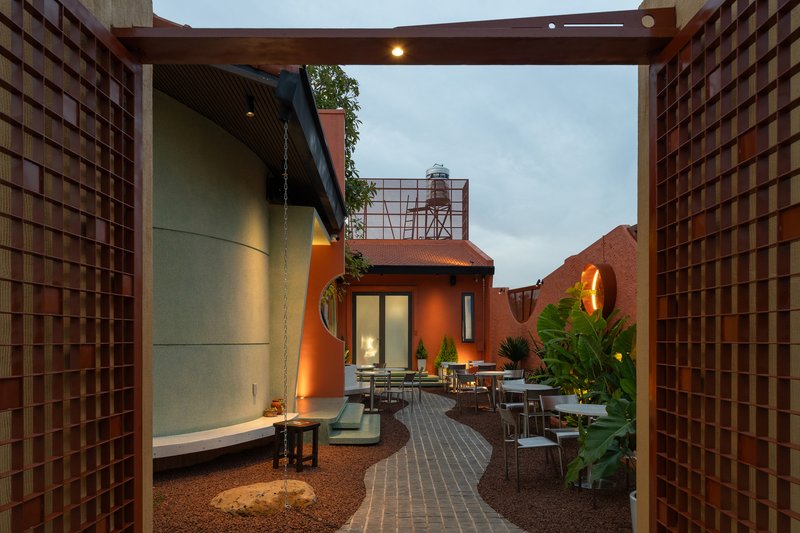
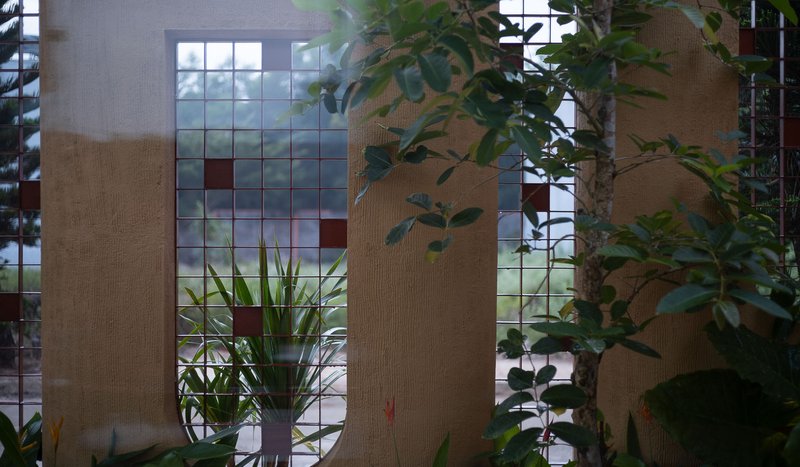
The courtyard is the hinge between the cafe and the home. A tree grows at the centre. A white curved bench wraps around it. Brick columns with scalloped arch cutouts define the edges. A circular window in a green plastered wall frames a view through to the interior. The ground is herringbone brick, and a curved path leads from the entrance gate through the courtyard to the cafe door.
At dusk, the courtyard becomes the best seat. The terracotta walls catch the last light. The tree is silhouetted. The interior glows through the glass. The green concrete cylinder of the baking room anchors one corner, and the timber deck with cushioned seating fills the other. The courtyard does what courtyards in Vietnamese architecture have always done: it brings air, light, and social life into the centre of a compact plan.
The Cafe Interior
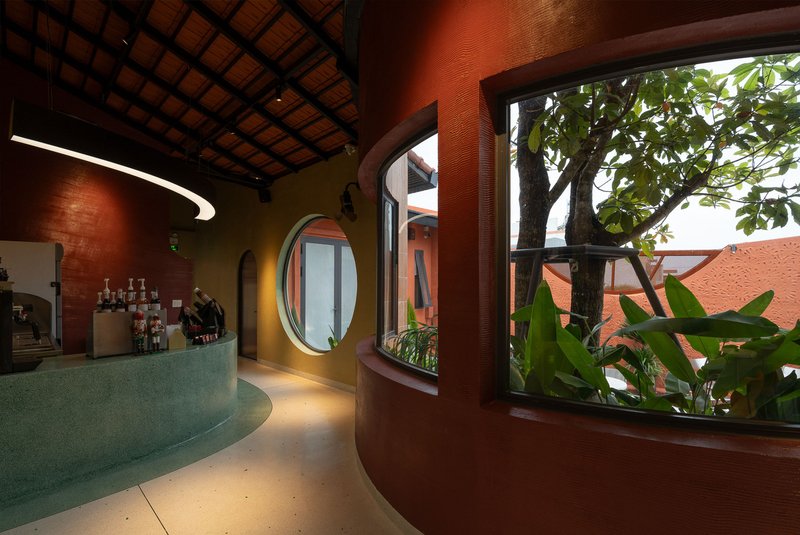
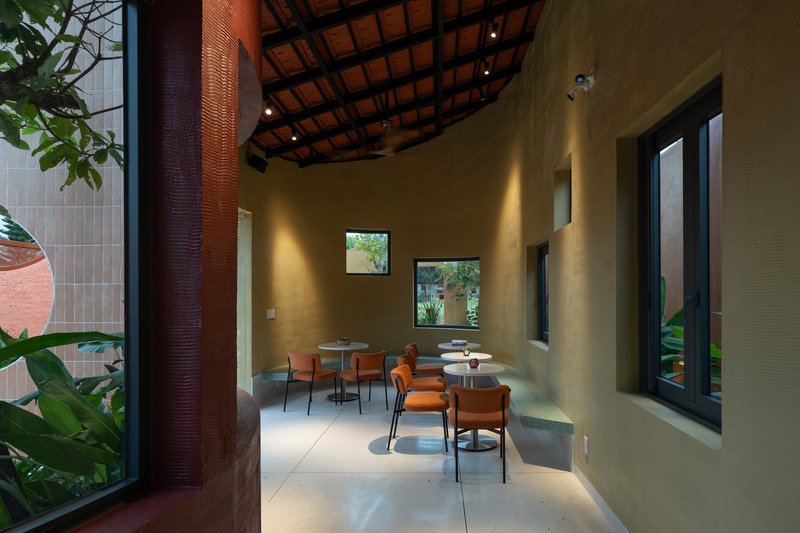
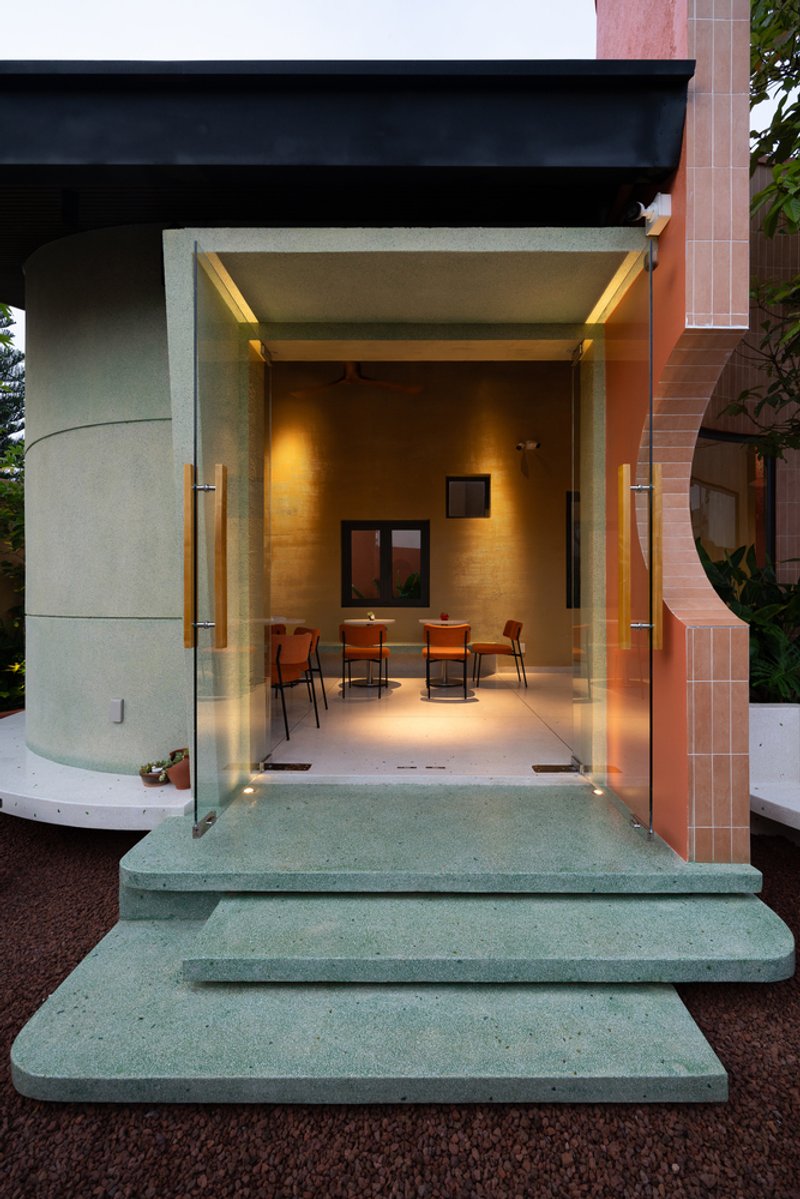
Inside, the cafe has a curved green terrazzo counter with a round window that frames the courtyard tree. The walls are terracotta and ochre plaster. The ceiling is tiled with a traditional Vietnamese roof structure visible above. Small round tables and leather chairs fill the seating area. Timber-framed windows open to the garden. The material palette is warm, earthy, and continuous: the same terracotta outside appears inside, the same green concrete of the exterior cylinder reappears in the counter and the entry steps.
Night: The Bakery as Lantern
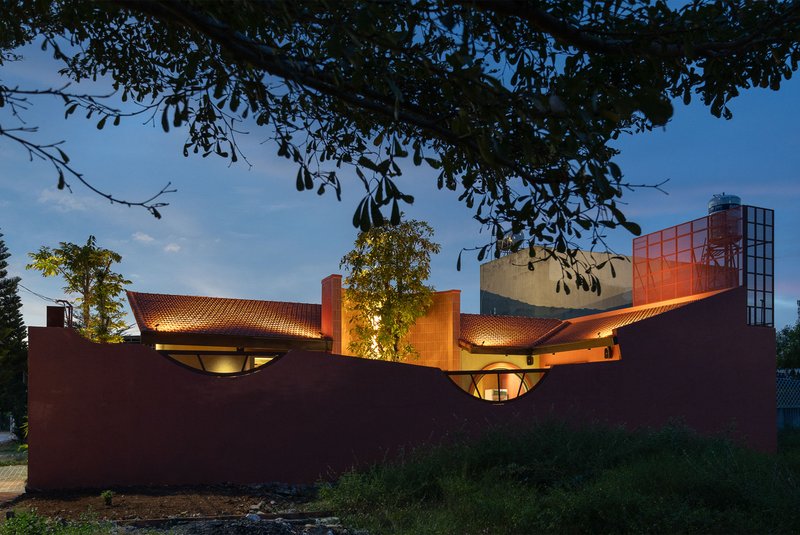
The strongest image is taken at night from the rubber field. The entire bakery glows. The undulating roofline with its tiled overhangs is lit from below. The terracotta walls are warm orange. The green volumes are cool. The trees are dark silhouettes. The building becomes a lantern at the edge of the field. This is the quality that makes a neighbourhood bakery into architecture: it is not just a place to buy bread, it is a presence in the landscape.
Drawings and Diagrams
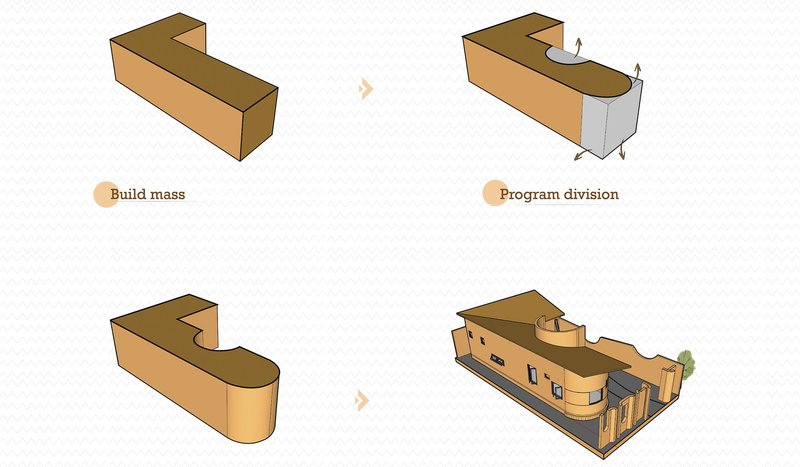
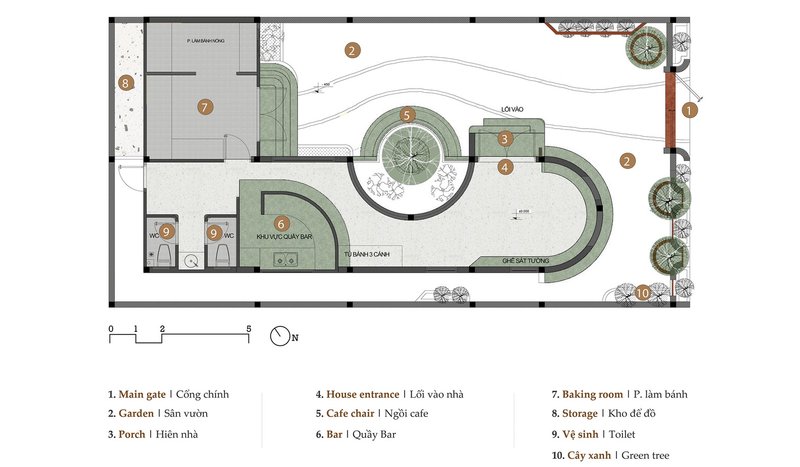
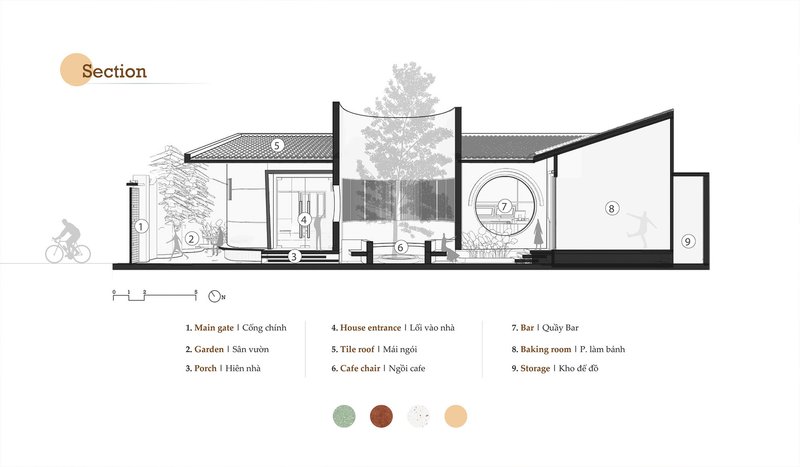
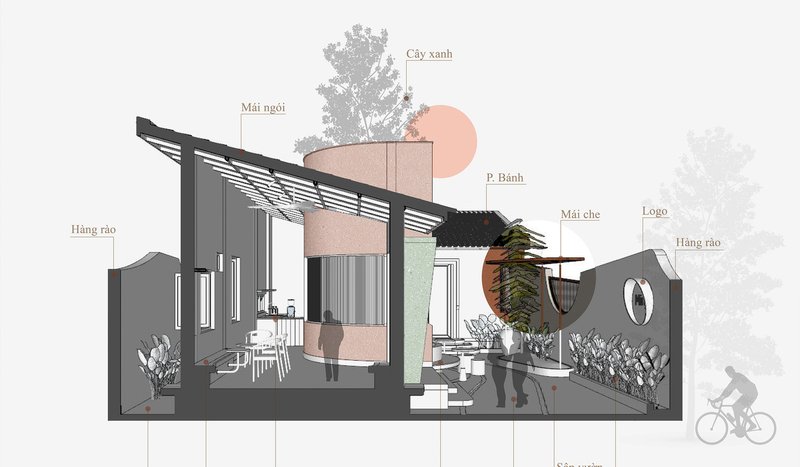
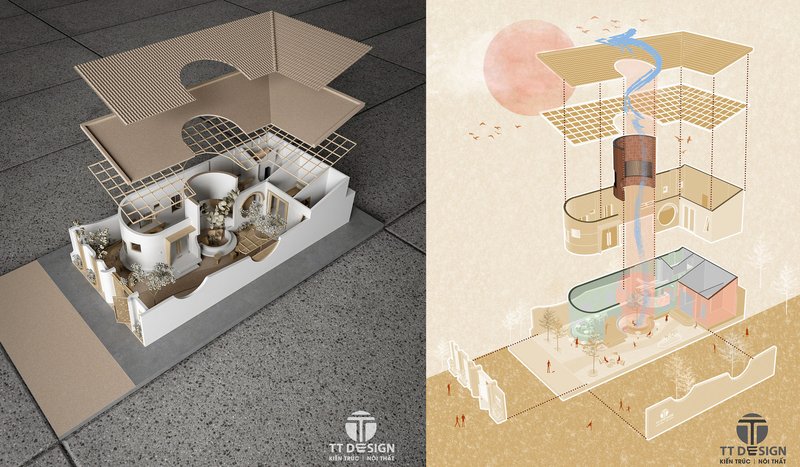
The massing diagram shows how the design evolved: a rectangular volume is divided into two programmes (home and bakery), the form is curved to soften the edges and create the courtyard, and the final design adds the cylindrical baking room and the scalloped boundary wall. The floor plan shows the full layout: main gate, garden, porch, house entrance, cafe seating, bar counter, baking room, storage, and toilet. The section reveals the tiled roof structure spanning both zones. The perspective collage shows the spatial experience from inside. The physical model and exploded axonometric illustrate how the cylindrical volume acts as a natural ventilation chimney, drawing hot air up and out.
Why This Project Matters
Vietnamese cafe and bakery design is one of the most active categories in Southeast Asian architecture. The best examples use local materials, respond to climate, and create atmosphere on a small budget. Tiem Banh Minji Bakery does all three. The terracotta matches the soil. The tiled roof sheds monsoon rain. The courtyard ventilates the interior. The curved forms soften what could be a hard-edged commercial building into something that belongs to its neighbourhood.
If you are designing a small commercial building, a bakery, a cafe, or any project where material and atmosphere matter more than scale, this project is worth studying for how curves, courtyards, and local materials create a building that is both functional and beautiful.
About the Studio
Share Your Own Work on uni.xyz
If you are working on cafe design, bakery interiors, or small commercial architecture, uni.xyz is a place to publish your work and connect with a global design community.
Project credits: Tiem Banh Minji Bakery by TT Design. Duc Linh, Vietnam. Photographs: Quang Tran.




Popular Articles
Popular articles from the community

20 Most Popular Commercial Architecture Projects of 2025
From sustainable market concepts to heritage factories, the commercial buildings and proposals that drew the most attention on uni.xyz this year.

Magic Box Office Barcelona Innovative Sustainable Workplace Design
Innovative sustainable office design featuring triangular form, ceramic façade, flexible interiors, natural light optimization, and creative workspace for modern work culture.
Marvila Apartment Renovation in Lisbon: A Bright Minimalist Attic Transformation by KEMA Studio
Bright attic transformed into minimalist Lisbon apartment with skylights, sustainable materials, open plan layout, and industrial-inspired interior design elements.
Free Architecture Competitions You Can Enter Right Now
No entry fees, real prizes. Here are the best free architecture competitions open for submissions in 2026.

Similar Reads
You might also enjoy these articles

Filtering Space: A Gradual Spatial Experience
From urban intensity to spatial calm.


The Ken Roberts Memorial Delineation Competition (Krob)
As the most senior architectural drawing competition currently in operation anywhere in the world, it draws hundreds of entries each year, awarding the very best submissions in a series of medium-based categories.

Waterfront Redevelopment and Urban Revitalization in Mumbai: Forging a New Dawn for Darukhana
A transformative waterfront redevelopment project reimagining Darukhana’s shipbreaking heritage into an inclusive urban future.

OUT-OF-MAP: A Call for Postcards on Feminist Narratives of Public Space
Rhizoma Design and Research Lab invites artists, designers, architects, researchers, and students to reflect on how feminist perspectives can reshape public space. Selected works will be exhibited in Barcelona, October 2026. Submissions open until 15 April 2026.


Explore Architecture Competitions
Discover active competitions in this discipline




The International Standard for Design Portfolios


The Global Benchmark for Architecture Dissertation Awards


The Global Benchmark for Graduation Excellence


Challenge to reimagine the Iron Throne
Comments (0)
Please login or sign up to add comments
No comments yet. Be the first to comment!