
Tip-Top Urban Mates: Recycled Ocean Plastic Becomes Rooftop Social Infrastructure
A modular furniture system made from ocean waste reclaims a Portland parking rooftop as a public gathering space above the city grid.


Most rooftop parking structures sit empty after hours, flat expanses of concrete offering panoramic views to no one. Tip-Top Urban Mates takes that vacancy and fills it with a system of bright yellow modular seating units, each one manufactured from recycled ocean plastic, each one designed to hook, stack, and reconfigure across the roof of a downtown Portland parking garage. The project treats the rooftop not as leftover infrastructure but as the next layer of public space in a vertically compressed city.
Designed by Akos Huber, the project received an Honorable Mention in the Urbanscape 2018 competition. The chosen site is the SmartPark parking garage in downtown Portland, located just three blocks from the Willamette River with clear sightlines to Mount Hood. Huber's concept grew from a simple observation made from a nearby high-rise apartment: parking rooftops remain perpetually empty because weather exposure deters use, yet they command some of the best urban views in the city. The response is a furniture system robust enough to withstand rain, UV radiation, and heat, and compelling enough to draw people upward.
A Parking Deck Reimagined as Public Terrain
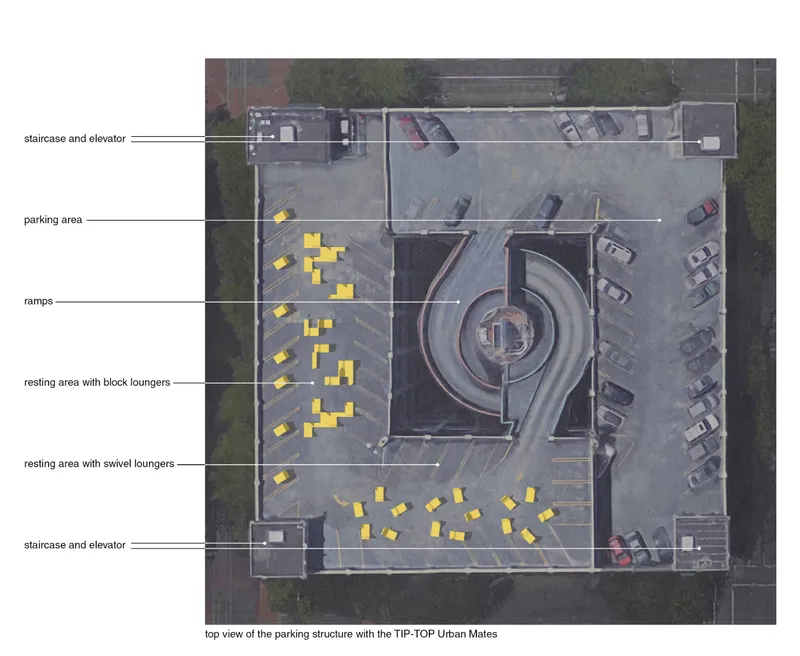
The aerial rendering reveals the full ambition of the intervention. Yellow block loungers populate the open concrete deck, clustered in loose social groupings while the garage's spiral ramp anchors the composition at one edge. The arrangement reads less like outdoor furniture placement and more like landscape strategy: the modules create pockets of activity across an otherwise featureless plane, giving the rooftop a legible spatial hierarchy without any permanent construction. People drift between clusters, and the panoramic urban context reinforces the project's argument that vertical layering in dense cityscapes can unlock genuinely useful public space within a city's existing footprint.
Three Components, Infinite Configurations
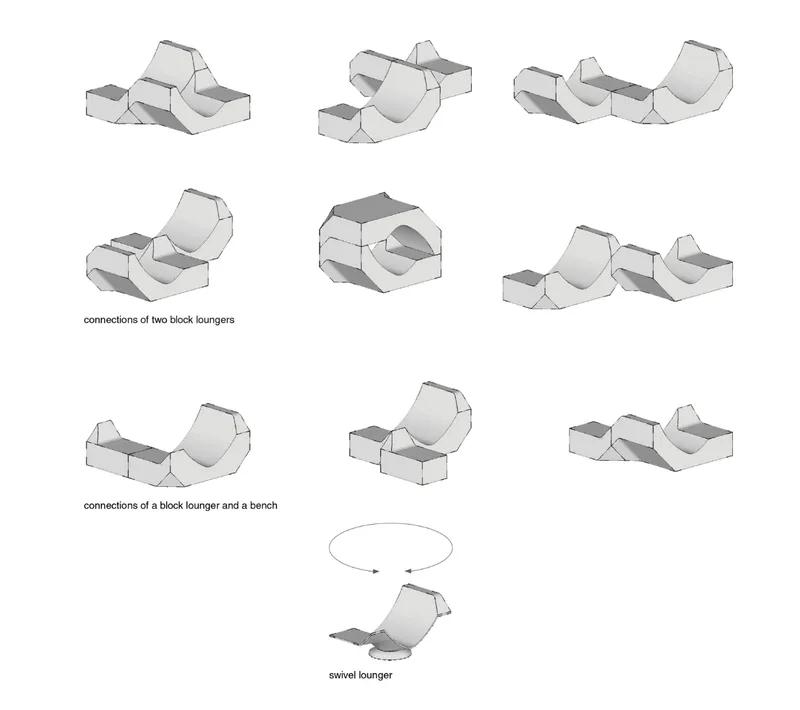
The axonometric drawing catalogues the system's three main components: the block lounger, the swivel lounger, and the bench. All three share compatible geometries, meaning they can be hooked together, separated, or stacked vertically. The drawing shows how a single set of parts generates radically different spatial outcomes: linear seating rows for events, circular pods for conversation, or individual loungers spread across the deck for solitary rest. Their wave-like profiles take cues from the geometry of Portland's street grid and parking patterns, integrating the furniture's formal language into the city fabric it sits above.
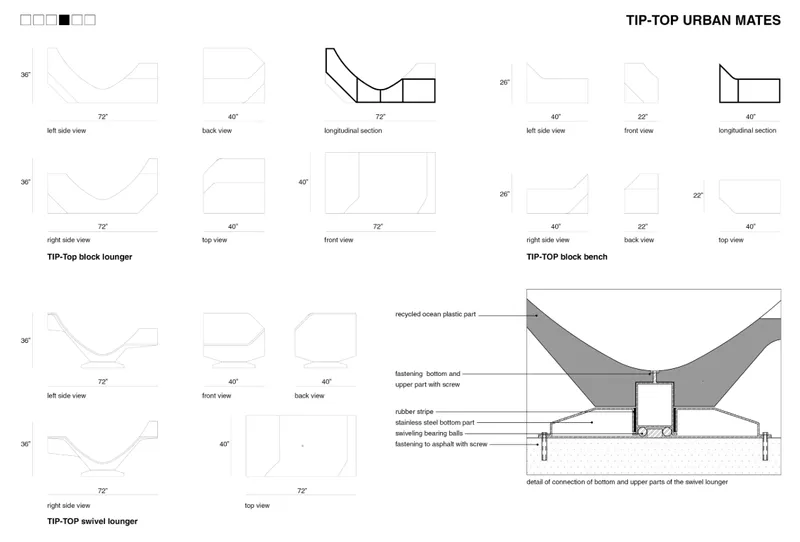
The technical sections and elevations expose the construction logic. Curved seating surfaces are held together by visible fastening systems, allowing quick assembly and disassembly without specialized tools. This matters for seasonal adaptation: during summer, modules spread across the rooftop for group lounging or programmed events; in winter, they stack vertically for compact storage or remain on-site as sculptural markers. The design supports multiple seating postures, from upright perching to fully reclined lounging, encouraging a flexibility that static urban benches rarely offer.
Yellow Seats Made from Ocean Waste
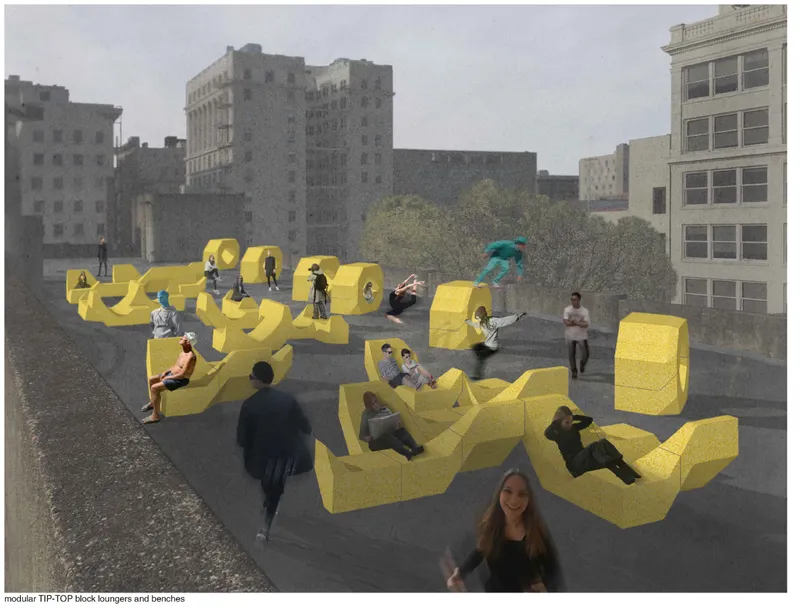
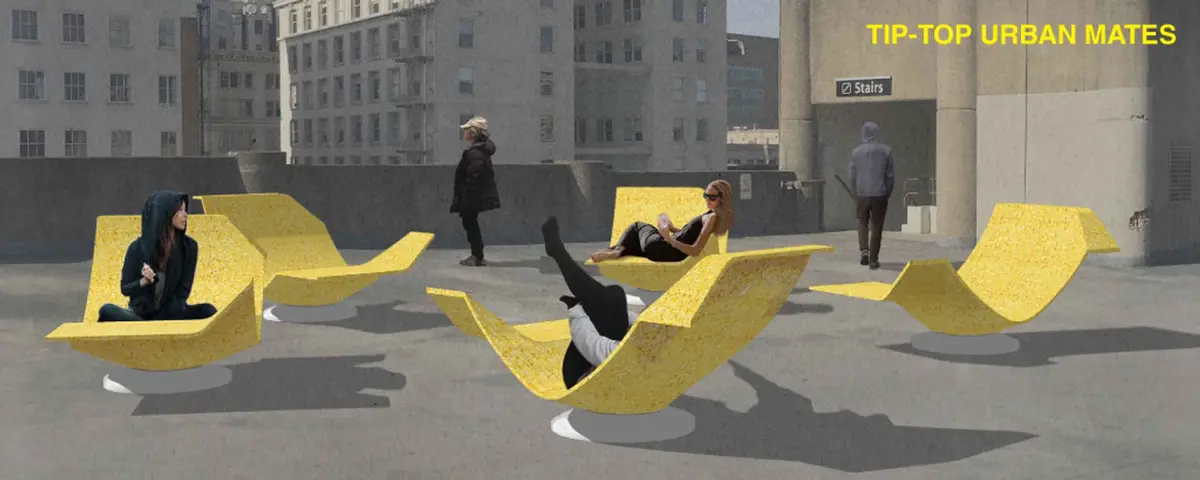
The rendering of the populated rooftop confirms the visual and social effect of the material choice. The furniture's saturated yellow pops against the grey concrete, acting as both wayfinding signal and mood calibrator. That color is intrinsic to the recycled ocean plastic from which every module is fabricated. Huber selected this material for its environmental symbolism and its practical resilience: UV resistance, weatherproofing, and structural durability make it well suited to the exposed conditions of an open rooftop. Because the components can be locally produced in Portland, the project also reduces the carbon footprint associated with long-distance material transport.
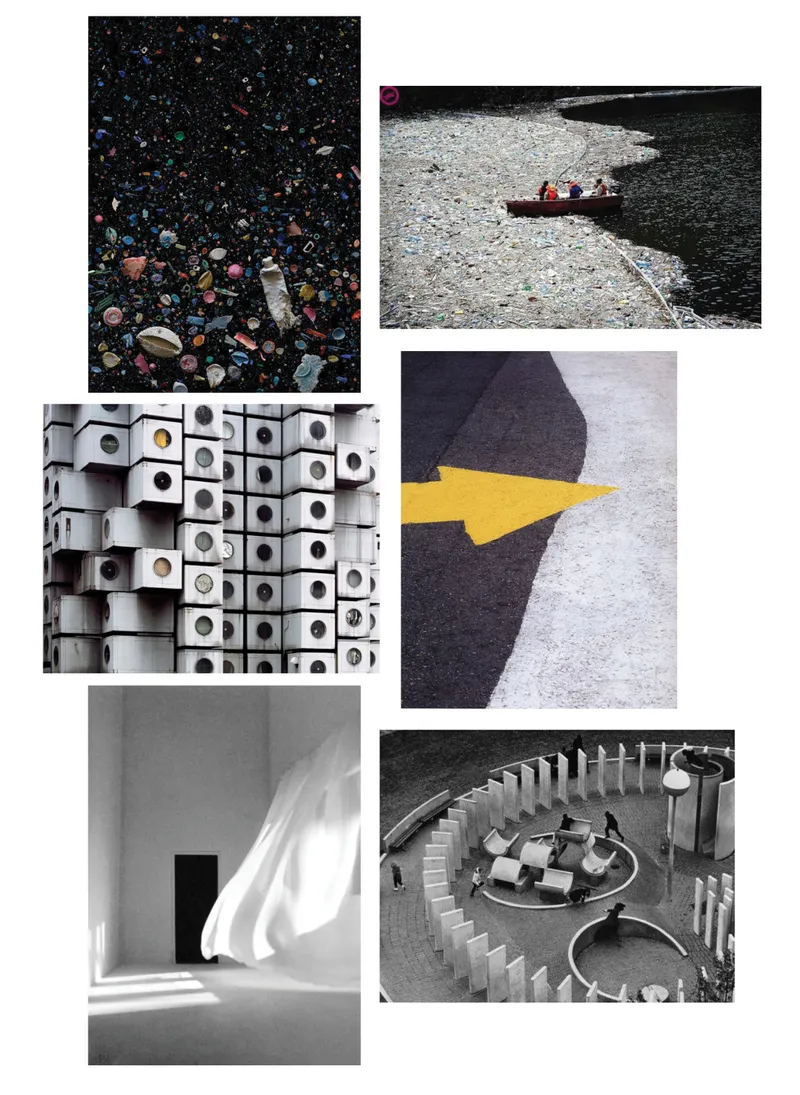
The collage board contextualizes the material research, pairing samples of processed ocean plastic with reference images of circular architectural forms. The visual argument is clear: waste streams can become spatial inputs. By routing discarded plastic from the ocean into the production of public furniture, the project turns an ecological problem into architectural material. It is a pointed demonstration that sustainable design need not sacrifice legibility or presence; here, the recycled origin of the material is precisely what makes the furniture vivid and identifiable.
Why This Project Matters
Tip-Top Urban Mates operates at an intersection that few design proposals occupy so convincingly: adaptive reuse of existing urban structures, modular furniture systems, and circular material economies. Rather than proposing a new building, Huber works within the constraints of what already exists, treating a SmartPark garage as found infrastructure and asking what program its roof can support. The answer, a flexible public gathering space accessible to anyone willing to take an elevator, suggests a scalable model for cities struggling to create new public amenity within fixed footprints.
The project's strength lies in how tightly its material story and its spatial ambition reinforce each other. Recycled ocean plastic is not a green garnish applied to a conventional design; it is the reason the furniture looks the way it does, performs the way it does, and communicates the values it does. That coherence, from waste stream to rooftop social scene, is what distinguishes the proposal from generic modular furniture exercises and positions it as a serious contribution to the conversation about how cities can grow upward, not outward, using resources they have already discarded.
View the Full Project
About the Designers
Designer: Akos Huber
Enter a Design Competition on uni.xyz
uni.xyz runs architecture and design competitions year-round that reward proposals with spatial conviction and real site intelligence.
Project credits: Tip-Top Urban Mates by Akos Huber Urbanscape 2018 (uni.xyz).


Popular Articles
Popular articles from the community


Juan García Correa, John González and Claudia Rueda Sink a Circular Amphitheater into a Manizales Engineering Building
On the La Nubia campus in Manizales, Colombia, the S1 Building folds labs and offices into a hillside of ramped lawns that double as a campus route.

Architekt Andreas Gruber Scatters 23 Dark Timber Chalets Across a South Tyrolean Forest Edge
In Molini di Tures, Amonti Chalets breaks a resort into a hamlet of gabled timber houses, with parking, storage and services pushed into the slope.

GROUP A Strips a 1969 Rotterdam Harbor Headquarters to Its Frame and Wraps It in Timber Louvers
In Rotterdam's M4H harbor district, Ferro Offices reuses a 1969 frame, adds one timber storey and reaches BREEAM-NL Outstanding.

Jaramillo Van Sluys Arquitectura and Urbanismo Turn a Demolished Registry Lot in Quito into an Orchard Plaza
In Quito's Centro Histórico, a 2,800 m² plaza exposes the San Agustín convent wall and redraws its lost Augustinian orchard in volcanic stone.

Similar Reads
You might also enjoy these articles

Gil Mello Arquitetura Tilts a Single Roof Toward the Waterfalls on a Plateau Above Aiuruoca, Brazil
In Aiuruoca, Minas Gerais, a 200 m² house of local labor and reclaimed poles pairs a low valley veranda with a tall mountain one.

U.GA Architects Wraps an Oval Rooftop Pool in Curved Board-Formed Concrete on Busan's Jeollidan-gil
In Busan's Jeonpo-dong, a 454 m² mixed-use block stacks a neighborhood facility, guest rooms and an oval rooftop pool inside spiraling concrete walls.

Felipe Hess Arquitetos Turns a Blind Stone Wall to the Street and Opens a Brazilian House onto a Courtyard and Canal
A canal-front house in Brazil hides behind painted stone and planting, then opens to an olive-tree courtyard, a reed-ceilinged porch and a curving pool.

David Macias Steps a Doorless Stone and Plaster House Down a Tropical Colombian Hillside
In the humid hills of Colombia, Threshold House replaces the front door with an open void and terraces its 850 m² down the slope instead of fighting it.

Explore Rooftop Competitions
Discover active competitions in this discipline

Design challenge to equip cities with modern furniture

Competition to design a workstation for architects

Packaging challenge - Design meets sustainability
Comments (0)
Please login or sign up to add comments
No comments yet. Be the first to comment!