

Toro Arquitectos Carves a Gateway to Puerto Rico's Political Memory into a Hillside in San Juan
A precast concrete visitor center channels the ghost of a bamboo grove to honor the legacy of Puerto Rico's first elected governor.


Luis Muñoz Marín, Puerto Rico's first democratically elected governor, spent decades on an estate at the edge of San Juan's expanding metropolis, sheltered by a dense thicket of bamboo. The bamboo is gone now, stripped away as an invasive plague, but the cleared northern edge of the property gave Toro Arquitectos a rare canvas: a narrow strip of sloping ground between the governor's former residence and the adjacent Doña Inés Park. The Visitor Center for the Luis Muñoz Marín Foundation, completed in 2011, occupies this threshold with two angular volumes that together redefine the property's boundary and create a new public entrance to the memorial campus.
What makes this project worth studying is not its scale, at 15,700 square feet it is modest, but the precision with which José Javier Toro embeds institutional ambition into landscape and material. The patterned precast concrete facade references the bamboo that once secured the site. The aluminum pergola linking the two buildings revives that canopy overhead while framing an outdoor vestibule below. And the decision to tuck administration and archival storage into the lower level, exploiting the slope rather than fighting it, preserves the site's irregular topography and keeps the visitor's experience anchored to the tree line. The building is designed to age: its concrete surfaces are intended to accept the stain of tropical weather as a patina over time, not a defect.
Two Volumes, One Threshold


The visitor center splits its program into two buildings separated by dense tropical planting. The larger eastern volume houses the vestibule, exhibition hall, museum shop, and incorporates Muñoz Marín's original library and office into the gallery sequence. The smaller western building serves as a reception room. Between them, the aluminum pergola defines an outdoor vestibule, an interior plaza that functions as both a small public space and the turning point from which visitors orient themselves toward the rest of the foundation's cluster of buildings.
The vertical cladding on both volumes, weathered and textured, gives the architecture a material temperament that reads as simultaneously monumental and organic. Surrounded by palms and mature canopy, the buildings appear to have been placed rather than constructed, occupying clearings in the vegetation without dominating them.
The Pergola as Landscape Surrogate


The green-slatted aluminum pergola does double duty. Structurally, it connects the two buildings across the outdoor vestibule. Conceptually, it stands in for the bamboo canopy that once defined the estate's identity. Walking beneath it, visitors experience a rhythmic pattern of shadow on concrete pavement that mimics the dappled light of a dense grove. It is a clever substitution: the architecture performs the role of a vanished ecology without resorting to literal replanting.
The covered walkway also controls the pace of arrival. Rather than depositing visitors directly into the gallery, it introduces a decompression zone, a passage from the park's open air into the calibrated interior sequence of vestibule, ramp, projection room, and main exhibition. The transition is gradual and deliberate, a sequence Toro clearly designed with narrative intent.
Concrete and Light in the Exhibition Hall


Inside the main volume, the exhibition hall is defined by a coffered bamboo plywood ceiling that filters zenithal light across a polished concrete floor. The choice of bamboo plywood for the ceiling is not incidental: it is another material echo of the site's botanical past, translated from landscape into architecture. The ceiling grid creates a warm, even diffusion that softens what could otherwise be an austere concrete box.
Continuous glazing along one wall opens the gallery to the surrounding trees, collapsing the boundary between interior exhibit space and the estate's living landscape. A built-in concrete bench runs below the glass, encouraging visitors to sit and look outward, a deliberate inversion of the typical museum experience where all attention is directed inward. Figures passing through the space appear in soft focus against the timber beams and tall windows, reinforcing the building's quality of stillness.
Working the Slope

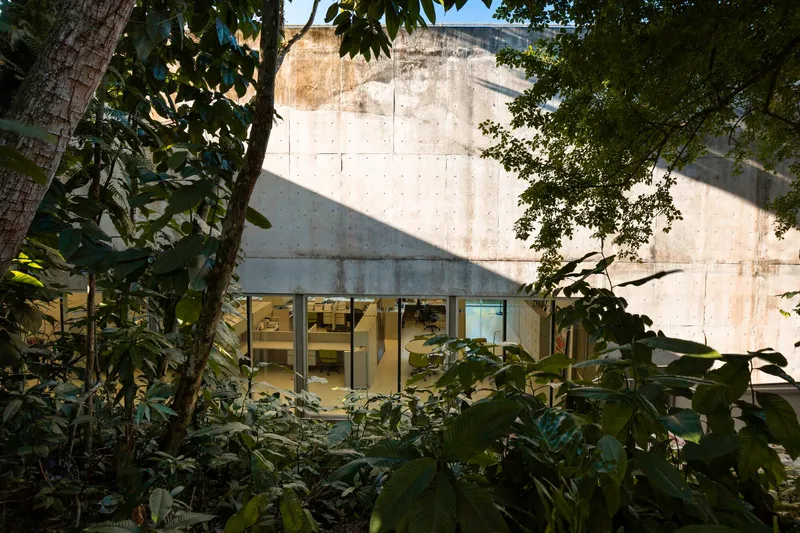
The site's irregular topography is the project's structural logic. By placing administrative offices and two archival storage areas on the lower level, Toro minimizes the building's visible mass from the entry approach. Visitors arrive at the upper level, which reads as a single-story pavilion set among trees. Only from the side, where a concrete stair descends beneath overhanging canopy, does the full two-story section reveal itself. The monumental glass panes at the lower level expose the building's water management strategies, turning infrastructure into a visible element of the design.
The concrete facade at the lower level, with its horizontal ribbon windows framed by dense foliage, has the character of a retaining wall that happens to contain habitable space. Dappled sunlight plays across surfaces designed to absorb it, to stain and weather over years until the building and the hillside become compositionally inseparable.
Plans and Drawings
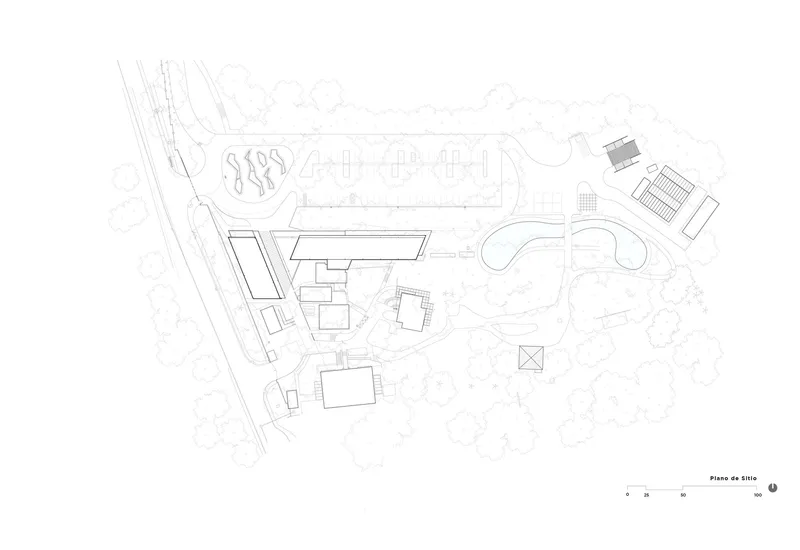

The site plans reveal the angular geometry of the two volumes and their deliberate orientation: rotated slightly off-axis from each other, they create the wedge-shaped outdoor vestibule at the center while directing views outward toward the park and the foundation campus. Pathways thread through planted courtyards, reinforcing the idea that this is not a single building but a landscape operation.


The cross sections are the most revealing drawings. They show the gallery as a long, top-lit volume that steps down the slope, with the exhibition level floating above the administrative base. The relationship between the two levels is compressed at one end and expansive at the other, following the terrain's natural descent. Figures in the drawings establish scale and reinforce the generous ceiling heights in the exhibition spaces.
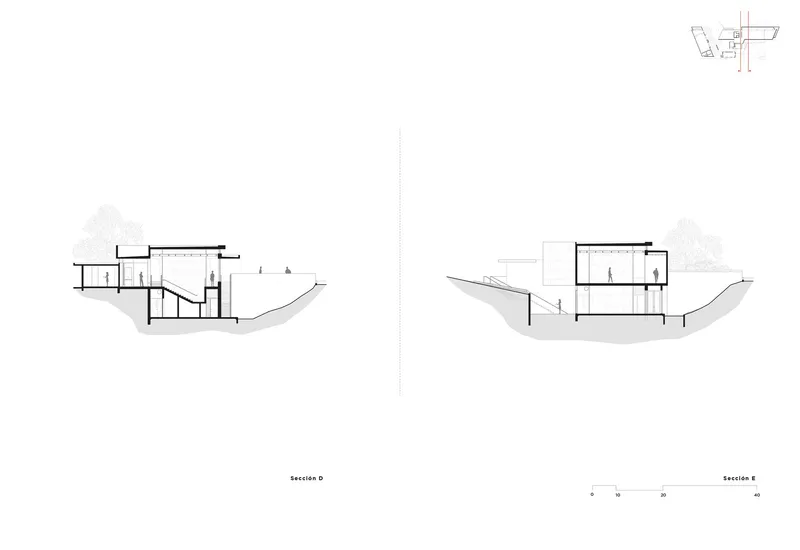

Stair sections illustrate how vertical circulation operates within the stepped volumes, connecting the public upper level to the working lower level. The north elevation drawing reads almost like a landscape profile: horizontal volumes with vertical cladding descending the topography, their massing broken by the pergola gap. There is a clear intent to read the building as topographic extension rather than freestanding object.


The longitudinal section is the project's most instructive drawing. It reveals a series of volumes embedded into undulating ground, with the building's floor plates stepping in response to the grade changes. Trees bookend each end of the composition, establishing the architecture as an interval within the landscape rather than an imposition upon it.
Why This Project Matters
Memorial architecture often falls into one of two traps: overwrought symbolism or sterile neutrality. The Muñoz Marín Visitor Center avoids both by grounding its commemorative purpose in material and topographic specificity. The bamboo reference is present in the facade pattern, the plywood ceiling, and the pergola, but it never becomes kitsch because it is always mediated through construction logic rather than applied decoration. The building memorializes a political figure by honoring the landscape he chose to inhabit, which feels like a more honest act of preservation than any bronze bust.
For a $5.5 million budget, Toro Arquitectos delivered a building that handles complex program requirements, archives, exhibition, administration, public gathering, with spatial clarity and material economy. The decision to design for aging, to welcome patina rather than resist it, gives the project a temporal dimension that many contemporary visitor centers lack. As the concrete darkens and the vegetation thickens, the distance between architecture and site will continue to narrow. That is the kind of long game worth paying attention to.
Visitor Center Luis Muñoz Marín Foundation by Toro Arquitectos (Lead Architect: José Javier Toro), San Juan, Puerto Rico. 15,700 sq ft. Completed 2011. Photography by Paola Quevedo.
About the Studio
Share Your Own Work on uni.xyz
If projects like this are the kind of work you want to make, uni.xyz is a place to publish your own, find collaborators, and enter design competitions.


Popular Articles
Popular articles from the community


Extended Shell: Retrofitting Kolkata's Balconies as Living Urban Thresholds
A modular retrofit system recovers the social and environmental intelligence of Kolkata's historic verandas for contemporary Park Street residents.
Faces of the Soviet Avant-Garde: Turning Moscow's Street Names into an Open-Air Museum
A network of sculptural installations across a Moscow residential district transforms forgotten architect names into spatial encounters with cultural memor

Opera by the Sea Estonia: Three Shells Dissolving Architecture into Tallinn's Coastline
A winning opera house proposal replaces monumental form with interconnected shells that blur the boundary between building, park and Baltic Sea.

Singing Woman: An Opera House That Performs Before the Curtain Rises
Ovidiu Cristian Pavel's conceptual opera house translates Estonia's choral identity into a sculpted waterfront landmark facing the Baltic Sea.

Similar Reads
You might also enjoy these articles

Pixel Gardens: One Repeated Module Stacked Into a Terraced Social Housing Tower for Famagusta
Salem Bader's shortlisted housing tower builds a vertical neighbourhood from one repeated module, offsetting units to carve terraces, light and air.

Bao Huynh Watercolor Atelier: A Serene Art Retreat in Hội An
Bao Huynh Watercolor Atelier in Hội An blends multifunctional art spaces, sustainable design, local materials, and family-friendly living in a serene environment.

Atelier Macri Concept Store Interior Design by CASE-REAL
Atelier Macri store features a "ko" counter, walnut wood details, cork displays, blending retail, gallery, and seamless customer experiences.

Manuel Vargas Izquierdo Stadium and High-Performance Sports Center: Architectural Excellence in Jalpa de Méndez
The Manuel Vargas Izquierdo Stadium blends sustainable design, inclusive sports facilities, and cultural-inspired architecture, revitalizing Jalpa de Méndez’s public spaces.

Explore Marine Center Competitions
Discover active competitions in this discipline

Challenge to reimagine the Iron Throne

Photograph architecture without architects

Illustrate the lost glory of Angkor Wat - Render Challenge

Design challenge to reuse E-waste
Comments (0)
Please login or sign up to add comments
No comments yet. Be the first to comment!