

Toxic TerRAIN: Survival Architecture Suspended Above a Poisoned Manhattan
A post-apocalyptic research habitat perched on the Queensboro Bridge reimagines water, waste, and adaptive reuse in the year 2139.


What happens when the rain itself becomes the enemy? In a speculative 2139 where acid precipitation has annihilated vegetation, groundwater is undrinkable, and toxic air suffocates cities, the Queensboro Bridge transforms from a relic of industrial connectivity into a spine for human survival. Toxic TerRAIN lifts an entire micro-city above the poisoned landscape of Manhattan, treating the bridge not as infrastructure to demolish but as a skeleton to inhabit. It is architecture that refuses to touch the ground, because the ground can no longer be trusted.
Designed by Joshua Rigsby and Jarrett Niestroy, this runner-up entry in the Architecture of the Apocalypse competition frames water as a double-edged element: once life-giving, now lethal through centuries of human negligence. The project imagines a resilient research campus conceived by the brilliant minds at Cornell Tech, spanning disciplines of technology, law, business, and design. Built from recycled and locally sourced materials including light concrete, composite alloys, and salvaged metals, the habitat functions as an active agent of ecological healing rather than a passive shelter.
An Elevated Ecosystem on a Repurposed Bridge
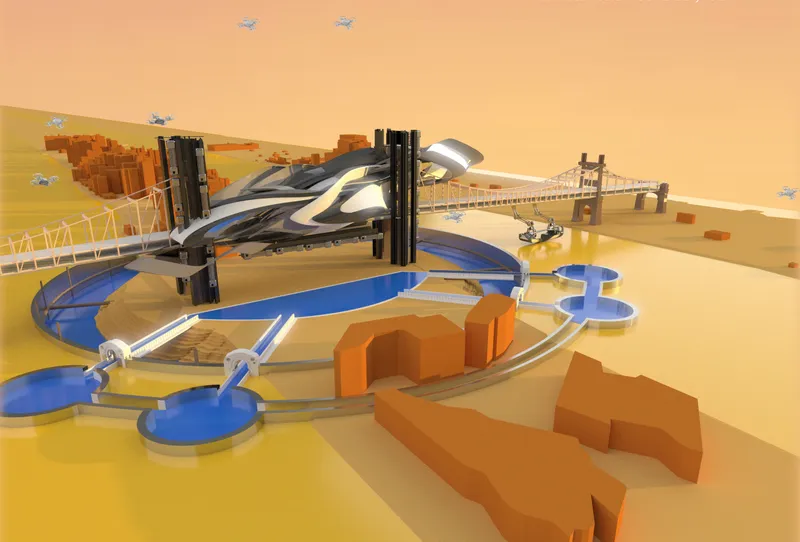
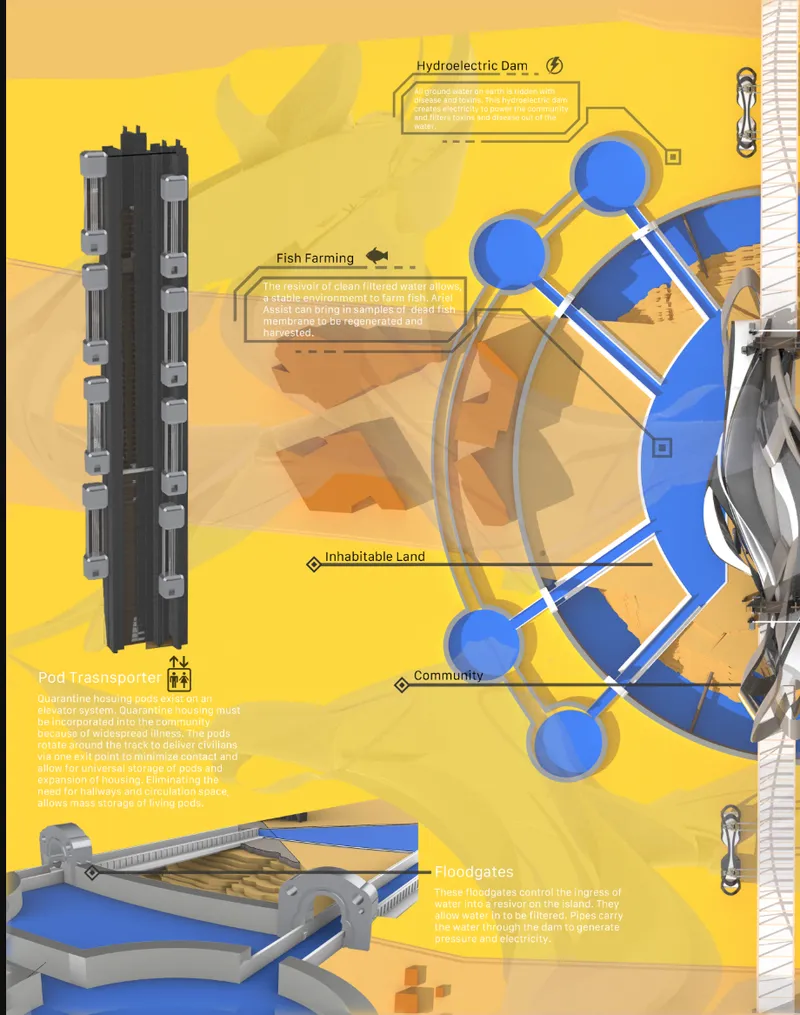
The axonometric rendering reveals the full scale of the intervention: curved bridges link circular reservoirs to vertical towers, all perched above what was once a waterway and is now a toxic channel. The structure disconnects completely from contaminated land and water, operating instead as a self-sustaining ecosystem. Below the sweeping formal composition lies a rigorously annotated infrastructure diagram that lays bare the working systems: a hydroelectric dam that filters pathogens from rainwater while generating electricity for the entire habitat, fish farming reservoirs that maintain a stable food supply through aquaculture, and a pod transporter system that circulates quarantine housing along a vertical track to reduce human contact and maximize storage.
The philosophy of adaptive reuse is central here. Rather than erasing the Queensboro Bridge, Rigsby and Niestroy repurpose every structural member to host life, energy generation, and ecological processing. Wind harness members and photovoltaic panels capture clean energy from natural elements to power internal systems, while vertical farming modules allow food production without any contact with poisoned soil. The bridge becomes not a monument to the past but a scaffold for the future.
Drones, Airlocks, and Oxygen Bulbs: The Anatomy of Survival
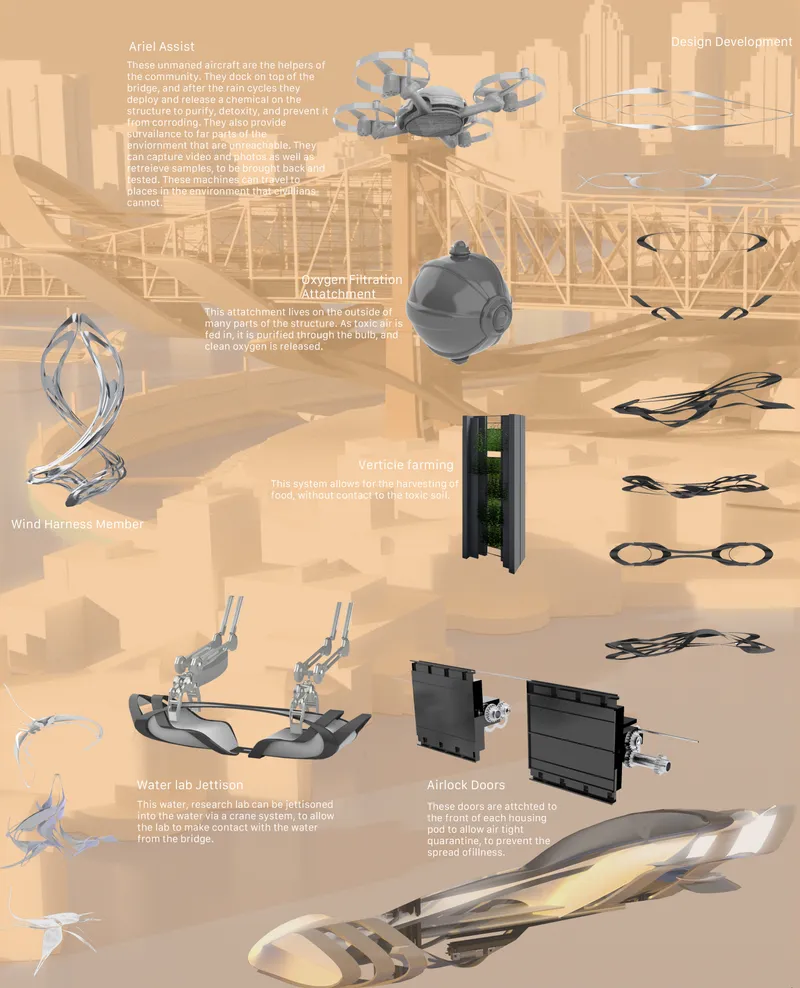
The exploded axonometric diagram is where the project's inventiveness becomes most legible. Each component system is isolated and labeled: aerial assist drones patrol and purify the structure's surface by releasing anti-corrosive chemicals and scanning otherwise unreachable zones. Spherical oxygen filtration attachments absorb toxic gases and transform them into breathable air. Airlock quarantine doors maintain sealed environments in individual housing pods to prevent the spread of illness. These are not decorative flourishes; they are the literal machinery of continued existence, each one responding to a specific threat posed by the degraded atmosphere and water supply.
What makes the diagram compelling is its honesty. The systems are exposed, layered, visibly recycled. The designers deliberately eschew the smooth minimalism typically associated with futuristic architecture, choosing instead to let the story of human resilience and improvisation read directly from the surface of the building. Every pipe, every seal, every drone trajectory is on display, reinforcing the project's thesis that survival architecture should wear its logic on the outside.
Interior Life in a Sealed World
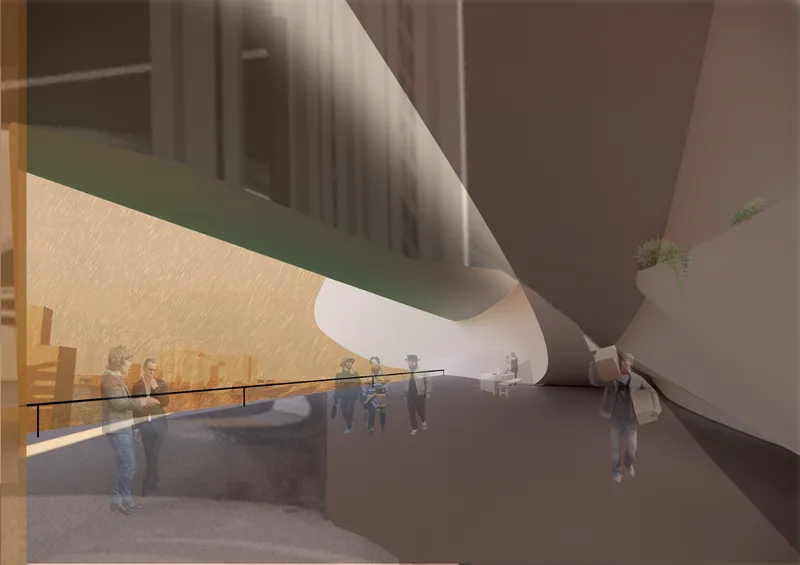
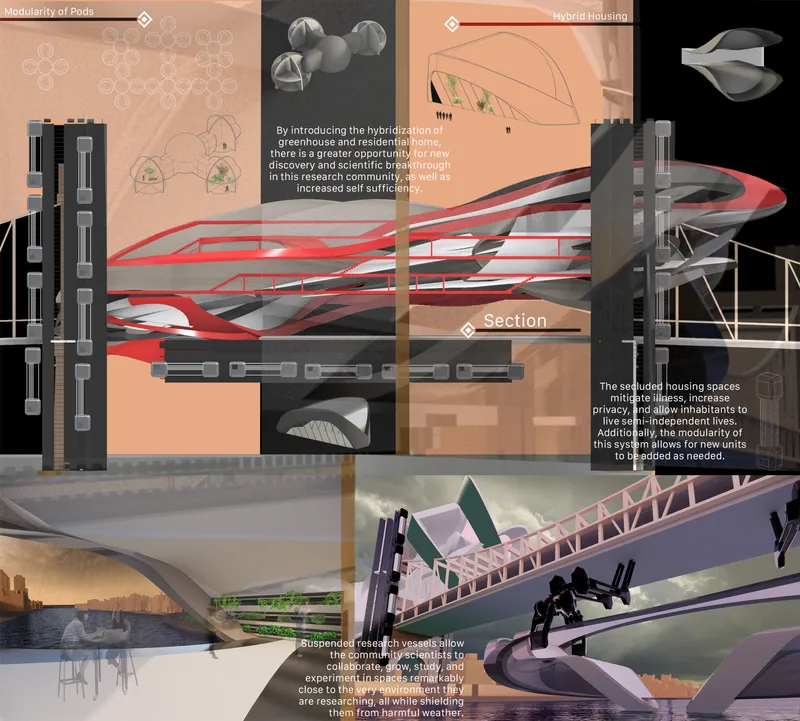
Inside the curving corridor, floor-to-ceiling windows let in light while hanging planters signal the careful reintroduction of vegetation in controlled conditions. People gather near the glass, and the atmosphere reads as calm rather than desperate. It is a crucial design choice: survival need not feel like incarceration. The interior rendering suggests that even in a post-apocalyptic scenario, architecture can cultivate dignity, communal gathering, and visual connection to the world outside the sealed membrane.
The composite board of sections, elevations, and modular housing units reveals the organizational logic more precisely. A red ribbon circulation system threads through the towers, connecting individual pods and shared spaces in a continuous loop. The modularity is deliberate: housing units can be sealed independently through airlock doors, quarantined if contamination occurs, and serviced by the pod transporter without requiring residents to move through open air. It is a plan shaped entirely by the conditions of its fictional scenario, yet its principles of modularity, quarantine flexibility, and closed-loop circulation feel disturbingly relevant.
Vertical Towers and the Canopy Above the Waterway
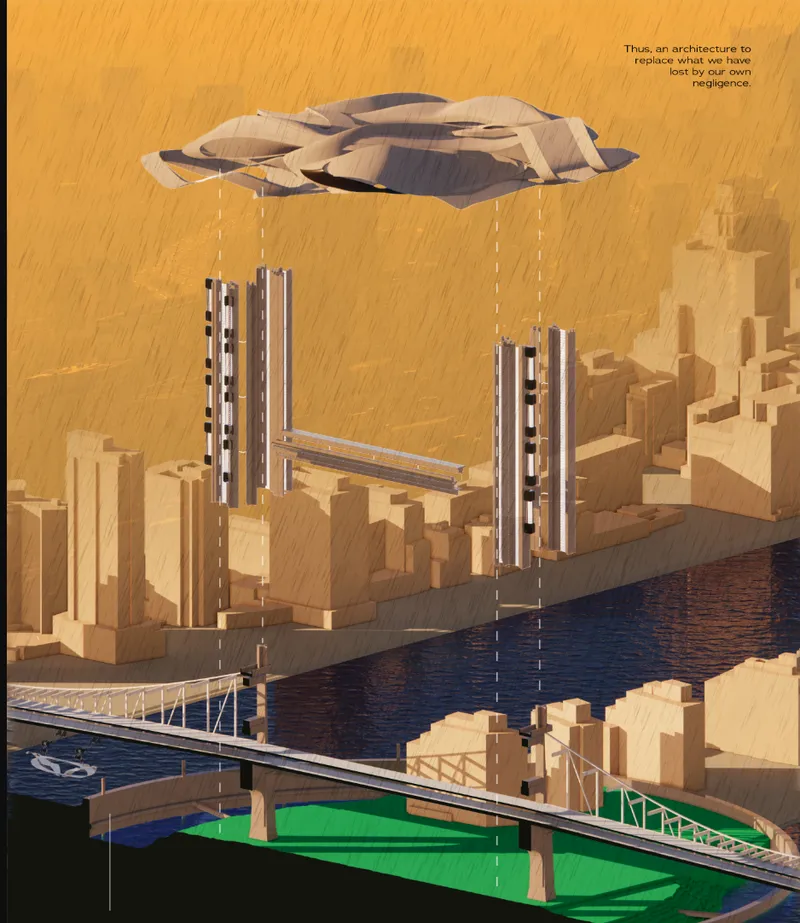
The aerial rendering pulls the camera back to show the full territorial ambition of the project. Vertical housing towers rise beside the waterway, and a suspended canopy structure stretches above, shielding the habitat from the acid rain that defines this world's climate. The canopy is more than protection; it is part of the water management cycle, channeling rainfall toward the hydroelectric dam for filtration and energy generation. From this vantage point, the relationship between bridge, towers, reservoirs, and canopy reads as a single integrated organism rather than a collection of parts.
Why This Project Matters
Toxic TerRAIN positions architecture as an act of apology. The designers describe a structure that humbly accepts the built remnants of the past, choosing to build upon them rather than start from scratch. That philosophical posture gives the project a depth that many speculative designs lack. It is not interested in imagining a gleaming utopia that pretends the damage never happened; it is interested in the harder, more honest question of what we do with what we have left after we have ruined everything.
Rigsby and Niestroy have built a convincing world here. The systems interlock, the narrative is internally consistent, and the layered aesthetic of exposed infrastructure and recycled materials reinforces the story at every scale. As a runner-up in the Architecture of the Apocalypse competition, Toxic TerRAIN earns its place by refusing to treat the apocalypse as spectacle. Instead, it treats it as a design problem with real constraints, real materials, and real consequences for how communities might persist when the most fundamental resource on the planet turns against them.
View the Full Project
About the Designers
Designers: Joshua Rigsby, Jarrett Niestroy
Enter a Design Competition on uni.xyz
uni.xyz runs architecture and design competitions year-round that reward proposals with spatial conviction and real site intelligence.
Project credits: Toxic TerRAIN by Joshua Rigsby, Jarrett Niestroy Architecture of the Apocalypse (uni.xyz).


Popular Articles
Popular articles from the community

Temporary Home for Dogs: A Reversed Zoo Rethinks Animal Shelter Architecture
In Bucharest, a sinuous corridor and freed landscape flip the logic of containment, designing a shelter that works to make itself unnecessary.

Opera on the Sea: Driftwood Logic Shapes a Timber Opera House on Estonia's Coast
Trevor Orgill's opera house translates the entangled drift of floating timber into a civic building where wood, water, and music converge.

Manzana Morphosis: Stretching Barcelona's Grid into a Living Landscape for 2050
A radical reworking of the Eixample manzana turns density into a tool for generous public space, vertical ecology, and environmental performance.

Singing Woman: An Opera House That Performs Before the Curtain Rises
Ovidiu Cristian Pavel's conceptual opera house translates Estonia's choral identity into a sculpted waterfront landmark facing the Baltic Sea.

Similar Reads
You might also enjoy these articles

Shakur's House: Exposed Brick as an Interior Organiser in a 168 m² Mashhad Residence
Brick moves indoors in this Mashhad residence, where masonry walls, glass partitions and teal planes sequence a compact home without closing it off.

Day and Night Park: A Time-Based Urban Newsstand in Beijing
A temporary urban newsstand in Beijing blending travel, light, and reading through poetic colors, compact form, and community-focused design.

Modernist Patio Renovation in El Masnou, Barcelona by Oliver Segura Arquitectura + Cebrià Arquitectura
Modernist patio renovation blending tradition and innovation with a movable pool, leveled floors, and Catalan materials in El Masnou.

Alto Residencial Coop: Cooperative Housing Development in Santiago de Compostela by Carbajo Barrios Arquitectos
A linear cooperative housing complex blending white volumes and perforated metal façades, enhancing community living, natural light, privacy, and urban integration.

Explore Dystopian Architecture Competitions
Discover active competitions in this discipline

Challenge to design a shop stop sunk in the city

Challenge to reimagine the Iron Throne

Photograph architecture without architects

Illustrate the lost glory of Angkor Wat - Render Challenge
Comments (0)
Please login or sign up to add comments
No comments yet. Be the first to comment!