![[Y/N] Studio Wraps a Victorian Terrace in a Glowing Polycarbonate Shell in Dalston](https://ojo2mx38l6.execute-api.ap-south-1.amazonaws.com/image/eyJidWNrZXQiOiJ1bmktYmxvZyIsImtleSI6InVuL3VuaWVkaXRvcmlhbC91bmllZGl0b3JpYWwyMDI0LTAzLTExVDE1LTA5LTQ5LTQxMjYyNi5wbmciLCJlZGl0cyI6eyJyZXNpemUiOnsid2lkdGgiOjUwfSwianBlZyI6eyJxdWFsaXR5IjoxMH0sImZsYXR0ZW4iOmZhbHNlLCJub3JtYWxpc2UiOmZhbHNlfX0=)
![[Y/N] Studio Wraps a Victorian Terrace in a Glowing Polycarbonate Shell in Dalston](https://ojo2mx38l6.execute-api.ap-south-1.amazonaws.com/image/eyJidWNrZXQiOiJ1bmktYmxvZyIsImtleSI6InVuL3VuaWVkaXRvcmlhbC91bmllZGl0b3JpYWwyMDI0LTAzLTExVDE1LTA5LTQ5LTQxMjYyNi5wbmciLCJlZGl0cyI6eyJyZXNpemUiOnsid2lkdGgiOjIwMDAsImZpdCI6Imluc2lkZSJ9LCJqcGVnIjp7InF1YWxpdHkiOjg1fSwiZmxhdHRlbiI6ZmFsc2UsIm5vcm1hbGlzZSI6ZmFsc2V9fQ==)
[Y/N] Studio Wraps a Victorian Terrace in a Glowing Polycarbonate Shell in Dalston
Bradbury Works layers translucent cladding over old brick to create nearly 500 square meters of new workspace around a community square in east London.

There is a particular thrill when a building manages to be simultaneously transparent and opaque, when it reveals its history without turning it into a museum piece. Bradbury Works, designed by [Y/N] Studio in Dalston, east London, does exactly that. A two-story prefabricated steel extension rises over a Victorian brick terrace that once backed onto a car park behind disused warehouses, and the whole thing is wrapped in colourless multi-wall polycarbonate panels. During the day, the facade catches the shifting tones of London's sky. At night it glows from within, turning the building into something the architects describe as an X-ray: the old masonry structure legible as a ghost inside a lightweight skin.
What makes Bradbury Works genuinely interesting is not the polycarbonate itself, which has been a go-to material for agricultural and industrial buildings for decades, but the ambition behind it. The project adds nearly 500 square meters of workspace to 600 square meters of refurbished existing space, replaces ten underperforming retail units with a mix of 10 to 65 square meter workspaces and retail pods, and does all of this while leaving the street-facing conservation area elevation virtually untouched. The pitched roof form is deliberately shed-like, designed for flexibility and future adaptation rather than architectural vanity. It is a project that takes a clear position: that density and character are not opposites.
The Facade as Filter
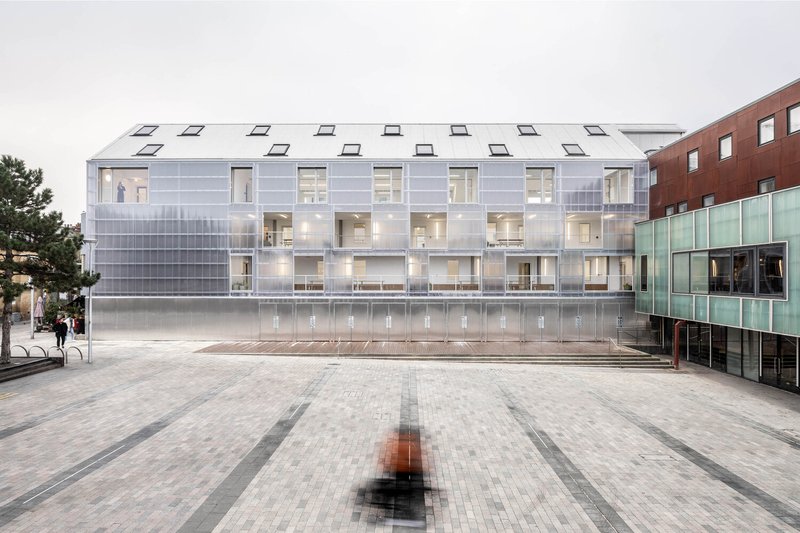
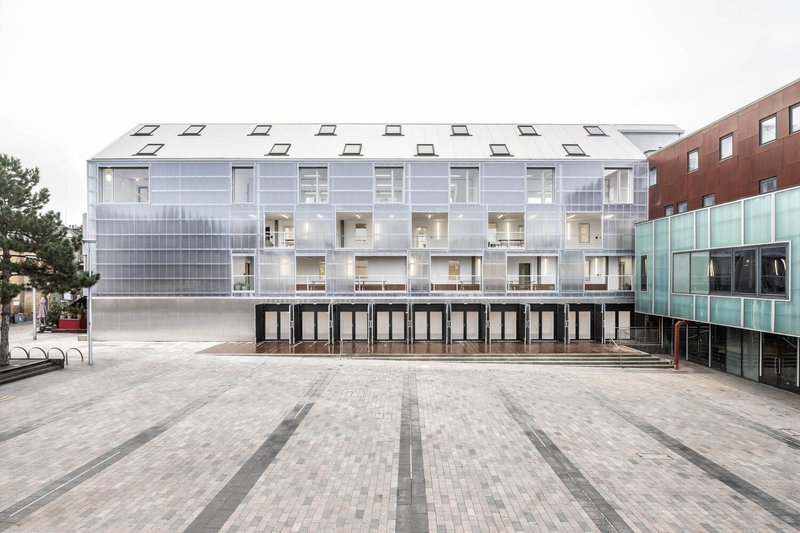
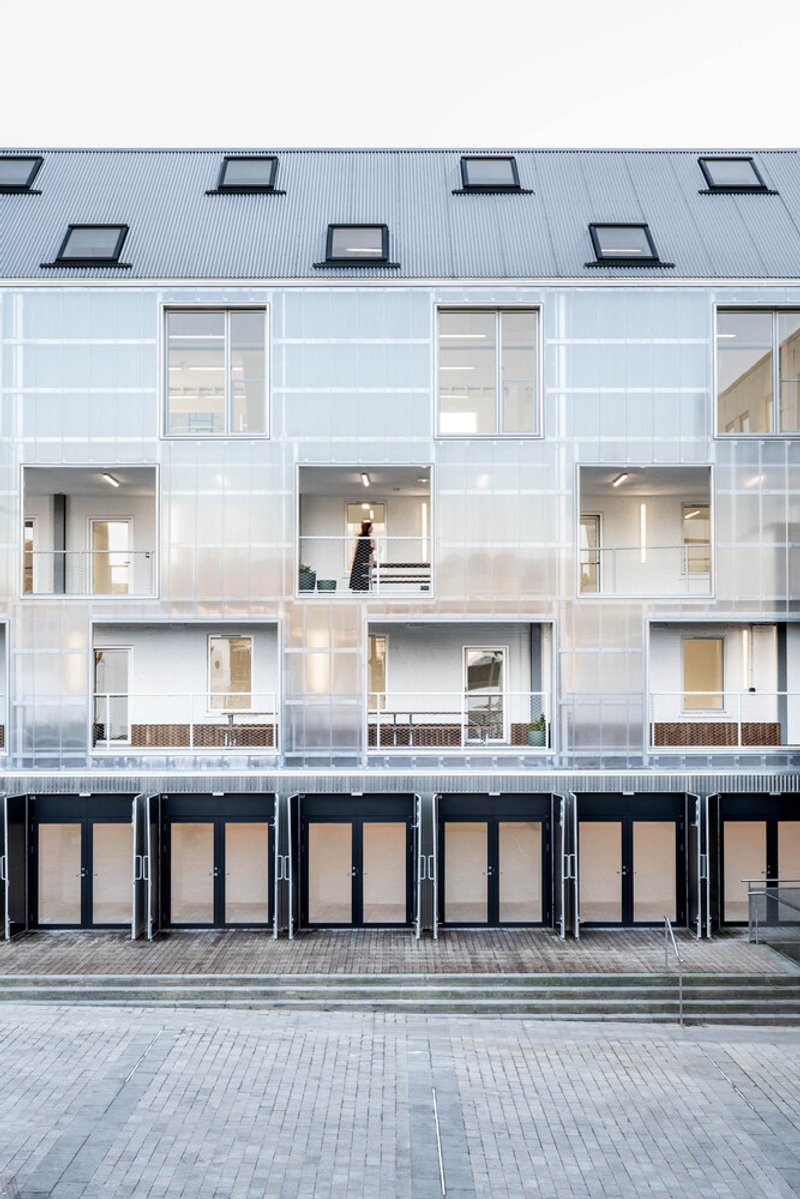
The polycarbonate facade, supplied by Rodeca, is the defining gesture of Bradbury Works, and its success lies in what it does not do. It does not try to mimic glass curtain walling or pretend to be something refined. It sits honestly as a lightweight industrial material, corrugated and translucent, wrapping the extension in a continuous skin that lets diffused daylight flood the workspaces behind while keeping the original white-painted Victorian brick visible from outside. The aluminium base and roof, finished in mill aluminium, frame the polycarbonate panels without competing with them.
At ground level, corrugated aluminium sheets clad a row of 10 square meter retail pods with fully openable glazed fronts. These pods can be secured with profiled metal gates when closed and customized with tenant signage when open. The transition from opaque metal at street level to translucent polycarbonate above creates a legible hierarchy: commerce below, work above, light everywhere.
Layered Skins and Visible History
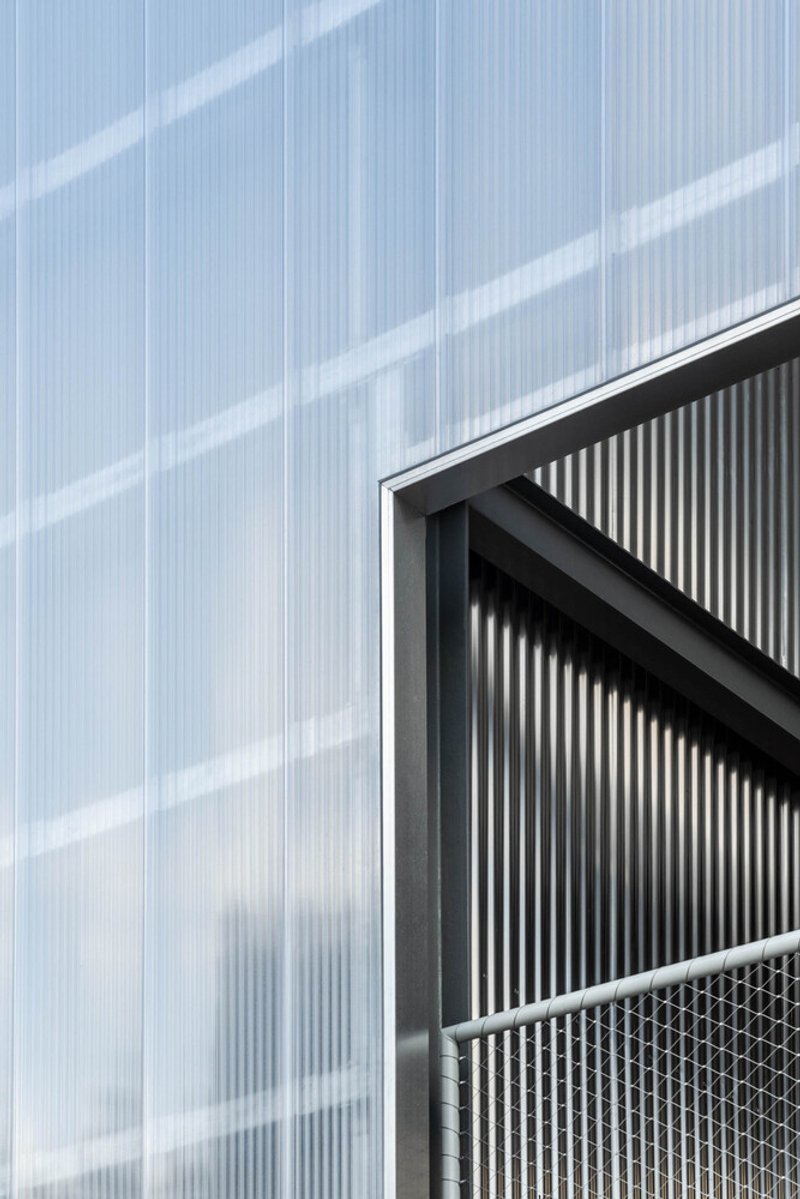
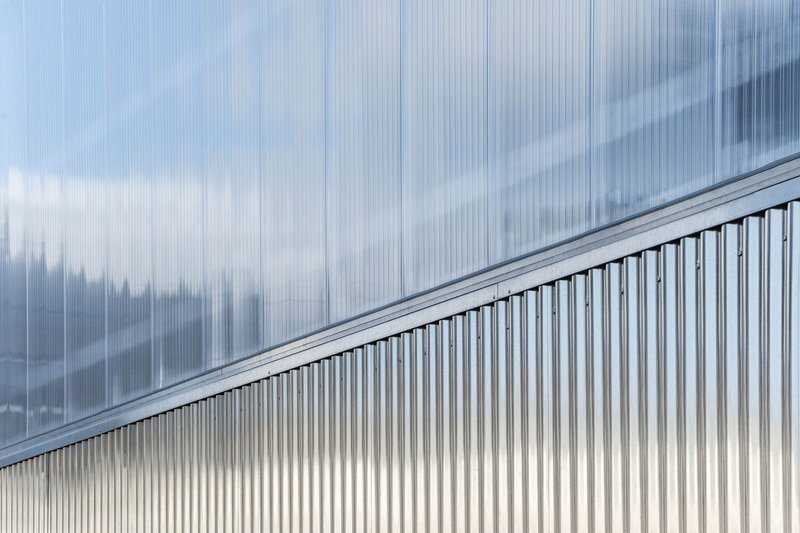
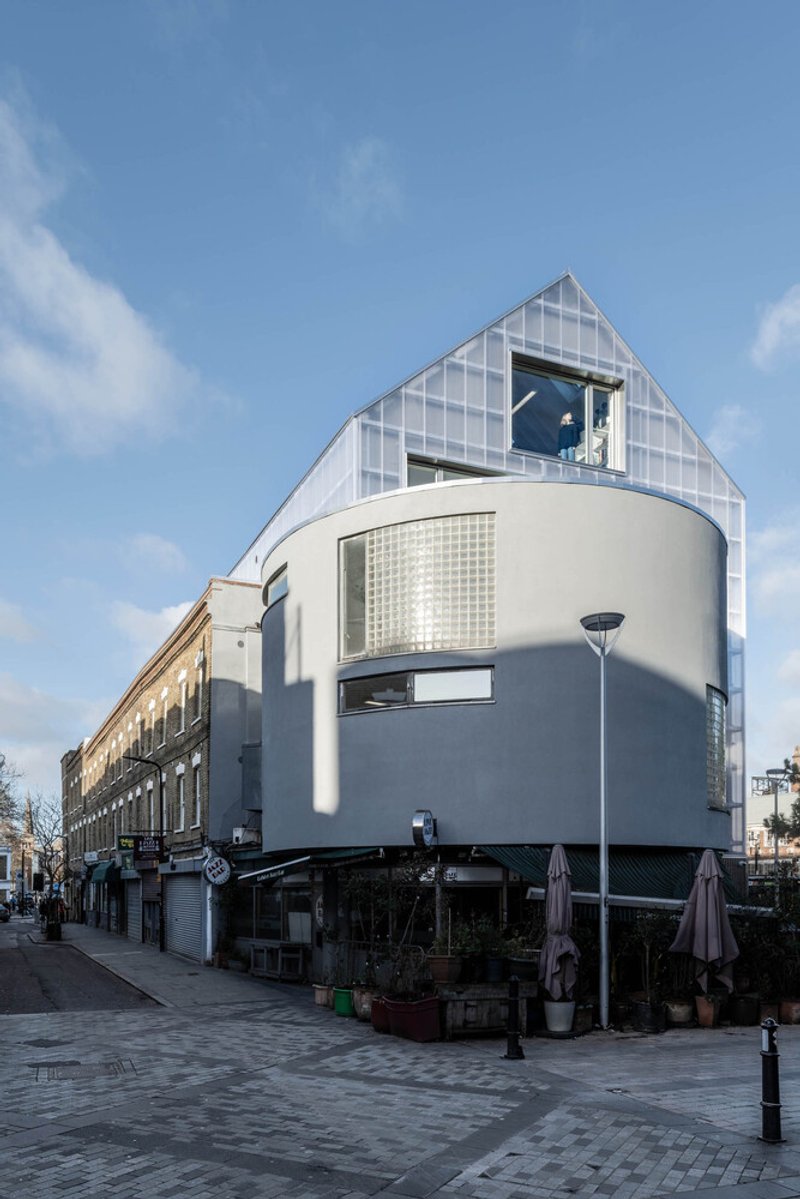
The most compelling detail of Bradbury Works is the way [Y/N] Studio treats the boundary between old and new as a thick, inhabited zone rather than a clean joint. Behind the polycarbonate skin sits the white-painted original terrace facade, then galvanised steel plank walkways that allow dappled light to filter down to the second floor, then wire-mesh balustrades, balconies of heat-treated timber deck and perforated metal, and steel structure painted in mid-grey intumescent paint. Every plane has something happening within it.
Recessed balconies framed by vertical metal slats punch through the translucent envelope, giving tenants a direct connection to the square below. The curved white volume at the corner, visible through the cladding, introduces a counterpoint to the rectangular grid. These moments of specificity prevent the building from reading as a generic shed and reward close looking.
The Square and the In-Between Spaces
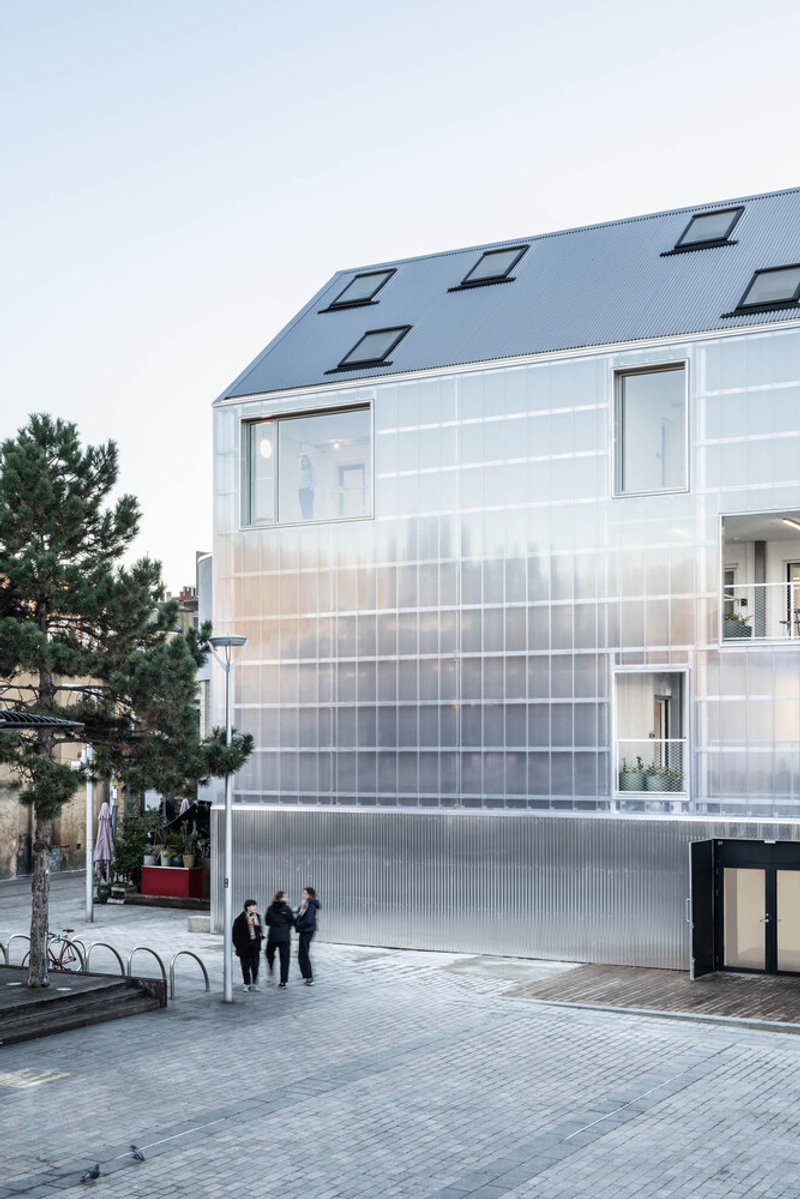
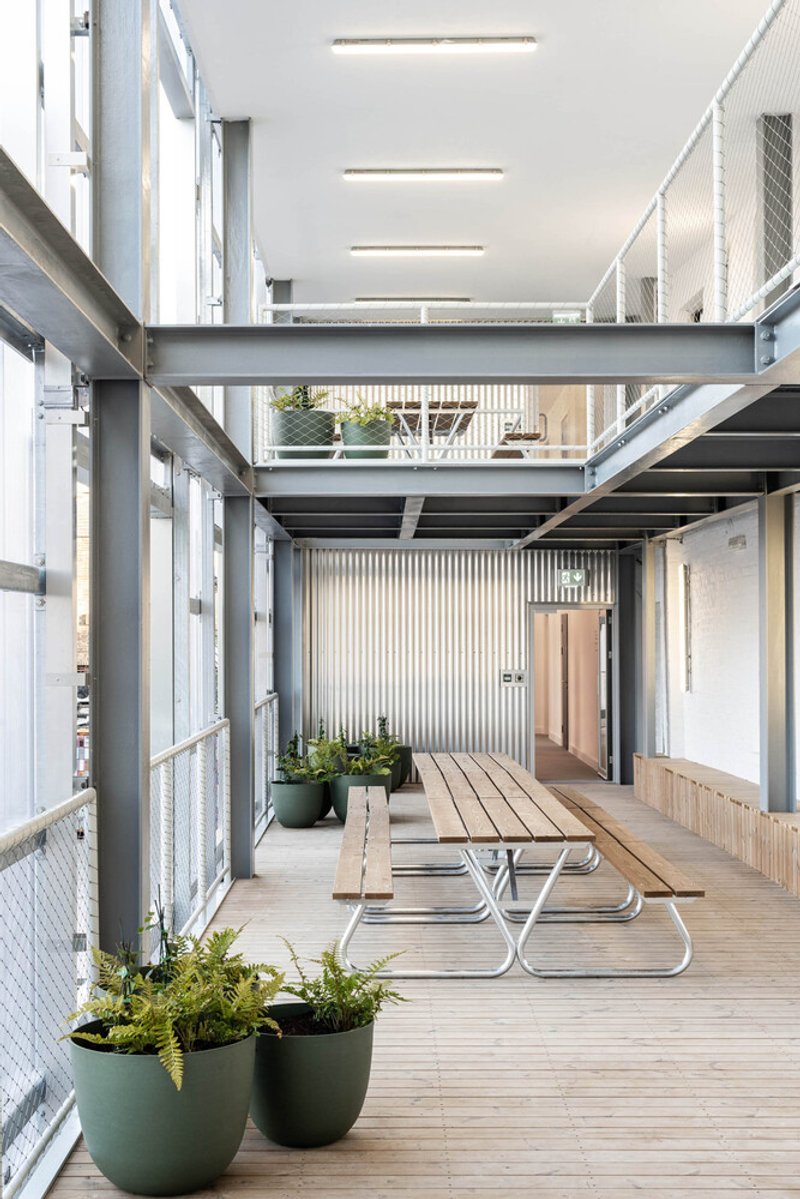
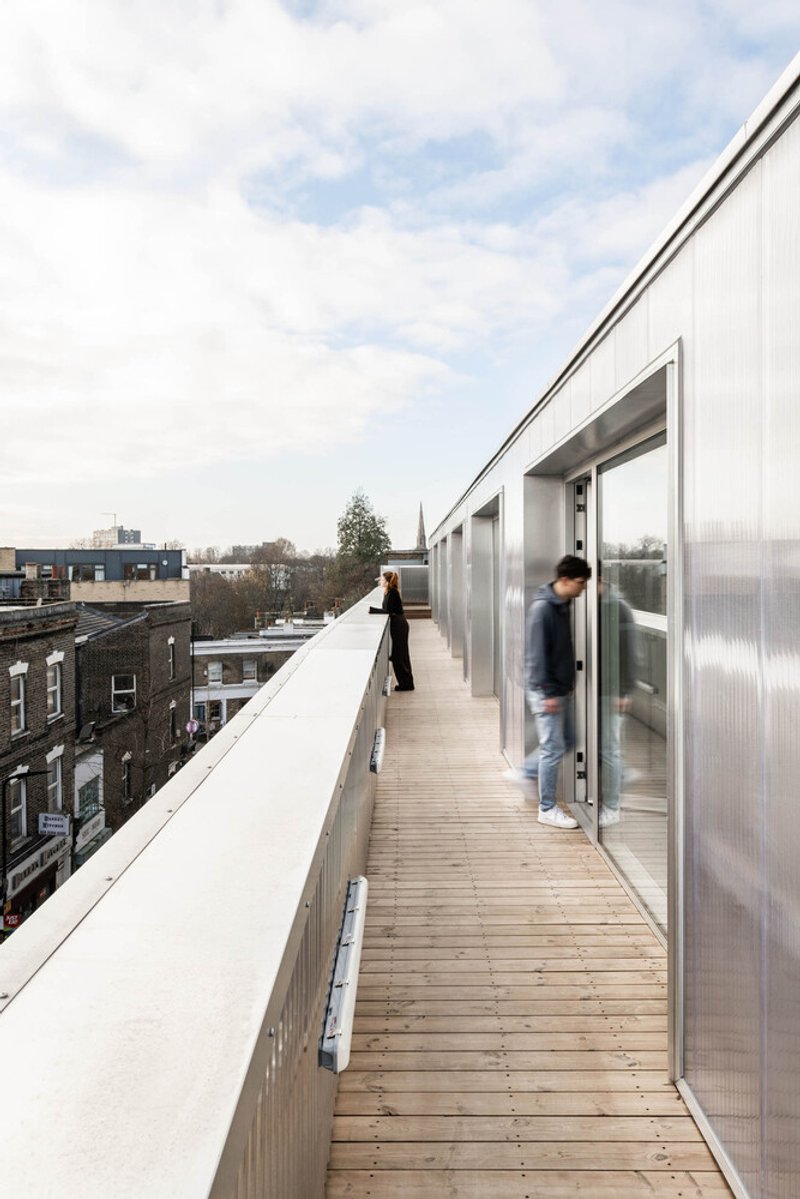
Bradbury Works wraps around a community-focused public square, and the architects were explicit that their proposals should not sanitize it. The existing shops, bars, and restaurants facing Bradbury Street remain. What changes is the quality of the space between the retail pods and the upper workspaces: a covered double-height external terrace that functions as a buffer, a meeting point, and a threshold. Picnic tables, evergreen ferns, and climbing plants populate the courtyard, encouraging year-round use.
Existing circulation decks that once served purely as access routes have been reimagined as usable terraces and breakout spaces. The south-facing access deck behind the existing brick parapet brings natural cross-ventilation to the workspaces while offering rooftop views across Dalston. A timber deck terrace on the upper level, sheltered by the translucent wall panels, becomes an outdoor extension of the workspace, animated at dusk by the glow of the polycarbonate behind.
Workspaces as Blank Canvas
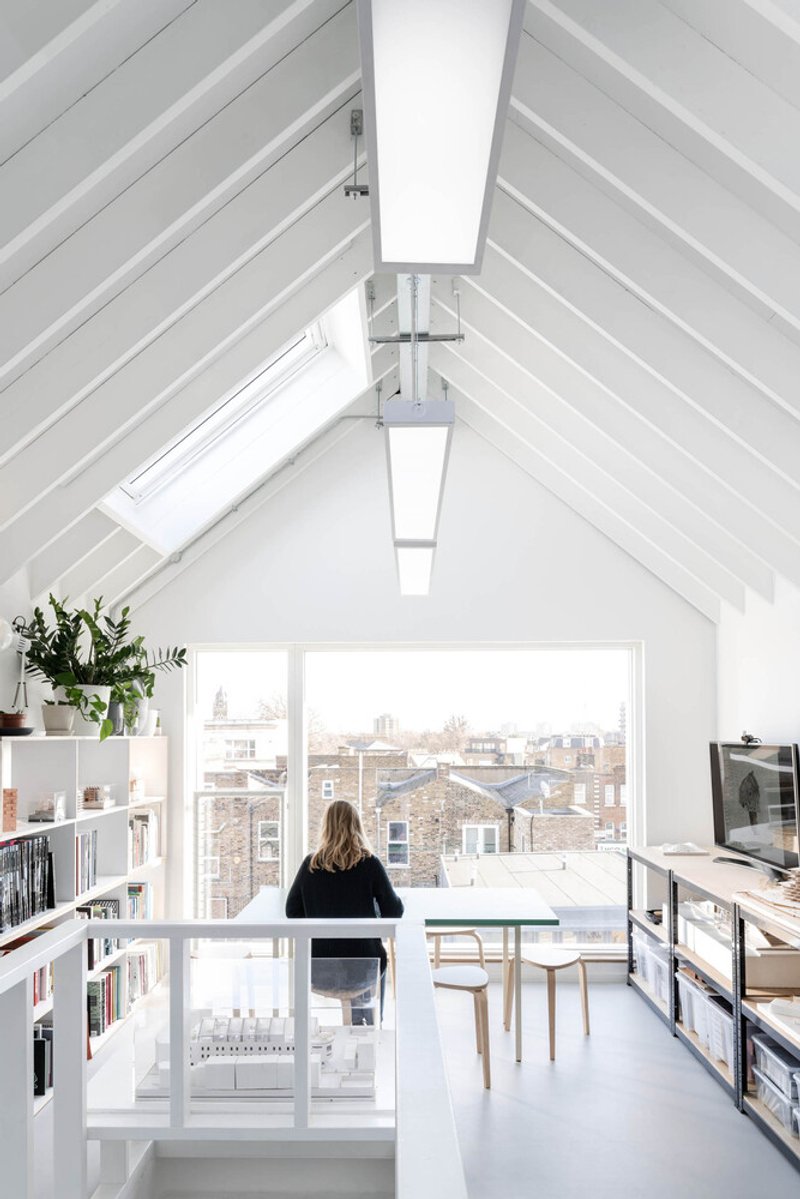
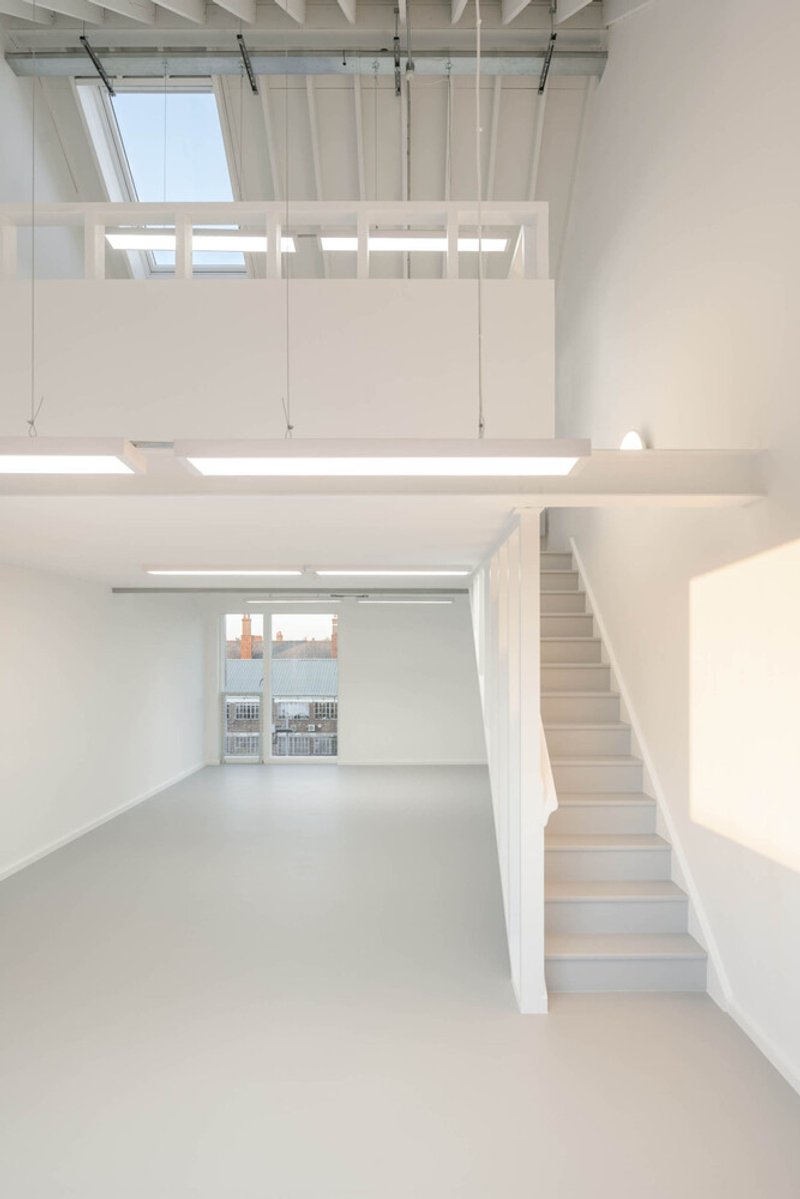
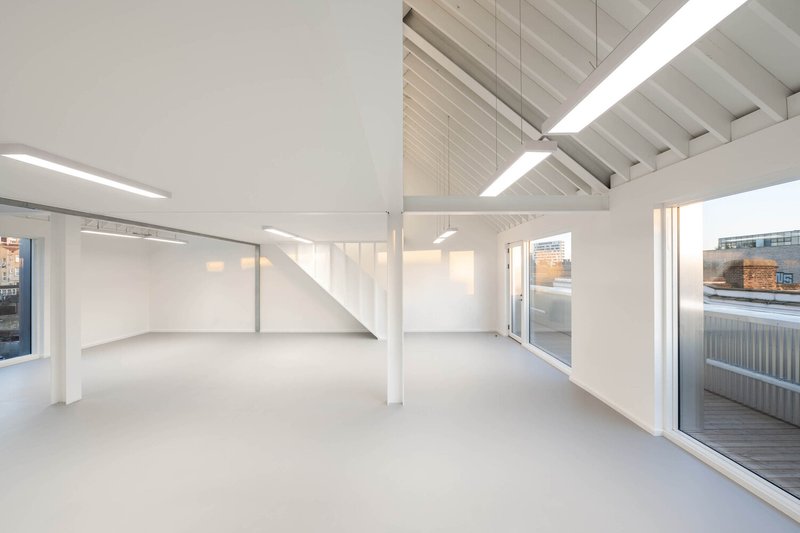
Inside the third-floor workspaces, where no internal partitions are load bearing, the pitched roof opens up to a chequerboard arrangement of openable skylights on the northern pitch. Tenants can control their own environment in summer, and the light that enters is diffuse and even. The grey and white palette is intentional: a blank canvas that tenants can colonize with their own identities. Slender steel columns and white-painted ceiling joists give the rooms an airy, almost domestic quality that contrasts with the industrial toughness of the exterior.
Private mezzanine levels inserted beneath the pitched roof on the third floor give the larger units, ranging from 40 to 65 square meters, a sense of generosity that belies their modest floor area. The double-height section with a mezzanine stair flooded by skylight is one of the most compelling interior moments: a workspace that feels closer to a loft studio than a serviced office.
The CMYK Stairwell and the Sum of Parts
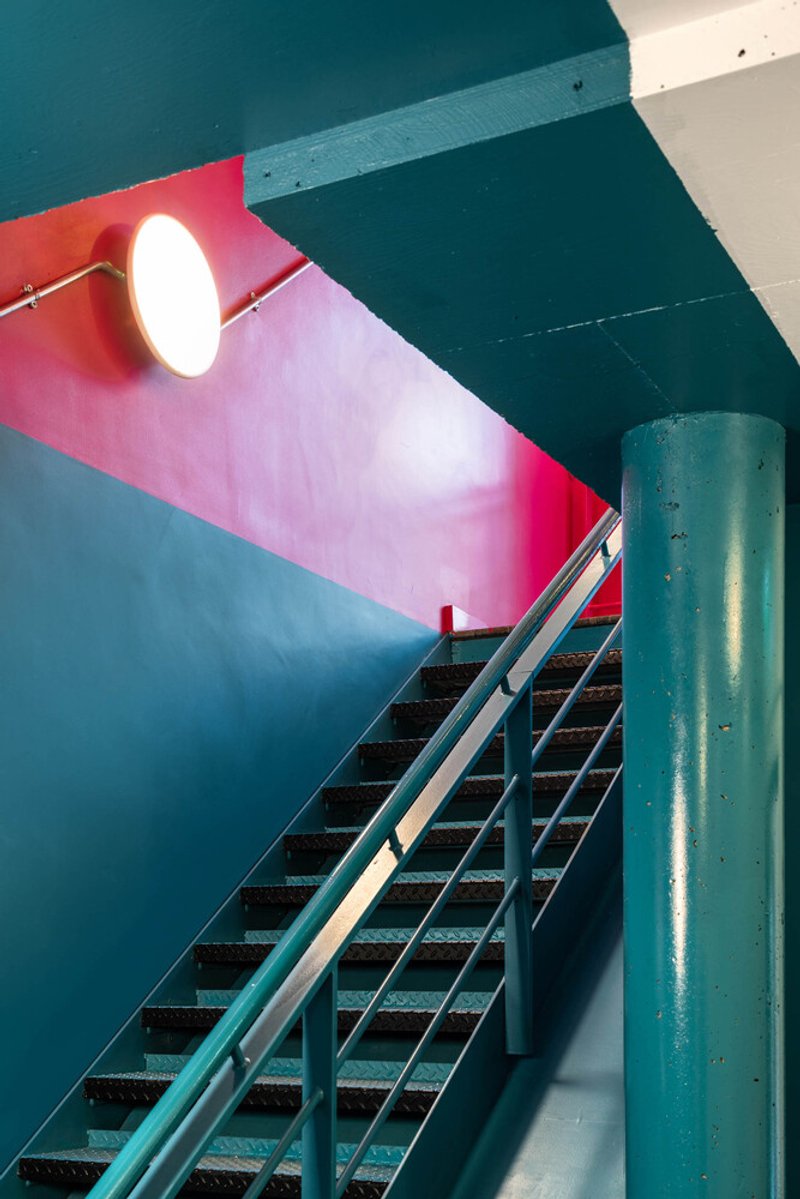
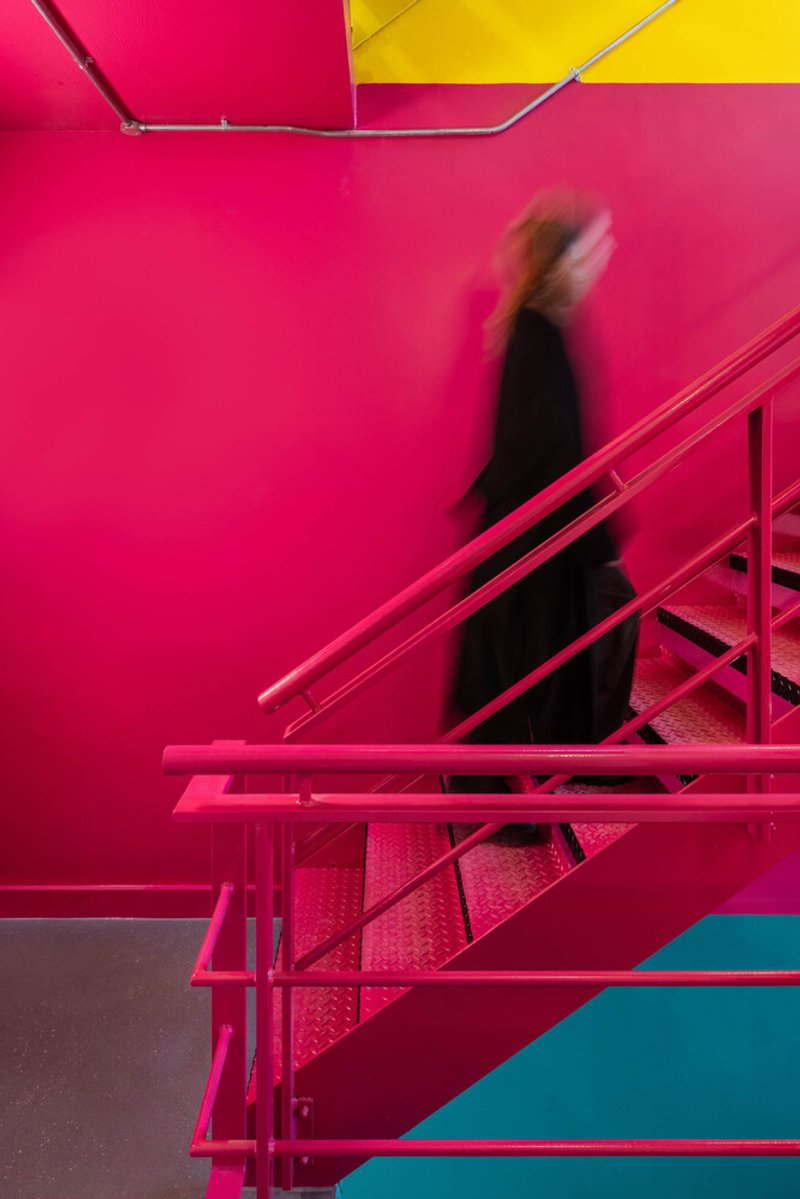
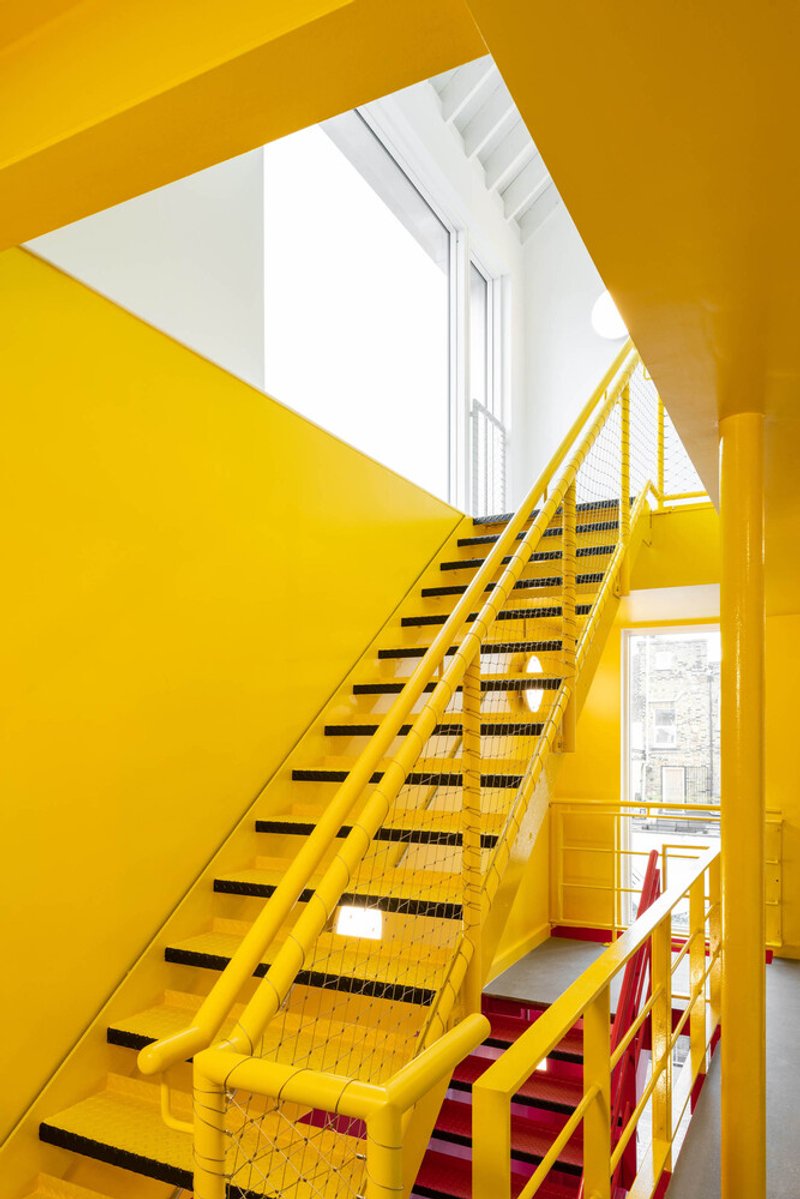
The stairwell at Bradbury Works is the one space where [Y/N] Studio let colour rip. Walls are painted in cyan, magenta, yellow, and black, referencing CMYK printing ink colours and the studio's stated ambition for the building to become greater than the sum of its parts. The perforated metal treads and magenta railings give the staircase a graphic intensity that acts as a counterweight to the muted palette elsewhere. It is a small, bold move that signals this is a building for making things.
As circulation, the stairwells and walkways work hard. They are not leftover space but the social spine of the building, connecting the retail pods at ground level to the workspaces and terraces above, channeling people past each other and past the activities of their neighbours. The decision to make them visually distinct from the workspaces reinforces their role as shared infrastructure.
Gallery and Meeting Spaces
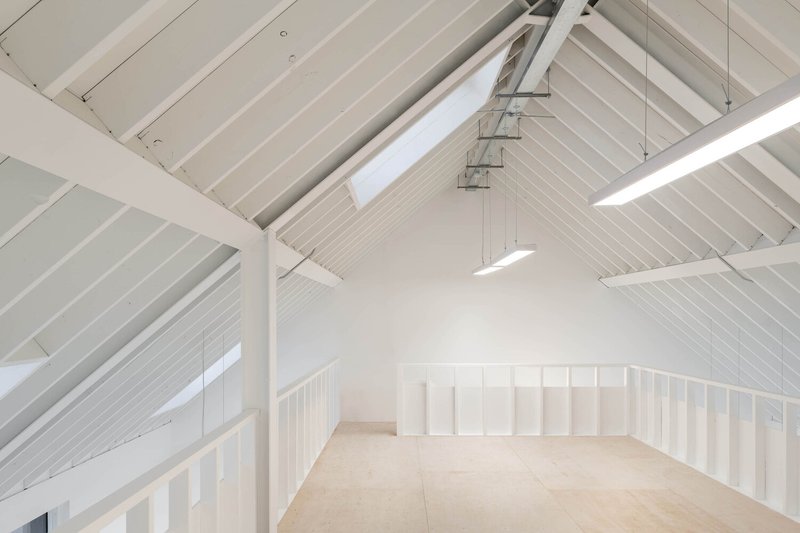
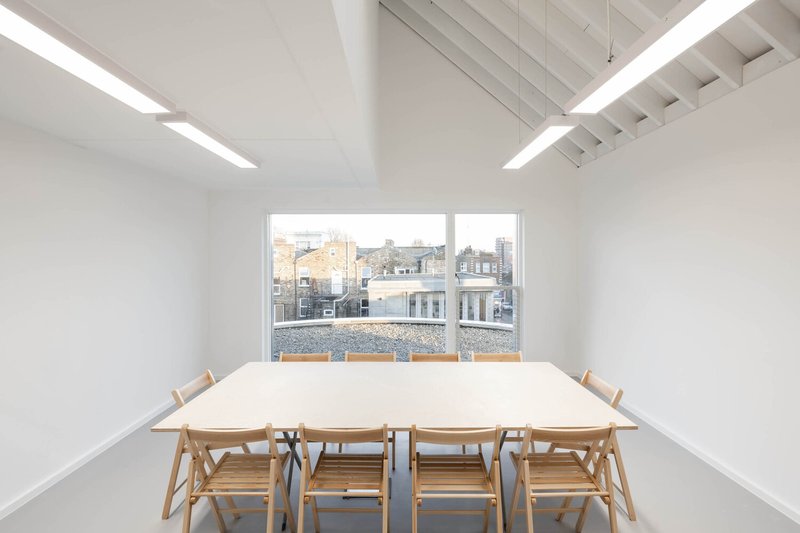
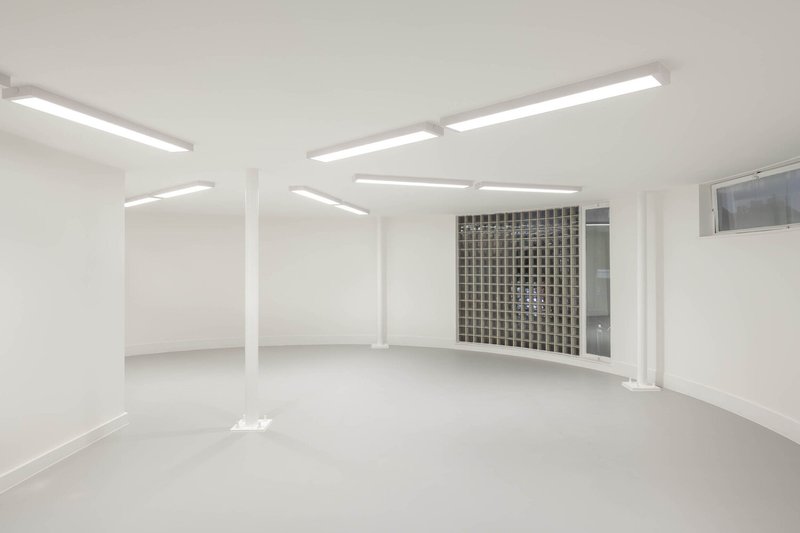
A large flexible meeting and event space serves both tenants and the wider community, reinforcing the building's relationship with the square below. Upper gallery spaces with painted timber ceiling rafters and glass balustrades overlook the floors below, creating visual connections between levels that make the building feel larger than its 1,578 square meters. A conference room with a pale timber table faces a window overlooking adjacent rooftops, offering the kind of view that makes a meeting slightly less painful.
Some existing retail units have been knocked through to create dual-aspect arrangements, letting light and air move through the plan in both directions. The glass brick window panel filtering daylight in the open-plan room is a quiet nod to the translucent logic of the facade, applied at interior scale.
Dusk and the Building as Lantern
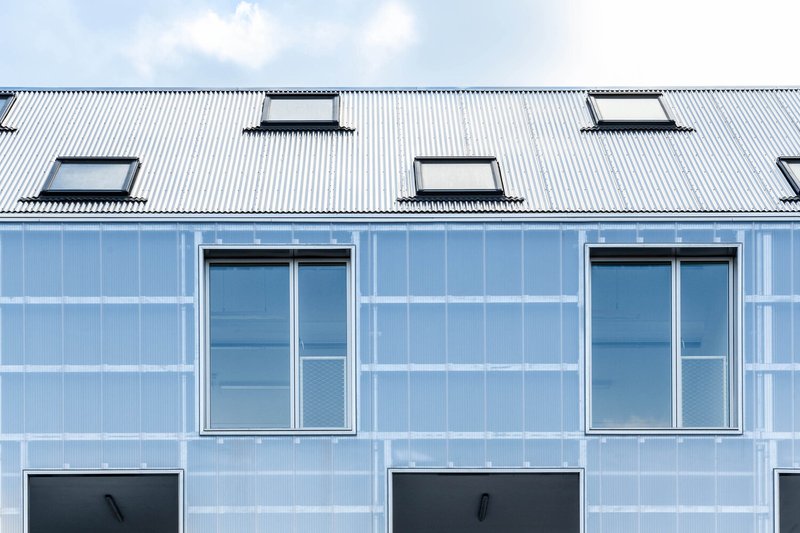
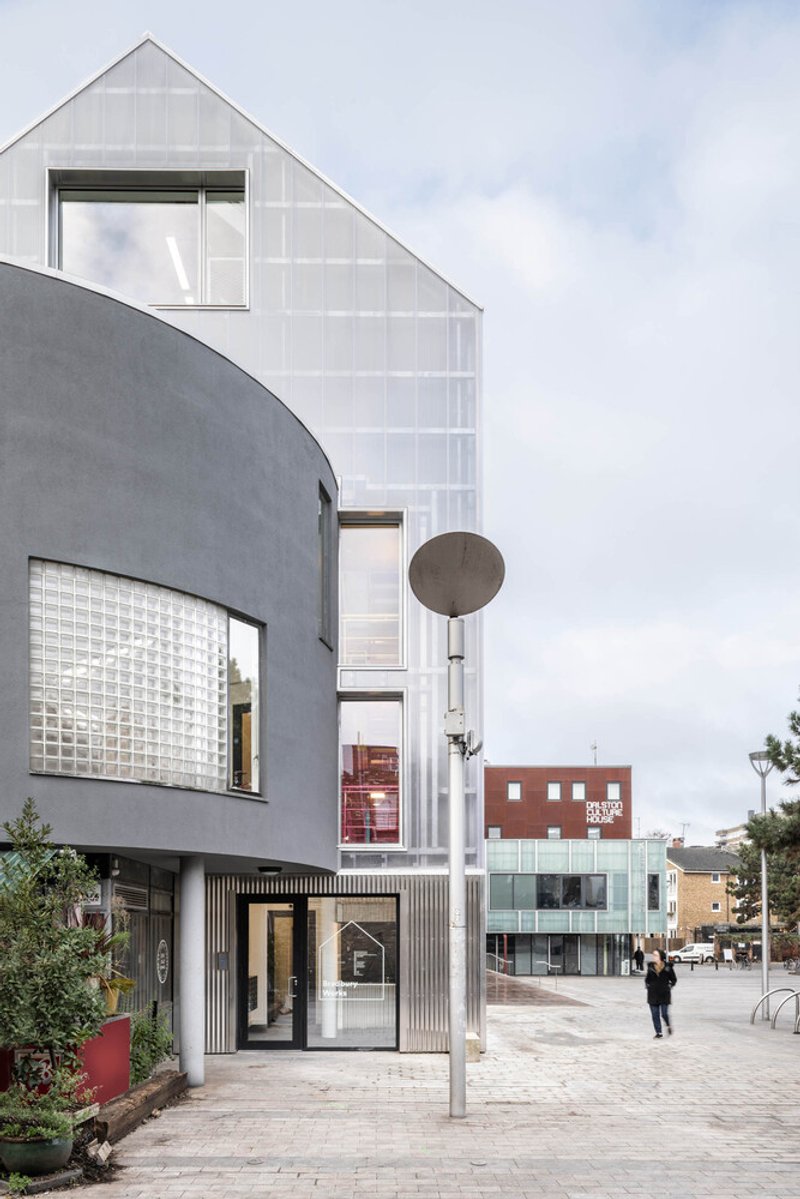
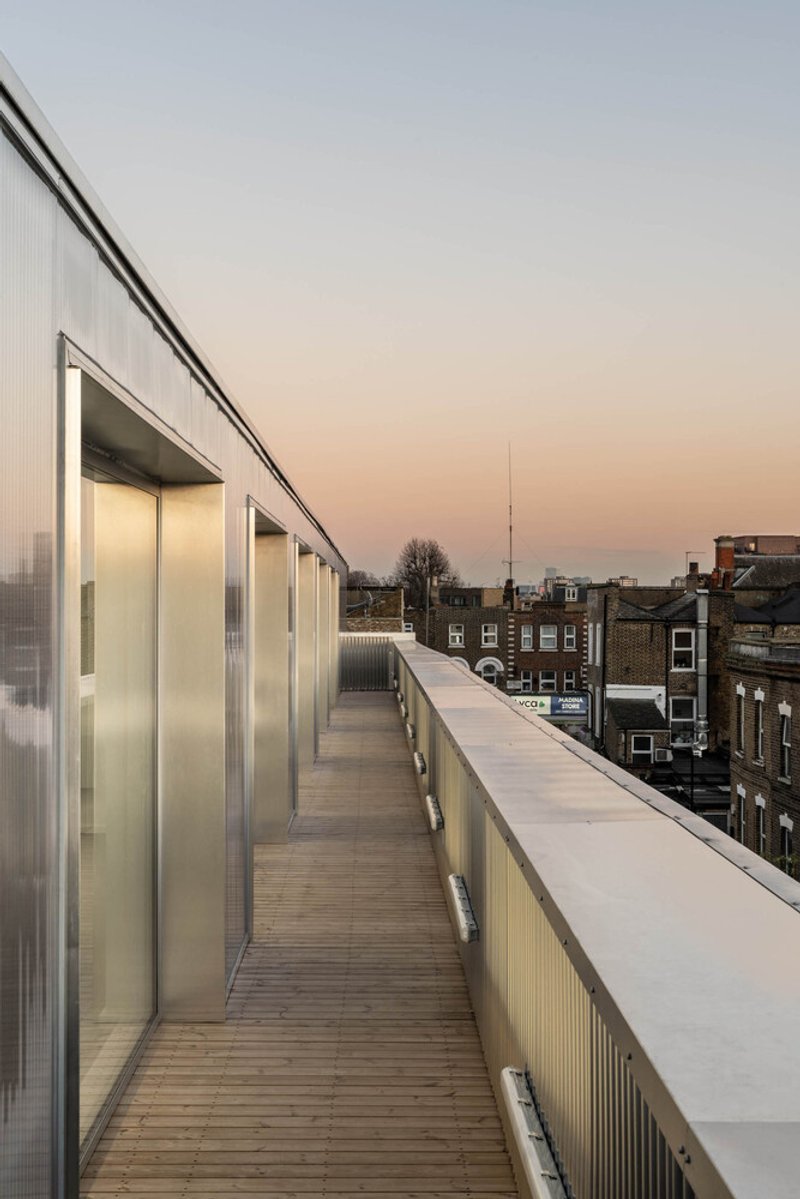
Bradbury Works is at its most theatrical at dusk. The translucent polycarbonate, which reads as a neutral silvery surface during the day, begins to glow as interior lights come on. Silhouetted figures appear at upper windows. The pitched roof with its skylights catches the last light. The building oscillates between solid and transparent, between a closed workshop and a lit stage set. The architects' X-ray metaphor is most convincing at this hour, when the old brick structure inside becomes a shadow play.
The pitched roof minimizes overshadowing of the square, a practical consideration that also shapes the building's profile against the sky. From Bradbury Street, the extension is largely hidden behind the conservation area facade, preserving the street's existing character while adding density behind it. It is the architectural equivalent of the duck-rabbit illusion: old from one angle, new from another.
Plans and Drawings
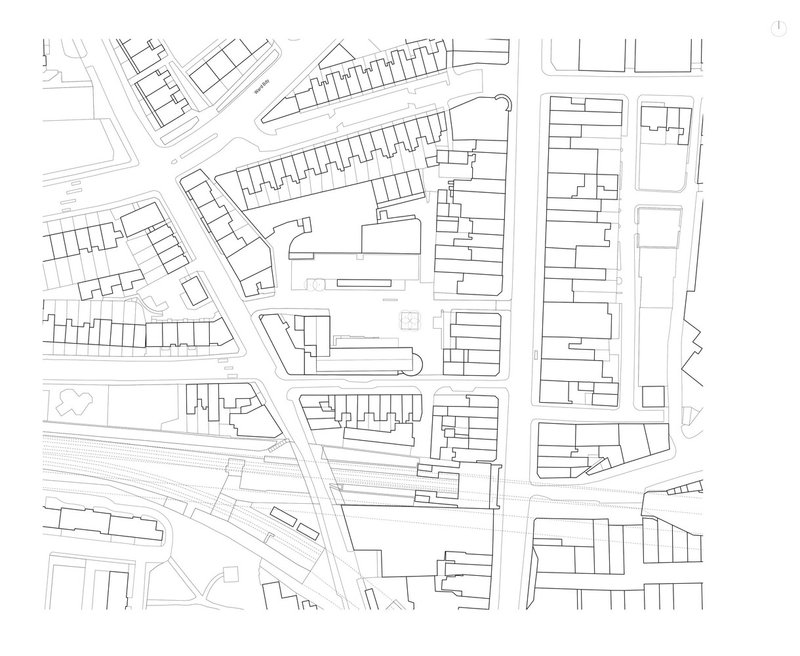
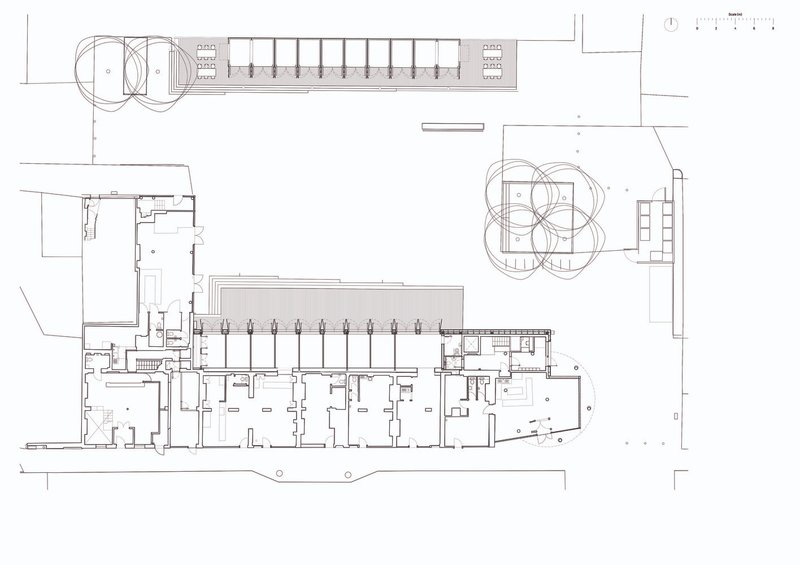
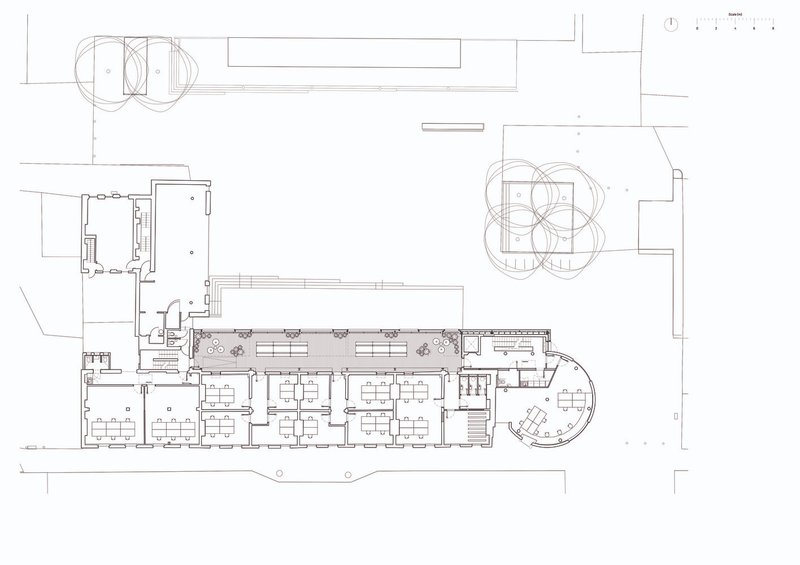
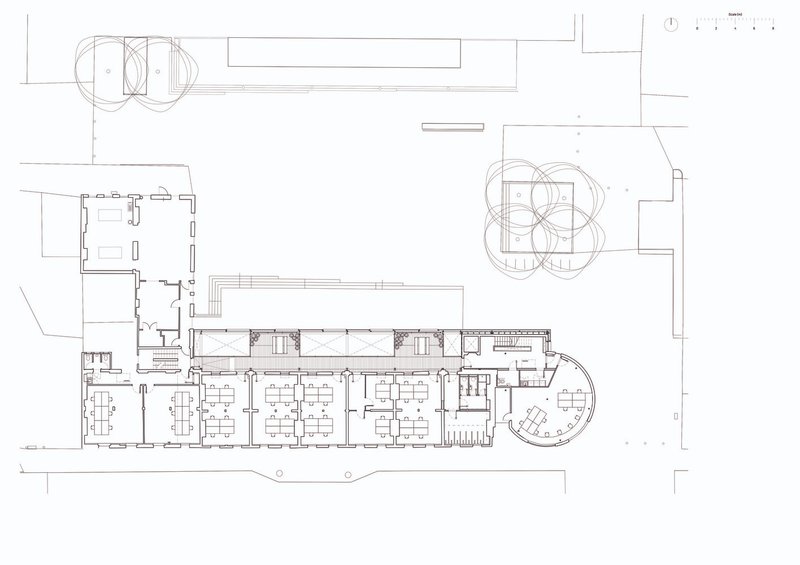
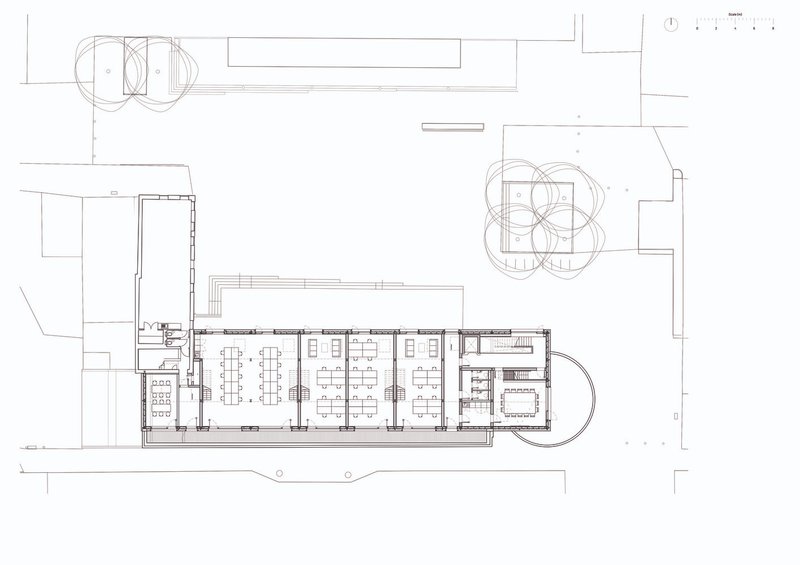
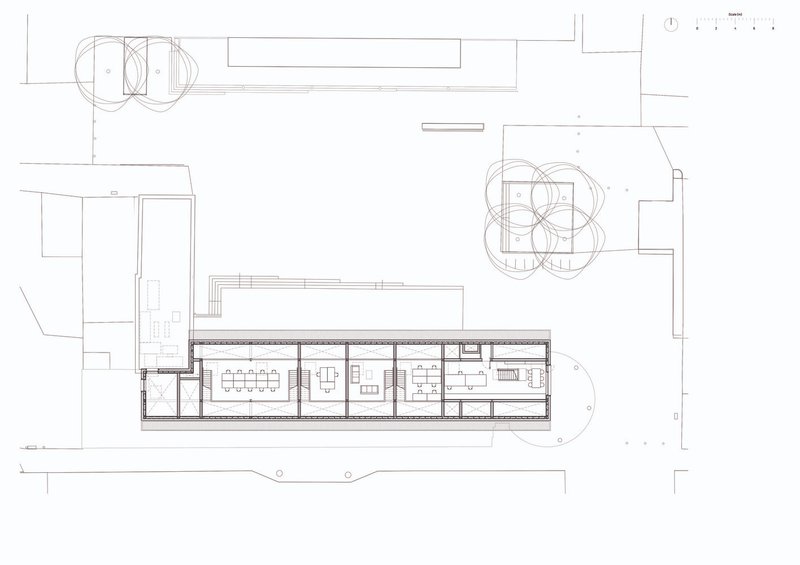
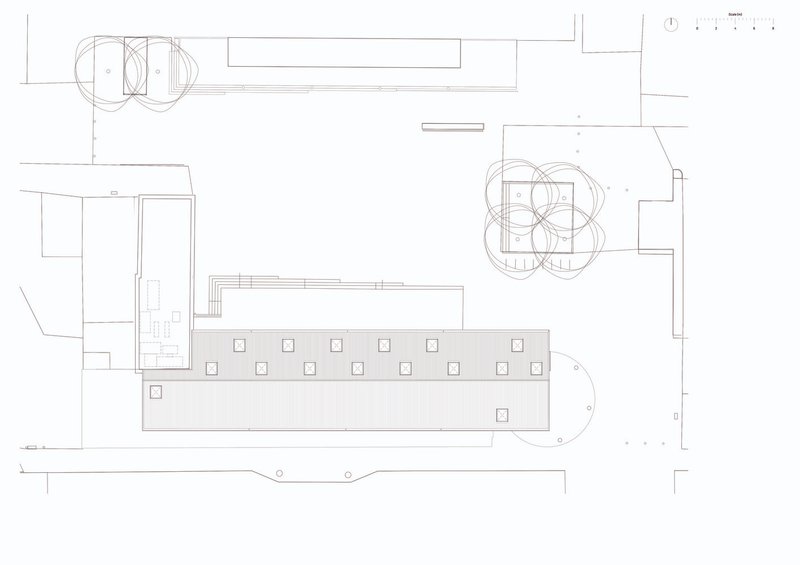
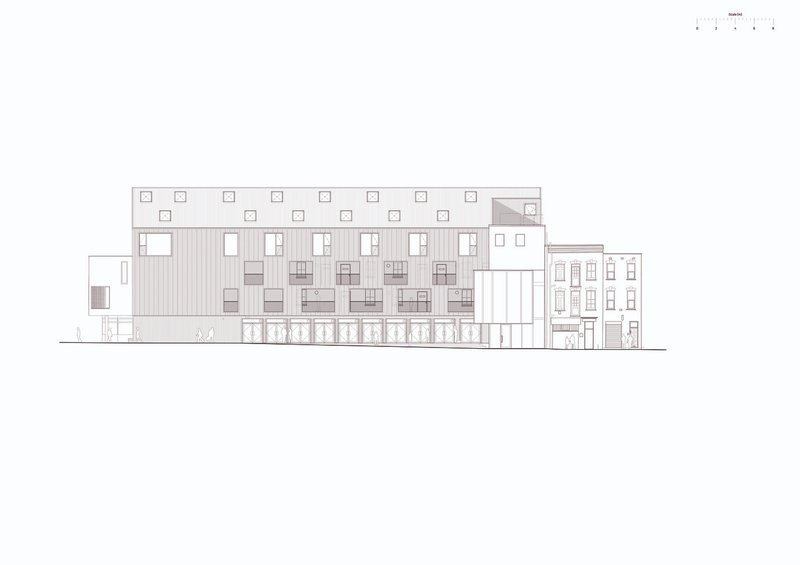
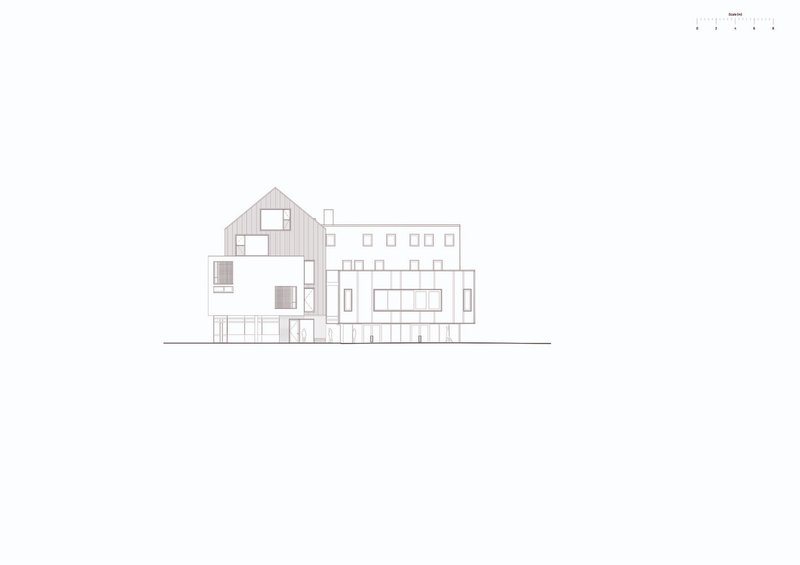
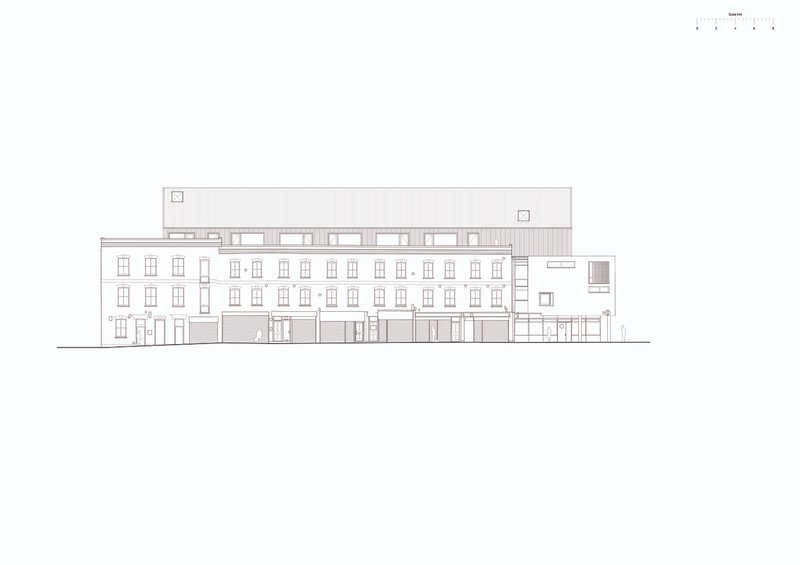
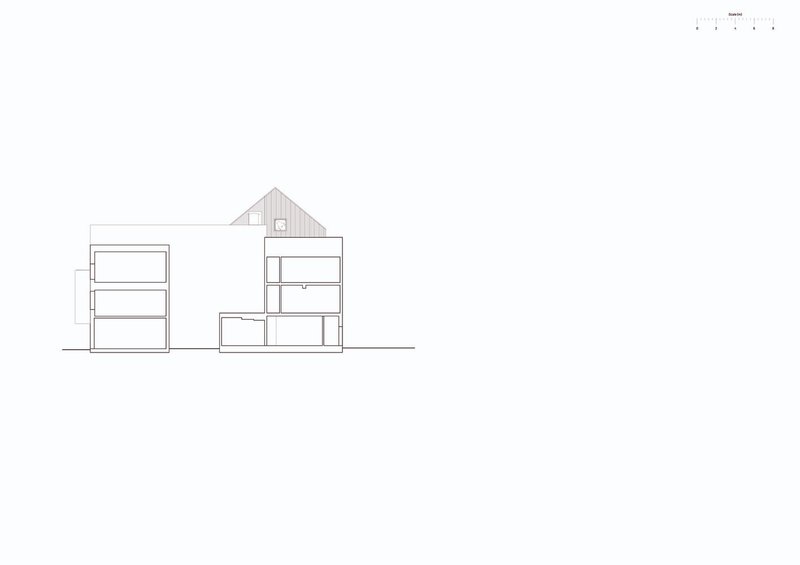
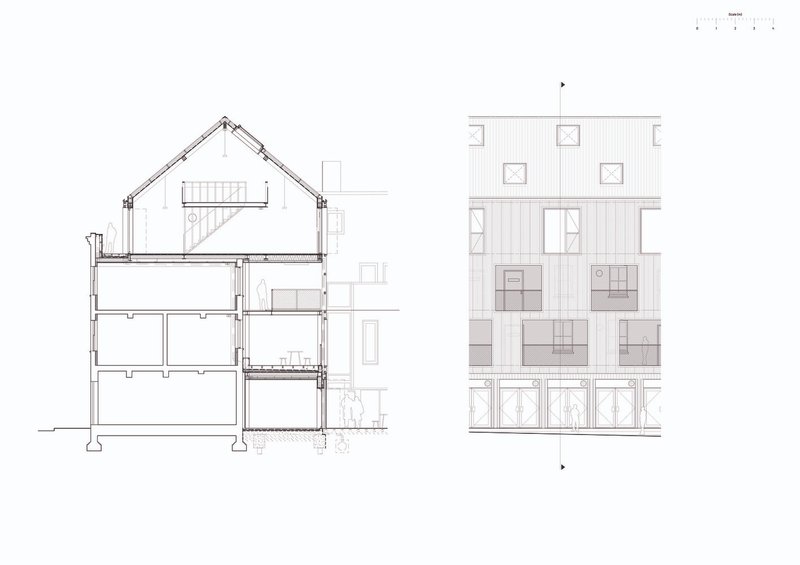
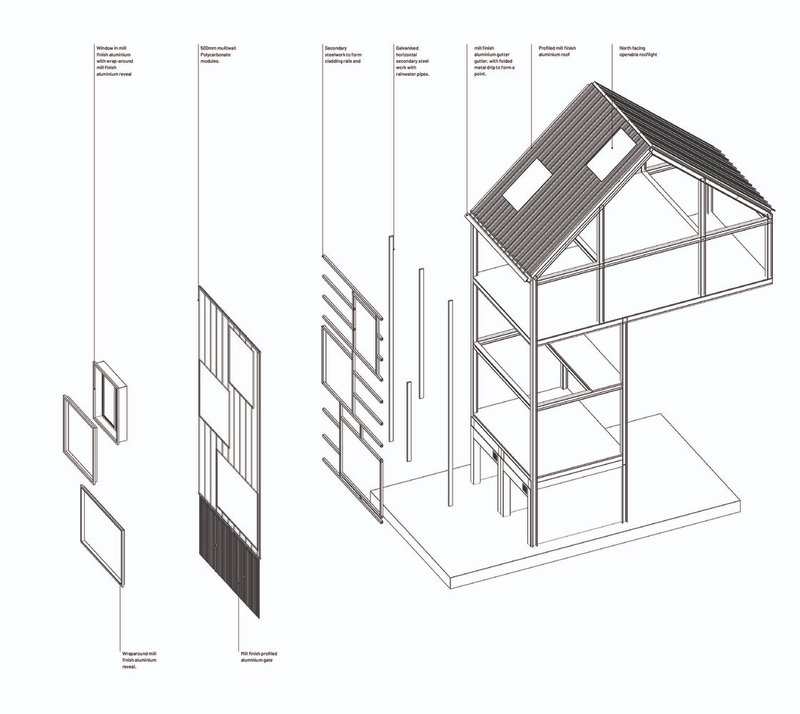
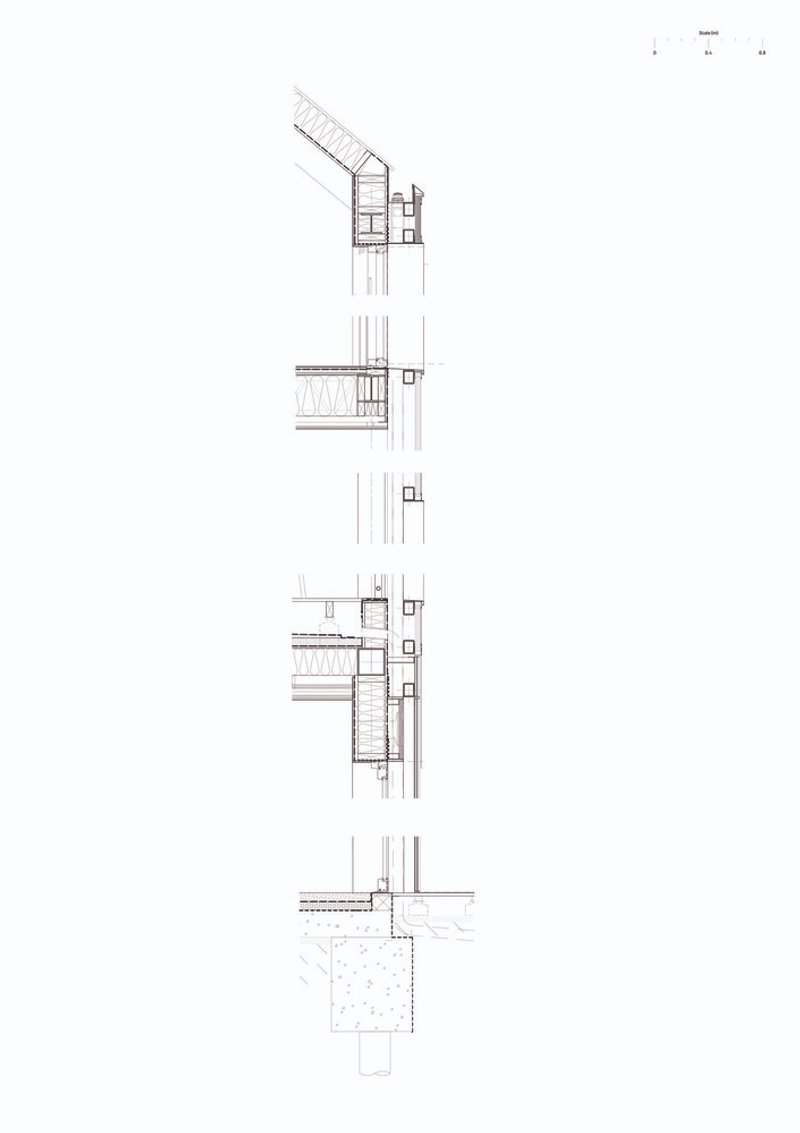
The drawings reveal the full logic of the project. The site plan shows how Bradbury Works occupies the interior of the block, wrapping around the square without disrupting the Bradbury Street frontage. Floor plans progress from the cellular retail pods at ground level, through open workspace bars on the first and second floors, to the larger third-floor units with their mezzanines. The roof plan, with its grid of square skylights, reads almost like a textile pattern. Sections cut through the pitched-roof volume to show how the new steel frame sits over the existing masonry, creating the layered depth that defines the facade.
The axonometric exploded view is especially useful: it separates the timber frame assembly, cladding panels, and roofing into distinct layers, making the construction logic legible. The detail drawings at the bottom of the set, covering roof eave, balcony edge, and foundation connections, show the care taken at junctions where different materials meet. These are the moments where a building either convinces or falls apart, and the precision here suggests a team that understood their prefabricated steel frame would only work if the details were resolved before anything arrived on site.
Why This Project Matters
Bradbury Works matters because it refuses the false choice between preservation and intensification. Too many projects in London's conservation areas either freeze the existing fabric in amber or bulldoze it for maximum floor area. [Y/N] Studio found a third path: retain the Victorian terrace, paint it white, wrap it in a new skin that makes the old structure more visible rather than less, and add nearly 500 square meters of workspace without touching the street elevation. The prefabricated steel frame is designed to be easily modified in the future, which means the building is not a monument to its own cleverness but a framework for decades of adaptation.
More broadly, the project demonstrates that affordable workspace does not require dull architecture. The polycarbonate facade, the CMYK stairwells, the inhabited threshold between old and new: these are inexpensive moves that produce real spatial and atmospheric richness. Dalston has been subject to relentless development pressure for over a decade, and Bradbury Works proves that density, character, and community use can coexist if the architect is willing to work with what is already there rather than starting from scratch.
Bradbury Works by [Y/N] Studio. Dalston, London, United Kingdom. 1,578 m². Photography by French + Tye.
About the Studio
Share Your Own Work on uni.xyz
If projects like this are the kind of work you want to make, uni.xyz is a place to publish your own, find collaborators, and enter design competitions.




Popular Articles
Popular articles from the community

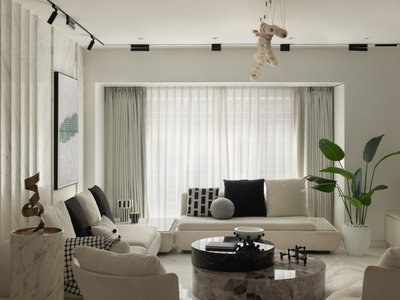
Inside a Timeless Mumbai Residence by Aether Studio
Aether Studio's 2,250 sq ft apartment in Malad, Mumbai uses marble, brass, boucle, and disciplined restraint to build a quiet retreat from the city.
R/URBAN DESIGN OFFICE Carves a Communal Living Room from a Tokyo Corporate Dormitory
In Shinagawa's Oi district, a 35-year-old reinforced concrete tower becomes a 49-unit rental residence with shared spaces that redefine cohabitation.

The Heart of Milano: Slow Fashion Architecture for a New Circular Culture
The Heart of Milano turns slow fashion architecture into a civic landmark where learning, making, sharing, and circular culture meets daily.
The Flow: Coffee Shop Interior Design Where Time, People, and Process Intertwine
The Flow reimagines Viennese coffee culture through arched forms, warm interiors, music, reading, work, and social gathering.


Similar Reads
You might also enjoy these articles

Olio Towers: A Mid-Rise for Performers That Fuses Housing, Rehearsal, and Stage
Located blocks from Houston's Theater District, this modular tower stacks living units around a central performance atrium.
Oasis: Modular Green Housing Carved into Dhaka's Urban Fabric
A shortlisted Plugin Housing entry reclaims unauthorized settlements in Dhaka with stepped concrete volumes, green roofs, and ventilation-driven design.

Black Hole: A Floating Megastructure for the Post-Physical Era
Emiliano Mazzarotto envisions a spherical, self-scaling arena where e-sports, digital hotels, and holographic stadiums replace traditional public space.
Compact & Sustainable Living in Piraeus: A Four-Level Family Home Built Around Light and Air
A narrow townhouse in one of Greece's densest port cities uses a central atrium and passive strategies to house three generations under one roof.


Explore Architecture Competitions
Discover active competitions in this discipline




The International Standard for Design Portfolios


The Global Benchmark for Architecture Dissertation Awards


The Global Benchmark for Graduation Excellence


Challenge to reimagine the Iron Throne
Comments (0)
Please login or sign up to add comments
No comments yet. Be the first to comment!