

Transposed Courtyard House by Studio MSA
A contemporary Goan house reimagines the courtyard as an external social space, combining passive cooling, cultural elements, and climate-responsive design.


Redefining Goan Domestic Architecture Through a Reimagined Courtyard Typology
Located in Goa, India, the Transposed Courtyard House by Studio MSA presents a contemporary reinterpretation of the traditional Goan residence, challenging the long-established notion of the centrally placed courtyard. Completed in 2024 and spanning 261 m², the house responds to evolving domestic patterns, climatic considerations, and cultural traditions by repositioning the courtyard as an external yet integral social space.

Reinterpreting the Courtyard Tradition
Historically, Goan houses organized domestic life around a centrally located courtyard that functioned as both a climatic moderator and a social nucleus. In contrast, the Transposed Courtyard House deliberately shifts this space outward, towards the entrance, reflecting changing relationships between public and private realms in contemporary urban living. This transposition allows the courtyard to act as a threshold rather than an inward-facing void, fostering interaction while maintaining privacy.

At the heart of the project lies this external courtyard, conceived as a multifunctional gathering space that encourages social exchange among residents and visitors alike. Anchored by a traditional “Sopo” seating, the courtyard draws from Goan cultural practices while adapting to present-day lifestyles, reinforcing a sense of community and shared experience.


Climate-Responsive Planning and Orientation
The house is strategically oriented along the East, West axis, optimizing daylight penetration and cross-ventilation while reducing harsh solar gain. Existing tree cover on the southwest side is carefully preserved, providing natural shading and enhancing thermal comfort. These passive design strategies reduce dependence on mechanical cooling, aligning the project with principles of sustainable residential architecture.


The courtyard itself is enclosed by a Mangalore tiled screen, which shields the space from the street while creating a visually porous boundary. This screen not only ensures privacy but also mediates the transition from the public realm to the private interior, offering a layered spatial experience. Within this cocooned enclosure, a mature Frangipani tree becomes the focal point, animating the courtyard with fragrance, filtered light, and shifting shadows throughout the day.


Spatial Sequence and Interior Experience
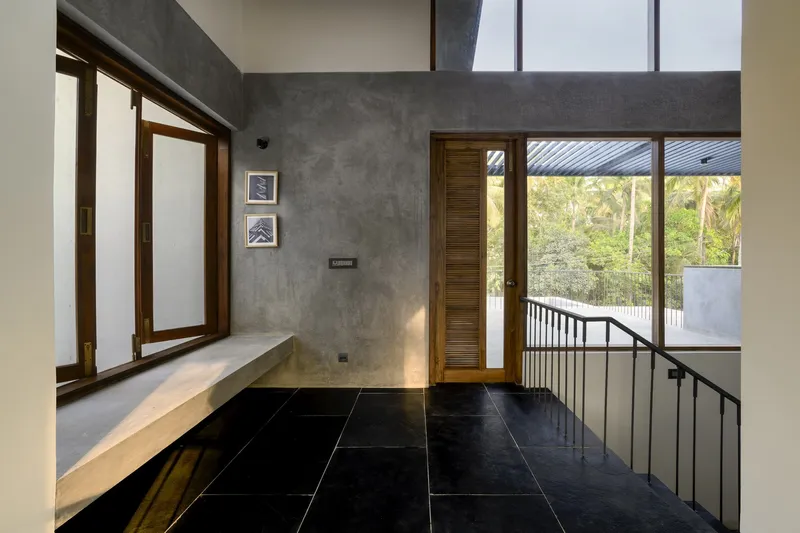
A modern interpretation of the traditional low-height verandah leads into a double-height living room capped with a sloping roof. This transition bridges vernacular architectural language with contemporary spatial openness. Full-height windows and operable louvered shutters introduce soft northern light and facilitate continuous airflow, creating a comfortable and naturally lit interior environment.
Material choices further reinforce the connection to local building traditions. Wooden fenestration, lime-washed walls, and terracotta elements lend the interiors a warm, tactile quality that resonates with Goa’s architectural heritage while remaining understated and modern.

Passive Cooling and Material Intelligence
A reading niche constructed with a terracotta filler slab subtly connects the living and dining areas, enhancing spatial continuity. The use of a brick jali along the southern façade filters intense sunlight, preventing heat buildup around the double-height stairwell. This feature draws from Indian architectural precedents, where perforated screens balance light, ventilation, and thermal comfort.
The house employs a centralized cross-ventilation strategy that leverages the Venturi effect, efficiently expelling warm air and maintaining a temperate indoor climate. Together, these passive design measures significantly improve energy efficiency and occupant comfort, demonstrating a thoughtful response to Goa’s tropical conditions.


A Contemporary Goan House
Through its transposed courtyard, climate-sensitive planning, and material restraint, the Transposed Courtyard House offers a nuanced architectural response to cultural continuity and modern living. Studio MSA’s design successfully bridges tradition and innovation, creating a residence that is socially engaging, environmentally responsive, and deeply rooted in its regional context.


All photographs are works of Hemant Patil


Popular Articles
Popular articles from the community


Singing Woman: Contemporary Architecture Inspired by Estonia’s Voice and the Sea
Singing Woman turns Estonia’s song culture into flowing opera house architecture, blending public life, landscape, sea, and national memory.
Opera by the Sea Estonia: Three Shells Dissolving Architecture into Tallinn's Coastline
A winning opera house proposal replaces monumental form with interconnected shells that blur the boundary between building, park and Baltic Sea.
Temporary Home for Dogs: A Reversed Zoo Rethinks Animal Shelter Architecture
In Bucharest, a sinuous corridor and freed landscape flip the logic of containment, designing a shelter that works to make itself unnecessary.

Opera on the Sea: Driftwood Logic Shapes a Timber Opera House on Estonia's Coast
Trevor Orgill's opera house translates the entangled drift of floating timber into a civic building where wood, water, and music converge.

Similar Reads
You might also enjoy these articles


Hodi-Mandai Geram
Project Function: Preservation and revitalization of the Intangible heritage and socio-spatial identity of the Hodi by Housing, Cultural Memory Center, Sacred Grove, landscape, local tourism economy


Olio Towers: A Mid-Rise for Performers That Fuses Housing, Rehearsal, and Stage
Located blocks from Houston's Theater District, this modular tower stacks living units around a central performance atrium.

Oasis: Modular Green Housing Carved into Dhaka's Urban Fabric
A shortlisted Plugin Housing entry reclaims unauthorized settlements in Dhaka with stepped concrete volumes, green roofs, and ventilation-driven design.

Black Hole: A Floating Megastructure for the Post-Physical Era
Emiliano Mazzarotto envisions a spherical, self-scaling arena where e-sports, digital hotels, and holographic stadiums replace traditional public space.

Explore Courtyard Competitions
Discover active competitions in this discipline

Challenge to reimagine the Iron Throne

Photograph architecture without architects

Illustrate the lost glory of Angkor Wat - Render Challenge

Design challenge to reuse E-waste
Comments (0)
Please login or sign up to add comments
No comments yet. Be the first to comment!