

dSPACE Studio Stacks a Family Retreat Above the Indiana Dunes Like a Vertical Treehouse
A narrow, inverted home in Beverly Shores rises through the canopy to frame Lake Michigan, the Chicago skyline, and a century of progressive architecture.


Beverly Shores, Indiana, is a small beach community that happens to sit inside a national park. It is also home to five relocated houses from the 1933 Chicago World's Fair, structures that were radical enough to earn their own historic district. Building anything new here means reckoning with federally protected dunes, steep topography, and a legacy of architectural ambition that most vacation homes never even attempt. dSPACE Studio, led by principals Kevin Toukoumidis and Robert McFadden, took that context seriously. Their Treehouse project, completed in 2023, is a columnar residence that occupies the smallest possible footprint on a sloping, wooded site while channeling the progressive spirit of its World's Fair neighbors.
What makes Treehouse genuinely interesting is its refusal to sprawl. On a lot where the only buildable ground is the highest point of the dune, the architects went vertical, stacking bedrooms and workspaces below and pushing the primary living areas to the top floor. The result is a house that behaves like its namesake: you climb into it, and the reward is canopy-level views of Lake Michigan and the Chicago skyline. It is a deliberate inversion of the typical lakeside retreat, where the ground floor living room opens onto a deck. Here, the ground floor is almost incidental. The life of the house happens in the treetops.
A Tower in the Canopy


From the outside, Treehouse reads as a slender tower wrapped in white corrugated metal cladding, its profile interrupted by deep timber-lined voids punched into the volume. The proportions are closer to a grain elevator or a fire lookout than a conventional house, and the effect is striking against the deciduous trees that press in from every side. The white ATAS metal skin is deliberately neutral, a blank surface that catches the shifting shadows of branches and leaves throughout the day. Against that cool plane, the cedar-clad balcony recesses register as warm, inviting apertures, scaled to the human body rather than the building's full height.
The massing borrows its logic from the mature trees around it: tall, narrow, rooted at one point, and branching outward at the top. It is a strategy born partly from environmental constraint, since the protected dune severely limits the buildable area, and partly from a genuine desire to minimize disturbance to the landscape. The house touches the ground lightly, rising from a concrete base wall that negotiates the slope without excavating it.
Arriving Through Concrete and Light


Entry to the house is a choreographed ascent. A concrete staircase with board-formed walls climbs alongside the building's base, establishing a material language that is both robust and textured. The formwork imprints give the concrete a handmade quality that softens its mass, and the transition from this heavy, earthbound material to the lightweight metal cladding above signals the shift from ground to canopy. It is a procession that primes you for the vertical experience inside.
Once inside, the vertical circulation continues with a wood staircase finished in natural oak treads and a matching handrail. A tall, narrow window runs alongside the stair, framing a tight composition of tree branches that changes with every step and every season. The architects clearly understood that in a vertical house, the stairs are not just connective tissue but a primary living space. You spend time on them. They deserve a view.
Living at the Top


The inversion of the typical floor plan is the project's most consequential move. By placing the kitchen and living room on the highest level, the architects give the most social spaces the most expansive light and views. The living room sits behind floor-to-ceiling glazing that opens directly onto the wooded landscape, flooding the room with afternoon sun filtered through leaves. It feels less like being inside a house and more like occupying a platform suspended in the forest.
The kitchen, finished in clean white surfaces with Caesarstone countertops and integrated appliances, occupies a corner condition with windows on two sides. Oriented to the west, it captures the full spectrum of dusk light. An oval dining table sits in the crook of those corner windows, surrounded by green foliage that presses up against the glass. The effect is intimate but not claustrophobic, because the canopy simultaneously frames the view and filters the sky. Each room on this level has a specific solar orientation: the primary suite faces east for morning light, the kitchen faces west for sunset. Nothing is accidental.
Carved Voids and Cedar Balconies


The large rectangular voids cut from the white volume are the building's most distinctive formal gesture. They create protected outdoor rooms, balconies lined in warm cedar with timber decking and glass balustrades that keep the sightlines open. These are not decorative notches. They are full-depth subtractions from the building's mass, and they do real work: they bring daylight deep into the interior, they provide sheltered outdoor space on a site exposed to lakefront weather, and they give the facade a sculptural depth that reads differently as you move around the building.
From the covered terrace on the upper level, the timber soffit creates a warm ceiling overhead while the glass balustrade dissolves the edge between deck and canopy. Looking out, the wooded slope falls away beneath you, and the dappled sunlight coming through the trees above is almost identical to the light inside the house. That continuity is the point. The boundary between interior and exterior is not erased, which would be naive on a site with real weather, but it is softened to the point where both conditions feel like part of the same spatial experience.
Why This Project Matters
Treehouse succeeds because it treats constraint as generative rather than limiting. A protected dune, a steep slope, a tiny buildable footprint, and the watchful presence of five landmark World's Fair houses next door: these are the kinds of conditions that often produce cautious, apologetic architecture. dSPACE Studio went the other direction, designing a house that is unapologetically vertical, formally assertive, and programmatically inventive. The inverted plan is not a gimmick; it is a logical response to a site where the best light and views exist only above the canopy line.
The project also offers a quiet argument about how to build in sensitive landscapes. Rather than spreading across the dune, the house consolidates its impact into a single, narrow column and lets the surrounding ecosystem remain intact. The careful routing of the driveway and utilities, the minimal excavation, and the vertical stacking all point to a design process that measured its success not just by what was built but by what was left untouched. In a community that has been preserving radical domestic architecture since 1933, Treehouse fits right in.
Treehouse by dSPACE Studio (Kevin Toukoumidis, Robert McFadden, principals; Ethan Werkmeister, project manager). Beverly Shores, Indiana, United States. Completed 2023. Structural engineering by Goodfriend Magruder Structures. Photography by Tony Soluri Photography.
About the Studio
Share Your Own Work on uni.xyz
If projects like this are the kind of work you want to make, uni.xyz is a place to publish your own, find collaborators, and enter design competitions.


Popular Articles
Popular articles from the community

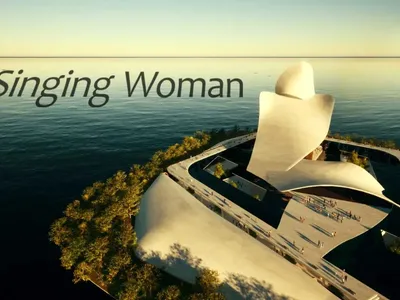
Singing Woman: Contemporary Architecture Inspired by Estonia’s Voice and the Sea
Singing Woman turns Estonia’s song culture into flowing opera house architecture, blending public life, landscape, sea, and national memory.
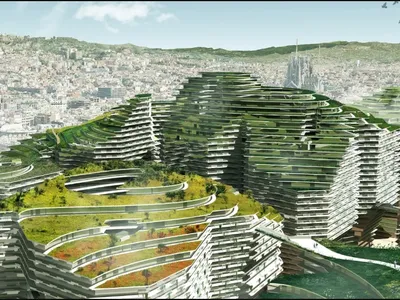
Manzana Morphosis: Stretching Barcelona's Grid into a Living Landscape for 2050
A radical reworking of the Eixample manzana turns density into a tool for generous public space, vertical ecology, and environmental performance.
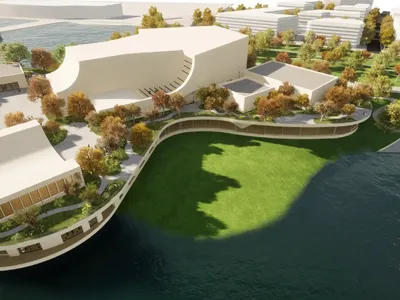
The Amber Palace Opera: A Geological Fiction Surfaces on Tallinn's Baltic Waterfront
Pierre Brillard reimagines a Baltic legend as a public landscape, opera house, and waterfront promenade rooted in Tallinn's coastal identity.
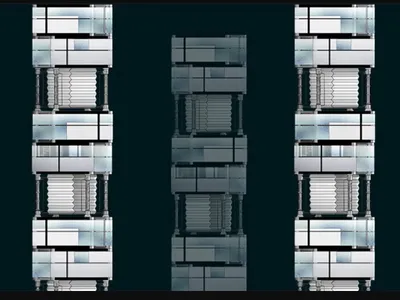
Tsunami Convergenics: Turning Catastrophic Ocean Forces into Underwater Housing Infrastructure
A speculative underwater settlement off the coast of Onagawa, Japan, treats tsunamis and typhoons as energy sources rather than threats.

Similar Reads
You might also enjoy these articles


Hodi-Mandai Geram
Project Function: Preservation and revitalization of the Intangible heritage and socio-spatial identity of the Hodi by Housing, Cultural Memory Center, Sacred Grove, landscape, local tourism economy


Olio Towers: A Mid-Rise for Performers That Fuses Housing, Rehearsal, and Stage
Located blocks from Houston's Theater District, this modular tower stacks living units around a central performance atrium.

Oasis: Modular Green Housing Carved into Dhaka's Urban Fabric
A shortlisted Plugin Housing entry reclaims unauthorized settlements in Dhaka with stepped concrete volumes, green roofs, and ventilation-driven design.

Black Hole: A Floating Megastructure for the Post-Physical Era
Emiliano Mazzarotto envisions a spherical, self-scaling arena where e-sports, digital hotels, and holographic stadiums replace traditional public space.

Explore Tree House Competitions
Discover active competitions in this discipline

Challenge to reimagine the Iron Throne

Photograph architecture without architects

Illustrate the lost glory of Angkor Wat - Render Challenge

Design challenge to reuse E-waste
Comments (0)
Please login or sign up to add comments
No comments yet. Be the first to comment!