

Trees & Traces – The (In)visible Pavilion by Plastique Fantastique
An immersive pavilion in Seoul blending history, reflection, and sound, reconnecting visitors with Songhyeon-dong’s forgotten past and urban transformation.


A Temporal Bridge Between Past and Present in Seoul
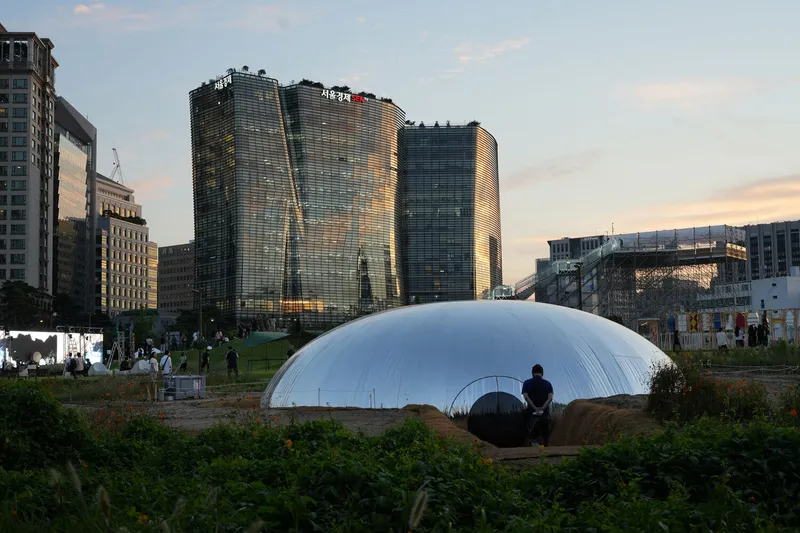
In the heart of Seoul, adjacent to the historic Gyeongbokgung Palace, a striking architectural intervention emerges—Trees & Traces – An (In)visible Pavilion by Plastique Fantastique. Designed for the 4th Seoul Biennale of Architecture and Urbanism, this ephemeral structure redefines spatial and temporal boundaries, seamlessly integrating the past and present.
Located in Songhyeon-dong, a site with a dynamic and layered history, the pavilion serves as a reflective and transparent space that invites visitors to engage with the invisible traces of time. The project’s design concept plays on dualities—its mirrored surface reflects the surrounding city, while its transparent interior unveils a hidden narrative of Seoul’s urban evolution.
Unveiling History: A Site of Rediscovery
Plastique Fantastique, led by architects Yena Young and Marco Canevacci, delved into the history of the site to uncover its buried heritage. During an exploratory visit in April 2023, they unearthed artifacts embedded in the soil—tangible fragments of the past now integrated into the installation’s earthen wall. These relics narrate forgotten stories, allowing visitors to experience the layered history of Songhyeon Green Plaza.

A Sensory Experience: Light, Sound, and Space
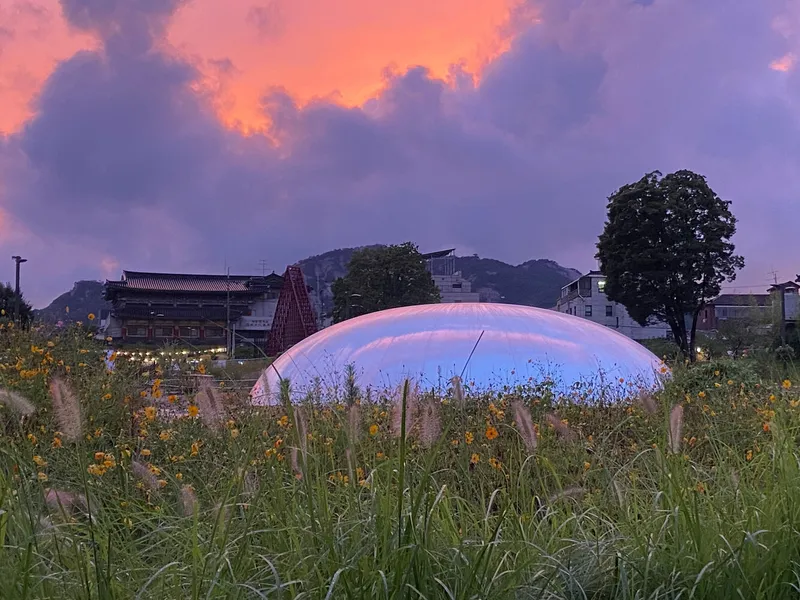
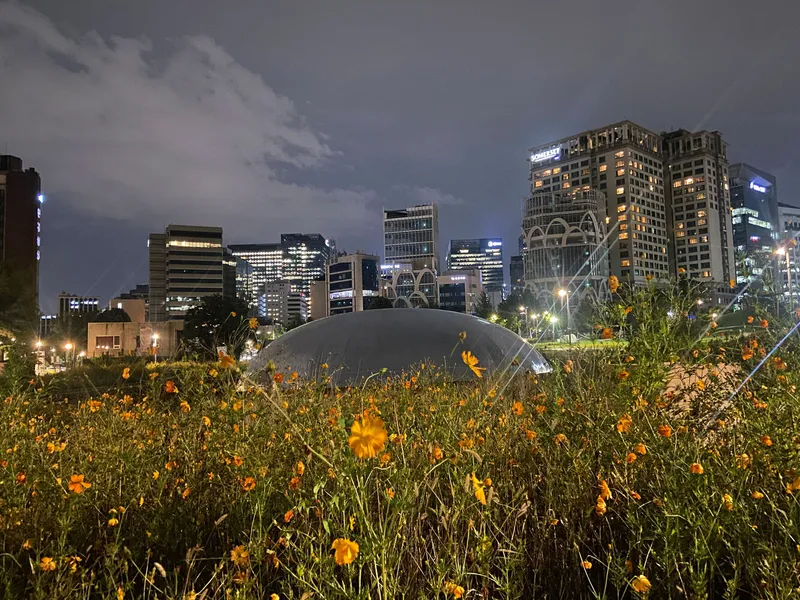
The pavilion transcends traditional architecture by engaging multiple senses. An immersive soundscape echoes the long-lost pine forest that once stood in this location, believed to have channeled energy towards the royal palace. The interplay of light and reflection, combined with the soft murmur of nature’s past, creates a dreamlike experience that dissolves the barriers between memory and modernity, nature and the urban landscape.
The installation’s futuristic yet archaic presence invites visitors to question their perception of time, history, and the role of architecture in preserving cultural memory. Through its interplay of acoustic memories, visual reflections, and tactile experiences, the pavilion offers a unique dialogue between Seoul’s past and its evolving urban future.
A Reflection on Architecture and Urbanism
As part of the Seoul Biennale, Trees & Traces serves as a thought-provoking exploration of architecture’s ability to reconnect people with forgotten landscapes. The pavilion challenges conventional structures, transforming into a living archive of the site's architectural and ecological history.
By merging contemporary design, historical research, and sensory engagement, Plastique Fantastique has crafted an installation that redefines the essence of architectural storytelling—an ephemeral yet profound experience that lingers in the minds of those who visit.



Popular Articles
Popular articles from the community


Co-Life: Senior Housing Design That Reconnects Older Adults With the City
Co-Life reimagines senior housing design through healing gardens, shared streets, workshops, and a sustainable community across generations.

Conexión: Biophilic Design Reimagines High-Rise Living in Hong Kong
Conexión reimagines high-rise living in Hong Kong through biophilic design, green facades, shared spaces, daylight, water and nature within.

AL-JANNAH: Sustainable Architecture and Permaculture for Afghan Widows
AL-JANNAH uses sustainable architecture and permaculture to create resilient oasis of housing, learning, work and renewal for Afghan widows.

Riyadh For All: Intergenerational Urban Design for Active Aging in Rabat
Riyadh For All reimagines urban design in Rabat with intergenerational co-living, adaptive courtyards, and Moroccan cultural exchange today.


Similar Reads
You might also enjoy these articles


Hodi-Mandai Geram
Project Function: Preservation and revitalization of the Intangible heritage and socio-spatial identity of the Hodi by Housing, Cultural Memory Center, Sacred Grove, landscape, local tourism economy


Olio Towers: A Mid-Rise for Performers That Fuses Housing, Rehearsal, and Stage
Located blocks from Houston's Theater District, this modular tower stacks living units around a central performance atrium.

Oasis: Modular Green Housing Carved into Dhaka's Urban Fabric
A shortlisted Plugin Housing entry reclaims unauthorized settlements in Dhaka with stepped concrete volumes, green roofs, and ventilation-driven design.

Black Hole: A Floating Megastructure for the Post-Physical Era
Emiliano Mazzarotto envisions a spherical, self-scaling arena where e-sports, digital hotels, and holographic stadiums replace traditional public space.


Explore Remembrance Pavilion Competitions
Discover active competitions in this discipline


Challenge to design a portable theatre


Challenge to design a portable music platform

Challenge to design an open learning module for the elderly


Challenge to reimagine the Iron Throne
Comments (0)
Please login or sign up to add comments
No comments yet. Be the first to comment!