
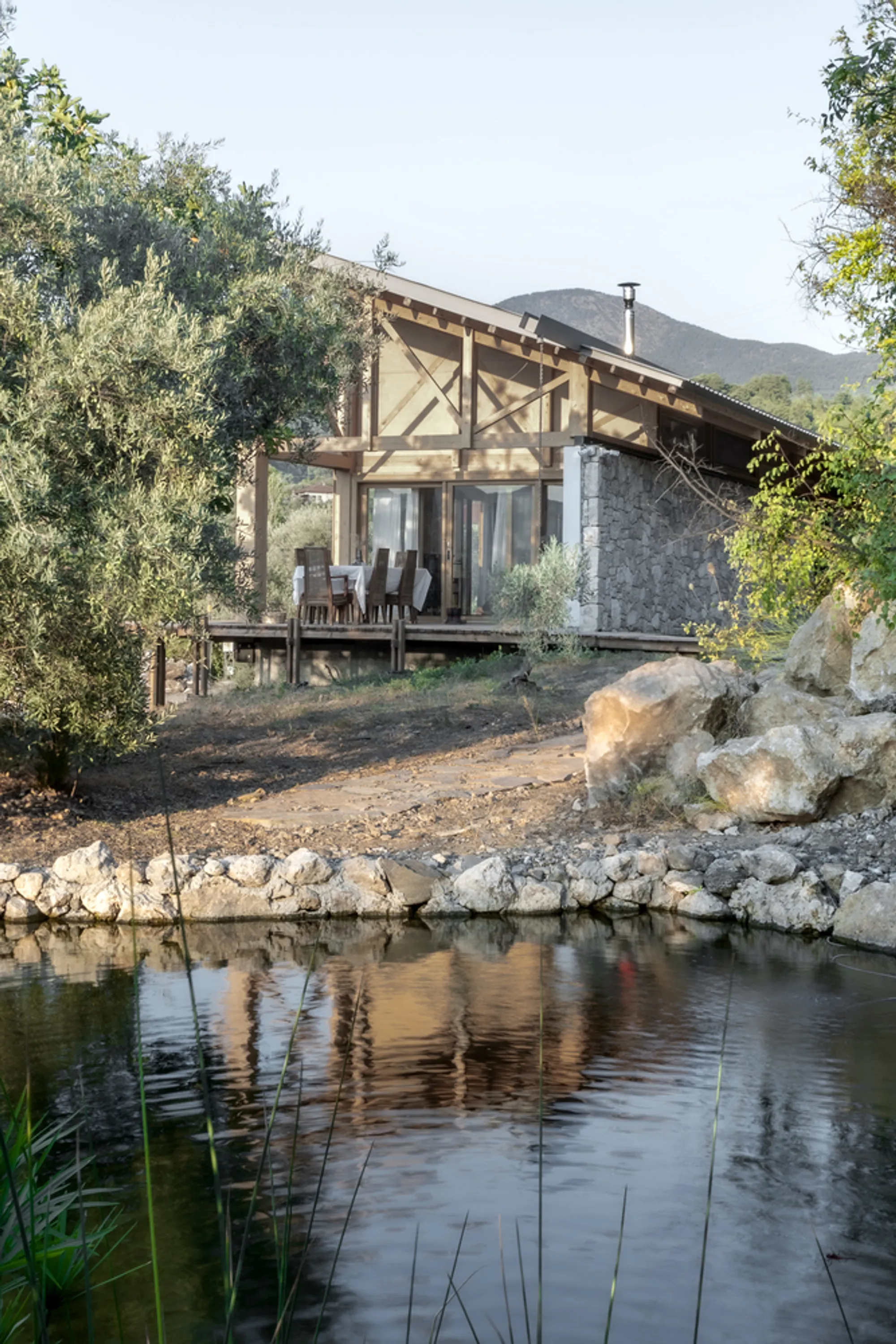
SO? Architecture and Ideas Splits a Turkish Hillside House Between Stone and Timber
Two Face House in Turkey layers rubble stone walls and exposed timber trusses into a dwelling that reads differently from every angle.


A house that changes identity depending on where you stand is a tricky thing to pull off without slipping into pastiche. SO? Architecture and Ideas manages it with Two Face House, a rural dwelling in Turkey's mountainous landscape that presents one face in rubble stone and another in exposed timber framing. Neither material dominates; instead, the building oscillates between the two, reading as a vernacular stone farmhouse from one vantage and as a light, braced timber pavilion from another.
What makes the project genuinely interesting is the refusal to segregate old from new. The stone and the timber are not applied to different wings or stacked in a before-and-after diagram. They coexist wall by wall, sometimes within a single elevation, so the house never settles into a single stylistic register. The result is a building that earns its name: two faces, one body, and an argument that rural construction can hold contradiction without anxiety.
Dual Materiality on a Hillside
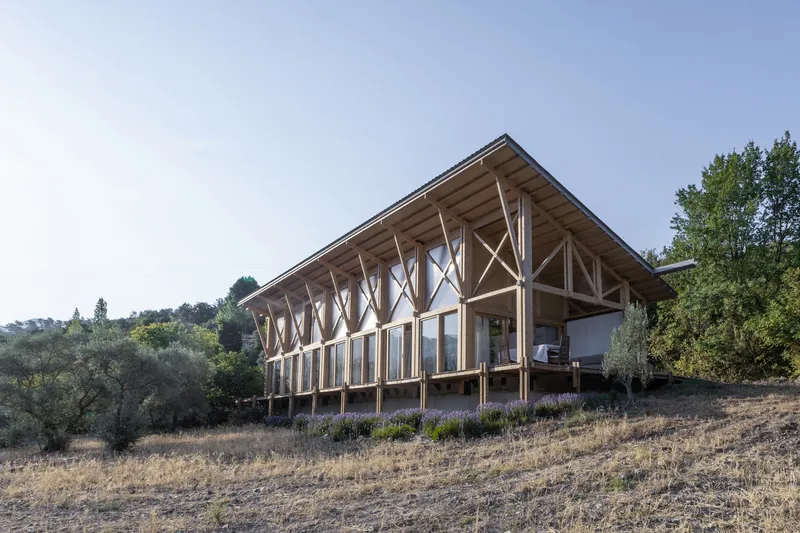
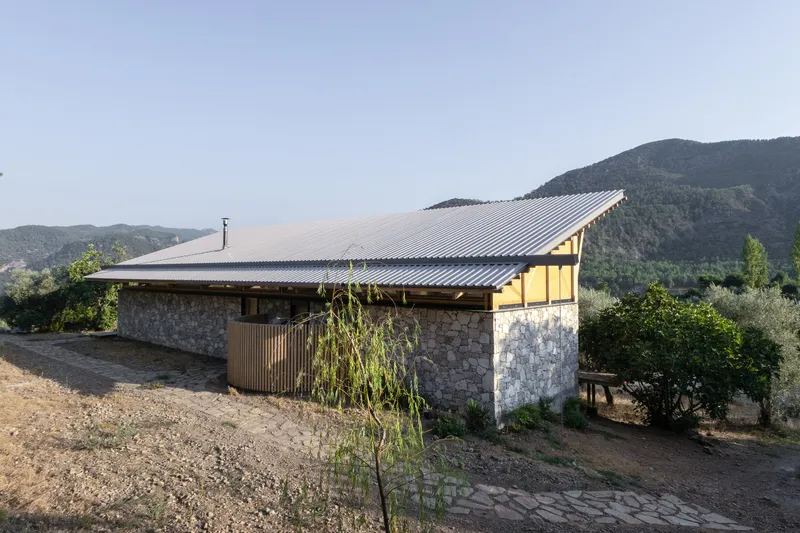
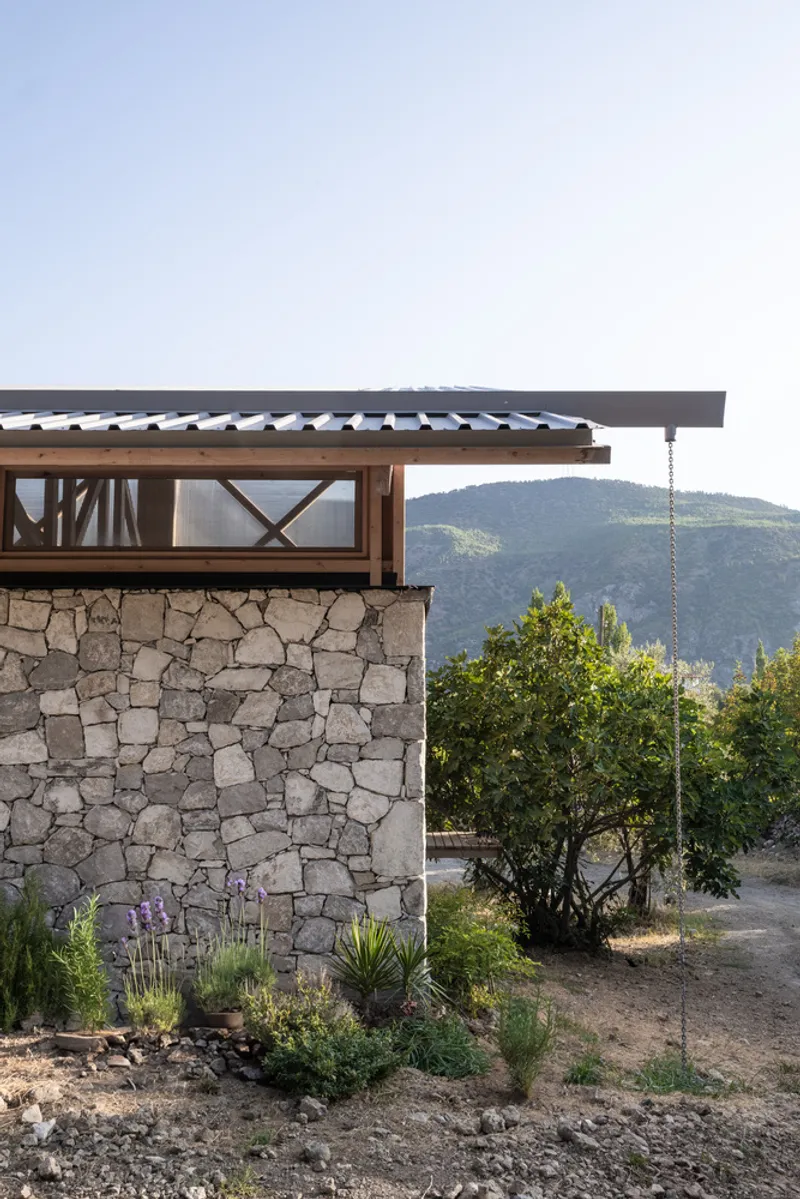
The building sits on a sloped site thick with lavender and dry grass, a landscape that already suggests a tension between cultivated and wild. Stone walls anchor the house to the terrain, their rough rubble texture blending with the rocky hillside as if they had always been there. Above and beside them, timber frames appear with diagonal bracing fully exposed, their geometry unmistakably structural rather than decorative.
Corrugated metal roofing spans across both systems, providing a pragmatic lid that refuses to pick a side. It is not a traditional tile roof playing along with the stone, nor a sleek contemporary sheet trying to match the timber's linearity. It simply covers the house, letting the walls below fight it out.
Covered Terraces and the Space Between Inside and Out
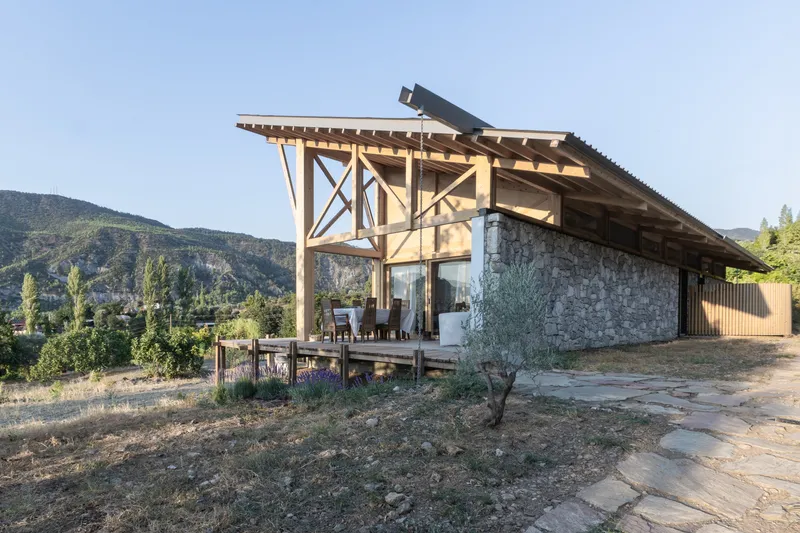
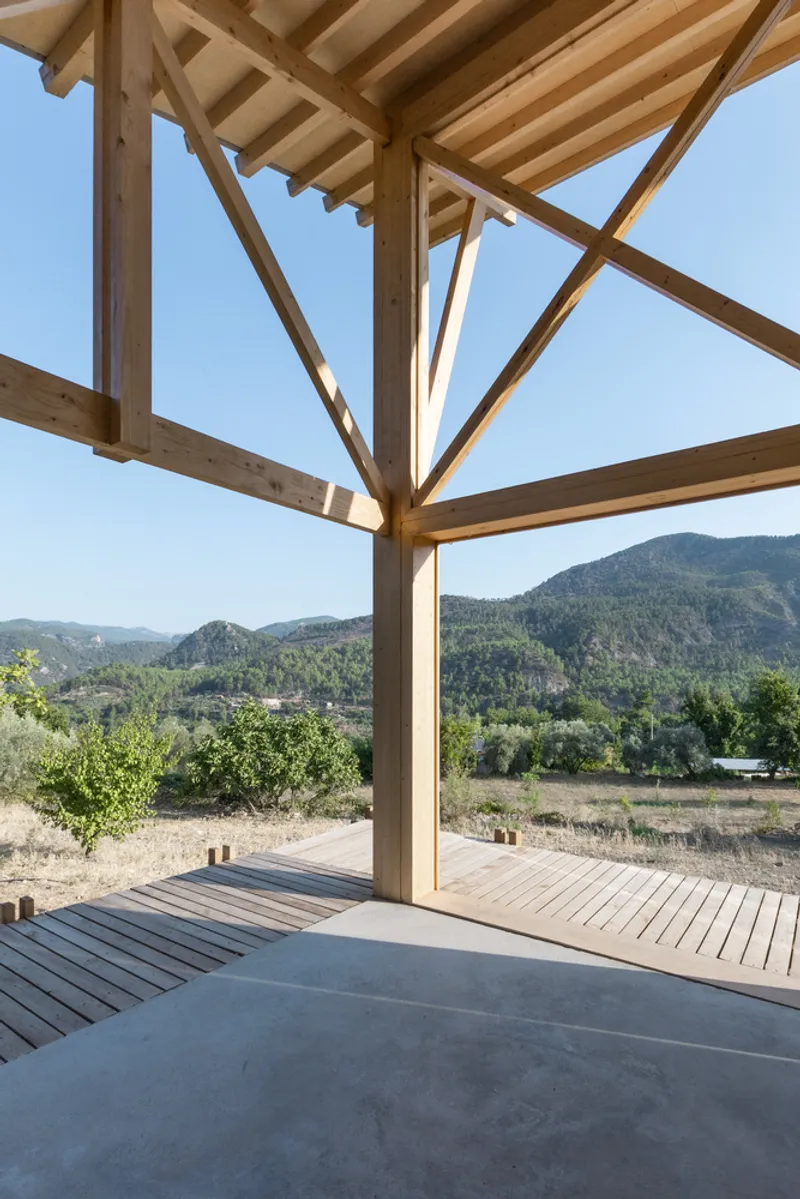
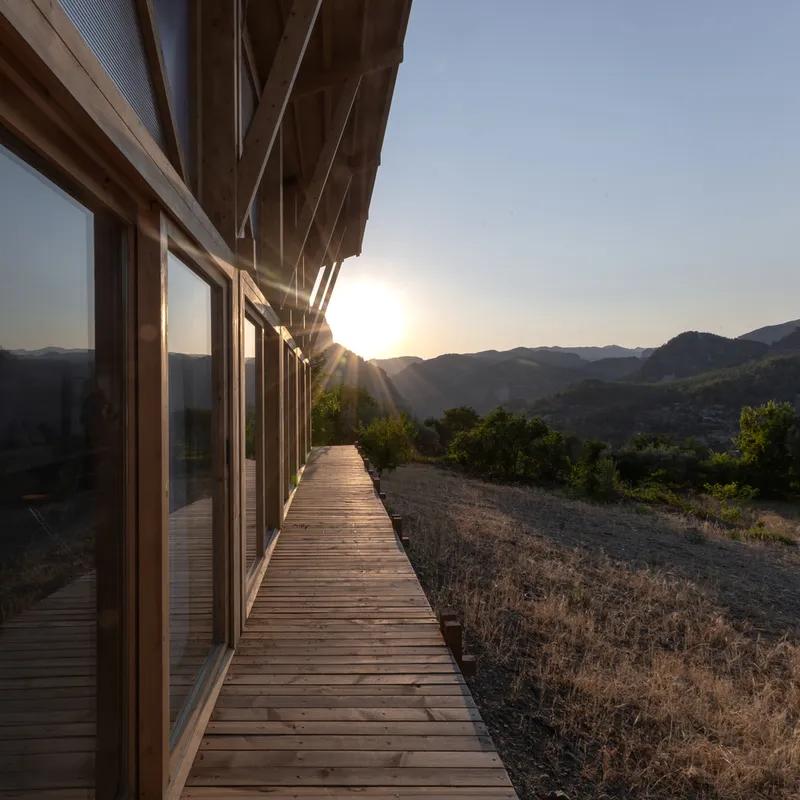
Some of the most accomplished spaces in the house are neither interior nor exterior. Deep covered terraces, formed by extending the roof well beyond the enclosure line, create zones where timber rafters radiate overhead and stone walls form a partial backdrop. These porches face the mountain foothills and collect the last light at dusk, turning the act of sitting outside into something almost ceremonial.
The timber deck at the building's edge, captured at sunset, shows how carefully the architects calibrated the relationship between structure and view. Exposed rafters frame the landscape without obstructing it, and the glazed facade behind acts as a thin membrane rather than a hard boundary. You are always aware of the mountains, whether you are inside, outside, or in between.
Interior Timber Frames as Spatial Events
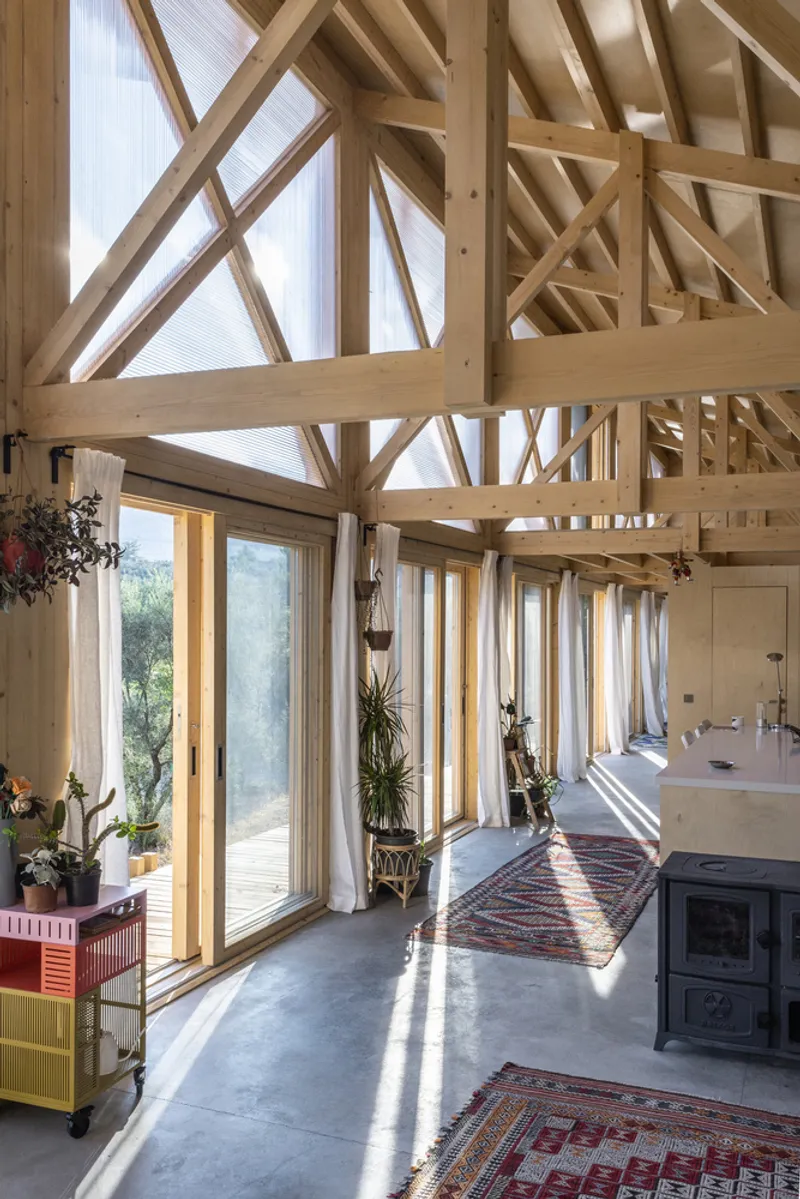
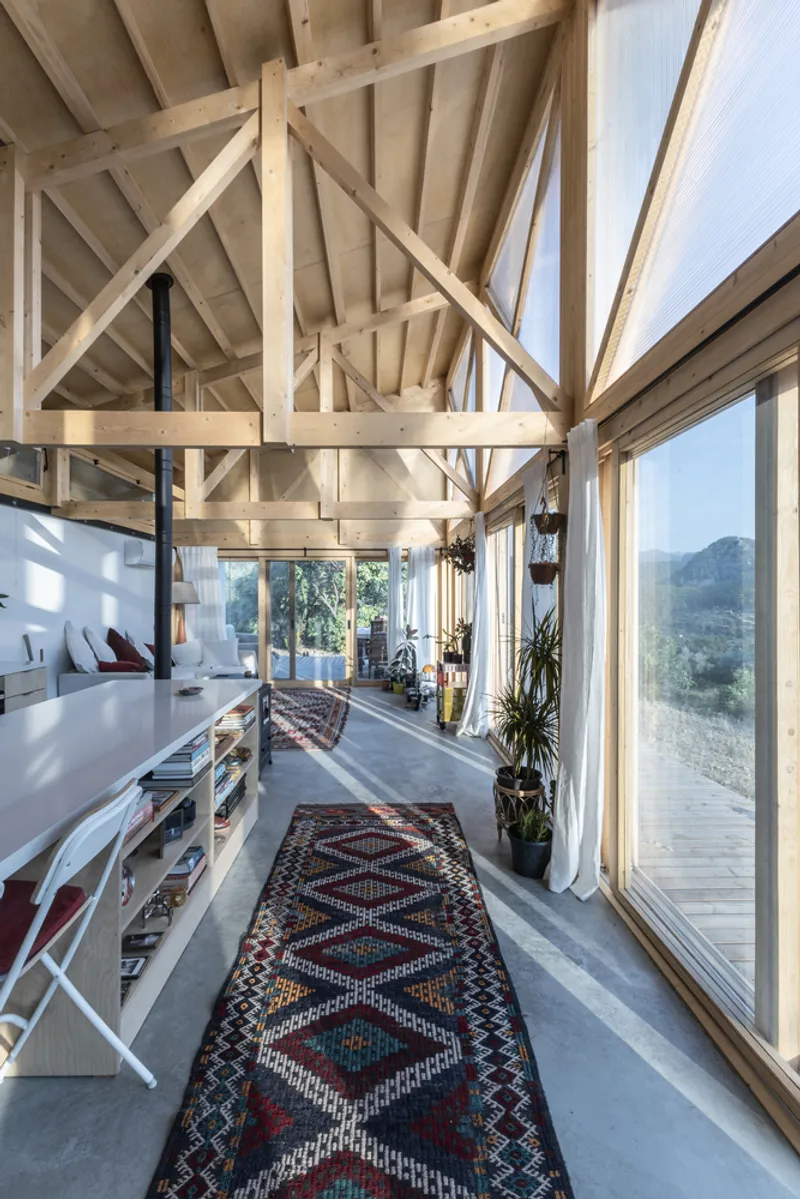
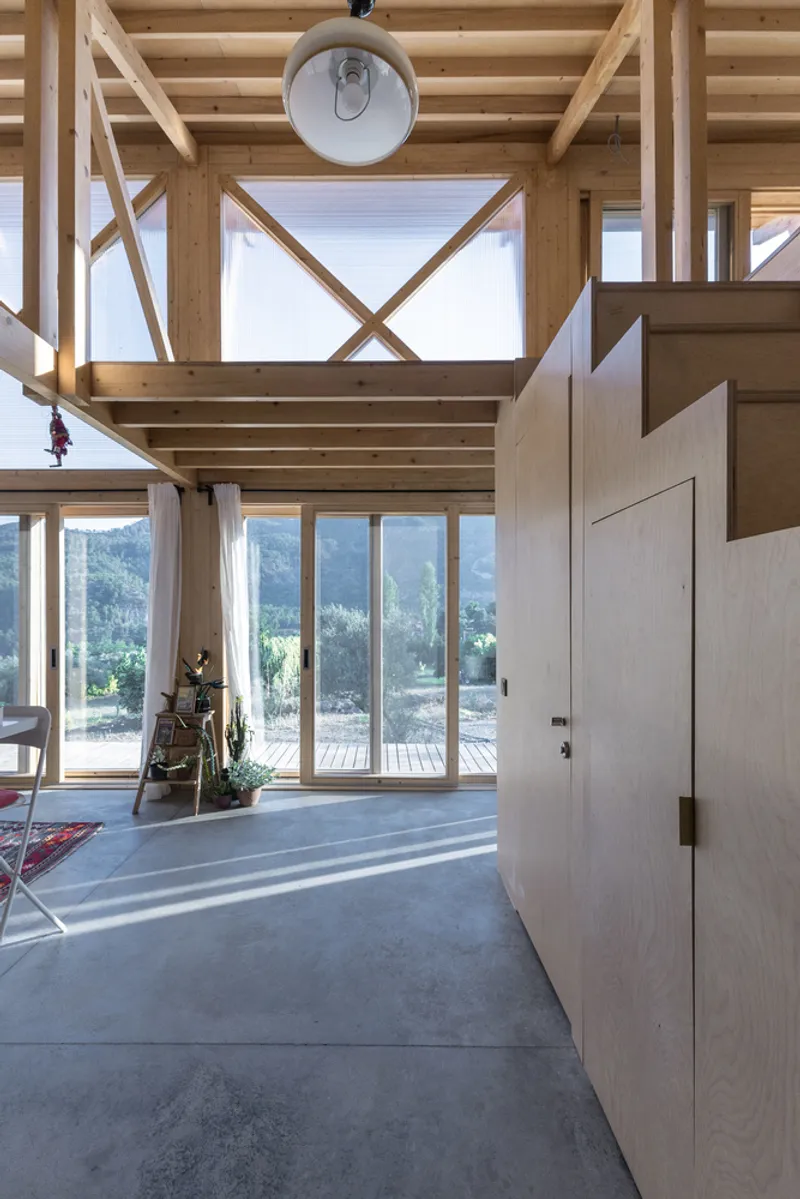
Inside, the diagonal bracing that defines the exterior elevations becomes a spatial device. In the entry hall, cross-braced timber frames throw sharp shadows across the concrete floor, turning a simple corridor into a lattice of light and structure. The effect is heightened where floor-to-ceiling glazing meets the truss ceiling: the interior reads as an inhabited framework rather than a closed room.
The architects resist the urge to clad or conceal any of this. Every joint, every brace, every rafter is visible and legible. A patterned rug beneath the exposed trusses provides a deliberate counterpoint, a flat, decorative surface set against the three-dimensional logic of the frame above.
Screens, Slats, and Filtered Light
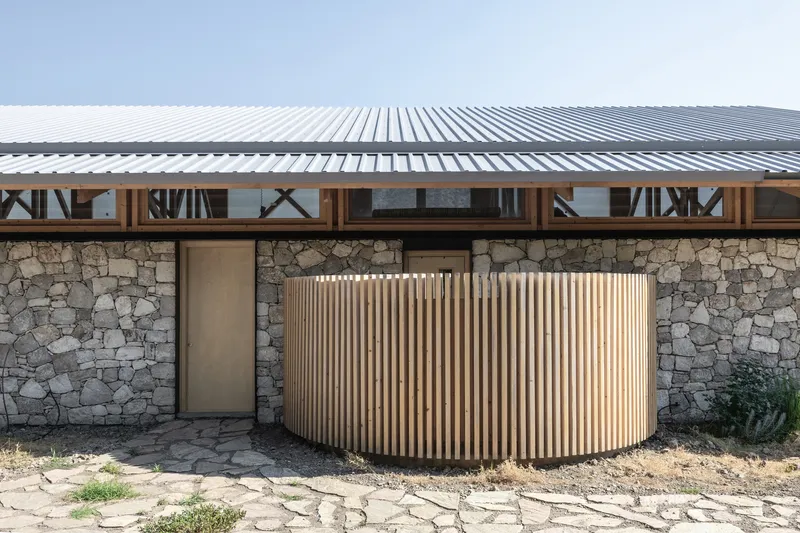
Where the house needs to modulate privacy or solar gain, curved timber slat screens step in. These elements curve gently away from the stone walls beneath the corrugated roof overhang, filtering daylight into bands rather than blocking it outright. It is a strategy borrowed from traditional Turkish screens, reinterpreted in wider slats and a less ornamental geometry.
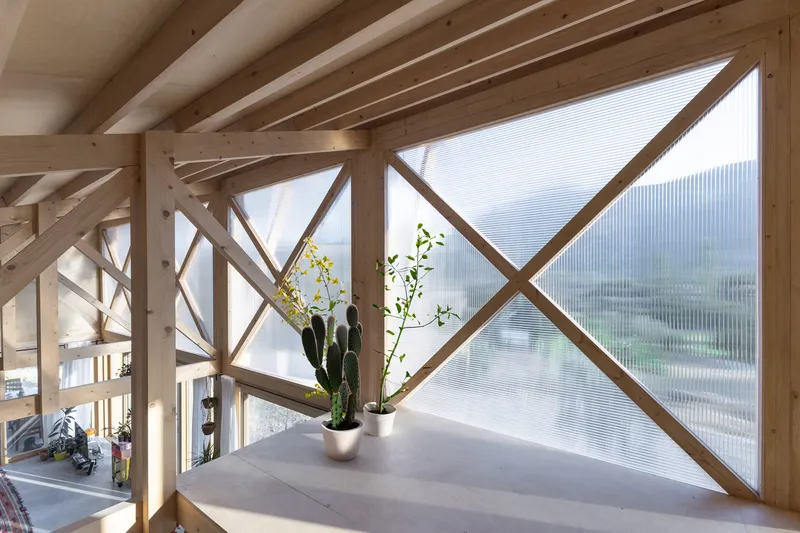
Translucent corrugated panels appear in select locations, framing potted cacti on concrete sills and letting diffused light wash into corners that glazing would over-expose. The material palette is narrow but precisely deployed: stone, timber, metal, and the occasional translucent panel, each doing a specific job.
Water, Landscape, and Domestic Rituals
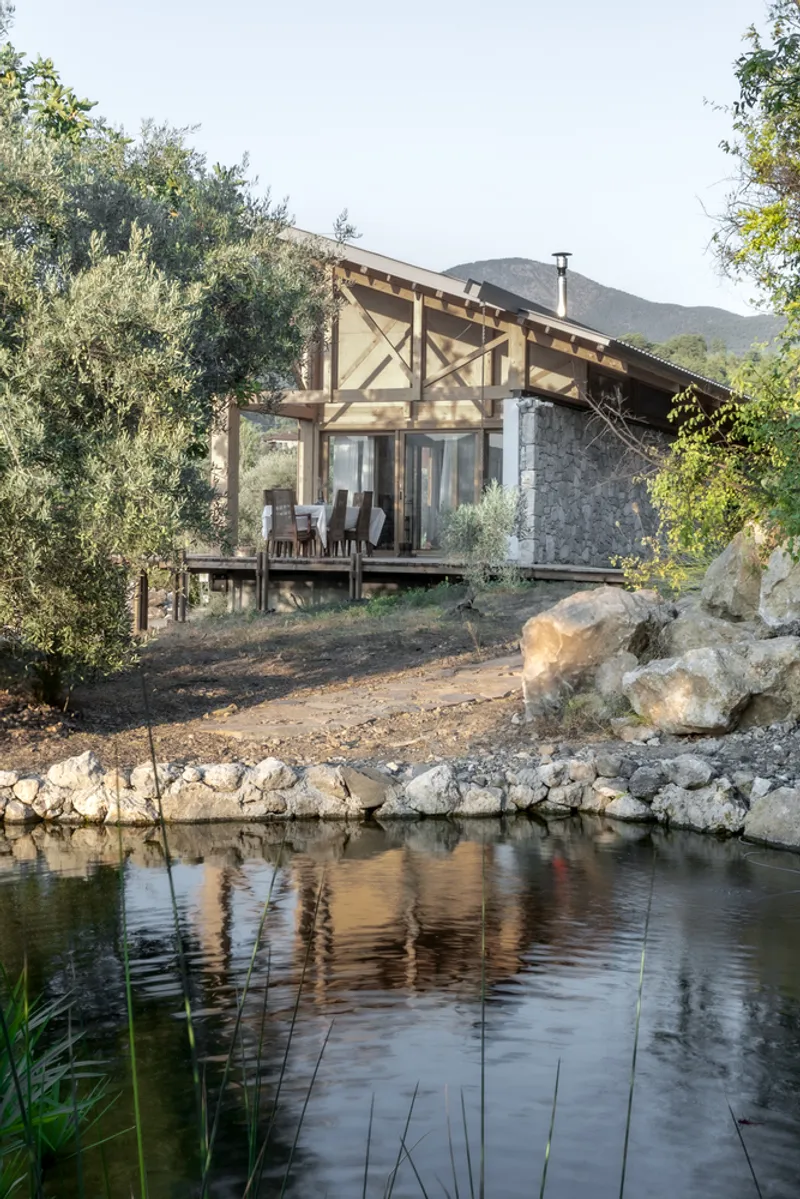
A still reflecting pond at the building's base doubles the timber deck and stone facade into a mirror image, adding a contemplative dimension to an otherwise muscular material composition. Native plantings surround the pool, grounding the house in its ecological context rather than the imported lawn aesthetic that plagues so many rural projects.
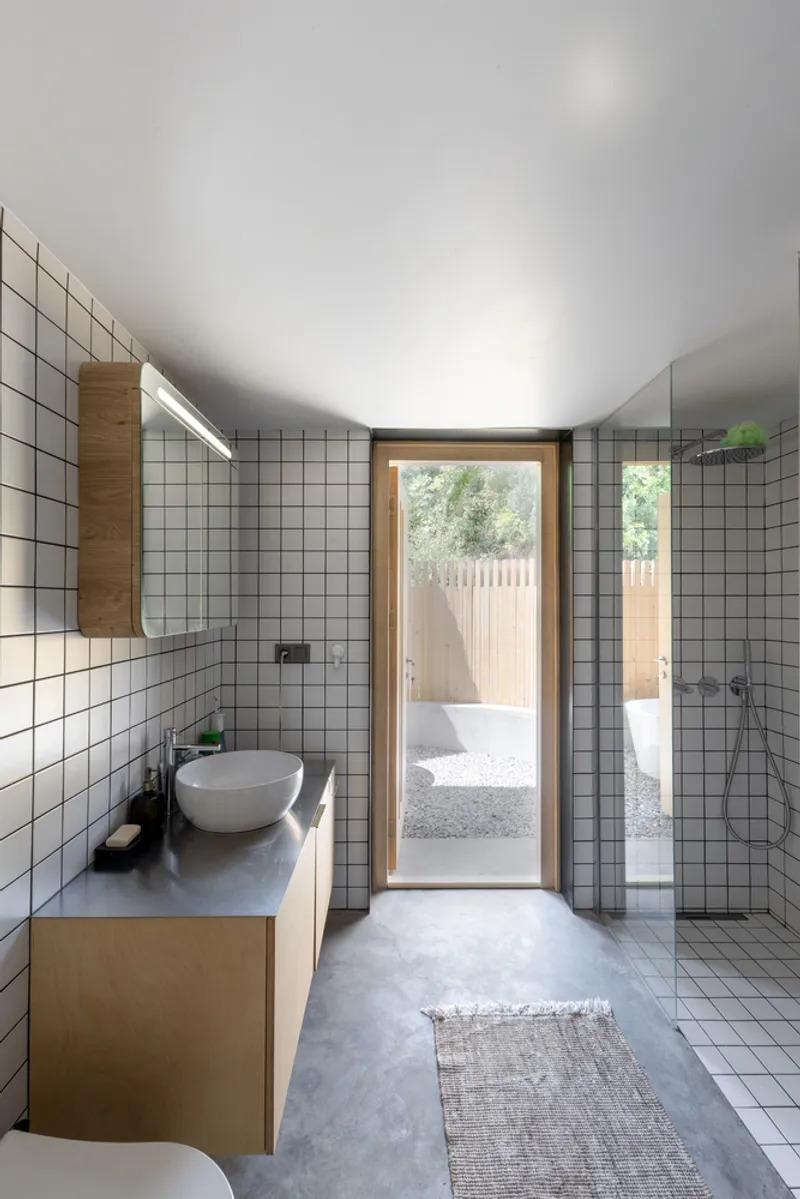
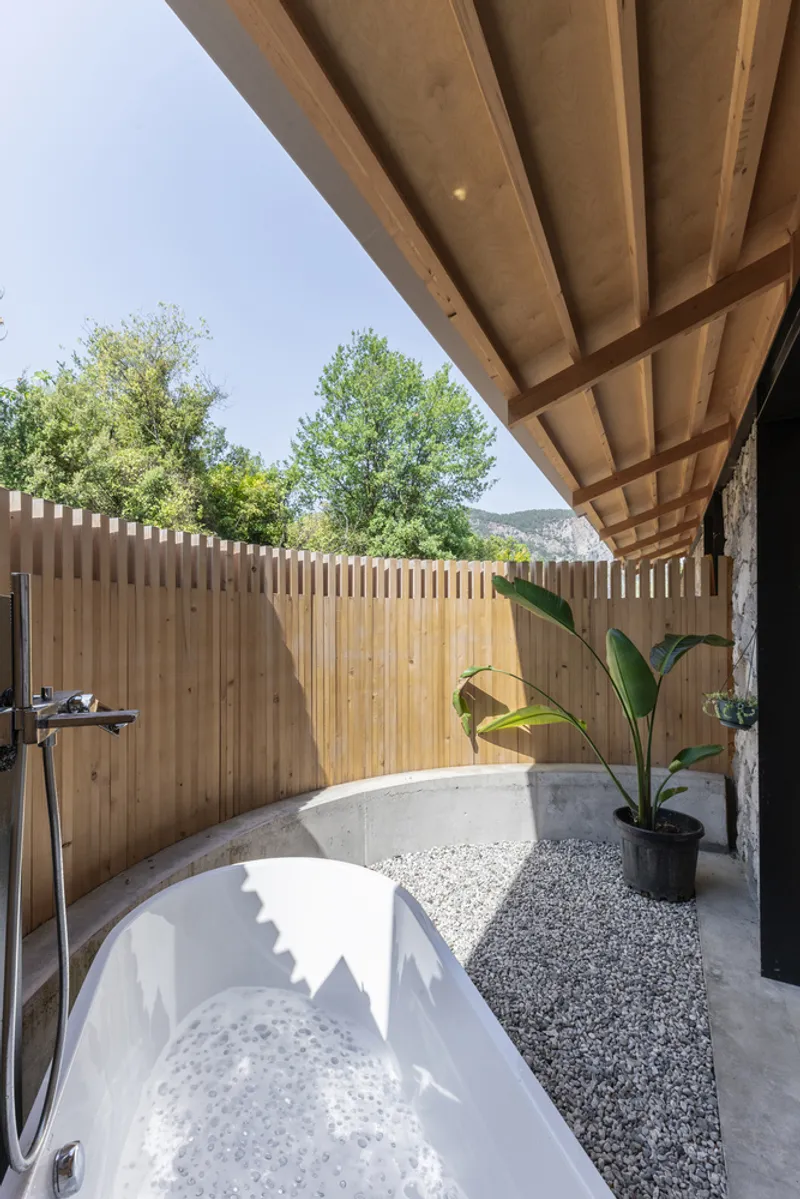
The outdoor bathtub beneath a timber canopy and the bathroom opening onto a gravel courtyard suggest that the architects treated domestic rituals with the same spatial ambition as the public rooms. Bathing is not hidden away; it is framed by slatted fences and potted plants, given its own architectural moment.
The Rear Elevation and Gable Logic
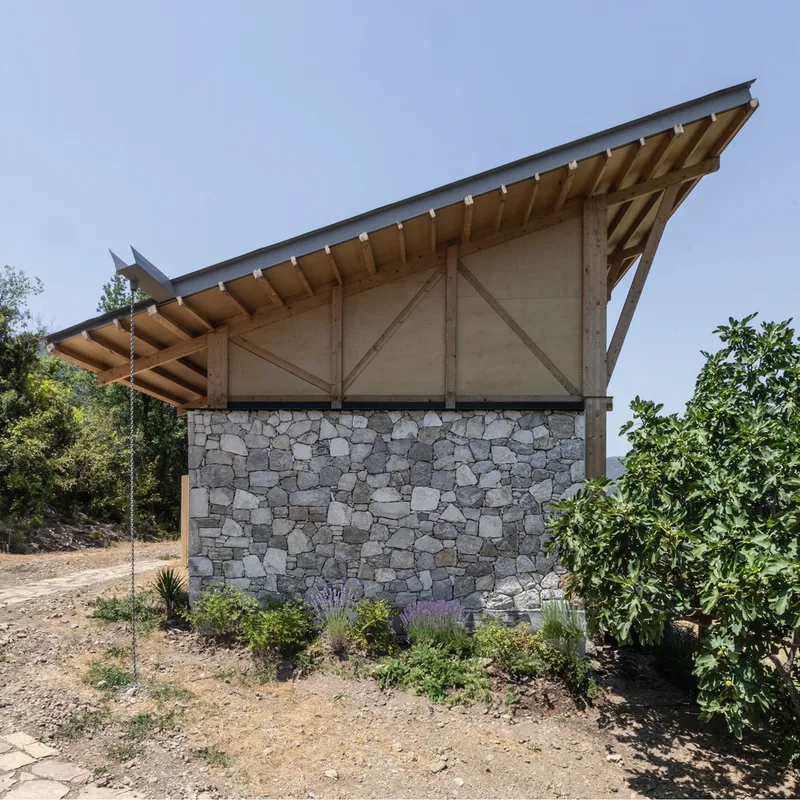
The rear gable end may be the most revealing elevation. Here, timber truss infill panels sit above rubble stone walls, and planted beds soften the base. The composition is frank: stone carries the weight, timber fills the gable, and the roof ties both together. No cladding, no trim, no attempt to make the junction invisible. The joint between the two materials is simply where one stops and the other begins.
Plans and Drawings
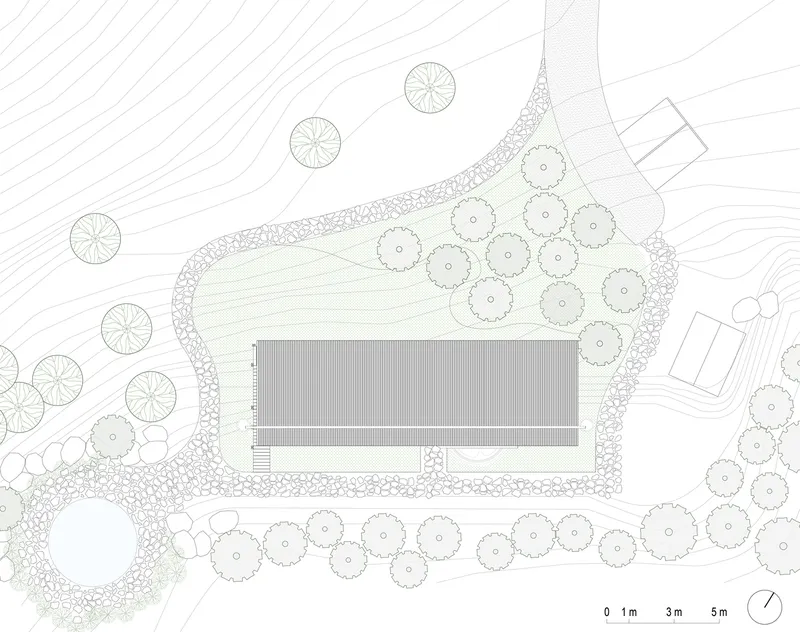
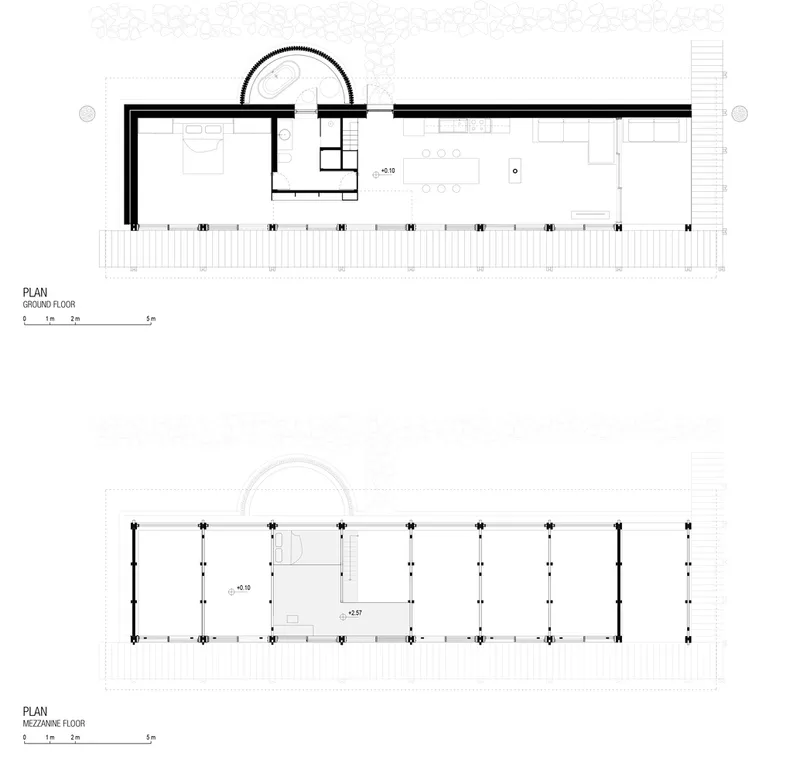
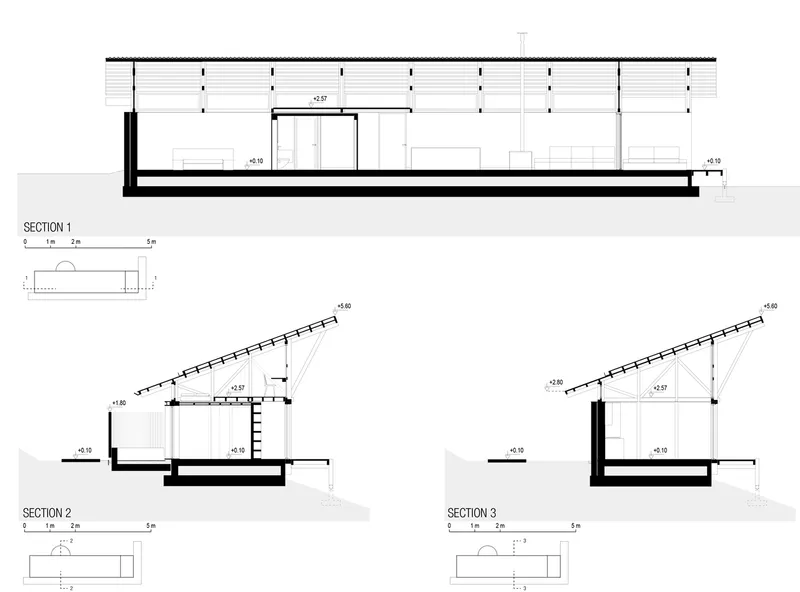
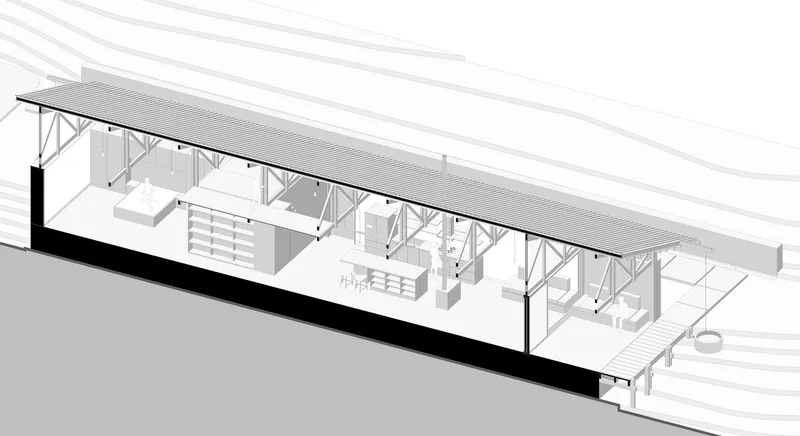
The site plan confirms what the photographs suggest: a rectangular footprint oriented along the slope, with trees and landscaping contours wrapping the building. The ground floor and mezzanine plans reveal a linear layout organized by a clear structural grid, with habitable space distributed along the length rather than stacked vertically. Sections cut through the building expose the sloped roof structure and the open interior volumes created by the exposed trusses, making legible the spatial ambition that drives the entire project.
Why This Project Matters
Two Face House avoids the two most common traps in rural residential architecture: uncritical reproduction of the vernacular and aggressive modernist imposition. By weaving stone and timber together without hierarchy, SO? Architecture and Ideas creates a building that belongs to its landscape without pretending it was always there. The honesty of the joints, the legibility of the structure, and the careful calibration of covered outdoor space all point to an architecture that respects craft as much as concept.
The project matters because it demonstrates that duality does not require division. The two faces of the house are not split down the middle or assigned to separate volumes. They coexist in the same walls, under the same roof, serving the same rooms. That integration, achieved with a handful of materials and zero theatrical gestures, is more difficult than it looks and more instructive than most houses that claim to bridge tradition and modernity.
Two Face House by SO? Architecture and Ideas, Turkey. Photographs by Oral Goktas.
About the Studio
Share Your Own Work on uni.xyz
If projects like this are the kind of work you want to make, uni.xyz is a place to publish your own, find collaborators, and enter design competitions.



Popular Articles
Popular articles from the community


The Earth Pod: 3D Printed Homes for Resilient Refugee Communities
The Earth Pod reimagines refugee housing through 3D printed homes made from clay, combining resilience, self-sufficiency, and rapid shelter.

The Musturak Paradise: Senior Living Architecture for a Connected Future in Temara, Morocco
The Musturak Paradise reimagines senior living architecture in Temara via private homes, social spaces, culture, community, and shared care.

Conexión: Biophilic Design Reimagines High-Rise Living in Hong Kong
Conexión reimagines high-rise living in Hong Kong through biophilic design, green facades, shared spaces, daylight, water and nature within.

The Ocean Hive: Sustainable Architecture for a Self-Sufficient Civilization at Sea
The Ocean Hive imagines sustainable architecture at sea, where modular habitats, algae, wave power and ocean waste sustain a growing colony.

Similar Reads
You might also enjoy these articles


Hodi-Mandai Geram
Project Function: Preservation and revitalization of the Intangible heritage and socio-spatial identity of the Hodi by Housing, Cultural Memory Center, Sacred Grove, landscape, local tourism economy


Olio Towers: A Mid-Rise for Performers That Fuses Housing, Rehearsal, and Stage
Located blocks from Houston's Theater District, this modular tower stacks living units around a central performance atrium.

Oasis: Modular Green Housing Carved into Dhaka's Urban Fabric
A shortlisted Plugin Housing entry reclaims unauthorized settlements in Dhaka with stepped concrete volumes, green roofs, and ventilation-driven design.

Black Hole: A Floating Megastructure for the Post-Physical Era
Emiliano Mazzarotto envisions a spherical, self-scaling arena where e-sports, digital hotels, and holographic stadiums replace traditional public space.

Explore Double Skin Facade Competitions
Discover active competitions in this discipline



Challenge to reimagine the Iron Throne


Photograph architecture without architects


Illustrate the lost glory of Angkor Wat - Render Challenge


Design challenge to reuse E-waste
Comments (0)
Please login or sign up to add comments
No comments yet. Be the first to comment!