
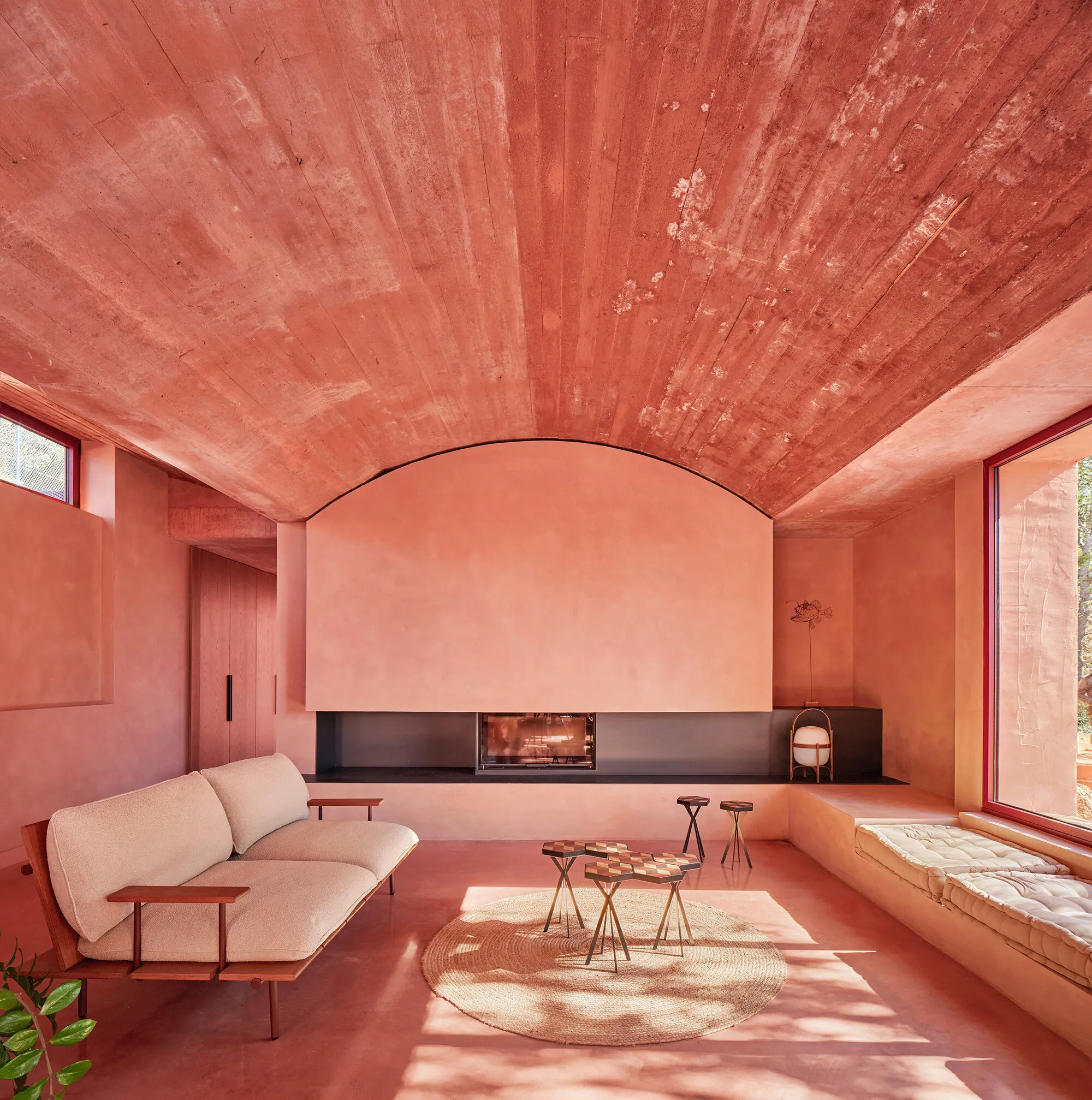
TwoBo Arquitectura Buries a Pigmented Concrete House into a Catalan Mountainside
At the foot of La Mola peak near Barcelona, two reddish volumes split around an oak grove to become part of the terrain itself.


The name says it all. Sota la Mola, beneath La Mola, the highest point in the Sant Llorenç del Munt i l'Obac Natural Park outside Barcelona. TwoBo arquitectura, the studio led by María Pancorbo, Alberto Twose, and Pablo Twose, received a commission from a couple with two children who had spent fifteen years in Australia and wanted to root themselves back into the Catalan landscape. The architects answered not with a house that sits on the land but with one that seems to have grown out of it: reddish pigmented concrete matching the conglomerate cliffs above, walls partially buried in the slope, and a rock discovered during excavation left in place and folded into the courtyard.
What makes this project genuinely compelling is its refusal to treat the building as a single object. The 250 square meter program splits into two volumes that follow the natural water runoff of the terrain, embracing a small oak forest between them. One volume handles communal life, opening fully to afternoon sun and the mountain panorama. The other gathers the bedrooms around a cooler central courtyard suited to rest. The strategy owes a declared debt to Aalto's experimental house at Muuratsalo, but the material and tectonic language are unmistakably Catalan: vaulted ceilings that reinterpret the volta catalana at a sculptural scale, lime mortar facades, and board-formed concrete that retains the grain of its wooden formwork like a fossil record of its own making.
A Mineral Camouflage
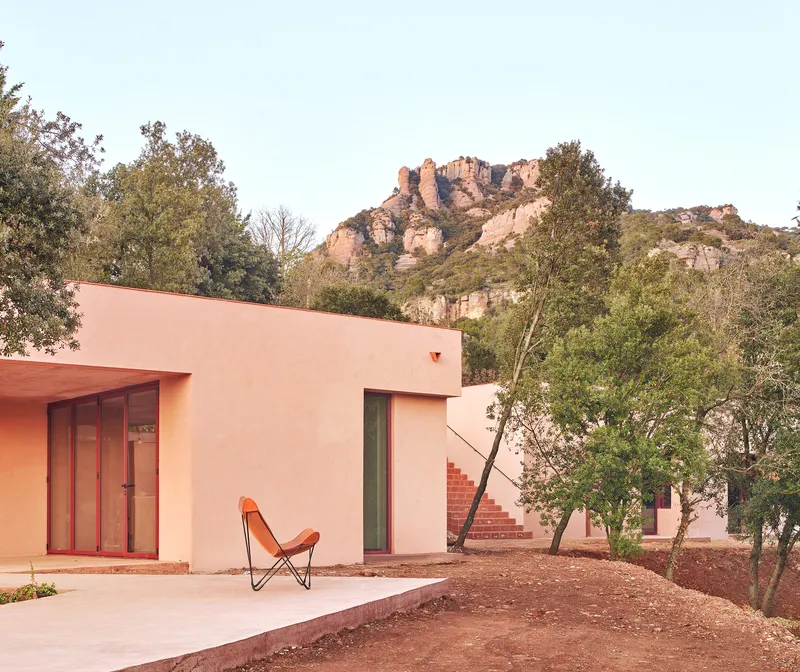
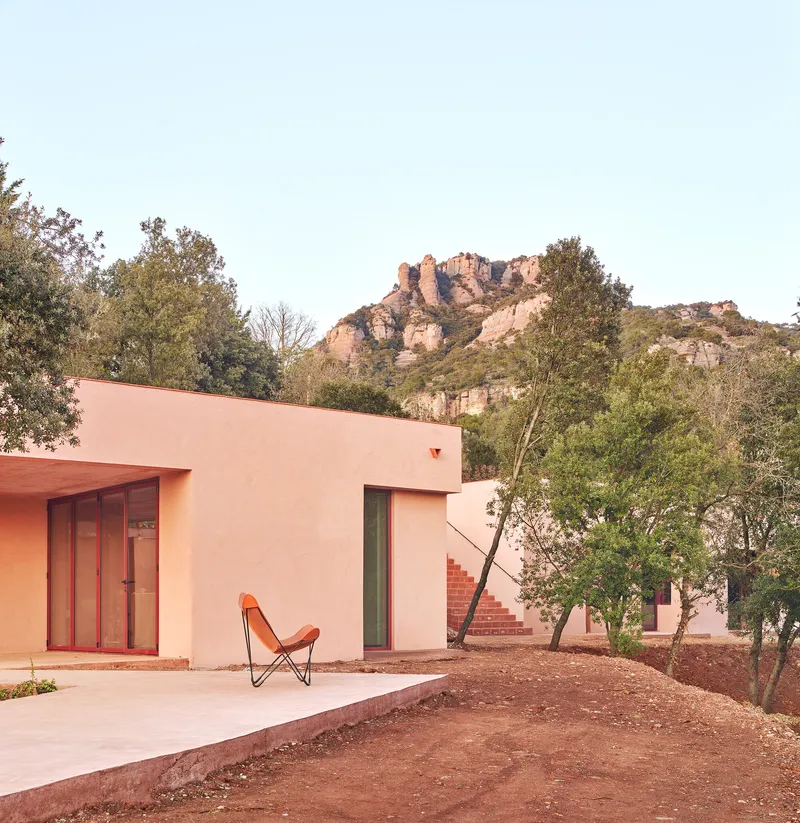
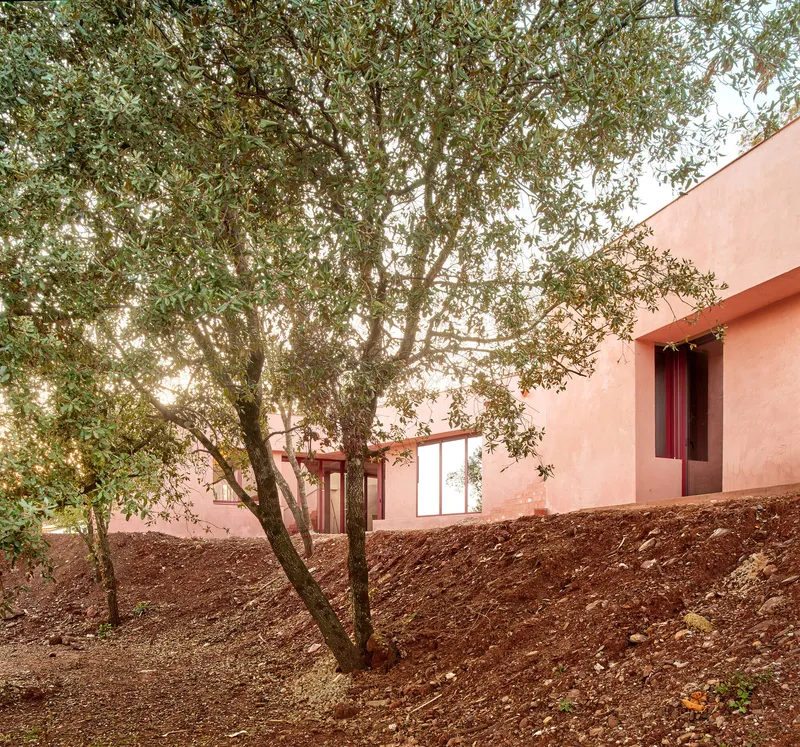
The exterior walls are pigmented to match the reddish conglomerate monoliths that define this stretch of the park. Lime mortar gives the facades a soft, matte surface that shifts in tone under different light conditions, reading almost coral in the morning and deep terracotta at dusk. Against the rocky hillside, the volumes look less like an architectural intervention and more like another stratum of the mountain. An orange butterfly chair on the concrete terrace is practically the only signal that someone lives here.
The landscaping reinforces the camouflage. Red gravel gardens, olive trees, and the preserved oaks blur the line between cultivated ground and natural slope. The house does not announce itself from the road; it is found, not displayed.
Vaults as Rooms
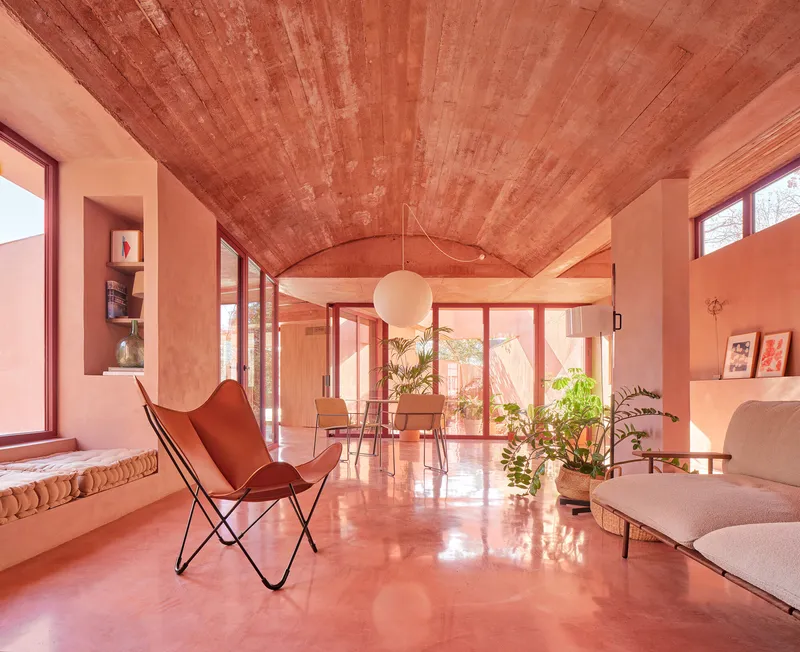
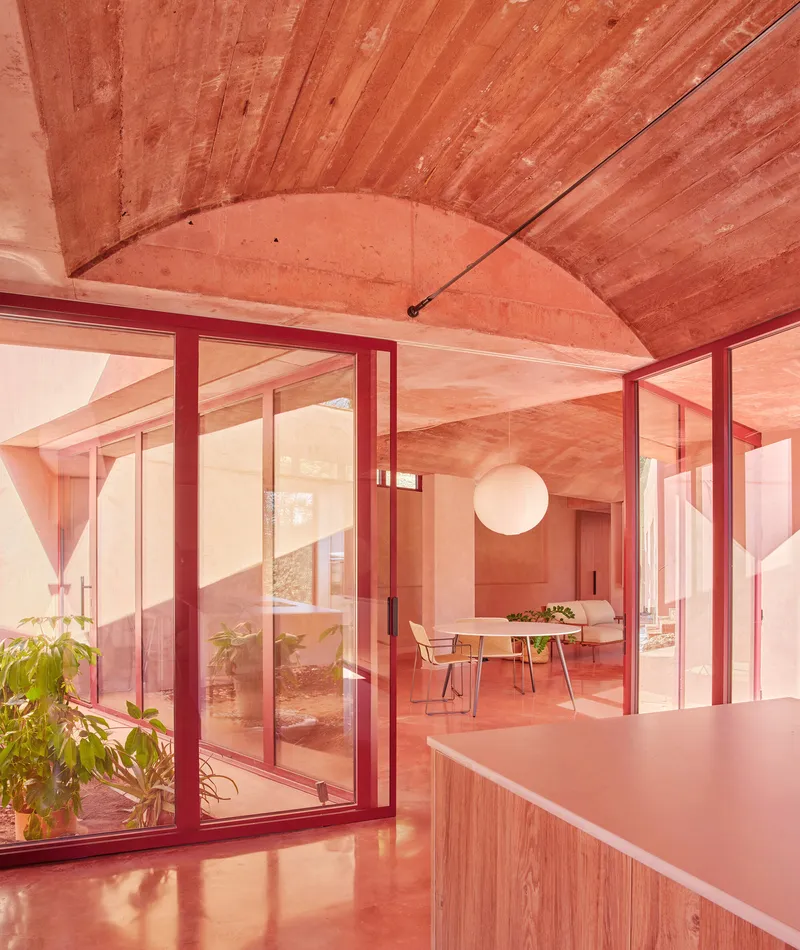
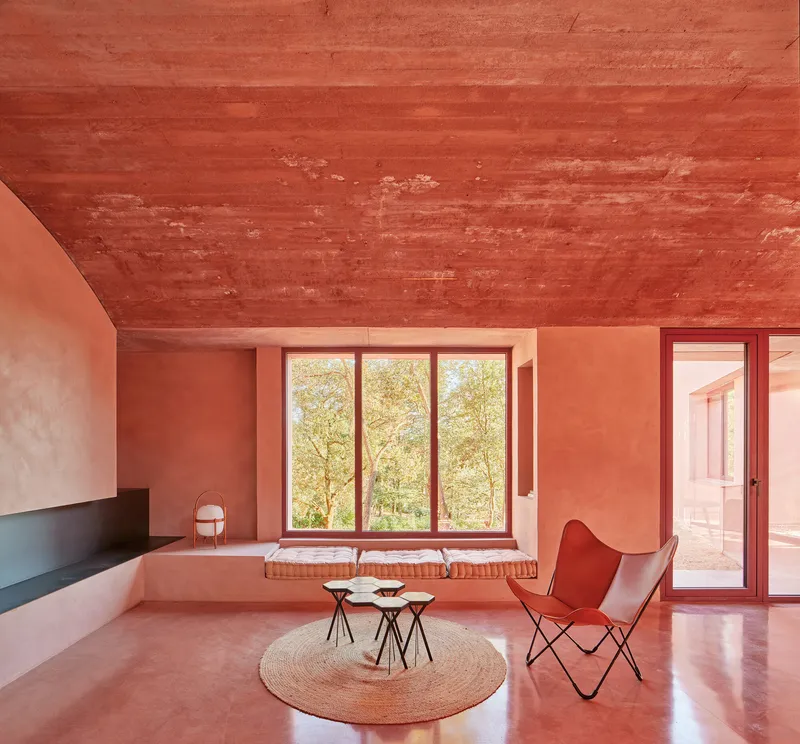
The communal volume is defined by a series of barrel vaults executed in concrete and framed with timber. The Catalan vault, or volta catalana, is a traditional thin-shell technique typically associated with brick layering. TwoBo scales it up and translates it into pigmented concrete, producing interiors that feel simultaneously archaic and contemporary. Wooden formwork leaves its imprint on every surface, so the ceilings carry a texture that reads as woven rather than poured.
The vaults do more than decorate. They organize the plan: living room, kitchen, and dining space each sit under their own arc, linked by lower threshold zones. The result is a sequence of rooms that feel distinct without relying on walls or doors to separate them. Low window sills let afternoon light flood across the polished terracotta floors, and a built-in fireplace anchors the living room vault like the hearth of a cave.
Kitchen and Dining Under the Arc


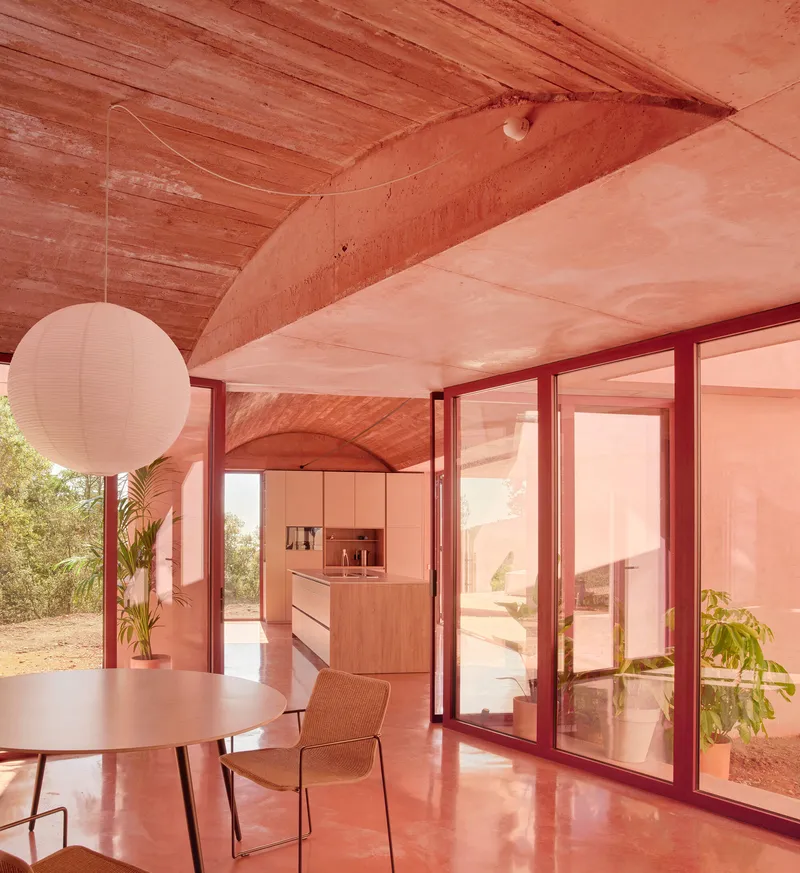
The kitchen sits under one of the most generous vaults in the house, with a timber island that anchors the center of the room while glazed doors on two sides open to the courtyard and the landscape beyond. Ceramic tiles line the vault above, shifting the material register just enough to distinguish this space from the adjacent living room without breaking the tonal continuity. Everything stays within the same warm palette: pink, terracotta, timber, and the green of potted plants brought inside.
Corner glazing at the dining end pulls the eye diagonally through the space and out to the trees, a move that makes a 250 square meter house feel considerably larger than its footprint suggests. The dining table sits where two vaults almost meet, under a seam of light that drops from a clerestory above.
Courtyard and Passage
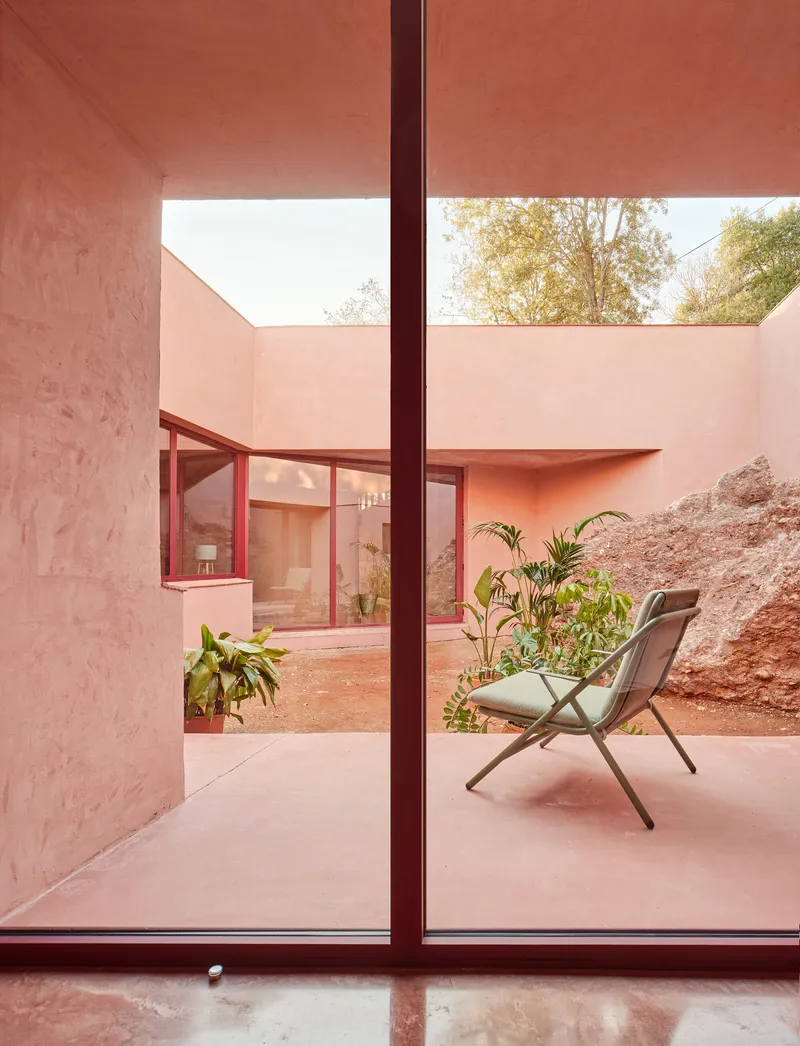
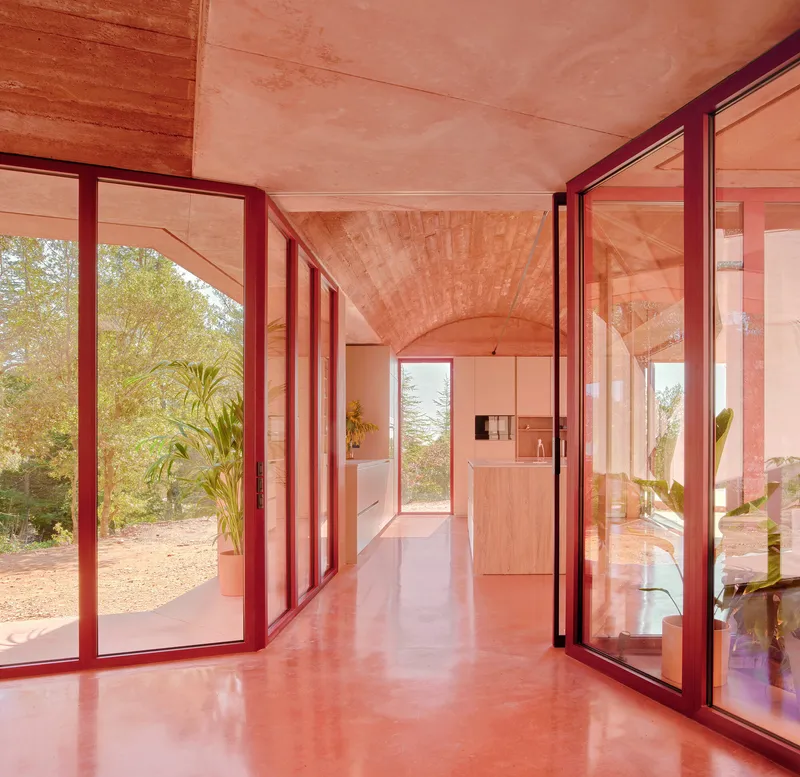
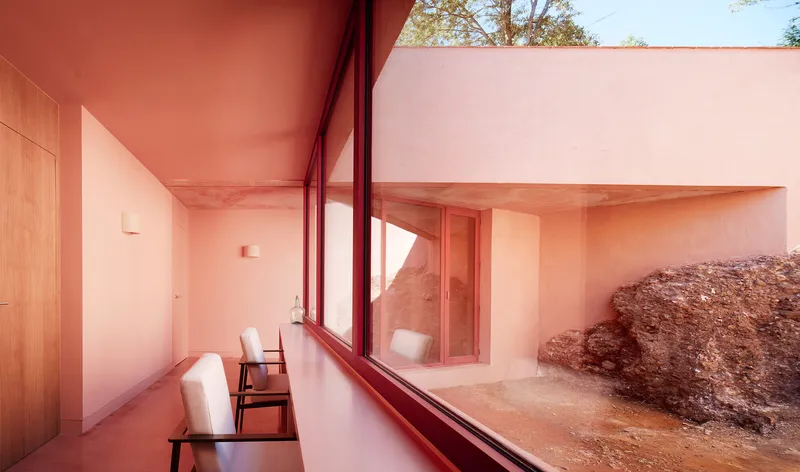
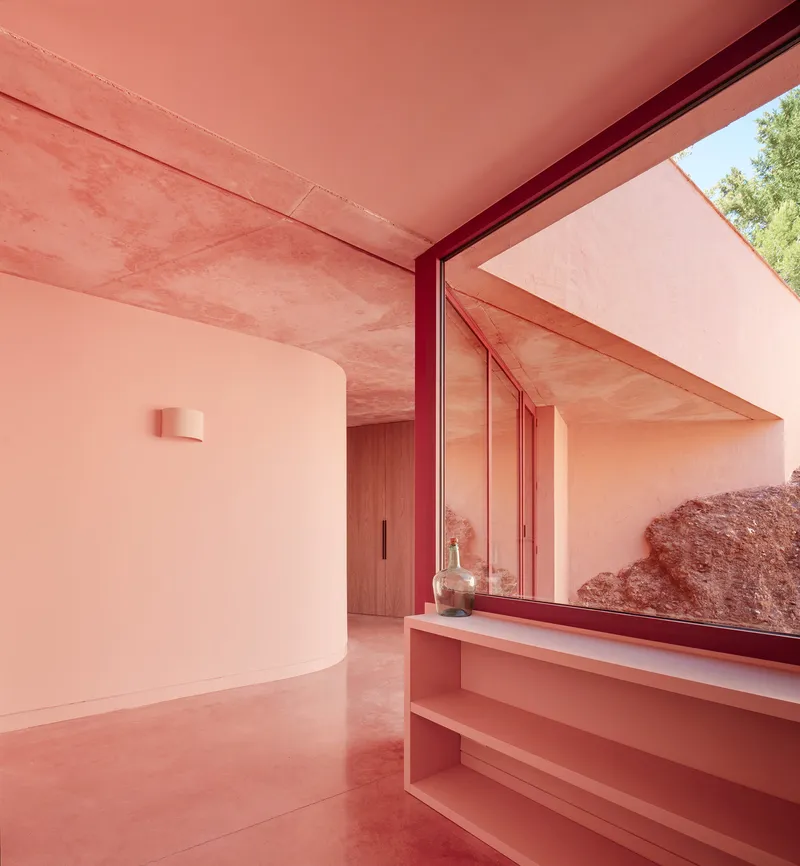
The courtyard between the two volumes is more than a gap; it is a climate device. Grouped around this cooler, sheltered space, the bedrooms benefit from shade and cross ventilation while the communal volume opens to full sun. A polished pink concrete corridor connects the zones, its red steel window frames introducing a sharp chromatic note that keeps the palette from drifting into monotony.
One of the project's most revealing details appears along this passage: a built-in bench lines the glazed wall overlooking the courtyard, where the excavated rock outcrop sits exposed and unfinished against the red earth. The architects chose to integrate this boulder rather than blast it away, and the decision pays off. It turns the courtyard into a geological exhibit, reminding everyone inside that the house is literally carved from the hill.
Bedrooms Calibrated for Rest
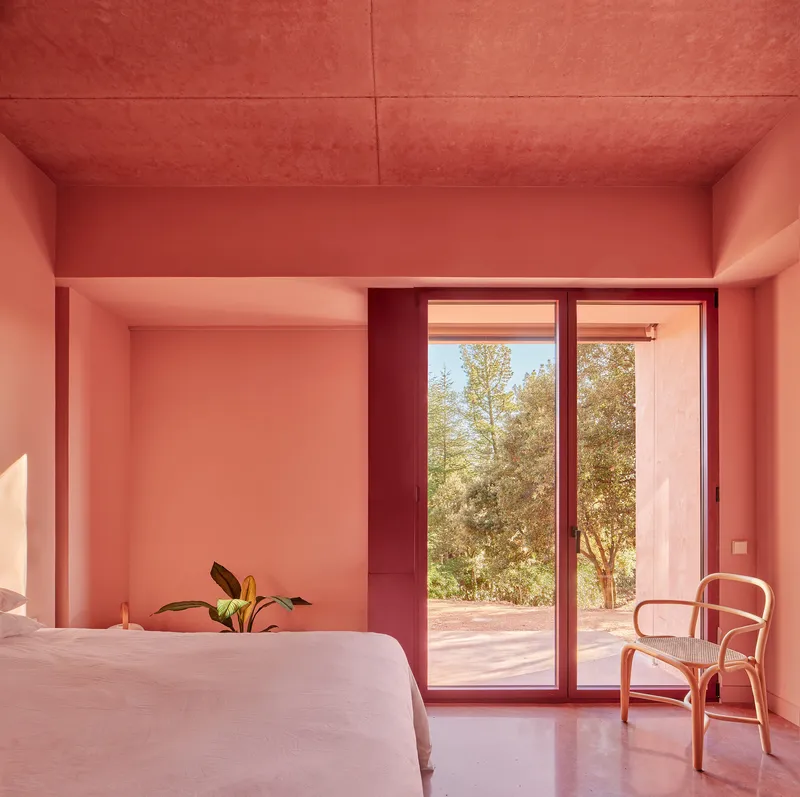
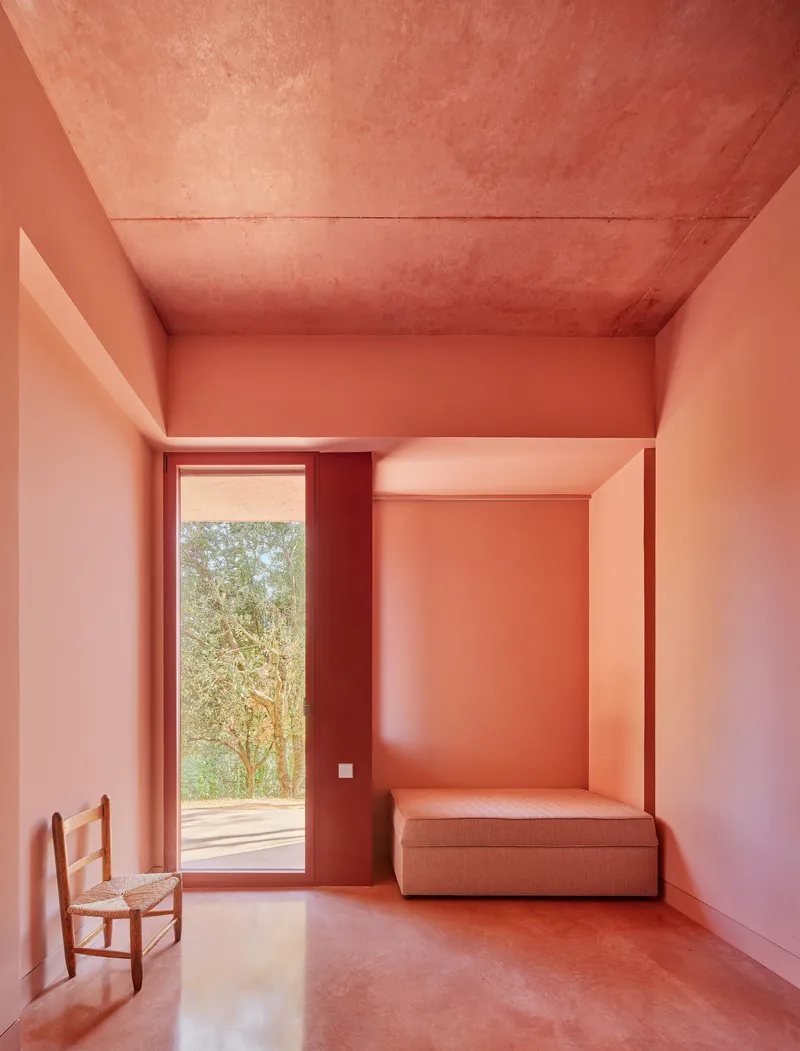
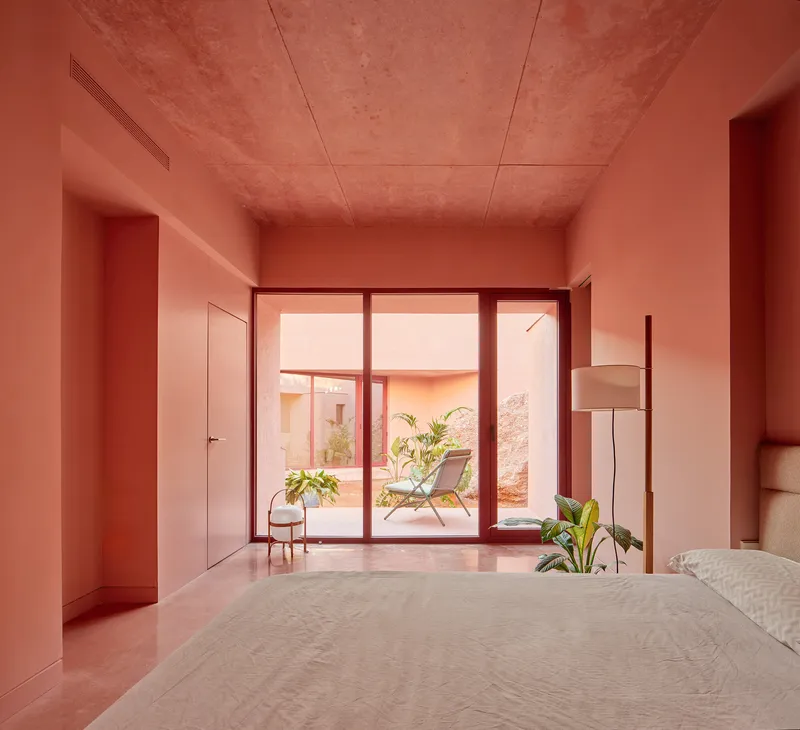
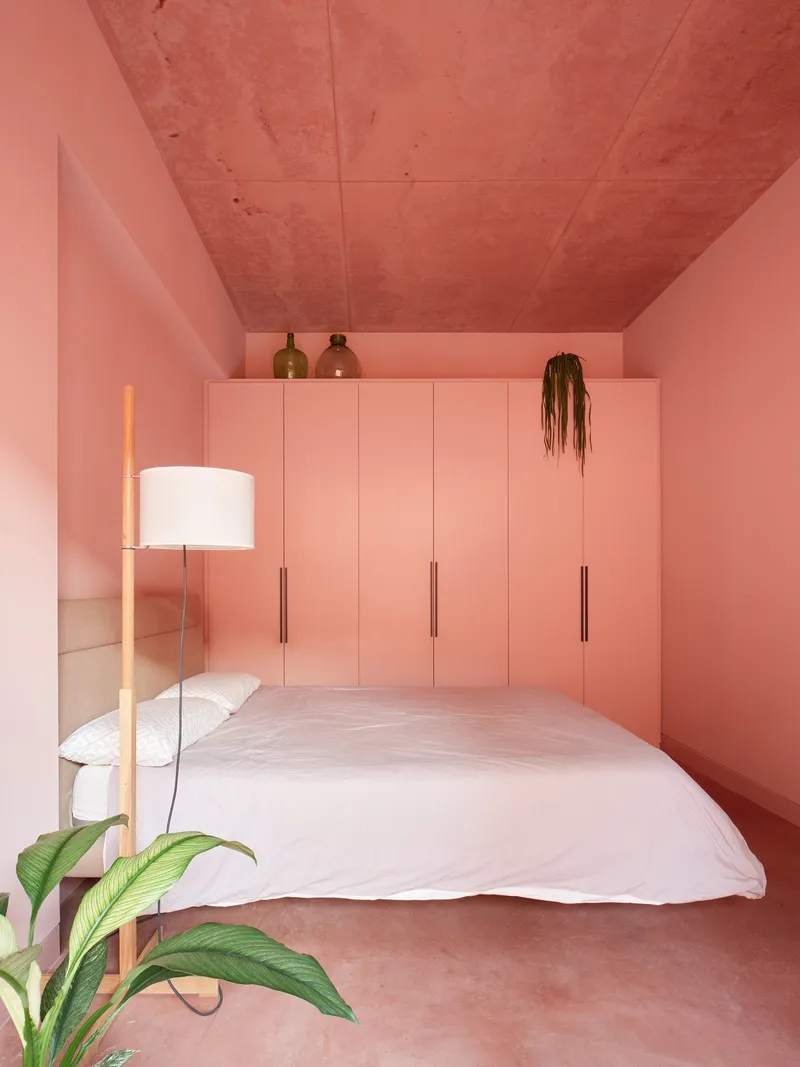
The bedroom volume is quieter in every sense. Rooms are compact, with built-in bed niches, pink plaster walls, and tall windows framed precisely to capture a single view of the oak canopy outside. Sliding glass doors open to the courtyard garden, but the scale of the openings is deliberately restrained compared to the panoramic glazing of the communal wing. The message is clear: these rooms are for sleeping, not spectacle.
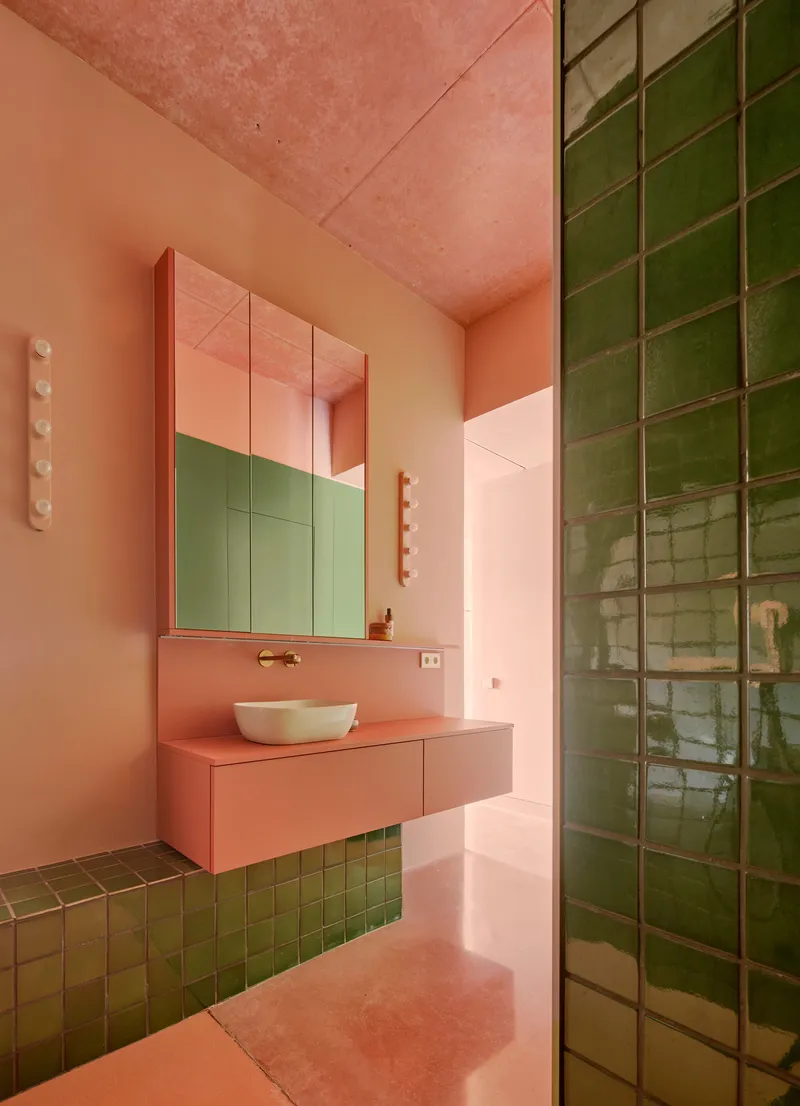
A pink terrazzo ceiling in one bedroom and green glazed tiles in the main bathroom provide moments of material intensity that reward close looking. The bathroom in particular, with its floating vanity and mirrored cabinets set against the emerald tile, is one of the most resolved interiors in the house.
Roofscape and Terrain

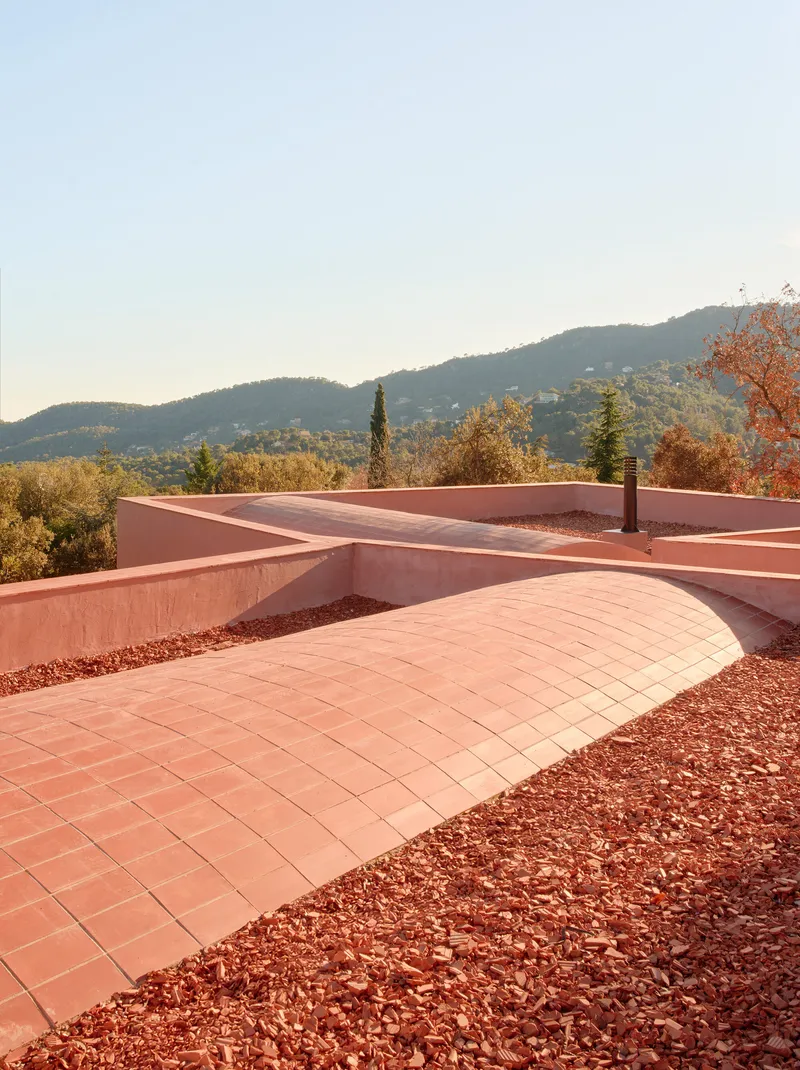
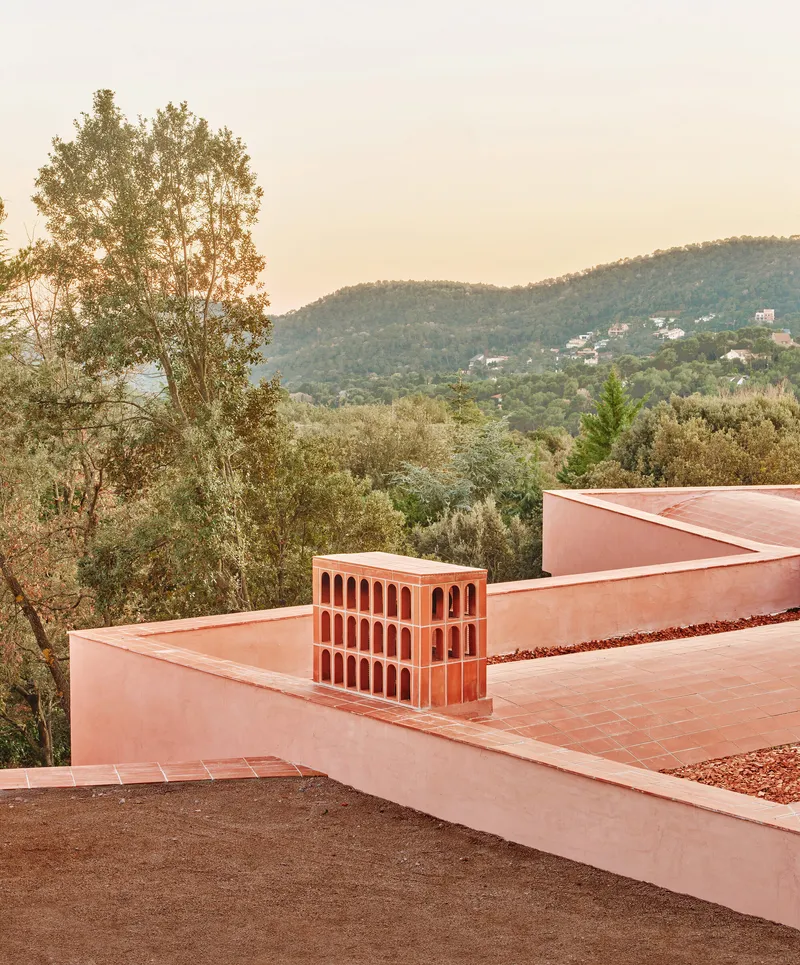
Seen from above, the house reads as a cluster of pink and terracotta forms half-submerged in the hillside. Gravel-filled terraces, curved tile paving, and crushed stone beds create a roofscape that is clearly designed to be inhabited, not just weatherproofed. A brick chimney rises from the living room vault, the only vertical element that punctuates the low, horizontal composition.
The dusk photographs reveal how effectively the house disappears into its context. With the forested hillside climbing behind and the warm tones of the concrete merging into the evening light, the building reads as a ledge, an outcrop, anything but a conventional house. That is the point.
Thresholds and Covered Ground

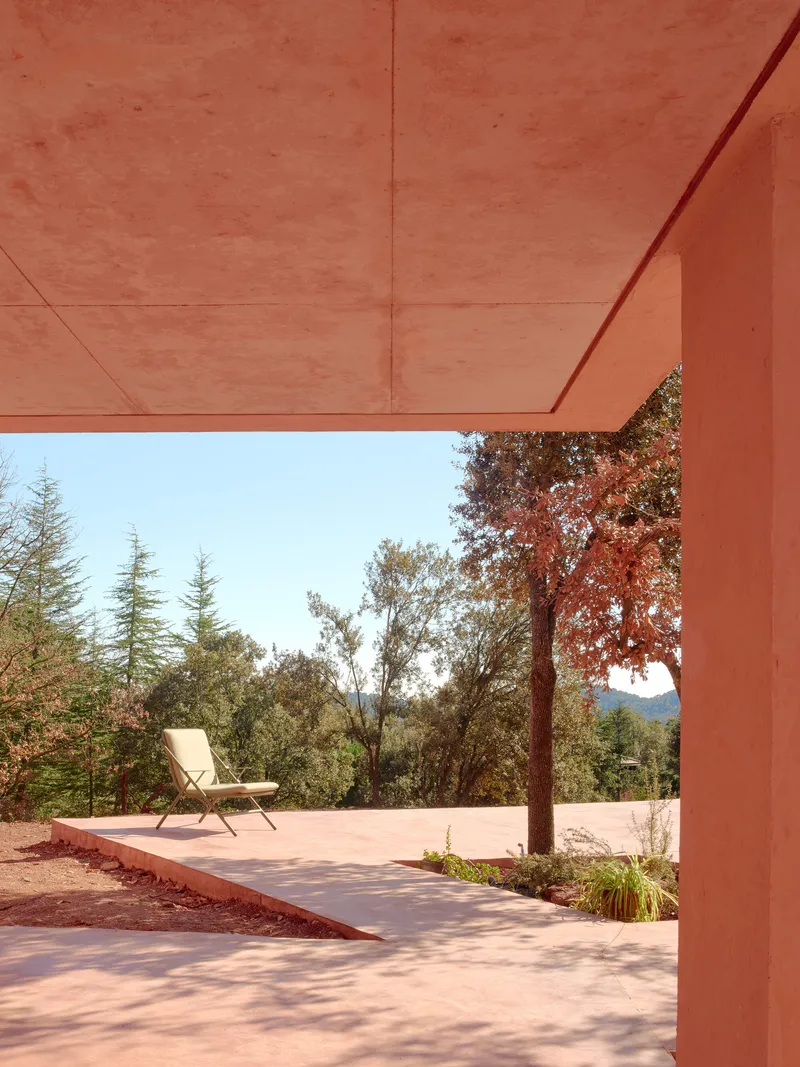
TwoBo gives particular attention to the spaces that are neither fully inside nor fully outside. Covered terraces with timber ceiling panels and deep soffits frame views toward the distant tree line, filtering direct sun while keeping the connection to landscape immediate. These threshold zones extend the usable footprint of the house through the warmer months and establish a rhythm of compression and release as you move from room to terrace to garden.
Along one corridor, the exposed rock face visible through a red steel window frame turns what could have been a service passage into one of the house's most memorable moments. The architects understand that architecture is often best at the edges, where control meets contingency.
Plans and Drawings
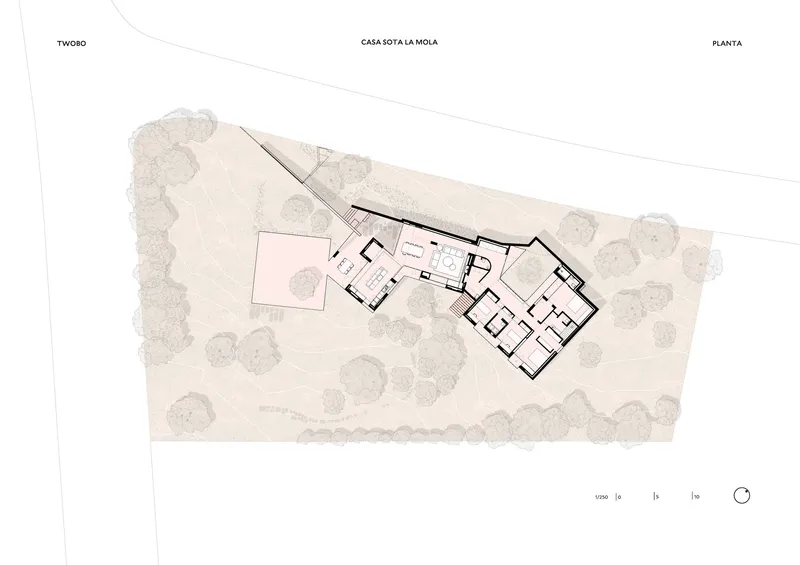
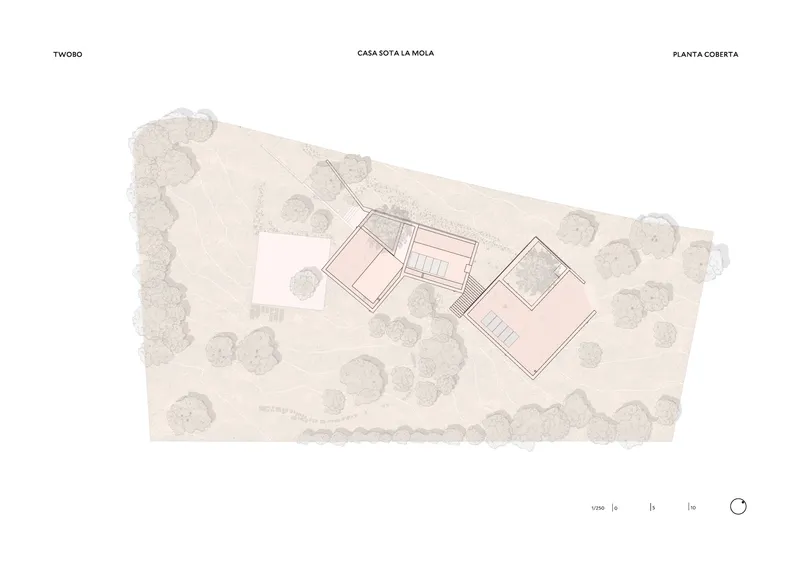
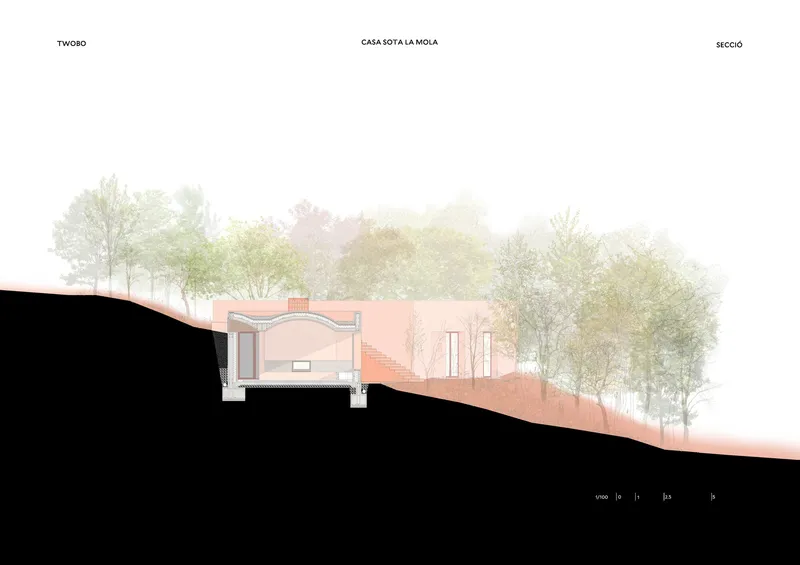
The site plan reveals the logic behind the fragmentation: the two volumes are rotated slightly off-axis, following the fall line of the slope and the pattern of existing tree canopies. The roof plan shows three distinct masses arranged diagonally across the plot, their gaps corresponding to preserved vegetation. In section, the relationship to the terrain becomes fully legible. Spaces are carved into the hillside so that parts of the house sit below grade, reducing visual impact and borrowing the thermal mass of the earth. The section also shows how the vaults generate varied ceiling heights across the plan, giving each room a distinct spatial character even within a compact envelope.
Why This Project Matters
There is no shortage of houses that claim to blend with their landscape, but most rely on green roofs or recessive glazing to make the gesture. House Sota la Mola takes a more fundamental approach: it matches the geology. The pigmented concrete reproduces the exact color of the conglomerate cliffs above. The volumes follow the terrain's drainage patterns. A boulder stays where it was found. These are not symbolic moves; they are construction decisions with real consequences for how the building sits, weathers, and reads at a distance.
Equally significant is the recovery of the Catalan vault as a living technique rather than a heritage quotation. By translating the volta catalana into board-formed concrete at a domestic scale, TwoBo demonstrates that regional building traditions can evolve without losing their spatial logic. The result is a house that feels both ancient and decisively contemporary, a kind of inhabitable cliff dwelling for a family coming home.
House Sota la Mola by TwoBo arquitectura (María Pancorbo, Alberto Twose, Pablo Twose). Matadepera, Spain. 250 m². Completed 2025. Photography by Jose Hevia.
About the Studio
Share Your Own Work on uni.xyz
If projects like this are the kind of work you want to make, uni.xyz is a place to publish your own, find collaborators, and enter design competitions.



Popular Articles
Popular articles from the community


Conexión: Biophilic Design Reimagines High-Rise Living in Hong Kong
Conexión reimagines high-rise living in Hong Kong through biophilic design, green facades, shared spaces, daylight, water and nature within.

Co-Life: Senior Housing Design That Reconnects Older Adults With the City
Co-Life reimagines senior housing design through healing gardens, shared streets, workshops, and a sustainable community across generations.

Riyadh For All: Intergenerational Urban Design for Active Aging in Rabat
Riyadh For All reimagines urban design in Rabat with intergenerational co-living, adaptive courtyards, and Moroccan cultural exchange today.

Co-life: Sustainable Architecture for Age-Friendly Community Living
Co-life reimagines sustainable architecture for seniors through courtyards, rammed earth, shared gardens, and spaces designed for belonging.


Similar Reads
You might also enjoy these articles

Bao Huynh Watercolor Atelier: A Serene Art Retreat in Hội An
Bao Huynh Watercolor Atelier in Hội An blends multifunctional art spaces, sustainable design, local materials, and family-friendly living in a serene environment.

Atelier Macri Concept Store Interior Design by CASE-REAL
Atelier Macri store features a "ko" counter, walnut wood details, cork displays, blending retail, gallery, and seamless customer experiences.

Manuel Vargas Izquierdo Stadium and High-Performance Sports Center: Architectural Excellence in Jalpa de Méndez
The Manuel Vargas Izquierdo Stadium blends sustainable design, inclusive sports facilities, and cultural-inspired architecture, revitalizing Jalpa de Méndez’s public spaces.

KAKR Buluh Awar Hall: Revitalizing Community and Ecology Through Bamboo Architecture
Community built bamboo hall revitalizes Buluh Awar village, empowering youth, restoring ecology, celebrating vernacular craftsmanship through sustainable architecture and culture.


Explore Power Generation Competitions
Discover active competitions in this discipline


Challenge to design mud housing for contemporary communities


Challenge to reimagine the Iron Throne


Photograph architecture without architects


Illustrate the lost glory of Angkor Wat - Render Challenge
Comments (0)
Please login or sign up to add comments
No comments yet. Be the first to comment!