

Ubik Architecture Buries a 2,000-Square-Meter Winery into a Tuscan Hillside
Il Quinto Winery in Magliano in Toscana disappears beneath green roofs, stone walls, and the logic of gravity-fed winemaking.


There is an old instinct in Tuscan agriculture: work with the land, not against it. Ubik Architecture, led by Gabriele Pinca, took that principle literally for Il Quinto Winery in Magliano in Toscana. Rather than planting a new volume on the hilltop, the firm carved into the southwest-facing slope, burying 2,000 square meters of production, storage, and hospitality beneath green roofs that bloom with local shrubs. From the neighboring farmhouses, the building barely registers. What reads instead is a continuation of the terraced landscape, punctuated by bands of excavated stone and ribbons of weathering steel.
The genuinely interesting move here is not the camouflage itself but the way concealment serves function. The three-level section follows the hill's natural grade, allowing grapes harvested above to fall by gravity through hatches into the processing and fermentation levels below. No pumps, no unnecessary mechanical intervention. The architecture is organized vertically around an oenological logic: reception and tasting at the top, barrique cellar in the middle, vat room at the base. Every design decision, from the positioning of the staircase to the orientation of the glazing, negotiates between the demands of winemaking and the heritage commission's insistence that the intervention blend with its context.
Landscape as Architecture
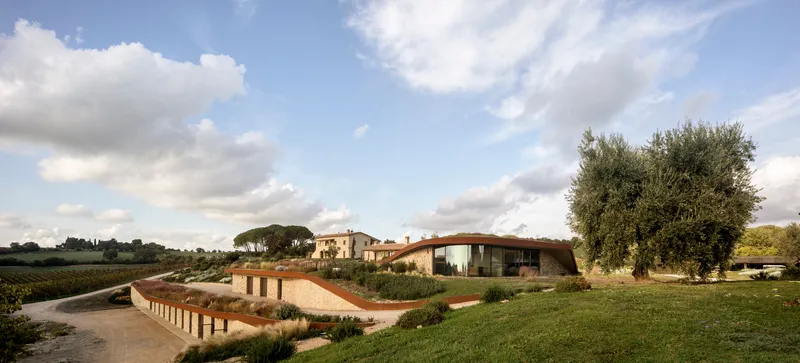
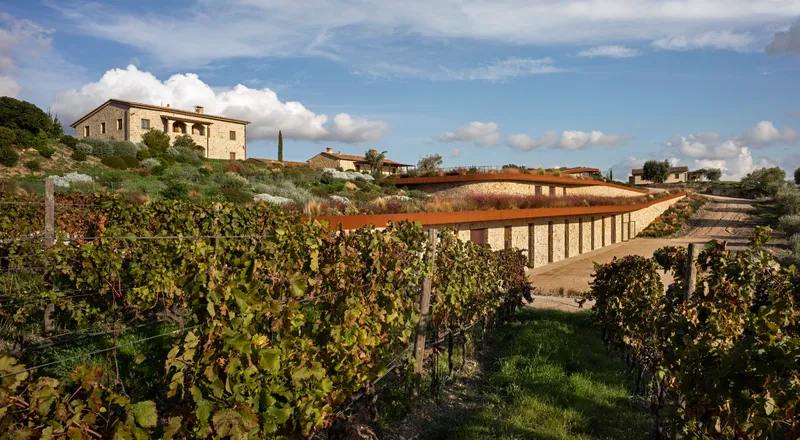
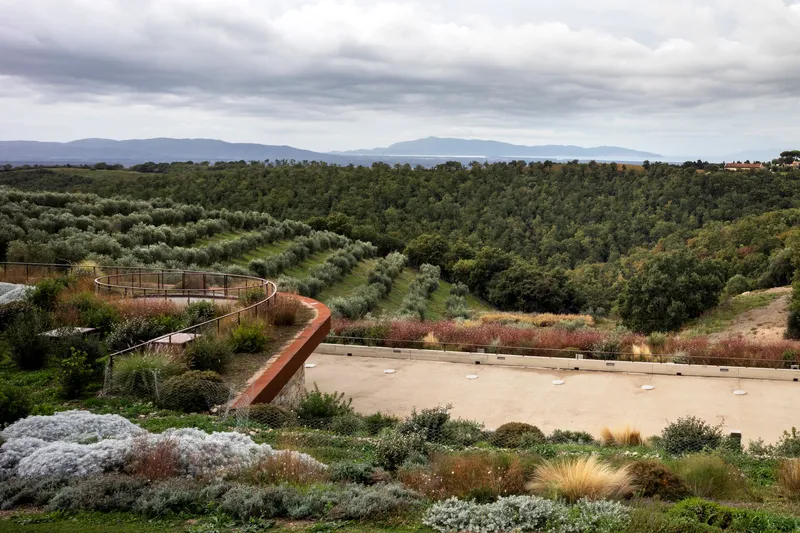
Approach Il Quinto from the existing road network and you might miss it. The planted roofs merge with the olive groves and vineyard rows that define this corner of Grosseto province. Ubik's strategy was to avoid constructing new roads altogether, instead reconnecting the site's pre-existing routes at different levels so that the building slips into the infrastructure already present. The farmhouse on the hilltop beyond remains the visual anchor; the winery defers.
The terracing is not decorative. It remodulates the terrain using a technique common to cultivated Tuscan hills, creating planting beds deep enough to sustain native flora. From above, the green roof bands read as agricultural contours. From the elevated terrace, corten steel pathways wind through planted beds that frame views toward the Argentario Promontory. The landscape does not surround the building; the building participates in the landscape.
Stone, Steel, and the Logic of Reuse
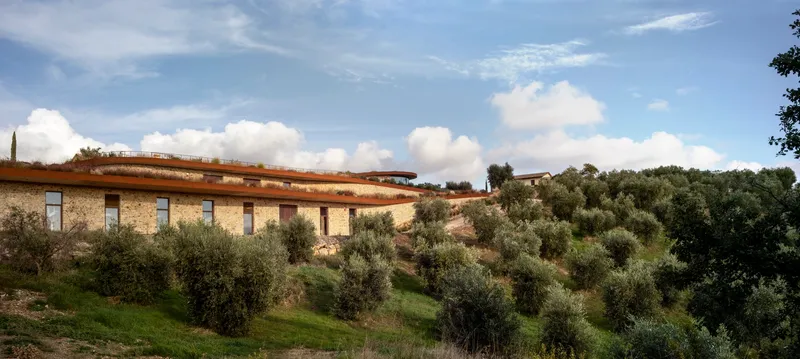
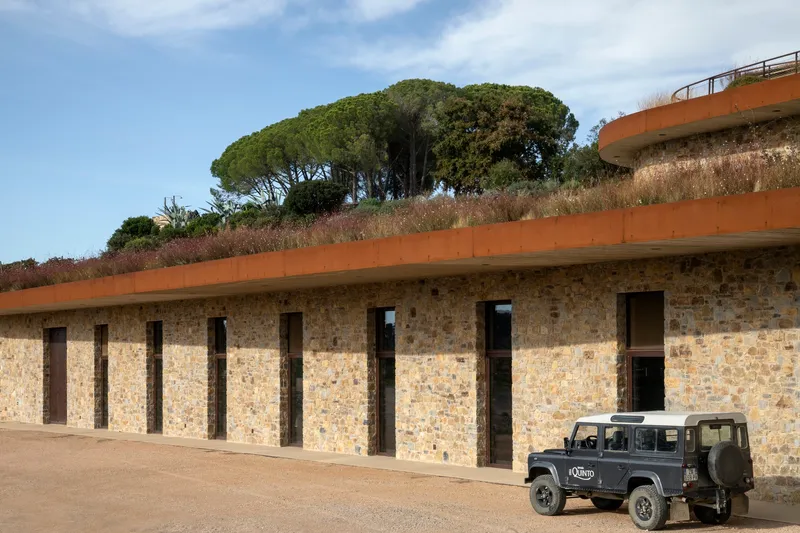
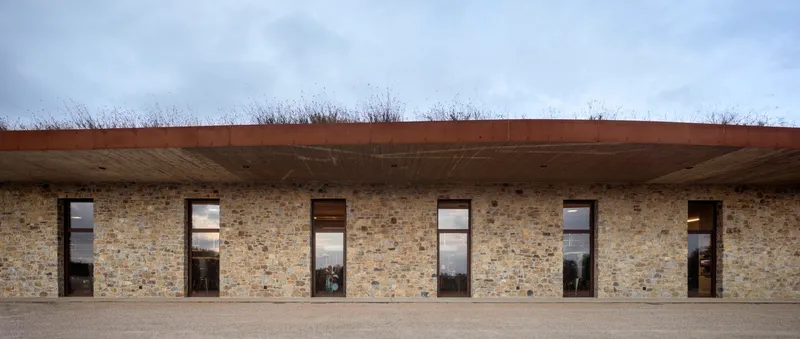
The stone cladding the facade was sourced directly from the excavation. This is the most straightforward kind of material sustainability: dig the building's cavity, then use what you removed to make its skin. The result is a rough, warm surface whose color tones echo the surrounding countryside. Rhythmic timber-framed openings punch through the stone walls, providing controlled ventilation and filtered daylight to the storage levels behind.
Weathering steel, the other primary exterior material, plays a different role. It appears as retaining walls, canopies, and the metal ribbons that Ubik describes as transforming from road to wall to roof. The corten will continue to patinate over time, pulling closer to the ochres of the local soil. Where stone grounds the building in geology, the steel signals a deliberate artifice, marking thresholds between landscape and enclosure.
The Glass Pavilion
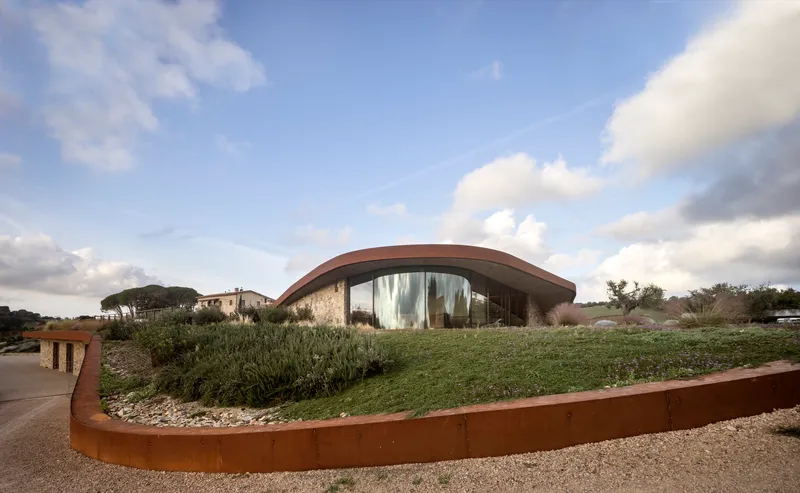
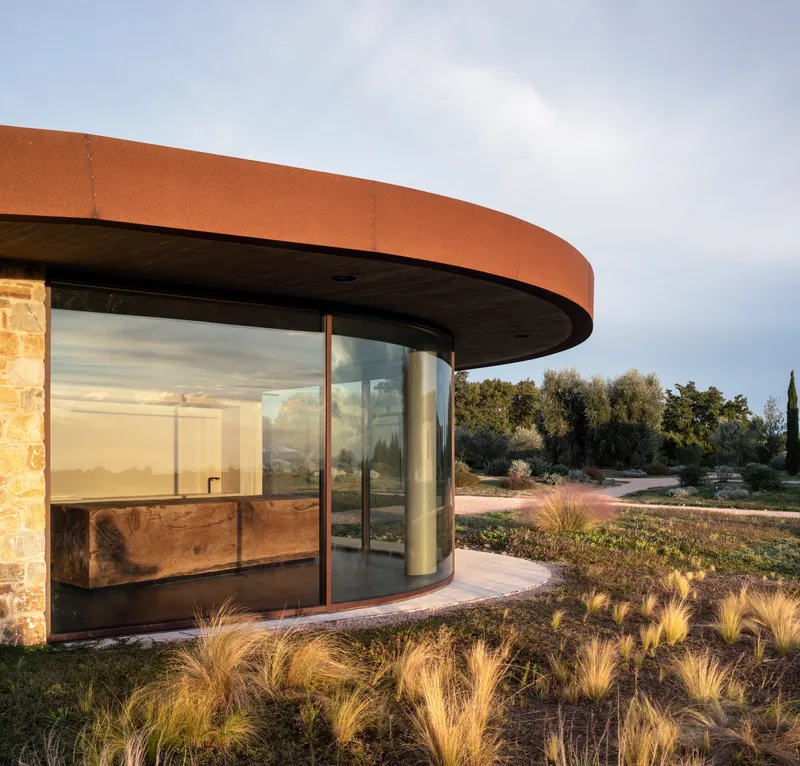
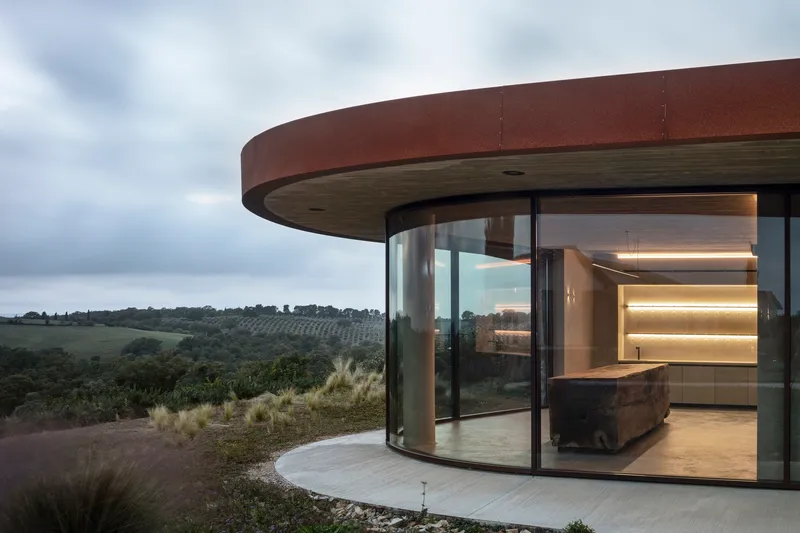
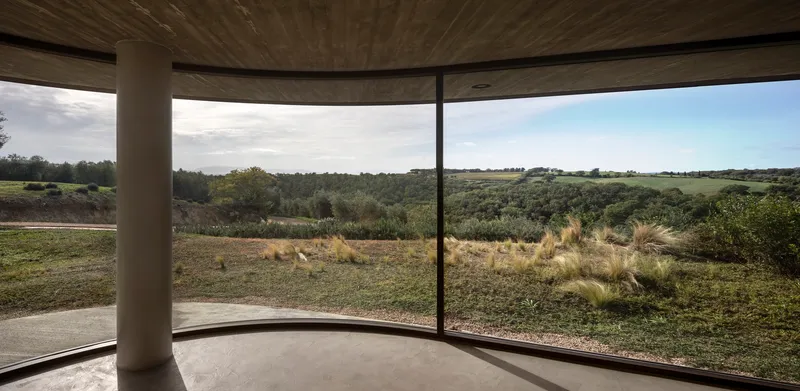
The reception and tasting level is the only part of the building that fully reveals itself. Curved floor-to-ceiling glazing wraps beneath a corten steel overhang, creating a pavilion that opens onto the olive grove and the distant hills. At dusk, the interior glows against the hillside, turning the building's single visible gesture into a lantern.
The curvature is not arbitrary. It follows the contour of the hill, keeping the glazing line parallel to the slope rather than imposing a rectilinear geometry. Native grasses flank the approach, softening the transition between ground and glass. The effect is an architecture that feels less placed than revealed, as if the hill peeled open to expose a room already there.
Tasting Room and Interior Warmth
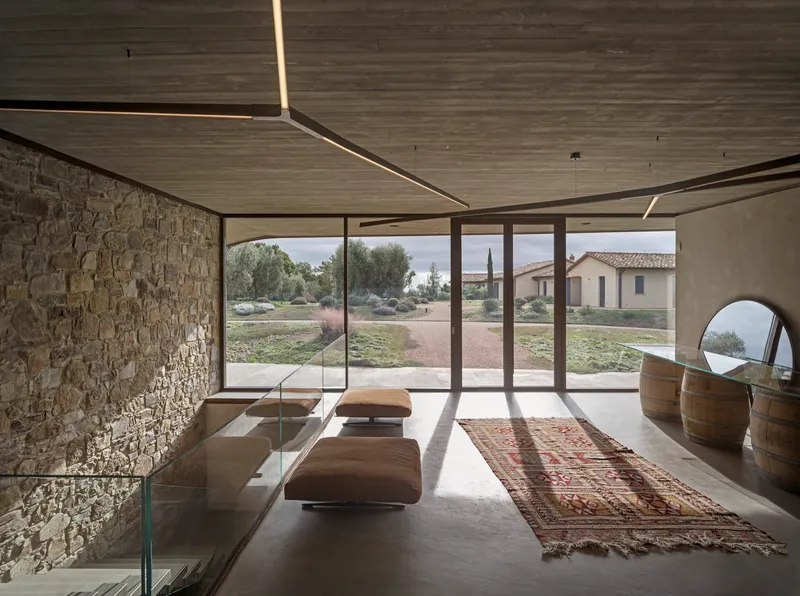
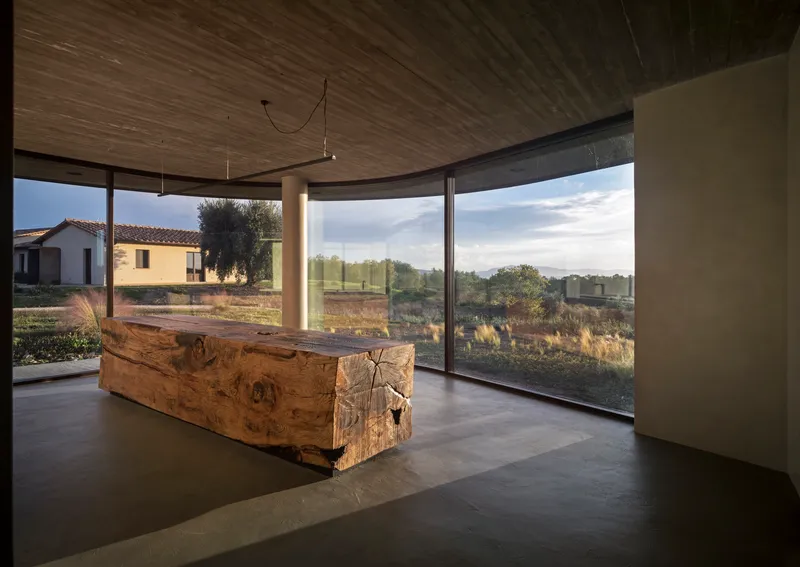
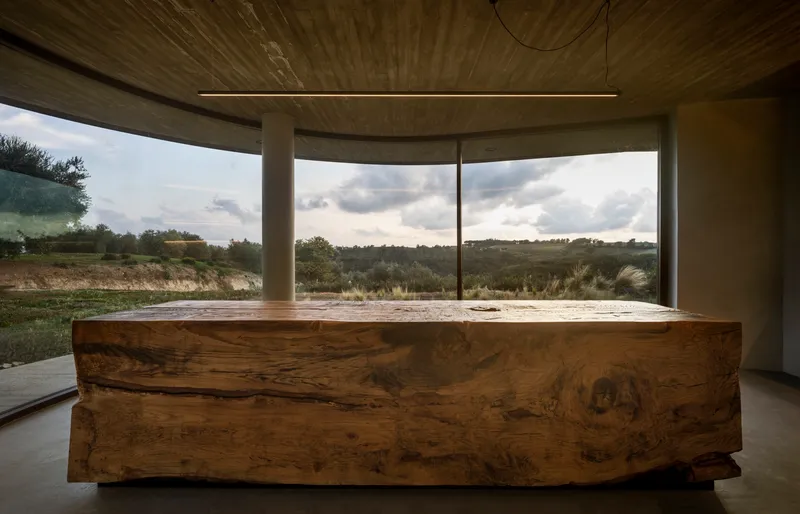
Inside the tasting room, Ubik shifts register. A raw stone wall anchors one side while a timber ceiling warms the overhead plane. Linear lighting traces the joinery, and glazed doors frame the landscape as if composing a series of horizontal paintings. A massive burled wood counter, organic and sculptural, serves as the room's centerpiece beneath the curved concrete ceiling. The material palette, stone, wood, concrete, exposed steel, is restrained but tactile, inviting touch rather than demanding distance.
The panoramic windows do more than provide views. They establish the tasting room as a threshold between the cultivated exterior and the production spaces below. Visitors look out over the very vines whose fruit will travel downward through the building's section. The connection between terroir and glass is made spatial, not just metaphorical.
Descending into Production
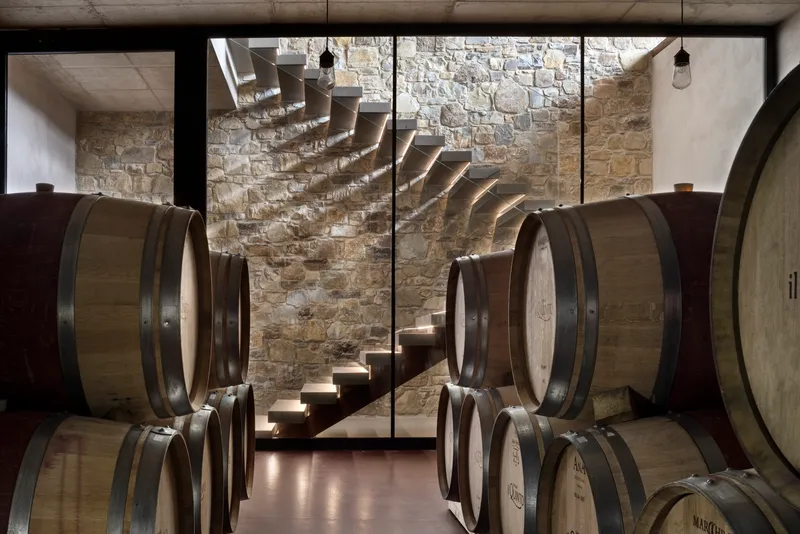
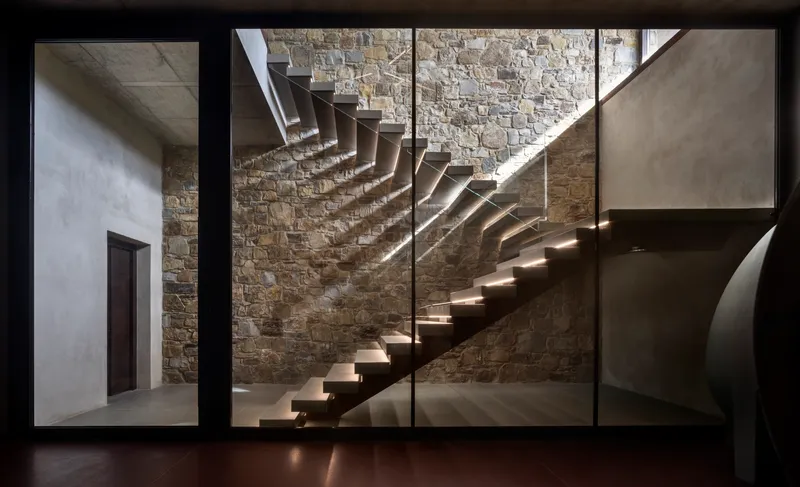
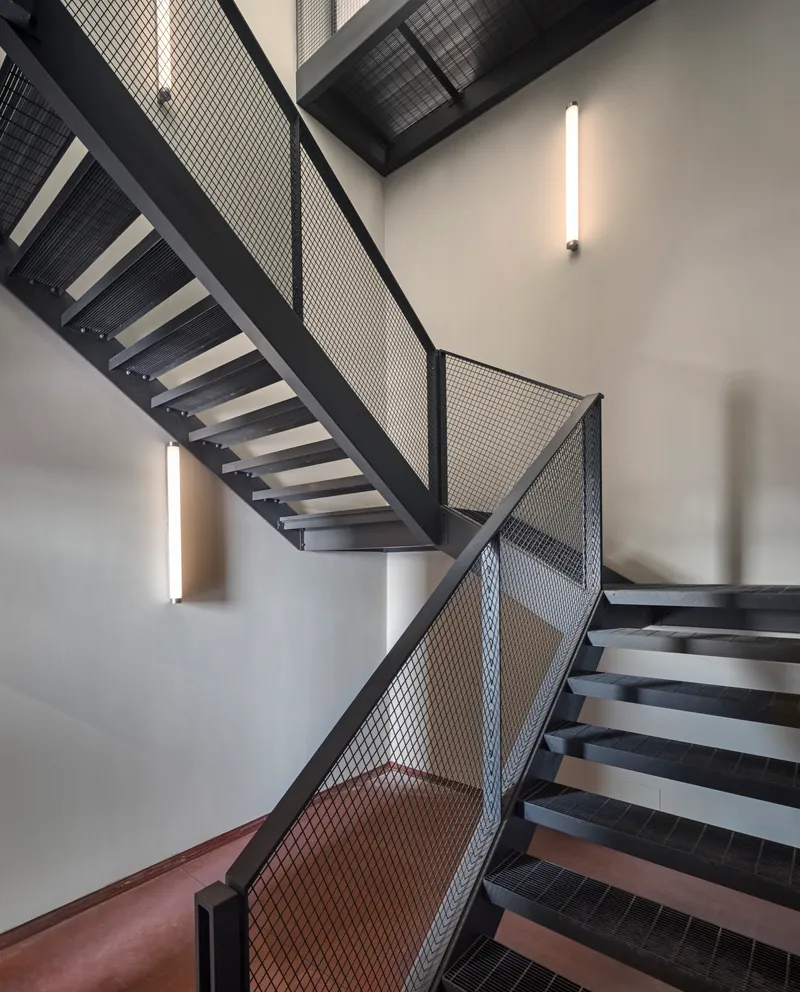
The staircase is the building's spine. A cantilevered concrete flight descends past exposed stone walls and oak barrels, channeling natural light that shifts throughout the day. Deeper in, a black steel staircase with mesh balustrades and wall-mounted linear fixtures leads to the vat room below. These are not merely circulation elements; they orchestrate a procession from daylight to earth, from hospitality to labor.
Ubik designed the stairwell as a light shaft, pulling sun deep into the hillside. The changing quality of that light, bright at the entrance, diffuse in the barrel cellar, almost absent in the vat room, mirrors the stages of winemaking itself: harvest in the open air, aging in shadow, fermentation in controlled darkness.
Barrel Cellar and Vat Room
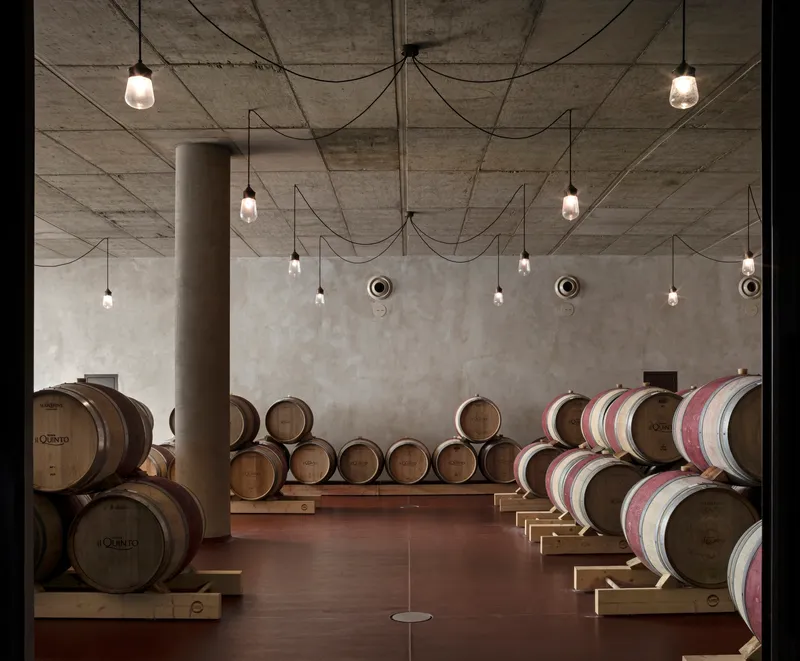
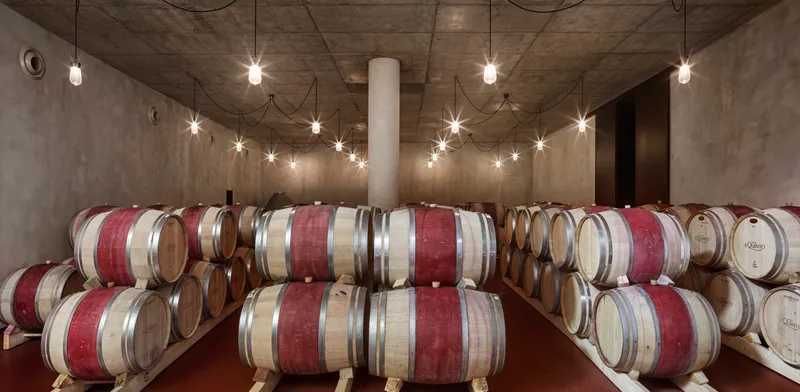
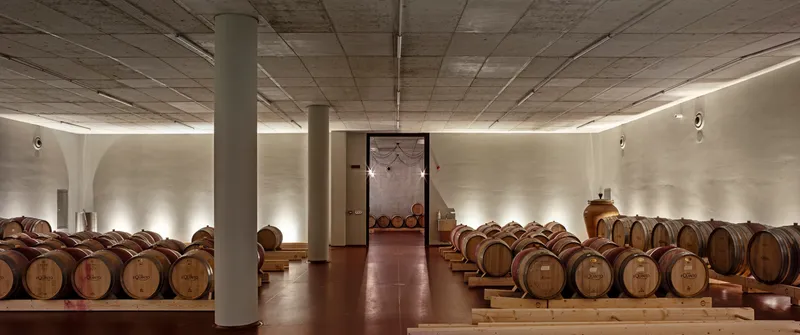
The barrique cellar sits at the middle level: exposed concrete ceiling, pendant lights on draped cables, and wine casks resting on timber racks. The material honesty here is almost monastic. Concrete and red resin flooring define the room. No plasterboard, no finishes pretending to be something else. The cylindrical columns in the underground cellar below add a vaulted rhythm that recalls older Tuscan cellars without imitating them.
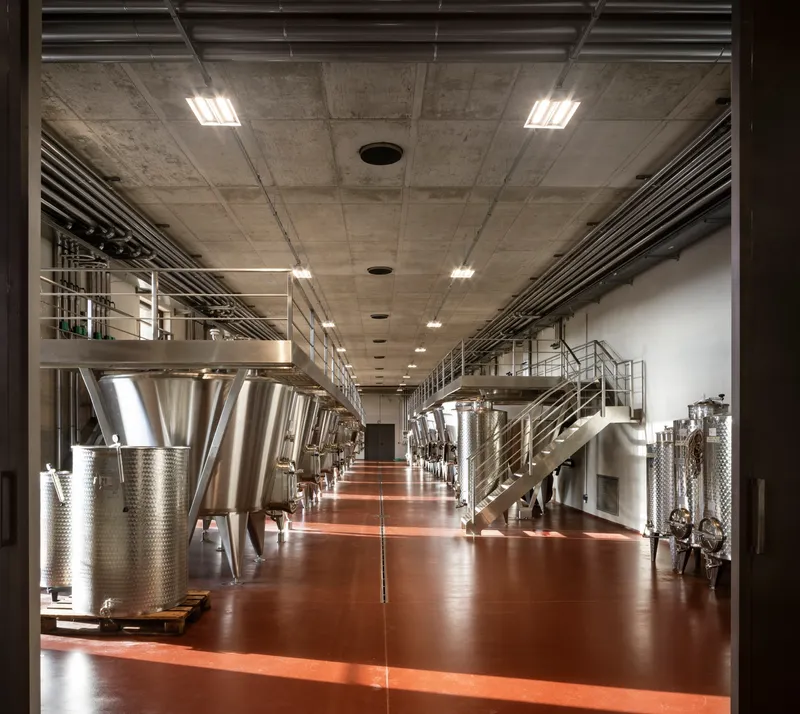
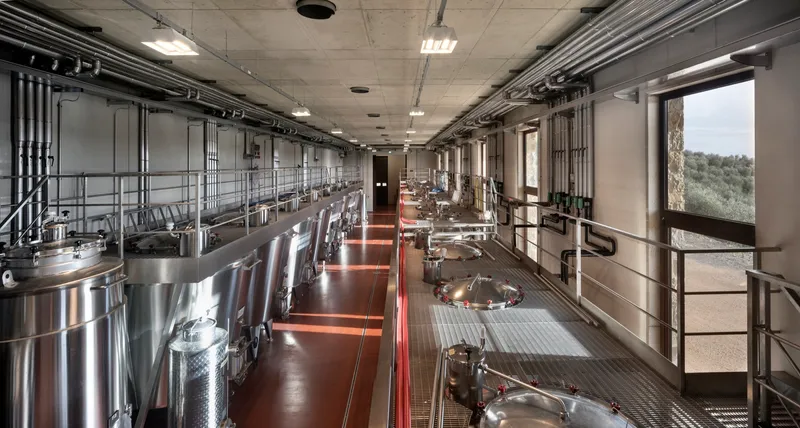
The vat room at the lowest level houses stainless steel fermentation tanks beneath the same raw concrete ceiling. Elevated catwalks allow workers to access the tops of the tanks, and a window at the far end opens onto the hillside vineyard, reminding anyone inside that the grapes just fell from up there. The gravity-fed system eliminates the need for mechanical pumping, which winemakers argue preserves the integrity of the fruit. Architecture and process are inseparable here.
Plans and Drawings
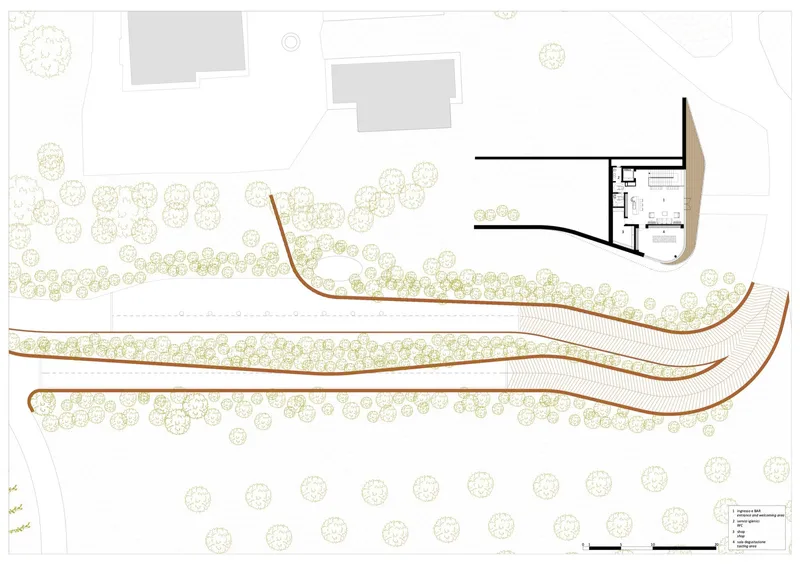
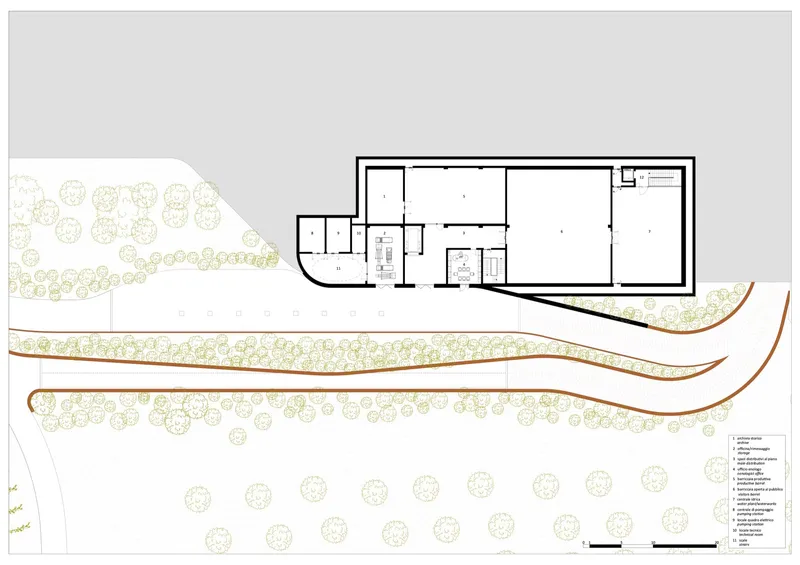
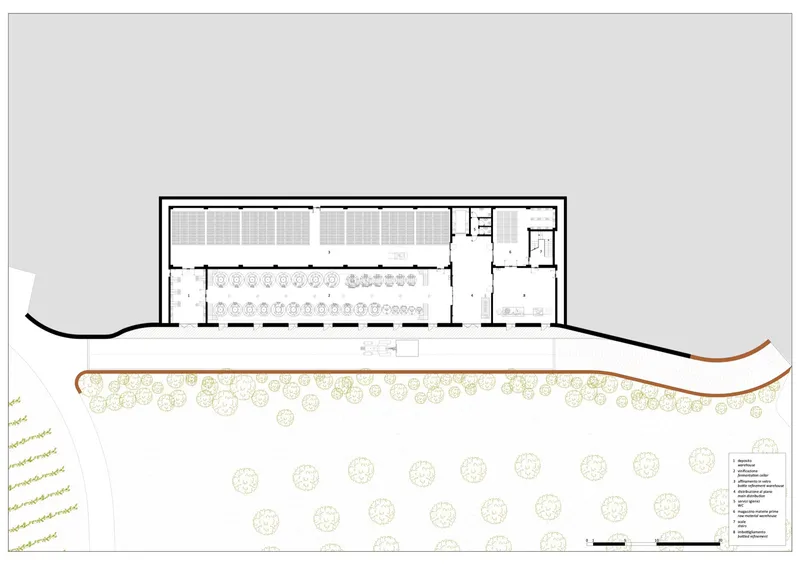
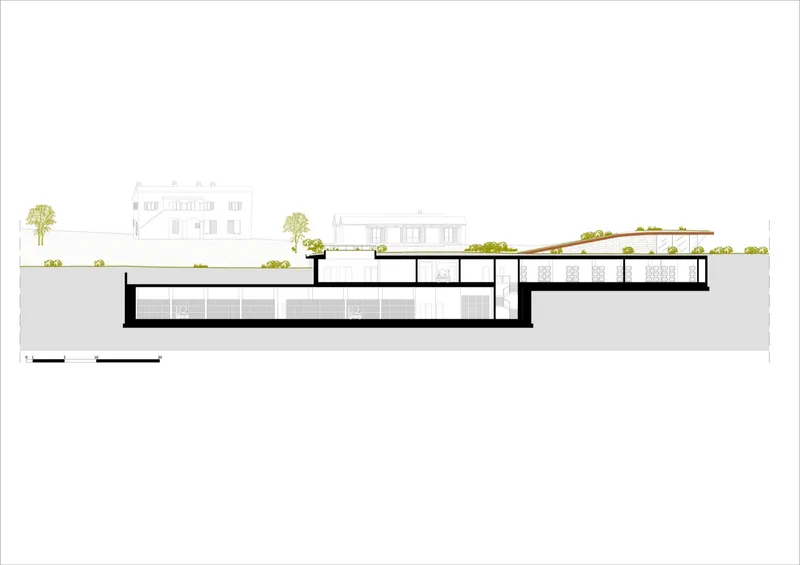
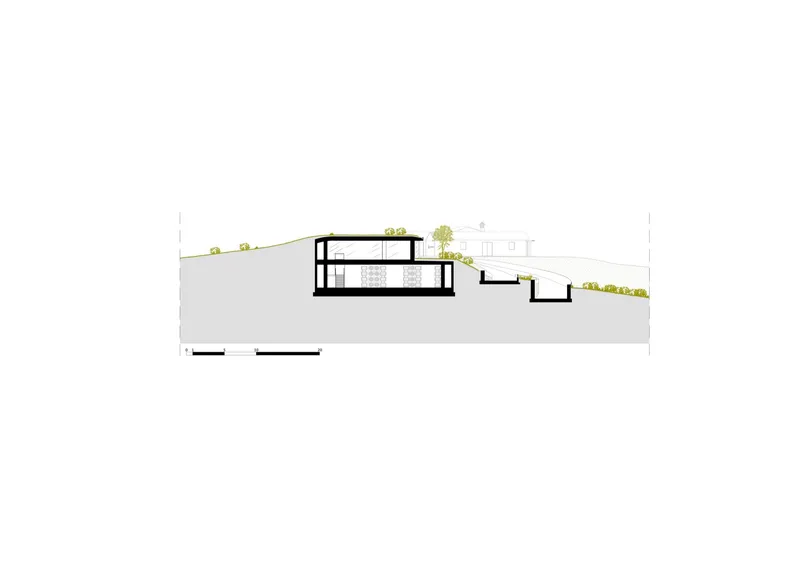
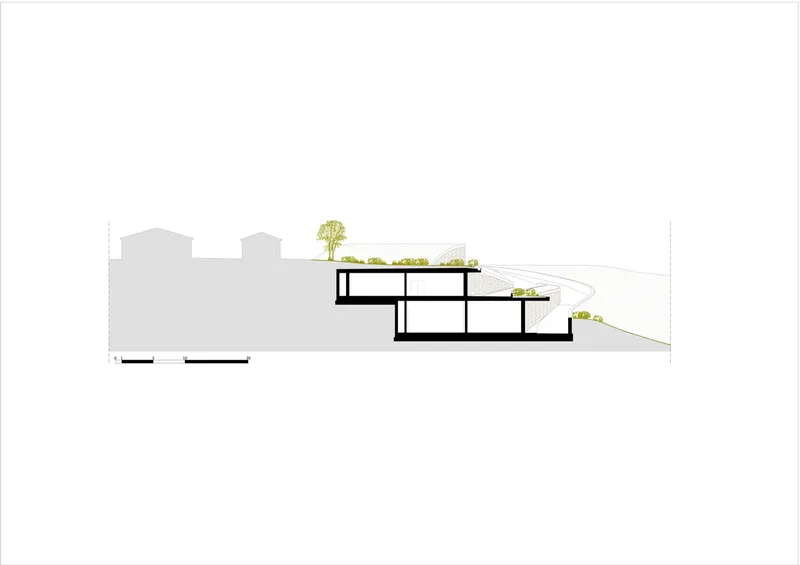
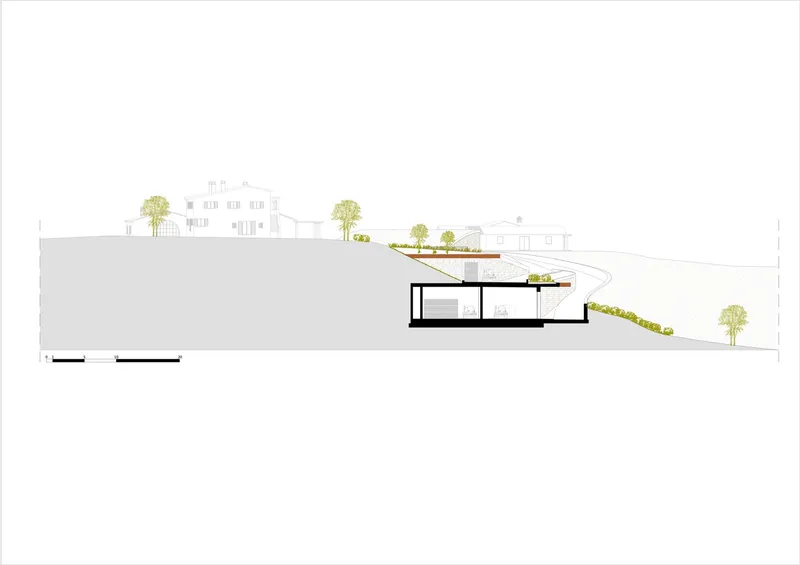
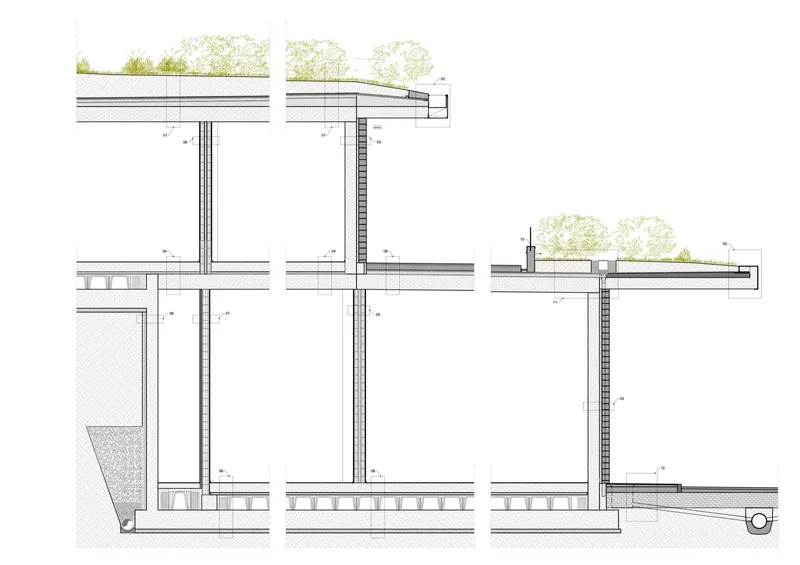
The section drawings tell the story more clearly than any photograph. The building descends through three distinct levels, each stepping down with the hillside's natural slope. The green roof assembly, detailed in the final drawing, shows planting substrate deep enough to support shrubs rather than just sedum, an investment that makes the camouflage convincing from the first season. The site plan reveals how tightly the volume is threaded into the existing road system, with no new cuts in the landscape.
What stands out in the sections is the relationship between the curved canopy at the entrance and the mass of earth behind it. The building reads as a single long incision in the hill, sealed with planted roofs that restore the original profile. The terracing on the upper levels corresponds to actual vineyard rows, so the functional landscape and the architectural landscape share the same geometry.
Why This Project Matters
Winery architecture has a vanity problem. Too many cellar doors compete for attention with sculptural gestures that have nothing to do with growing grapes or making wine. Il Quinto takes the opposite position. Its most ambitious architectural move is disappearance, and its most sophisticated system, the gravity-fed section, is borrowed from centuries of agrarian practice. Ubik Architecture proves that restraint and ambition are not opposites; they can be the same thing when the site and the program demand it.
The building also demonstrates that heritage regulations, often treated as obstacles, can sharpen design. The commission's requirement to integrate with the landscape forced Ubik to think in section rather than elevation, to excavate rather than erect, to reuse rather than import. The result is a winery that earns its place on a Tuscan hillside not by asserting itself but by belonging. That is a harder thing to achieve than any cantilevered tasting room, and it will age better too.
Il Quinto Winery, designed by Ubik Architecture (lead architect: Gabriele Pinca). Magliano in Toscana, Grosseto, Italy. 2,000 square meters. Completed 2021. Photography by Alessandra Chemollo.
About the Studio
Share Your Own Work on uni.xyz
If projects like this are the kind of work you want to make, uni.xyz is a place to publish your own, find collaborators, and enter design competitions.


Popular Articles
Popular articles from the community


Manzana Morphosis: Stretching Barcelona's Grid into a Living Landscape for 2050
A radical reworking of the Eixample manzana turns density into a tool for generous public space, vertical ecology, and environmental performance.


ETEH Reworks the Shared Spaces of São Domingos School in Brazil Around Timber, Color and Hanging Plants
At São Domingos School in Brazil, 436 m² of hall, refectory and library are recast with timber joinery, a yellow and blue code and trailing greenery.

graciastudio Turns a Viewless Tijuana Lot Inward Around a Courtyard of Concrete, Timber and Trees
In Tijuana, Jorge Gracia's GA2 House stacks a timber-clad private floor over exposed concrete and replaces a missing view with a planted interior patio.

David Ortega Stacks a Two-Story Mexico City Penthouse Around a Steel Stair and a Pergola-Shaded Roof Terrace
In Colonia Roma, a 300 m² penthouse uses oak joinery, a planted steel stair and a slatted roof pergola to make a new-build apartment feel like a house.

Similar Reads
You might also enjoy these articles

LAVA Architecten Gives Vocational Education a Sawtooth-Roofed Face on a Mechelen School Campus
In Mechelen, Belgium, a 2,053 m² STEM school on a 6×6 m grid turns workshops and classrooms into rooms that can be rearranged as teaching changes.

KEMA Studio Turns a Derelict Marvila Attic into a 60 m² Lighthouse Apartment Above Lisbon
In Lisbon's Marvila district, a rebuilt roof, four skylights and two plywood volumes turn an unlivable attic into a bright home facing the Tagus.

Pixel Gardens: One Repeated Module Stacked Into a Terraced Social Housing Tower for Famagusta
Salem Bader's shortlisted housing tower builds a vertical neighbourhood from one repeated module, offsetting units to carve terraces, light and air.

Bao Huynh Watercolor Atelier: A Serene Art Retreat in Hội An
Bao Huynh Watercolor Atelier in Hội An blends multifunctional art spaces, sustainable design, local materials, and family-friendly living in a serene environment.

Explore Winery Competitions
Discover active competitions in this discipline

Challenge to design a portable theatre

Challenge to design a portable music platform

Challenge to design an open learning module for the elderly
Comments (0)
Please login or sign up to add comments
No comments yet. Be the first to comment!