
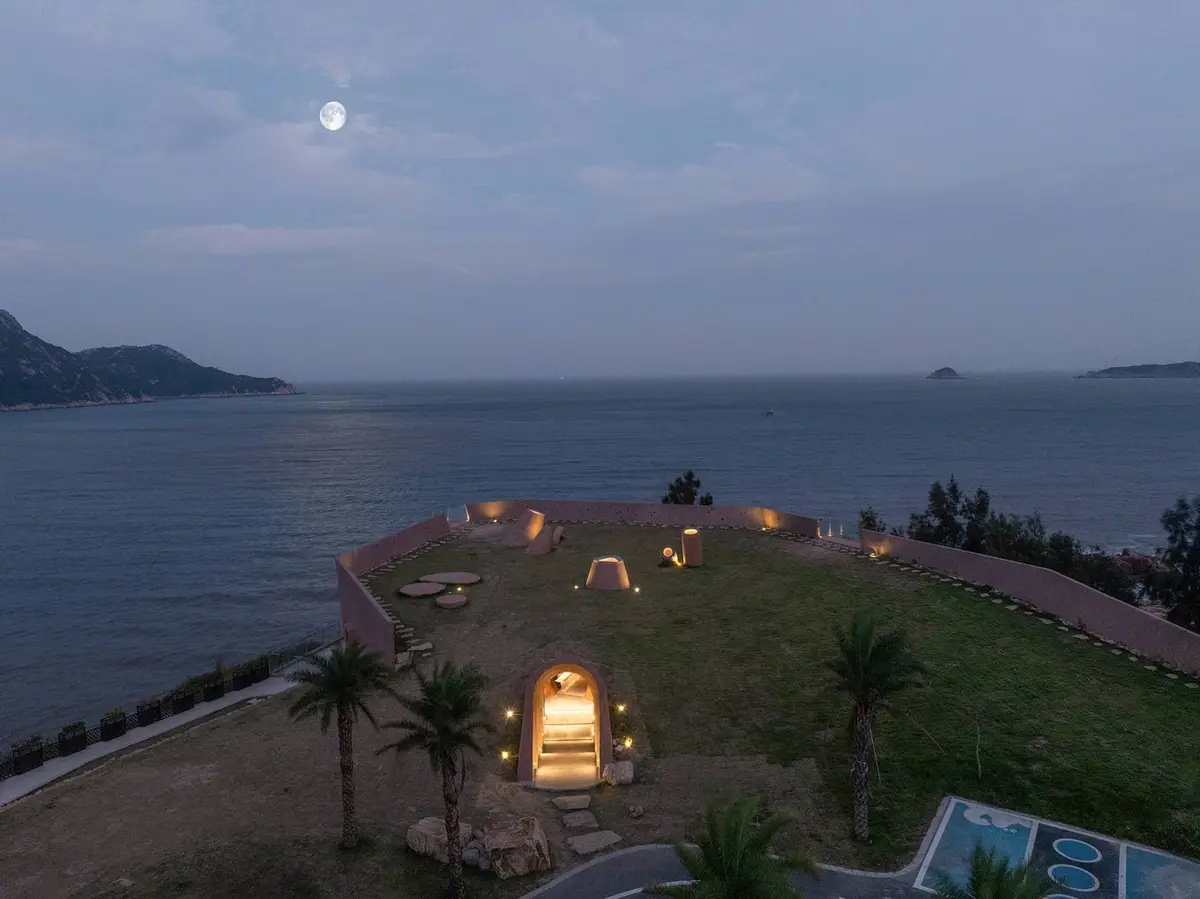
3andwich Design Carves a Zero-Carbon Cave Space into a Fujian Clifftop Overlooking the East China Sea
On a rocky promontory along Donghai No.1 Road in Xiapu, a sculpted concrete cavern disappears into the landscape it celebrates.


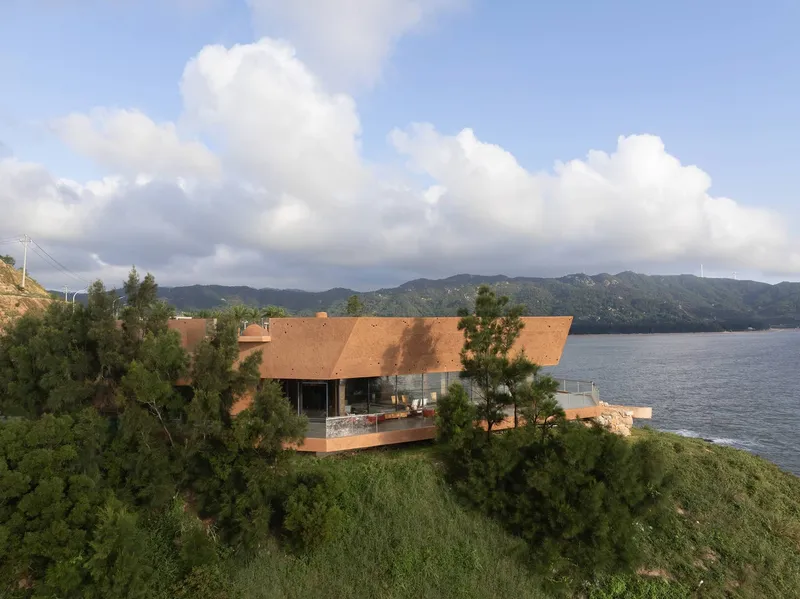
Architecture that buries itself is usually trying to hide. The Blue Insight Cave Space by 3andwich Design/He Wei Studio is doing something more ambitious: it is trying to become geology. Sited on a rocky promontory along Donghai No.1 Road in Xiapu, Fujian Province, the 460 square meter cultural venue tucks almost entirely beneath a green roof that doubles as a public viewing platform. What remains visible are clustered skylights and a single tilted concrete prow that cantilevers toward the East China Sea. The rest is terrain.
The project belongs to Ningde's "Zero Carbon Island" initiative, and its most consequential design decision is structural: by embedding the building underground, the architects achieve what they call "zero land used," returning the footprint to vegetation and public circulation while exploiting the earth's thermal mass to slash cooling loads in Fujian's humid summers. But the sustainability argument, however legitimate, is secondary to the experiential one. What makes this project worth studying is the way it translates the erosion patterns of sea caves and reef formations into inhabitable concrete space, using construction techniques borrowed from sculpture rather than conventional formwork.
Disappearing Into the Headland
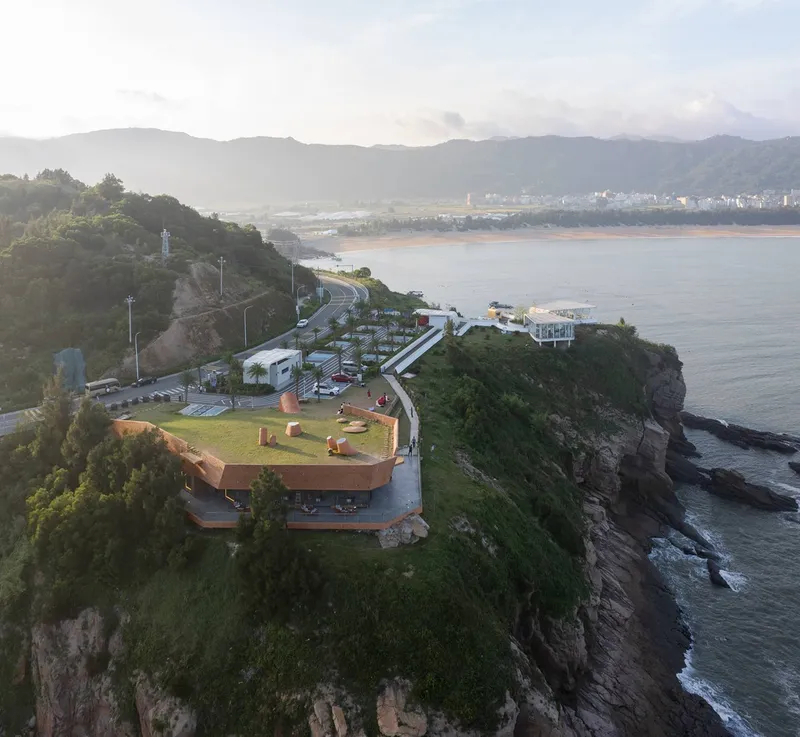
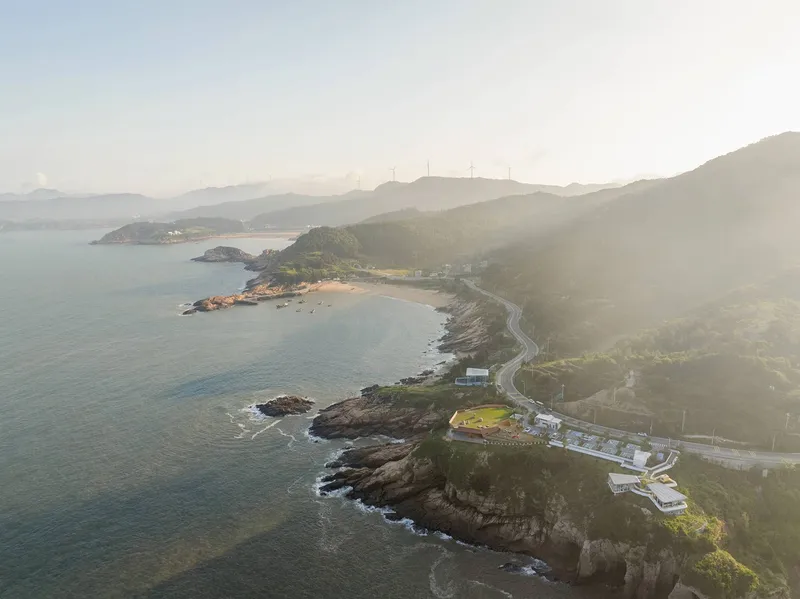
From the air, the building barely registers. Aerial views reveal a low polygonal form nestled into the promontory, its grass-covered roof continuous with the surrounding hillside. A winding coastal road and a parking lot define the western boundary; to the east, layered sedimentary cliffs drop to breaking waves. The architects inherited this site as a simple viewing platform and parking area, and the intervention preserves both functions while adding a third: a fully enclosed cultural venue underneath.
The roof's geometry is high on the east and low on the west, following the natural grade of the terrain. This asymmetry is not decorative. It allows the east facade to open with floor-to-ceiling glass toward the ocean and Bijia Mountain Island while the western entry descends gently from grade level, so visitors move from open landscape into enclosed cave without ever confronting a conventional threshold.
Roof as Landscape
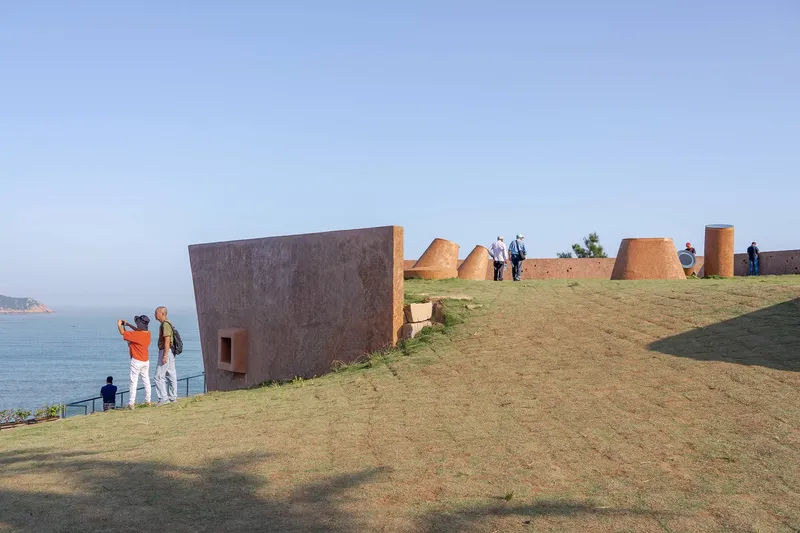
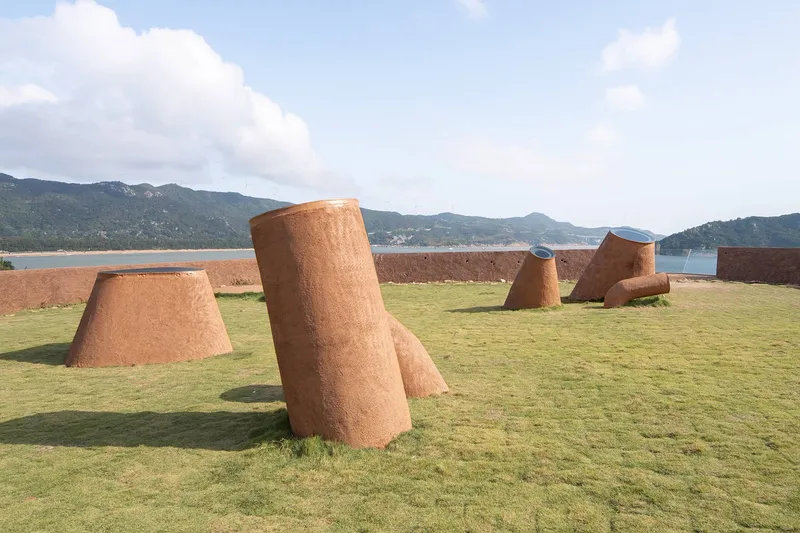
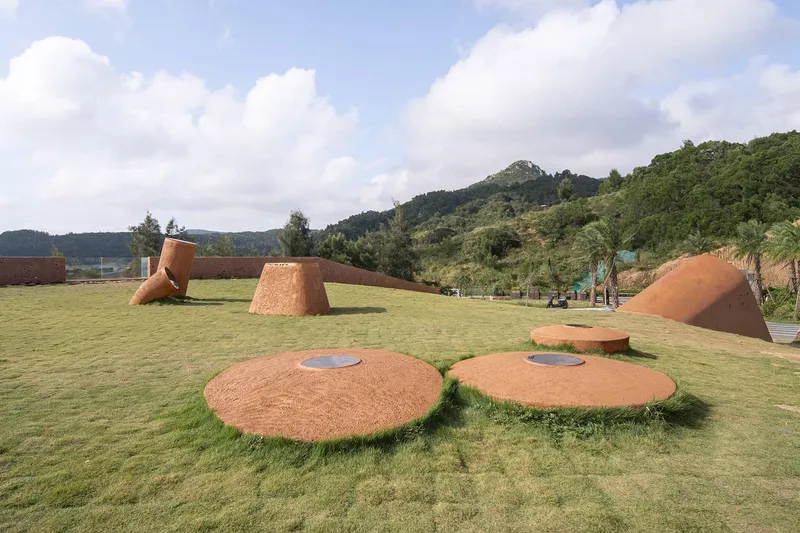
The green roof is punctured by a constellation of forms that read as geological artifacts: tilted cylinders, circular platforms, and tapered cones finished in brown pigmented concrete with a deliberately roughened surface. These are the tops of the light tubes and ventilation shafts that serve the interior below. Their shapes, flat circles, triangles, and elongated tubes, are described by the architects as mimicking marine creatures, though from ground level they look more like eroded basalt columns or barnacle-encrusted bollards. Either reading works.
An outer ring of boardwalk, leisure seating, and glass railings wraps the perimeter, connecting to surrounding roads and parking. The plan includes extending this boardwalk below the rock wall so visitors can view the actual sea-eroded caves that inspired the architecture. The roof is not a garden in any ornamental sense; it is public infrastructure, a piece of coastal promenade that happens to have a building inside it.
Entering the Cave
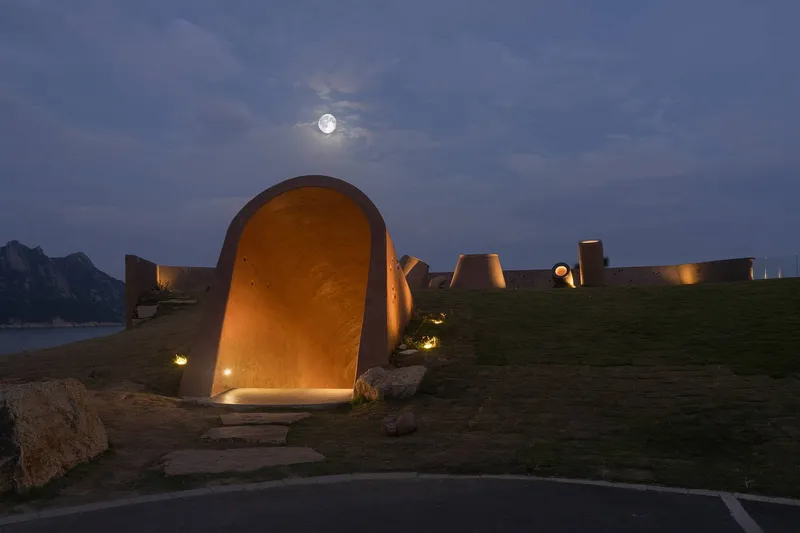
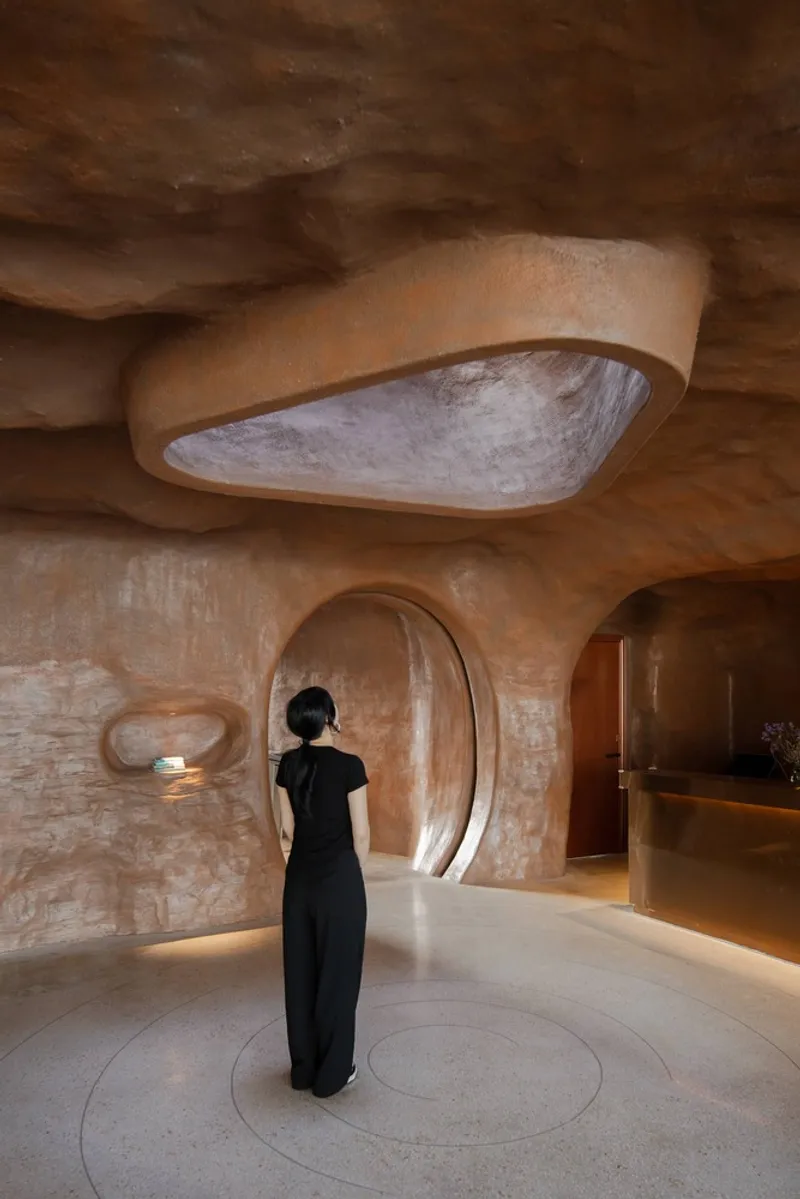
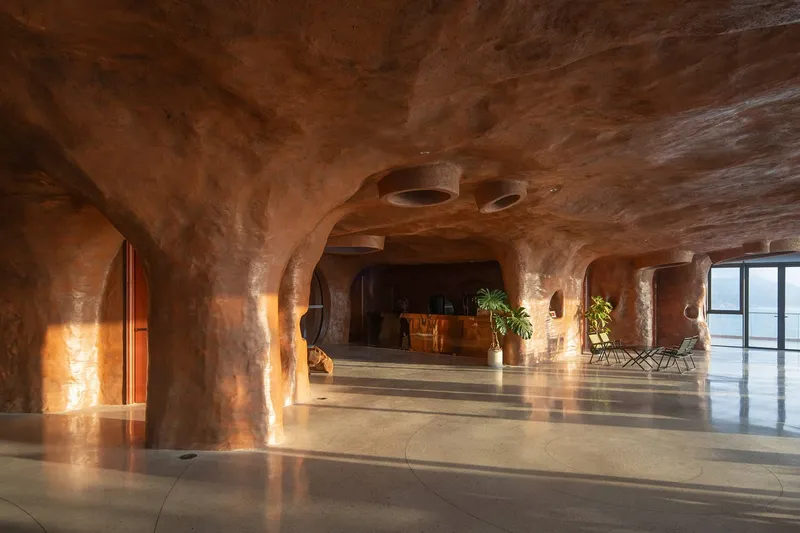
Arrival is theatrical. A semi-circular portal on the roof's western edge, stone steps descending beneath an arched concrete frame, marks the entrance. Under moonlight or at twilight, the portal glows from within, a single warm aperture in the dark hillside. The descending passage narrows and curves, compressing sightlines before releasing visitors into the interconnected cave spaces of the lobby.
Inside the lobby, sculpted concrete walls and ceilings form arched openings that frame views deeper into the building. The construction method is key: metal mesh was first positioned to define the free curved surfaces where columns meet roof, and then plastic concrete was applied by hand, shaped like sculpture, and given a roughening treatment to achieve a rock-like texture. The result is a surface that absorbs light unevenly, casting soft shadows that shift through the day as sunlight moves through the overhead tubes.
Light Tubes and Oculi
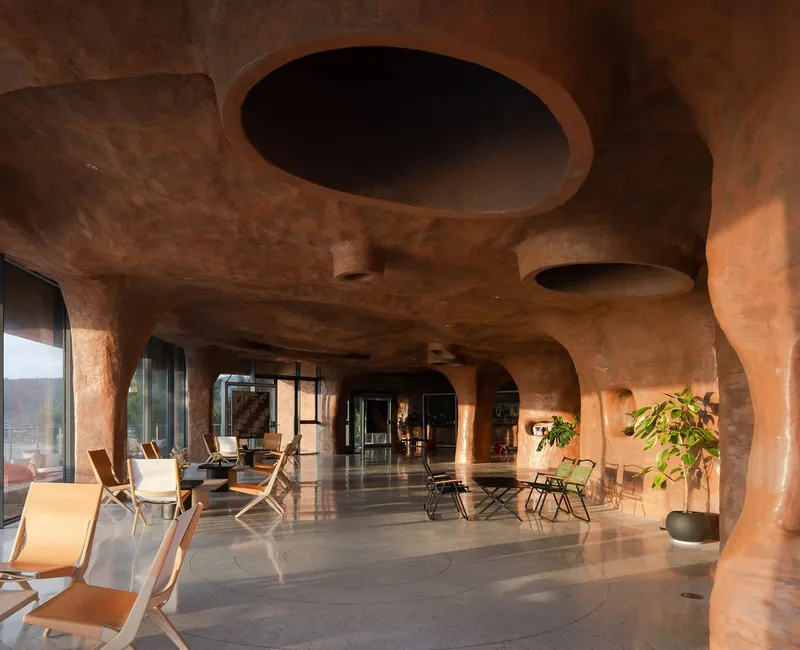
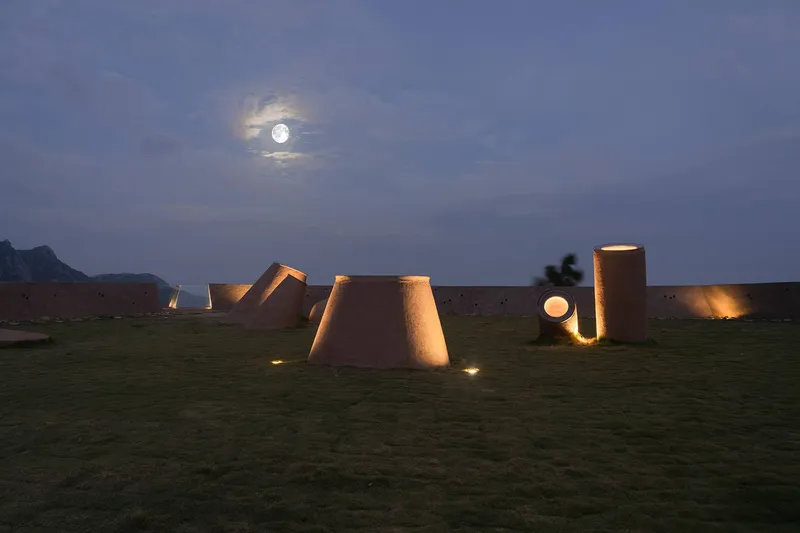
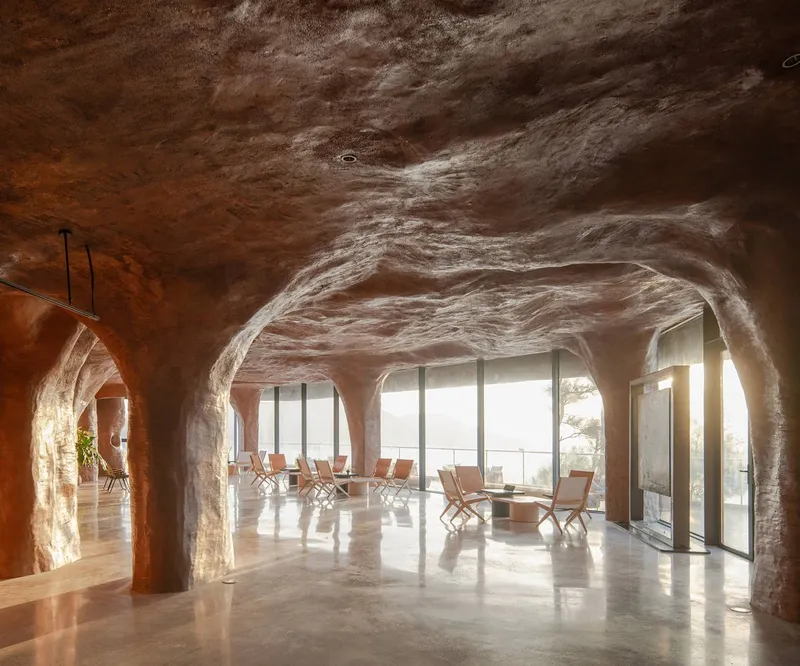
The ceiling is the building's most inventive element. Varying in size and geometry, the light tubes that puncture the roof create a constellation of oculi across the lobby, main salon, and logistics area. Some are narrow vertical slots; others are wide enough to frame a circle of sky. They allow soft, diffused natural light to enter while maintaining a visual connection between the rooftop landscape and the interior below. At night, restrained ambient lighting from buried lamps ensures the building does not disturb surrounding wildlife or compete with the darkness of the coastal environment.
The irregular undulations and voids on the concrete walls are not incidental. They serve as niches for books, display objects, and integrated lighting fixtures. Form and function collapse into a single gesture: every bump and hollow in the sculpted surface has a programmatic alibi.
The Sea-Facing Salon
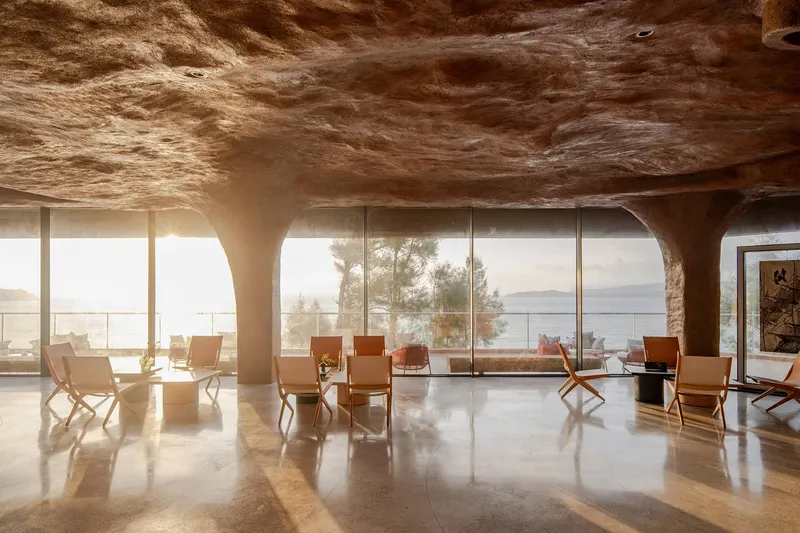
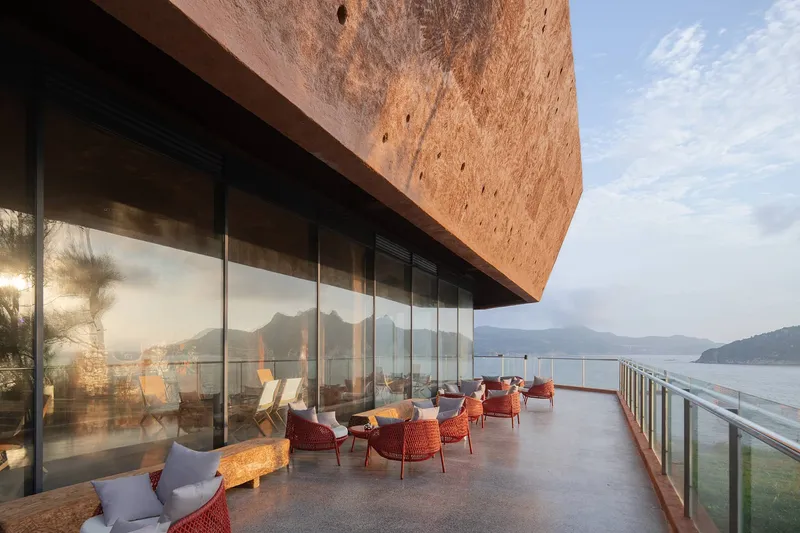
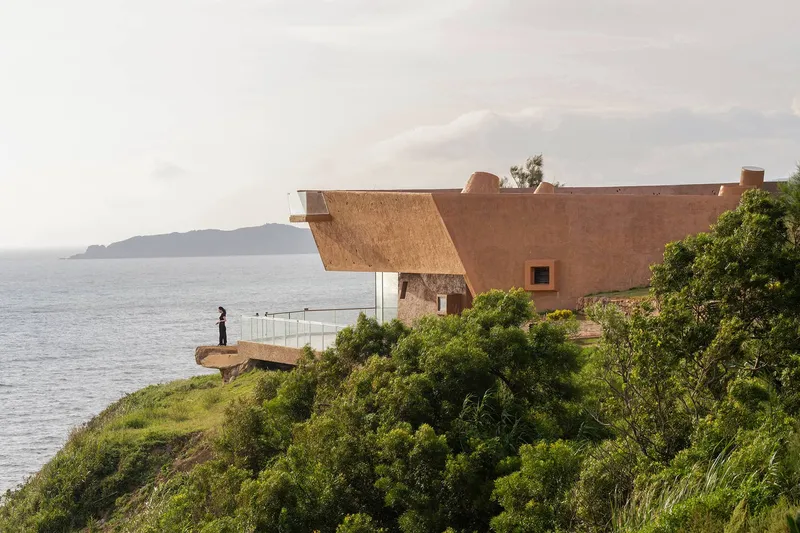
The main space, housing a salon and gallery, occupies the eastern portion of the plan where the roof rises to its highest point. Floor-to-ceiling glass wraps this edge, framing panoramic views of the coastline, Bijia Mountain, and the open Pacific. Leather folding chairs are arranged in loose rows, oriented toward the water. The space is designed to accommodate exhibitions, small gatherings, and catering services, a flexible cultural program for a region that has historically lacked high-quality public venues.
At dusk, the glass-enclosed terrace beneath the cantilevered concrete volume becomes the most compelling seat in the house. The tilted roof overhead reads as a geological overhang, a slab of coastline that has tipped forward to shelter the view. A person standing at the glass railing is simultaneously inside architecture and inside landscape, which is precisely the ambiguity the project cultivates.
Coastal Materiality
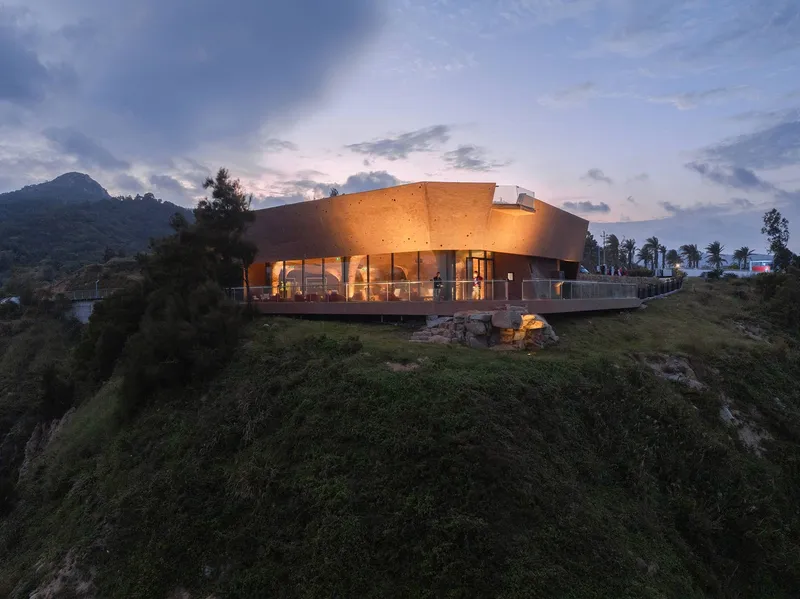
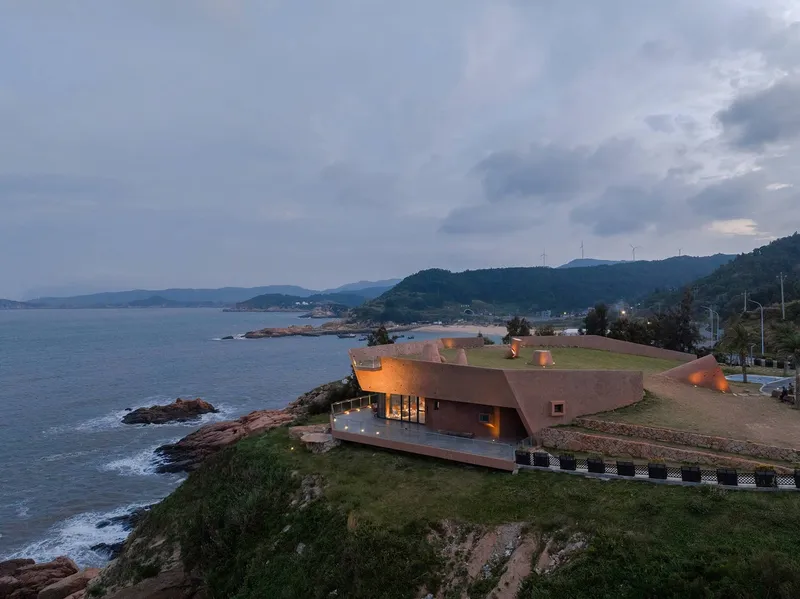
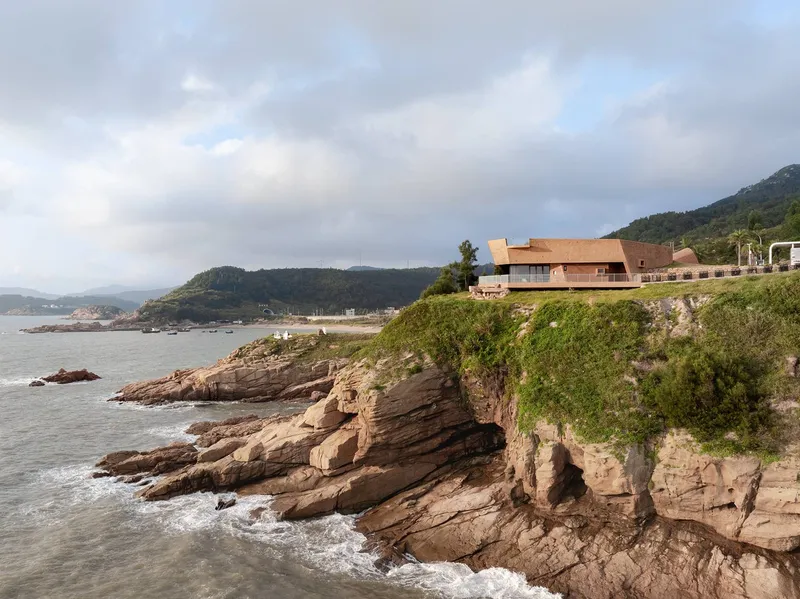
The brown pigmented concrete is the project's single material commitment, and it pays off. Exterior surfaces are roughened to approximate the texture of the sedimentary cliffs below the site; interior surfaces are smoother but still tactile, catching raking light from the oculi. There is no cladding, no secondary finish, no applied warmth. The warmth comes from the material itself and from the amber glow of interior lighting seeping through glass and apertures at twilight.
Perched on the layered cliffs, the structure's angular roof planes and earth-toned mass merge with the stratigraphy of the shoreline. Under overcast skies, the building nearly vanishes. Under stormy evening light, it gains the brooding presence of a bunker or a coastal fortification. The material refuses to age poorly: roughened concrete on a windswept headland will only become more convincing over time.
Night Presence
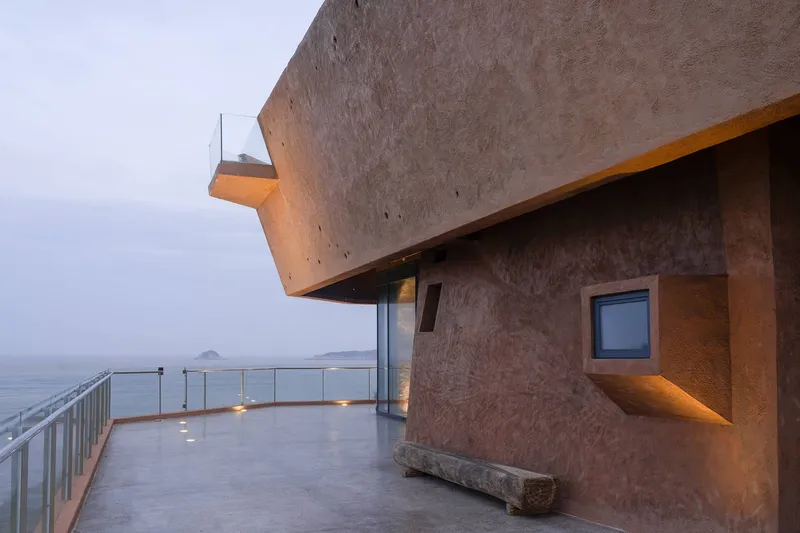
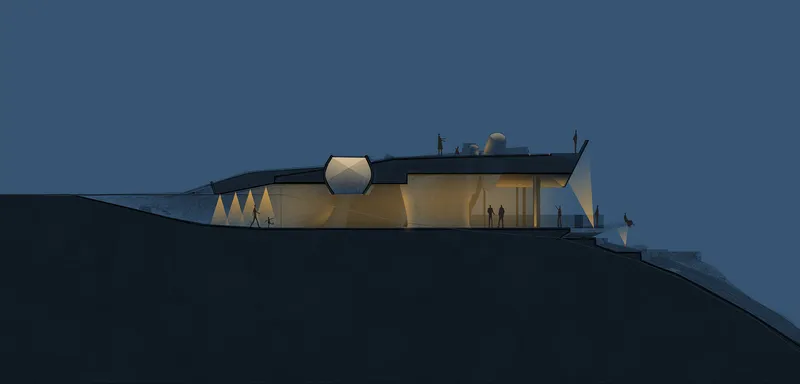
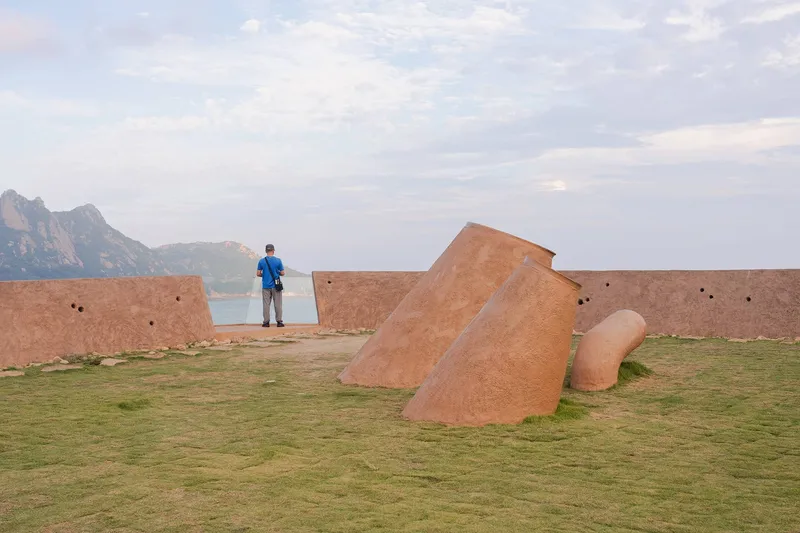
After dark, the building communicates through restraint. Recessed windows and a cantilevered upper volume glow faintly against the ocean. On the hillside, the illuminated form reads as a warm lantern, present but not aggressive. The architects were explicit about minimizing light pollution to protect nocturnal animal activity along the coast, and the result is a nighttime identity that relies on silhouette and the occasional warm aperture rather than floodlighting.
Plans and Drawings
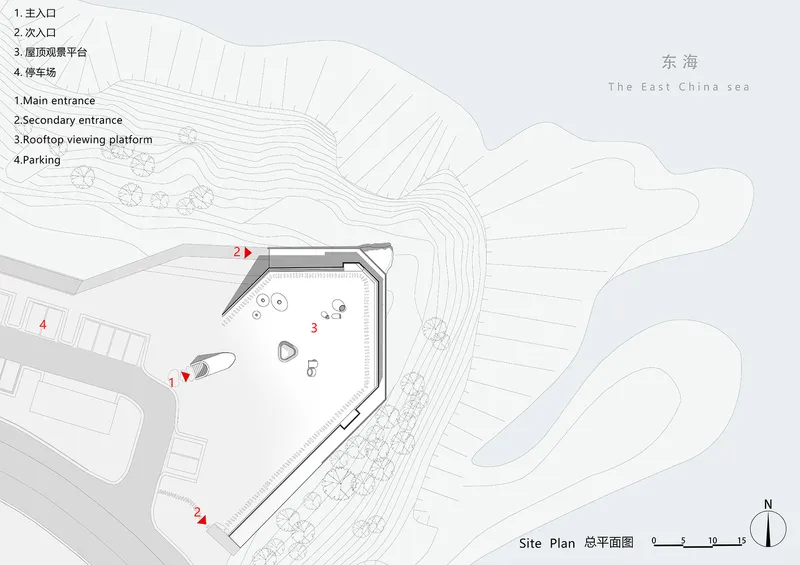
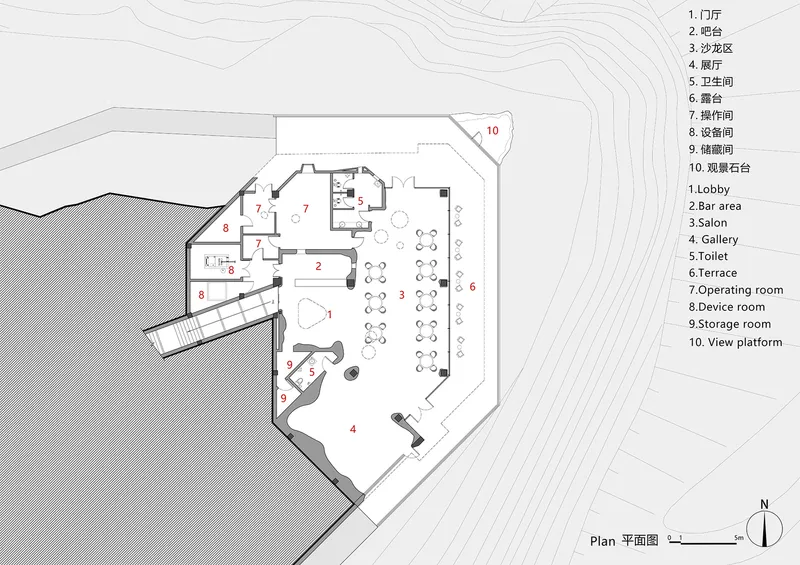
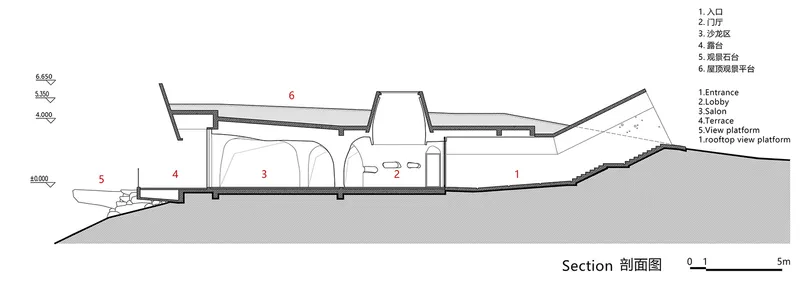
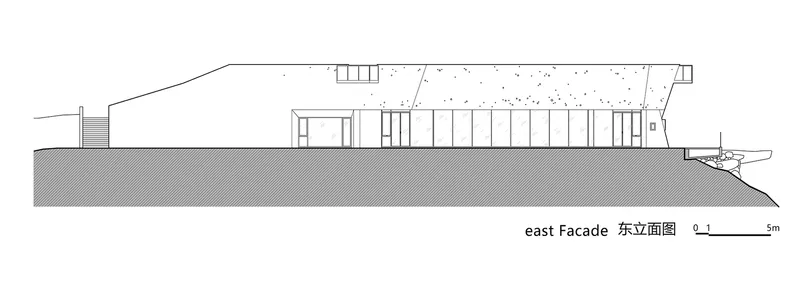
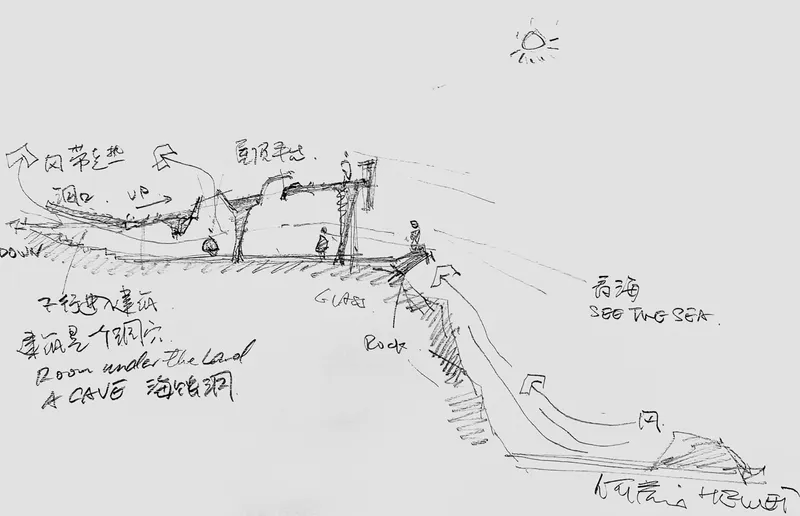
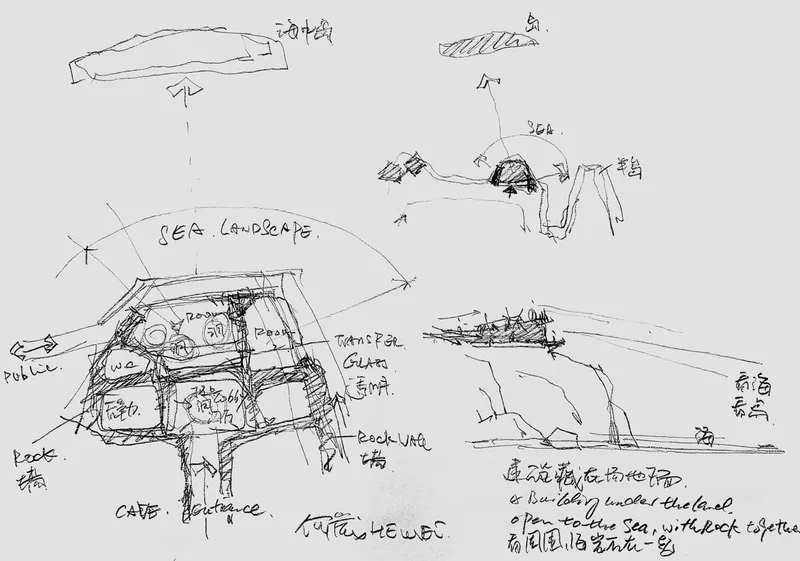
The site plan confirms the building's strategic placement between the parking area and the coastline, occupying the cliff edge without consuming it. The floor plan reveals rooms radiating from a central gallery, an arrangement that ensures every functional zone, lobby, salon, logistics, maintains either a direct ocean view or a connection to the rooftop light tubes. The section is the most telling drawing: it shows the building sliced into sloping terrain, with the entrance lobby at grade and terraced platforms stepping down toward the sea-facing glass wall. The elevation reveals just how little of the structure protrudes above the landscape, a low horizontal volume with vertical glazing and clerestory windows.
The conceptual sketches are worth attention. They show He Wei working through the relationship between figure and ground, annotating spatial sequences and sightlines to the water. The plan studies depict multiple configurations of the cave network, suggesting the final form was arrived at through iterative sculpting rather than top-down geometry. These drawings make the design process legible in a way the finished photographs cannot.
Why This Project Matters
Underground architecture often suffers from a credibility problem. It promises ecological sensitivity and delivers dark basements. The Blue Insight Cave Space avoids this trap by treating burial not as an obligation but as a spatial opportunity. The descending entry sequence, the sculpted ceilings, the oculi that register the passing sky: these are experiences that would be impossible in a conventional above-grade pavilion. The underground condition is not a constraint to be mitigated; it is the entire architectural proposition.
The broader lesson is about site legibility. Xiapu's coastline is defined by erosion, by the slow subtraction of stone by water and wind. 3andwich Design's response is to build as though the architecture itself were a product of that same erosion, a void carved from the headland rather than an object placed upon it. The sculptural concrete technique, hand-shaped over metal mesh, makes this metaphor physically real. In a moment when sustainable architecture too often defaults to photovoltaic panels and timber frames, this project argues that the most consequential green strategy might simply be to put the building back in the ground.
The Blue Insight Cave Space by 3andwich Design/He Wei Studio, Xiapu, Ningde City, Fujian Province, China. 460 m². Completed 2024. Photography by DONG Image.
About the Studio
Share Your Own Work on uni.xyz
If projects like this are the kind of work you want to make, uni.xyz is a place to publish your own, find collaborators, and enter design competitions.


Popular Articles
Popular articles from the community


The Musturak Paradise: Senior Living Architecture for a Connected Future in Temara, Morocco
The Musturak Paradise reimagines senior living architecture in Temara via private homes, social spaces, culture, community, and shared care.

Play: Fragments of Their World
Familiar architecture becomes modular playground design, creating safe spaces where displaced children can learn, connect, imagine and play.

Conexión: Biophilic Design Reimagines High-Rise Living in Hong Kong
Conexión reimagines high-rise living in Hong Kong through biophilic design, green facades, shared spaces, daylight, water and nature within.

Hill & Cross Opera: Sculptural Opera House Architecture Shaped by Tallinn’s Landscape and Identity
Hill & Cross Opera reimagines opera house architecture in Tallinn through its sculptural hill, civic plaza, glass wave and a luminous cross.

Similar Reads
You might also enjoy these articles

Bamboo Housing Challenge 2026: Design Affordable, Sustainable Homes Using Bamboo
An international design competition by Bamboo U and IBUKU inviting architects and designers to reimagine affordable housing using bamboo — with the winning design built full-scale in Bali.

Computational Design & Education: Beegraphy Design Awards Introduces 7th Category (Featuring Jiyun's Innovative Approach)
Dive into Beegraphy’s 7th Design Awards category, where computational design meets education to create immersive, interactive learning tools, inspired by Jiyun’s work.
From Parametric Lighting to Urban Furniture: Join the 2nd Workshop in Beegraphy’s Computational Design Series
Dive into Cutting-Edge Design Techniques and Practical Applications with Industry Experts

Last Call: Unleash Your Architectural Genius in SHAK's Kindergarten Design Competition
Urgent call for architects to join SHAK's kindergarten design competition before the looming deadline

Explore Architecture Competitions
Discover active competitions in this discipline

Challenge to reimagine the Iron Throne

Photograph architecture without architects

Illustrate the lost glory of Angkor Wat - Render Challenge

Design challenge to reuse E-waste
Comments (0)
Please login or sign up to add comments
No comments yet. Be the first to comment!