
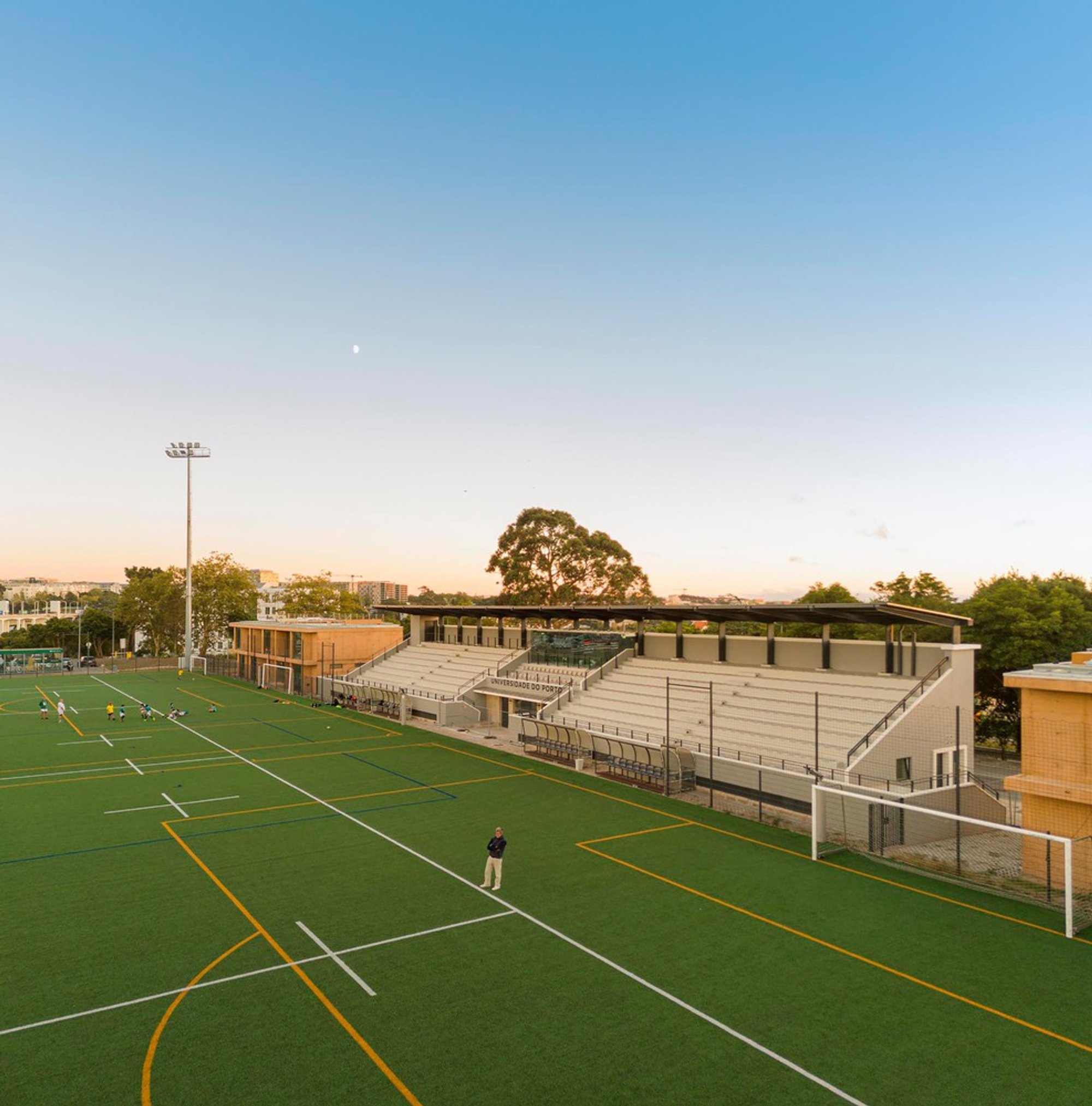
Crea Arquitetos Extends a 1953 University Stadium in Porto with Terracotta Concrete Pavilions
A rationalist grandstand in Quinta do Campo Alegre gains two new buildings that reinterpret its metric in a freer, warmer key.

Porto's University Stadium has stood in Quinta do Campo Alegre since 1953, a product of postwar rationalism defined by geometric clarity, strict symmetry, and granite bas-reliefs depicting ancient mythology. Seventy years on, the grandstand still commands the site, but the complex around it had long outgrown its original program. Crea – Arquitetos was brought in not simply to restore the building but to extend the stadium into a three-volume complex that houses the headquarters of CDUP, the University of Porto's sports center, while keeping the original grandstand as its compositional anchor.
What makes the project worth studying is the calibration between deference and independence. The two new pavilions sit along the longitudinal axis of the grandstand, picking up its pillar rhythm and opening generously toward the playing fields to the east. But where the 1953 structure relies on rigorous bilateral symmetry, the additions loosen that grid into something more fluid. Pigmented concrete in a warm terracotta tone wraps facades, ceilings, and ground floor interiors alike, giving the three buildings a shared material identity without pretending they were all built at once. The result, completed in November 2024, is a university sports facility that treats history as a compositional resource rather than a constraint.
The Original Grandstand and Its Entrance Ritual
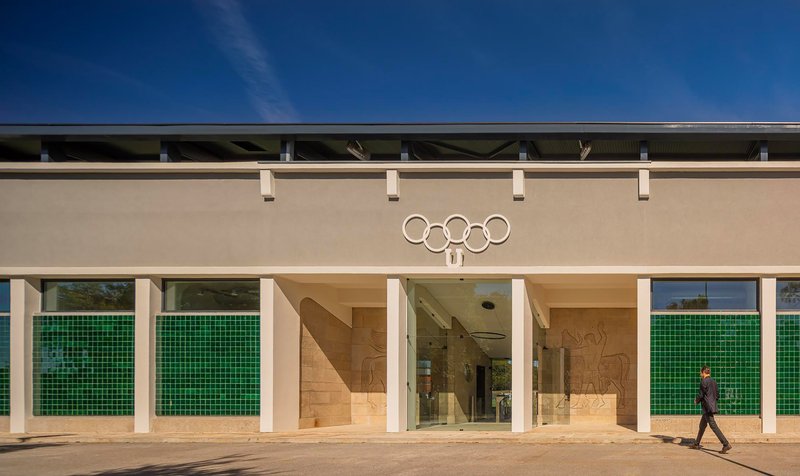
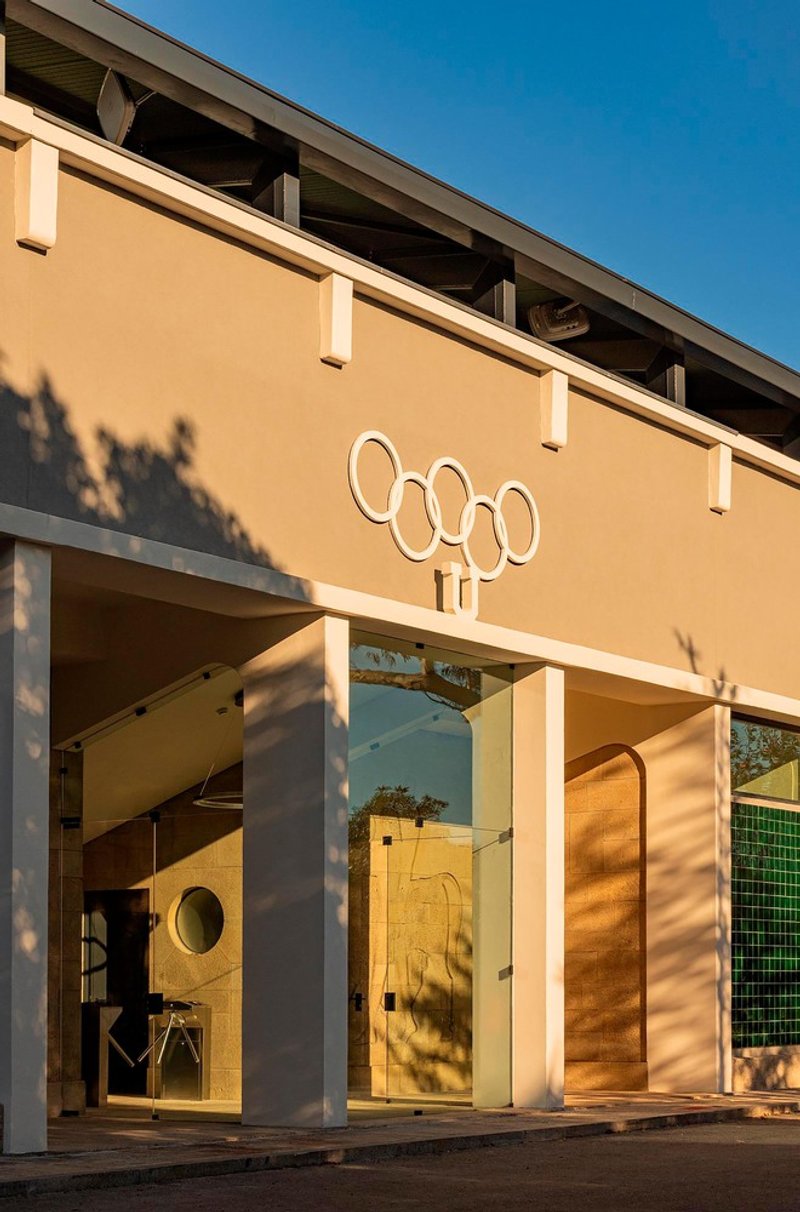
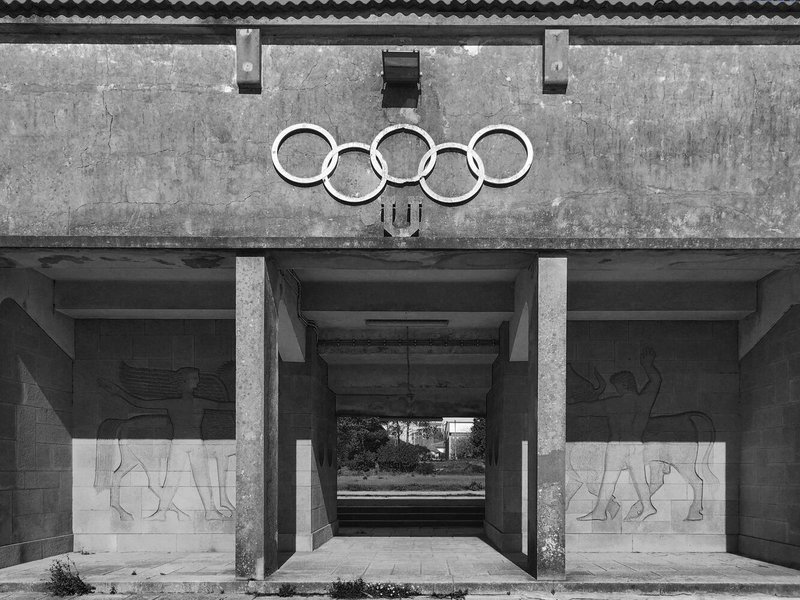
The 1953 entrance facade remains the most formal moment in the complex. A porticoed loggia of white cylindrical columns leads visitors beneath the Olympic rings emblem and past green tile flanking panels into the stadium's interior. The sequence is deliberate: spectators move through a compressed, shaded portico before ascending stairs to the top of the grandstand, where the playing fields open up below. It is a classic mid-century procession from street to sport.
Crea preserved the chiseled granite bas-reliefs that adorn the entrance, their motifs of ancient games and mythology now cleaned but left deliberately weathered. The decision not to polish them smooth is telling. These surfaces carry the patina of seven decades, and the architects understood that their roughness gives the building a temporal depth that no new material can replicate.
Three Volumes Across the Field
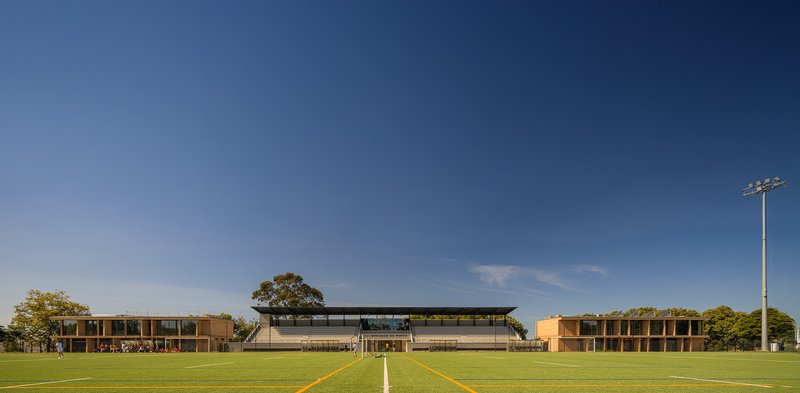
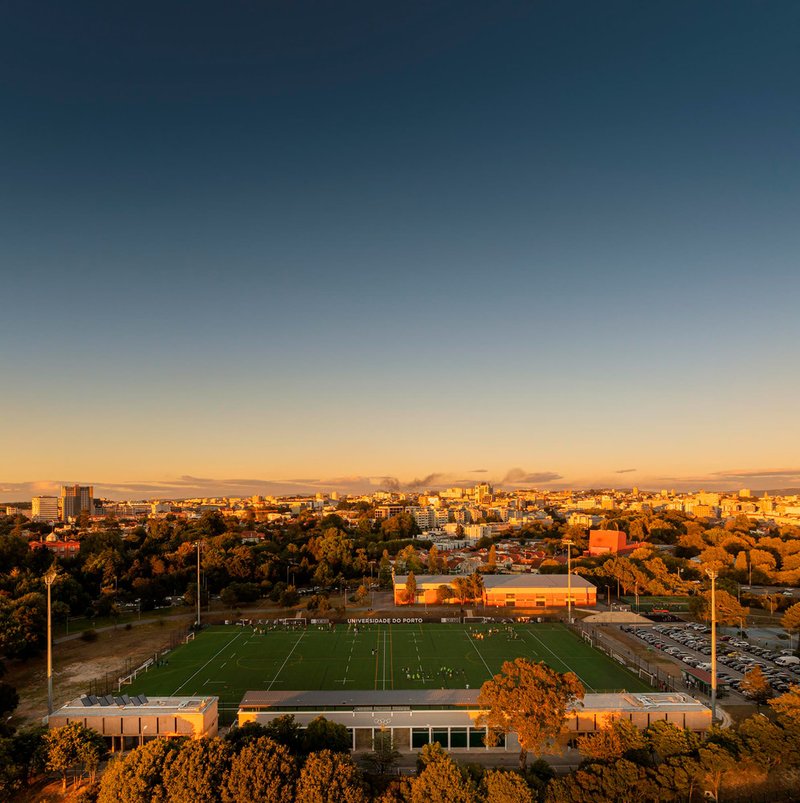
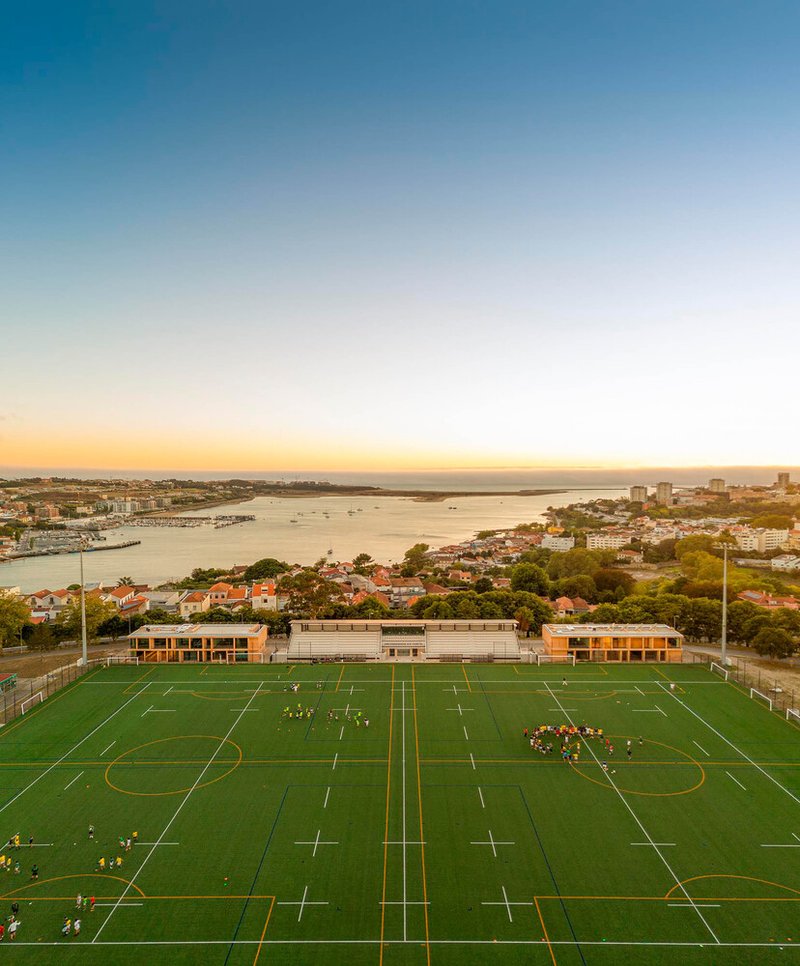
Seen from across the pitch, the three buildings read as a single horizontal datum. The original grandstand anchors the center while the new pavilions extend the composition to either side. Crea organized the CDUP headquarters across these flanking volumes, distributing work offices, meeting and social rooms, and multipurpose spaces for university students. The program is deliberately social: these are not just administrative buildings but places where the campus community gathers.
Aerial views at sunset reveal how the complex nestles into Porto's green topography, the autumn canopy of Campo Alegre wrapping the site on three sides while the playing fields stretch east toward distant views of the harbor. The low, horizontal massing means the buildings never compete with the landscape; they sit beneath the treeline and let the terrain do the work of enclosure.
Timber, Louvers, and the New Pavilion Language
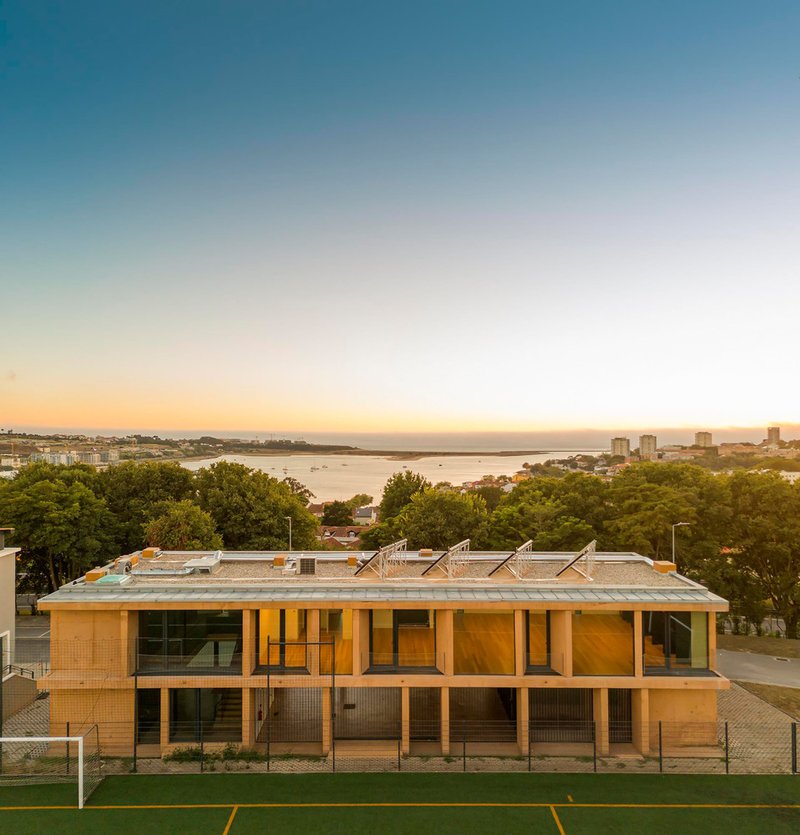
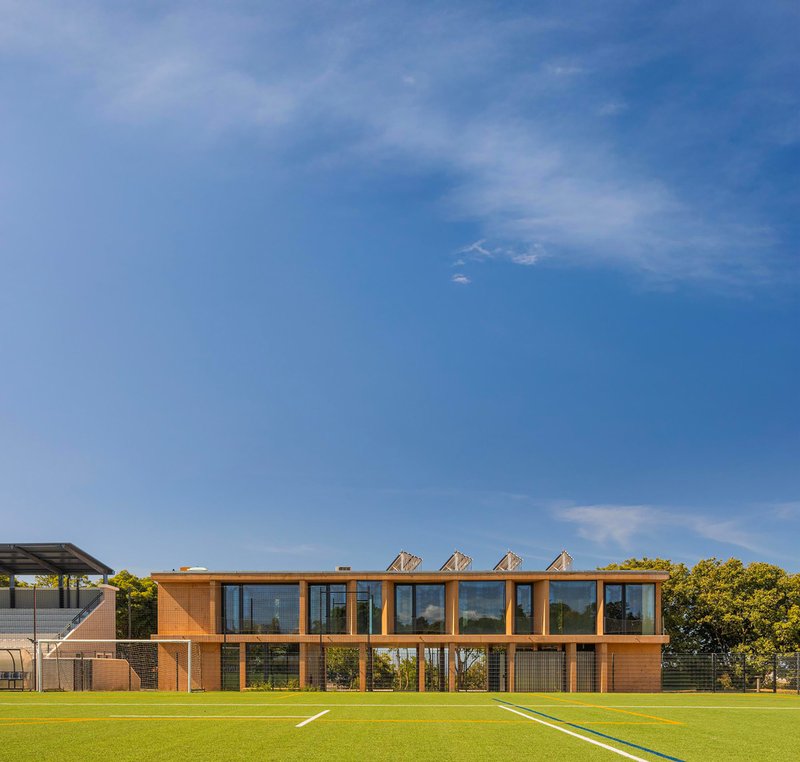
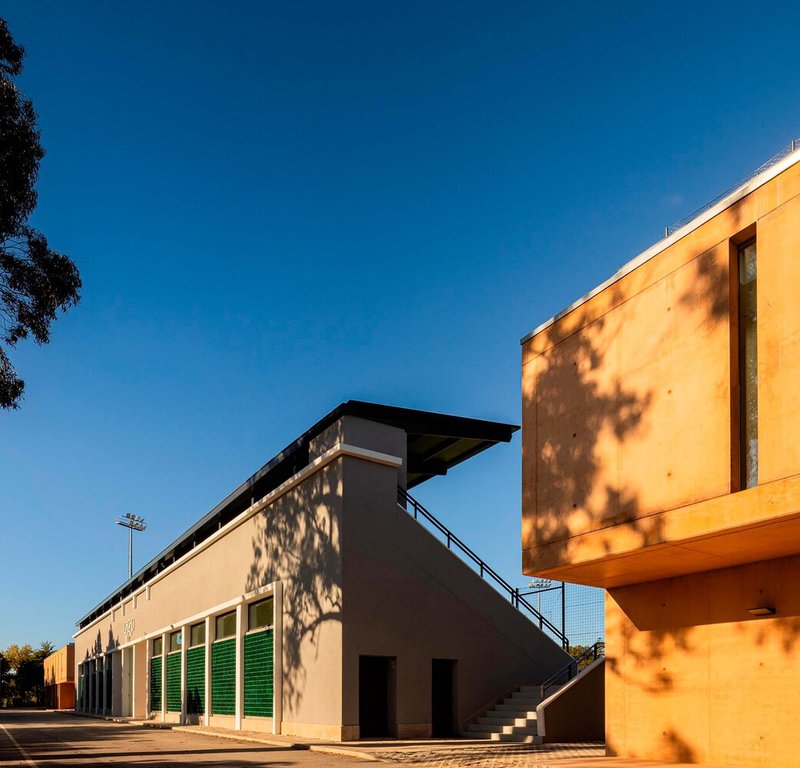
The new pavilions introduce a material vocabulary that is warmer and more tactile than the grandstand's concrete and granite. Timber louvers and plywood ceilings soften the interiors, while sawtooth roof monitors bring controlled natural light into the upper floors. Green metal shutters on the exterior staircase volumes nod to the original building's green tile panels, establishing a chromatic link without mimicry.
The concrete pillars on the new facades are arranged in a rhythm that echoes the grandstand's structural metric but is not bound by its symmetry. Where the 1953 building uses pillars to enforce order, the additions use them to frame: balconies project toward the pitch, large planes of glazing open onto the grass, and the pillar spacing widens and narrows in response to the program behind. It is the same structural idea made more conversational.
Spectators, Stairs, and the Expanded Roof
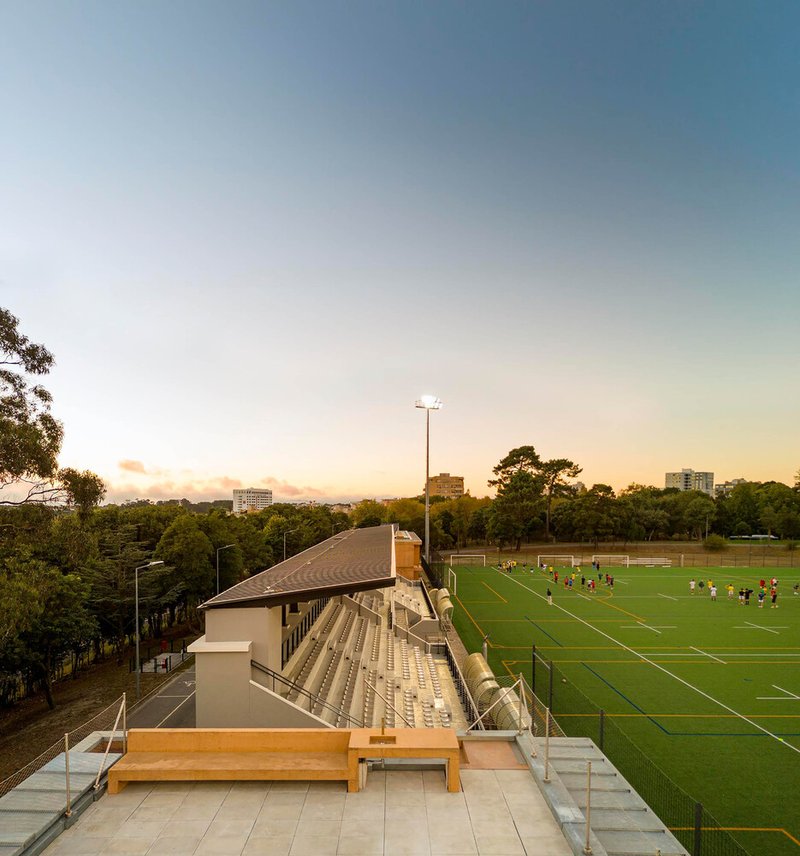
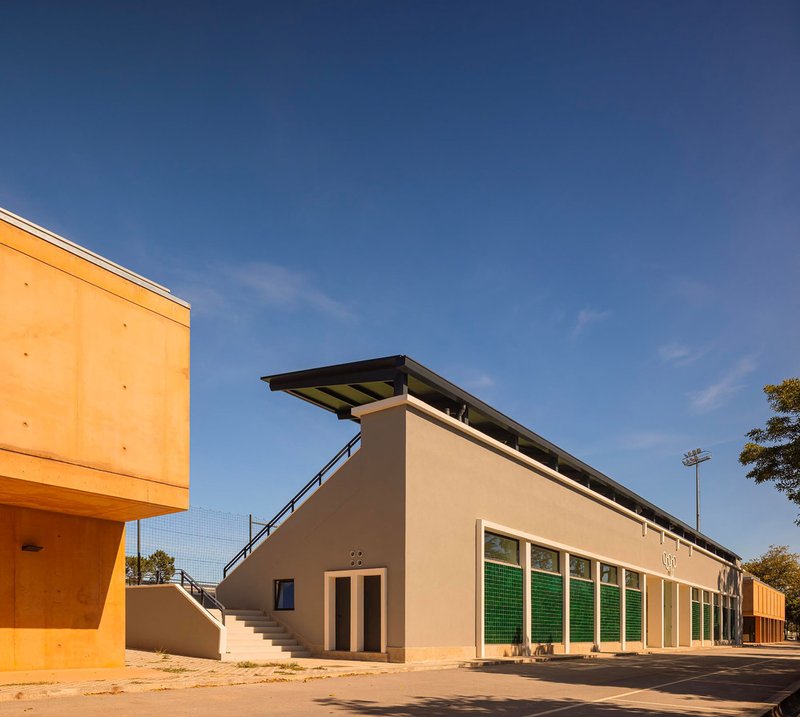
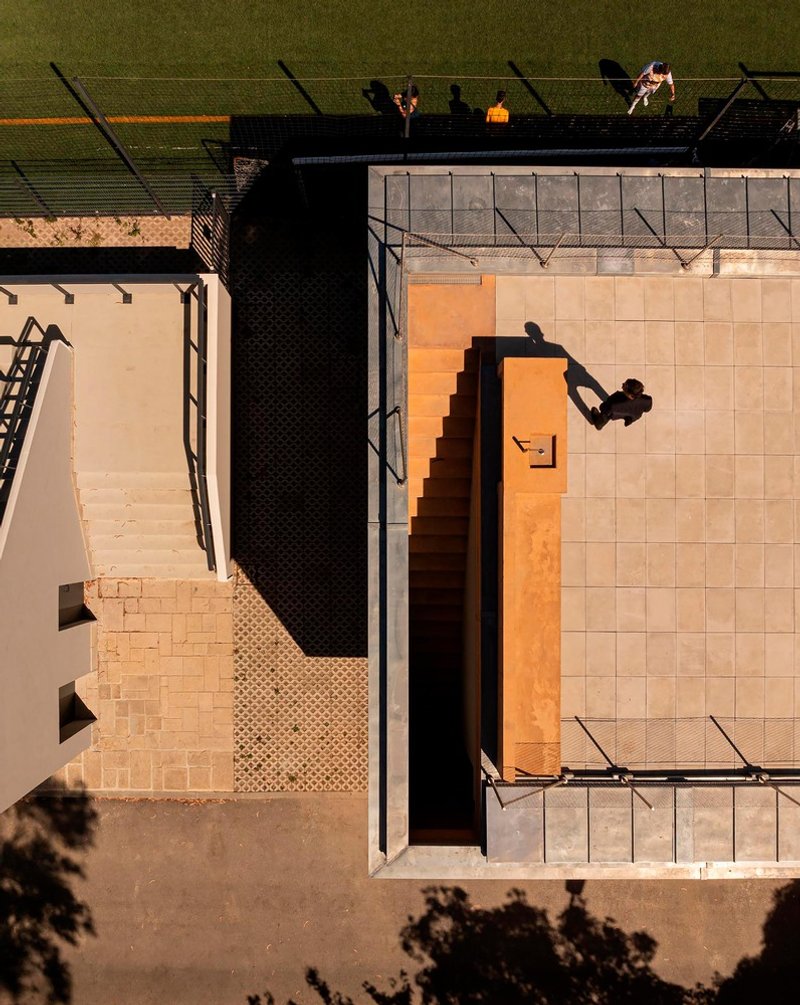
One of the most pragmatic moves in the renovation is the redesigned roof, which significantly expands the covered area over the grandstand seating. Tiered concrete steps with timber bench inserts face the field, and spectators now enter from stairs at the top of the stand, descending to their seats. The cantilevered overhang protects far more rows than the original structure managed, a functional upgrade that also sharpens the building's profile against the sky.
External staircases on the pavilion flanks double as vertical circulation and as architectural events in their own right. At dusk, their concrete treads and slender railings catch raking light, and the green shutters behind throw long shadows onto the terracotta walls. These are not fire escapes bolted onto a facade; they are composed elements that give the buildings scale and rhythm when viewed from the pitch.
Interior Life: Plywood, Resin, and Open Light
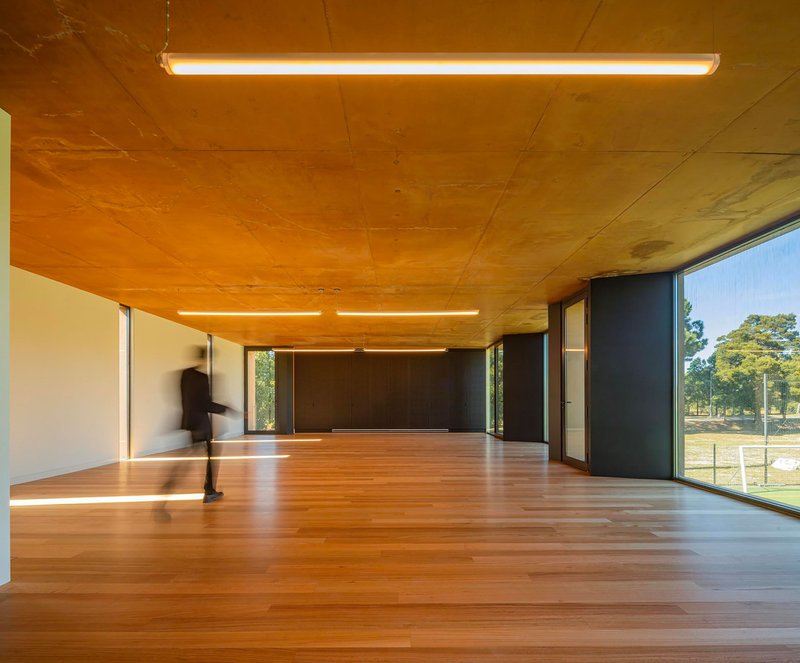
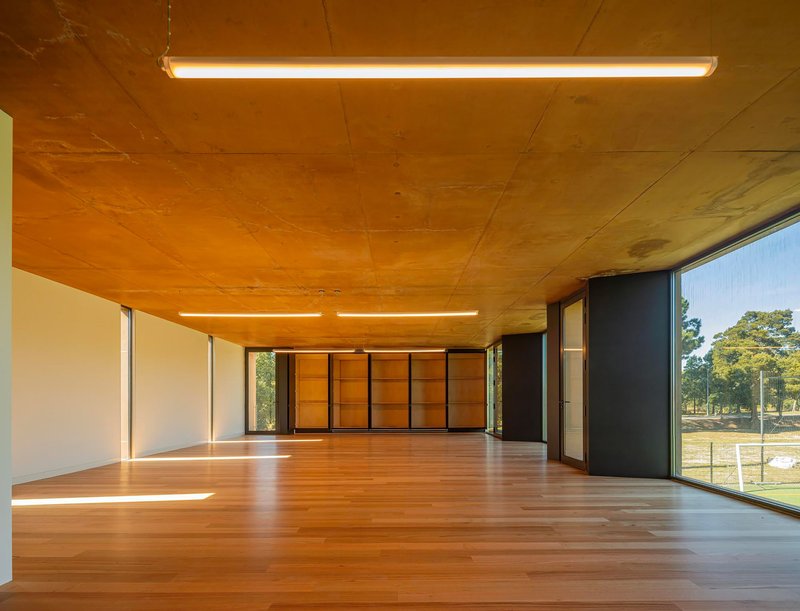
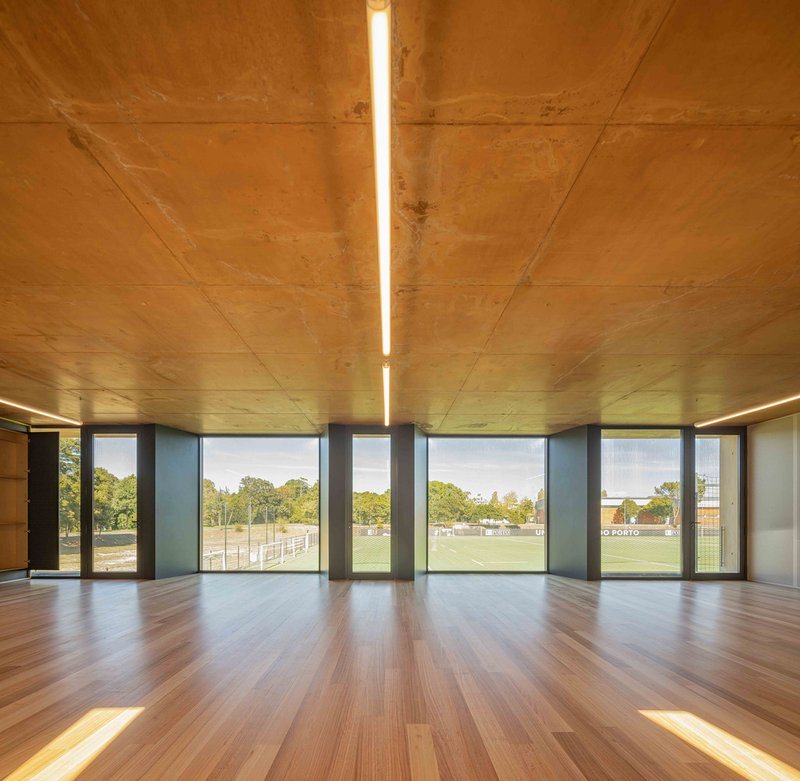
Inside the new pavilions, the material palette is deliberately restrained: timber flooring, plywood ceilings, linear lighting fixtures, and floor-to-ceiling glazing facing the playing fields. Multipurpose halls on the upper levels can be subdivided with movable partition walls, allowing the university to reconfigure the spaces for lectures, training sessions, or social events. The architecture does not dictate use; it sets up a generous container and steps back.
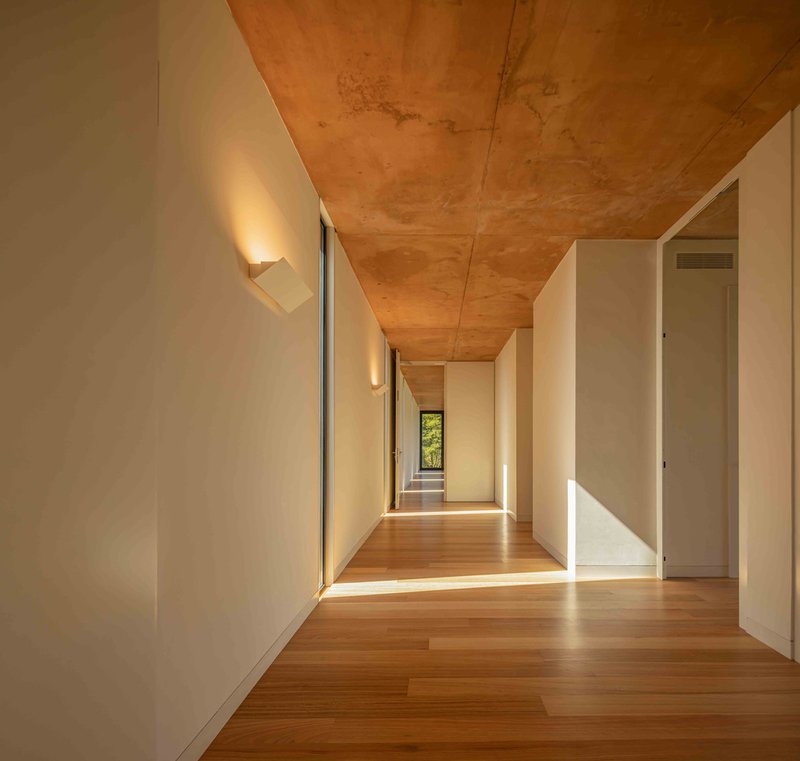
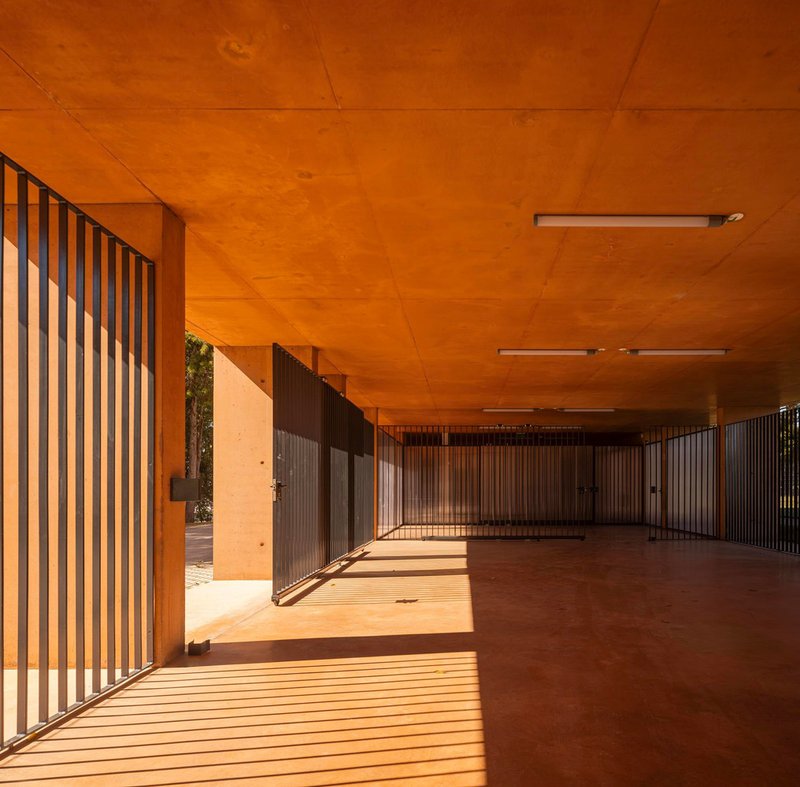
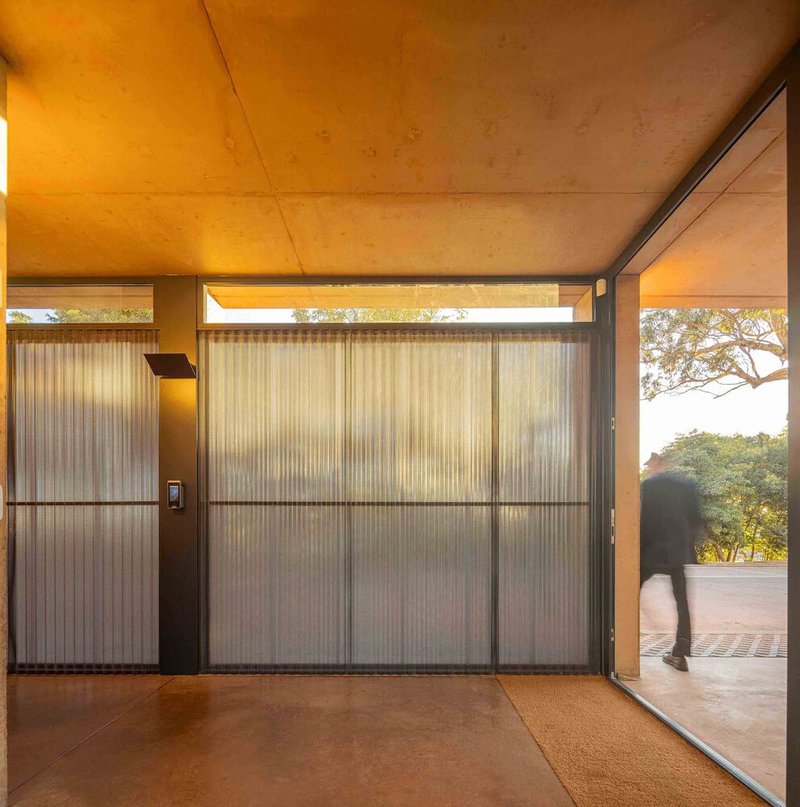
Corridors and transitional spaces receive equal attention. Covered walkways with vertical timber slats cast striped shadows onto polished concrete floors, turning circulation into a sensory experience. Translucent corrugated panels in some rooms filter afternoon sun into a soft, diffuse glow. The effect is warm without being precious: these are sports buildings, and the materials are chosen to absorb wear gracefully.
Support Spaces and the Ground Plane
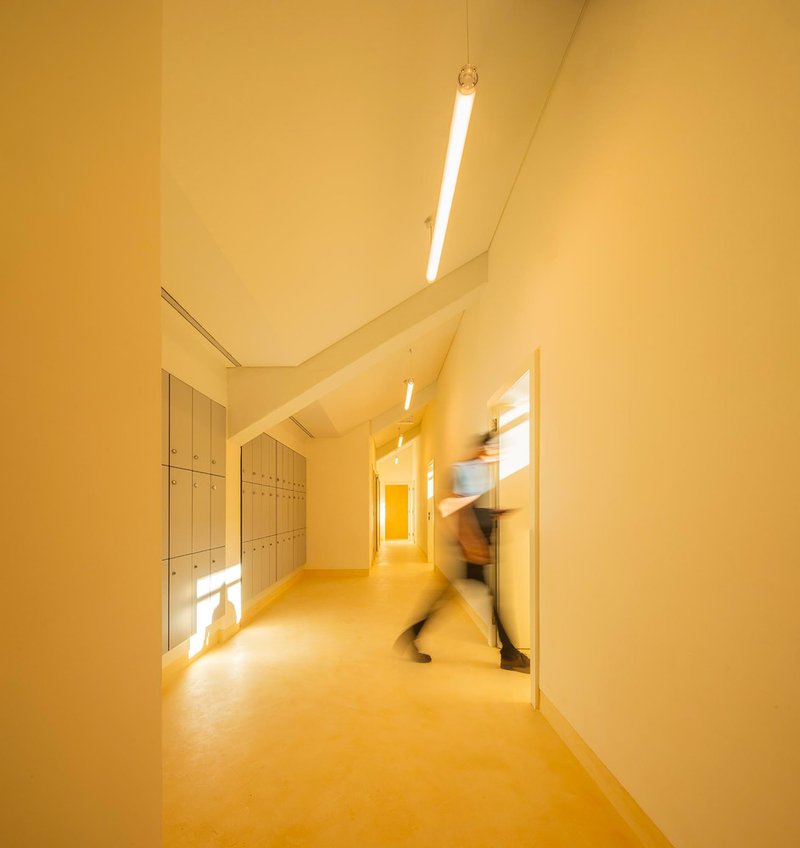
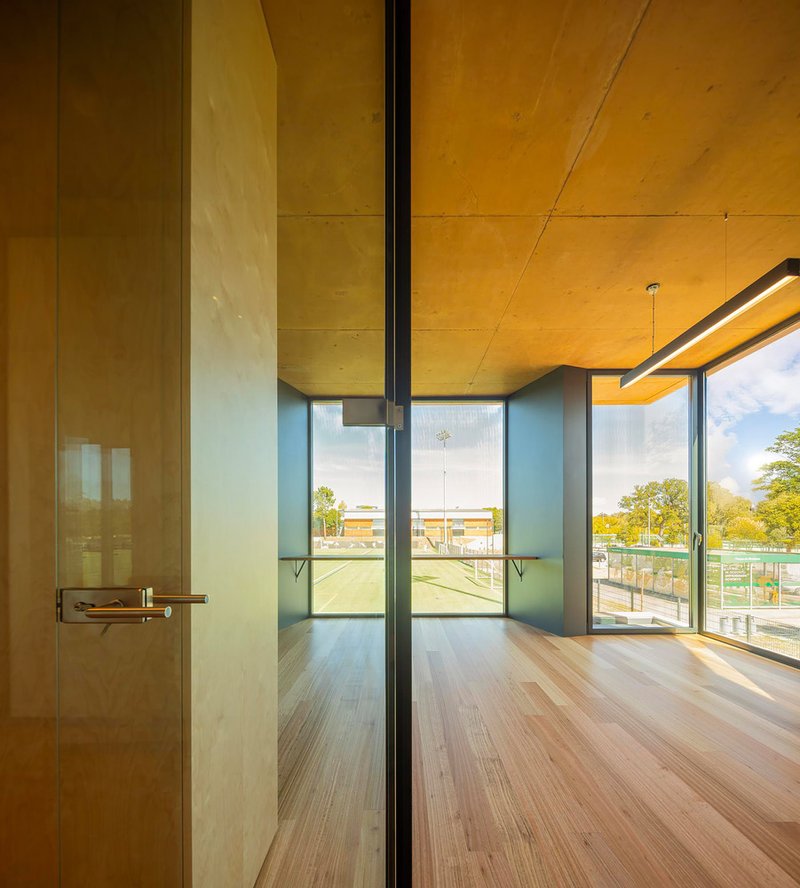
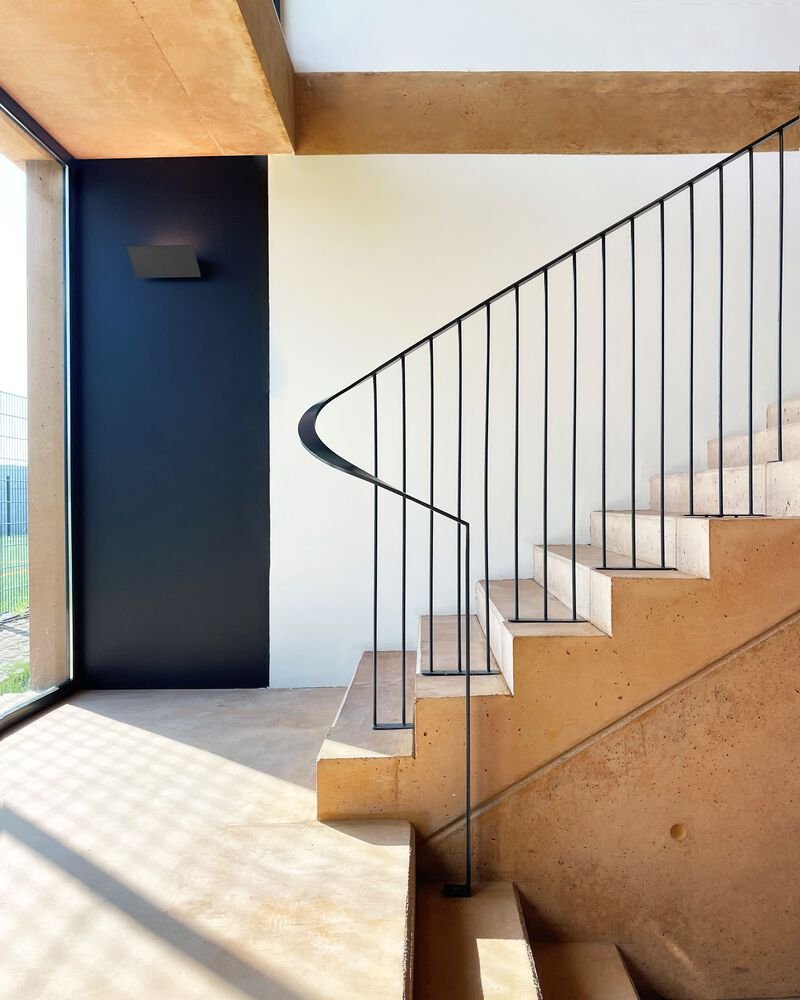
Below the public rooms, the ground floor holds changing facilities, storage, and service corridors finished in yellow resin flooring and wall-mounted lockers. These are frankly utilitarian spaces, and Crea does not try to dress them up. The yellow floor is vivid and practical, easy to clean and bright enough to feel safe in a windowless corridor. A curving staircase with rammed earth steps and slender metal railings connects this service level to the offices above, introducing an almost domestic warmth into what could have been a purely institutional zone.
Landscape and Site
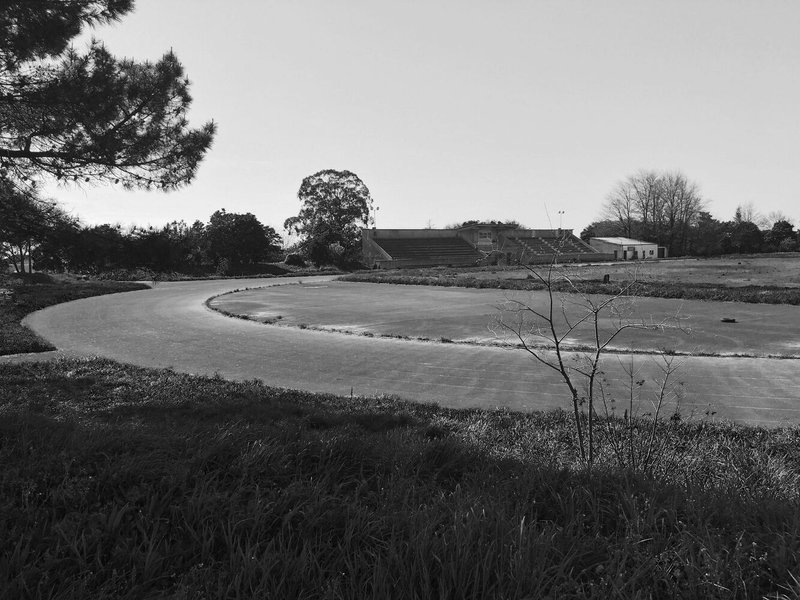
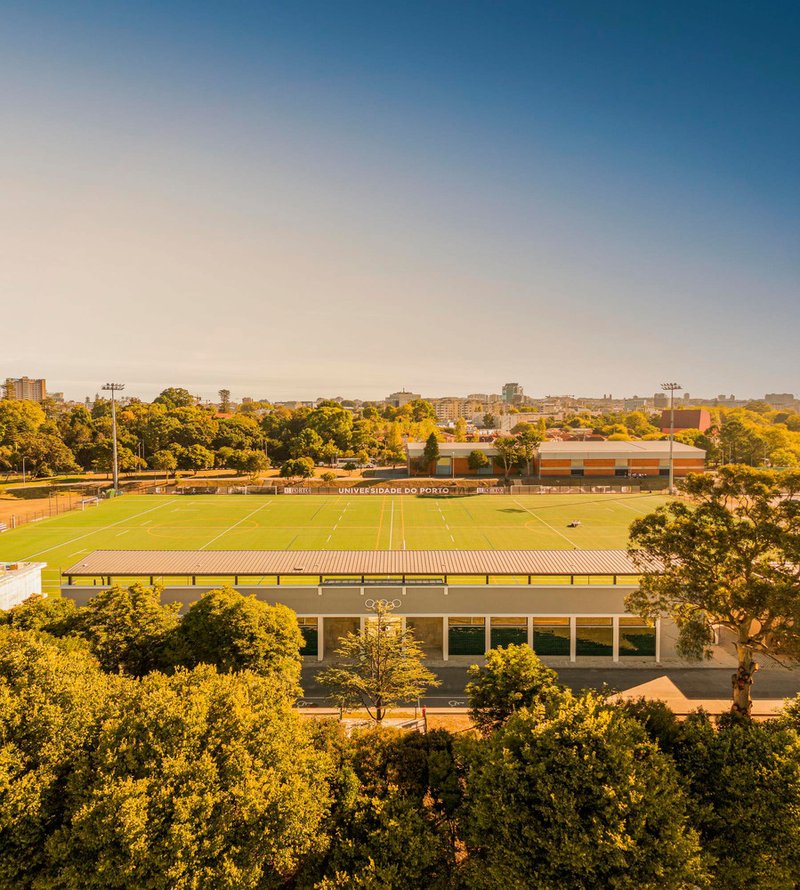
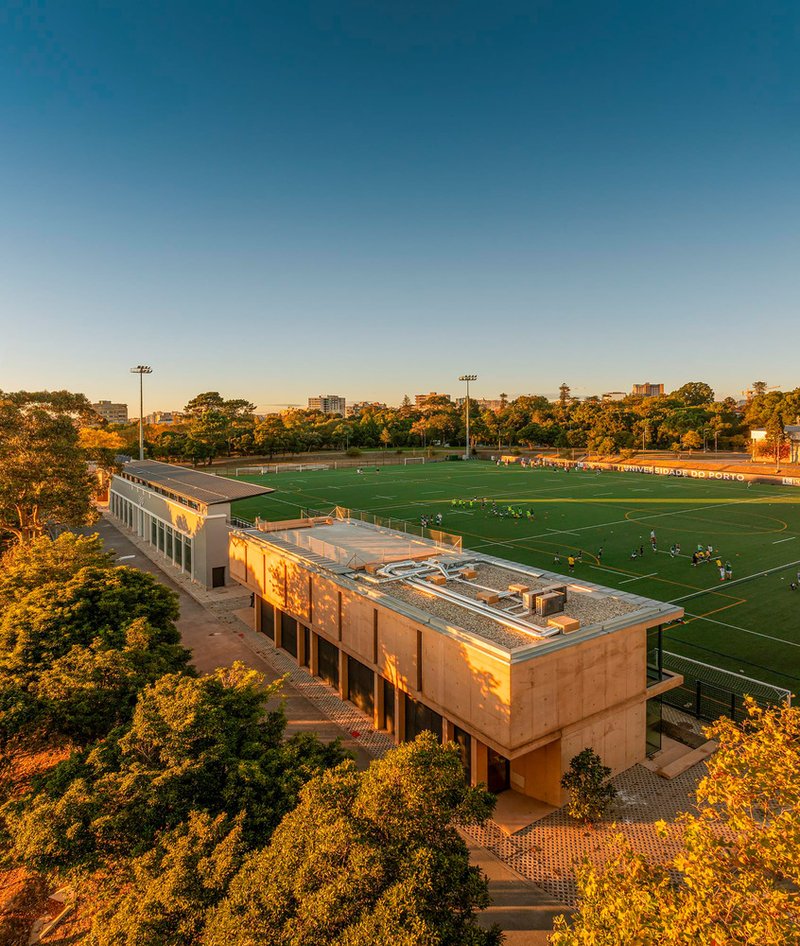
The site strategy is one of restraint. A curving concrete pathway winds through the surrounding landscape of scattered trees and bare winter grass, connecting the stadium to the broader campus without formalizing the approach. From above, the low horizontal pavilion reads as a long seam between the playing fields and the park, its rammed earth facade and rooftop terrace blending into the autumn palette of Campo Alegre.
Crea understood that the stadium's real setting is not the street but the landscape. The buildings orient decisively eastward, toward the pitch, and let their western edges dissolve into the trees. It is an architecture of directed attention: everything frames the game.
Plans and Drawings
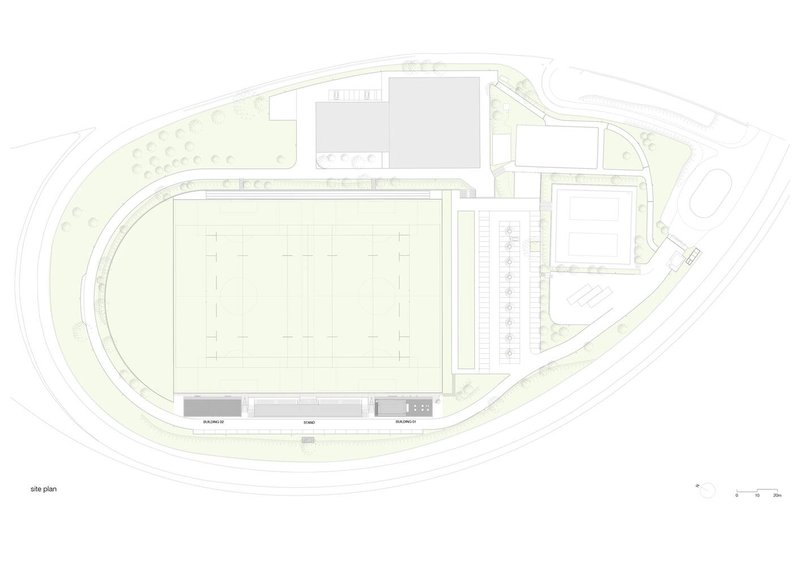
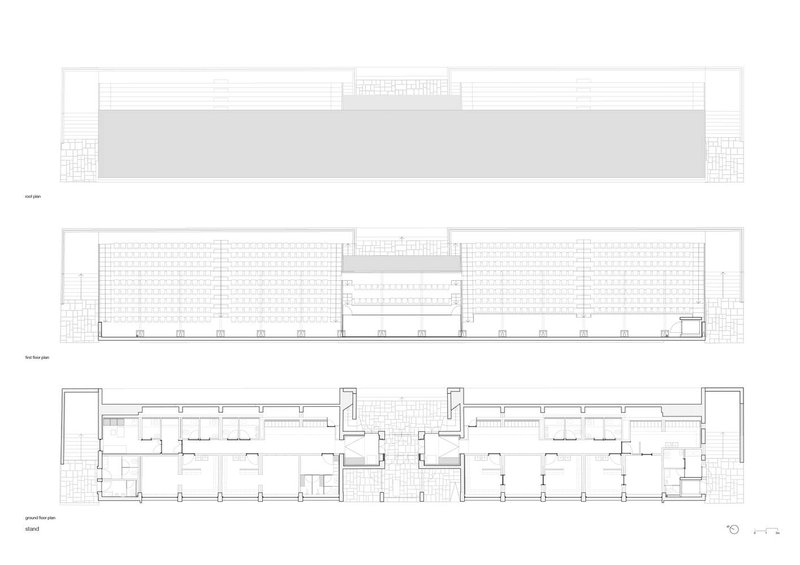
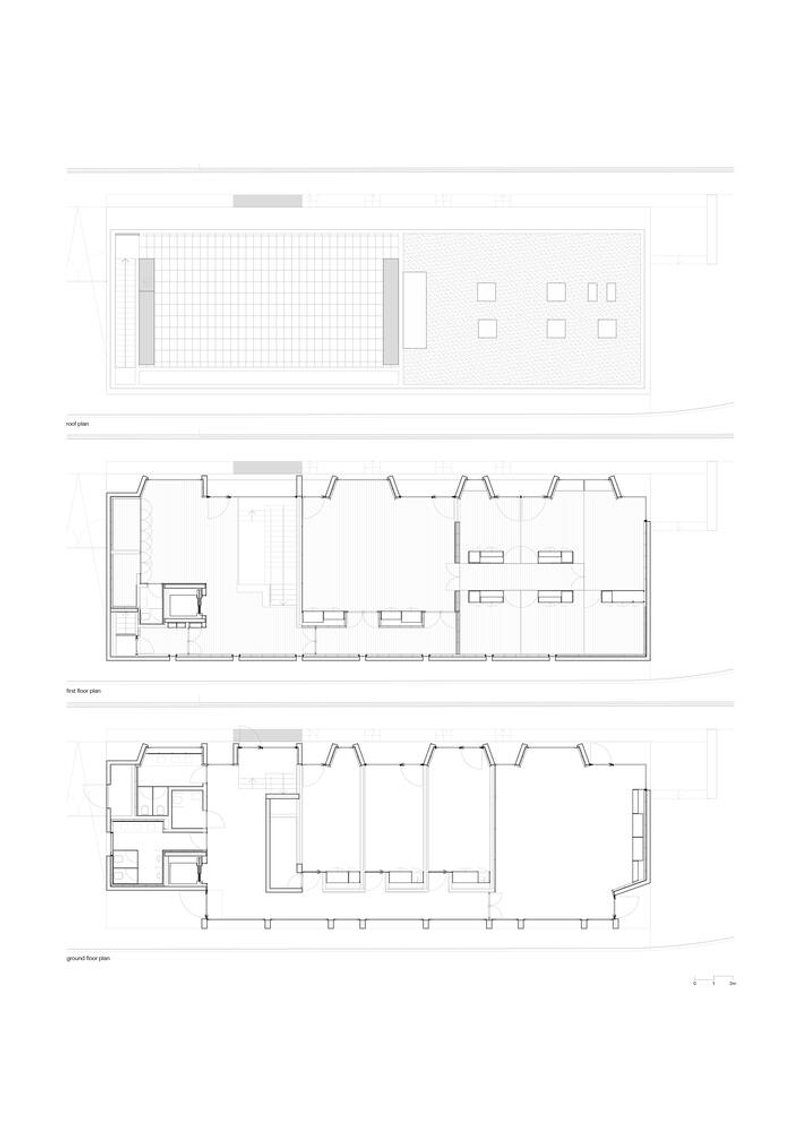
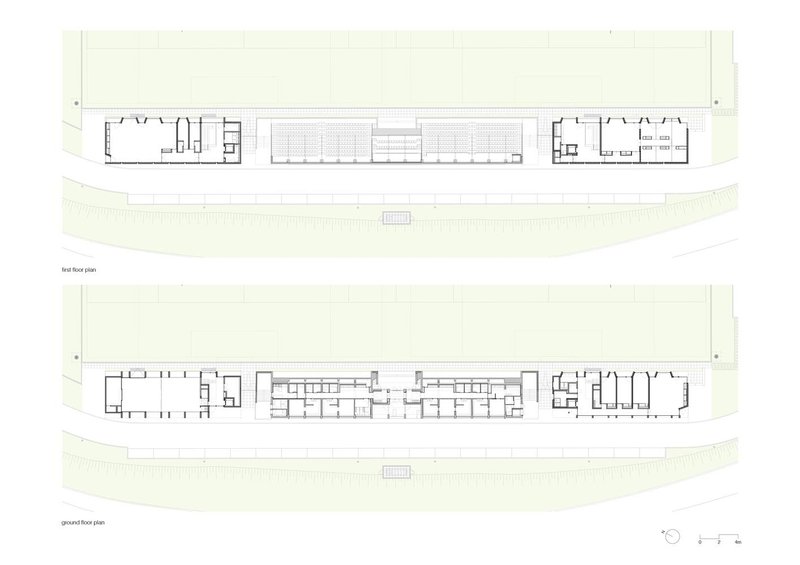
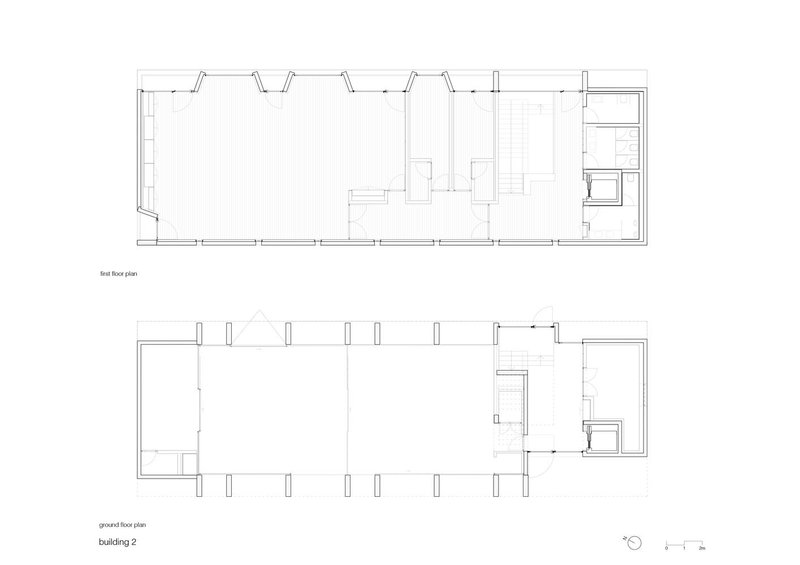
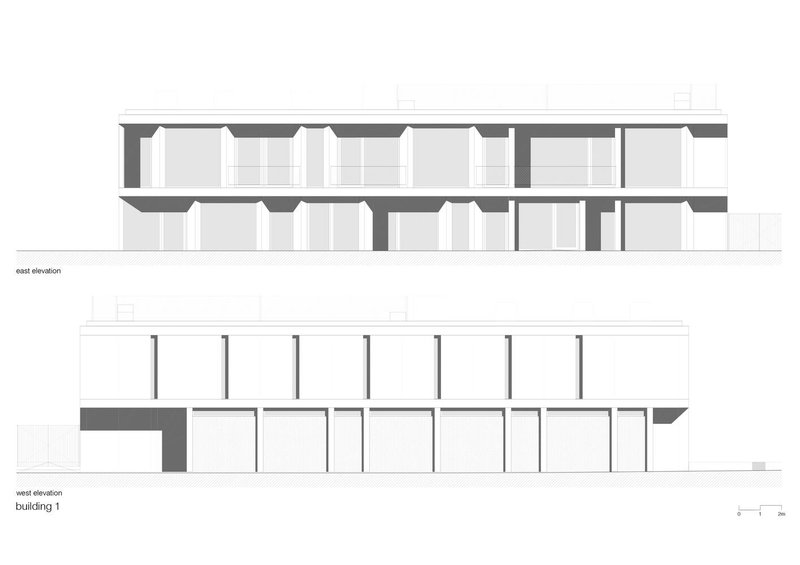
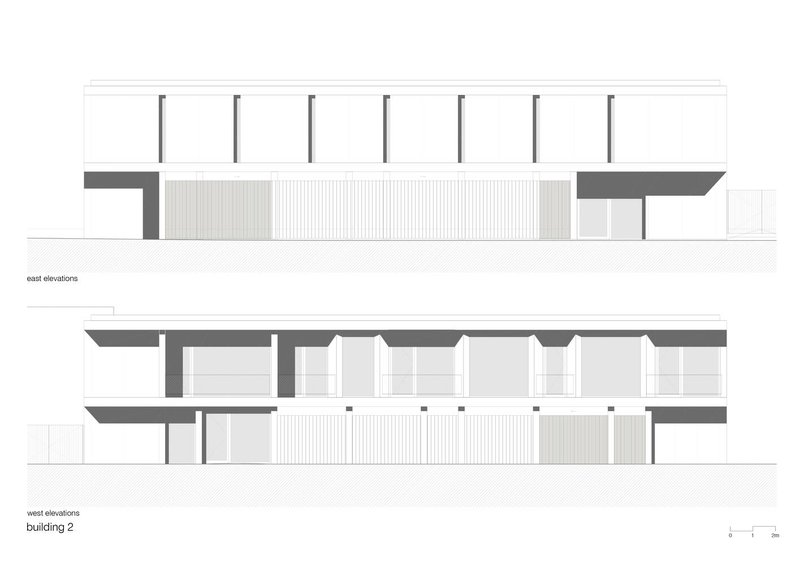
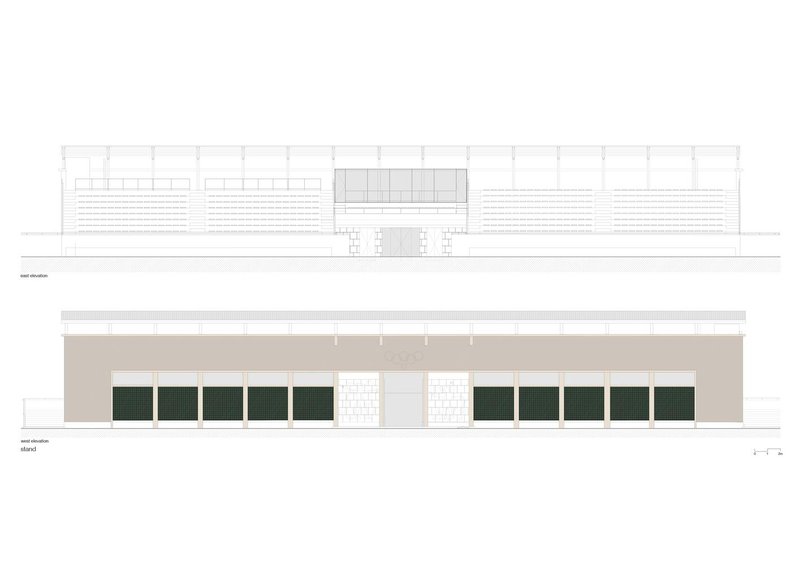
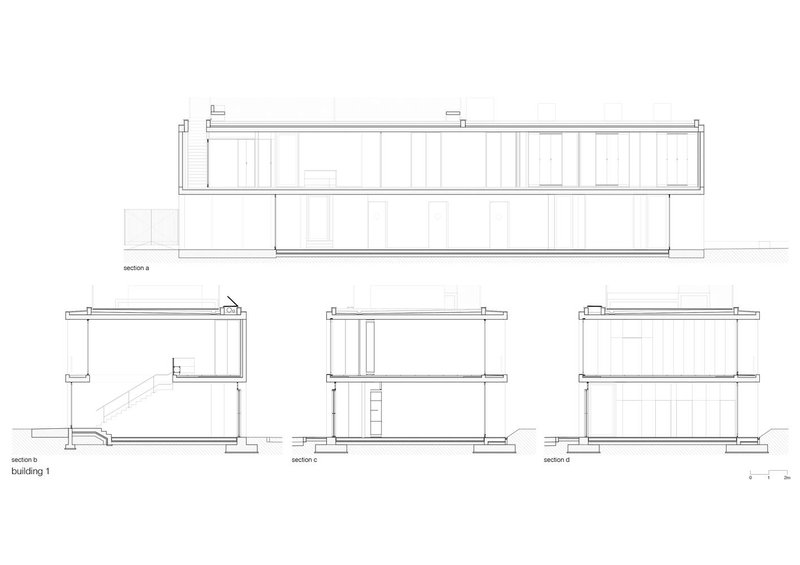
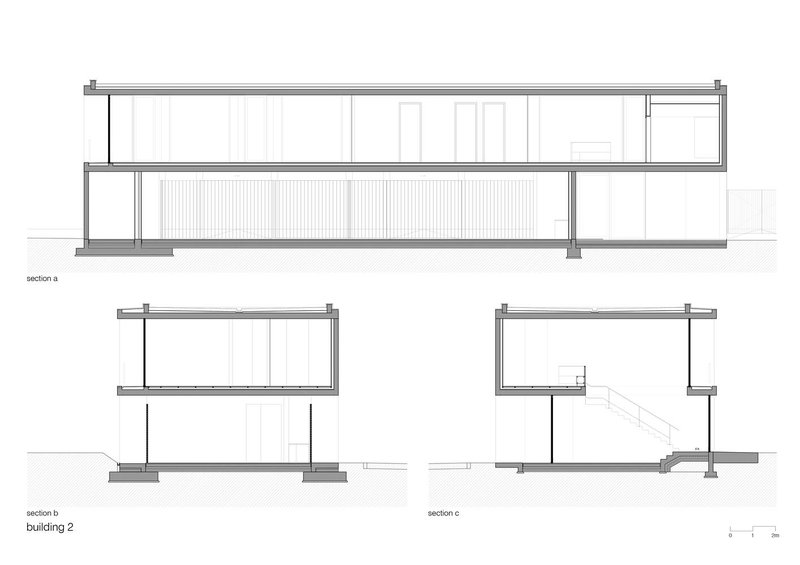
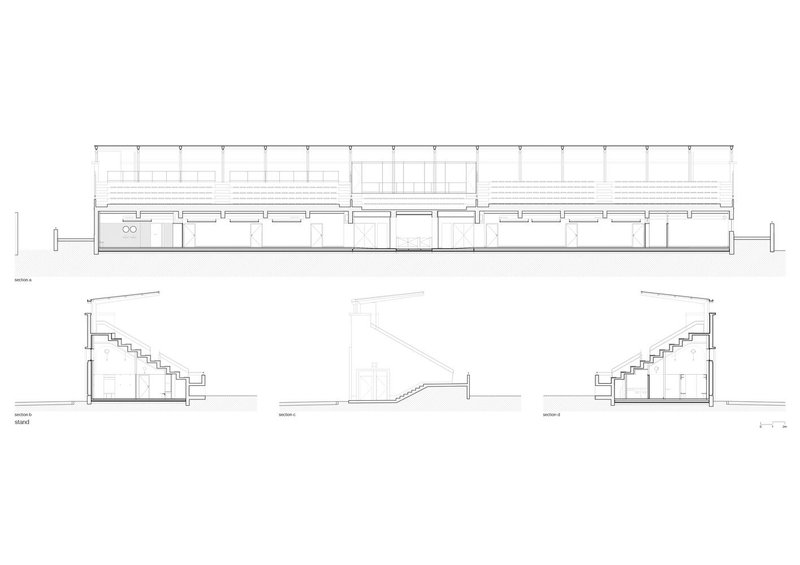
The drawings reveal the project's organizational logic with precision. The site plan shows the rectangular playing field as the primary datum, with parking and landscape wrapping the perimeter. Floor plans of the new pavilions expose open layouts with regularly spaced columns and service cores clustered at one end, confirming the structural clarity visible in the photographs. Elevations document the repeating bay rhythm on the east and west facades, while sections through the grandstand show how the enlarged roof cantilevers over the seating and how interior staircases connect the two levels.
The symmetrical linear plan of the original grandstand, with its central circulation spine, reads clearly against the freer organization of the flanking buildings. Crea's drawings make the compositional argument explicit: the new is continuous with the old in section and alignment but liberated from its plan symmetry, allowing the program to breathe.
Why This Project Matters
University sports facilities rarely receive this level of architectural thought. Most renovations of midcentury stadiums default to either nostalgic preservation or wholesale replacement; Crea's approach does neither. By extending the grandstand's compositional logic into new volumes while loosening its symmetry and introducing a warmer material palette, the firm demonstrates that heritage and contemporary performance can coexist without one diminishing the other. The terracotta pigmented concrete is the key move: it gives old and new a shared tone without erasing the difference in age.
The project also makes a case for the public value of sports architecture at the university scale. CDUP's new headquarters are not tucked into a generic office block; they are part of the stadium, oriented toward the fields, designed for social life. Students passing through the timber-lined corridors can see athletes training on the pitch below. That visual connection between study and sport, between institution and body, is not accidental. It is the argument the building makes every day it is open.
University Stadium Renovation in Porto by Crea – Arquitetos. Located in Quinta do Campo Alegre, Porto, Portugal. Completed 2024. Photography by Fernando Guerra | FG + SG.
About the Studio
Share Your Own Work on uni.xyz
If projects like this are the kind of work you want to make, uni.xyz is a place to publish your own, find collaborators, and enter design competitions.




Popular Articles
Popular articles from the community

BLDUS Turns a 250-Square-Foot Screened Porch into a Pine Forest Temple in East Hampton
A gabled cedar pavilion mimics the rhythm of surrounding pines, anchoring a 1990s wooded home to its hollow in Long Island.
VEIVE Architects Builds a Mountain Hostel That Disappears into a Hangzhou Hillside
On the Huihang Ancient Trail in Xiangjian Village, a shelter of wood, steel, and rammed earth roots itself in the rural landscape.
Johnston Architects Reimagines the Methow Valley Hay Barn as a Small-Town Library in Winthrop
A 7,300-square-foot timber library channels the region's agrarian vernacular to serve a rural Washington community of 400 year-round residents.
Constanti Architects Builds a Fortress of Privacy in Nicosia with House 345
A concrete and timber residence in Cyprus reinterprets the traditional introverted courtyard house for a new urban landscape.


Similar Reads
You might also enjoy these articles

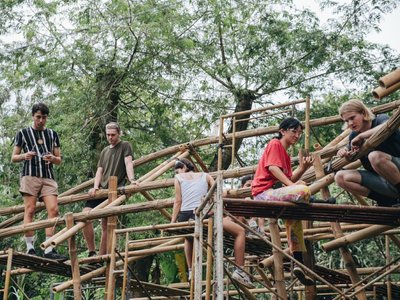
Bamboo Housing Challenge 2026: Design Affordable, Sustainable Homes Using Bamboo
An international design competition by Bamboo U and IBUKU inviting architects and designers to reimagine affordable housing using bamboo — with the winning design built full-scale in Bali.

Computational Design & Education: Beegraphy Design Awards Introduces 7th Category (Featuring Jiyun's Innovative Approach)
Dive into Beegraphy’s 7th Design Awards category, where computational design meets education to create immersive, interactive learning tools, inspired by Jiyun’s work.

From Parametric Lighting to Urban Furniture: Join the 2nd Workshop in Beegraphy’s Computational Design Series
Dive into Cutting-Edge Design Techniques and Practical Applications with Industry Experts

Introducing Sphere by UNI: Pioneering a New Era in AEC Industry
Unlocking Global Potential with BIM and Agile Management


Explore Architecture Competitions
Discover active competitions in this discipline




The International Standard for Design Portfolios


The Global Benchmark for Architecture Dissertation Awards


The Global Benchmark for Graduation Excellence


Challenge to reimagine the Iron Throne
Comments (0)
Please login or sign up to add comments
No comments yet. Be the first to comment!