
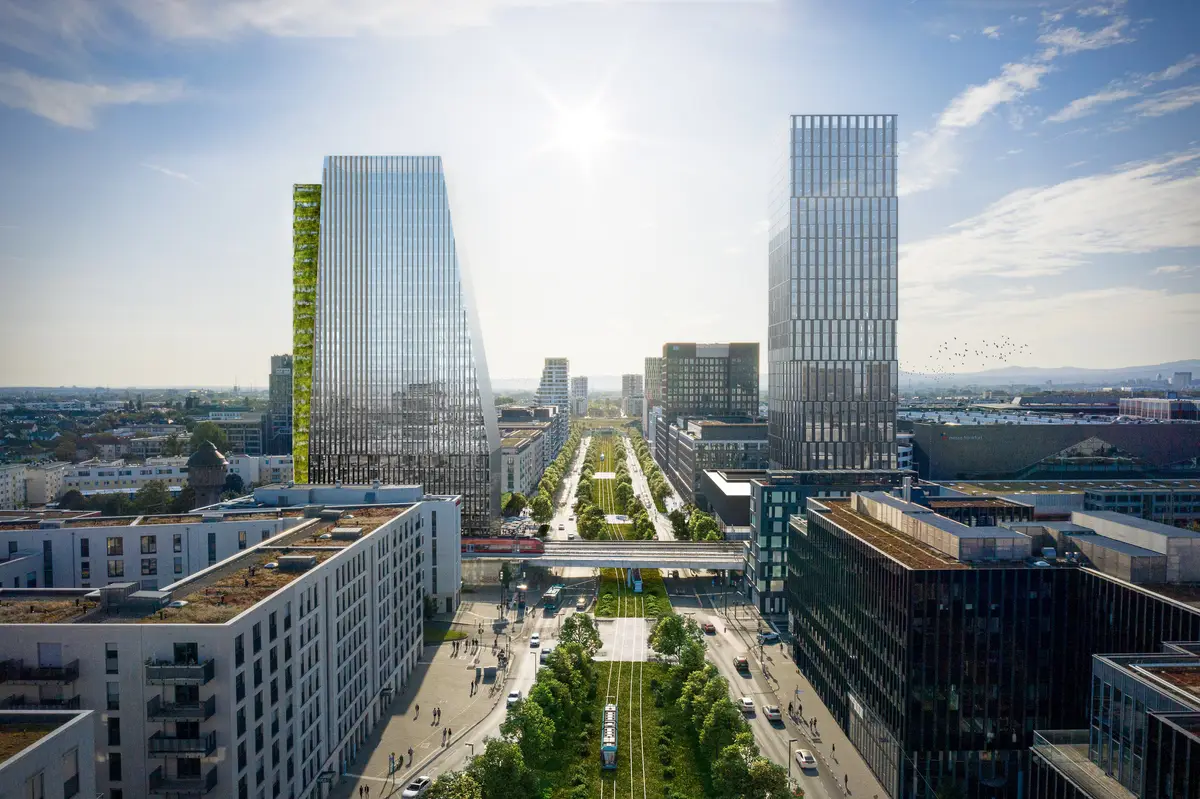
UNStudio's design for an office building in Germany has been announced as the winner project - one of the most sustainable office buildings.
The building is designed to be highly energy efficient and to use renewable energy sources.

UNStudio is set to design one of the most sustainable office buildings in Germany with its cutting-edge, sustainable NION design. This new concept breaks ground both technically and architecturally and sets a new standard for sustainable office buildings.
NION, a state-of-the-art 45,000 m2 office tower in Frankfurt's Europaviertel, has been selected for further development by Groß & Partner.
- NION will be one of the most sustainable office buildings in Germany.
- Overall concept breaks new, sustainable ground both technically and architecturally.
- Incorporates ESG objectives and highly efficient, resource-saving technology.
NION is located in the Europaviertel West, at the interface to the Europaviertel East. This lively hybrid city district, which combines residential, work and recreational facilities, has been in continual development since 2005. NION is intended to bring ecological benefits to the environment, by improving the microclimate and contributing to the well-being of visitors and users of the building.
Uncompromising sustainability
“A comprehensive sustainability and ESG approach for NION has been at the forefront from the beginning“ states Jürgen Groß, managing director of Groß & Partner. “The tower will offer great added value to its surroundings, not only in terms of design but above all climatically and ecologically”
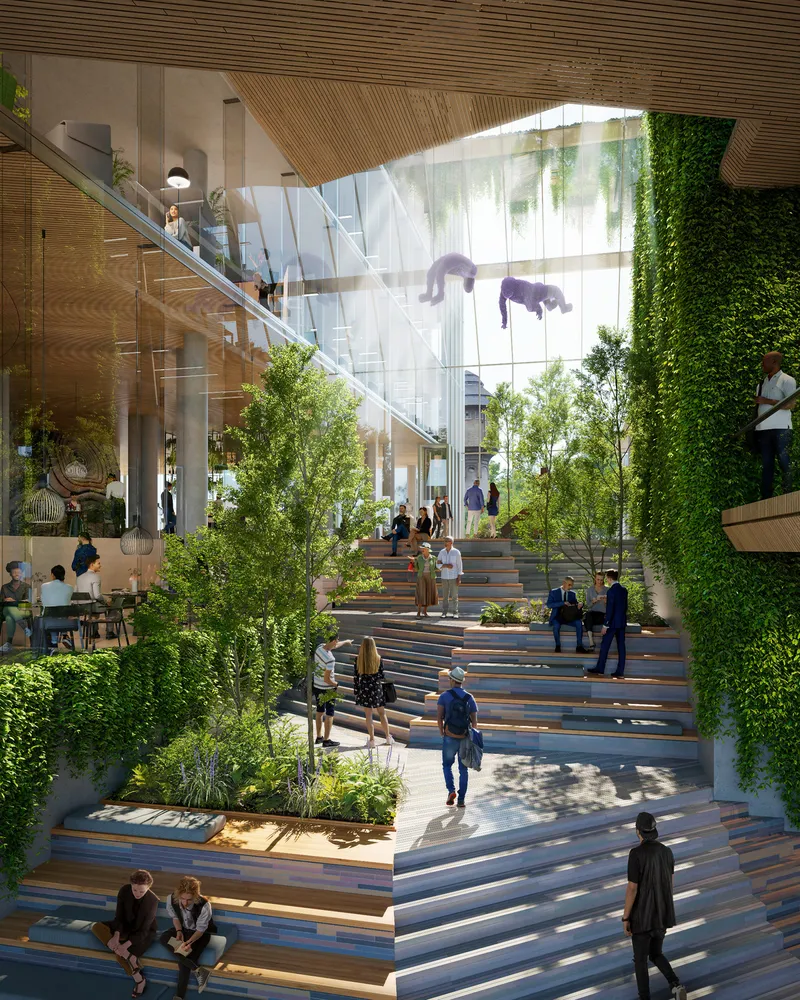 NION is also designed to be socially sustainable, with specific programming that encourages communication, gathering, and knowledge sharing.
The sustainable concept for NION focuses on both environmental and social sustainability. Alongside intensive greening throughout, DGNB Platinum Certified NION employs a low-carbon load-bearing structure. Prefabricated components will be used in construction, alongside a modular supporting structure. The design further focuses on the use of sustainable, recyclable, and circular construction materials. Spatial efficiency and future-proofing are achieved through the use of flexible floor plans.
The sustainable concept for NION further responds intelligently to the weather and actual demand. It incorporates a photovoltaic facade, rainwater management, geothermal heating and cooling (30%-40% cooling / 70% heating), smart building management, demand-based air conditioning and LED lighting, energy recuperating elevators, e-charging stations with intelligent load management, and green and open work environments. Solar gain is minimized by way of a 50% closed facade.
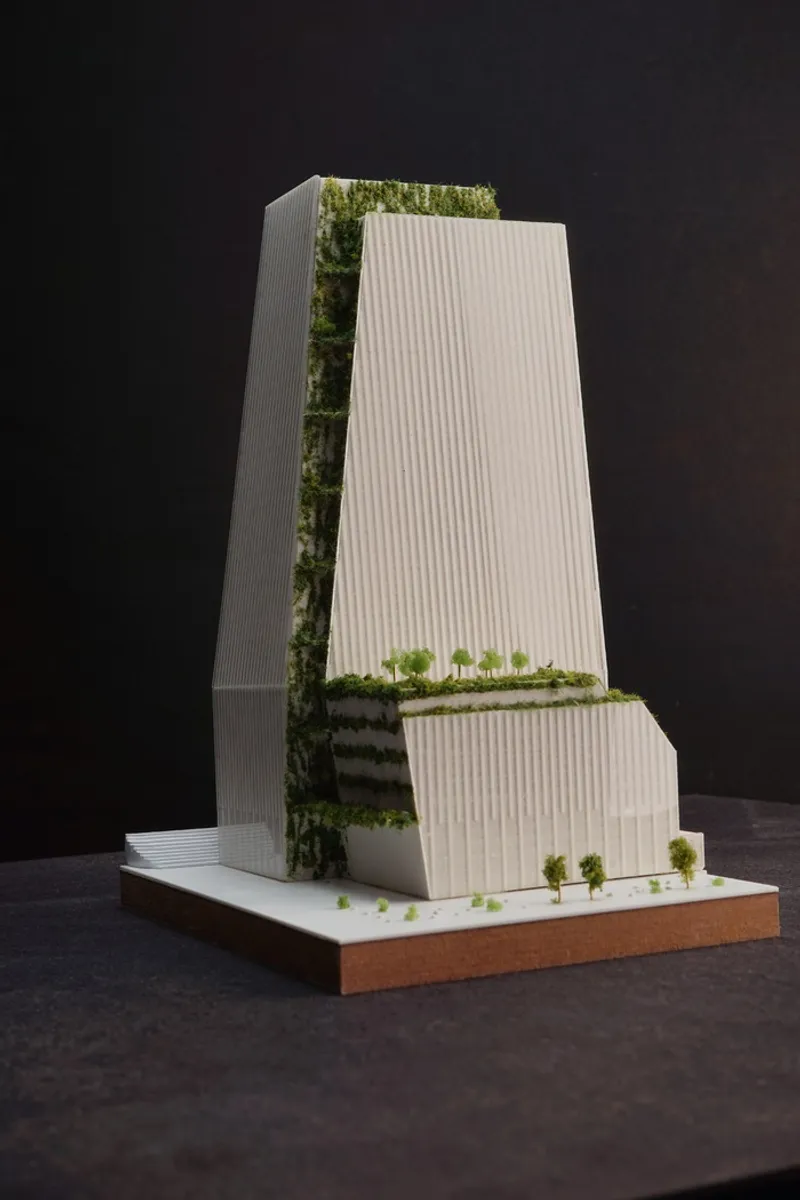 A physical model of NION Office complex
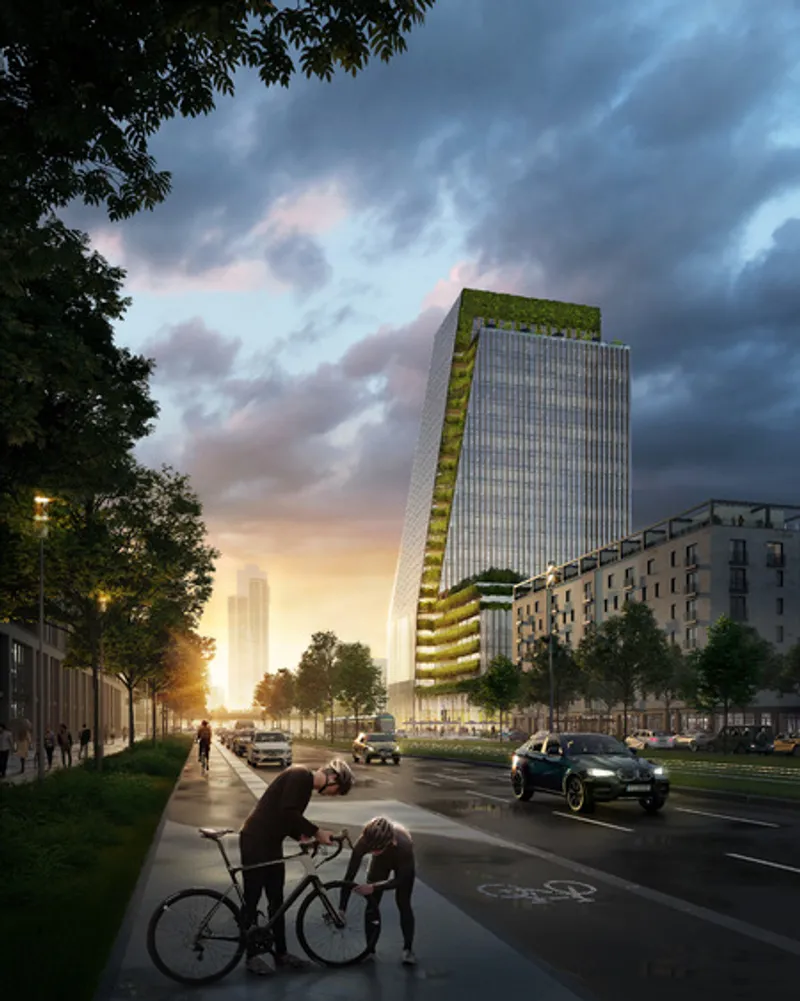 By using cutting-edge technology, NION is able to stay ahead of the curve and offer a product that is truly sustainable and responsive to the environment.
NION is also designed to be socially sustainable, with specific programming that encourages, communication, gathering, and knowledge sharing. Additionally, semi-public use is incorporated by way of dining establishments, a bakery, and a café on the ground and first upper floor, alongside the inclusion of partially public urban space in front of the base building.
Intensive greening
Alongside passive design strategies and state-of-the-art building technology, greening plays a large role in the design of NION.
As an integral part of the Europa-Allee urban green corridor, the site is intended to be a vehicle for greenery and biodiversity, bringing ecological benefits to the environment, while improving the microclimate and contributing to the well-being of visitors and users of the building. To this end, UNStudio collaborated with OKRA landscape architects in optimizing the design as an integral part of Frankfurt’s green network.
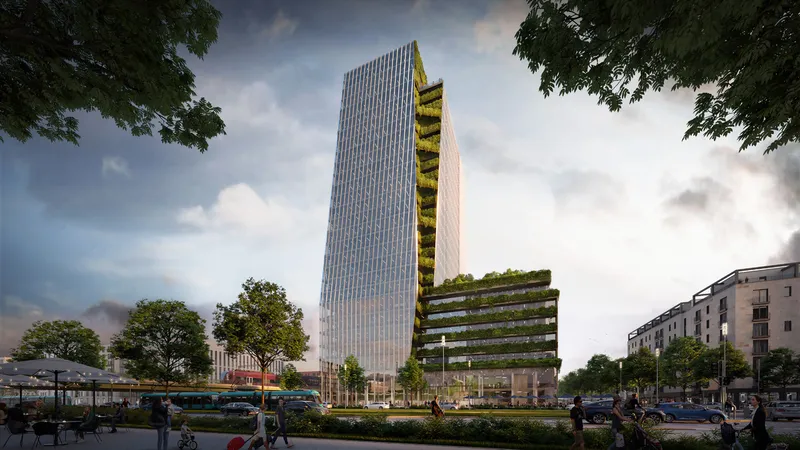 NION's sustainable concept will be taken to the next level with its ability to respond to the weather and actual demand.
The structure consists of two intersecting volumes, where the northwest and southeast corners are cut away to create a striking vertical effect, emphasized by lush greenery.
The cubature responds to the proximity of surrounding buildings and to NION’s prominent position next to the park, by way of angled facade surfaces that contrast dynamically with the cut-out corners. These cut-outs taper from the seven-storey base building, picking up the lines of the surrounding perimeter block development and unifying the different urban scales. The vertical intersection of the inner corner on the northwest side also divides the building into a tower and podium, giving the building a more slender appearance.

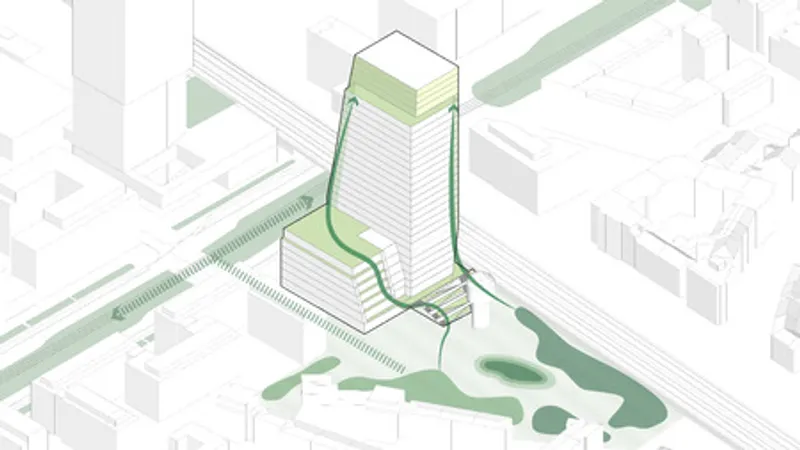 The DGNB Platinum Certified building is more than just a pretty face - it's intensively green throughout!
While the green corners of the building create a striking focal point on the route into downtown Frankfurt, the wide facade elevations are structured by light and dark elements to create differentiation within the volume.
While the vertical green in the external articulation anchors NION within the cityscape, further greening plays an important role throughout the project. From the green lobby to the semi-public interior space at the base, to the green zones on the office floors, which are combined with green terraces and roof gardens. All of the spaces in NION are designed to enhance the working climate and create an exciting relationship between interior and exterior.
UNStudio is also currently working with Groß & Partner on the currently under construction FOUR project in Frankfurt, one of the densest inner-city developments in Europe.

Credits (competition phase)
UNStudio: Ben van Berkel with Tina Kortmann and Stelina Tsifti, Ignacio Andres Mejia Zubillaga, Verena Lihl, Lourenco Vaz Pinto, Cristina Bolis, Ka Shin Liu, Martina Karner, Stijn Tonen, Konstantinos Chryssos, Tiia Vahula, Astrid Piber, Patrik Noome
Advisors (competition phase):
Landscape: OKRA Landschapsarchitecten BV
Structure and Facade: Bollinger+Grohmann
MEP and Energy: KBP Ingenieure GmbH
Fire Protection: HHP Berlin
Local Support: Hochform Architekten Frankfurt
CGI visualisations: MOARE
References (1)

Popular Articles
Popular articles from the community


Cube Design Draws an Ecological Corridor Between Two Shenzhen Hills with the Nankai Building
Beside Shenzhen's container docks, the Nankai Building pairs stacked balconies with a climbing green screen to connect two hillsides across its height.


The Amber Palace Opera: A Geological Fiction Surfaces on Tallinn's Baltic Waterfront
Pierre Brillard reimagines a Baltic legend as a public landscape, opera house, and waterfront promenade rooted in Tallinn's coastal identity.

LT2A and OPEN Architectes Thread a Brick and Glass High School Through a Wooded Belgian Campus
In Braine-l'Alleud, a 3,000 m² wing for Collège Cardinal Mercier pairs pale brick with a glazed colonnade, deferring to a small chapel and a dense wood.

Aquadapt: An Underwater Habitat That Rewrites Its Rooms by the Hour
Curved modules ring the seabed while one shell shifts from breakfast room to cinema, farm and football pitch as residents' needs change.

Similar Reads
You might also enjoy these articles

Rede Arquitetos Turns Circulation into Civic Space at the Educar II SESC School in Fortaleza
In Fortaleza, Brazil, Educar II SESC-CE trades a signature form for mesh screens, yellow thresholds and courtyard walkways built for equatorial heat.
116 Rokeby Building, Collingwood
Sustainable Collingwood office building featuring double-skin façade, natural ventilation, rooftop amenities, and carbon-neutral design focused on wellbeing and longevity.
Contemporary Apartment Renovation in Spain: RV House by BIAN Opens Up to the Sea
A minimalist 1930s apartment in Santander is transformed into a flexible, sea-facing home through contemporary Spanish renovation.
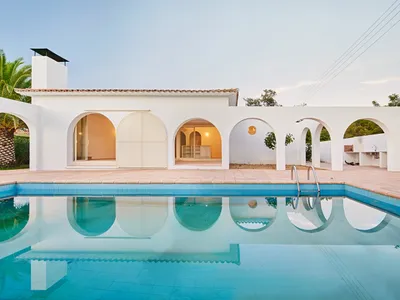
3 Marías House: A Contemporary Mediterranean Courtyard Retreat by Bajet Giramé + Burckhardt
Mediterranean courtyard home blending traditional architecture with modern design, terracotta flooring, flexible interiors, sustainable climate strategies, and garden integration.

Explore Office Building Competitions
Discover active competitions in this discipline


Challenge to reimagine the Iron Throne

Photograph architecture without architects

Illustrate the lost glory of Angkor Wat - Render Challenge

Design challenge to reuse E-waste
Comments (0)
Please login or sign up to add comments
No comments yet. Be the first to comment!