
UP2DATE Architects Designs a Retail Interior in Almaty That Feels Like a Home You'd Never Leave
Messa House blurs the line between boutique and residence with coffered ceilings, arched thresholds, and a quiet domestic warmth in Almaty, Kazakhstan.


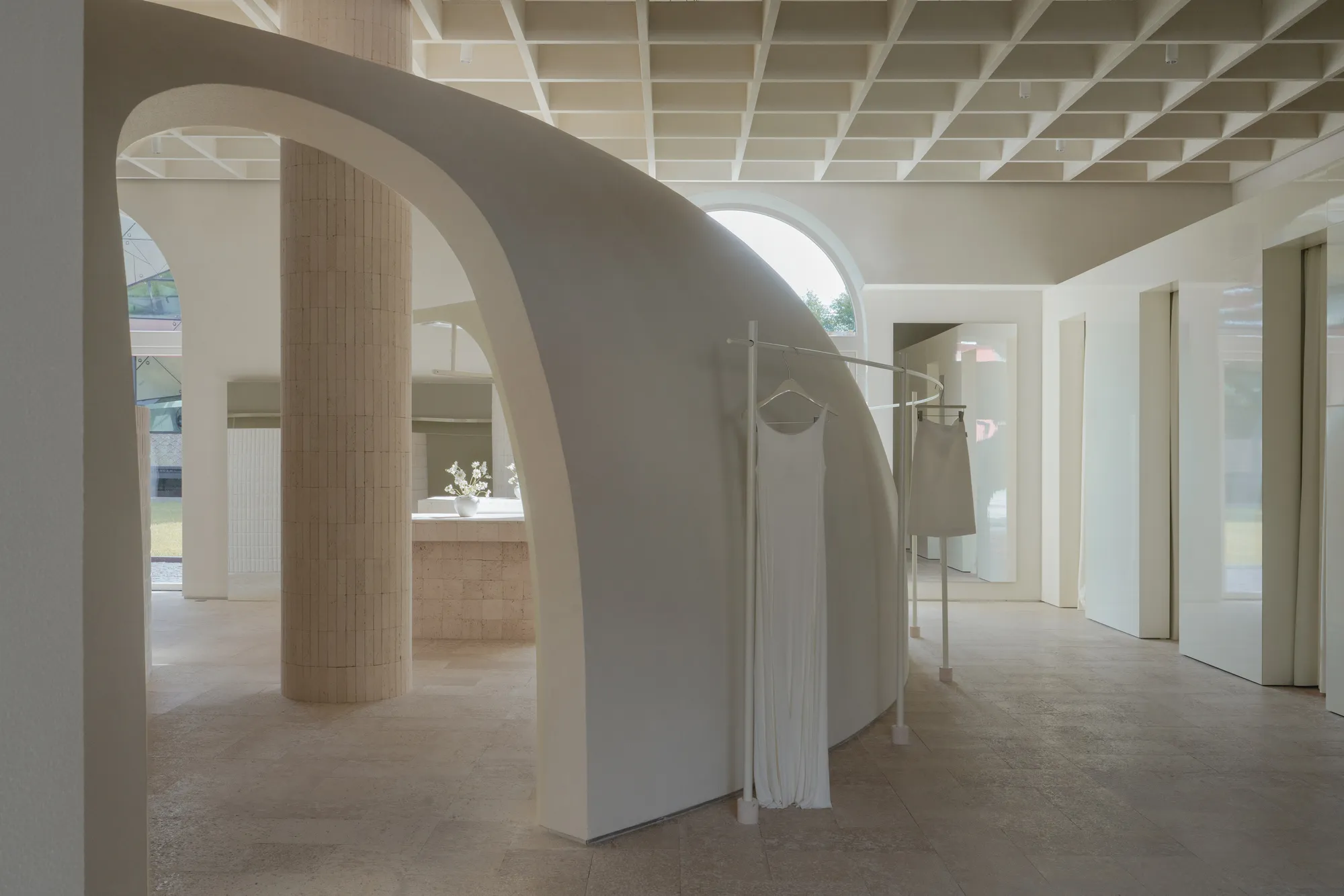
Walk into most fashion retail spaces and you feel the transaction before you feel anything else: bright lights, hard surfaces, garments arranged like products on a factory line. UP2DATE architects went the opposite direction with Messa House, a 350-square-metre boutique in Almaty, Kazakhstan, that reads less like a store and more like a well-appointed private residence. Lead architect Akhat Baimenov treated the program not as a problem of merchandise display but as a question of atmosphere, and the result is a space that persuades you to slow down before it asks you to buy anything.
What makes Messa House genuinely interesting is the conviction of its domestic language. Coffered timber ceilings, arched doorways, travertine surfaces, built-in seating niches, and a spiraling brick staircase all belong to the vocabulary of residential architecture. Garments appear almost incidentally, hung in niches or draped on plinths that could just as easily hold sculpture. The architecture does not frame product; it frames slowness. In a retail landscape obsessed with spectacle, that restraint is the most radical thing here.
Arches, Curves, and the Refusal of Right Angles
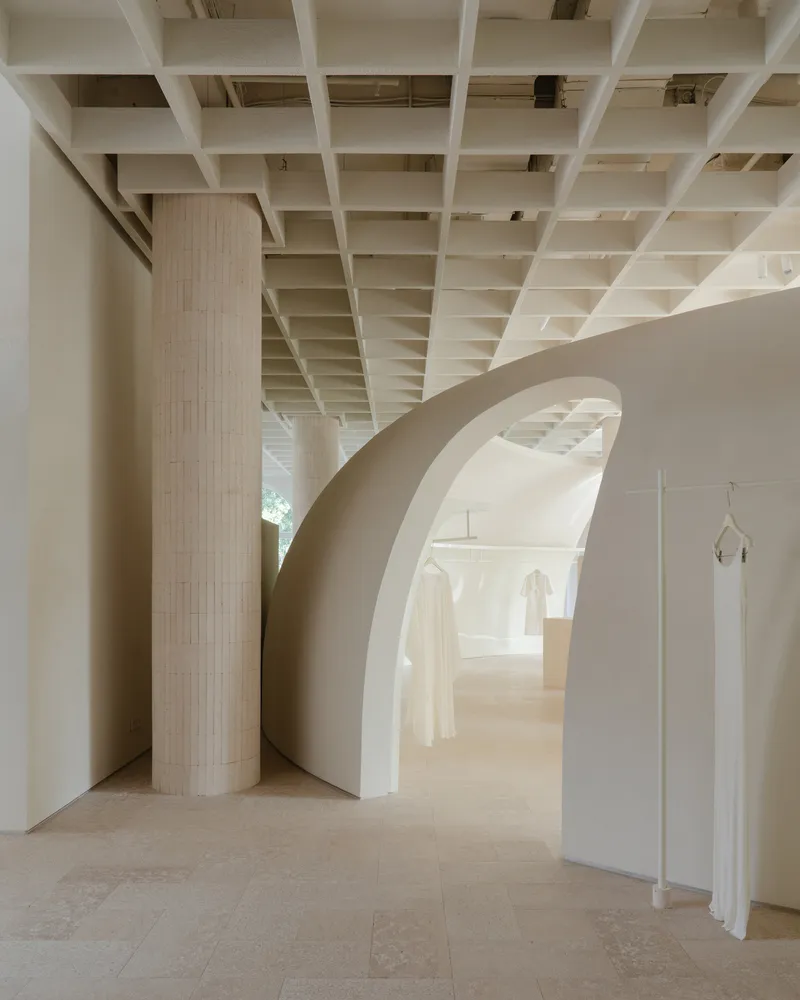
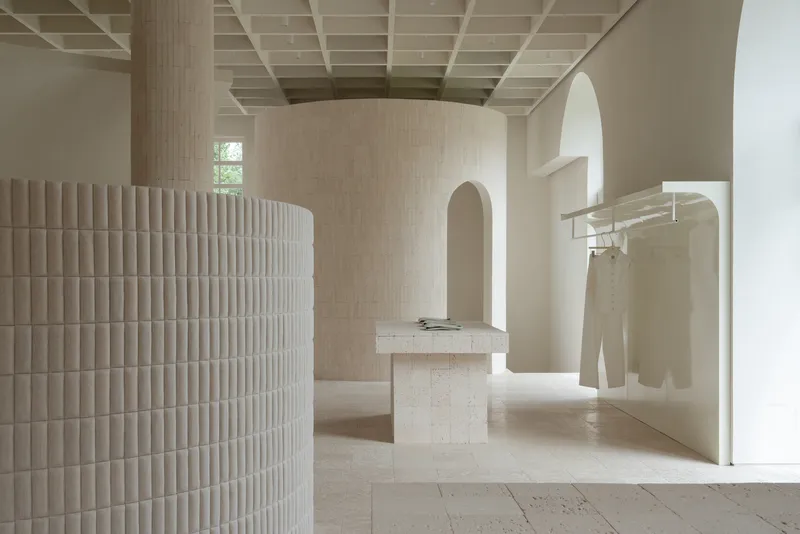

The plan is organized by a continuous curving wall that sweeps through the interior, eliminating hard corners and creating a sequence of arched thresholds. You never see the entire space at once. Each archway frames the next room as a vignette, pulling you forward with a gentle curiosity rather than a sales funnel. Fluted cylindrical columns punctuate these transitions, their verticality a counterpoint to the horizontal rhythm of the coffered ceiling overhead.
The arched openings do double duty. They establish a domestic register, recalling Roman villas and Mediterranean courtyards, while also controlling sightlines so that merchandise reveals itself gradually. A hanging garment glimpsed through three successive archways becomes an object of desire precisely because it is not immediately available. UP2DATE understands that retail seduction is about delay, not display.
The Coffered Ceiling as Unifying Device

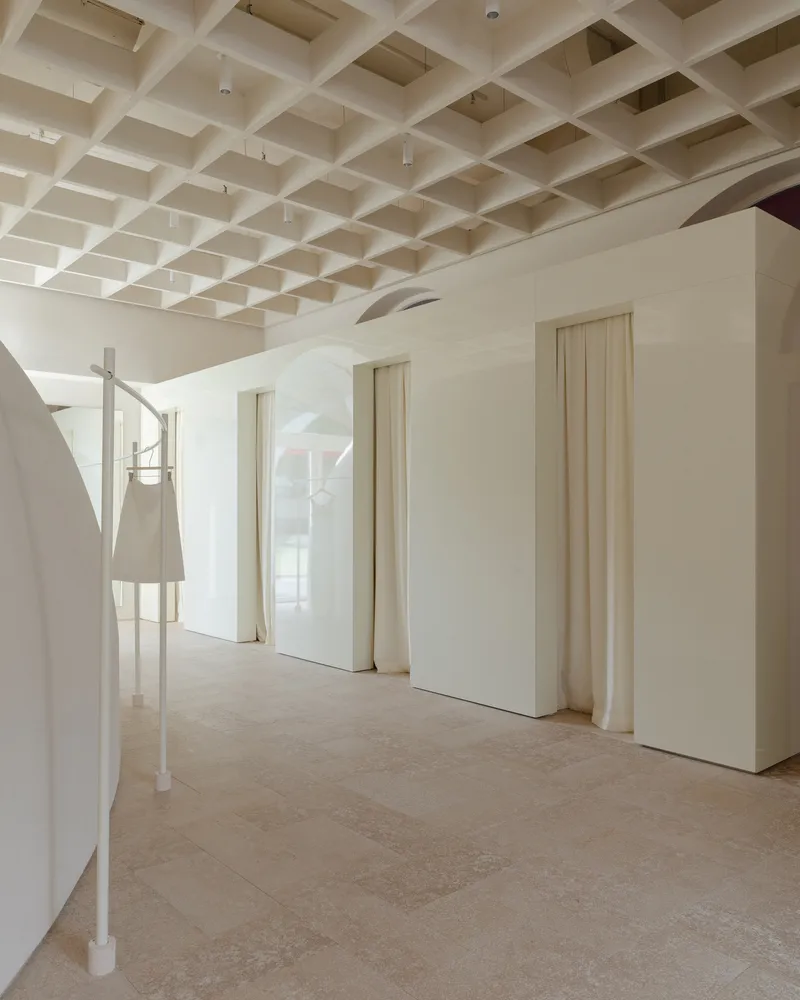
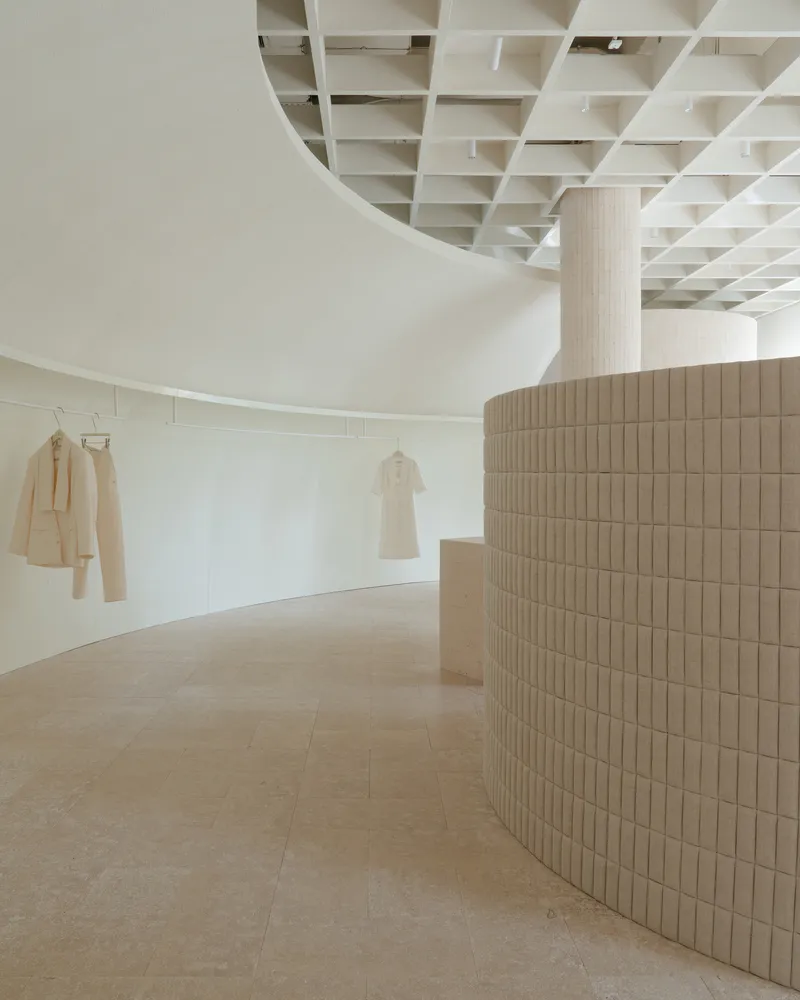
A gridded timber coffered ceiling runs nearly the full extent of the interior, and it is the single element that holds the spatial complexity together. Beneath it, walls curve, columns shift, and floor levels change, but the ceiling remains a stable datum. It absorbs acoustic energy and softens the light, giving every room a warm, even glow that flatters both fabric and skin. In a clever material move, ribbed timber tiles on the curved display walls echo the ceiling grid, collapsing the distinction between wall and overhead plane.
The effect is enveloping without being claustrophobic. The coffers are shallow enough to keep headroom generous, and their pale timber finish avoids the heaviness that deeper classical coffers can produce. It is a modernized version of an ancient device, confident enough to reference history without quoting it literally.
Living Rooms Disguised as Retail Zones


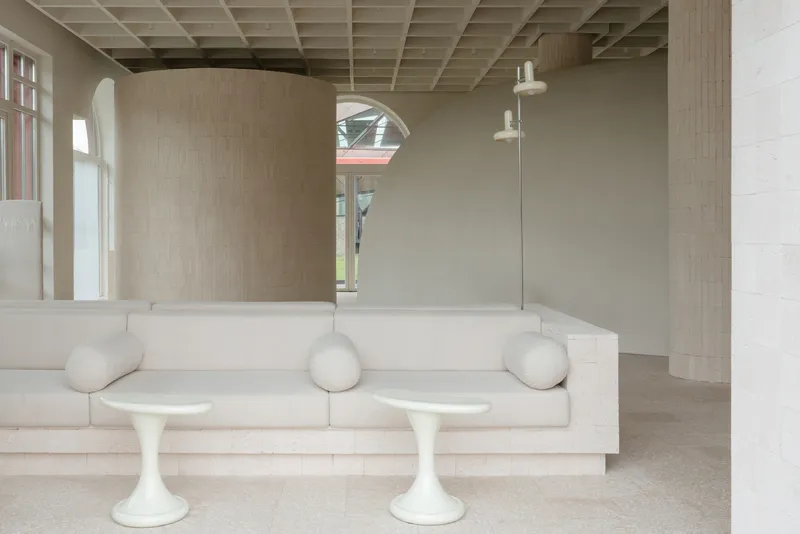
Several rooms in Messa House contain no visible merchandise at all. Built-in timber shelving holds books and ceramics. Pale upholstered seating groups cluster around sculptural side tables. Rounded bolsters line a curved bench beneath the coffered soffit. These are living rooms, full stop. The message to the visitor is not "browse" but "sit."
This strategy is not new in luxury retail, where lounge areas have been common since the early 2000s. But UP2DATE goes further by making the domestic zones architecturally indistinguishable from the selling zones. The same materials, the same ceiling, the same light. There is no threshold you cross from relaxation back into commerce. The commercial function dissolves into hospitality, and that dissolution is the project's core thesis.
Stone, Brick, and the Weight of Material
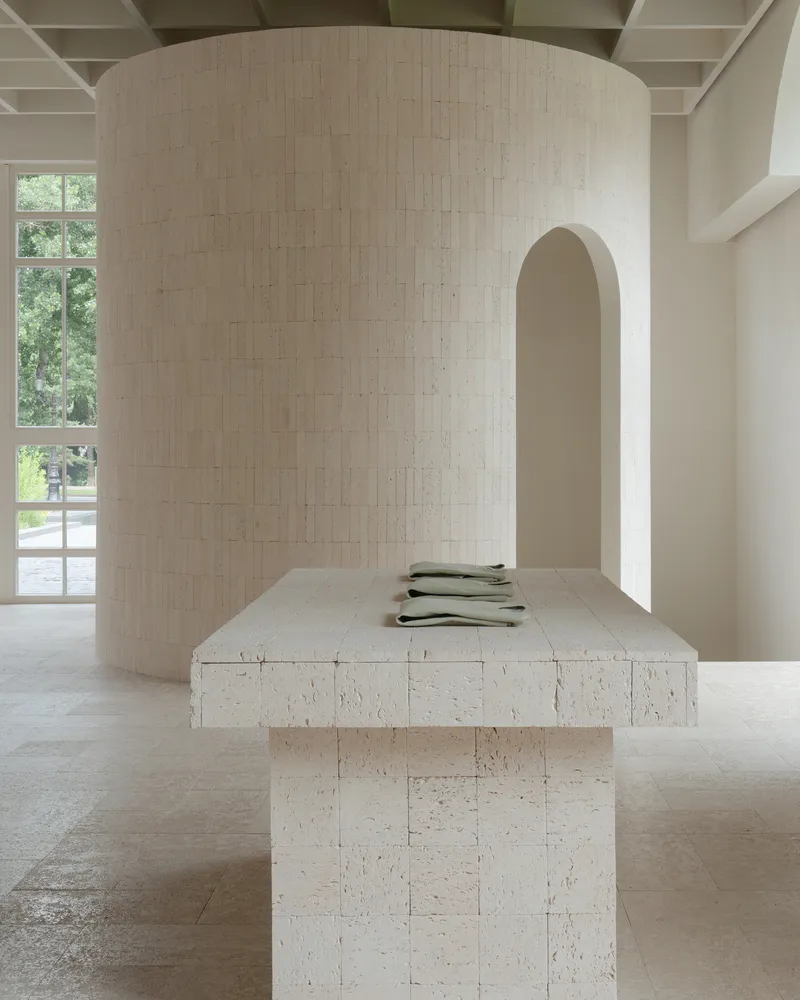

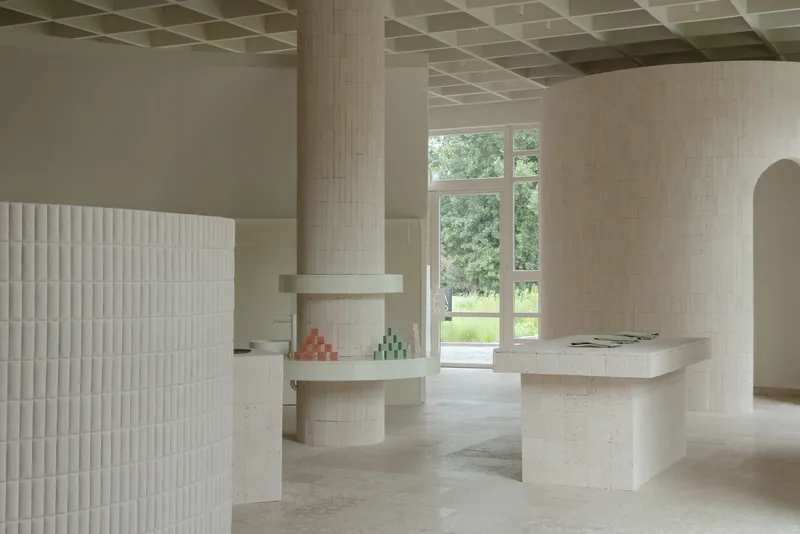
The palette is almost monochromatic: travertine, pale plaster, cream brick, bleached timber. But within that narrow band, the material variety is substantial. A massive limestone block serves as a side table. Brick columns with a rough, handmade texture anchor a room whose ceiling is smooth and precise. A textured brick island in one area introduces a kitchen-like domesticity. The result is a space that reads as materially rich without ever becoming visually loud.
Natural stone and brick carry physical weight, and UP2DATE uses that weight to counterbalance the ethereal quality of the garments on display. Fashion is ephemeral, seasonal, disposable. Architecture, when it insists on mass, argues the opposite. The tension between the permanence of the container and the transience of its contents is productive: it lends seriousness to what might otherwise feel like another Instagram-ready boutique.
Display as Archaeology


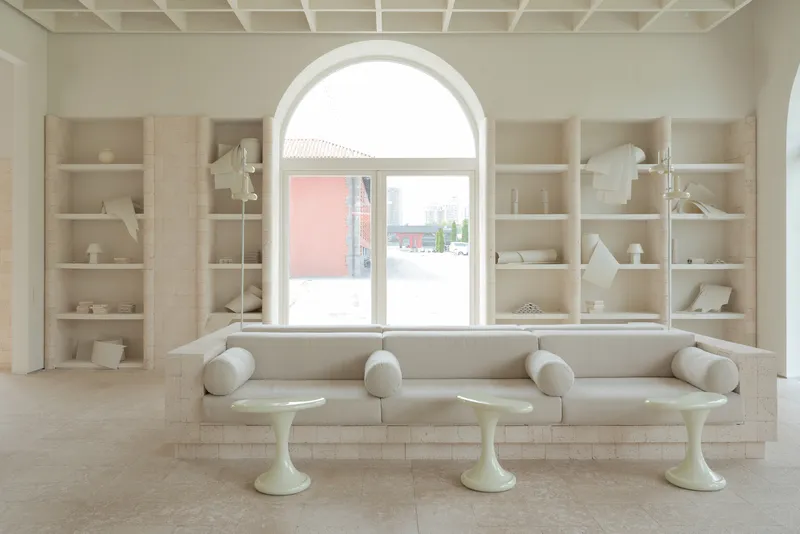
Garments are presented on stone plinths, inside recessed niches, and on freestanding metal stands that recall museum easels. A long travertine table beneath an arched window holds a single mannequin as if it were a gallery piece. Built-in shelving displays ceramics alongside clothing with no hierarchy between art object and commodity. The framing suggests that every item has been curated, discovered, preserved.
The arched windows reinforce this museum logic. Horizontal timber louvers filter daylight into soft, directional washes that land on display surfaces the way conservation lighting lands on artifacts. The effect is reverential, and it asks the shopper to treat each piece not as stock but as something worth contemplating.
The Spiral Staircase as Sculptural Center


A curved staircase clad in vertical brick tile is the most overtly architectural gesture in the project. Glimpsed through an arched opening, it rises in a tight spiral that is equal parts functional circulation and freestanding sculpture. The brick cladding wraps continuously from wall to stair soffit, giving the entire volume a monolithic quality. It is the one moment where the building sheds its domestic composure and reveals structural ambition.
Adjacent to the stair, a cushioned seating niche with a travertine shelf frames an arched window overlooking a garden. The pairing is deliberate: vertical ascent next to horizontal repose, movement next to stillness. It is a small compositional decision, but it captures Messa House's broader logic of calibrated contrasts within a unified material world.
Texture at Close Range


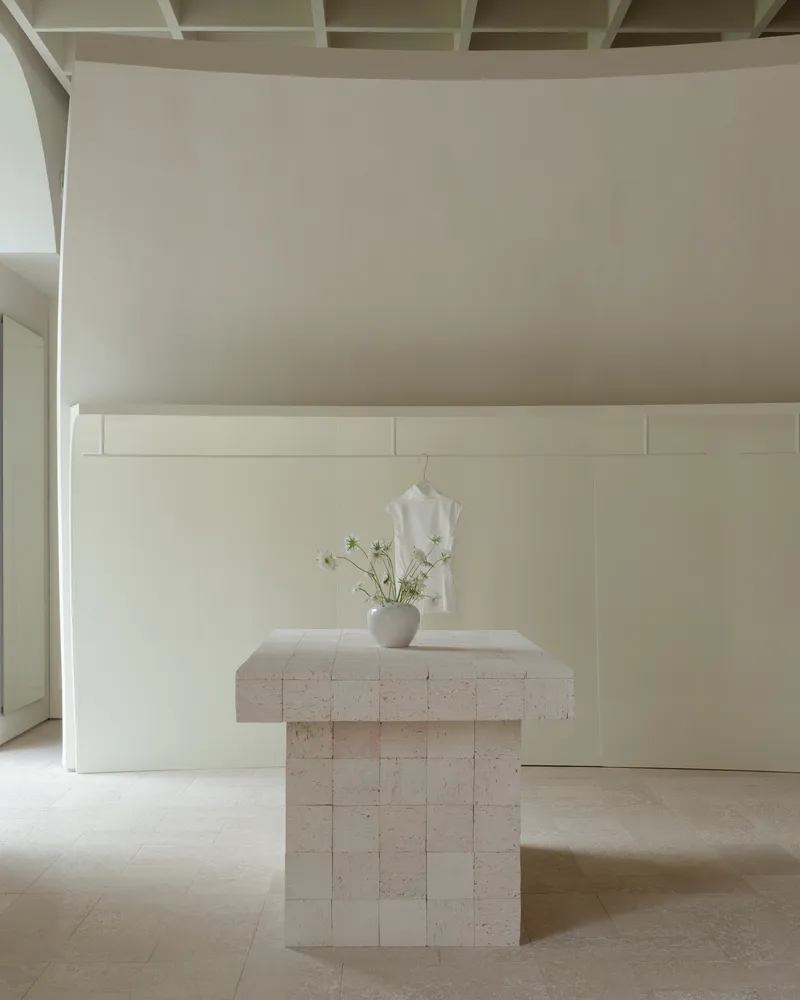
Messa House rewards proximity. Cylindrical stone columns between shelving niches reveal tool marks and natural vein patterns when you lean in. Folded paper sculptures sit beside cream-colored books, their matte surfaces absorbing light in a way that makes the air itself feel softer. A travertine pedestal table holds a single vase of white flowers with the quiet confidence of a still-life painting. These moments are not incidental; they are the payoff for the architecture's invitation to slow down.
In an era when retail interiors are increasingly designed to photograph well from a single angle, UP2DATE has built a space that improves with physical presence. The haptic variety of stone, timber, plaster, and brick cannot be flattened into a screen. Messa House is, in that sense, an argument for showing up.
Plans and Drawings


The floor plan confirms what the experience suggests: the curving wall is the organizing spine, wrapping a spiral stair at its tightest radius and opening outward into a sequence of rooms of varying scale. The axonometric drawing reveals an ambitious lattice roof structure with three radiating lobes, a timber canopy whose geometry is largely hidden from the interior by the coffered ceiling below. These drawings show a project that is structurally more complex than its calm interiors let on, a reminder that the appearance of ease in architecture usually costs a great deal of effort.
Why This Project Matters
Retail design in Central Asia is evolving rapidly, and much of it defaults to the same glossy minimalism found in Seoul, Dubai, or Shanghai. Messa House stands apart because it roots itself in material specificity and spatial generosity rather than brand-driven aesthetics. UP2DATE architects have produced a boutique that does not look like a boutique, and in doing so, they have made a case that the most effective retail environment is one that forgets it is selling.
The project also raises a question worth sitting with: when a commercial space is this convincingly domestic, who is the architecture really serving? The customer who lingers on a built-in bench, or the brand whose conversion rate quietly benefits from that lingering? Messa House is generous enough to let you enjoy the ambiguity. That is more than most retail interiors can say.
Messa House, Almaty, Kazakhstan. 350 m². Completed 2025. Architecture by UP2DATE architects, lead architect Akhat Baimenov. Photography by Varvara Toplennikova.
About the Studio
Share Your Own Work on uni.xyz
If projects like this are the kind of work you want to make, uni.xyz is a place to publish your own, find collaborators, and enter design competitions.



Popular Articles
Popular articles from the community


Riyadh For All: Intergenerational Urban Design for Active Aging in Rabat
Riyadh For All reimagines urban design in Rabat with intergenerational co-living, adaptive courtyards, and Moroccan cultural exchange today.

Co-Life: Senior Housing Design That Reconnects Older Adults With the City
Co-Life reimagines senior housing design through healing gardens, shared streets, workshops, and a sustainable community across generations.

Hill & Cross Opera: Sculptural Opera House Architecture Shaped by Tallinn’s Landscape and Identity
Hill & Cross Opera reimagines opera house architecture in Tallinn through its sculptural hill, civic plaza, glass wave and a luminous cross.

Co-life: Sustainable Architecture for Age-Friendly Community Living
Co-life reimagines sustainable architecture for seniors through courtyards, rammed earth, shared gardens, and spaces designed for belonging.


Similar Reads
You might also enjoy these articles

Bao Huynh Watercolor Atelier: A Serene Art Retreat in Hội An
Bao Huynh Watercolor Atelier in Hội An blends multifunctional art spaces, sustainable design, local materials, and family-friendly living in a serene environment.

Atelier Macri Concept Store Interior Design by CASE-REAL
Atelier Macri store features a "ko" counter, walnut wood details, cork displays, blending retail, gallery, and seamless customer experiences.

Manuel Vargas Izquierdo Stadium and High-Performance Sports Center: Architectural Excellence in Jalpa de Méndez
The Manuel Vargas Izquierdo Stadium blends sustainable design, inclusive sports facilities, and cultural-inspired architecture, revitalizing Jalpa de Méndez’s public spaces.

KAKR Buluh Awar Hall: Revitalizing Community and Ecology Through Bamboo Architecture
Community built bamboo hall revitalizes Buluh Awar village, empowering youth, restoring ecology, celebrating vernacular craftsmanship through sustainable architecture and culture.

Comments (0)
Please login or sign up to add comments
No comments yet. Be the first to comment!