

Urban Green Museum: Turning a 350m Industrial Shell Into a Living Agricultural Exhibition
A shortlisted competition entry reimagines a massive rectangular industrial building as a hybrid of winter garden, market hall, and working farm.


What happens when you hollow out a 350m by 148m industrial building and fill it with hydroponic farming beds, market kiosks, and a 4-meter-high circulation pathway that lets visitors look down on all of it? The Urban Green Museum proposes exactly that: a building where the act of growing food becomes the exhibition itself, and where architecture's role shifts from housing artifacts to hosting agriculture.
Designed by Pinar Soylu and dln sns, the project was shortlisted in the Urban Meal Mine competition. The brief called for sustainable farming interventions in urban contexts, and this entry responds with a large-scale adaptive reuse strategy that splits an industrial structure into distinct programmatic wings: one translucent agriculture zone, one preserved market hall, and a central buffer that stitches them together.
A Low Horizon Line Hiding a Complex Interior
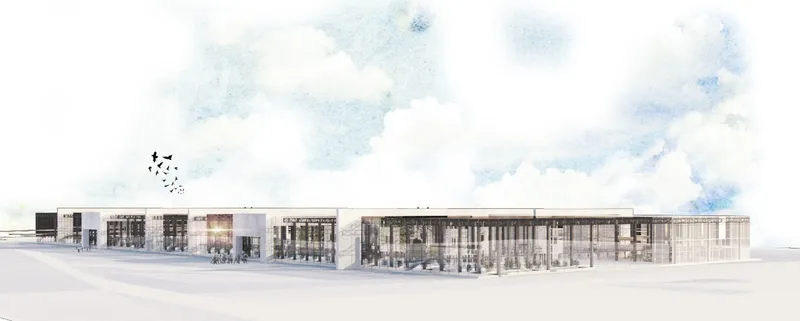
The elevation drawing reveals a building that refuses to dominate its skyline. Vertical timber louvers run along the facade, filtering light and air while maintaining the visual rhythm of the original industrial envelope. The low, horizontal profile is deliberate: rather than announcing itself as a landmark, the structure recedes, letting its interior program do the talking. The existing roof elements are preserved and extended, a strategy that enhances natural light flow while keeping the building's industrial lineage legible.
Market Corridors Where Produce Meets Public Life


One wing of the building is preserved as a market hall, and the interior rendering shows what that looks like in practice: timber seating clusters, potted plants catching dappled sunlight, and a corridor scaled for wandering rather than rushing. Kiosks, workshops, gathering areas, and food courts populate this zone, creating the kind of overlapping social program that turns a market into a community hub. The connection between what is grown in the agriculture wing and what is sold or eaten here is not metaphorical; it is spatial.
The axonometric diagram maps the full program with unusual clarity. Farming areas, observatories, restaurant terraces, and circulation networks are color-coded and labeled alongside their intended user groups. The horizontal circulation system, that 4-meter-high pathway, binds these zones into a single loop, ensuring visitors move through agriculture before arriving at the market. The sequence matters: understanding production precedes consumption.
Hydroponic Beds Under Steel Trusses

The agriculture wing is the project's most compelling spatial proposition. By making this entire wing translucent, Soylu and sns create a winter-garden atmosphere within an industrial skeleton. The rendering shows rows of hydroponic farming beds running beneath exposed steel trusses, with figures tending the greenery as if in a greenhouse. The structural frame is left intact, its industrial character juxtaposed against the organic geometry of growing plants. Light floods in from above and through the translucent walls, turning the growing process into something visitors can watch, study, and participate in through workshops.
Suspended Planting and the Lattice Roof

The wide interior view of the market hall reveals a second layer of agriculture overhead: suspended planting trays hang from an exposed lattice roof structure, blurring the boundary between the building's two primary programs. Rather than segregating farming and commerce into separate zones only, the design allows agriculture to infiltrate the market hall vertically. The lattice roof, an extension of the original industrial structure, does double duty as both a light filter and a support system for aerial planting. It is a smart use of existing infrastructure that avoids the trap of treating adaptive reuse as mere preservation.
Why This Project Matters
The Urban Green Museum takes on a genuinely difficult problem: how to make food production visible, accessible, and culturally meaningful inside an urban building. Most urban farming proposals treat agriculture as a technical problem to be optimized. Soylu and sns treat it as a spatial experience to be designed, wrapping it in a circulation sequence that transforms visitors from observers into participants. The 4-meter elevated pathway is not just a clever section detail; it reframes the entire relationship between spectator and subject.
The adaptive reuse of a 350m by 148m industrial building is ambitious, and the project does not shy away from that scale. By dividing the plan into distinct wings connected by a central buffer zone, the designers create legible spatial territories without fragmenting the visitor experience. The result is a building that functions simultaneously as a museum, a farm, and a market, three programs that, in this design, are revealed to be aspects of the same civic ambition: reconnecting urban populations with the food systems that sustain them.
View the Full Project
About the Designers
Designers: Pinar Soylu, dln sns
Enter a Design Competition on uni.xyz
uni.xyz runs architecture and design competitions year-round that reward proposals with spatial conviction and real site intelligence.
Project credits: Urban Green Museum by Pinar Soylu, dln sns Urban Meal Mine (uni.xyz).


Popular Articles
Popular articles from the community

Faces of the Soviet Avant-Garde: Turning Moscow's Street Names into an Open-Air Museum
A network of sculptural installations across a Moscow residential district transforms forgotten architect names into spatial encounters with cultural memor

Singing Woman: Contemporary Architecture Inspired by Estonia’s Voice and the Sea
Singing Woman turns Estonia’s song culture into flowing opera house architecture, blending public life, landscape, sea, and national memory.
Opera by the Sea Estonia: Three Shells Dissolving Architecture into Tallinn's Coastline
A winning opera house proposal replaces monumental form with interconnected shells that blur the boundary between building, park and Baltic Sea.

Manzana Morphosis: Stretching Barcelona's Grid into a Living Landscape for 2050
A radical reworking of the Eixample manzana turns density into a tool for generous public space, vertical ecology, and environmental performance.

Similar Reads
You might also enjoy these articles

Bao Huynh Watercolor Atelier: A Serene Art Retreat in Hội An
Bao Huynh Watercolor Atelier in Hội An blends multifunctional art spaces, sustainable design, local materials, and family-friendly living in a serene environment.

Atelier Macri Concept Store Interior Design by CASE-REAL
Atelier Macri store features a "ko" counter, walnut wood details, cork displays, blending retail, gallery, and seamless customer experiences.

Manuel Vargas Izquierdo Stadium and High-Performance Sports Center: Architectural Excellence in Jalpa de Méndez
The Manuel Vargas Izquierdo Stadium blends sustainable design, inclusive sports facilities, and cultural-inspired architecture, revitalizing Jalpa de Méndez’s public spaces.

KAKR Buluh Awar Hall: Revitalizing Community and Ecology Through Bamboo Architecture
Community built bamboo hall revitalizes Buluh Awar village, empowering youth, restoring ecology, celebrating vernacular craftsmanship through sustainable architecture and culture.

Explore Green Architecture Competitions
Discover active competitions in this discipline

Challenge to design luxury tourism on rails

Challenge to reimagine the Iron Throne

Photograph architecture without architects

VR headsets Storefront design competition
Comments (0)
Please login or sign up to add comments
No comments yet. Be the first to comment!