

URBAN WILDERNESS
Rethinking the Relationship of Nature and the City
Vision
Our team reinvented the modern neighborhood serving the lifestyles of today while addressing the issue of the pandemic. We decided to study the past in order to intuitively inform future design decisions. We began with an analysis of New York City as well as our chosen site of Hudson Yards. Through thorough research of New York City, we found that the city’s previous natural terrain and topography were recorded by early settlers in 1609. New York City has since then evolved, shaving away natural landscapes and eliminating ecosystems that are in high demand within the city today. We took this concept of ecosystems and analyzed how the wilderness supports life. According to Merriam-Webster, wilderness is defined as an area essentially undisturbed by human activity combined with its naturally developed life community. Our research proved that without the interference of human activity, nature can be a self-sufficient system with all essential elements needed to support life. We then applied this idea to New York City, noting that cities contain all the necessary elements for life. Modern cities, however, are manmade and instead often destroy natural elements found in the wild. We concluded, “what if we could merge nature and the city” through a model that promotes and supports natural growth, independent life, and desired activities of inhabitants.

New York Before the City - Eric Sanderson
Concept
A forest’s ecosystem is a dense, complex system made of five main layers, including the roots layer, ground layer, understory layer, canopy layer, and emergent layer. Each layer is vital in supporting the ecosystems and occupants of the forest. We compared this vertical orientation of life with the main component of city living, the skyscraper. Typically, skyscrapers make it possible for living to extend vertically, yet leaves urban life to exist solely at the ground level. Utilizing a layering system, modeled after the forest ecosystem, allows for more public areas to be distributed vertically while creating crowdless density. We took the forest layers and associated them with functional aspects of the city such as living, working, movement, and resources.

Design
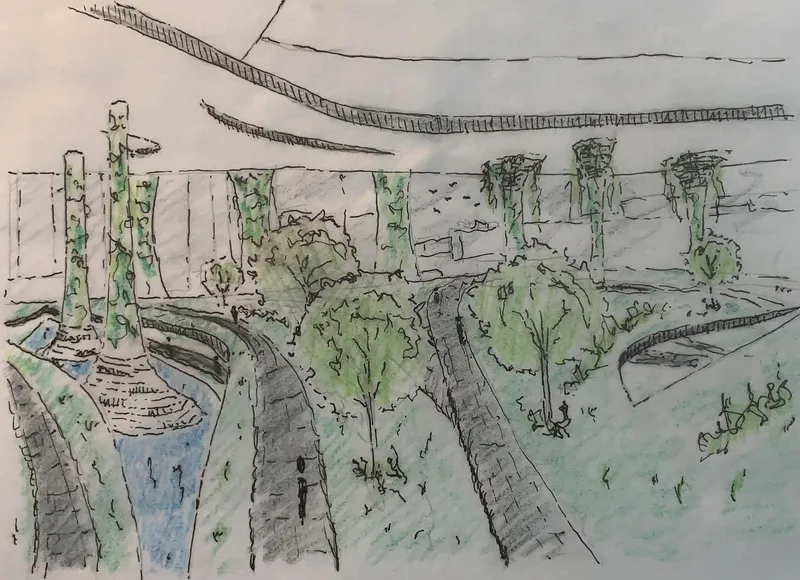
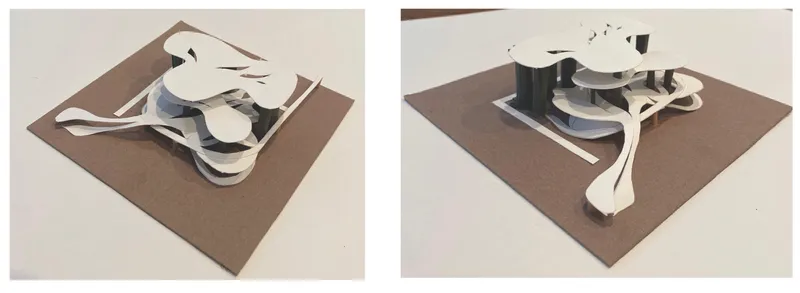
Next, we broke down the site into four layers. The first is the Ground Floor layer, which relates to the city in its form. The ground floor layer’s program consists of transient functions, which allow for movement and water interactions with onsite pools along with a Hudson River beach. The Understory layer stretches to interact with the surrounding context of the Hudson River and Highline while providing the site’s main source of social and physical interaction through park space and entertainment opportunities. The Canopy layer connects to all layers through tree structures providing vertical circulation, urban farming, and resource distribution to the site. The Canopy layer and the Emergent layer have a tiered form, which allows for a more natural terrain that is better suited for growing and water collection. Our site's top two layers are programmed with living, working, and commercial spaces that provide the public with a range of mixed-use functions.

Through many iterations, we developed our layers based on natural forms organized from a shift in the city’s existing grid. This creates directionality that suits our site and allows for organic movement. Flexible spaces and programs exist in the wilderness to allow for the adaptation of the occupants' needs. Therefore, we considered how our design could provide opportunities that benefit the user while making their individual lives more efficient. One example of this is through the circulation of our site, which is free and open, allowing the user to move throughout the site in a way that is most efficient for their needs. Our site’s upper layers allow for more private natural gathering spaces rarely found in the city creating an escape from harsh city conditions and relieving and boosting the health of the user. The site’s layering system allows for social distancing within on-site public spaces and possesses the ability to isolate layers internally and externally if the spread of a virus occurred. Additionally, the site is self-sufficient with on-site areas for food growth as well as copious working environments that allow members within the community to be unexposed to the virus while continuing their day-to-day lives.
The purpose of our design of Hudson Yards was to create a model for future cities. However, as our concept developed, we desired to explore how the urban wilderness could be carried out at different scales. One solution for New York City’s current pandemic state was turning select vehicular streets into pedestrian-only streets to allow people the option of venturing away from the sidewalk while social distancing. This solution sparked an investigation of neighboring streets to assess whether they were capable of transforming from vehicular to pedestrian. Our concept of urban wilderness will introduce additional elevated public spaces for resident use and commercial businesses and will include urban farming, natural green paths and water elements. Adding these additional spaces aids in bringing life to the street-level and benefits the user by providing them with green, open places in the city, ultimately making for a neighborhood that is more self-supporting, adaptable, and functionally diverse.

Conclusion
In conclusion, our team recognized an overall need for more public space in New York City. This space would be high density without crowding and include more natural features in order to benefit the user and transform the city into a self-sustaining ecosystem. Our design for a new Urban Wilderness celebrates city life by integrating nature into the city and creating a healthier improved way of life. Our team understands the reluctance of creating public space disconnected from the ground and the potential harm that it could do. Yet, we believe that the benefits outweigh the negatives when addressing the concerns and needs of the city dweller. We know that as cities demand more density there will be an increased need for more space. With that, we believe that the idea of public space versus private space will be challenged and in turn be forced to adapt and change. This project is the beginning of that change. It is not a question of “can cities and nature be equal in urban settings?”, but rather it is an imperative concern we must face that cities and nature must be equal if we hope to improve the future of urban life. Urban Wilderness is that catalyst for future change.
Sources
“Wilderness.” Merriam-Webster.com Dictionary, Merriam-Webster, https://www.merriam-webster.com/dictionary/wilderness. Accessed 17 Dec. 2020.
References (2)

Popular Articles
Popular articles from the community


Singing Woman: Contemporary Architecture Inspired by Estonia’s Voice and the Sea
Singing Woman turns Estonia’s song culture into flowing opera house architecture, blending public life, landscape, sea, and national memory.

Cloaked Colonization: A Mobile Underwater Habitat That Moves Like a Fish
Micah Abaya's shortlisted EHC Pacific entry reimagines ocean settlement as a dispersed network of self-sustaining architectural organisms.

The Amber Palace Opera: A Geological Fiction Surfaces on Tallinn's Baltic Waterfront
Pierre Brillard reimagines a Baltic legend as a public landscape, opera house, and waterfront promenade rooted in Tallinn's coastal identity.

Temporary Home for Dogs: A Reversed Zoo Rethinks Animal Shelter Architecture
In Bucharest, a sinuous corridor and freed landscape flip the logic of containment, designing a shelter that works to make itself unnecessary.

Similar Reads
You might also enjoy these articles
The Rhythm of Seasons
A Farmers' Market Connecting Nature and the City

More Than a Building-Designing a Living System
More Than a Building-Designing a Living System
Base Beyond
DESERT COMPOUND ARID: TOURISM OF ABSENCE AND ABUNDANCE

Comments (0)
Please login or sign up to add comments
No comments yet. Be the first to comment!