

Urko Sanchez Architects Plants an African Vernacular Village in a Sharjah Nature Reserve
Sharjah Bridi Park brings timber, thatch, and earthen walls to the UAE desert as a center for research and education within the Al Bridi Reserve.


Building with thatch in the Arabian desert is a provocation. Urko Sanchez Architects, a practice headquartered in Nairobi with deep roots in East African construction, has answered it with Sharjah Bridi Park: a 20,000 m² campus of rounded pavilions, conical towers, and sweeping canopies set within the protected Al Bridi Reserve, the largest conservation park for African wildlife species in the region. The program, which spans entrance buildings, ticketing, retail, an educational camp for field workshops, and ancillary research facilities, is distributed across a network of modest structures rather than consolidated under a single roof. The effect is closer to a settlement than a building.
What makes the project genuinely interesting is the directness of its premise. Rather than borrowing African motifs as ornament, the architects conducted extensive research into vernacular building typologies found across multiple African regions, then reinterpreted their structural logic, spatial strategies, and material systems into a contemporary construction adapted to Sharjah's harsh desert climate. Timber post-and-beam frames support thick thatch roofs that grow directly from the wooden skeleton beneath, making structure and enclosure a single unified assembly. Earthen walls complete the envelope. The result is a park architecture that reads as both ancient and deliberately contemporary, a place where the buildings feel as indigenous as the acacia trees planted around them.
A Compound, Not a Building
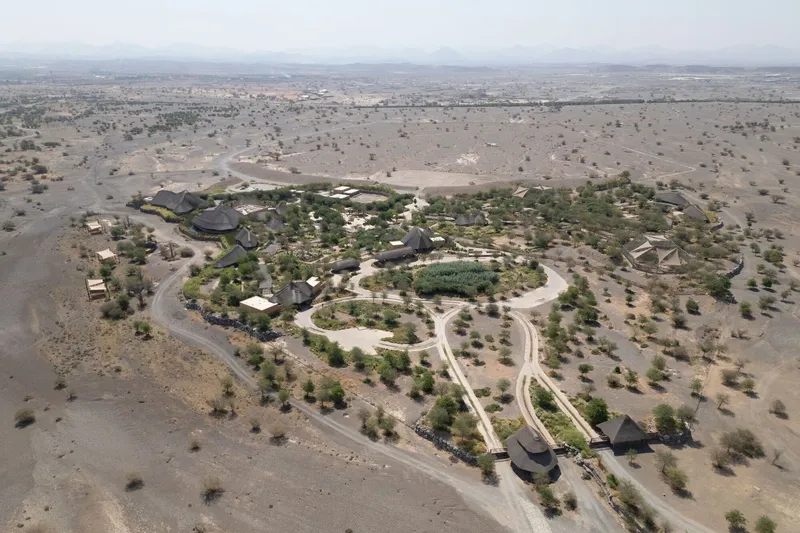
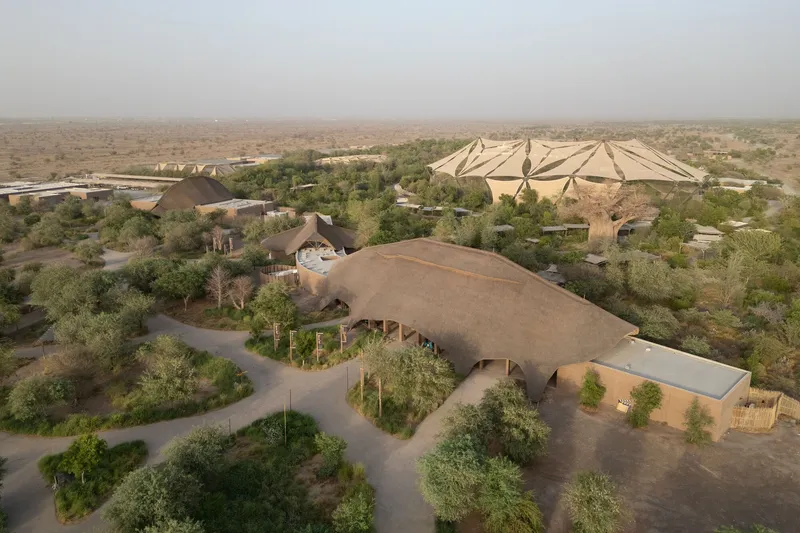
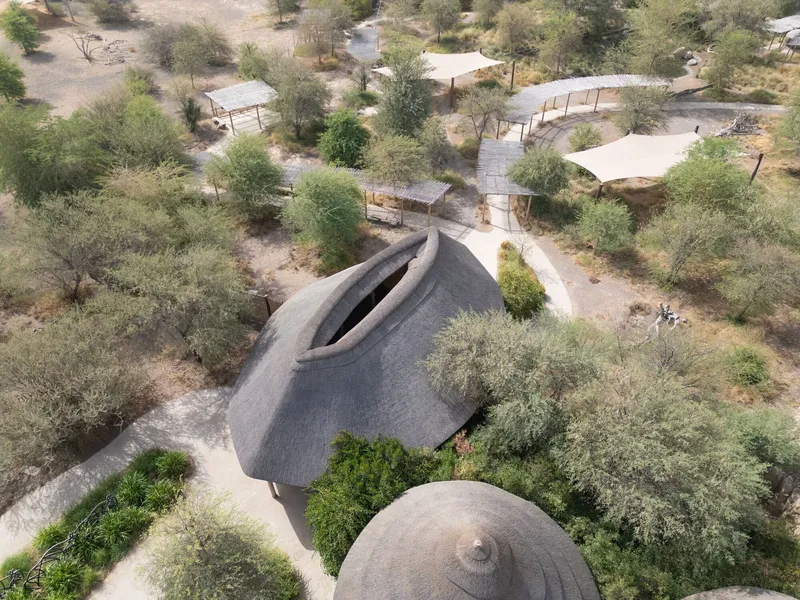
Seen from the air, Bridi Park dissolves into its terrain. Thatched roofs of varying profiles, some conical, some crescent-shaped, some undulating along elongated pavilions, are scattered among trees and native grasses with no dominant axis or symmetrical plan. The aerial views reveal a deliberate refusal of rigid geometry. Buildings appear to have been placed according to the logic of the landscape rather than an imposed grid, and the paths that link them trace gentle curves through planting and shaded courts.
The dispersed arrangement serves a practical purpose too. By breaking the program into discrete volumes, the architects ensure that movement between functions keeps visitors connected with the reserve's vegetation, turning circulation itself into an experience of the ecosystem. You never lose sight of the horizon or the canopy overhead.
Thatch as Structure, Not Decoration
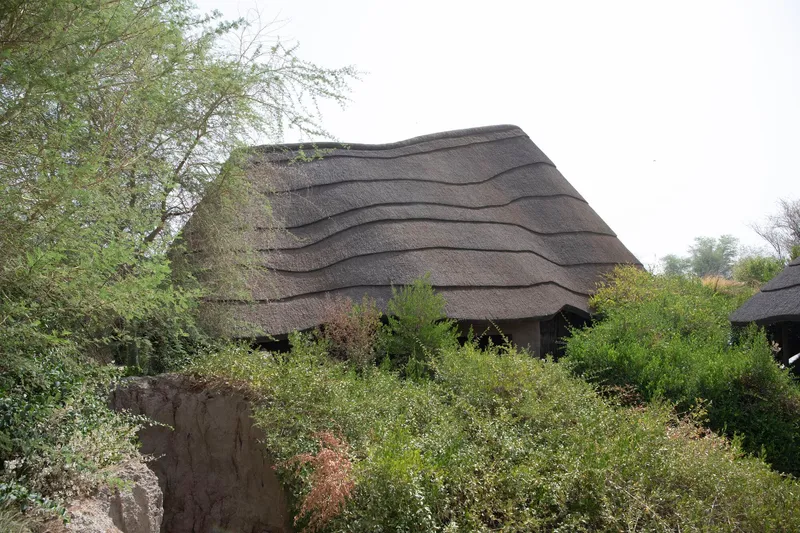
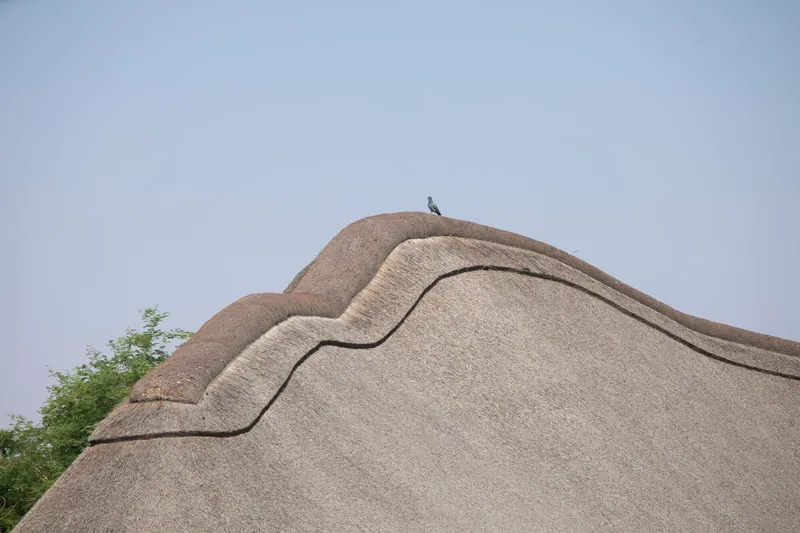
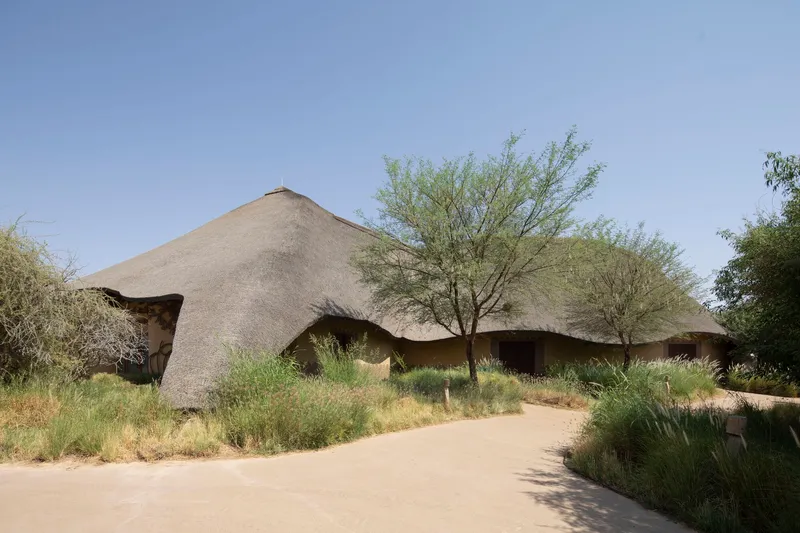
The thatched roofs are the project's most visible gesture, but they are also its most technically demanding. Unlike conventional thatch applications where a lightweight covering sits atop an independent frame, here the thatch grows directly from the timber structure beneath, creating a monolithic assembly where the roof is simultaneously cladding and structural bracing. The horizontal ridges visible on the close-up views indicate a layering system that adds mass and depth, helping the roof perform as thermal insulation against desert heat.
The sweeping eaves extend far beyond the wall line, forming protective canopies that shade openings and terraces from direct sun. That overhang is not decorative generosity; it is the primary passive cooling strategy. Combined with open interiors that allow air and light to move freely, the deep thatch canopy reduces reliance on mechanical systems in a climate that rarely forgives energy waste.
Earthen Walls and Timber Frames
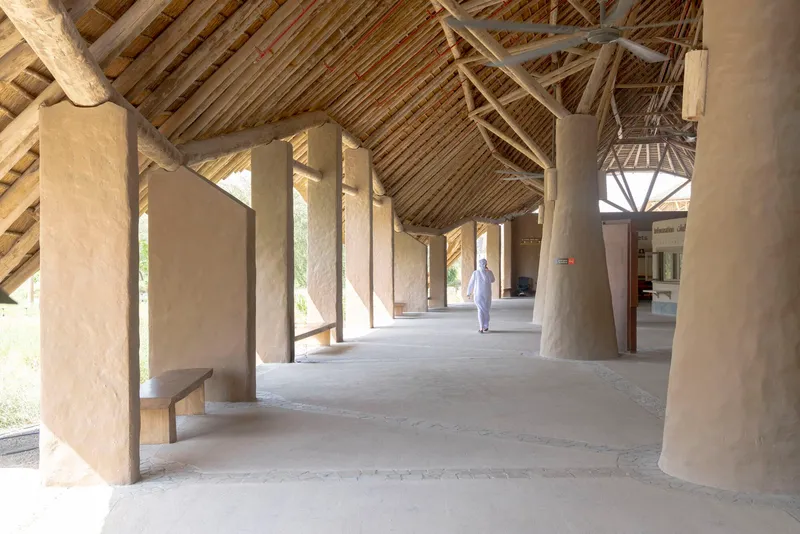
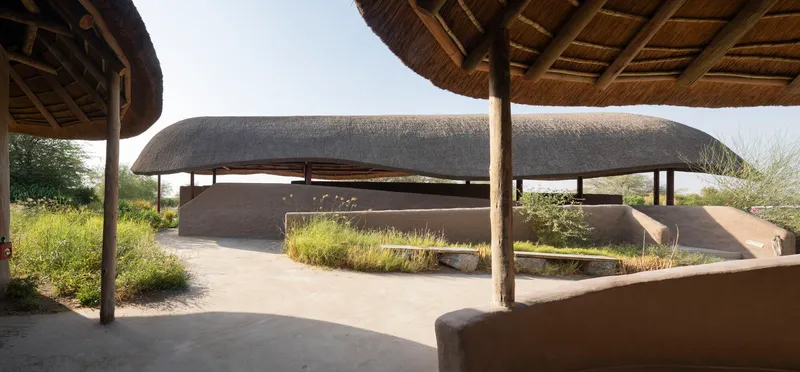
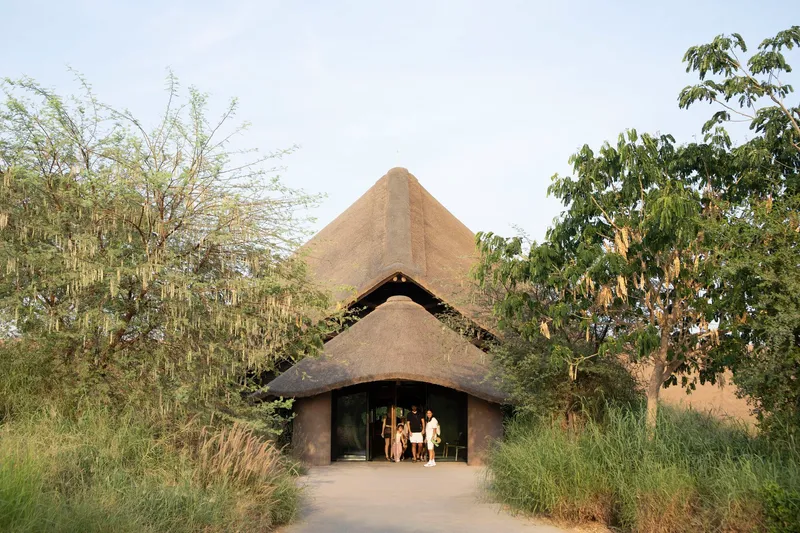
Beneath the thatch, the building palette narrows to two materials: timber and earth. Exposed wooden columns and beams create an open structural rhythm that defines interior spaces without enclosing them entirely, while plastered earthen walls provide thermal mass and a tactile surface that absorbs and releases heat slowly. The covered walkway captured in image shows how these elements operate together: rendered walls channel movement while timber rafters overhead establish a cadence of light and shadow.
The courtyard views reveal curved earthen walls that wrap around planted beds, creating intimate outdoor rooms beneath circular thatched canopies. These courtyards are the social heart of the compound, places where education, rest, and gathering happen without the formality of enclosed rooms. The palette is deliberately restrained so that texture, not color, carries the architectural expression.
Open Pavilions and the Desert Horizon
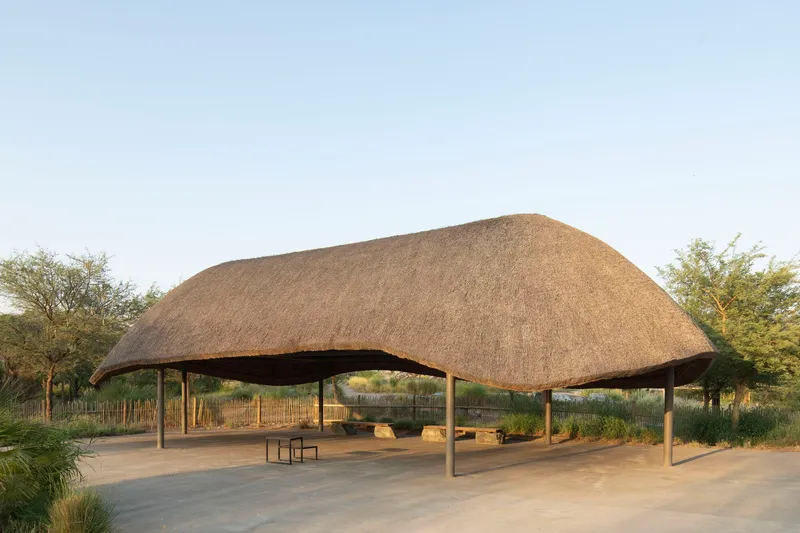
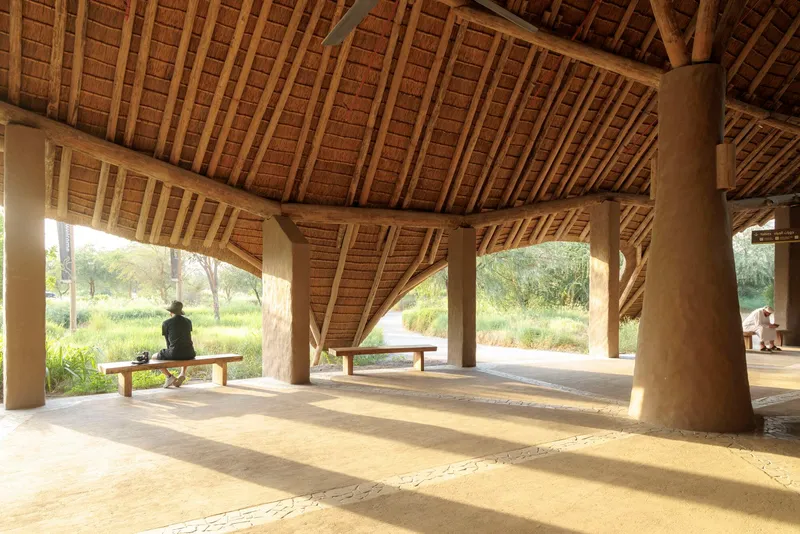
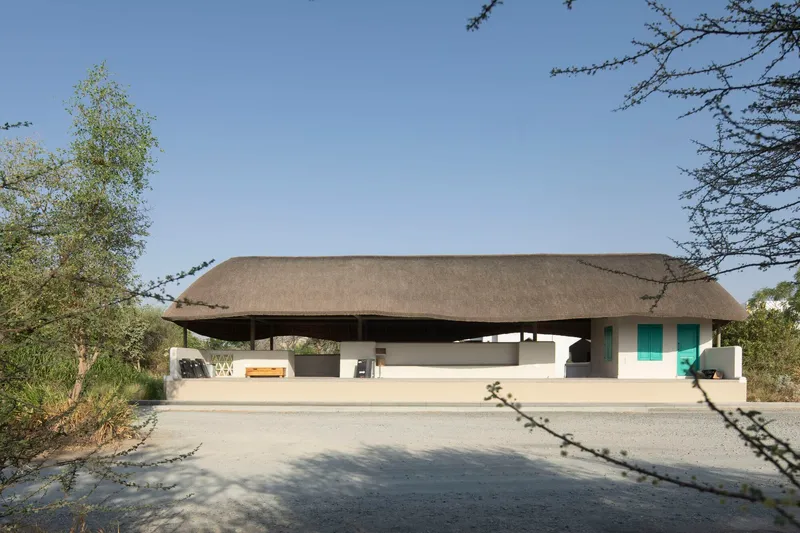
Several of the park's structures operate as fully open-air pavilions: sweeping roofs supported by timber columns with no walls at all. The savanna-like setting makes this viable for much of the year, and the architectural payoff is significant. Exposed rafters radiate outward from central columns, and the thatched ceiling above forms a warm, textured canopy that contrasts with the bright sky visible through every opening. Benches and gathering areas sit beneath these shelters, offering shade without separation from the landscape.
The sweeping canopy shown hovering above white rendered walls demonstrates how the pavilion typology scales up. The roof floats on slender supports, its deep profile silhouetted against bare trees, and the ground plane remains continuous. There is no threshold, no door. You drift in and out of architecture as naturally as you move through the reserve itself.
Landscape as Co-Author
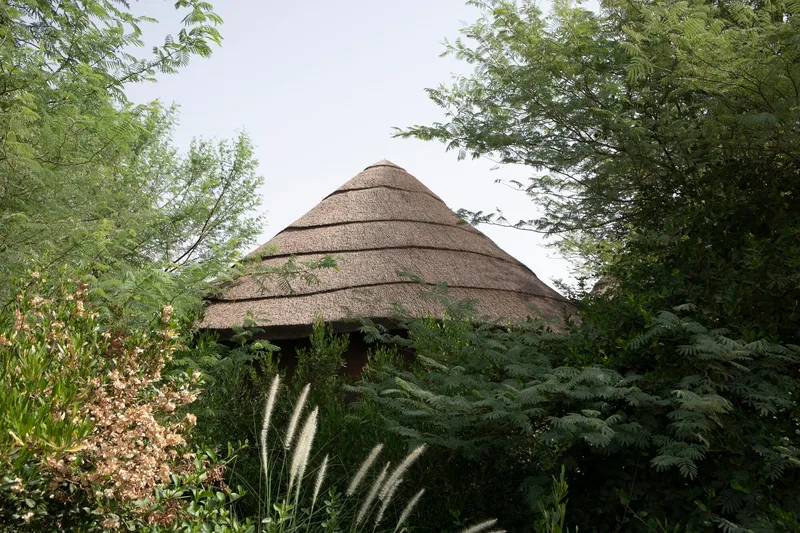
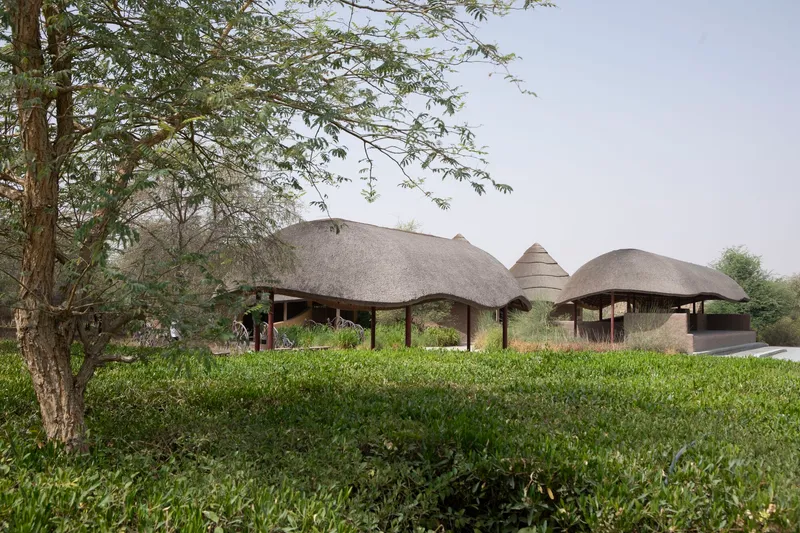
The planting strategy is inseparable from the architecture. Dense clusters of ferns, ornamental grasses, and native species press against the bases of conical roofs, blurring the boundary between building and ground. From certain angles the thatched forms appear to emerge from the vegetation rather than sit on it, reinforcing the architects' intention that structures should rise organically from the terrain.
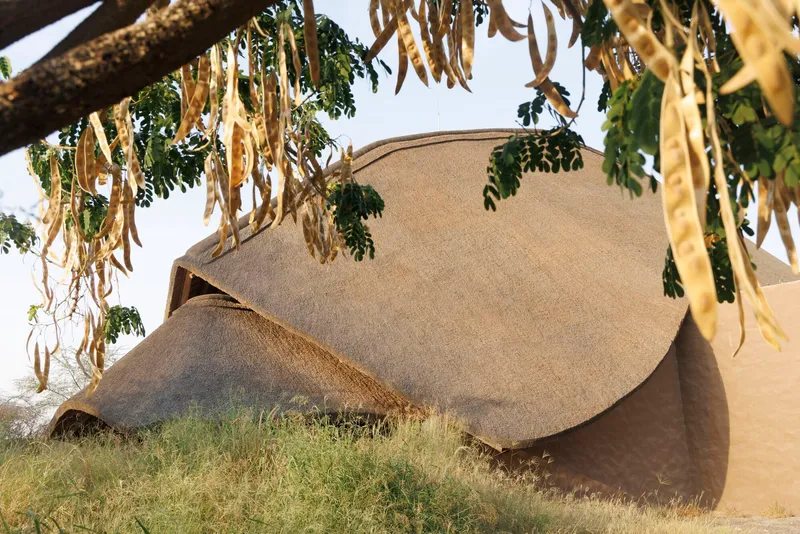
Views through hanging branches frame the organic roof silhouettes as landscape features rather than conventional buildings. The architects have avoided hard paving and formal edges wherever possible, letting gravel paths and planted beds mediate between architecture and the dry scrubland of the reserve. The buildings do not dominate; they participate.
Thresholds and Arrival
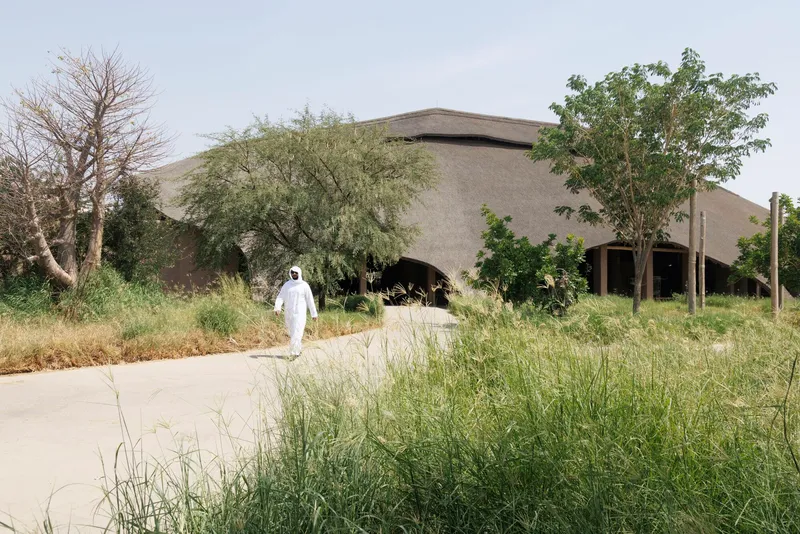
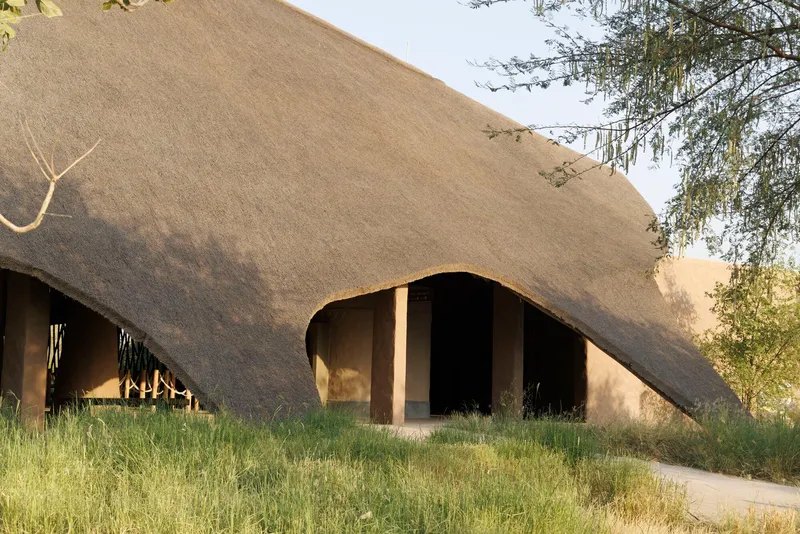
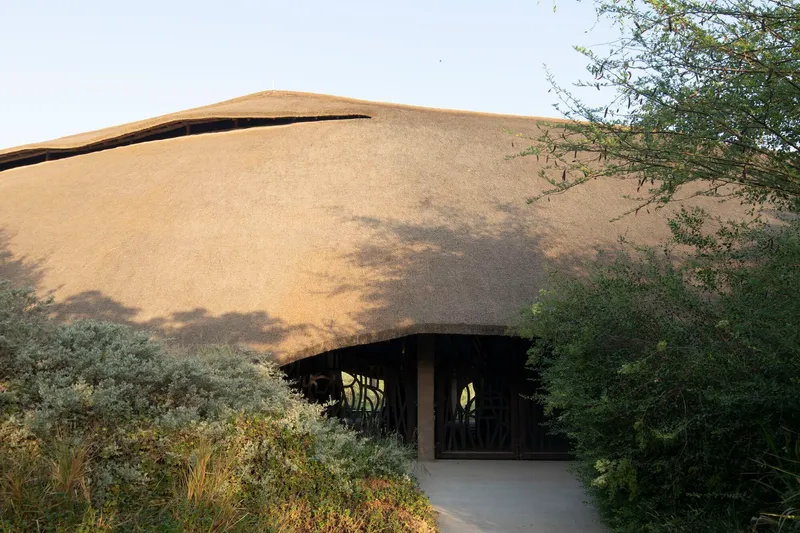
The arched openings cut into the thatched volumes serve as thresholds that compress and release space in a way that feels more geological than architectural. Approaching one of these entrances along a planted pathway, you pass through an opening scaled to the human body before the interior expands under a soaring roof. The golden-hour image of a swooping roof edge set into a grassy slope captures this quality perfectly: the building is part hill, part shelter, part threshold.
The curved eaves that extend over entrance pathways also create a transitional zone, neither fully outside nor fully inside, where your eyes adjust from desert glare to the softer light beneath thatch. It is a simple move with a powerful sensory effect, and it happens at every building in the compound.
Glazed Pavilions Along the Path
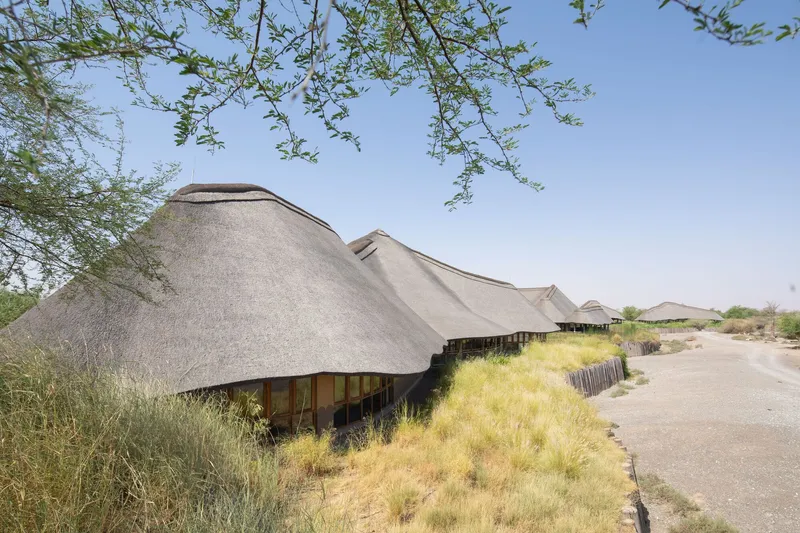
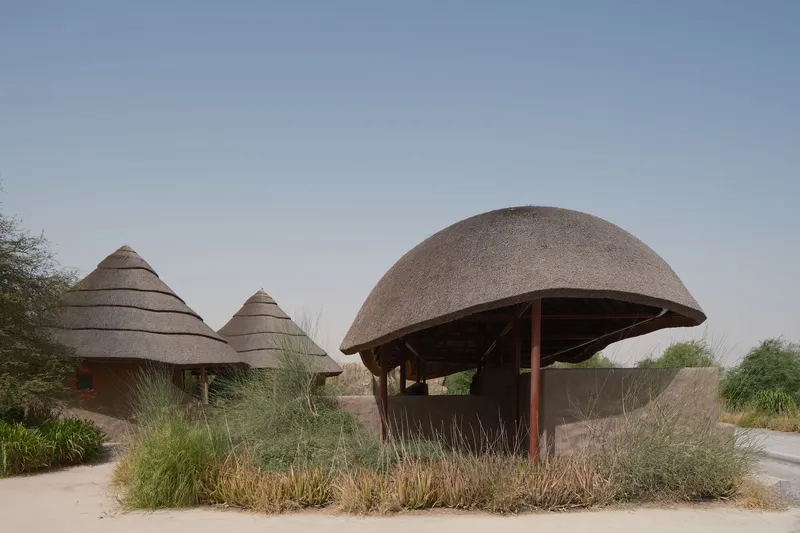
Not every structure relies on earthen walls. A series of pavilions along one pathway employs glass enclosures beneath their thatched roofs, presumably for retail or exhibition functions that require environmental control. The glass walls sit back from the roof edge, protected by the deep overhang, and the timber columns remain visible as the primary structural rhythm. The contrast between transparent modern glazing and the ancient materiality of thatch overhead is surprisingly resolved: the roof is so dominant that the glass reads as open air.
Plans and Drawings
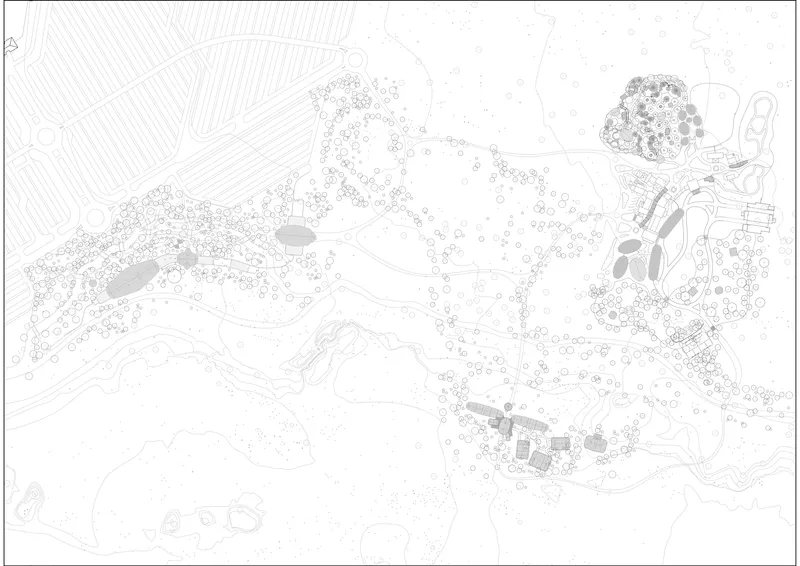
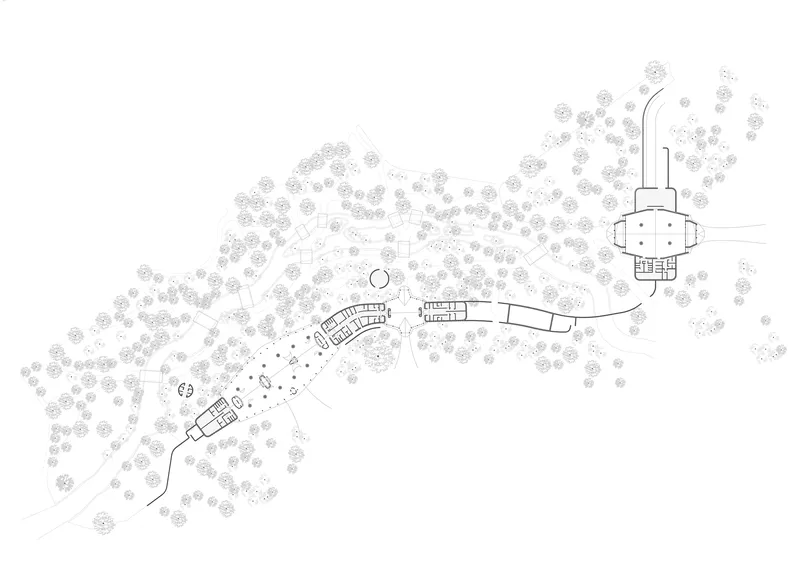
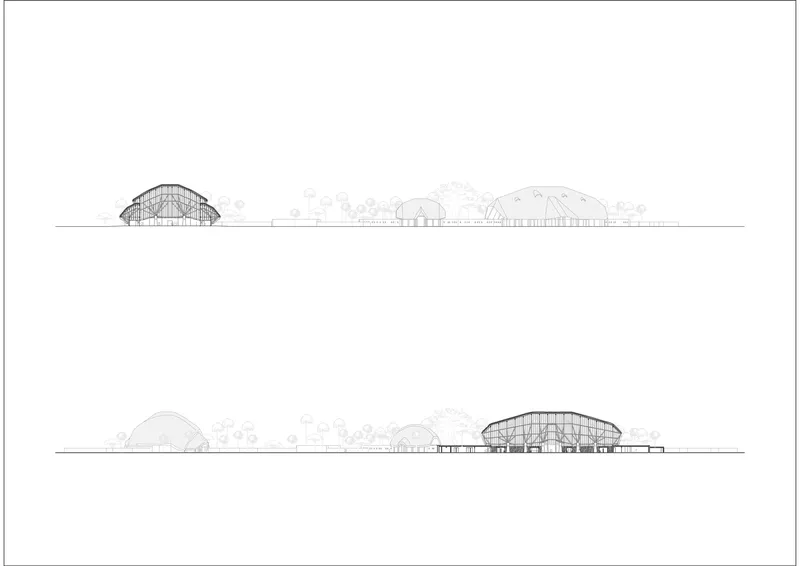
The two site plans reveal the full extent of the compound's dispersal strategy. Circular tree symbols fill the drawings like a stippled field, and the buildings, shown as compact clusters, occupy only a fraction of the total site. Pathways weave between structures with no straight runs, confirming that the landscape, not the architecture, dictates movement. The elevation drawing lays bare the structural logic: timber frames with clearly articulated columns and rafters support the thatched profiles, and the surrounding vegetation is drawn at the same scale as the buildings, a graphic choice that underscores the project's central argument that architecture and landscape carry equal weight.
Why This Project Matters
Sharjah Bridi Park is a serious test of whether vernacular construction intelligence can function at institutional scale in one of the world's most extreme climates. Urko Sanchez Architects did not import African aesthetics as a style; they imported African building logic, the deep overhangs, the porous interiors, the integration of structure and skin, and subjected it to the demands of a conservation park that will see heavy public use. The commitment to timber, thatch, and earth in a region dominated by concrete and steel is not romantic nostalgia. It is a material argument about performance, legibility, and cultural exchange.
The project also offers a compelling model for how educational and research facilities can be woven into protected landscapes without overwhelming them. By distributing the program across small volumes and letting circulation happen through the terrain itself, the architects have made the reserve the primary experience and the architecture its supporting frame. In a Gulf region that more often announces its ambitions through scale and spectacle, Bridi Park earns its presence by doing the opposite: staying low, staying open, and letting the land do the talking.
Sharjah Bridi Park by Urko Sanchez Architects. Located in Sharjah, United Arab Emirates. 20,000 m². Completed 2026. Photography by Arch-Exist.
About the Studio
Share Your Own Work on uni.xyz
If projects like this are the kind of work you want to make, uni.xyz is a place to publish your own, find collaborators, and enter design competitions.


Popular Articles
Popular articles from the community


Singing Woman: An Opera House That Performs Before the Curtain Rises
Ovidiu Cristian Pavel's conceptual opera house translates Estonia's choral identity into a sculpted waterfront landmark facing the Baltic Sea.

Temporary Home for Dogs: A Reversed Zoo Rethinks Animal Shelter Architecture
In Bucharest, a sinuous corridor and freed landscape flip the logic of containment, designing a shelter that works to make itself unnecessary.

Faces of the Soviet Avant-Garde: Turning Moscow's Street Names into an Open-Air Museum
A network of sculptural installations across a Moscow residential district transforms forgotten architect names into spatial encounters with cultural memor

Cloaked Colonization: A Mobile Underwater Habitat That Moves Like a Fish
Micah Abaya's shortlisted EHC Pacific entry reimagines ocean settlement as a dispersed network of self-sustaining architectural organisms.

Similar Reads
You might also enjoy these articles

Pixel Gardens: One Repeated Module Stacked Into a Terraced Social Housing Tower for Famagusta
Salem Bader's shortlisted housing tower builds a vertical neighbourhood from one repeated module, offsetting units to carve terraces, light and air.

Bao Huynh Watercolor Atelier: A Serene Art Retreat in Hội An
Bao Huynh Watercolor Atelier in Hội An blends multifunctional art spaces, sustainable design, local materials, and family-friendly living in a serene environment.

Atelier Macri Concept Store Interior Design by CASE-REAL
Atelier Macri store features a "ko" counter, walnut wood details, cork displays, blending retail, gallery, and seamless customer experiences.

Manuel Vargas Izquierdo Stadium and High-Performance Sports Center: Architectural Excellence in Jalpa de Méndez
The Manuel Vargas Izquierdo Stadium blends sustainable design, inclusive sports facilities, and cultural-inspired architecture, revitalizing Jalpa de Méndez’s public spaces.


Comments (0)
Please login or sign up to add comments
No comments yet. Be the first to comment!