

V-Park: Turning a 1952 Railway Groove into a Layered Public Spine for the City Centre
Wujingting Zeng reads an abandoned railway's V-shaped landform as a multi-level corridor of markets, farms, galleries and sports courts.


Most cities treat a dead railway as a scar to be paved over. V-Park treats it as a ready-made public room. The project takes the sunken, V-shaped profile left by an obsolete line at the heart of the city and argues that its awkward geometry is the most valuable thing on the site. The groove already separates movement from its surroundings, already gathers people along its edges, and already runs continuously through dense urban fabric. The design builds on what is there instead of starting from a clean slate.
Designed by Wujingting Zeng, the proposal received a Jury Commendation in Public Architecture 2020. The railway was built in 1952 as an infrastructural backbone for the city centre. Urban expansion and the arrival of high-speed rail made it redundant, and its planned relocation outside the city leaves a linear void slicing through neighbourhoods it once divided. Zeng's response is an urban spine that brings mobility, recreation, commerce, culture and ecology back into an ageing core that is losing activity as transport shifts outward.
A V-Shaped Groove Cut Through the Housing Blocks
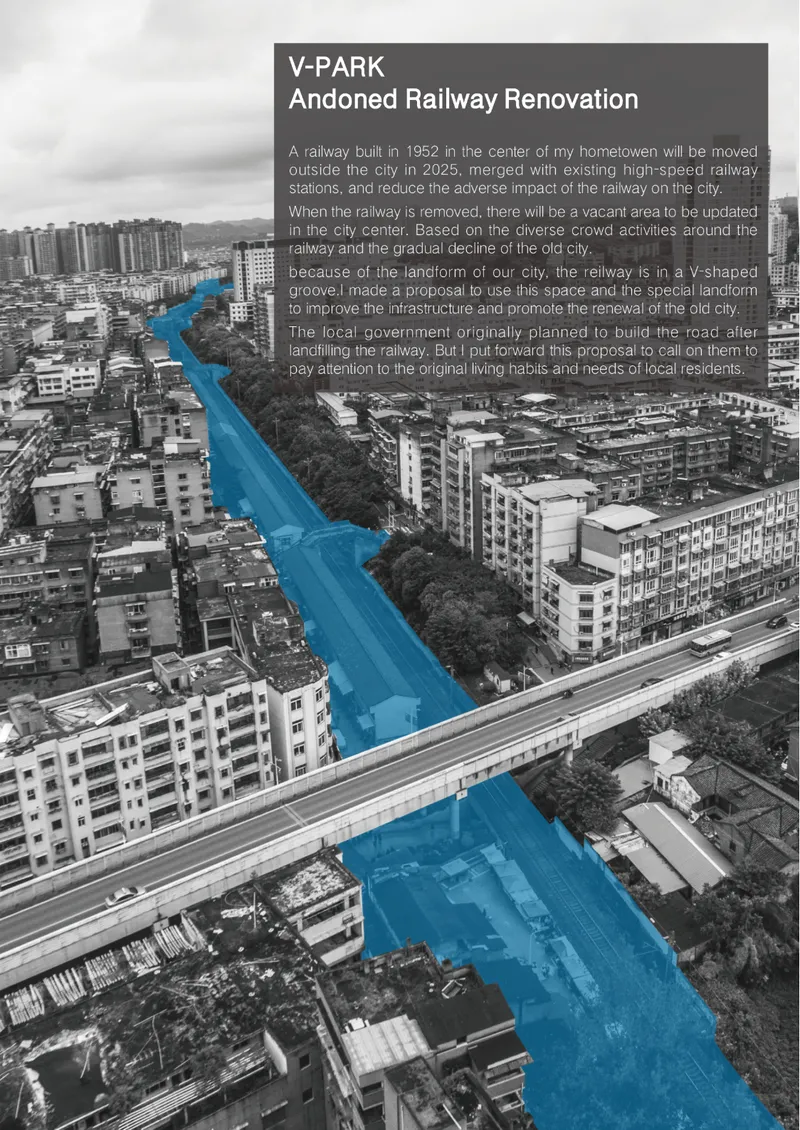
The aerial photograph is the project's thesis in a single frame. Highlighted in blue, the railway trench runs tight between apartment blocks and slips beneath an elevated road, a piece of land that belongs to no one and touches everyone. The V-shaped landform created by the track bed and surrounding terrain is not a problem to be levelled. It becomes the defining spatial condition of the scheme, giving the corridor natural edges, built-in changes of level and a sheltered floor.
Reading the site this way is the smartest move in the proposal. Zeng also observed the spontaneous activities residents had already brought to the abandoned corridor and chose to formalise those patterns rather than replace them. Adaptive reuse here grows out of existing social behaviour, which gives the plan a credibility that top-down masterplans often lack.
An Elevated Walkway Stitches the Corridor Together
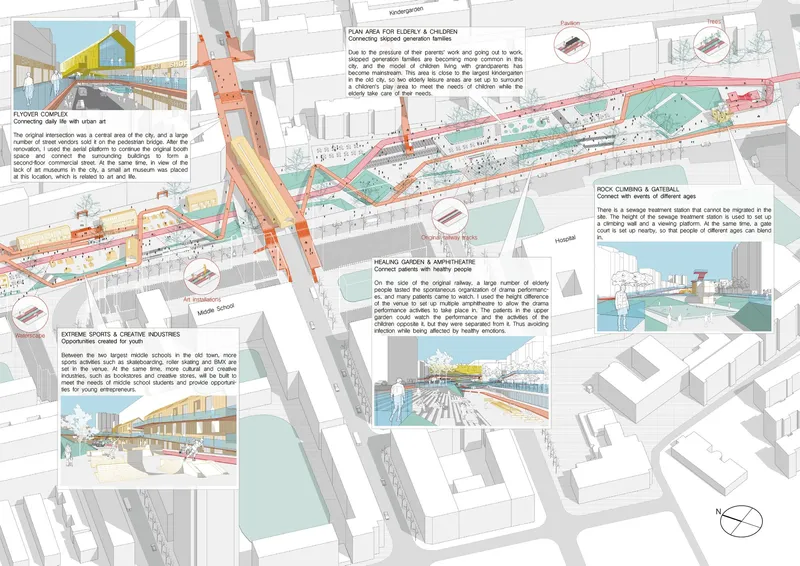
The axonometric site plan shows how the scheme organises itself: an orange elevated walkway threads along the old railway line, while inset views pick out programmed zones distributed down its length. The existing track elevation is put to work as a layered circulation system, separating and connecting different modes of movement so that pedestrians, cyclists and slower visitors can share the corridor without competing for the same surface.
Along this spine the programme is deliberately mixed. Art galleries, museums and heritage zones keep the railway's history legible. Markets, cafés, creative studios and flexible retail units support local enterprise. Urban farms, greenhouses and rehabilitation gardens bring working ecology into the core, while basketball courts, skate parks and running tracks keep the corridor busy across age groups. The distribution matters as much as the list: by spreading these uses, the plan avoids a single tourist hotspot and keeps activity even along the whole route.
Boardwalks, Ramps and Timber Pavilions at Human Scale
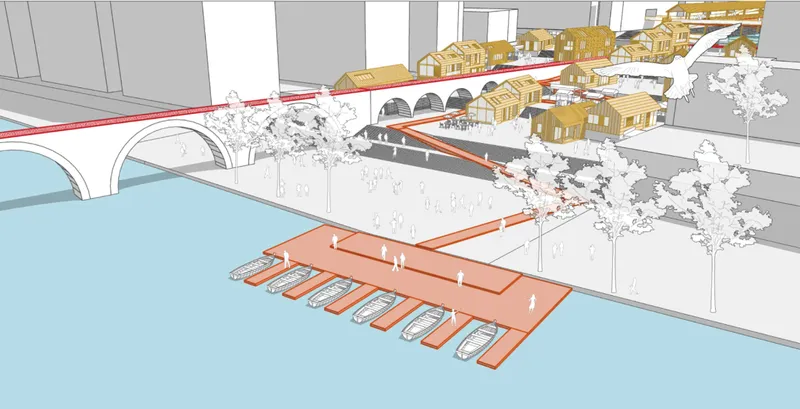
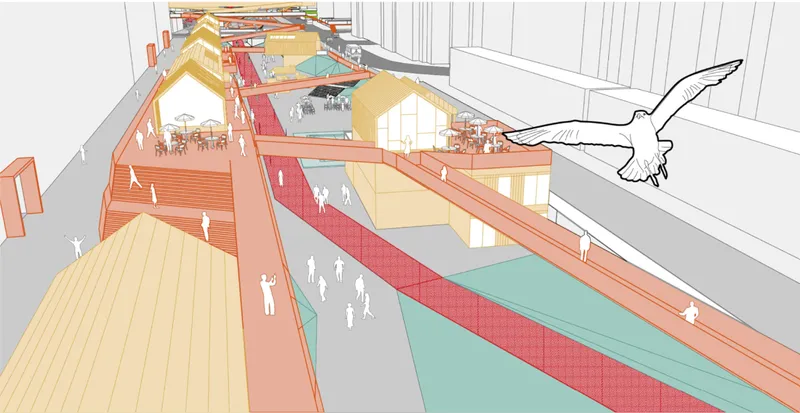
The perspectives bring the strategy down to eye level. At the water's edge, an orange boardwalk extends into a boat pier, crowded with people and framed by timber houses with gulls wheeling overhead. Further along, a red walkway and orange ramps link gabled timber pavilions spilling out onto café terraces. The ramps are where the vertical stratification becomes tangible: they turn the change in level into a sequence to walk through rather than a barrier to overcome.
The choice of small gabled timber volumes is telling. They read as market stalls, studios or cafés, structures that can change tenants and uses over time, which fits the brief's call for commercial space that adapts. They also keep the corridor at a domestic scale next to the surrounding apartment blocks, so the new public spine feels like an extension of the neighbourhood rather than an imported attraction.
Sunken Plazas and Terraced Edges Meet the Street
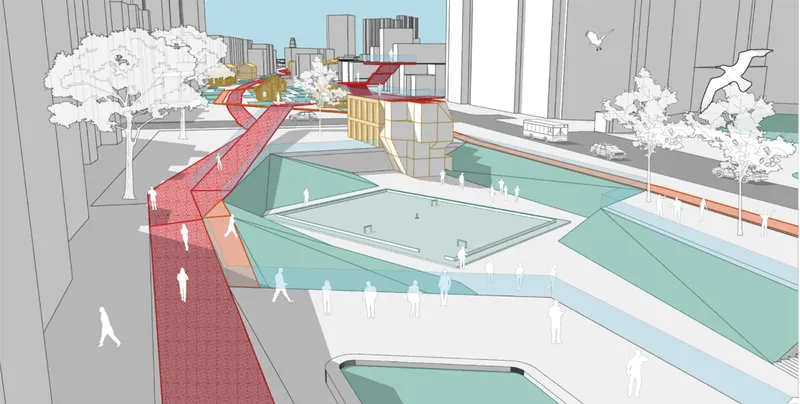
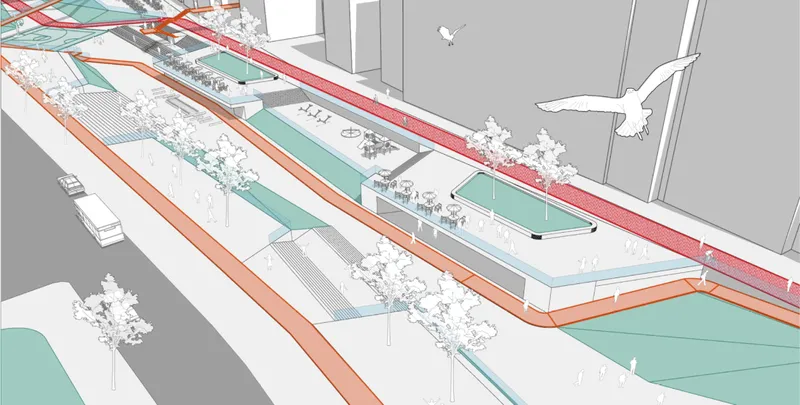
The final two views address the most delicate condition: where the corridor meets the everyday city. A sunken green plaza sits beside a red patterned path, with a faceted timber pavilion marking the space and buses passing on the street above. Elsewhere, terraced steps and planted courts step down from the road to the corridor floor. The V-section is turned into seating, planting and gathering space, so the slope that once isolated the tracks now acts as an amphitheatre for the street.
These edges are what allow V-Park to reconnect neighbourhoods previously split by the railway. With buses, pedestrians and cyclists all visible in the same frame, the drawings make a convincing case that the corridor belongs to the existing transport and pedestrian network rather than sitting apart from it as an enclosed park.
Why This Project Matters
As high-speed networks pull rail infrastructure to the edges of cities, many urban centres will be left with linear voids like this one. V-Park offers a clear method for dealing with them: read the existing landform, observe how people already use the leftover space, then layer circulation and programme so the corridor serves the whole surrounding fabric. The railway is reinterpreted rather than erased, and its 1952 history stays part of the city's identity.
What earns the project its commendation is restraint. Zeng resists the temptation of a single iconic gesture and instead proposes a continuous, mixed and adaptable public landscape built from modest timber pavilions, ramps, terraces and gardens. It is a reminder that the strongest adaptive reuse often starts by taking the existing conditions seriously, including the awkward ones.
View the Full Project
About the Designers
Designer: Wujingting Zeng
Enter a Design Competition on uni.xyz
uni.xyz runs architecture and design competitions year-round that reward proposals with spatial conviction and real site intelligence.
Project credits: V-Park, Abandoned Railway Renovation by Wujingting Zeng Public Architecture 2020 (uni.xyz).


Popular Articles
Popular articles from the community


Tsunami Convergenics: Turning Catastrophic Ocean Forces into Underwater Housing Infrastructure
A speculative underwater settlement off the coast of Onagawa, Japan, treats tsunamis and typhoons as energy sources rather than threats.
Faces of the Soviet Avant-Garde: Turning Moscow's Street Names into an Open-Air Museum
A network of sculptural installations across a Moscow residential district transforms forgotten architect names into spatial encounters with cultural memor

Opera by the Sea Estonia: Three Shells Dissolving Architecture into Tallinn's Coastline
A winning opera house proposal replaces monumental form with interconnected shells that blur the boundary between building, park and Baltic Sea.

The Amber Palace Opera: A Geological Fiction Surfaces on Tallinn's Baltic Waterfront
Pierre Brillard reimagines a Baltic legend as a public landscape, opera house, and waterfront promenade rooted in Tallinn's coastal identity.

Similar Reads
You might also enjoy these articles

Healing Façade: A Modular Chapel System That Restores Ethiopia's Sacred Forests
Winner of the Eco-Chapel competition, this circular timber façade collects water from air to rebuild soil and reforest degraded Ethiopian landscapes.
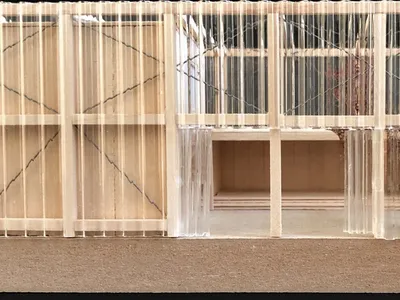
Kaffeebühnen: Where Coffee Shop Architecture Becomes a Civic Stage in Vienna
A linear sequence of timber boxes, transparent shells, and open yards turns the Viennese café tradition into a public performance space.
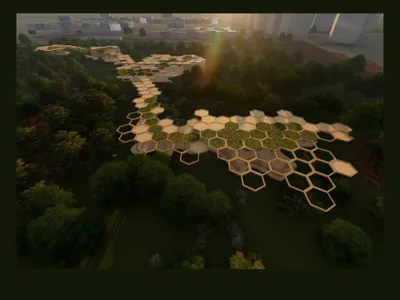
Eco Chapel: A Modular Forest Pavilion That Grows Like the Landscape It Protects
Hexagonal timber modules weave through existing trees, turning a chapel into a living system for prayer, education, and reforestation.


Urban Forest: A Vertical Ecosystem for 5,000 Workers in Singapore's Changi Business Park
Radially stacked pods and layered green decks turn a 7-acre plot into 47 acres of ecological workspace projected for 2040.

Explore Public Architecture Competitions
Discover active competitions in this discipline

Challenge to design luxury tourism on rails

Challenge to reimagine the Iron Throne

Photograph architecture without architects

VR headsets Storefront design competition
Comments (0)
Please login or sign up to add comments
No comments yet. Be the first to comment!