

V8 Architects Builds a Giant Solar-Powered Beach Chair for Dutch Design Week
A 10-by-10-meter demountable pavilion in Eindhoven harvests sunlight through 376 colored panels and gives it back after dark.


Most solar installations treat their panels as an engineering afterthought, something to mount on a roof and forget. V8 Architects took the opposite position at Dutch Design Week 2022 in Eindhoven: they made the solar panel the architecture. The Solar Pavilion is a 10-by-10-meter canopy of 376 colored glass panels arranged in a concentric gradient from deep blue at the edges to warm terracotta and amber at the center, tilted like a giant reclining beach chair over Ketelhuisplein square. It harvests roughly 7.5 kWp of energy during the day, stores it, and returns it to visitors after sunset as light from 44 LED lamps and warmth from infrared-heated furniture.
What makes the project genuinely interesting, and not merely a tech demo dressed up with color, is the commitment to full circularity at a budget under $100,000. Every structural component, from the four steel masts and tension cables to the solar panels developed with Kameleon Solar, was borrowed from suppliers and designed for disassembly and return. The pavilion existed for ten days and then vanished, leaving nothing behind but the energy it generated. That equation, all spectacle and zero waste, is a harder trick to pull off than it sounds.
A Roof That Is the Whole Building
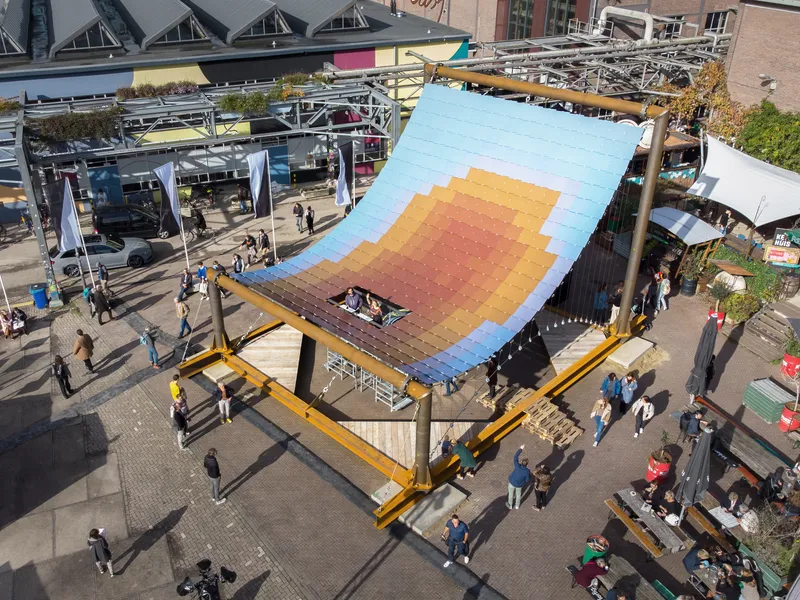
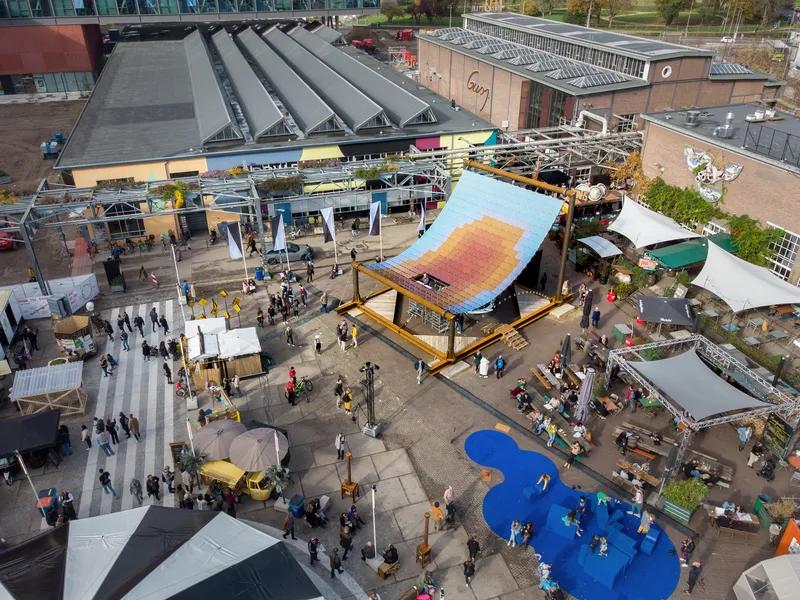
From above, the pavilion reads as a single continuous surface: a quilted gradient of seven panel colors rippling outward in concentric bands. The tilt is the key spatial gesture. By angling the entire canopy, V8 created a tall open edge for entry and a low intimate corner that shelters a seating pit and performance space. There are no walls, no doors, no façade in any conventional sense. The roof is the building.
The aerial perspective also reveals how carefully V8 sited the structure between surrounding buildings. Solar simulation software was used to determine the optimal orientation on the square so the panels could harvest maximum energy despite the dense urban context of Eindhoven's Ketelhuis neighborhood. The color gradient is not arbitrary decoration: it results from the different spectral responses of each panel type, turning an engineering variable into an aesthetic system.
Color as Energy, Energy as Color
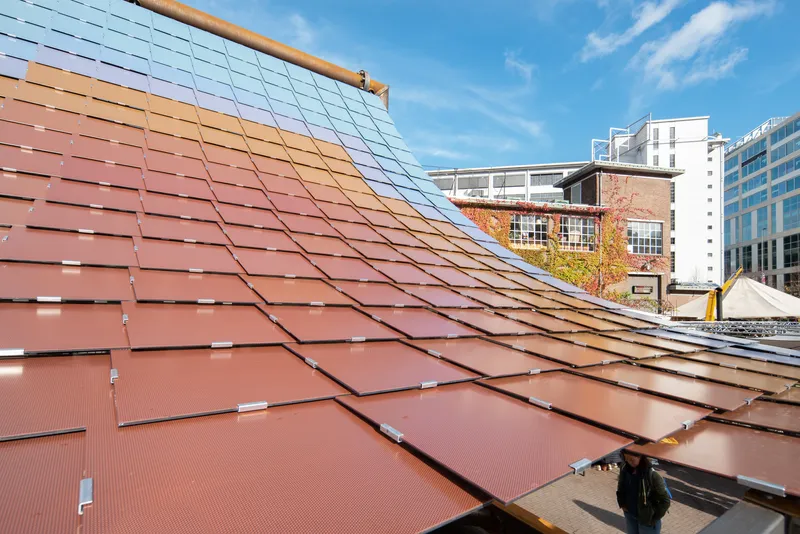
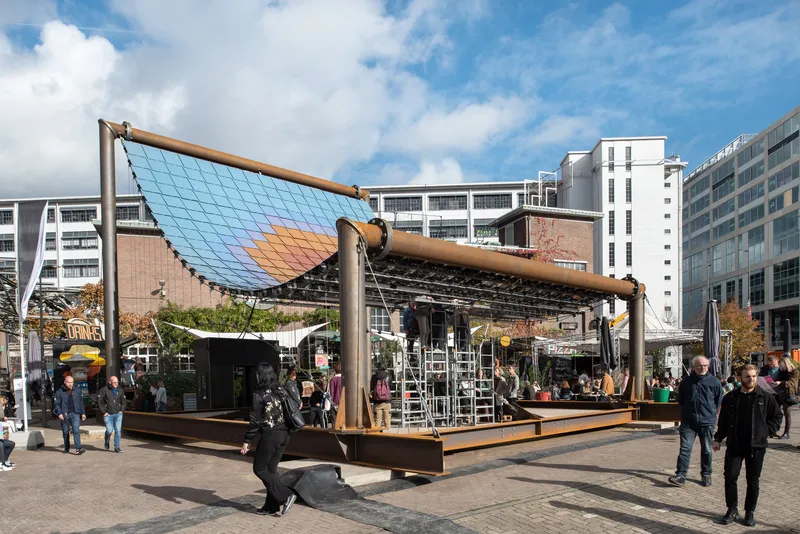
Up close, the panel surface looks less like a solar array and more like a tiled mosaic. Each of the 376 glass elements is slightly tilted and diagonally fitted into the larger puzzle of the roof, producing a subtle wave effect that makes the canopy seem to float. The collaboration with Kameleon Solar was essential here: the firm specializes in colored photovoltaic panels, which allowed V8 to treat energy generation as a design medium rather than an add-on.
The transition from warm terracotta tones to cool blues across the surface gives the roof a directional quality, almost like a compass rose. Standing beneath the warm-toned corner feels sheltered and enclosed; moving toward the blue edge, the space opens up and the sky takes over. It is a rare case where photovoltaic technology directly shapes the spatial experience rather than simply sitting on top of it.
Three Rooms Without Walls
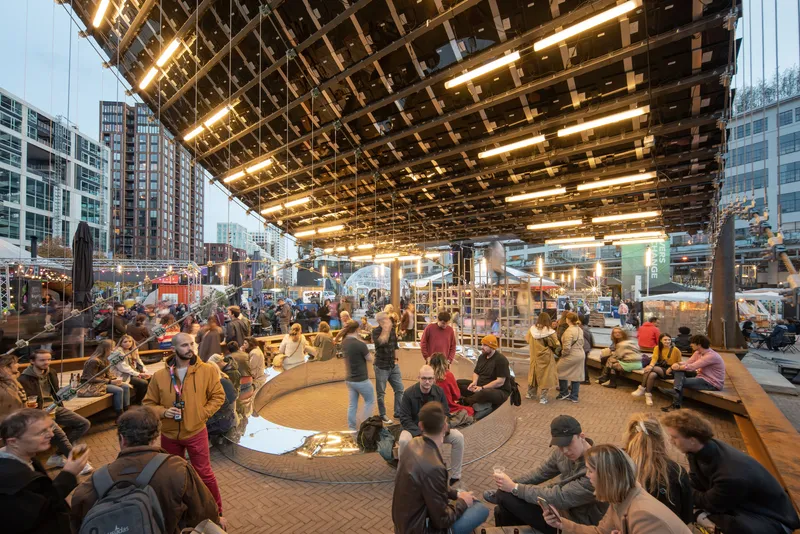
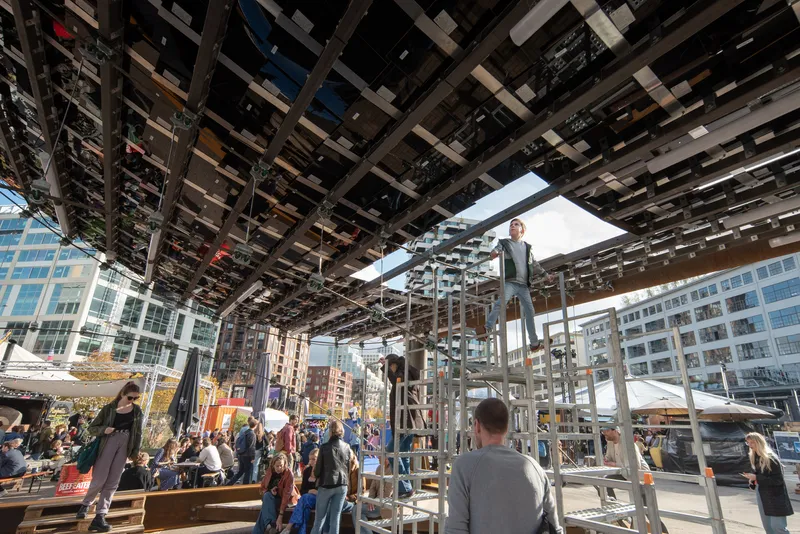
Beneath the canopy, V8 organized the 100-square-meter footprint into three distinct zones. The Solar Field is the journey itself: visitors climb a staircase from a sunken seating pit to stand in the middle of the stretched canvas, or "sun cloth," that hangs between two large steel beams. The Alcove is a smaller, more intimate room where infrared panels embedded in the furniture warm your body directly. The Circle is a flat, open space configured for talks and performances during the festival.
At dusk, the pavilion's second life begins. The energy stored during daylight hours powers the 44 LEDs integrated into the timber grid ceiling, transforming the underside of the canopy into a lantern visible across the square. The shift from day to night is not just atmospheric. It is the literal thesis of the building: the sun's energy, captured and stored, returned to the public as shared warmth and light.
Exposed Structure, Honest Assembly
V8 intentionally left every structural connection visible. The four steel masts, the tension cables, the large floor beams: all are legible from below, so visitors could understand how the pavilion stands up and, critically, how it comes apart. This is not transparency for its own sake. Full demountability was a core brief requirement. Every steel beam, every cable, every solar panel was a borrowed component destined to be returned to its supplier after the ten-day exhibition.
The detailing walks a deliberate line between "rough" construction and delicate technology. Heavy steel masts and tension wires do the structural work while thin colored glass panels handle the energy work. That contrast is visually honest. You see the muscle and the skin separately, and neither pretends to be the other.
Plans and Drawings
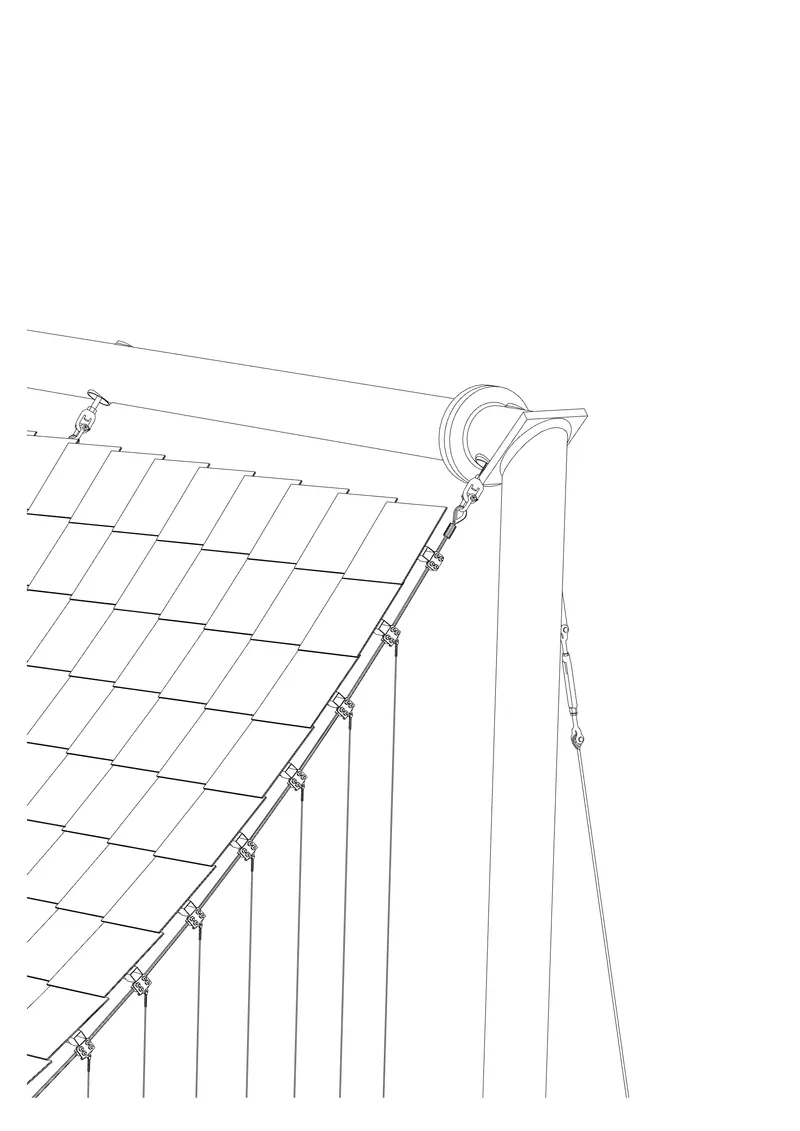
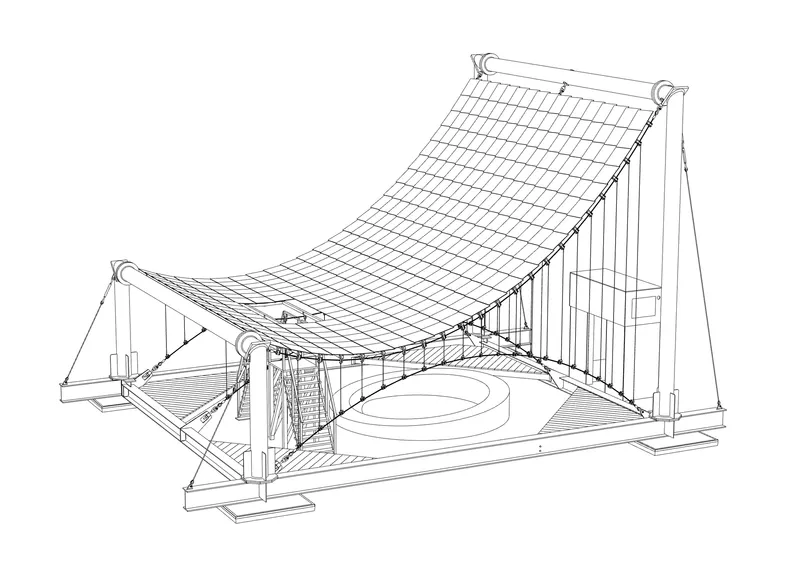
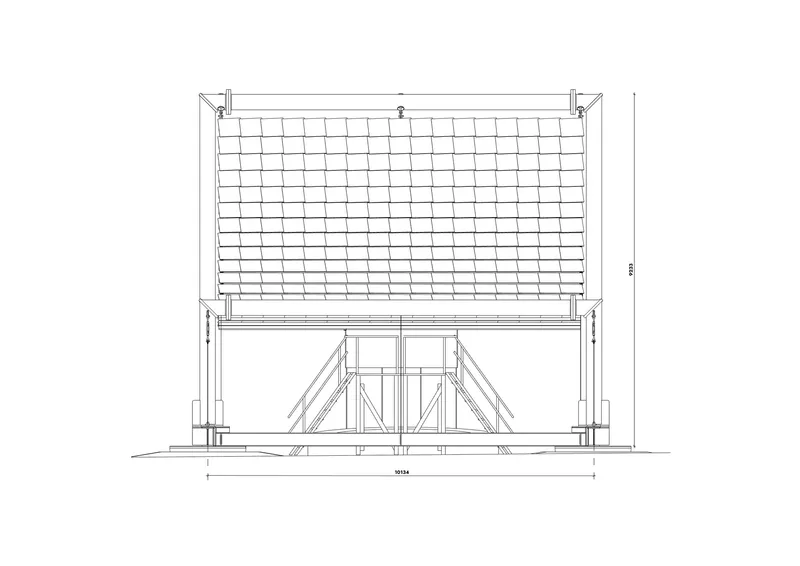
The axonometric drawings reveal the cable-stayed logic of the structure. Four masts work in combination with diagonal tension cables to absorb both static loads from the panel canopy and dynamic wind forces. The hanging canvas system, stretched between two large parallel steel beams, creates the seating zone below. The elevation drawing makes the "beach chair" analogy unmistakable: the canopy drapes from a high frame on one side to a low frame on the other, producing the tilted posture that defines the pavilion's silhouette on the square.
What the drawings also show is the structural economy at work. There are very few unique components. The masts are standard sections, the cables are off-the-shelf, and the floor element is a simple circular platform. The complexity is in the coordination, not the fabrication. That distinction matters because it is what makes true circularity feasible at this scale and budget.
Why This Project Matters
The Solar Pavilion matters because it collapses the gap between sustainability rhetoric and built evidence. Most temporary pavilions claim circularity in their press releases and then end up in a skip. V8 Architects structured the entire supply chain around return and reuse from the start, borrowing components rather than buying them, and designing every joint for disassembly. The result is a building that literally disappears without waste, which is a harder standard than LEED Platinum and arguably more meaningful.
It also makes a compelling case that solar technology can be a design driver, not a design compromise. The colored panels are not camouflage hiding the fact that the roof generates power. They celebrate it. By working directly with Kameleon Solar, V8 turned photovoltaic performance data into a color palette, and that palette into a spatial experience. If the energy transition is going to reshape our cities, projects like the Solar Pavilion suggest it does not have to be ugly.
Solar Pavilion by V8 Architects, Ketelhuisplein, Eindhoven, The Netherlands. 100 m². Completed 2022. Photography by Aiste Rakauskaite.
About the Studio
Share Your Own Work on uni.xyz
If projects like this are the kind of work you want to make, uni.xyz is a place to publish your own, find collaborators, and enter design competitions.


Popular Articles
Popular articles from the community


David Ortega Stacks a Two-Story Mexico City Penthouse Around a Steel Stair and a Pergola-Shaded Roof Terrace
In Colonia Roma, a 300 m² penthouse uses oak joinery, a planted steel stair and a slatted roof pergola to make a new-build apartment feel like a house.

FCC Arquitectura Expands a Portuguese Granite House with a Board-Marked Concrete Wing
In Portugal, JV House pairs a cleaned-up whitewashed and granite dwelling with a timber-shuttered concrete extension, courtyards and a garden pool.


Manzana Morphosis: Stretching Barcelona's Grid into a Living Landscape for 2050
A radical reworking of the Eixample manzana turns density into a tool for generous public space, vertical ecology, and environmental performance.

Cube Design Draws an Ecological Corridor Between Two Shenzhen Hills with the Nankai Building
Beside Shenzhen's container docks, the Nankai Building pairs stacked balconies with a climbing green screen to connect two hillsides across its height.

Similar Reads
You might also enjoy these articles

LAVA Architecten Gives Vocational Education a Sawtooth-Roofed Face on a Mechelen School Campus
In Mechelen, Belgium, a 2,053 m² STEM school on a 6×6 m grid turns workshops and classrooms into rooms that can be rearranged as teaching changes.

KEMA Studio Turns a Derelict Marvila Attic into a 60 m² Lighthouse Apartment Above Lisbon
In Lisbon's Marvila district, a rebuilt roof, four skylights and two plywood volumes turn an unlivable attic into a bright home facing the Tagus.

Pixel Gardens: One Repeated Module Stacked Into a Terraced Social Housing Tower for Famagusta
Salem Bader's shortlisted housing tower builds a vertical neighbourhood from one repeated module, offsetting units to carve terraces, light and air.

Bao Huynh Watercolor Atelier: A Serene Art Retreat in Hội An
Bao Huynh Watercolor Atelier in Hội An blends multifunctional art spaces, sustainable design, local materials, and family-friendly living in a serene environment.

Explore Solar Fabric Competitions
Discover active competitions in this discipline

Challenge to design a portable theatre

Challenge to design a portable music platform

Challenge to design an open learning module for the elderly
Comments (0)
Please login or sign up to add comments
No comments yet. Be the first to comment!