
Vaissnavi Shukl Turns a Farmland Security Cabin into a Brick Outhouse Near a Gujarat Bird Sanctuary
A 140-square-meter weekend retreat in exposed brick and concrete sits at the edge of cultivated farmland near Thol bird sanctuary.


Cool Shed began life as something far less ambitious: a security cabin with a store room on a corner of farmland near Gujarat's Thol bird sanctuary. Through successive rounds of rethinking, the brief evolved from security quarters to service quarters and finally to a full weekend outhouse, a 140-square-meter retreat designed by Vaissnavi Shukl. The name is a deliberate play on "tool shed," which signals the project's attitude: modest in posture, serious about craft.
What makes the project worth examining is less the program shift and more the environmental intelligence packed into a small footprint. Sitting on meticulously maintained farmland whose cultivated vegetation draws migratory birds from the nearby sanctuary, the building has to be both quiet enough to serve as a backdrop to the landscape and rigorous enough to handle Gujarat's harsh western sun. The answer is a load-bearing brick structure punctuated by exposed RCC elements, clerestories, pergolas, and brise-soleil that together form a finely tuned passive cooling system.
Brick and Concrete in Dialogue
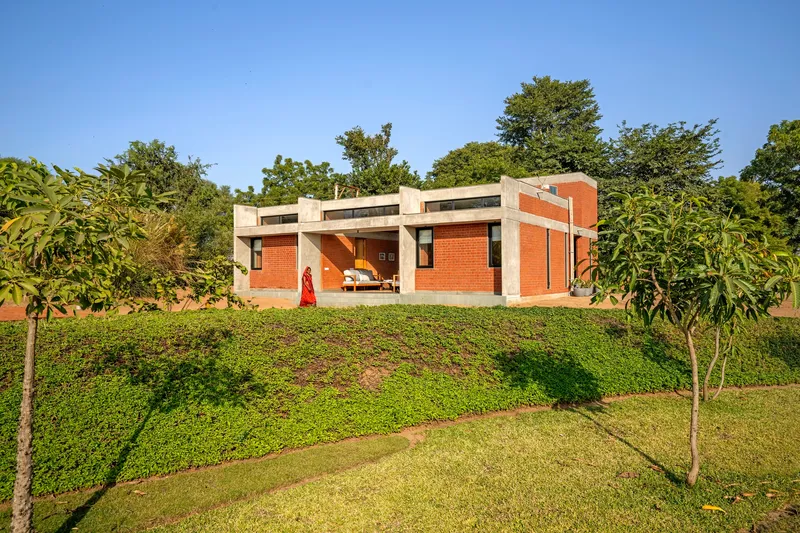
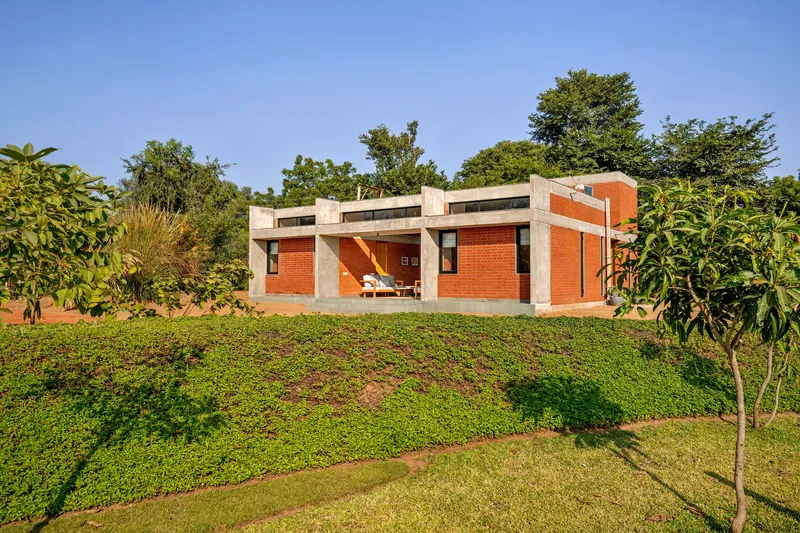
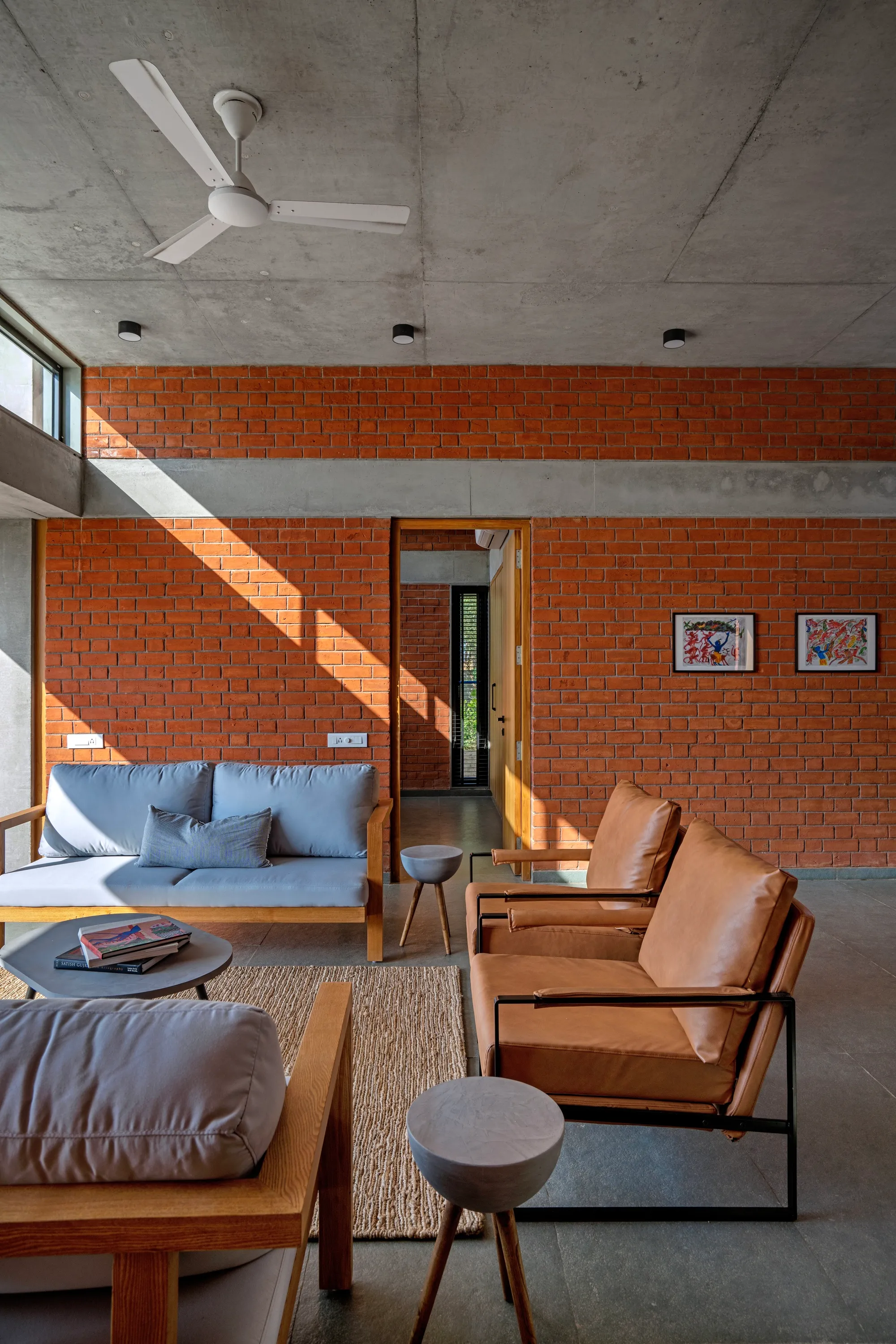
The material palette is deliberately limited: red brick masonry for mass and thermal storage, exposed reinforced concrete for spanning and framing. Rather than cladding or rendering either material, Shukl leaves both raw, letting the tonal contrast between warm brick and cool grey concrete do the work of articulating structure. Concrete lintels, ceiling beams, and brise-soleil read as precise insertions into the softer brick fabric, giving the small building a legibility that belies its size.
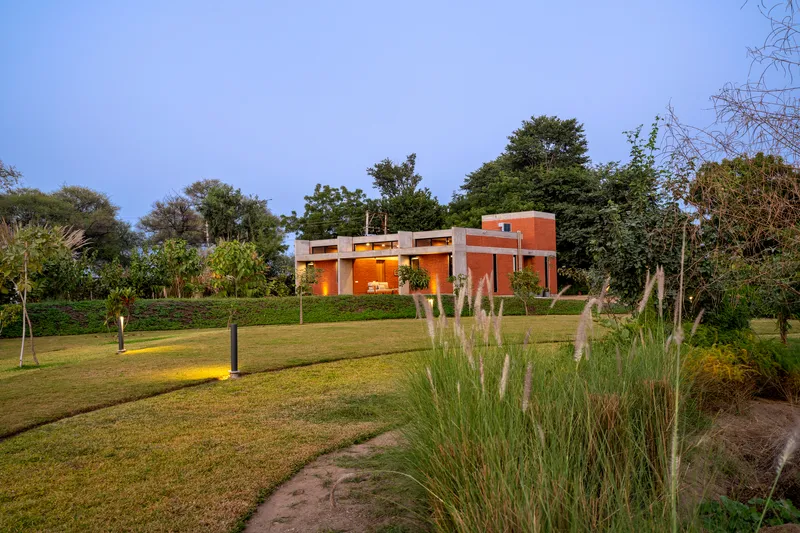
Seen from a distance across the terraced lawn, the building settles into the slope without asserting itself. The landscaping by Sahir Patel of Metabolic Office surrounds the footprint with young fruit trees and ornamental grasses, blurring the line between architecture and agriculture. At dusk, the brick mass glows against the flat horizon, looking less like a weekend house and more like something that has always been there.
Controlling the Western Sun
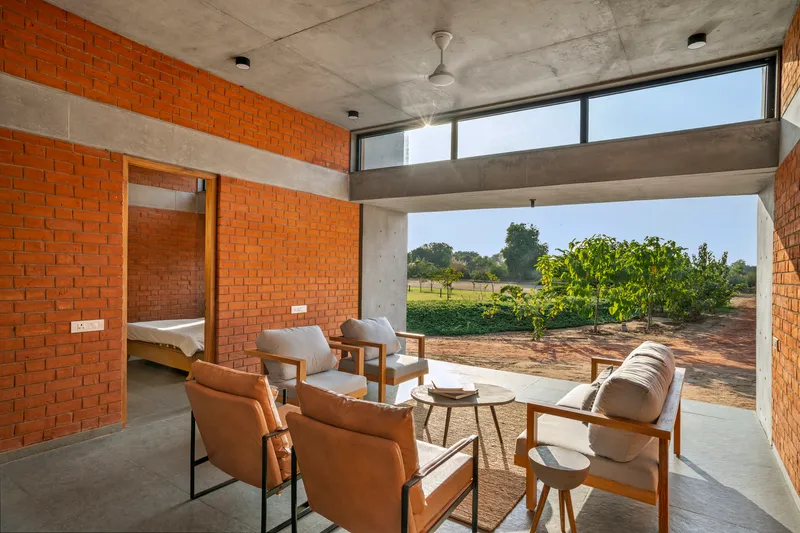
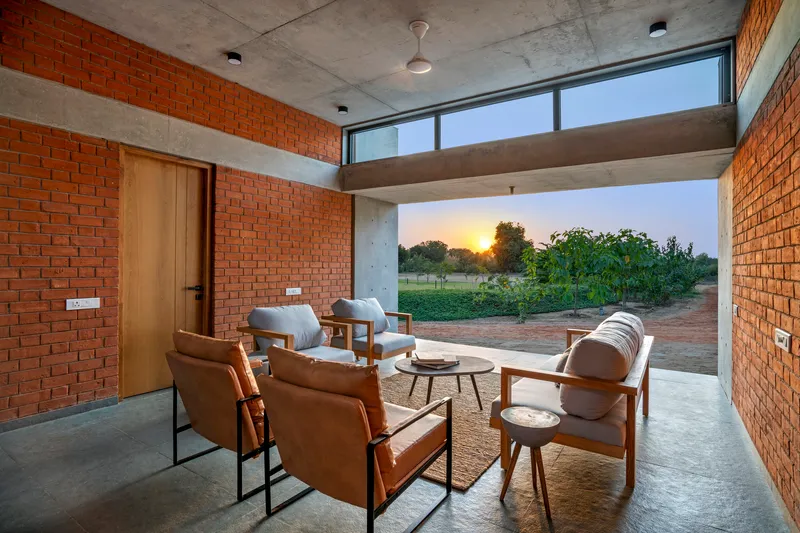
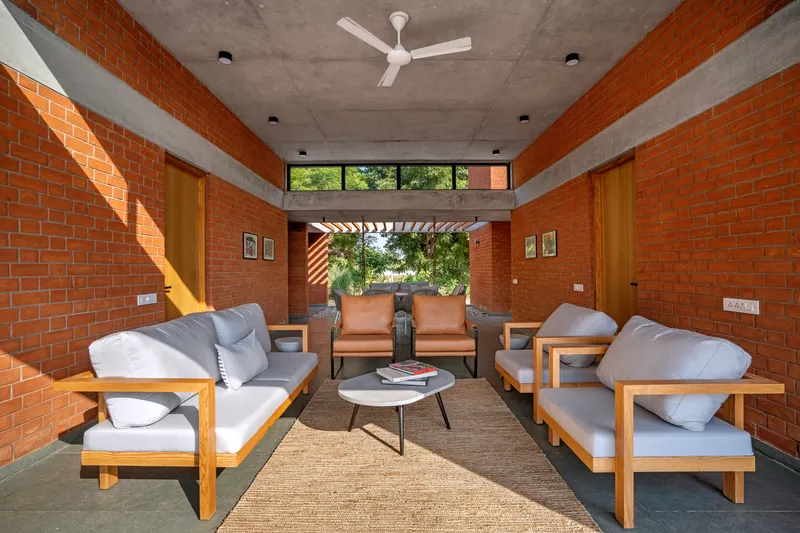
Gujarat's western sun is a design problem, not a scenic amenity. Shukl addresses it with exposed RCC brise-soleil on the west-facing openings, filtering harsh afternoon glare into tolerable bands of light. Clerestory windows along the upper walls pull diffused light deep into the interior without admitting direct solar gain at eye level. The result is a living space that stays cool without mechanical intervention, a critical achievement in a region where summer temperatures routinely push past 40°C.
Wide concrete-framed apertures open the interior to views of agricultural fields, but they are positioned and sized to balance prospect with protection. The building's long slit windows, visible in the elevation drawings, are not decorative gestures: they calibrate cross-ventilation through the load-bearing walls, turning the brick mass into an active thermal moderator.
The Courtyard as Climate Machine
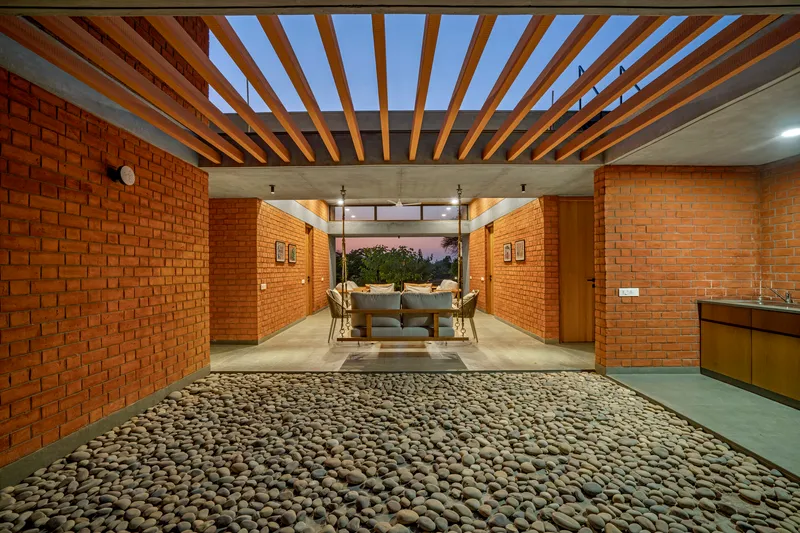
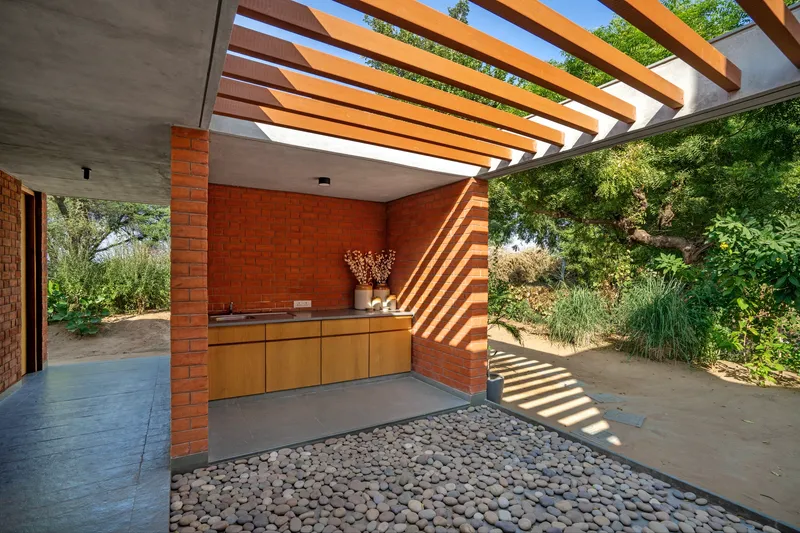
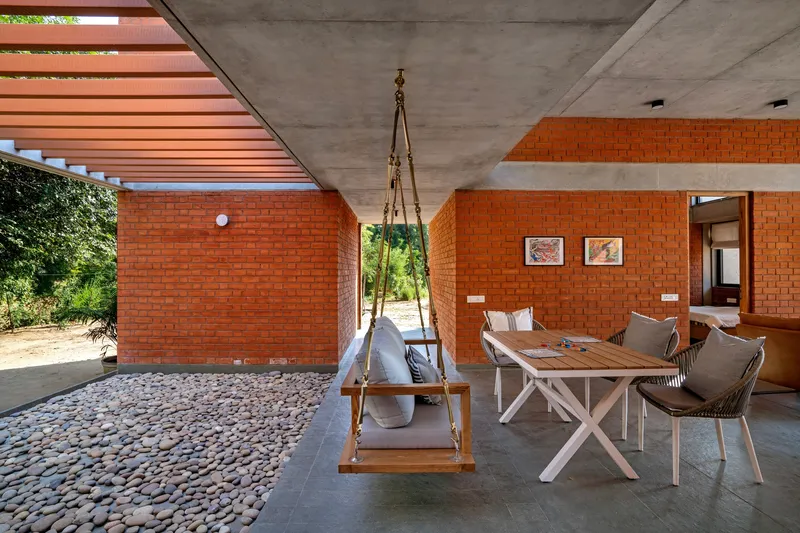
At the center of the plan, a courtyard performs double duty as gathering space and thermal chimney. Overhead, a timber pergola casts striped shadows across a pebble bed, reducing surface temperature while allowing hot air to rise and escape. The courtyard connects the living zones, kitchen, and bedroom corridors, so every room benefits from the stack effect it generates. It is the oldest passive cooling trick in the subcontinent, executed here with restraint.
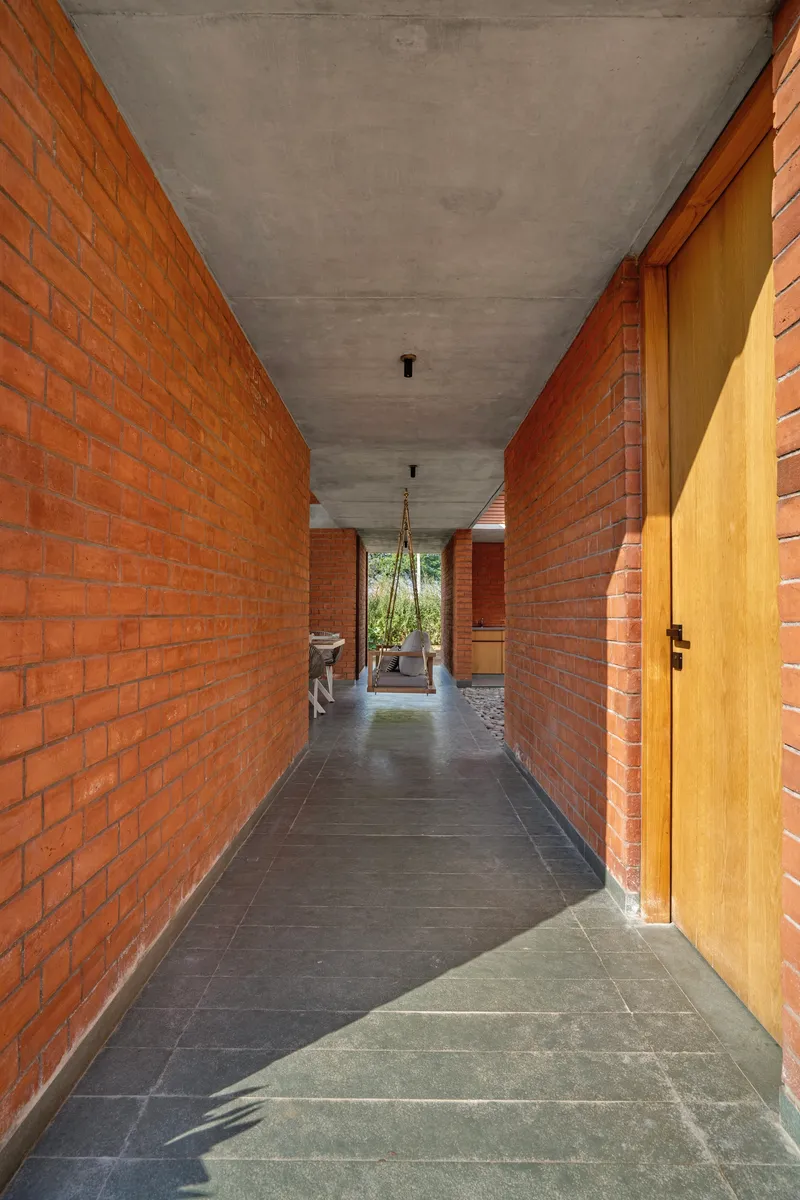
The pebble flooring in the courtyard and semi-outdoor areas deserves its own mention. River stones retain less heat than paving and allow rainwater to percolate directly into the ground, reducing runoff on a site that relies on careful water management to sustain its vegetation. Slate flooring transitions into the covered corridors, marking the threshold between semi-outdoor and interior zones without fuss.
Interior Warmth Without Excess
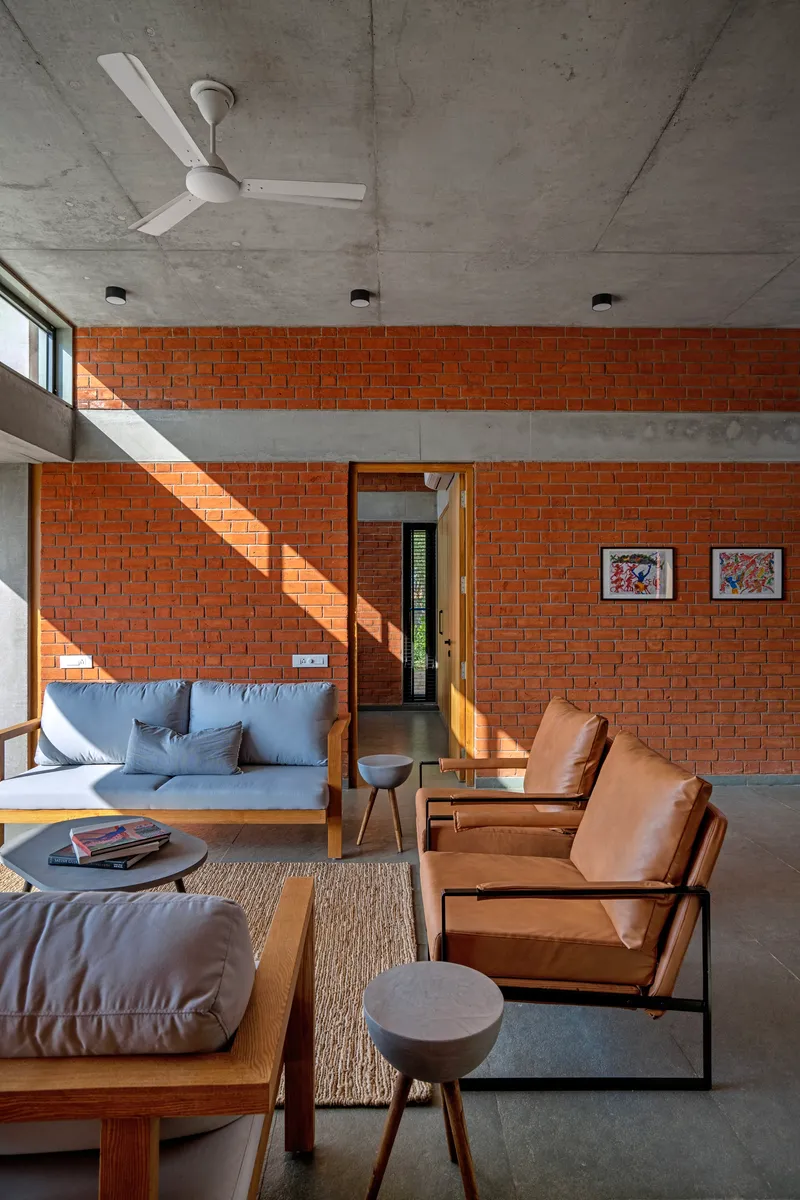
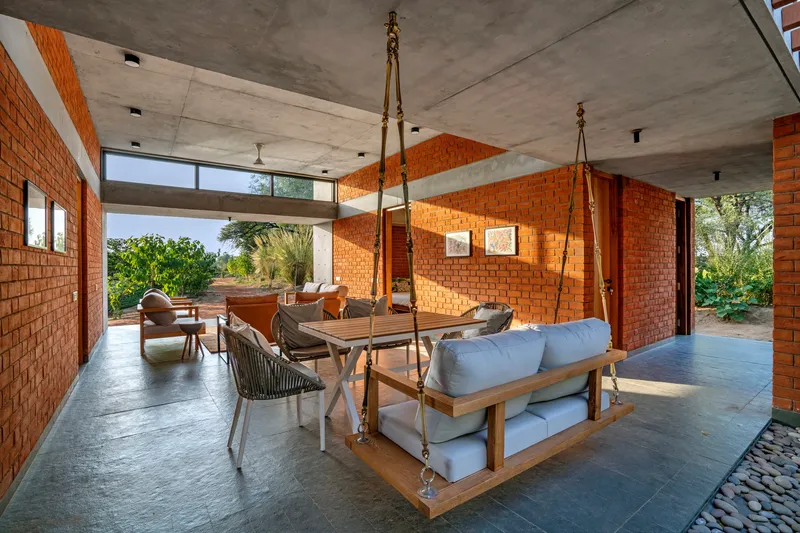
Inside, the double-height living room is the spatial anchor. Exposed concrete ceiling beams span the brick walls, and clerestory windows throw geometric light patterns across the floor that shift through the day. A suspended timber swing seat hangs from the structure, a detail that could easily tip into lifestyle cliché but here reads as a response to the informality the outhouse typology demands. There is no attempt to make this space feel like a city apartment transplanted to the countryside.
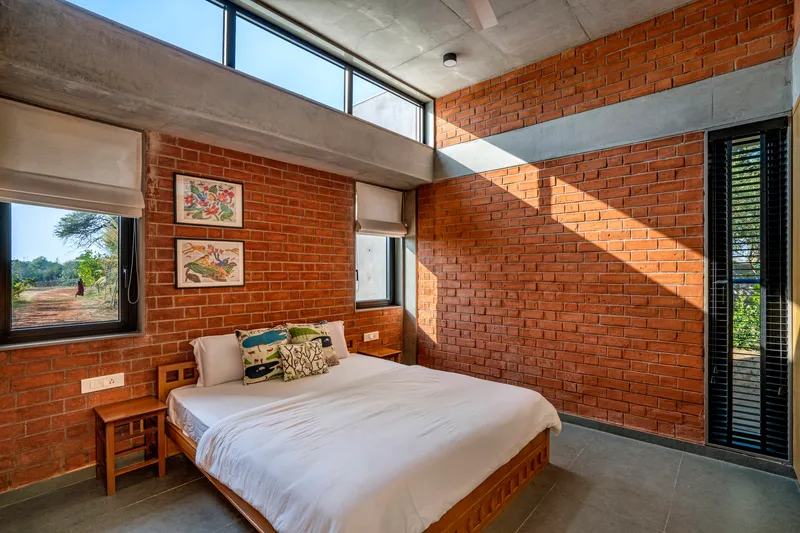
The bedrooms are compact and well considered. Pivoting timber doors connect sleeping quarters to the living area through the brick partition walls, maintaining visual continuity while allowing acoustic separation. Clerestory windows above the timber-framed doorways wash the upper walls with light, keeping the rooms bright without sacrificing privacy. The bathroom, clad in grey-blue tile, is the one space where the material palette departs from brick and concrete, a quiet signal that this is a room with a different thermal logic.
Threshold Spaces and the In-Between
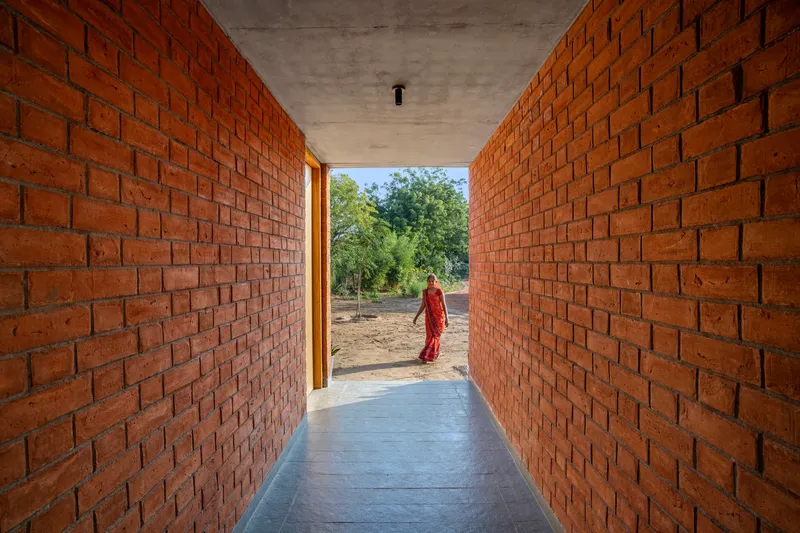
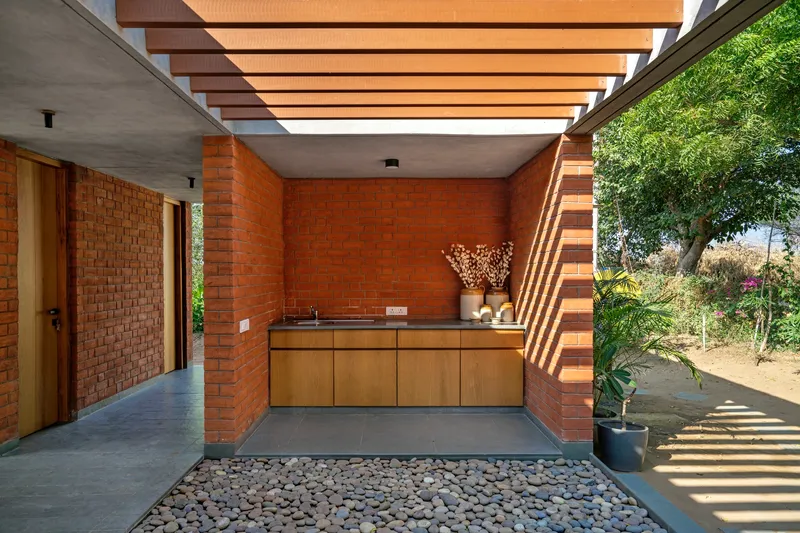
Some of the best moments in Cool Shed happen in the spaces that are neither inside nor outside. Covered corridors framed by brick walls lead from one zone to the next, their exposed concrete ceilings low enough to compress the experience before releasing it into the courtyard or landscape beyond. A semi-outdoor kitchen counter sits beneath timber pergola slats, casting afternoon shadow patterns across the river stone floor. These transitional spaces account for a significant portion of the 140-square-meter area, an allocation that makes sense in a climate where comfortable outdoor time extends across most of the year.
The covered terrace with its louvered ceiling is perhaps the most accomplished of these threshold zones. Afternoon sunlight filters through the slats in controlled bands, creating a space that is sheltered but not enclosed, cool but not dark. It is the kind of space that rewards slow occupation, which is precisely the point of a weekend outhouse on a bird sanctuary's edge.
Landscape as Context and Collaborator
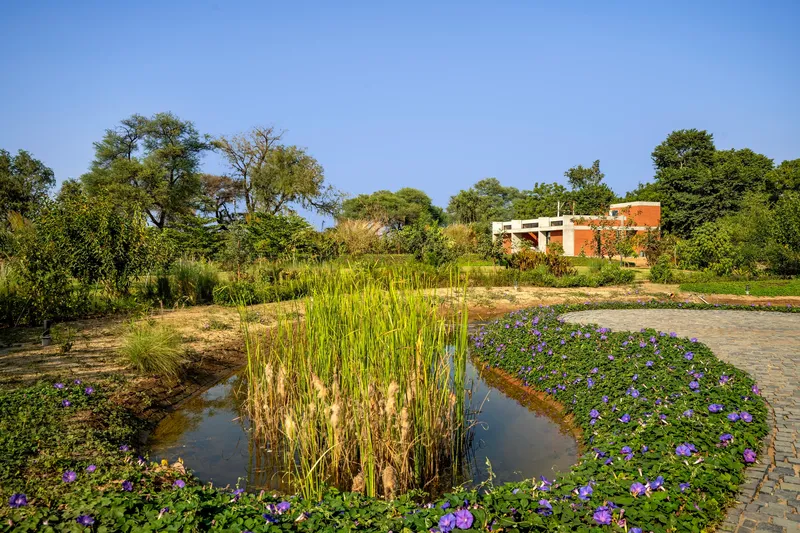
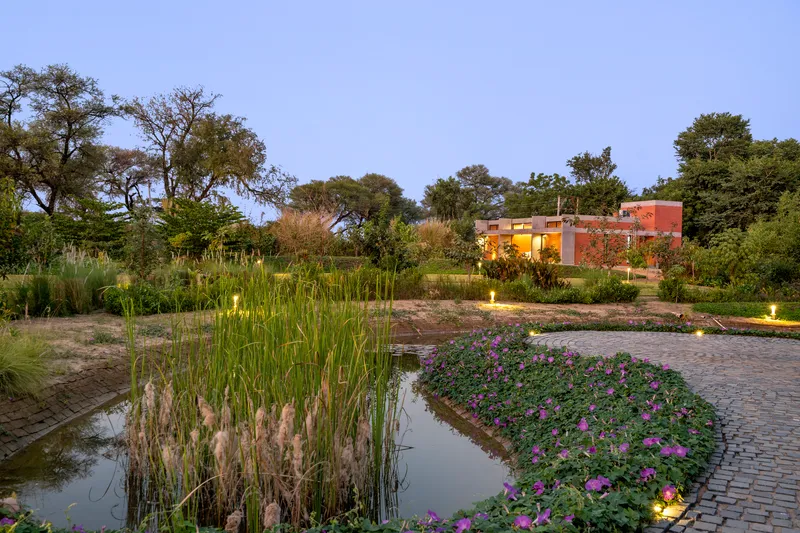
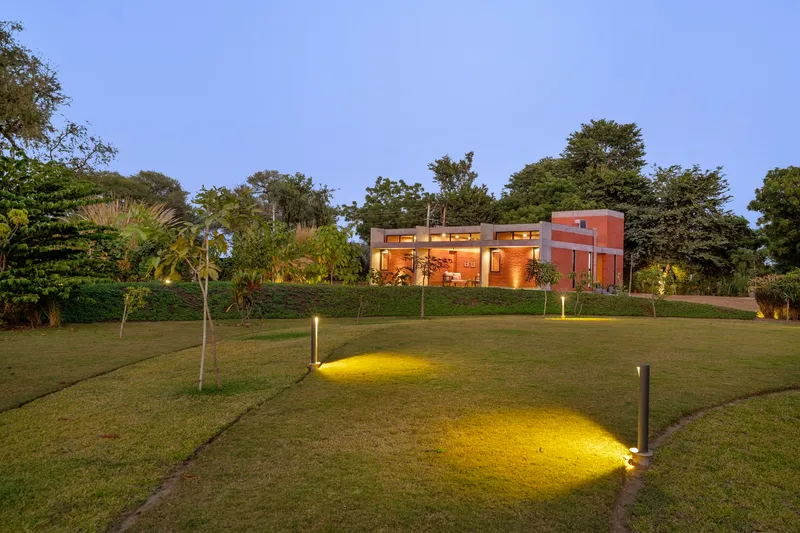
The site's proximity to Thol bird sanctuary is not incidental to the design. The farmland's meticulously cultivated vegetation is intended to attract birds, and the building's minimal ground footprint preserves as much planted area as possible. Water features with purple flowering plants and reeds extend the habitat potential right to the building's edge, while a garden pond with paved terracing creates a transitional zone between architecture and ecology.
Sahir Patel's landscape strategy treats the building as one element within a larger ecological system rather than the dominant figure. At twilight, landscape lighting casts yellow pools across the sloping lawn, illuminating the ground plane rather than the structure. The building recedes; the garden advances. It is a hierarchy of attention that most residential projects get exactly backward.
Plans and Drawings
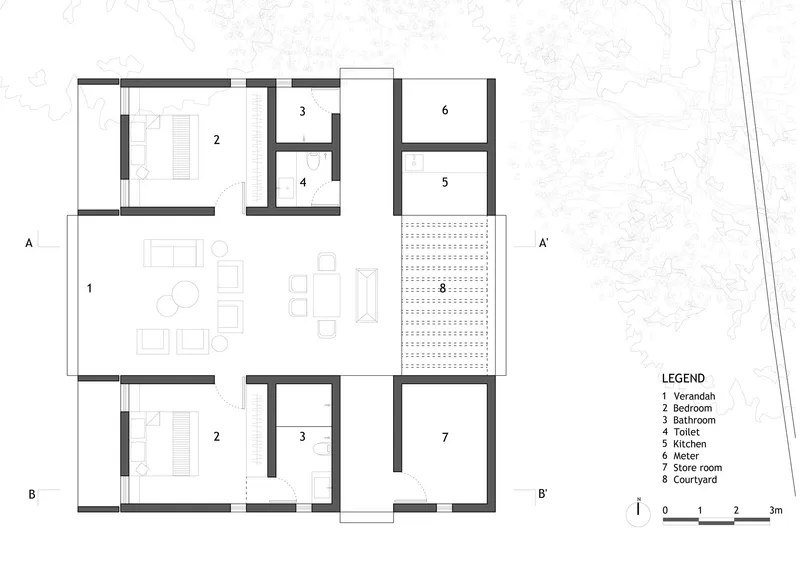
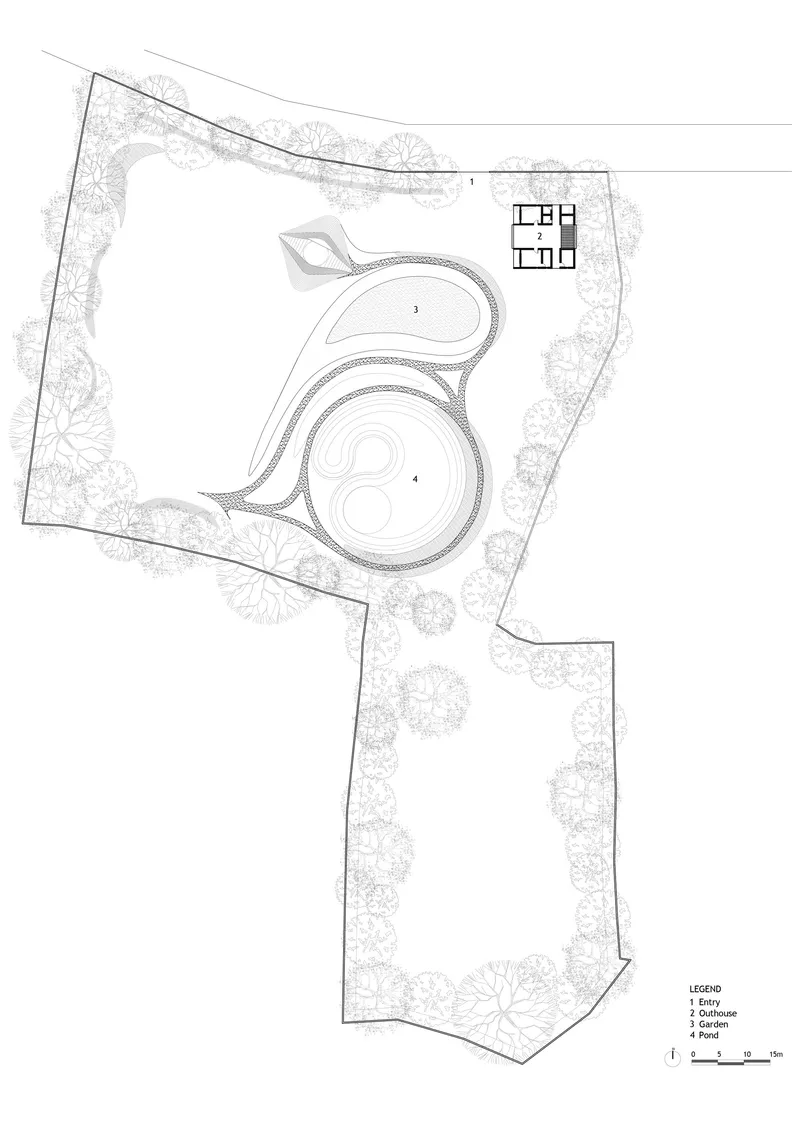
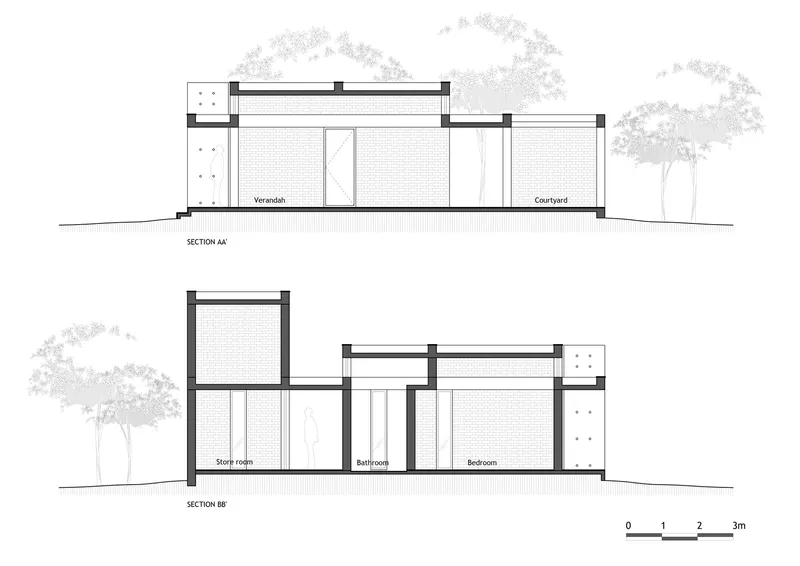
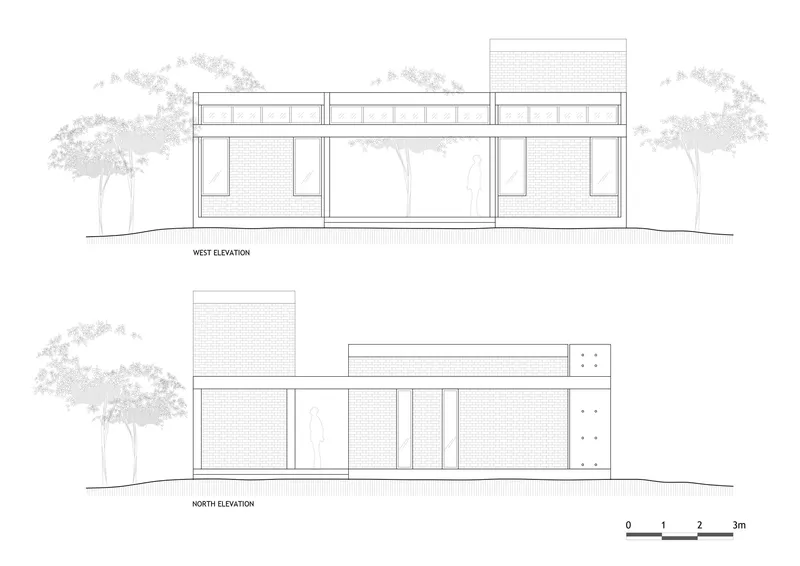
The floor plan reveals the organizational logic clearly: rooms arranged around a central open-air courtyard, with the living area, bedroom, and bathroom distributed along its perimeter. The site plan shows curving water features threading through the landscape, connecting the residence to the broader terrain. Section drawings expose the spatial relationships between veranda, courtyard, bedroom, and bathroom, illustrating how the clerestory windows and pergola work together to manage light and ventilation. The elevation drawings confirm the careful placement of openings on the west and north facades, with tree canopies drawn in to show the intended relationship between building and planting at maturity.
Why This Project Matters
Cool Shed is a lesson in how much design intelligence can be compressed into a small building when the architect resists the temptation to overreach. At 140 square meters, it could have been a footnote, a simple brick box on farmland. Instead, Shukl treated every surface, every opening, and every material joint as an opportunity to manage climate, frame a view, or create a spatial transition. The result is a building that performs well thermally, sits gracefully in its landscape, and provides genuine comfort without mechanical dependency.
More broadly, the project demonstrates that the outhouse typology, so often treated as an excuse for indulgent rural escapism, can be a vehicle for disciplined architectural thinking. The load-bearing brick walls, the exposed concrete structure, the calibrated brise-soleil and clerestories: none of these elements are novel individually, but assembled together at this scale and in this climate, they form a coherent argument for low-technology, high-intelligence design. In a profession increasingly fixated on parametric complexity and carbon-neutral branding, Cool Shed makes its case quietly, with brick, concrete, and good sense.
Cool Shed by Vaissnavi Shukl, India. 140 m², completed 2022. Landscape architect: Sahir Patel (Metabolic Office). Structural engineer: CAES Consultants. Civil contractor: Rising Infracon. Photography by Inclined Studio.
About the Studio
Share Your Own Work on uni.xyz
If projects like this are the kind of work you want to make, uni.xyz is a place to publish your own, find collaborators, and enter design competitions.




Popular Articles
Popular articles from the community


The Musturak Paradise: Senior Living Architecture for a Connected Future in Temara, Morocco
The Musturak Paradise reimagines senior living architecture in Temara via private homes, social spaces, culture, community, and shared care.

Co-Life: Senior Housing Design That Reconnects Older Adults With the City
Co-Life reimagines senior housing design through healing gardens, shared streets, workshops, and a sustainable community across generations.

Hill & Cross Opera: Sculptural Opera House Architecture Shaped by Tallinn’s Landscape and Identity
Hill & Cross Opera reimagines opera house architecture in Tallinn through its sculptural hill, civic plaza, glass wave and a luminous cross.

Co-life: Sustainable Architecture for Age-Friendly Community Living
Co-life reimagines sustainable architecture for seniors through courtyards, rammed earth, shared gardens, and spaces designed for belonging.


Similar Reads
You might also enjoy these articles

Bao Huynh Watercolor Atelier: A Serene Art Retreat in Hội An
Bao Huynh Watercolor Atelier in Hội An blends multifunctional art spaces, sustainable design, local materials, and family-friendly living in a serene environment.

Atelier Macri Concept Store Interior Design by CASE-REAL
Atelier Macri store features a "ko" counter, walnut wood details, cork displays, blending retail, gallery, and seamless customer experiences.

Manuel Vargas Izquierdo Stadium and High-Performance Sports Center: Architectural Excellence in Jalpa de Méndez
The Manuel Vargas Izquierdo Stadium blends sustainable design, inclusive sports facilities, and cultural-inspired architecture, revitalizing Jalpa de Méndez’s public spaces.
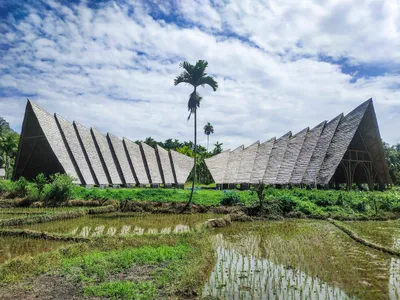
KAKR Buluh Awar Hall: Revitalizing Community and Ecology Through Bamboo Architecture
Community built bamboo hall revitalizes Buluh Awar village, empowering youth, restoring ecology, celebrating vernacular craftsmanship through sustainable architecture and culture.




Comments (0)
Please login or sign up to add comments
No comments yet. Be the first to comment!