
vardastudio Carves a Concrete Belvedere into a Cypriot Hillside Facing the Sea
ZI House in Episkopi channels panoramic Kourion views through stacked concrete volumes, timber screens, and cross-ventilated open plans.


Most coastal houses in the Mediterranean treat the view as a given, something to be captured with a big window and left at that. vardastudio, led by head architect Andreas Vardas, took a more combative approach with ZI House in Episkopi, Cyprus. The 226 m² residence sits on a plot hemmed in by neighbors on three sides, so the architects elevated it, rotated its openness exclusively toward the Kourion shoreline, and sealed the remaining facades into stark, board-formed concrete walls that reveal almost nothing. The result is a house that earns its panorama rather than simply inheriting it.
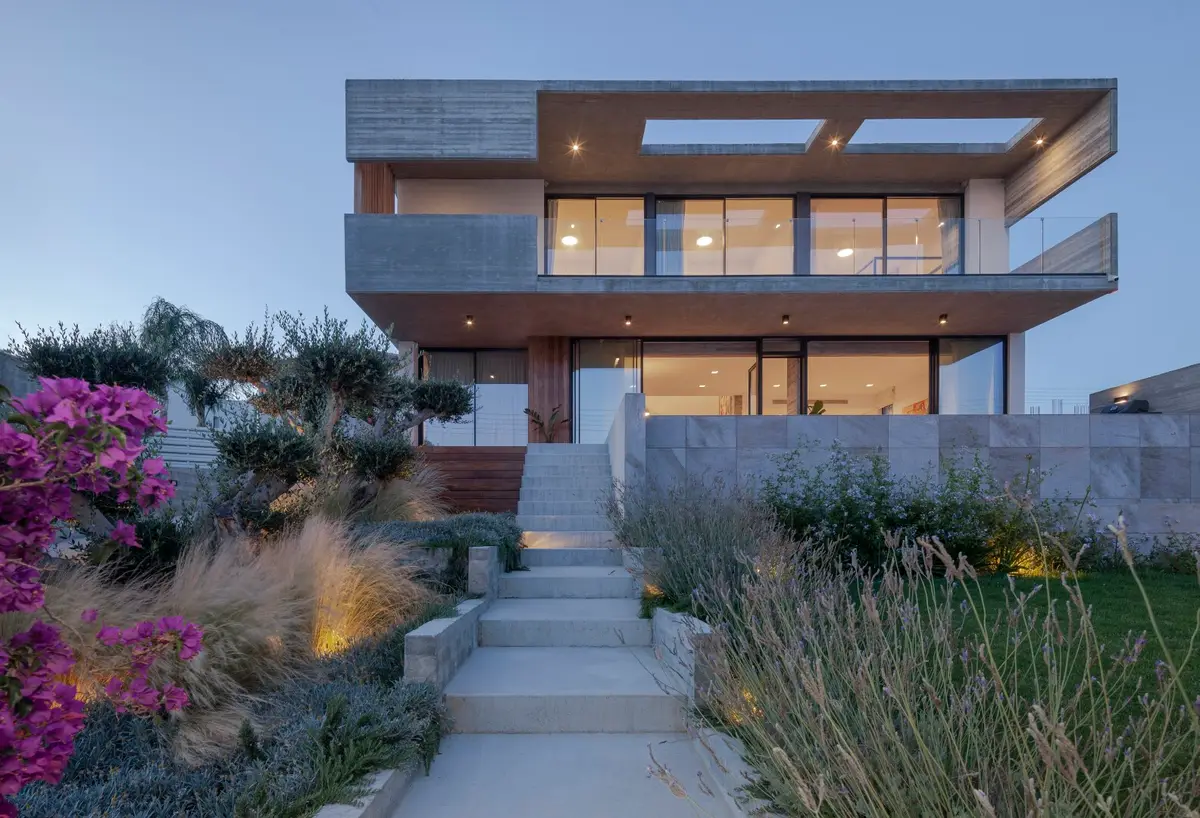
What makes ZI House worth studying is its refusal to compromise between introversion and extroversion. The three closed sides are deliberately blunt, nearly fortress-like, while the sea-facing elevation dissolves into floor-to-ceiling glazing that fuses the living room with a covered terrace, swimming pool, and small amphitheater. The tension between those two postures gives the house its character and prevents it from becoming another generic glass box perched on a slope.
A Concrete Mask for Three Sides
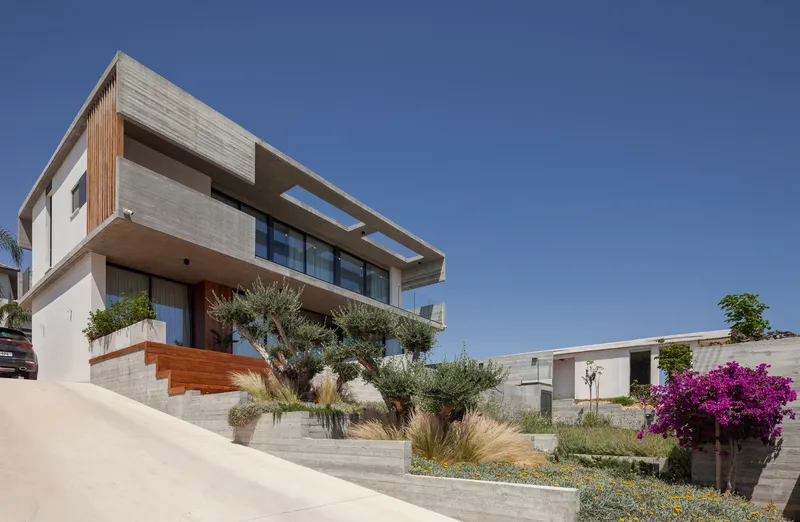
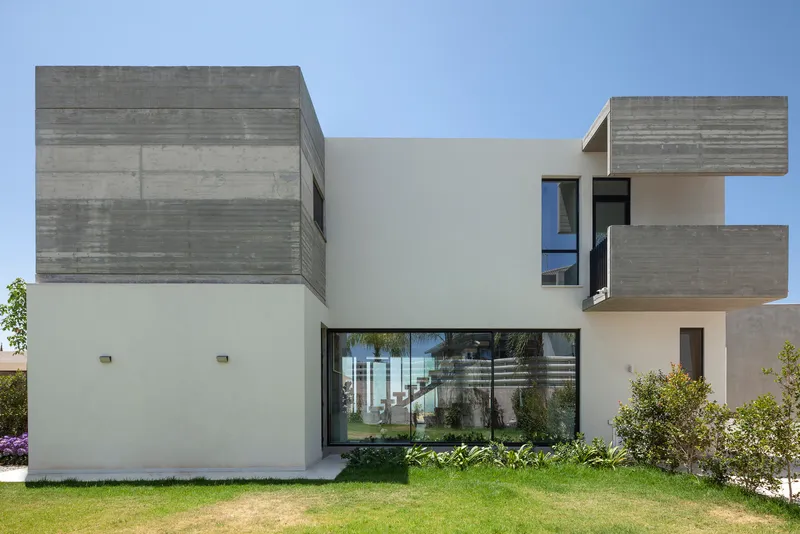
From the street, ZI House reads as a composition of interlocking volumes: white stucco planes, board-formed concrete slabs, and vertical timber screens layered in a way that communicates depth without revealing domestic life. The cantilevered upper floor projects forward, creating shaded zones below while asserting the house's presence on the sloped plot. Vardastudio treats the neighboring facades not as afterthoughts but as the primary architectural statement, using the raw imprint of formwork boards as a kind of deliberate texture that ages well in the Cypriot sun.
Thin concrete slabs are the structural trick here. They keep the cantilevers looking light, almost buoyant, despite the material's inherent mass. Combined with the timber screening, which filters light without blocking air, the closed facades avoid feeling oppressive. They are guarded, yes, but not hostile.
Arrival Through Landscape
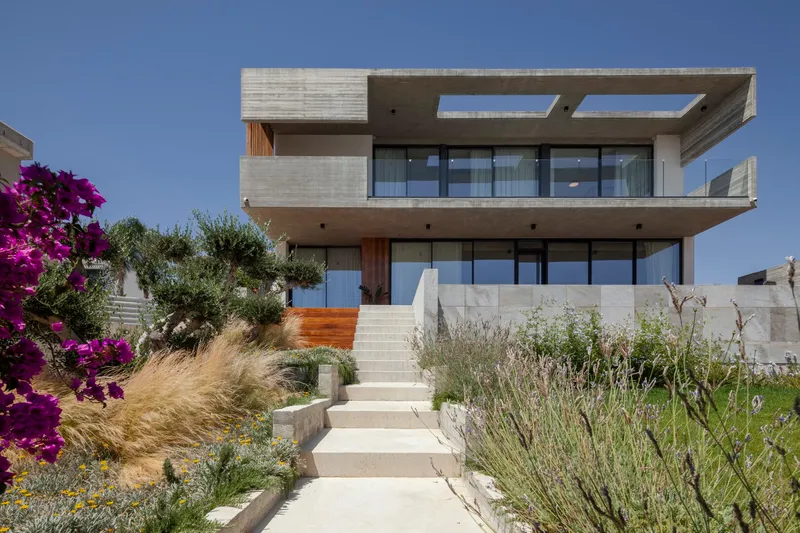
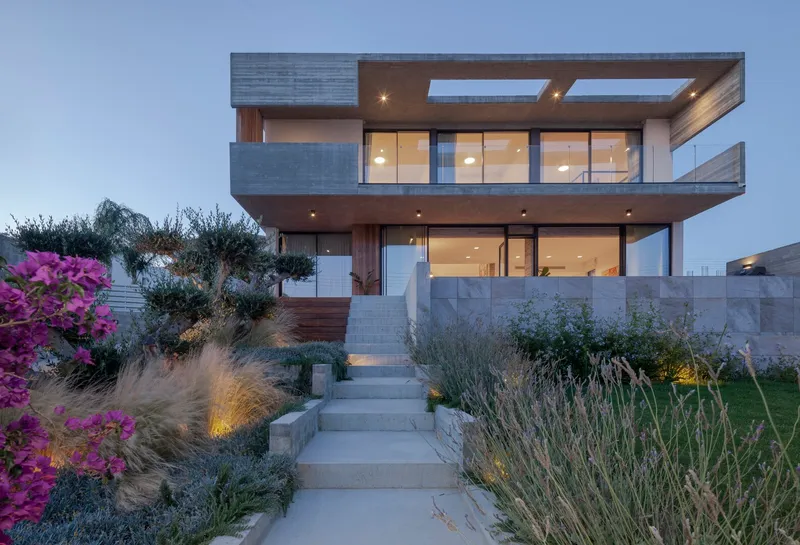
The approach sequence is choreographed through planted terraces. A concrete stairway rises between beds of ornamental grasses and bougainvillea, compressing the visitor's field of vision before the house opens up at the entry level. The planted beds do double duty: they soften the hard geometry of the concrete retaining walls and manage the grade change inherent to the sloping site. At dusk, with the interiors illuminated, the three-level composition reads as a stack of glowing volumes hovering above the garden, the stair acting as a spine connecting ground to threshold.
Opening Up to Kourion
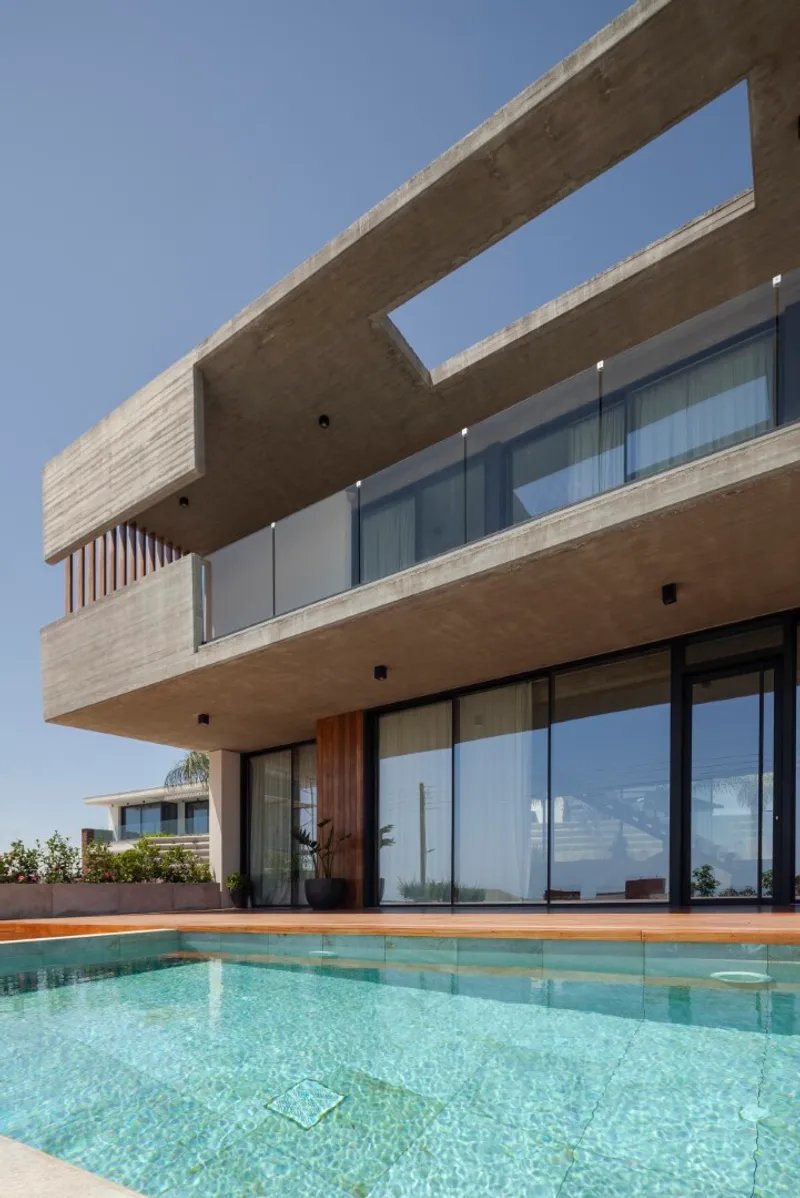
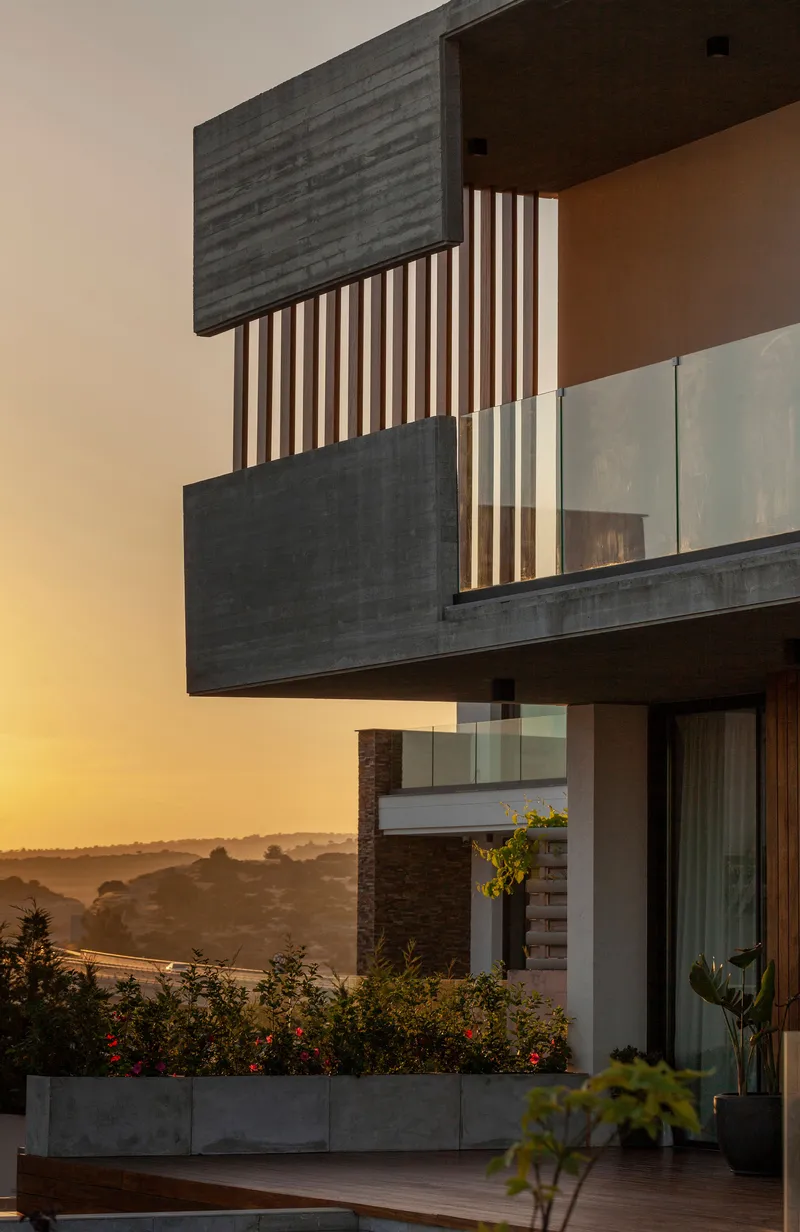
The sea-facing elevation is the house's release valve. Large sliding windows erase the boundary between the living room and the covered terrace, allowing the pool deck, an outdoor amphitheater with deck flooring, and the interior open plan to register as a single continuous surface. A large opening at the rear of the house connects the front terrace with a back garden, setting up cross-ventilation and cross-lighting that reduce dependence on mechanical systems.
At sunset, the cantilevered concrete balconies frame the distant hills like viewing platforms. The timber screens on the upper floor filter the fading light into warm stripes across the bedroom floors, a calibrated effect that rewards the decision to use natural materials rather than aluminum louvers.
Ground Floor: Living as One Room
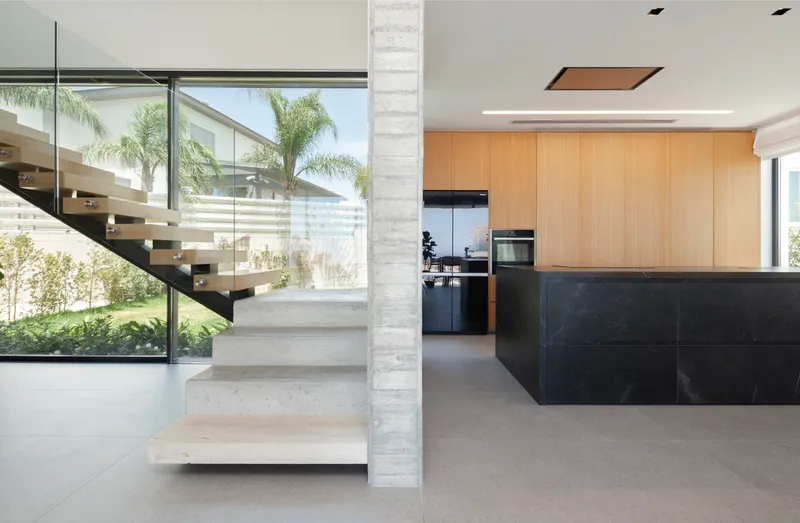
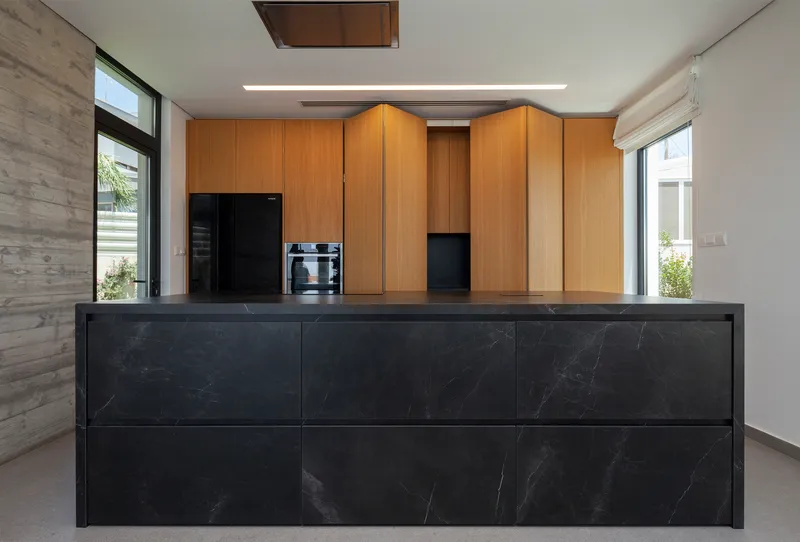
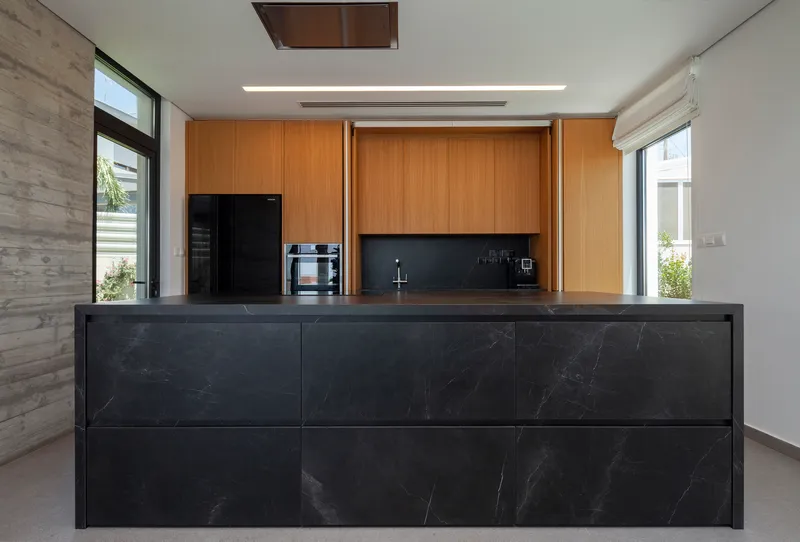
The ground floor is organized as a single open-plan space that contains the living room, dining area, kitchen, and a study. The kitchen island, clad in dark marble, anchors the plan and serves as the spatial divider between cooking and socializing zones. Wood cabinetry behind the island provides storage without closing off sight lines, and flanking windows wash the work surfaces with natural light from two directions.
The material palette here is restrained: soft grey floors, fair-face concrete on the ceiling and stair walls, dark stone, and warm timber. Nothing competes for attention. The effect is a calm backdrop that lets the sea view, framed by the floor-to-ceiling glass, remain the dominant presence in the room.
The Stair as Sculptural Spine
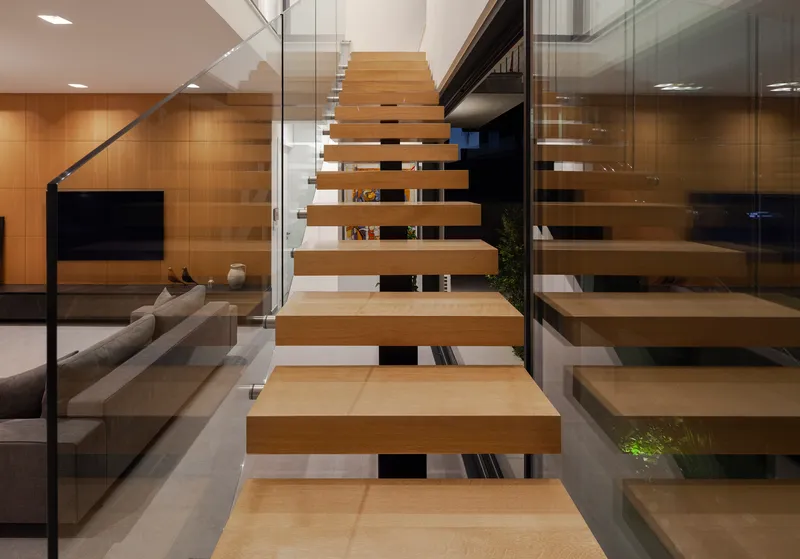
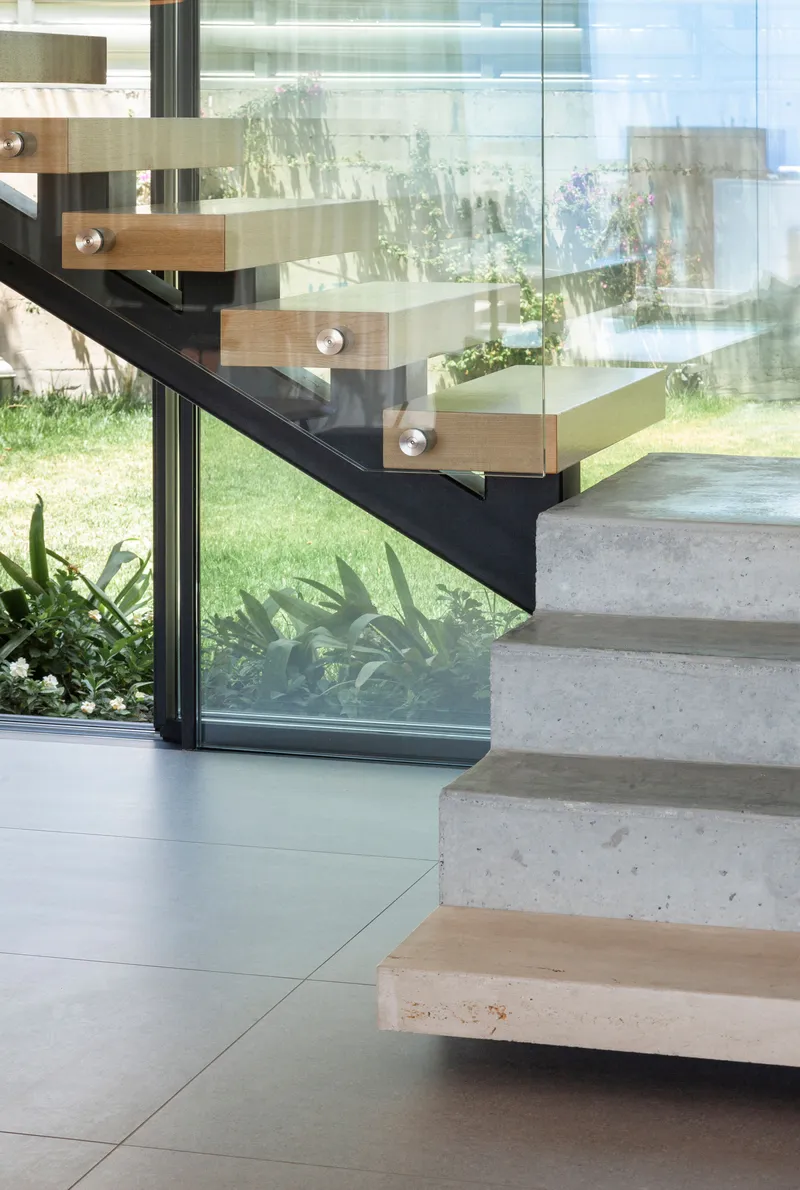
A floating stair with timber treads and glass balustrades rises through the double-height living space, connecting the social ground floor with the private upper level. The stair is positioned against a full-height glass wall that faces the garden, turning the act of climbing into a framed cinematic sequence of greenery and sky. Concrete treads with timber nosings and a black steel stringer give the assembly a hybrid character, neither entirely industrial nor domestic, that matches the house's broader tonal register.
Detail and Texture
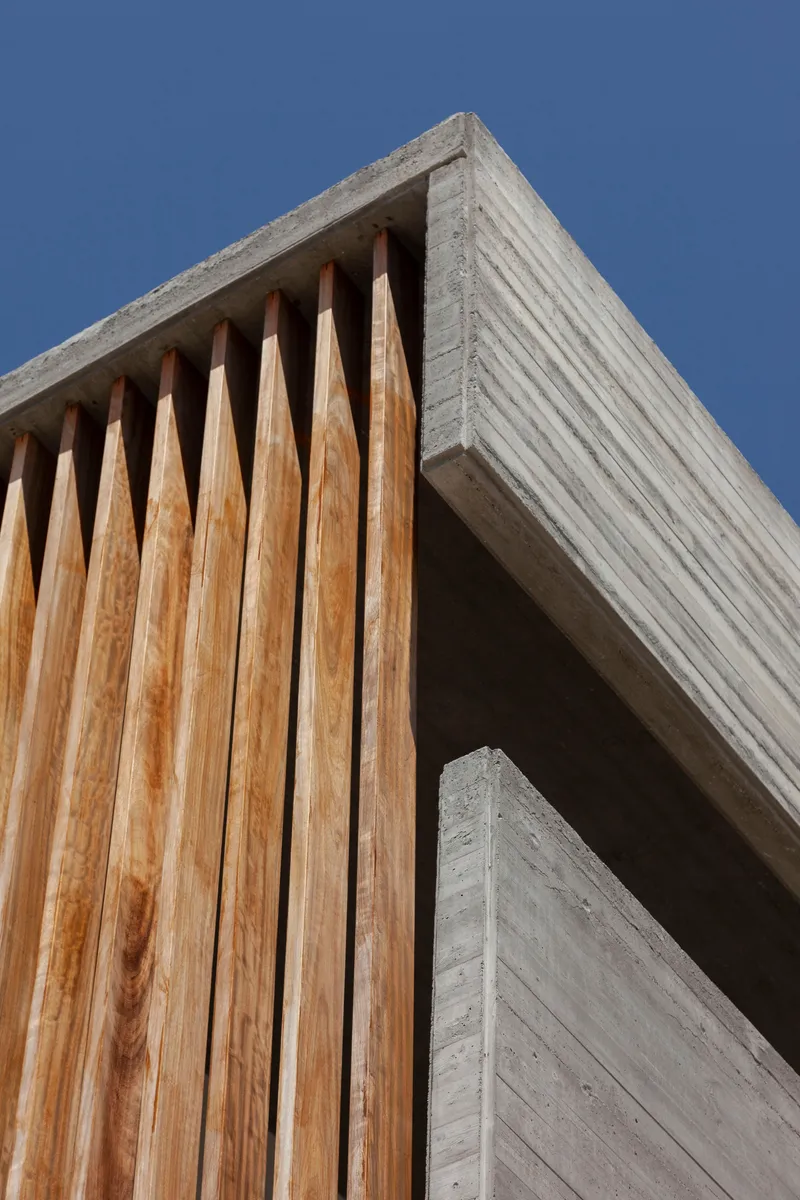
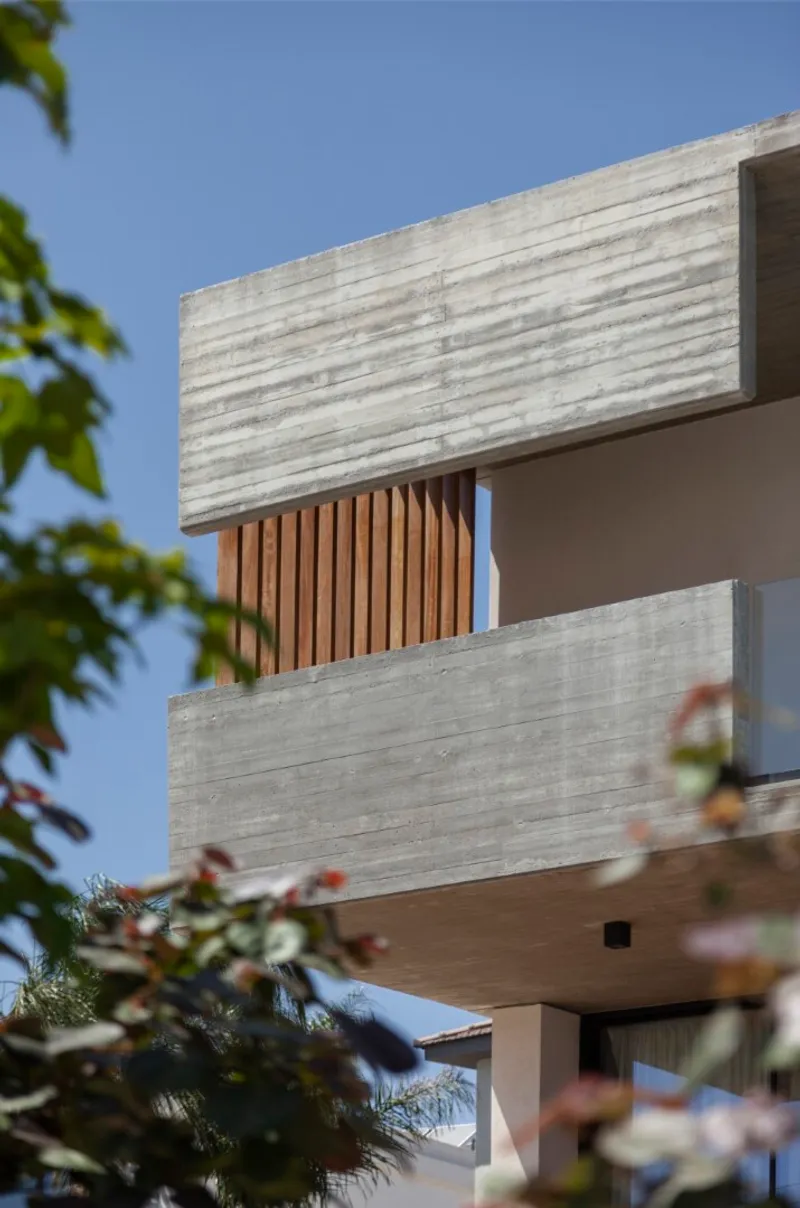
Close inspection reveals how much the project relies on the meeting of materials. Where a board-formed concrete beam corner meets vertical timber slats, the joint is left exposed, almost celebratory. The grain of the formwork echoes the grain of the timber, creating a visual dialogue between the permanent and the replaceable. These details matter because they prevent the house from reading as monolithic. Despite its fortress-like posture, ZI House is assembled from distinct tectonic layers, each legible at arm's length.
Plans and Drawings
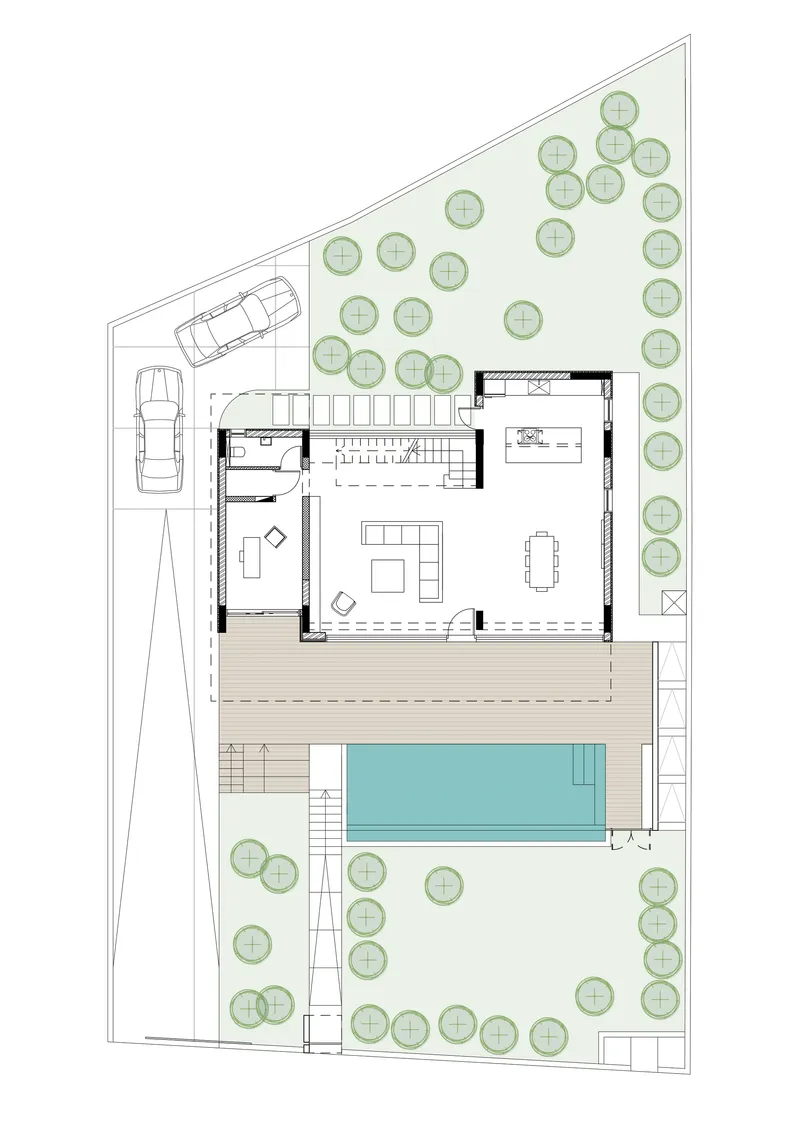
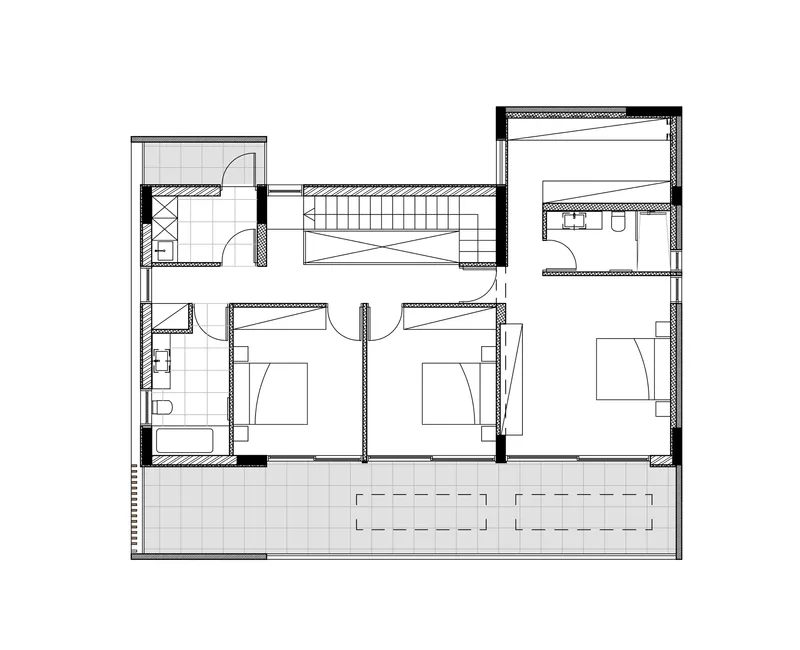
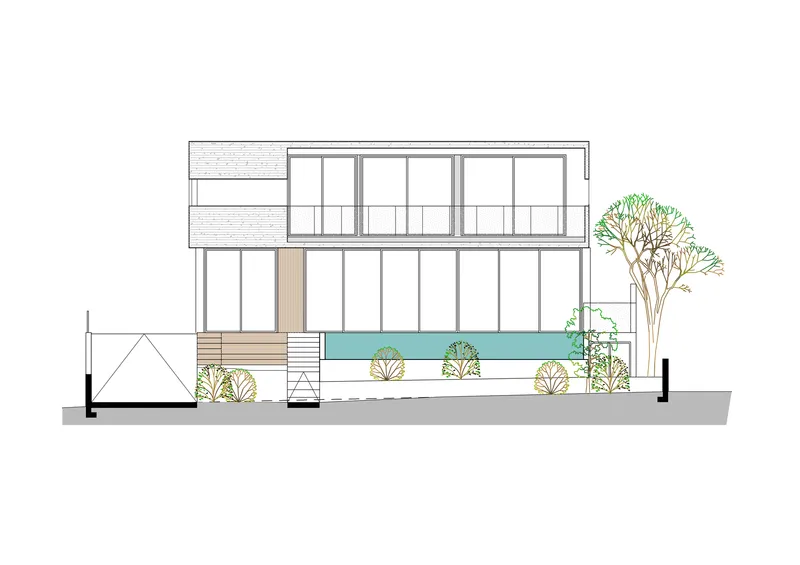
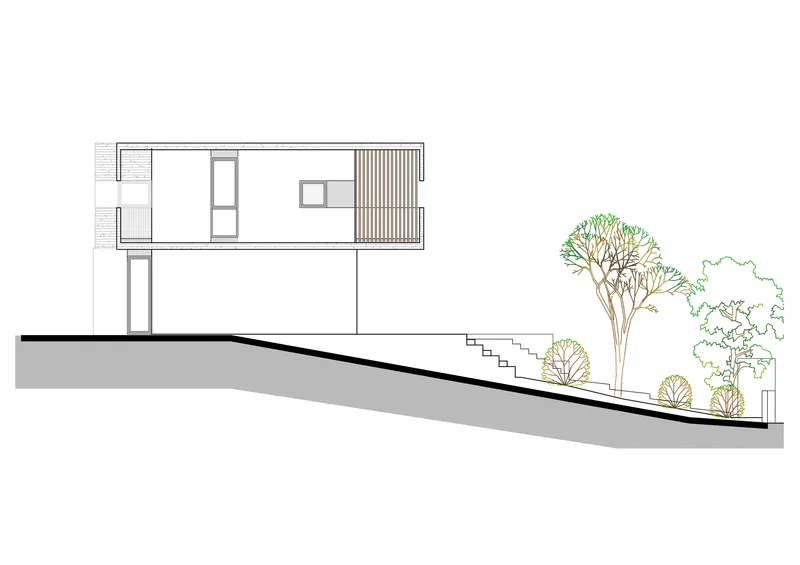
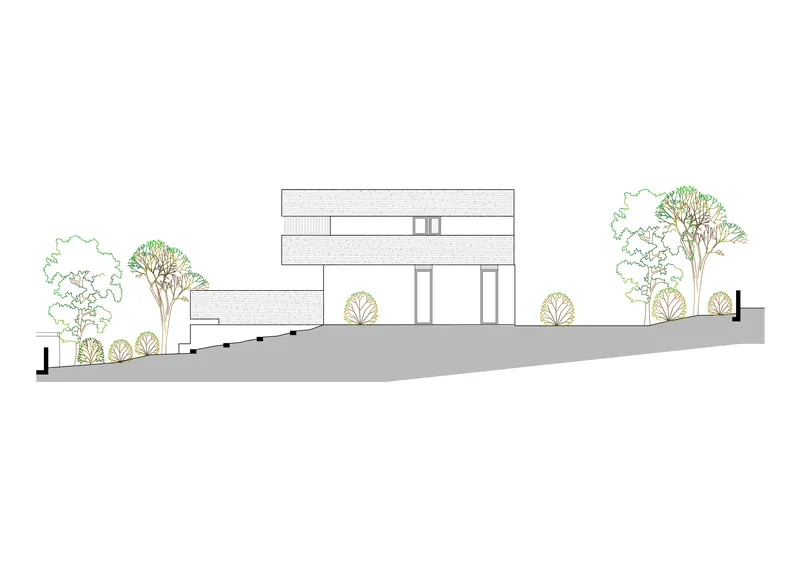
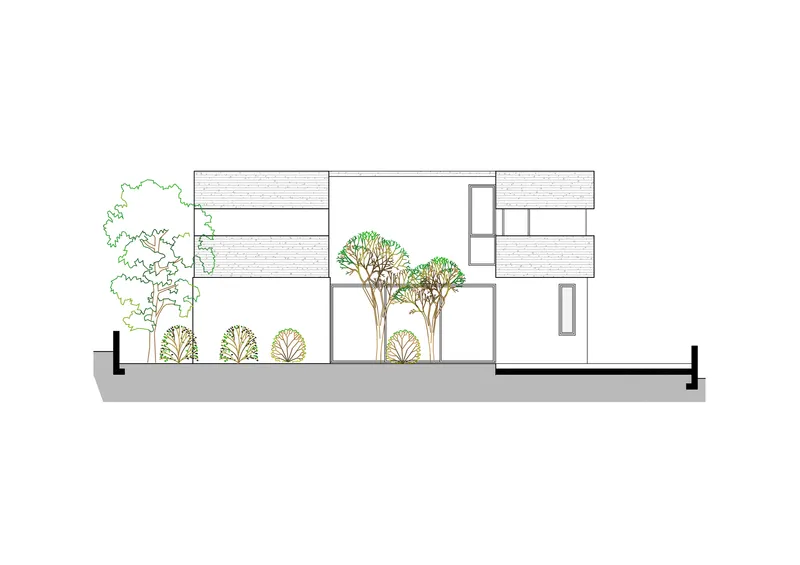
The site plan confirms what the photographs suggest: the pool deck and amphitheater terrace align precisely with the sea-facing facade, maximizing the usable outdoor area within the view corridor. The upper-level plan reveals a compact arrangement of a master bedroom with en-suite bathroom, two additional rooms sharing a bathroom, and a utility space, all organized around the central stair core. The sections are where the design's intelligence becomes most legible. They show how the sloping site is exploited to embed the lower level partially into the hillside, how the thin concrete slabs stack with just enough offset to create shading for the floor below, and how the rear garden is connected through the building to the front terrace, establishing the cross-lighting strategy that defines the interior atmosphere.
Why This Project Matters
ZI House demonstrates that a modest footprint, 226 m² on a constrained suburban plot, does not have to produce a modest piece of architecture. By treating the three neighbor-facing elevations as a disciplined concrete shell and concentrating all openness on the fourth, vardastudio achieved spatial generosity without sacrificing privacy. The lesson here is directional: orient your effort, and your glazing, where it counts, and let the rest be unapologetically closed.
The project also offers a corrective to the notion that concrete houses in warm climates must be heavy and dark. Thin slabs, cross-ventilation, timber screens, and a landscape-integrated approach to arrival give ZI House a lightness that photographs can only partially convey. It is a house designed for the way air moves, not just for the way light falls, and that distinction puts it ahead of many of its regional peers.
ZI House by vardastudio (Head Architect: Andreas Vardas), Episkopi, Cyprus. 226 m², completed 2021. Photography by Creative Photo Room.
About the Studio
Share Your Own Work on uni.xyz
If projects like this are the kind of work you want to make, uni.xyz is a place to publish your own, find collaborators, and enter design competitions.


Popular Articles
Popular articles from the community


David Ortega Stacks a Two-Story Mexico City Penthouse Around a Steel Stair and a Pergola-Shaded Roof Terrace
In Colonia Roma, a 300 m² penthouse uses oak joinery, a planted steel stair and a slatted roof pergola to make a new-build apartment feel like a house.

Jaramillo Van Sluys Arquitectura and Urbanismo Turn a Demolished Registry Lot in Quito into an Orchard Plaza
In Quito's Centro Histórico, a 2,800 m² plaza exposes the San Agustín convent wall and redraws its lost Augustinian orchard in volcanic stone.

Architekt Andreas Gruber Scatters 23 Dark Timber Chalets Across a South Tyrolean Forest Edge
In Molini di Tures, Amonti Chalets breaks a resort into a hamlet of gabled timber houses, with parking, storage and services pushed into the slope.

U.GA Architects Wraps an Oval Rooftop Pool in Curved Board-Formed Concrete on Busan's Jeollidan-gil
In Busan's Jeonpo-dong, a 454 m² mixed-use block stacks a neighborhood facility, guest rooms and an oval rooftop pool inside spiraling concrete walls.

Similar Reads
You might also enjoy these articles


LAVA Architecten Gives Vocational Education a Sawtooth-Roofed Face on a Mechelen School Campus
In Mechelen, Belgium, a 2,053 m² STEM school on a 6×6 m grid turns workshops and classrooms into rooms that can be rearranged as teaching changes.

KEMA Studio Turns a Derelict Marvila Attic into a 60 m² Lighthouse Apartment Above Lisbon
In Lisbon's Marvila district, a rebuilt roof, four skylights and two plywood volumes turn an unlivable attic into a bright home facing the Tagus.

Pixel Gardens: One Repeated Module Stacked Into a Terraced Social Housing Tower for Famagusta
Salem Bader's shortlisted housing tower builds a vertical neighbourhood from one repeated module, offsetting units to carve terraces, light and air.

Bao Huynh Watercolor Atelier: A Serene Art Retreat in Hội An
Bao Huynh Watercolor Atelier in Hội An blends multifunctional art spaces, sustainable design, local materials, and family-friendly living in a serene environment.

Explore Vertical Zoning Competitions
Discover active competitions in this discipline

Comments (0)
Please login or sign up to add comments
No comments yet. Be the first to comment!