
VenhoevenCS Stacks Fifty Sports into One Energy-Neutral Campus Building in Rotterdam
An 8,800-square-meter vertical sports complex marks the entrance to Erasmus University's Woudestein Campus with reclaimed materials and solar ambition.


Most university sports buildings sprawl. They eat up hectares of campus land with single-story halls, then hide behind parking lots where nobody sees them. VenhoevenCS took the opposite approach for Erasmus University Rotterdam: stack the program vertically, place the building at the campus gateway, and make it impossible to ignore. The result is a compact, energy-neutral complex that serves over 11,000 users across more than fifty sports, all on a footprint that respects the tight urban grain of Campus Woudestein.
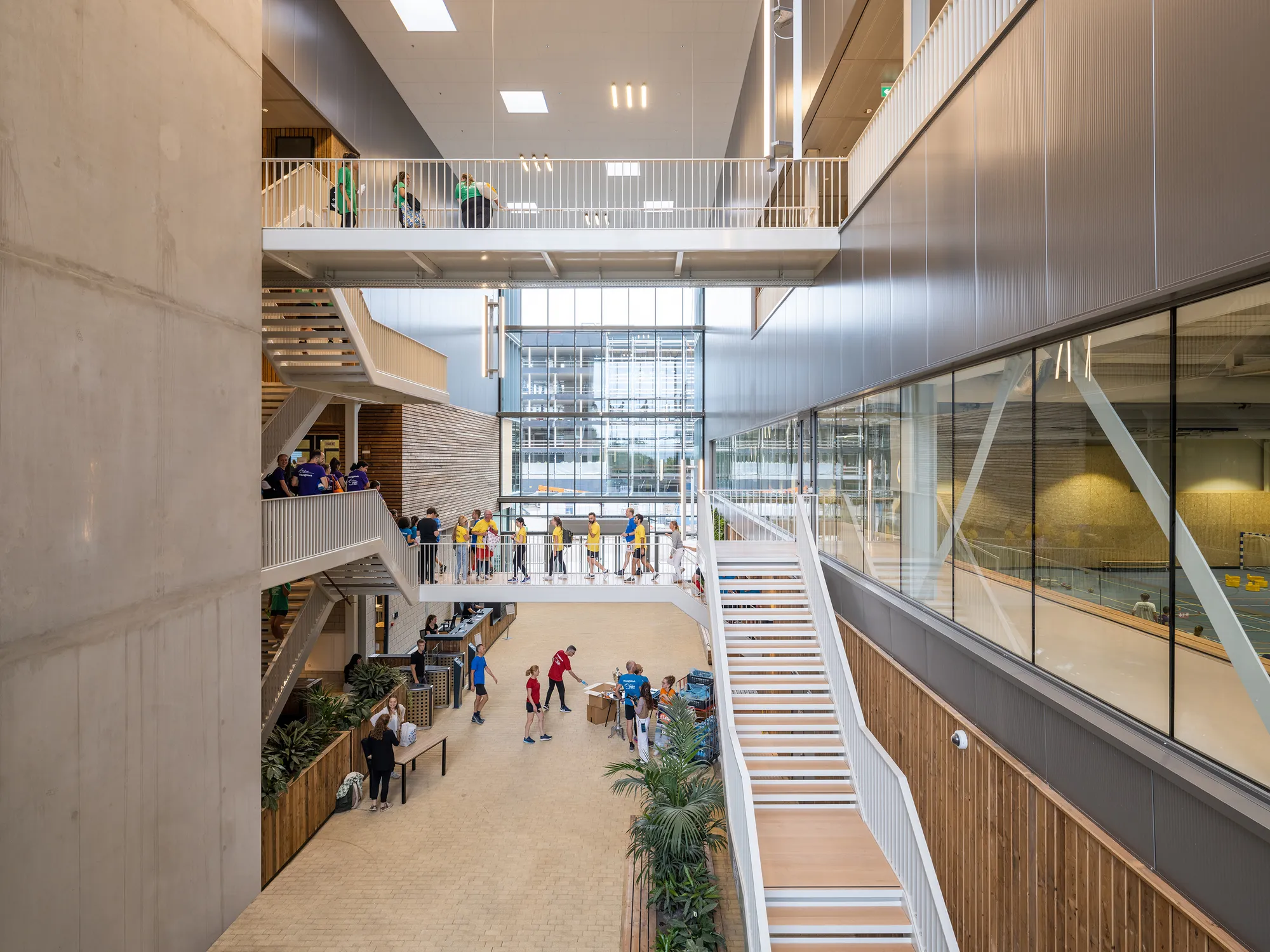
What makes the project genuinely interesting is how it treats the interior public space not as leftover circulation but as the building's primary architectural event. A planted inner street splits the two stacked volumes apart and stitches them back together with bridges, stairs, and terraces. You can pass through the building as a shortcut across campus, or you can linger at the bar watching basketball overhead. The building is simultaneously infrastructure and destination, which is a trick that most campus buildings never even attempt.
Vertical Stacking on a Compact Site
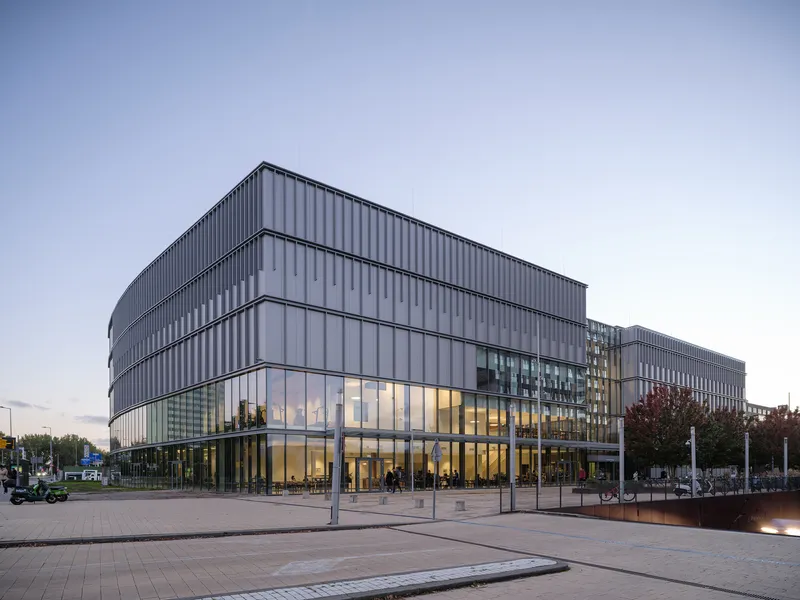

The program reads like a layer cake: weightlifting stacked above spinning, a basketball court sitting on top of a gym, three full competition halls, two training halls, and a fitness facility all packed into 8,800 square meters. One competition hall includes stands for 250 spectators. The logic is ruthlessly pragmatic. The campus plot was small and the brief was enormous, so VenhoevenCS organized the building as two slightly offset volumes connected by a central core. This offset creates a visual break in the massing that keeps the facade from reading as a single monolithic block.
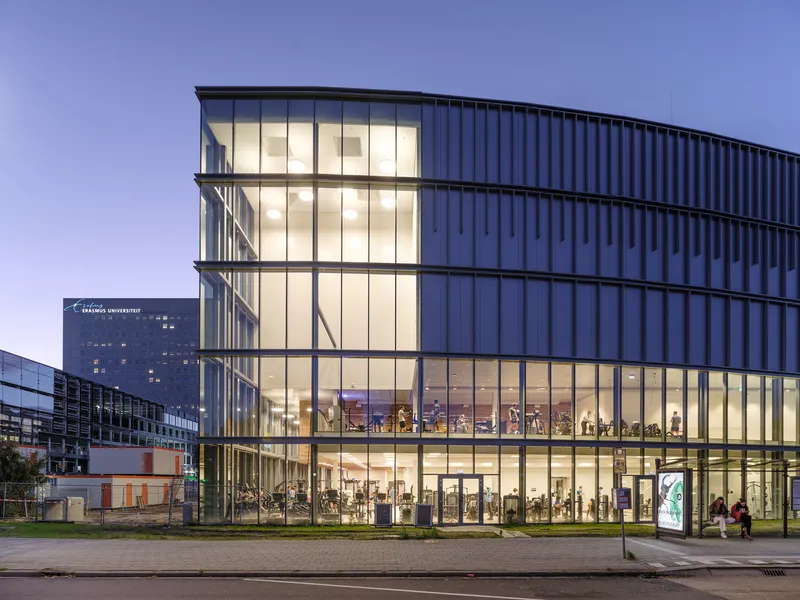
From the street, the building presents a transparent glass base that reveals activity inside, topped by a ribbed aluminum and glass envelope with vertical fins. The horizontal articulation gives each floor its own register while the vertical fins add depth and shadow, preventing the facade from flattening into a generic curtain wall. At the corners, full-height glazing wraps around to dissolve the building's mass, and the slightly curved eastern facade opens with a generous glass corner that pulls the campus into the interior.
The Inner Street as Social Engine
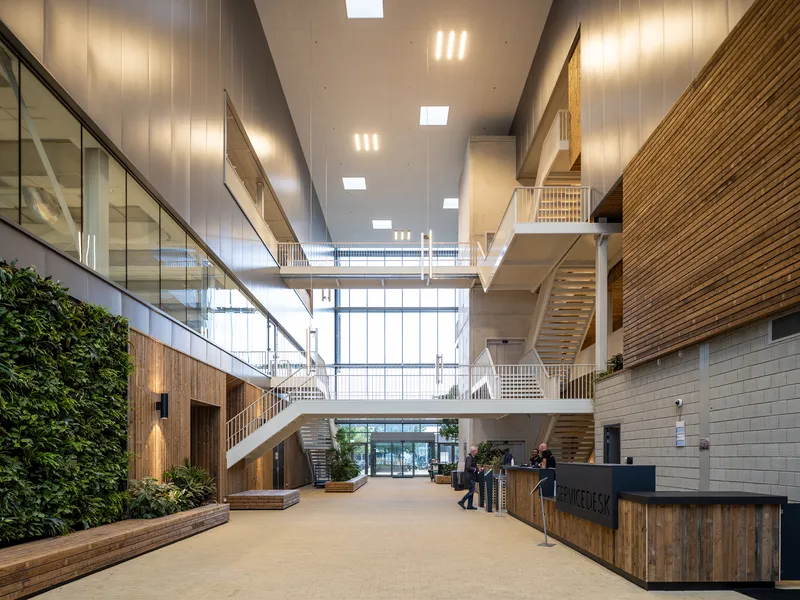
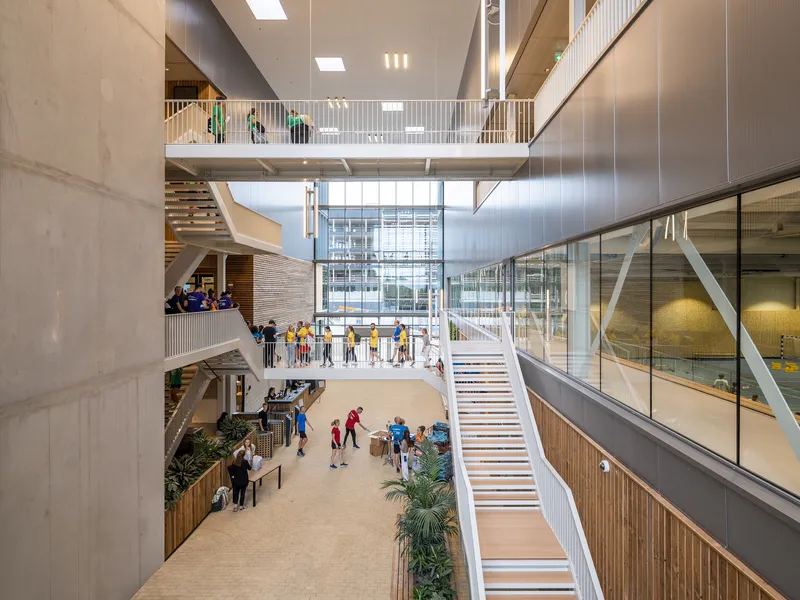
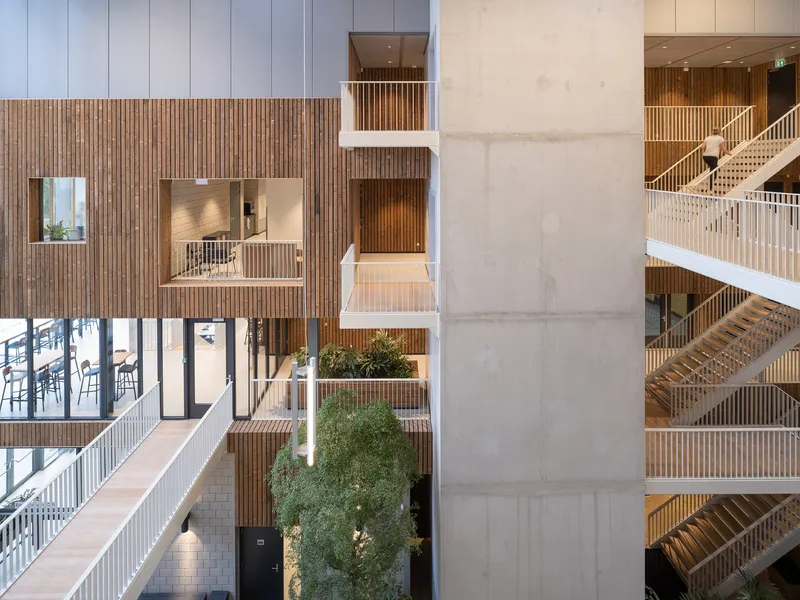
The central passage is the building's real argument. Both ends are entirely glass, turning the interior into a transparent connector between the two sides of campus. Inside, curved timber staircases, planted terraces, walkways, and a bar create a multi-level social landscape that functions whether or not anyone is playing sports. VenhoevenCS treated this space as an interior garden, with green walls, freestanding plants, and even a tree occupying the atrium.
The success of this strategy depends on legibility. Twenty-five student sports associations representing over fifty different sports need to navigate the building efficiently, often arriving at different levels and different volumes. The public core handles this with visual openness: you can stand on the ground floor and trace the circulation all the way up through bridges and landings. The space is designed for easy wayfinding and adaptive use, shifting between peak competition days and quiet weekday training sessions without feeling either overcrowded or abandoned.
Reclaimed Wood and Circular Material Logic
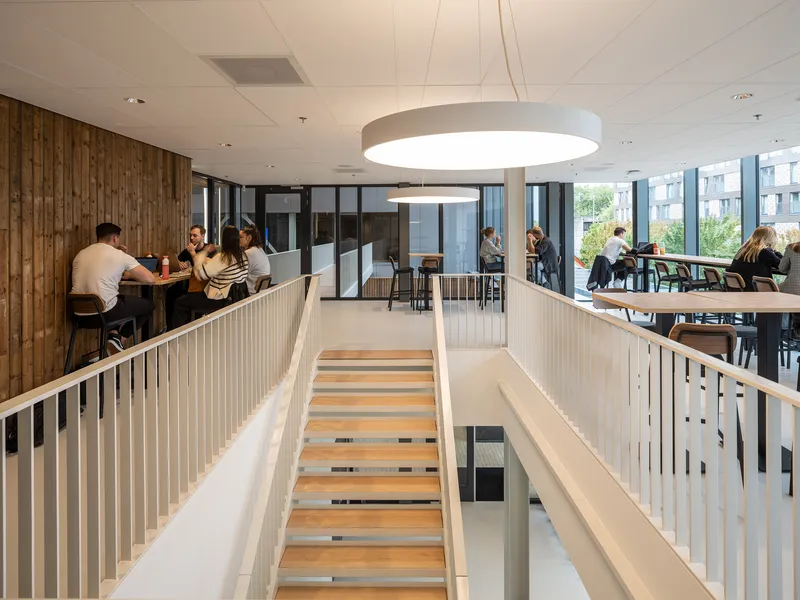

Walk through the public spaces and you notice the warmth of the interior finishes immediately. Walls and ceilings in multiple rooms are clad with reclaimed wooden floorboards salvaged from a demolished sports hall in Eindhoven. The timber shows its history: varying tones, worn grain, the occasional knot that reminds you this material had a previous life. VenhoevenCS applied circular material strategies extensively throughout the public interior, using reclaimed and circularly harvested products wherever possible.
The timber slat railings, plywood wainscoting in the sports halls, and horizontal wood cladding wrapping the upper levels all work together to soften what could easily have been a sterile athletic facility. The vertical slat screens flanking the concrete core in the atrium filter light and create visual layers, giving the interior depth and texture without relying on expensive bespoke details. It is a smart material palette: warm, durable, and defensible on sustainability grounds.
The Facade Up Close
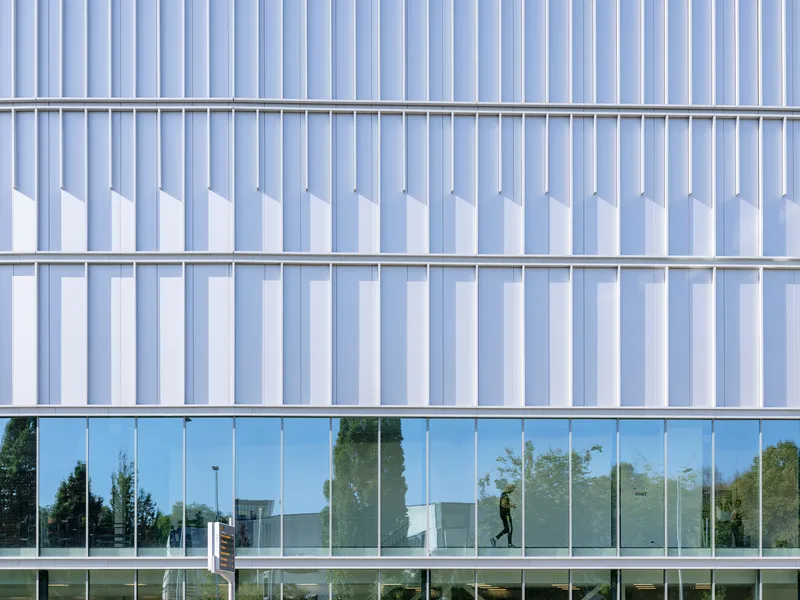

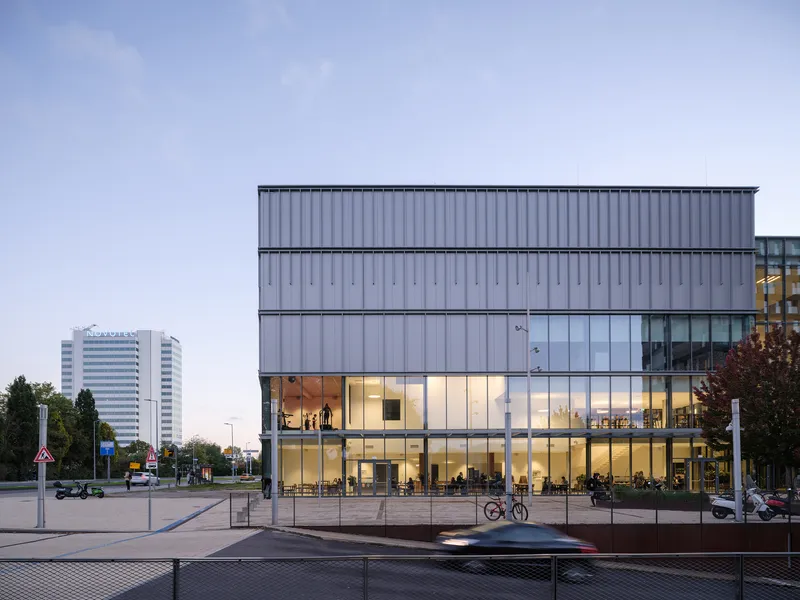
The vertical metal fins deserve closer attention. They serve multiple purposes: controlling solar gain, adding rhythm to what is fundamentally a large rectangular volume, and creating a sense of depth when viewed at oblique angles. At twilight, the illuminated interiors glow through the glass base while the upper stories recede behind the fin pattern, giving the building a visual stratification that corresponds to its programmatic layers. The corner conditions are handled with care: the fins wrap cleanly, and the glass base turns the corner without interruption.
Energy Neutrality Without Greenwashing
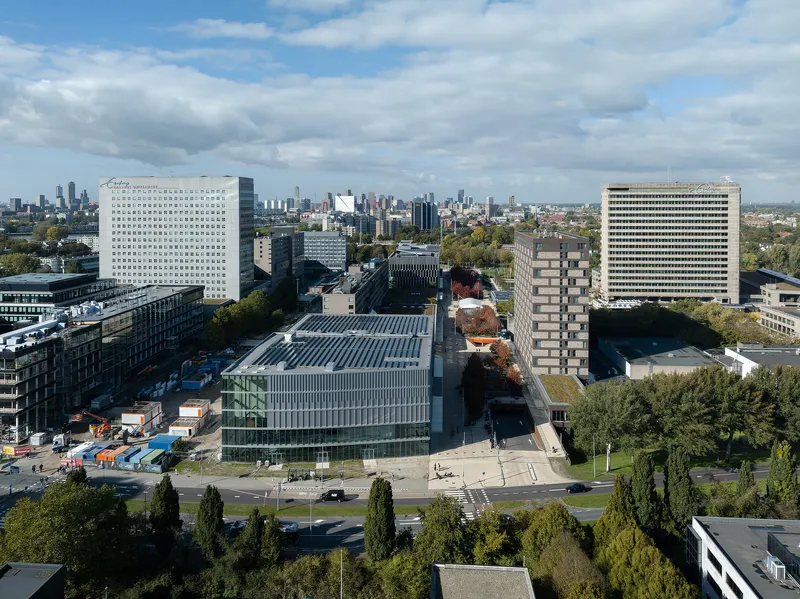
The roof is covered in photovoltaic panels, clearly visible in aerial views as a working surface rather than a decorative gesture. Energy neutrality is achieved through the combination of rooftop solar generation and a connection to the campus thermal storage system, which handles heating and cooling loads. The building also captures, retains, exchanges, and reuses water. These are not aspirational targets listed in a press release: the building has been operating since its completion in the summer of 2022, built by Bouwbedrijf Remmers over roughly eighteen months of construction.
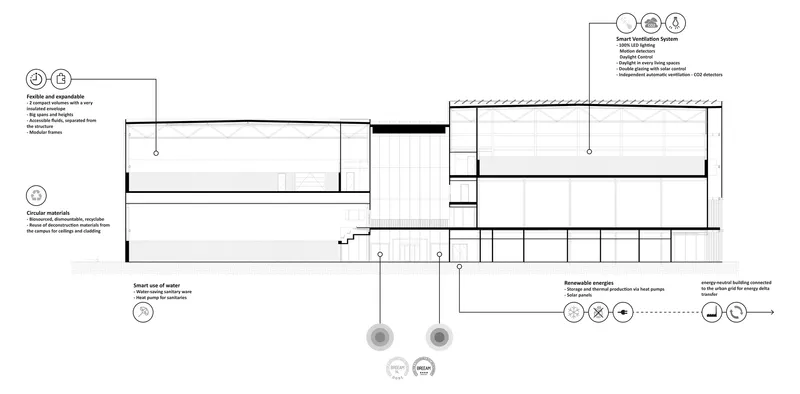
Maximizing transparency serves the energy strategy as well. Daylight penetrates deep into the sports halls and the central atrium, reducing artificial lighting loads during the day. The glass ends of the central passage allow cross-ventilation strategies that the annotated section drawings make explicit. For a building that houses energy-intensive activities like competitive sport, achieving genuine energy neutrality is a meaningful accomplishment.
Sports Halls That Work
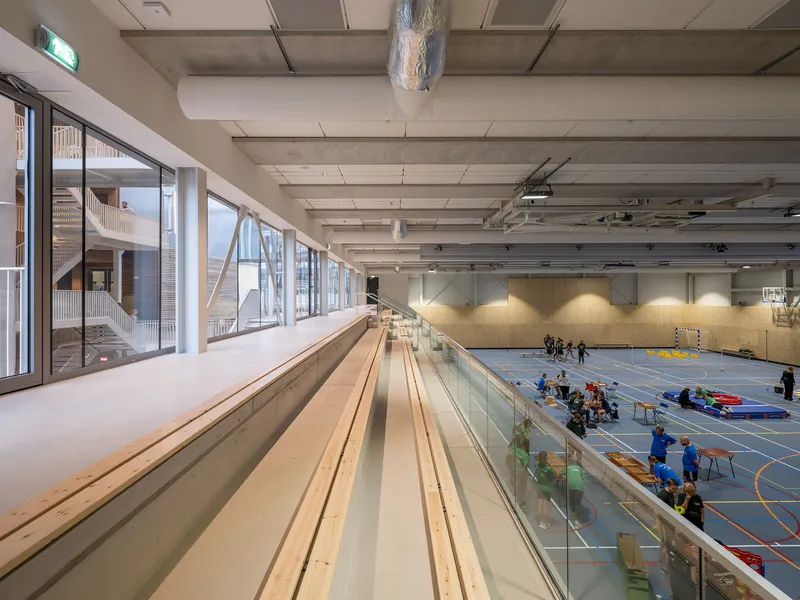
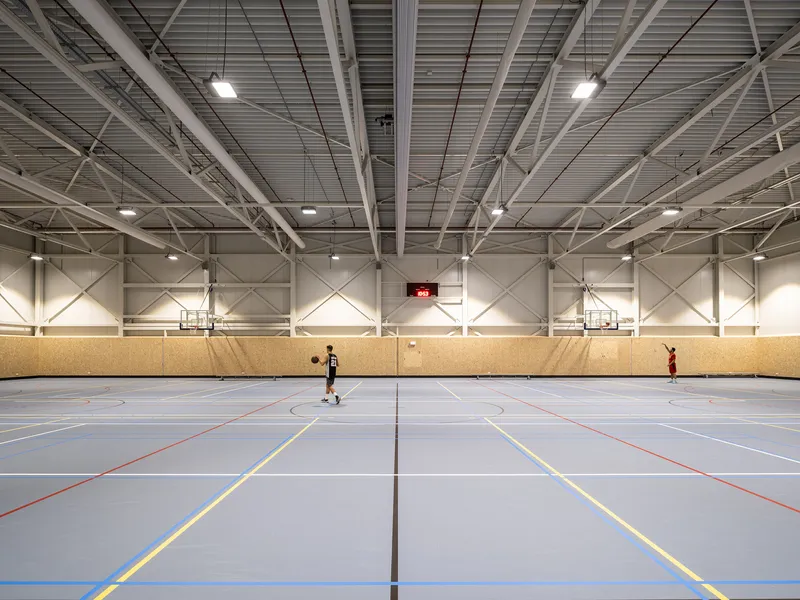
The halls themselves meet NOC*NSF requirements for competitive sport, which means regulation ceiling heights, appropriate flooring, correct lighting levels, and adequate spectator capacity. The exposed white steel truss structure in the upper halls is honest and efficient, spanning the clear widths needed for court sports without intermediate columns. Plywood wainscoting protects the lower walls from ball impact while keeping the material language consistent with the public spaces.
The 250-seat competition hall with tiered wooden seating shows that the architects understood the difference between a training facility and a venue. The stepped seating is integrated into the section rather than bolted on as retractable bleachers, which gives the space a civic quality that most university gyms lack entirely.
Plans and Drawings


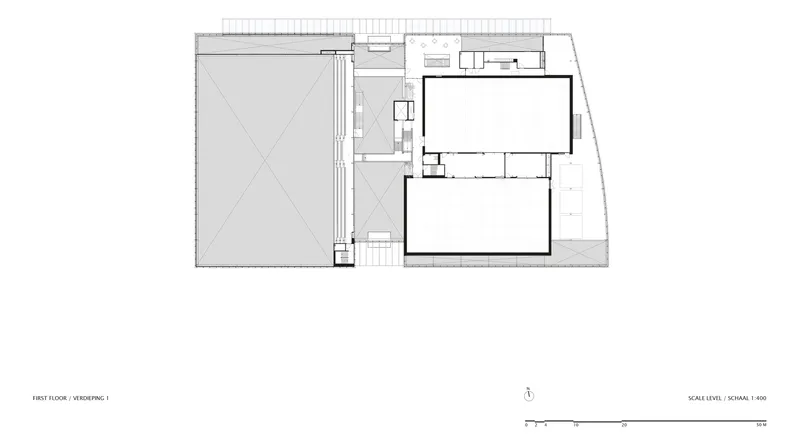
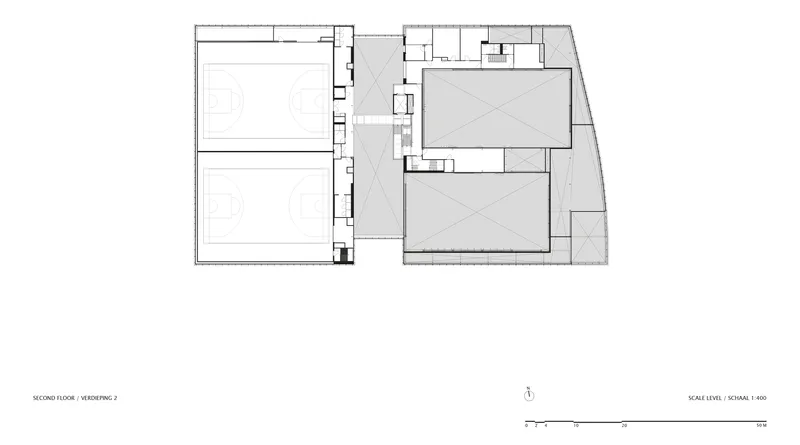
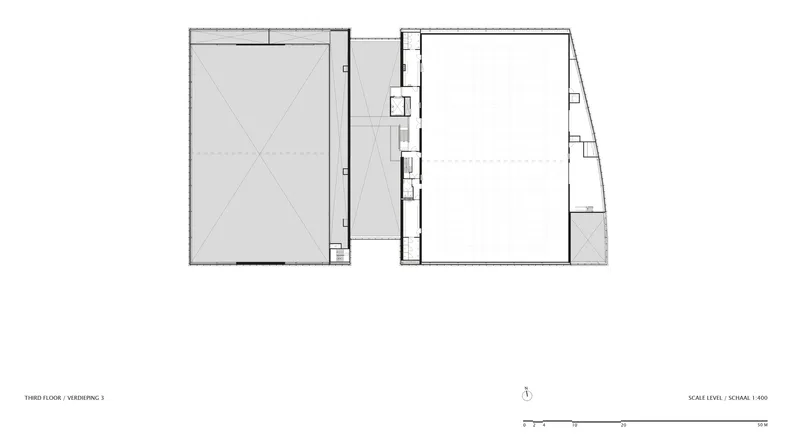


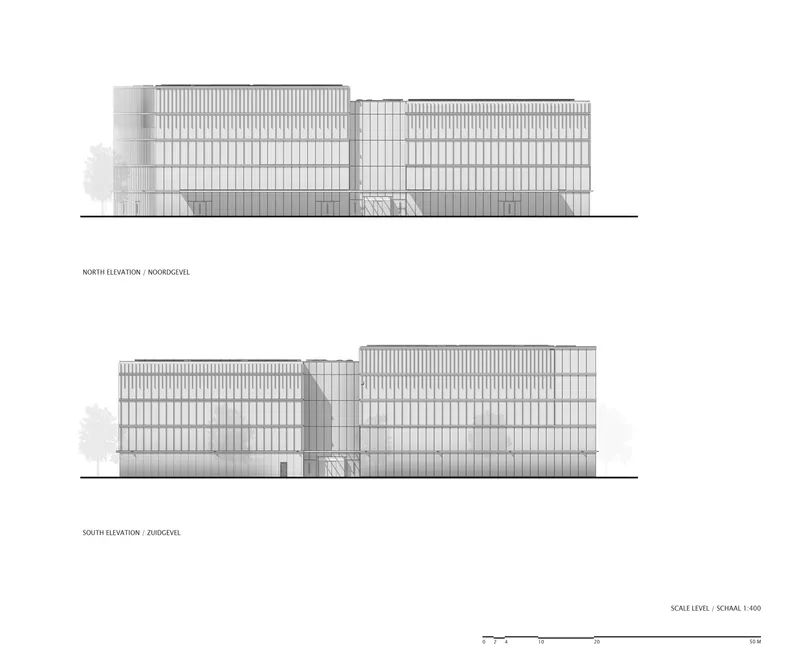
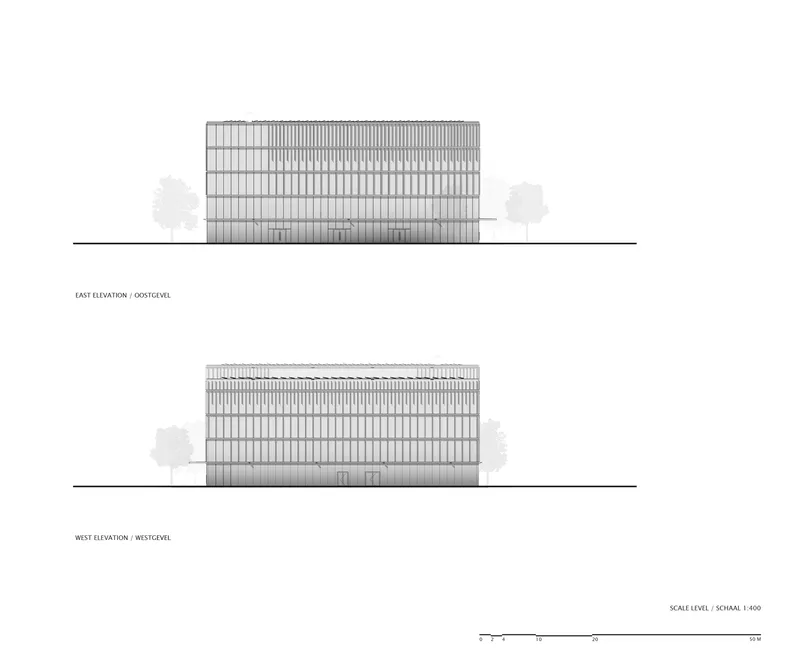
The floor plans confirm the offset relationship between the two volumes and show how the central circulation spine widens and narrows as it moves through the section. The ground floor plan reveals two courts flanking the public core with support spaces tucked along the edges. As you move up, the plan shifts: larger halls occupy one volume while smaller, more flexible spaces fill the other, connected always by the narrow corridor that reads as a bridge at the upper levels.
The sections are the most revealing drawings. They show how the split-level organization creates visual connections between floors, with galleries and walkways overlooking the sports halls below. The annotated sustainability section makes the building's energy strategy legible: solar panels on top, thermal storage below, natural ventilation through the central void. The elevations demonstrate how the vertical fin rhythm holds the two offset volumes together as a single composition, with horizontal banding marking each floor.
Why This Project Matters
University sports buildings are typically the most generic structures on any campus. They are big, cheap, windowless boxes pushed to the periphery and tolerated rather than celebrated. VenhoevenCS rejected every one of those conventions. The Sports Building at Erasmus sits at the campus entrance, announces itself through transparency, and turns its circulation into the most architecturally ambitious space in the entire complex. The use of reclaimed materials from a demolished sports hall in another city is a practical example of circular construction that goes beyond the usual sustainability rhetoric.
The vertical stacking strategy is the project's most transferable idea. As universities worldwide compete for space on increasingly dense urban campuses, the reflex to spread sports programs across low-rise sheds becomes unsustainable. Stacking competition halls, training rooms, and fitness spaces into a compact vertical arrangement is not a new concept, but executing it with this level of spatial generosity, material care, and genuine energy neutrality is rare. The building proves that sports architecture can be architecturally serious without sacrificing athletic performance.
Sports Building Erasmus University Rotterdam by VenhoevenCS, Rotterdam, The Netherlands. 8,800 m², completed 2022. Photography by Ossip van Duivenbode.
About the Studio
Share Your Own Work on uni.xyz
If projects like this are the kind of work you want to make, uni.xyz is a place to publish your own, find collaborators, and enter design competitions.



Popular Articles
Popular articles from the community


Co-Life: Senior Housing Design That Reconnects Older Adults With the City
Co-Life reimagines senior housing design through healing gardens, shared streets, workshops, and a sustainable community across generations.

Co-life: Sustainable Architecture for Age-Friendly Community Living
Co-life reimagines sustainable architecture for seniors through courtyards, rammed earth, shared gardens, and spaces designed for belonging.

Conexión: Biophilic Design Reimagines High-Rise Living in Hong Kong
Conexión reimagines high-rise living in Hong Kong through biophilic design, green facades, shared spaces, daylight, water and nature within.

Lunar Spiral: Space Architecture Shaped by the Mathematics of the Universe
Lunar Spiral reimagines space architecture through Fibonacci geometry, lunar regolith, levitating habitats, and self-sustaining Moon living.

Similar Reads
You might also enjoy these articles

Bao Huynh Watercolor Atelier: A Serene Art Retreat in Hội An
Bao Huynh Watercolor Atelier in Hội An blends multifunctional art spaces, sustainable design, local materials, and family-friendly living in a serene environment.

Atelier Macri Concept Store Interior Design by CASE-REAL
Atelier Macri store features a "ko" counter, walnut wood details, cork displays, blending retail, gallery, and seamless customer experiences.

Manuel Vargas Izquierdo Stadium and High-Performance Sports Center: Architectural Excellence in Jalpa de Méndez
The Manuel Vargas Izquierdo Stadium blends sustainable design, inclusive sports facilities, and cultural-inspired architecture, revitalizing Jalpa de Méndez’s public spaces.

KAKR Buluh Awar Hall: Revitalizing Community and Ecology Through Bamboo Architecture
Community built bamboo hall revitalizes Buluh Awar village, empowering youth, restoring ecology, celebrating vernacular craftsmanship through sustainable architecture and culture.




Comments (0)
Please login or sign up to add comments
No comments yet. Be the first to comment!