
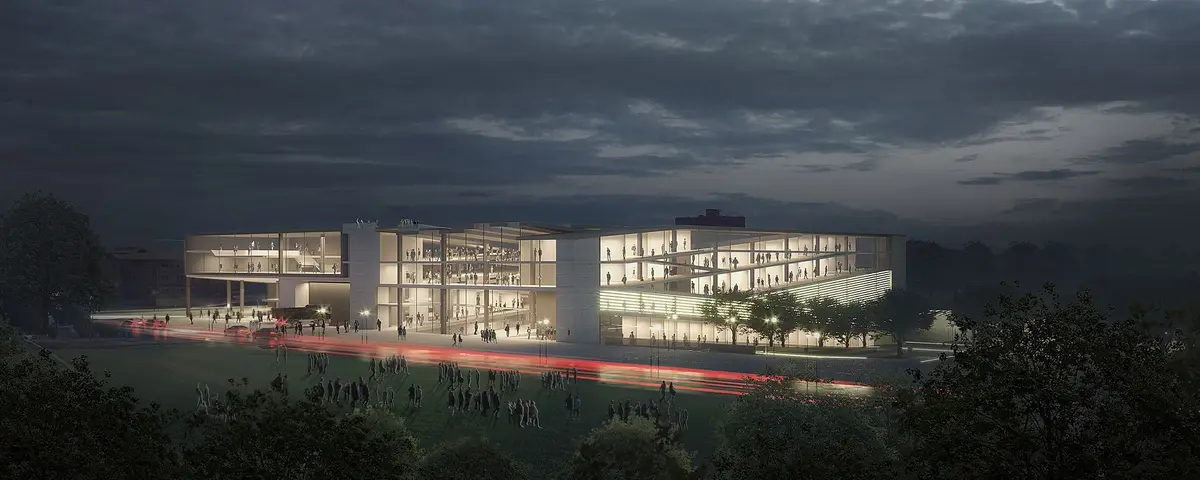
Vertical Warehouses: Stacking Retail and Logistics into a Single Urban Typology
A first-place competition entry that replaces elevators with sloped surfaces to merge warehouse logistics and public retail in one vertical structure.


What happens when you take an Amazon fulfillment center and fold it into the dense fabric of a city, then open it to the public? The result is something like Vertical Warehouses: a building type where storage, retail, and civic life occupy the same section, connected not by elevators or stairs but by continuous sloped surfaces that let people and goods move through the structure as if traversing a landscape. It is a provocation against the separation of logistics and everyday urban experience, one that argues these two worlds are converging and that architecture should formalize the merger.
Designed by Yasaman Arjomand and Nima Shoaie, this project won first place in the Upcycling Retail 2019 competition on uni.xyz. The brief asked designers to rethink retail through the lens of upcycling and adaptive reuse, and the winning response reframed the question entirely: rather than redesigning a shop, Arjomand and Shoaie proposed a new building typology that stacks warehousing and marketplace functions vertically, optimizing limited urban land while bringing consumers into direct contact with the supply chain that serves them.
A Section That Reads Like a Supply Chain
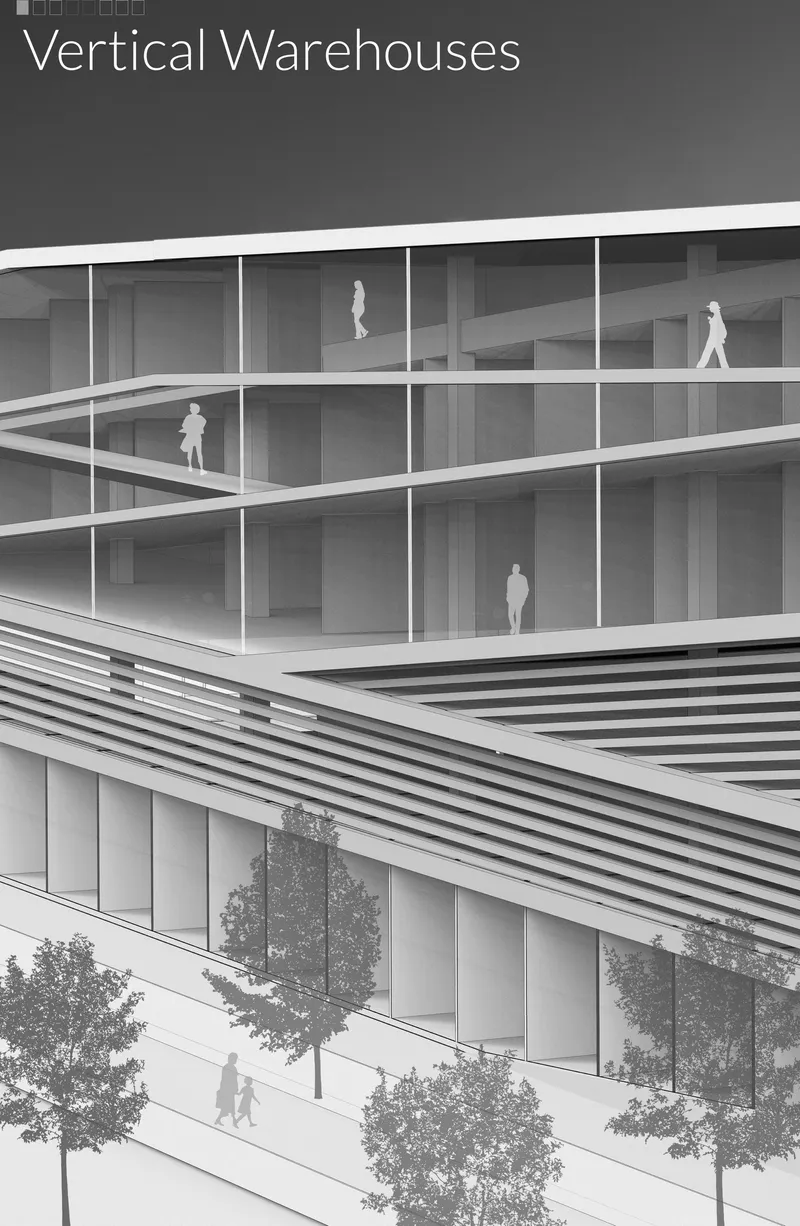

The section rendering reveals the building's core argument: stacked floors shielded by horizontal louvers, with figures walking through spaces that feel simultaneously like a warehouse and a public gallery. Trees at the base ground the structure in something recognizably civic, while the repetitive horizontal bands above suggest a machine for storage and distribution. The axonometric diagram isolates a single structural bay, filling it with embedded photographs of market activity. This overlay technique makes the connection between spatial structure and programmatic life legible at a glance. Each bay is not just a column grid; it is a module that can host retail, storage, or event space depending on demand.
What makes the section compelling is the absence of conventional vertical circulation. Instead of stacking discrete floors connected by elevator cores, the designers use traversable sloped surfaces that allow continuous pedestrian and vehicular movement. This eliminates the bottleneck of traditional lobbies and lift banks, creating a building where movement is always lateral and gradual, more ramp than corridor. The implication for logistics is significant: goods and people share circulation paths, collapsing the distance between product and consumer.
Urban Insertion: Siting a Logistics Building in the City
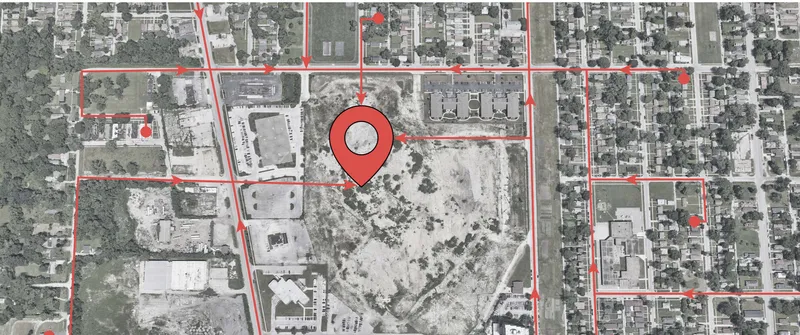

The aerial site plan marks the project's footprint with red boundary lines and a location pin, situating the vertical warehouse within an existing urban grid. The choice to place a logistics building inside a city rather than on its periphery is the project's most radical move. Conventional fulfillment centers demand vast horizontal acreage on cheap suburban land. By stacking that program vertically, Arjomand and Shoaie argue that warehousing can become a neighbor to housing, offices, and parks, reducing last-mile delivery distances and embedding the supply chain directly into the communities it serves.
The building section drawing confirms the multi-floor strategy: a structural grid supports several levels, with figures dispersed throughout to indicate simultaneous occupation across all floors. The even distribution of people suggests a building without a single dominant program. Retail, storage, and public space coexist vertically, each level adaptable to shifting ratios of commerce and community use. The structural regularity also hints at a system designed for repetition and scalability, a prototype rather than a one-off monument.
Ramps, Roof Openings, and the Interior Landscape

The isometric cutaway model is perhaps the most revealing drawing in the set. It peels away the exterior skin to expose interior ramps threading between floors, with roof openings that pull daylight deep into the building's core. The indicated section line suggests the designers are thinking carefully about how light, air, and movement interrelate across levels. These are not ramps added as accessible afterthoughts; they are the primary organizational device, replacing corridors with a continuous topographic surface that makes the entire building traversable without interruption.
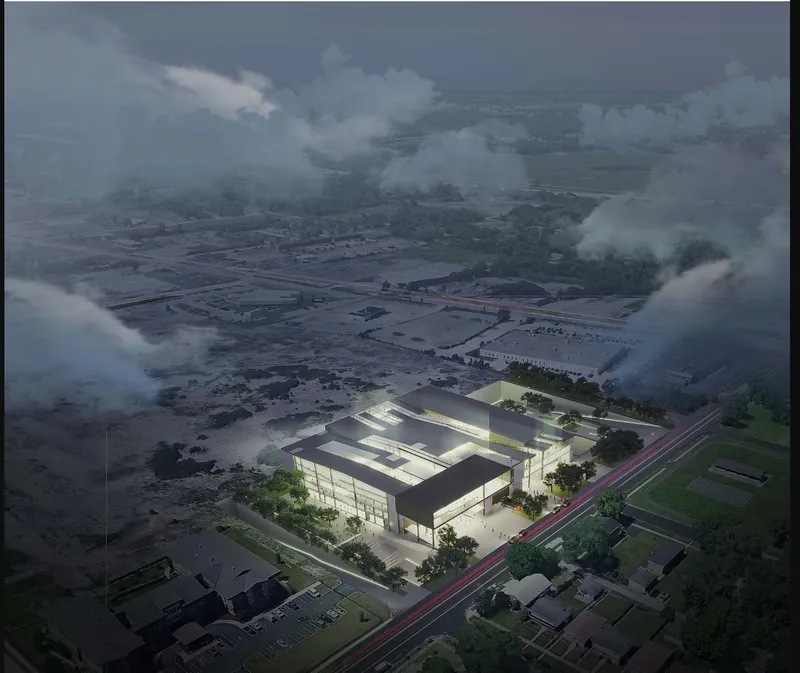
The aerial rendering captures the building at dusk under low clouds, presenting a rectangular volume punctuated by rooftop skylights. From above, the warehouse reads as a clean, almost monolithic form. The skylights betray the porosity within: this is not a sealed box but a structure designed to breathe, admitting natural light and ventilation into spaces that conventional warehouses would treat as sealed, climate-controlled voids. The tension between the building's compact exterior and its permeable interior is the project's strongest architectural quality.
Program as Spectrum: From Storage to Public Event

The longitudinal section drawing stretches the full length of the building, revealing colored gallery volumes in the upper levels and circulation paths traced below. The color coding suggests distinct programmatic zones, yet they are not separated by walls or floors in the traditional sense. Instead, they flow into one another along the building's linear organization. Shoppers can physically inspect items stored within the warehouse, bridging the experiential gap between scrolling through an online catalogue and handling a product in person. The inclusion of spaces for public events indicates that the building aspires to be more than functional infrastructure; it wants to be a destination.
The use of upcycled and sustainable materials, noted by the designers as a core strategy, aligns with the competition's brief while reinforcing the project's broader argument. If the building typology itself is about reducing waste in the supply chain, by shortening delivery routes and consolidating programs, then its material palette should embody the same ethic. Adaptive spaces that transition between functions mean fewer demolitions and rebuilds over the building's lifespan, extending the logic of upcycling from material selection to spatial design.
Why This Project Matters
Arjomand and Shoaie's Vertical Warehouses does something rare in competition culture: it proposes a new typology rather than a new shape. The project's significance lies not in its formal expression but in its organizational logic, the idea that urban land can serve both logistics and public life simultaneously, that the supply chain and the marketplace are not opposed forces but complementary programs waiting for the right section to bring them together. In a moment when e-commerce is hollowing out retail streets while its fulfillment centers sprawl across exurban landscapes, this kind of thinking feels urgent.
The project also raises productive questions it does not fully answer. How does noise and truck access coexist with public gathering? What governance model manages the shifting boundary between warehouse and retail? These are not criticisms but invitations for further development, precisely the kind of questions a winning competition entry should provoke. As cities grow denser and the pressure to integrate logistics into urban cores intensifies, the Vertical Warehouse stands as a credible blueprint for what that integration might look like in built form.
View the Full Project
About the Designers
Designers: Yasaman Arjomand, Nima Shoaie
Enter a Design Competition on uni.xyz
uni.xyz runs architecture and design competitions year-round that reward proposals with spatial conviction and real site intelligence.
Project credits: Vertical Warehouse by Yasaman Arjomand, Nima Shoaie Upcycling Retail 2019 (uni.xyz).


Popular Articles
Popular articles from the community

Opera by the Sea Estonia: Three Shells Dissolving Architecture into Tallinn's Coastline
A winning opera house proposal replaces monumental form with interconnected shells that blur the boundary between building, park and Baltic Sea.
Tsunami Convergenics: Turning Catastrophic Ocean Forces into Underwater Housing Infrastructure
A speculative underwater settlement off the coast of Onagawa, Japan, treats tsunamis and typhoons as energy sources rather than threats.

Cloaked Colonization: A Mobile Underwater Habitat That Moves Like a Fish
Micah Abaya's shortlisted EHC Pacific entry reimagines ocean settlement as a dispersed network of self-sustaining architectural organisms.

Extended Shell: Retrofitting Kolkata's Balconies as Living Urban Thresholds
A modular retrofit system recovers the social and environmental intelligence of Kolkata's historic verandas for contemporary Park Street residents.

Similar Reads
You might also enjoy these articles

Day and Night Park: A Time-Based Urban Newsstand in Beijing
A temporary urban newsstand in Beijing blending travel, light, and reading through poetic colors, compact form, and community-focused design.

Modernist Patio Renovation in El Masnou, Barcelona by Oliver Segura Arquitectura + Cebrià Arquitectura
Modernist patio renovation blending tradition and innovation with a movable pool, leveled floors, and Catalan materials in El Masnou.

Alto Residencial Coop: Cooperative Housing Development in Santiago de Compostela by Carbajo Barrios Arquitectos
A linear cooperative housing complex blending white volumes and perforated metal façades, enhancing community living, natural light, privacy, and urban integration.

Vil Genis School by BPA ARCHITECTURE – Massy, France
Vil Genis School in Massy, France, features sustainable design, south-facing classrooms, community integration, accessible spaces, and modern educational architecture.

Comments (0)
Please login or sign up to add comments
No comments yet. Be the first to comment!