

Dominique Perrault Sinks an Inverted Skyscraper Fifty Meters into the Earth Outside Paris
The Villejuif Gustave Roussy Station turns a 70-meter concrete cylinder into a daylit public space for the Grand Paris Express.


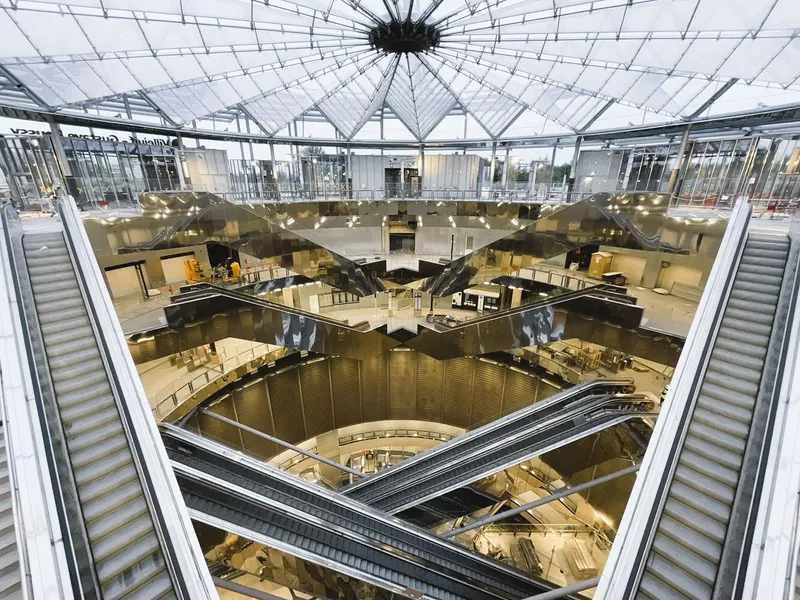
Most metro stations treat depth as a problem to solve. You descend, you wait, you leave. Dominique Perrault Architecture has spent over a decade arguing that for the Villejuif Gustave Roussy Station, depth is the architecture. The result, completed in December 2024 as part of the Grand Paris Express suburban metro network, is a 50-meter-deep concrete cylinder punched into the highest point of the Longboyau Plateau in Villejuif. It is neither building nor tunnel. Perrault calls it an inverted skyscraper, and the label is earned: 32 escalators crisscross an open central void that pulls natural light and fresh air all the way down to platforms serving lines 14 and 15 South, which together are expected to carry 100,000 passengers daily.
What makes the project genuinely interesting is not the spectacle of scale but the discipline of its environmental logic. The station is neither heated nor cooled. Its thermal stability comes from the surrounding earth. Its ETFE roof keeps rain out while allowing lateral air movement, eliminating the need for mechanical smoke extraction. The cylinder form uses the least material to enclose the maximum volume. Every dramatic gesture, the mirrored ceilings, the spiralling mesh canopies, the galleries lined with kiosks, serves a measurable purpose. Perrault has designed infrastructure that behaves like landscape, and a public space that happens to contain a metro.
The Cylinder as Urban Room
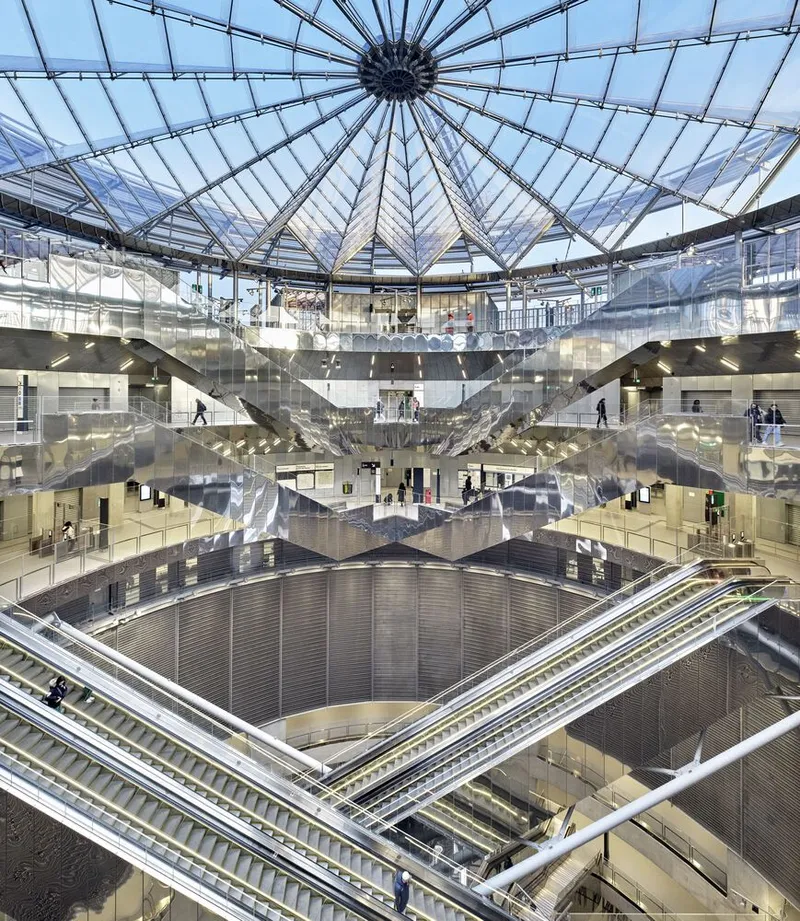
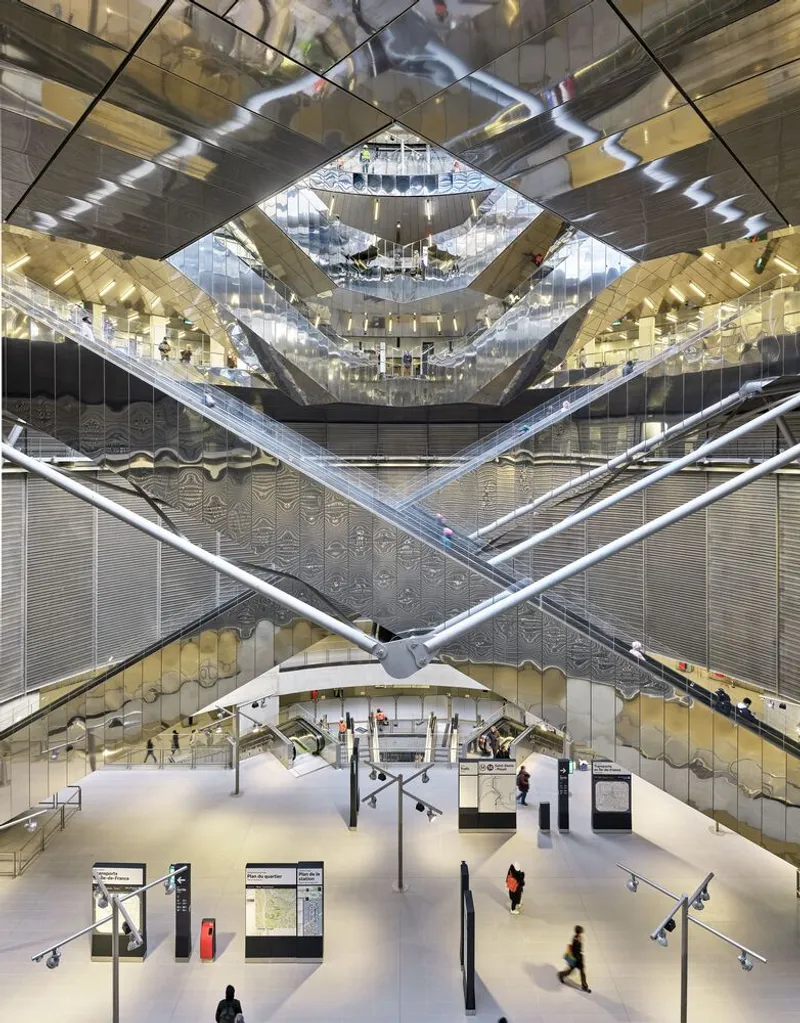
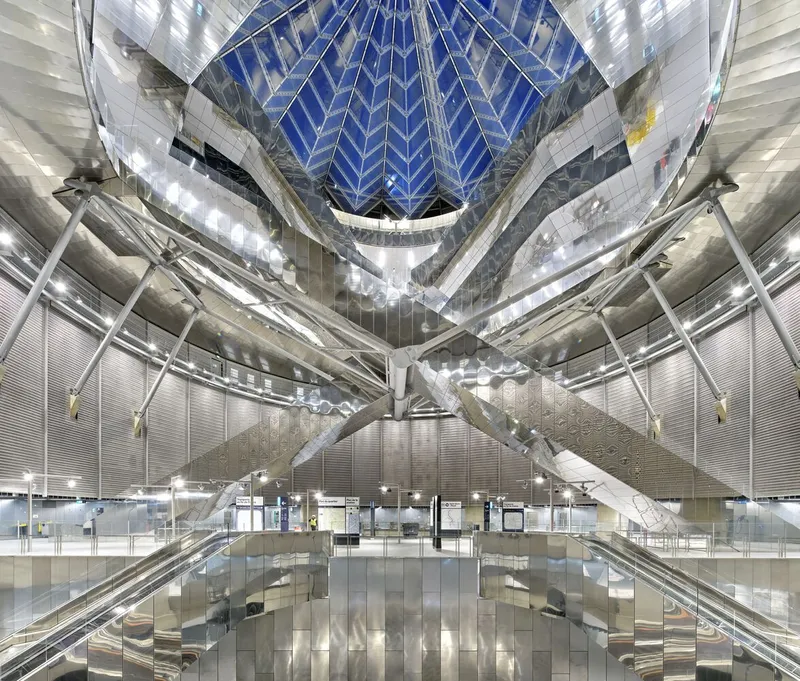
The core spatial move is simple to describe and staggering to experience. A concrete cylinder 70 meters in diameter and roughly 50 meters deep is hollowed out, leaving a 30-meter-wide open void at its center. Galleries and balconies ring the perimeter at each level, and escalators slice diagonally across the middle in overlapping pairs. From any balcony you can see the sky above and the platform concourse below. The legibility is total: the building is its own wayfinding.
The first two levels of balcony galleries are programmed with shops and services, accessible without a ticket. This means the station functions as a public interior even for people who never board a train. Little kiosks punctuate the periphery, turning what would otherwise be a transit corridor into something closer to a covered market square. Perrault's ambition to erase the threshold between city and station is most convincing here, where the gradient between shopping, strolling, and commuting is genuinely seamless.
Reflections and Orientation
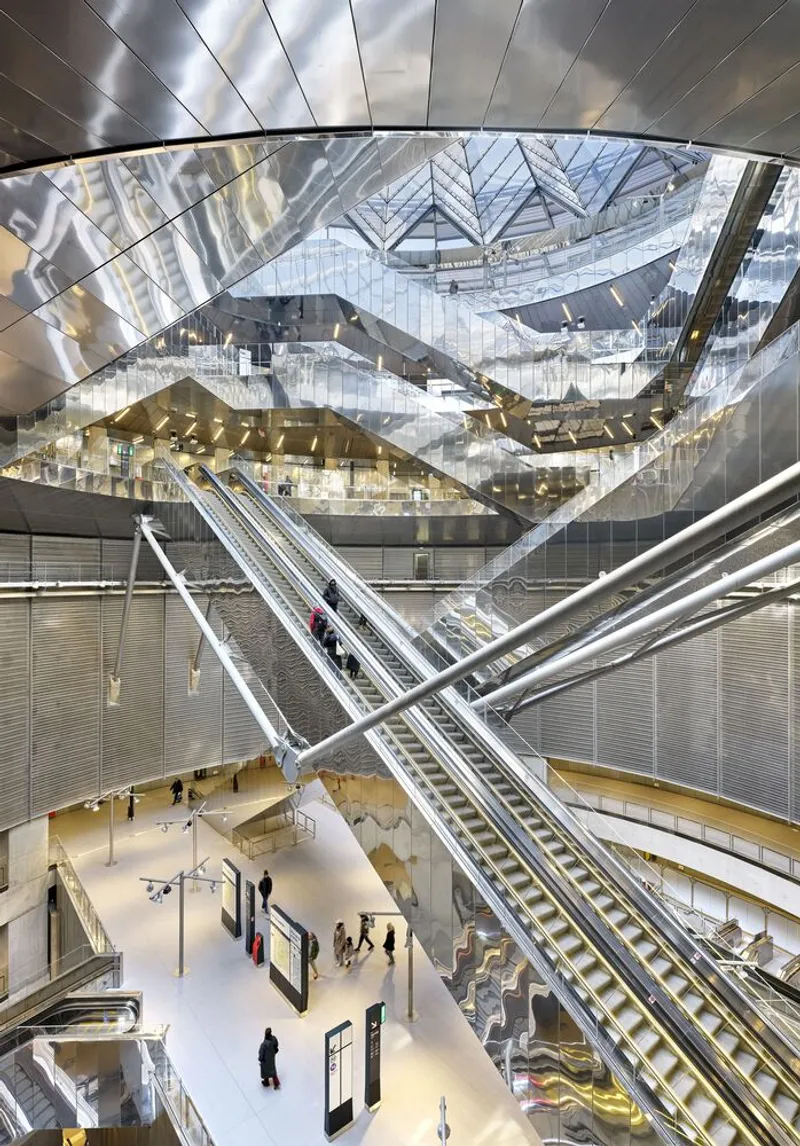
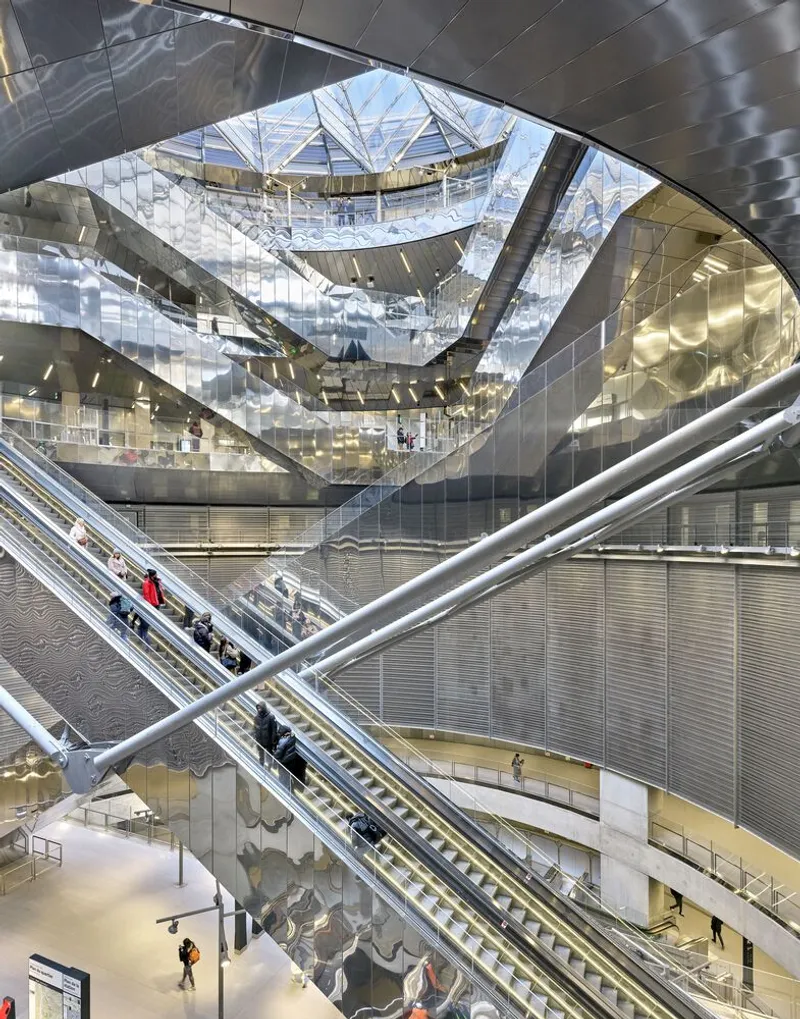

Stainless steel appears in at least five distinct textures throughout the station: smooth, mesh, perforated, mirror-polished, and satiny. The faceted ceiling panels above the escalator well use the mirror-polished finish to kaleidoscopic effect, reflecting the crisscrossing movement of riders and multiplying the apparent depth of the void. It is a controlled theatrical move. Rather than simply lighting the underground, Perrault makes the underground appear to extend upward infinitely.
The reflective surfaces also serve a pragmatic role in distributing daylight deeper into the cylinder. Light entering through the central ETFE dome bounces off the faceted panels and reaches balcony levels that would otherwise depend entirely on artificial illumination. The material palette, light-gray raw concrete paired with stainless steel, keeps the tone cool and consistent, reinforcing the sense of a single continuous space rather than a stack of disconnected floors.
The Roof as Environmental Machine

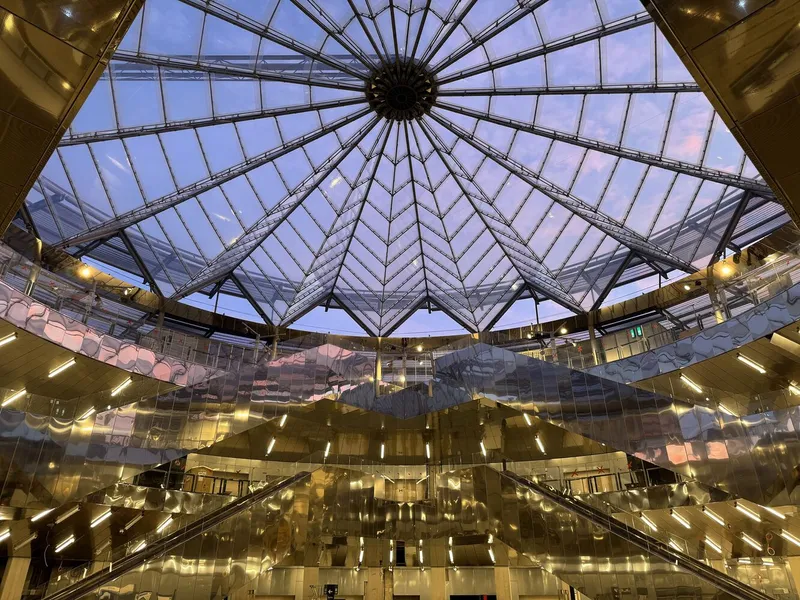
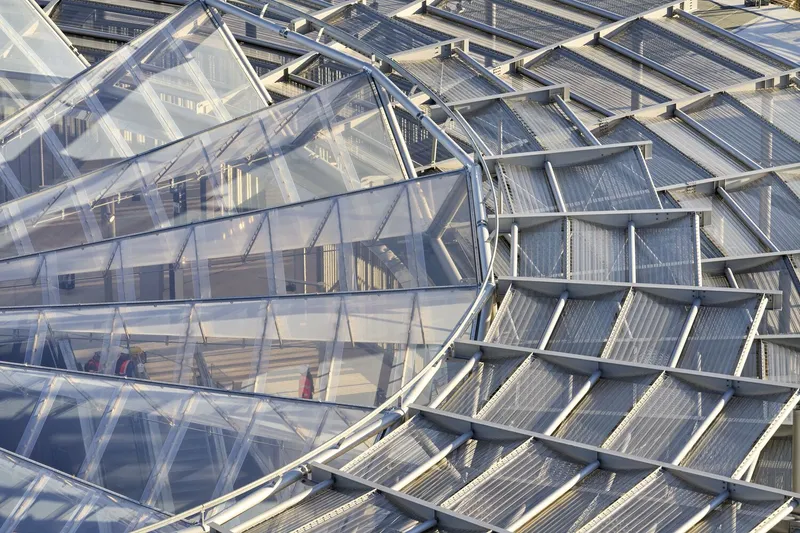
The station's roof is really three roofs operating at different scales. At the center sits a lightweight ETFE canopy stretched over a bicycle-wheel cable structure: a perimeter ring of steel, a central steel "eye," and slender tie beams radiating between them. This membrane keeps rain out of the central void while remaining transparent enough to flood the cylinder with daylight. Two additional canopies composed of spiralled stainless-steel mesh strips are positioned at different heights, functioning as brise-soleils that filter solar gain before it reaches the interior.
Because the central roof is open to air movement laterally, the entire station ventilates passively. This single decision cascades through the engineering: no mechanical smoke extraction in the central void, no ductwork threading through the concrete structure, and dramatically reduced energy consumption. The thermal inertia of the surrounding earth handles the rest, keeping the interior warmer than the Parisian winter and cooler than the summer above. It is an infrastructure project that consumes almost no energy to condition its 15,364 square meters of usable space.
Surface Canopies and the Public Threshold
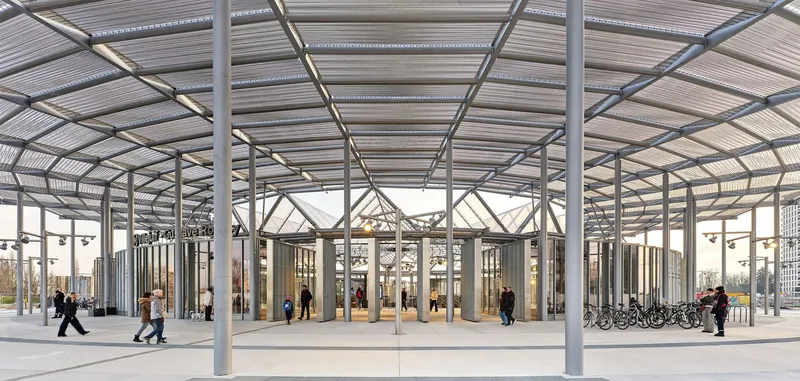
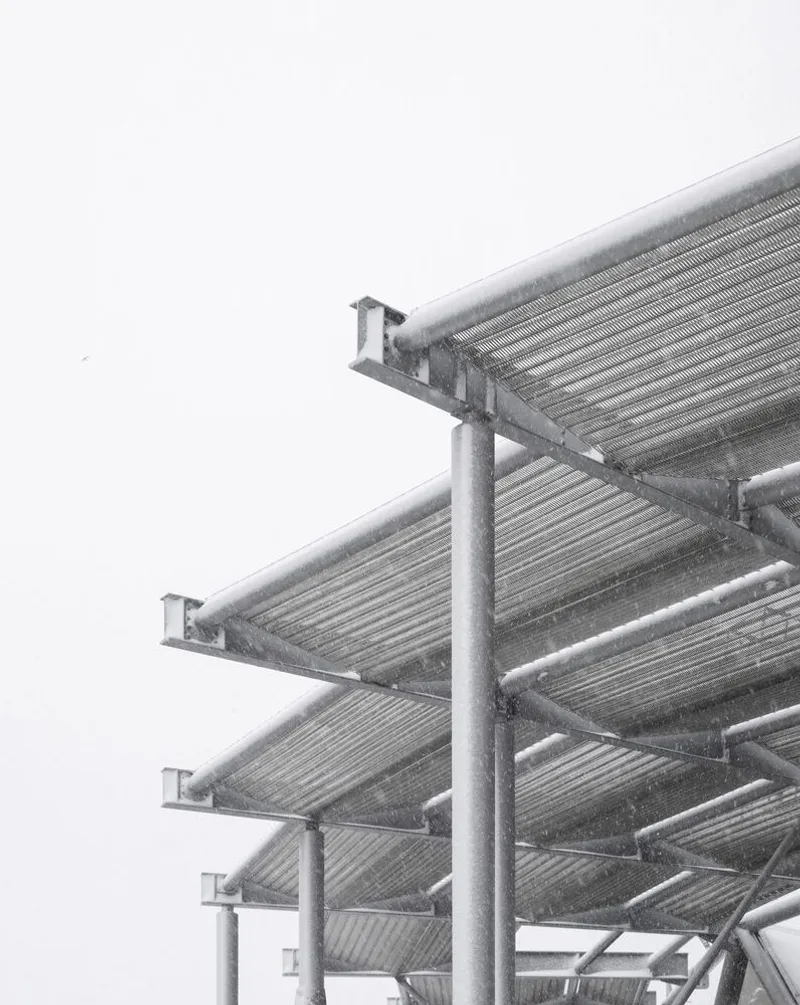
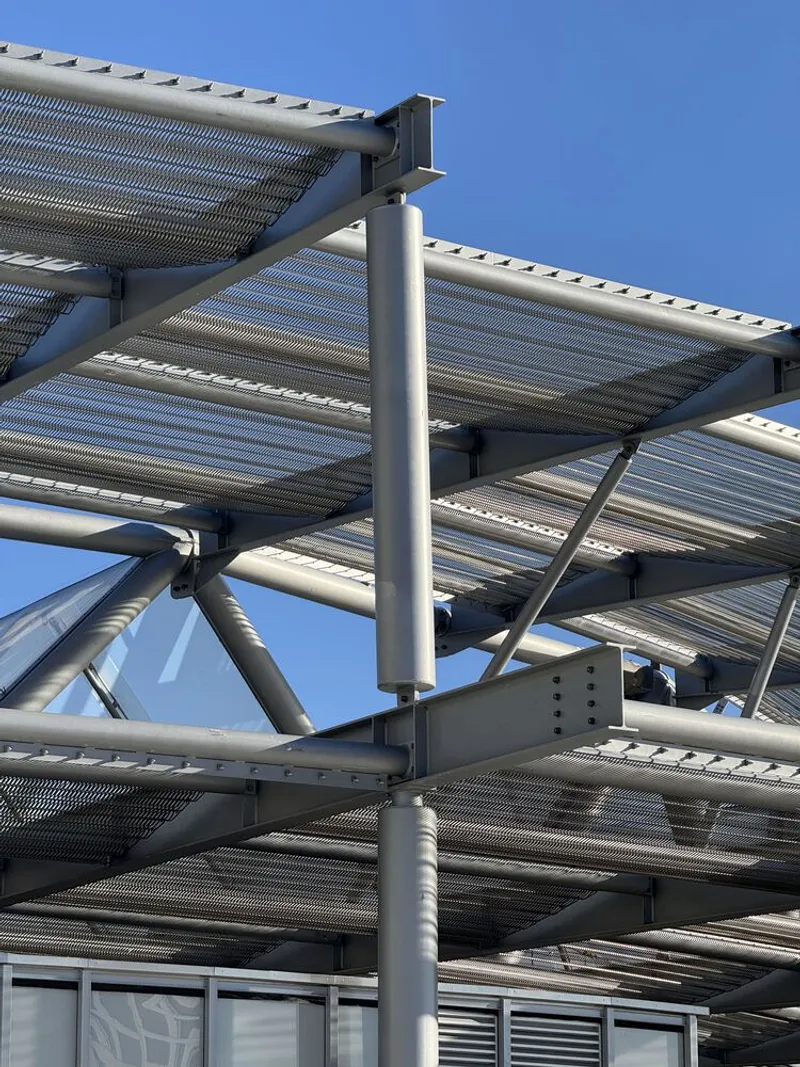
At ground level, the station barely announces itself. The cylinder is sunk into the earth, and what visitors encounter first are low cantilevered canopies of perforated metal supported by tubular steel columns. These shade structures extend across a new public plaza that links the Institut Gustave Roussy, Europe's leading cancer treatment center, to the Parc des Hautes-Bruyères. The architectural gesture is deliberately understated: rather than building a monumental entrance pavilion, Perrault lets the ground plane flow continuously into and over the station.
The perforated panels and diagonal bracing give the canopies a textured, almost textile quality that echoes the mesh strips of the larger roof canopies above. Steel connections are left exposed and celebrated rather than hidden, lending the surface structures an honest, industrial character that prepares visitors for the raw concrete interior below. The transition from park to plaza to station is a gentle slope, not a doorway.
Constructing the Void
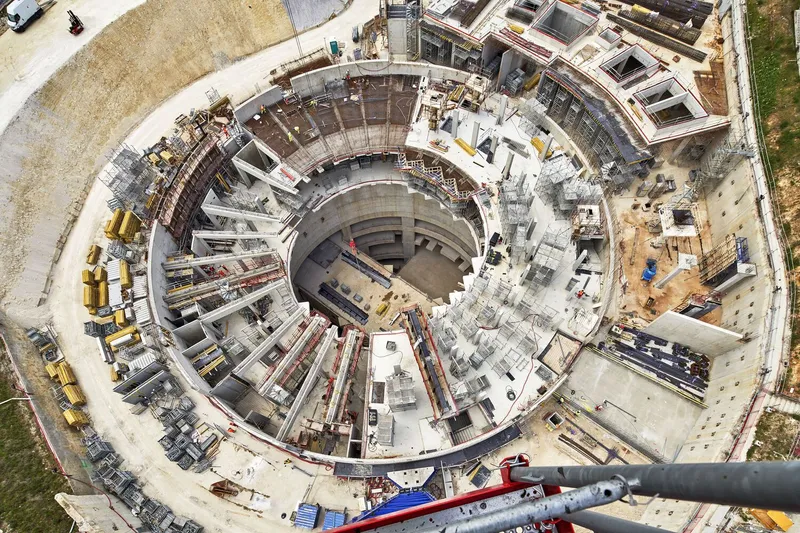
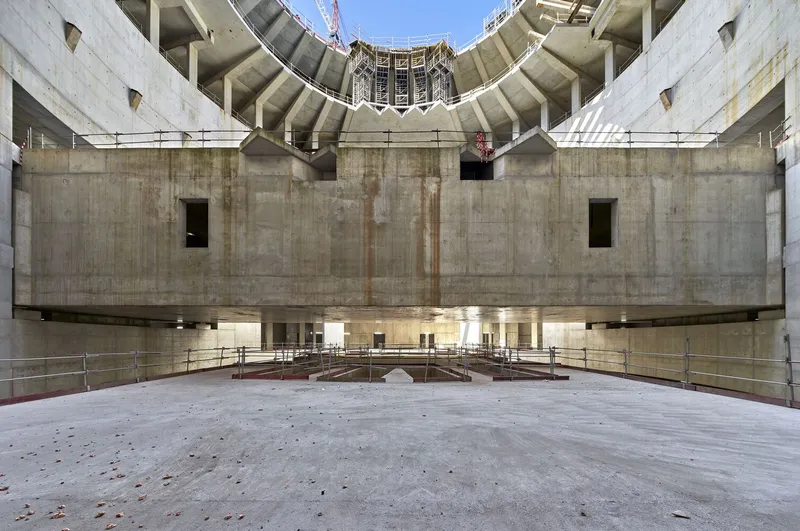
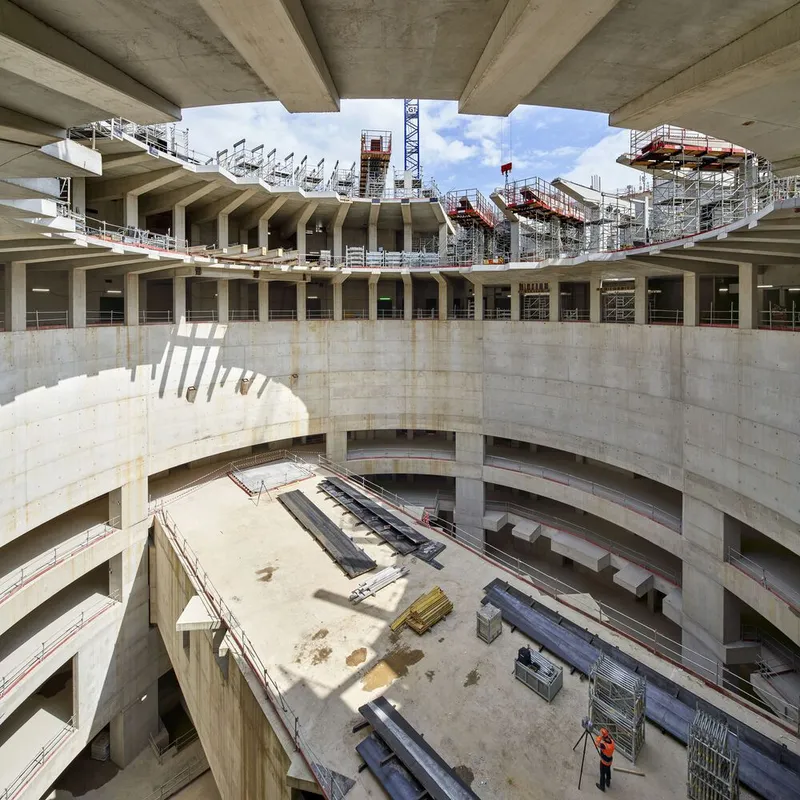
Construction photographs reveal the sheer ambition of the engineering. The project began with the excavation of a circular pit defined by moulded concrete retaining walls one meter thick and 42 meters deep. Inside this shell, concentric rings of floor slabs were cast at each level, creating the gallery structure visible in the finished station. At its deepest point, the line 15 South platforms sit 49 meters below grade; the line 14 South platforms are at 37 meters.
The construction images also expose the logic of the cylinder form. A circle is the most efficient shape for resisting the lateral earth pressures at this depth, and it minimizes the surface area of the retaining wall relative to the enclosed volume. The cylinder is not a formal conceit; it is a structural inevitability that Perrault has turned into an architectural proposition. The geometry that costs the least concrete also produces the most dramatic interior.
Arriving at Depth
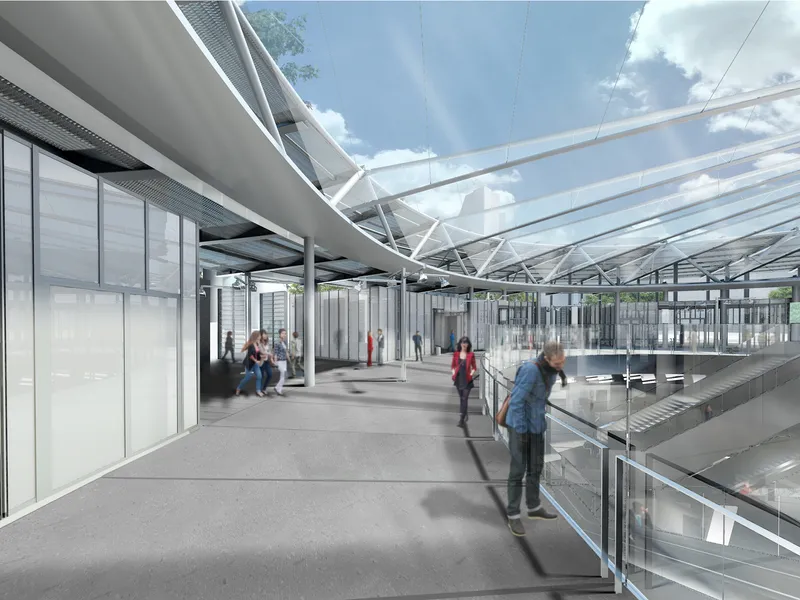

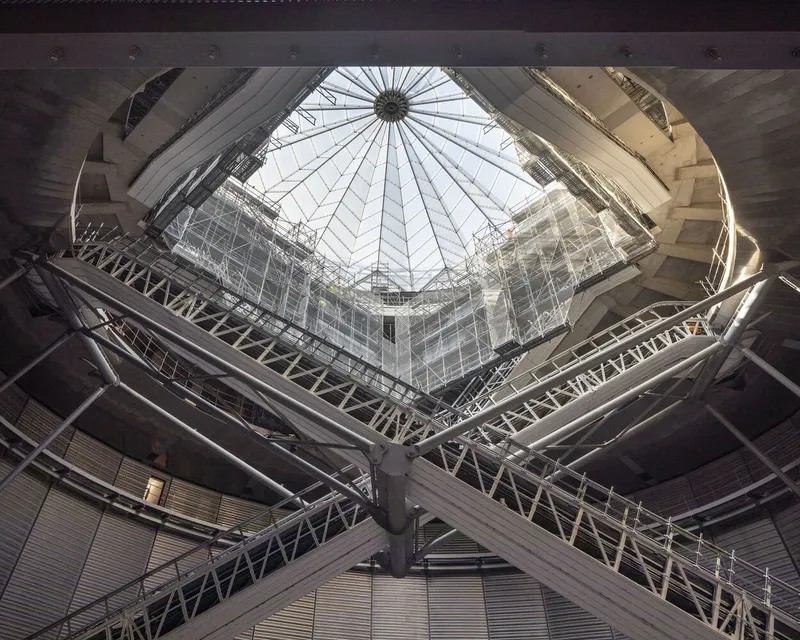
At platform level, the character shifts. Exposed steel trusses and a transparent roof canopy replace the faceted mirrors of the upper atrium, and the scale tightens. Passengers who have descended through the theatrical void arrive in a space that is functional, well lit, and oriented clearly toward the tracks. The contrast is deliberate: the spectacle belongs to the public realm of the galleries, while the platform concourse is designed for efficiency and clarity.
Looking upward from here, the full section of the inverted skyscraper is legible. The spiralling escalator paths, the ring of balconies, the radiating cable structure of the dome, and the open sky beyond all stack into a single vertical view. It is a moment of orientation that few transit systems provide. You know exactly where you are in relation to the city above, and that knowledge transforms the experience of being underground from one of disorientation into one of inhabitation.
Plans and Drawings
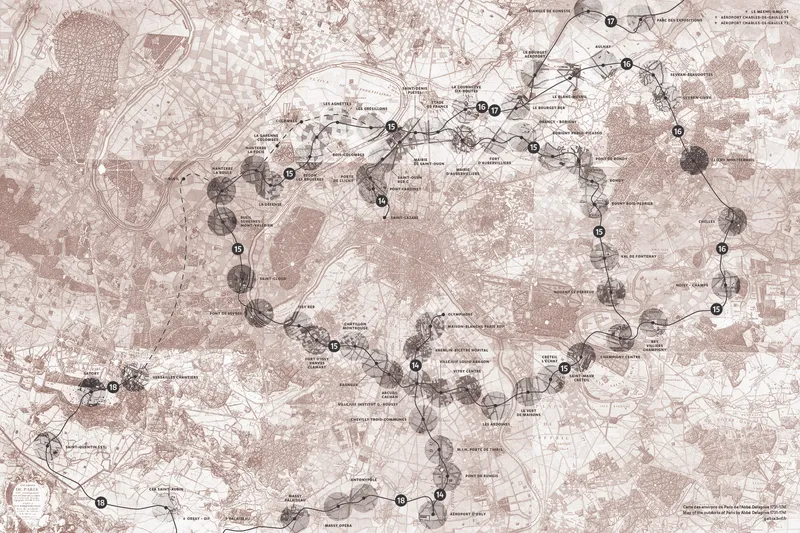
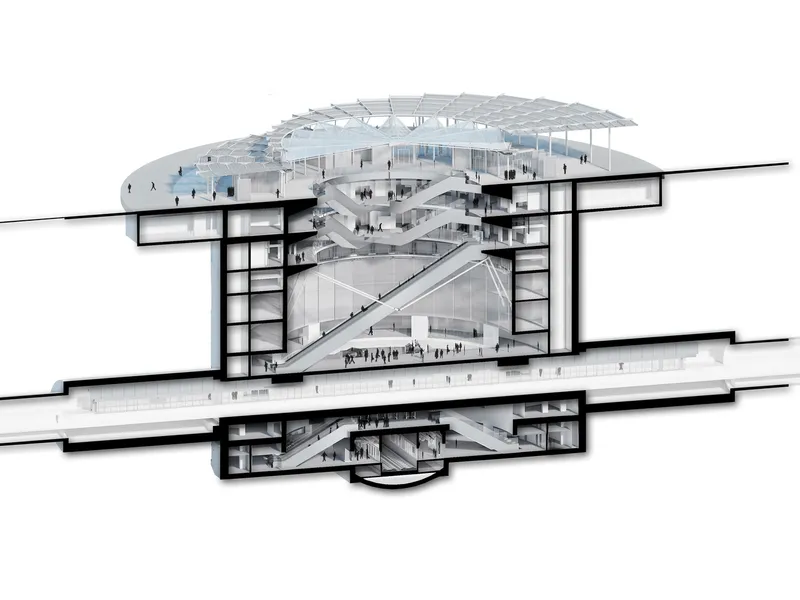


The sectional drawings are the most revealing documents. They show the full 50-meter descent from the ETFE canopy to the deepest platforms, with escalators drawn as long diagonal lines threading the open void. The moulded concrete wall reads as a continuous boundary, and the gallery floors cantilever inward from it like shelves. The urban plan locates the station within the broader Grand Paris Express network, which will eventually comprise 68 stations across 200 kilometers of new metro lines. Within that system, Villejuif Gustave Roussy is one of the deepest and most architecturally ambitious stops.
The physical models and axonometric sketch clarify the relationship between the circular station and its rectangular urban context. The radial roof structure sits within a field of trees, and the surrounding blocks of the ZAC Campus Grand Parc are oriented orthogonally. The tension between these two geometries is resolved at the ground plane, where the plaza mediates between the grid of the neighborhood and the circle of the station. Perrault's stacked elliptical floor plates, visible in the axonometric, show how the program narrows as it descends, concentrating public activity at the upper levels and reserving the deepest floors for transit operations.
Why This Project Matters

The Villejuif Gustave Roussy Station matters because it refuses the premise that underground infrastructure must be utilitarian, hermetic, and separate from the city. Perrault has designed a station that breathes, that receives daylight at its deepest level, that requires neither heating nor cooling, and that invites the public in without requiring a ticket. These are not luxuries; they are demonstrations that the engineering demands of a 50-meter-deep metro station can align with, rather than contradict, the goals of sustainable and humane urban design.
As the Grand Paris Express continues to reshape the relationship between Paris and its suburbs, this station offers a benchmark. It proves that infrastructure can be architecture, that depth can be made legible, and that the most efficient structural form can also be the most spatially generous. If future stations in the network follow this precedent, the Grand Paris Express will have produced not just a transit system but a new typology of public space embedded in the ground.
Villejuif Gustave Roussy Station by Dominique Perrault Architecture. Villejuif, France. 15,364 m². Completed 2024. Photography by Michel Denancé.
About the Studio
Share Your Own Work on uni.xyz
If projects like this are the kind of work you want to make, uni.xyz is a place to publish your own, find collaborators, and enter design competitions.


Popular Articles
Popular articles from the community


The Earth Pod: 3D Printed Homes for Resilient Refugee Communities
The Earth Pod reimagines refugee housing through 3D printed homes made from clay, combining resilience, self-sufficiency, and rapid shelter.

Hill & Cross Opera: Sculptural Opera House Architecture Shaped by Tallinn’s Landscape and Identity
Hill & Cross Opera reimagines opera house architecture in Tallinn through its sculptural hill, civic plaza, glass wave and a luminous cross.

Conexión: Biophilic Design Reimagines High-Rise Living in Hong Kong
Conexión reimagines high-rise living in Hong Kong through biophilic design, green facades, shared spaces, daylight, water and nature within.

Riyadh For All: Intergenerational Urban Design for Active Aging in Rabat
Riyadh For All reimagines urban design in Rabat with intergenerational co-living, adaptive courtyards, and Moroccan cultural exchange today.


Similar Reads
You might also enjoy these articles

Bamboo Housing Challenge 2026: Design Affordable, Sustainable Homes Using Bamboo
An international design competition by Bamboo U and IBUKU inviting architects and designers to reimagine affordable housing using bamboo — with the winning design built full-scale in Bali.

Computational Design & Education: Beegraphy Design Awards Introduces 7th Category (Featuring Jiyun's Innovative Approach)
Dive into Beegraphy’s 7th Design Awards category, where computational design meets education to create immersive, interactive learning tools, inspired by Jiyun’s work.
From Parametric Lighting to Urban Furniture: Join the 2nd Workshop in Beegraphy’s Computational Design Series
Dive into Cutting-Edge Design Techniques and Practical Applications with Industry Experts

Last Call: Unleash Your Architectural Genius in SHAK's Kindergarten Design Competition
Urgent call for architects to join SHAK's kindergarten design competition before the looming deadline
Explore Transit Station Competitions
Discover active competitions in this discipline



Challenge to reimagine the Iron Throne


Photograph architecture without architects


Illustrate the lost glory of Angkor Wat - Render Challenge


Design challenge to reuse E-waste
Comments (0)
Please login or sign up to add comments
No comments yet. Be the first to comment!