

void arhitektura Terraces a Slovenian Cemetery into a Forest Ridge Above the Bay of Trieste
Five terraces of washed concrete and karst limestone ascend a steep hillside in Ankaran, turning a cemetery into a traversable sacred grove.


A cemetery is not simply a repository for the dead. At its best, it is a landscape that recalibrates the living, a place where the cadence of walking, the quality of light, and the proximity of sky conspire to slow time. In Ankaran, on a steep ridge overlooking the Bay of Trieste, void arhitektura has completed a new public cemetery that treats these ideas with total seriousness. The site, originally earmarked for commercial development before local protests redirected its purpose, had been excavated and eroded, its loess subsoil prone to sliding. What the architects found was not a gentle meadow but a difficult, scarred terrain. What they built is a sequence of five terraces that fan outward as they climb, anchored by washed concrete walls the color of the flysch beneath them, threaded together by a serpentine path that orchestrates a deliberate dramaturgy of arrival, enclosure, and release.
What makes Cemetery Ankaran genuinely interesting is its refusal to wall itself off from the town. Traditional walled-in Mediterranean cemeteries near Ankaran, Lovran, Bertok, and Stari Milje provided a reference point, but lead architects Uroš Rustja, Primož Žitnik, Mina Hiršman, and Mateo Zonta inverted the model. Only the burial fields themselves are enclosed. The cemetery as a whole is freely accessible, woven into a network of woodland trails that connect to the center of Ankaran. It is simultaneously a sacred precinct and a public park, a place where a morning walk and a farewell ceremony can coexist without contradiction.
The Ridge and the Horizon

From the air, the project reads as a series of parallel green-roofed volumes laid across the slope like geological strata. The terraces spread in a fan shape, responding to the existing topography rather than imposing a rigid grid. The upper levels offer unobstructed views across the bay to layered blue mountains, while the lower terraces nestle closer to the tree canopy. The architects describe the design as a negotiation between the verticals of the forest and the horizontality of the horizon, and the aerial view confirms this: the buildings are emphatically horizontal, low lines drawn against the vertical trunks of pines and cypresses.
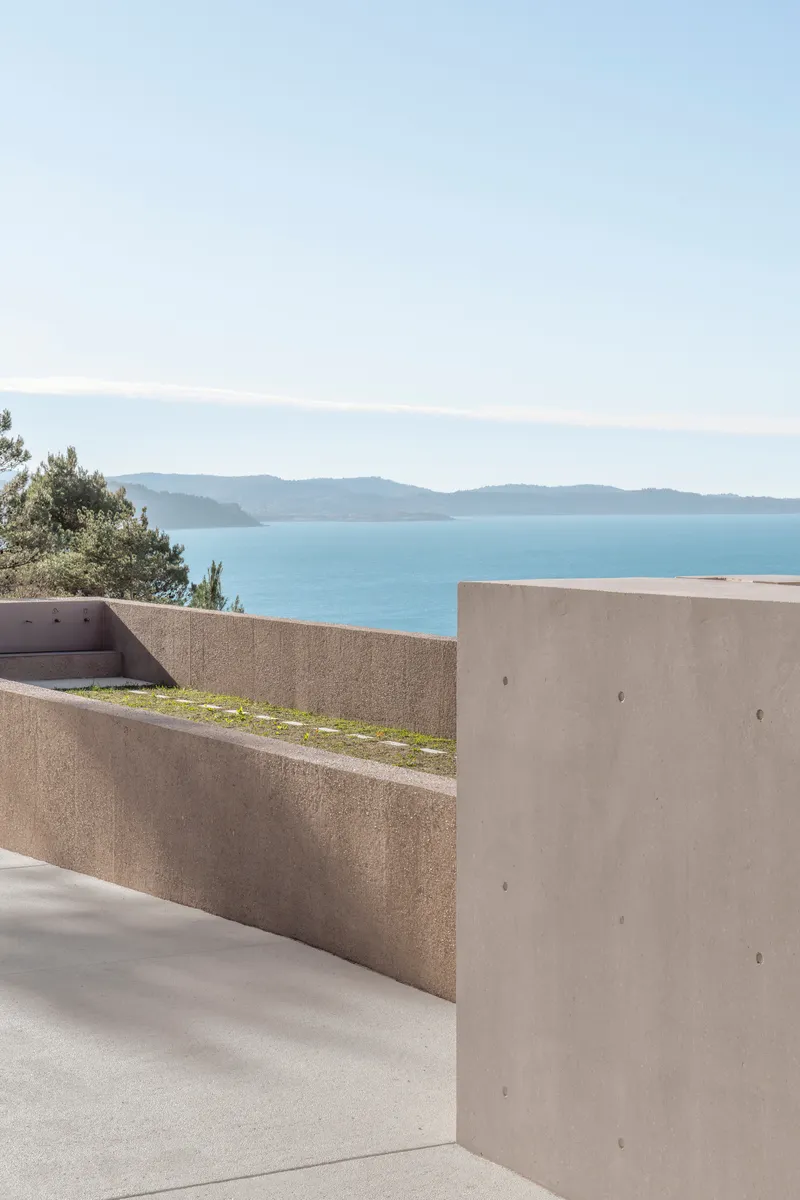
The site's position above the modernist church of St. Nikolaj along Oljčna pot gives it a kind of civic gravity. Before this project, Ankaran had no suitable place to say goodbye to its dead. Now it has one that doubles as a belvedere, a vantage point from which the Slovenian Istrian coast unfolds in panoramic clarity.
The Farewell Building
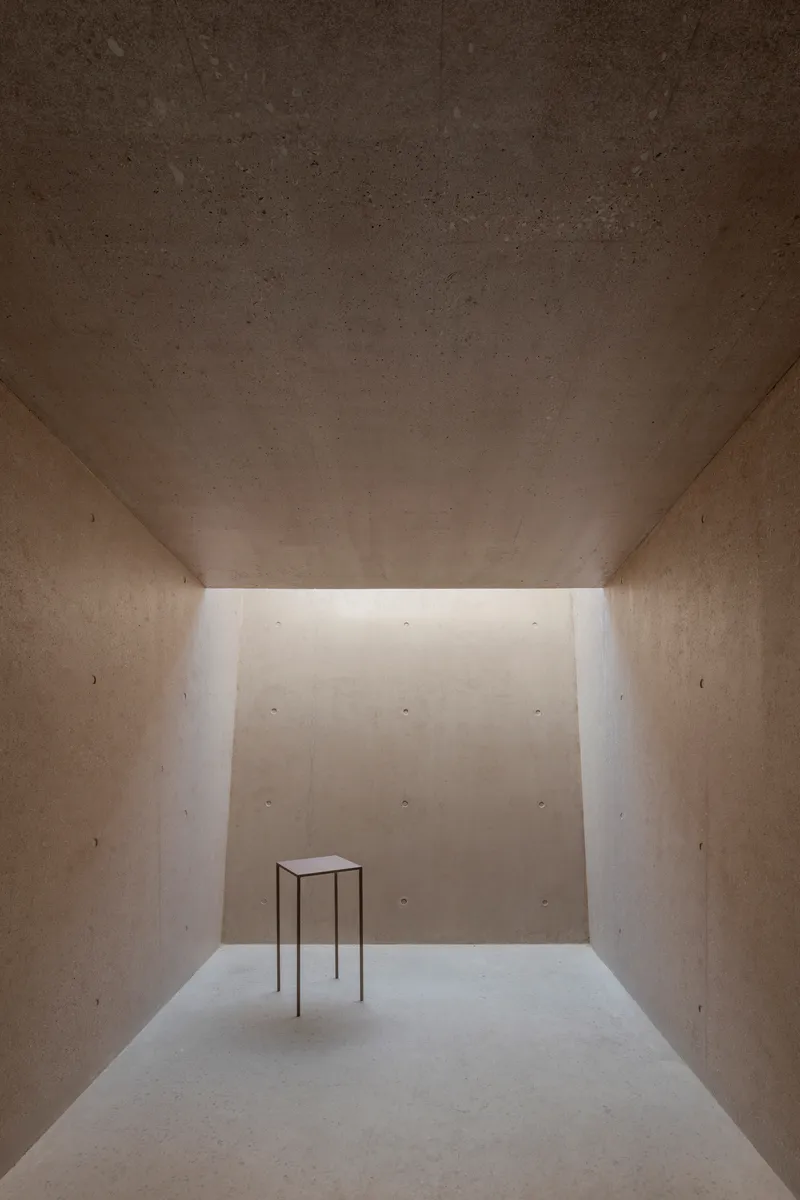


The farewell building occupies the lowest terrace, reached by a low ramp that ensures accessibility without disrupting the processional quality of the approach. It is organized into three sequential parts: an entrance platform with a bench, an introverted chapel lit by zenithal light, and a covered farewell area that opens onto the forest. Between the chapel and the farewell space, a green atrium with a water mirror focuses the gaze into the depths of the woods. The progression from public threshold to private grief to natural immersion is handled with restraint and precision.
The interior gallery space, spare and top-lit, reduces architecture to its essentials: a floor, walls, and controlled light falling from above. A solitary metal table occupies the room, and the absence of ornament forces attention onto the quality of the light itself, which shifts with the weather and the hour. Behind this, an introverted service volume discreetly houses storage, toilets, and a kitchenette, keeping the pragmatic necessities out of sight.
Material Language: Flysch, Limestone, and Washed Concrete


Every material decision here derives from the site. The washed concrete walls are tinted to match the earthy color of the flysch layers that make up the local subsoil. Polished concrete is reserved for the urn walls, creating a tactile distinction between the rough containment of the earth and the refined surface where names are inscribed. Local karst limestone appears in individual accents and functional elements, alongside wood and metal, but concrete dominates: it is the material that does the structural work, holds the slope, and defines the spatial boundaries.
The fluted column details and aggregate textures visible throughout the project demonstrate a commitment to concrete as an expressive medium, not just a structural expedient. The columns supporting the floating flat roofs are cylindrical, almost classical in their proportions, yet their roughness ties them to the landscape rather than to any historicist vocabulary. Against this, the slot openings in the boundary walls filter light through the pine canopy, casting shifting patterns that animate what could otherwise be inert surfaces.
The Serpentine Path
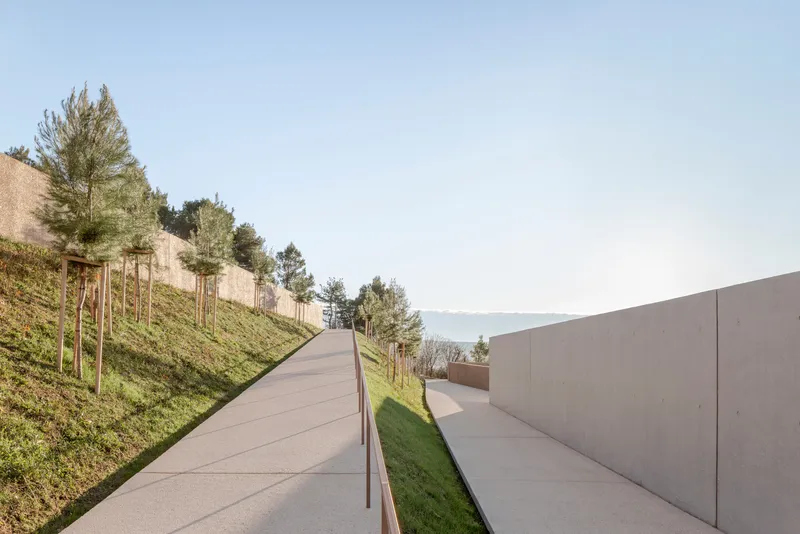
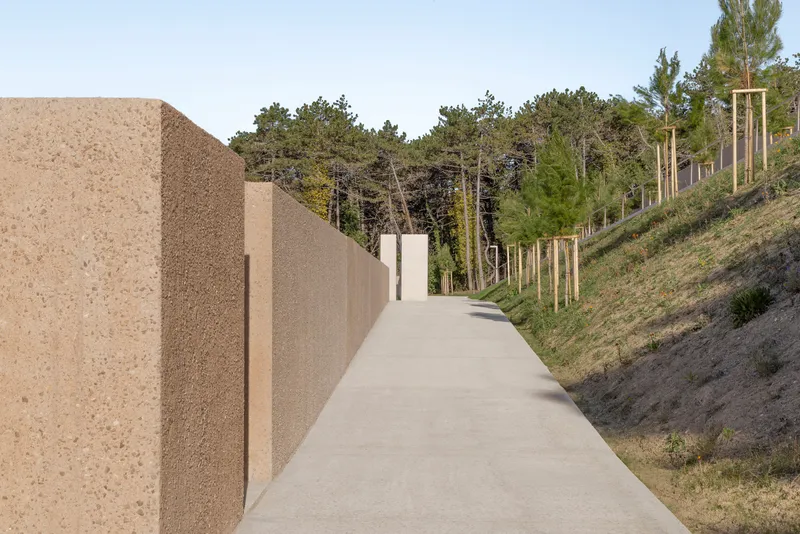

The connecting path is described by the architects as a ritual sequence, and it reads that way on the ground. It curves through the pine forest, flanked by cork-clad walls and smooth retaining surfaces, ascending from the farewell building through three terraces of walled burial fields to the highest level, where ash scattering takes place. The path is bright, floating slightly above the terrain, a deliberate contrast to the darker enclosures of the burial plots it connects.
Paired concrete panels form gateways along the route, and newly planted saplings on the slope signal that this landscape is still in formation. The cemetery accommodates 110 ground coffin graves, 246 ground urn graves, 180 urn niches, and 272 places for epitaphs in the ash scattering area. These numbers matter because they prove the design is not simply atmospheric: it is a working infrastructure for a community's needs over decades, organized so that the functional and the contemplative never undermine each other.
The Burial Terraces and the Sacred Grove

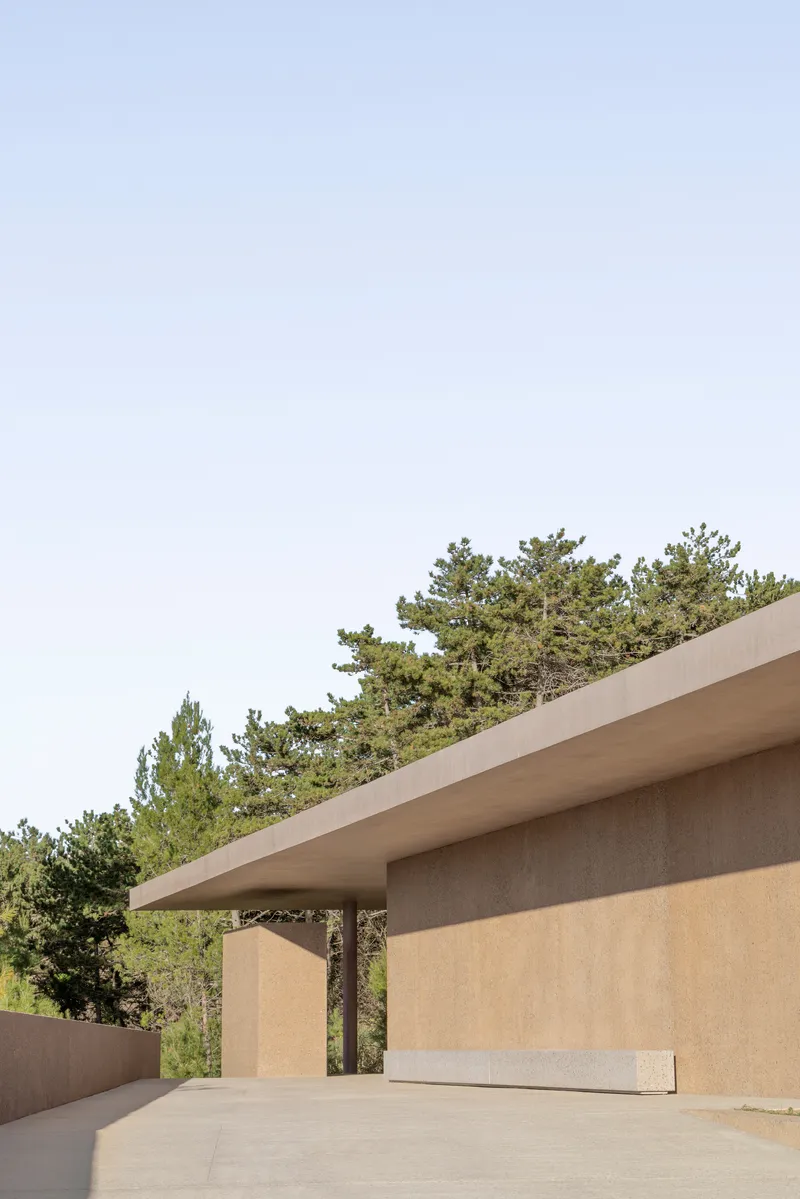

The three middle terraces contain the burial fields, each surrounded by a low wall interrupted at its entrance by a higher urn wall. The enclosure is selective: enough to mark a boundary, not enough to create isolation. Inside, angular walls and grouped timber posts establish a geometry that is precise but not rigid. Cypresses punctuate the composition in the way they do in Mediterranean cemeteries across the Adriatic, but here they share space with existing pines, producing a hybrid landscape that is neither wholly designed nor wholly natural.
The concept of the sacred grove, a forest that is also a sanctuary, runs through the project. The architects chose not to clear the existing trees but to build among them, so that the architecture emerges from the forest floor rather than displacing it. Covered colonnades with cylindrical columns support concrete slab roofs above lawns, creating sheltered gathering spaces that feel provisional in the best sense: as if the trees might one day reclaim them.
The Green Roof and Upper Terrace


The green roofs are more than environmental gestures. They are part of the project's strategy of disappearance, ensuring that from above, the cemetery reads as forest rather than as built mass. Curved gravel roof planes with circular planting apertures allow trees to grow through the architecture, blurring the line between building and terrain. At the upper terrace, thin retaining walls bound the ash scattering area, where the architecture is reduced to the minimum: a low line, an open sky, and the panoramic view of the bay.
The cor-ten steel parapets that appear at the upper levels introduce a warmer tone against the grey of the concrete, aging alongside the landscape in a way that polished materials cannot. The open-air terrace framed by columns, with the sea horizon visible beyond a low parapet, is perhaps the most emotionally direct space in the project. It offers nothing but the view, and that is enough.
Plans and Drawings

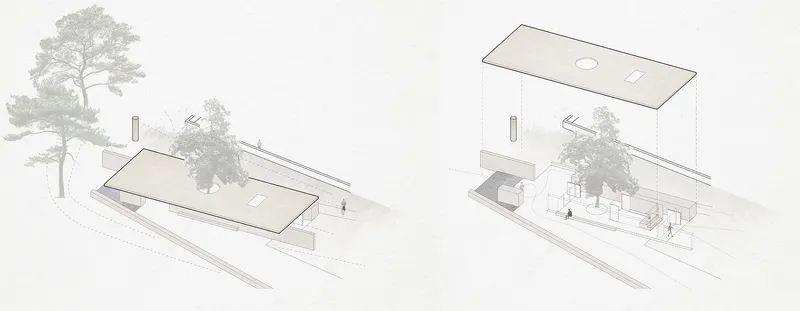

The axonometric drawings reveal the structural logic that the photographs only imply. The two elongated pavilion volumes with their latticed facades are shown nestled among trees, confirming that the architecture was designed around existing vegetation rather than against it. The exploded axonometric is particularly instructive: stacked horizontal floor plates float above a circular ground-level element, illustrating how the terracing system works as a three-dimensional section cut into the hillside. The interior spatial arrangement beneath the floating roof planes is legible in the second drawing, where figures and trees occupy the same space, reinforcing the project's central ambition: to make the forest and the cemetery indistinguishable.
Why This Project Matters
Cemetery Ankaran matters because it takes a building type that is frequently sentimentalized and treats it instead as an exercise in civic landscape infrastructure. The decision to leave the cemetery open, to integrate it into the network of public paths, to enclose only the burial fields rather than the entire precinct, is a statement about what a cemetery can be in a small Mediterranean town: not a fenced compound at the edge of consciousness but a daily landscape, walked through on the way somewhere else, present and ordinary and therefore available for contemplation without the requirement of formal occasion.
void arhitektura's material discipline, drawing every color and texture from the site's own geology, prevents the project from becoming generic. The washed concrete that echoes flysch, the karst limestone, the deliberate preservation of existing trees: these are not decorative choices but ethical ones, binding the architecture to the specific ridge on which it stands. In an era when cemetery design oscillates between banal commercial parks and overwrought memorial landscapes, this project charts a third course. It is quiet, specific, and deeply rooted in its place. Five years from competition to completion, through difficult loess subsoil and the memory of a site once destined for commercial exploitation, Ankaran now has the public space it was missing.
Cemetery Ankaran by void arhitektura (lead architects: Uroš Rustja, Primož Žitnik, Mina Hiršman, Mateo Zonta). Ankaran, Slovenia. 7,085 m². Completed 2024. Photography by Miran Kambič and Ana Skobe.
About the Studio
Share Your Own Work on uni.xyz
If projects like this are the kind of work you want to make, uni.xyz is a place to publish your own, find collaborators, and enter design competitions.


Popular Articles
Popular articles from the community


Manzana Morphosis: Stretching Barcelona's Grid into a Living Landscape for 2050
A radical reworking of the Eixample manzana turns density into a tool for generous public space, vertical ecology, and environmental performance.
Cloaked Colonization: A Mobile Underwater Habitat That Moves Like a Fish
Micah Abaya's shortlisted EHC Pacific entry reimagines ocean settlement as a dispersed network of self-sustaining architectural organisms.
Extended Shell: Retrofitting Kolkata's Balconies as Living Urban Thresholds
A modular retrofit system recovers the social and environmental intelligence of Kolkata's historic verandas for contemporary Park Street residents.

The Amber Palace Opera: A Geological Fiction Surfaces on Tallinn's Baltic Waterfront
Pierre Brillard reimagines a Baltic legend as a public landscape, opera house, and waterfront promenade rooted in Tallinn's coastal identity.

Similar Reads
You might also enjoy these articles

Bao Huynh Watercolor Atelier: A Serene Art Retreat in Hội An
Bao Huynh Watercolor Atelier in Hội An blends multifunctional art spaces, sustainable design, local materials, and family-friendly living in a serene environment.

Atelier Macri Concept Store Interior Design by CASE-REAL
Atelier Macri store features a "ko" counter, walnut wood details, cork displays, blending retail, gallery, and seamless customer experiences.

Manuel Vargas Izquierdo Stadium and High-Performance Sports Center: Architectural Excellence in Jalpa de Méndez
The Manuel Vargas Izquierdo Stadium blends sustainable design, inclusive sports facilities, and cultural-inspired architecture, revitalizing Jalpa de Méndez’s public spaces.

KAKR Buluh Awar Hall: Revitalizing Community and Ecology Through Bamboo Architecture
Community built bamboo hall revitalizes Buluh Awar village, empowering youth, restoring ecology, celebrating vernacular craftsmanship through sustainable architecture and culture.

Explore Cemetery Competitions
Discover active competitions in this discipline

Challenge to reimagine the Iron Throne

Photograph architecture without architects

Illustrate the lost glory of Angkor Wat - Render Challenge

Design challenge to reuse E-waste
Comments (0)
Please login or sign up to add comments
No comments yet. Be the first to comment!