
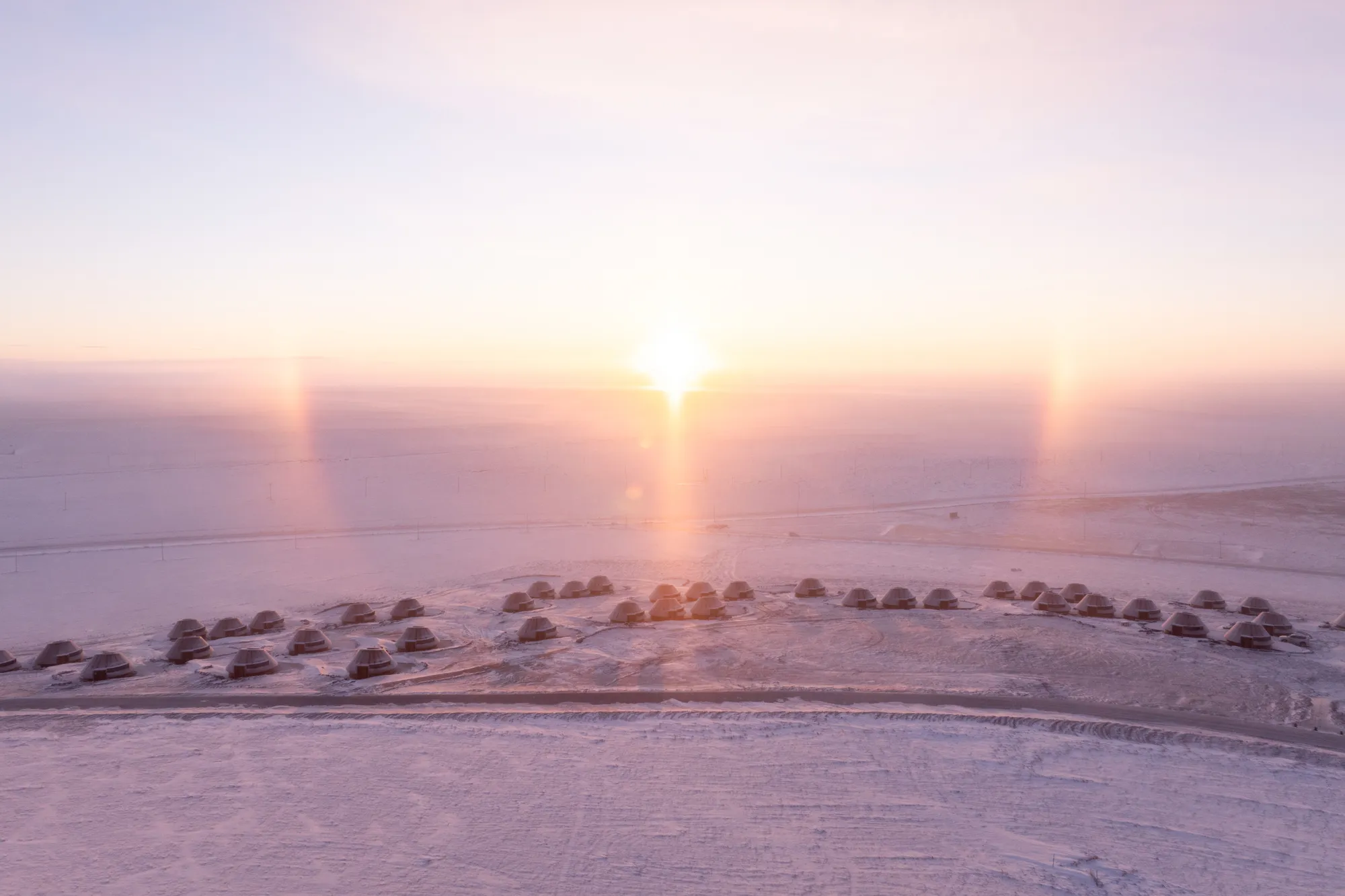
A Volcanic Landscape Reborn as Hotel Architecture
PLAT ASIA's Volcano-In Hotel of Arrivals scatters dome shelters across an Inner Mongolian snowfield, turning ecological restoration into hospitality.


There is something profoundly disorienting about encountering architecture that refuses to announce itself. On the volcanic plains of Xilingol League in Inner Mongolia, PLAT ASIA has completed a hotel that reads less like a building and more like a geological event: a field of dome shelters scattered across snow-dusted terrain, connected by curving pathways that follow the topography rather than impose a grid. The Volcano-In Hotel of Arrivals, finished in 2025, sits on land that was ecologically degraded, and the project treats hospitality and landscape remediation as inseparable acts.
What makes this project worth paying attention to is not just its formal language, though the domes are striking. It is the organizational logic. Rather than consolidating the hotel program into a single structure, the architects distributed it across dozens of small units, creating a settlement pattern that echoes nomadic encampments while allowing the ground to heal between buildings. The result is a hospitality project that operates at the scale of landscape planning, where the distance between your room and the restaurant is measured not in hallways but in weather.
Settlement as Strategy

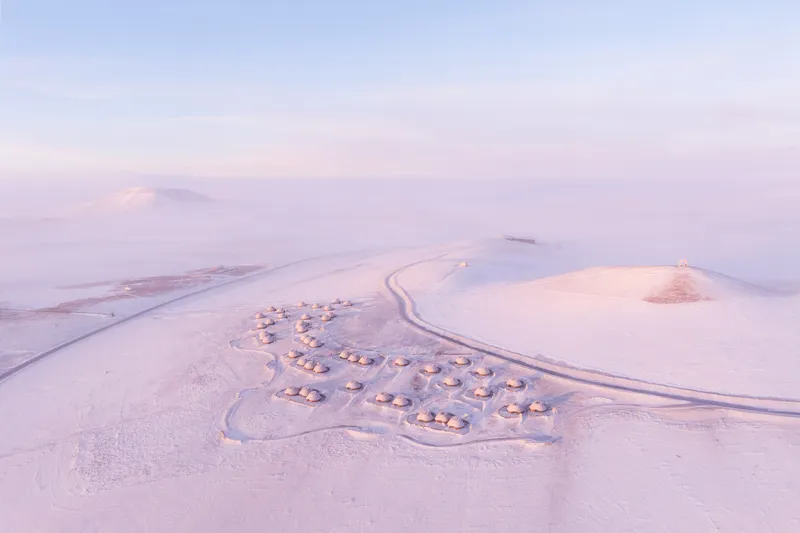
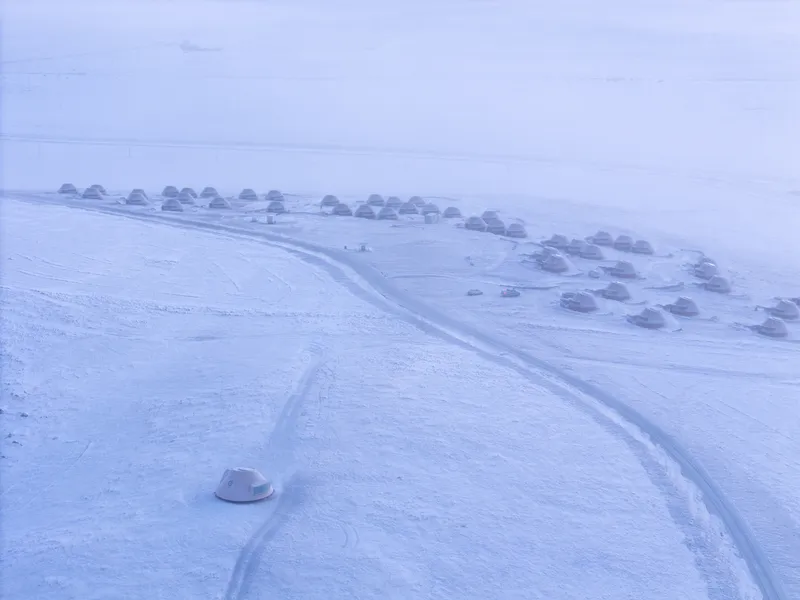
Seen from above, the hotel's organizational principle becomes legible. The dome units cluster in three loose groupings, connected by pathways that meander through the terrain. The pattern is neither random nor rigidly composed; it has the quality of a village that grew over time, shaped by wind direction, drainage, and the slope of the land. PLAT ASIA clearly studied how dispersed settlement can reduce ecological impact while creating a sense of discovery for guests moving between structures.
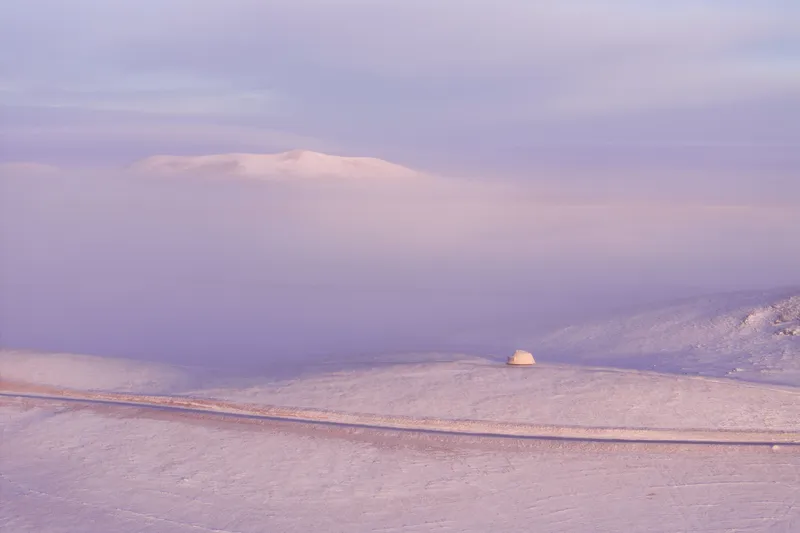
The aerial views reveal something else: vehicle tracks and access roads are minimized and curved, avoiding the straight-line cuts that typically scar remote sites. Infrastructure here is subordinate to topography. The three-lobed plan visible in misty conditions gives the entire complex a cellular, almost biological quality, as if the buildings are organisms colonizing a recovering landscape.
The Dome as Archetype


Each unit sits on a stone foundation and is capped with a dome roof, its form referencing both the yurt traditions of the Mongolian steppe and the volcanic cones that define the site's geology. The stone bases anchor the structures visually and practically, grounding them against the ferocious winds that sweep across Inner Mongolia's plains. Horizontal ribbon windows slice through the dome form, providing panoramic views while breaking the mass into readable layers: stone, glazing, shell.
At close range, the domes reveal their material honesty. There is no attempt to disguise the structures as natural formations. The rectangular entrance volumes that protrude from each dome acknowledge function plainly: you are entering a building, not a cave. The porthole windows on some units add a nautical undertone, reinforcing the sense of sheltering against elemental forces.
Material Variation and Texture
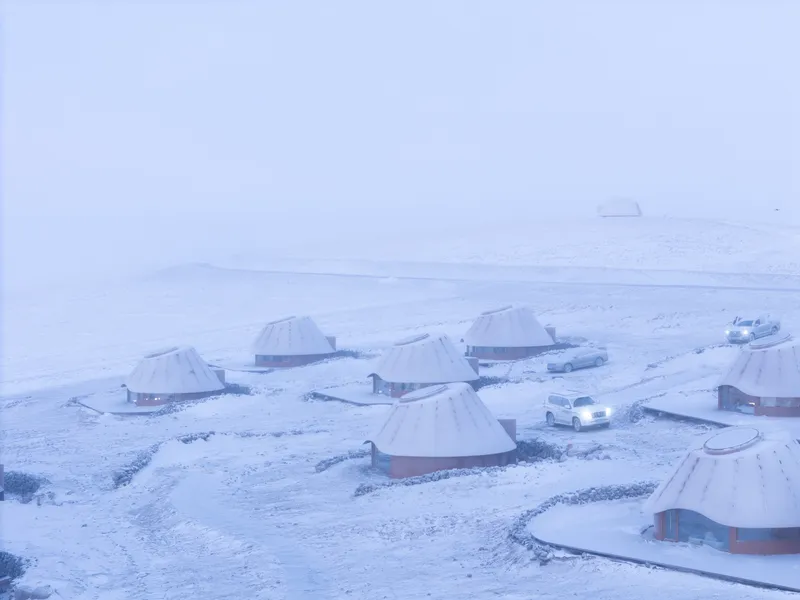


Not all the domes are identical. Some units feature conical roofs clad in timber, their vertical proportions and warm material palette creating a different register from the smoother dome shells elsewhere. The timber-clad structures, set on the same stone bases, suggest a second generation of the typology, or perhaps a programmatic distinction between guest rooms and communal spaces. Either way, the variation prevents the project from becoming monotonous across its considerable spread.
The illuminated glazed entries visible at twilight transform the units into lanterns, their warm glow against blue snow evoking the fundamental promise of shelter. PLAT ASIA has clearly calibrated the relationship between opacity and transparency: the domes are largely closed, protective shells, punctured only where views or entry demand openness. In a climate this extreme, that restraint is both practical and poetic.
Landscape as Context and Co-Author

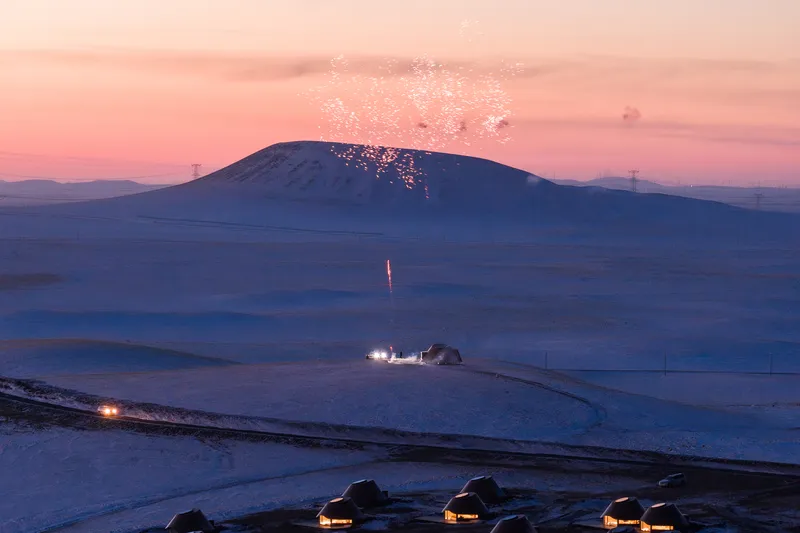
The volcanic terrain does not merely serve as a backdrop. It is the project's co-author. In one remarkable image, the dome shelters sit in their snowy field while a volcano erupts in the distance, illuminating the sky. The scale collapse is extraordinary: these small, human-scaled shelters positioned against the geological violence that formed the very ground they stand on. It is a confrontation with deep time that few hotel projects even attempt.
Rolling hills, low cloud cover, and vast snowfields dominate every frame. The architecture never competes with this vastness. Instead, it occupies the middle ground, literally and figuratively, between the immensity of the landscape and the intimacy of a single guest's experience. The ecological restoration mission is embedded in this posture: the buildings tread lightly because the land is still healing.
The Human Scale
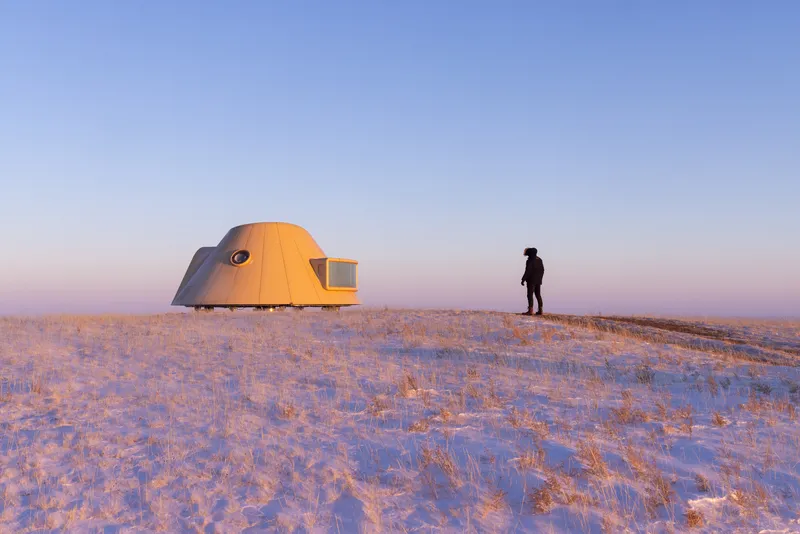

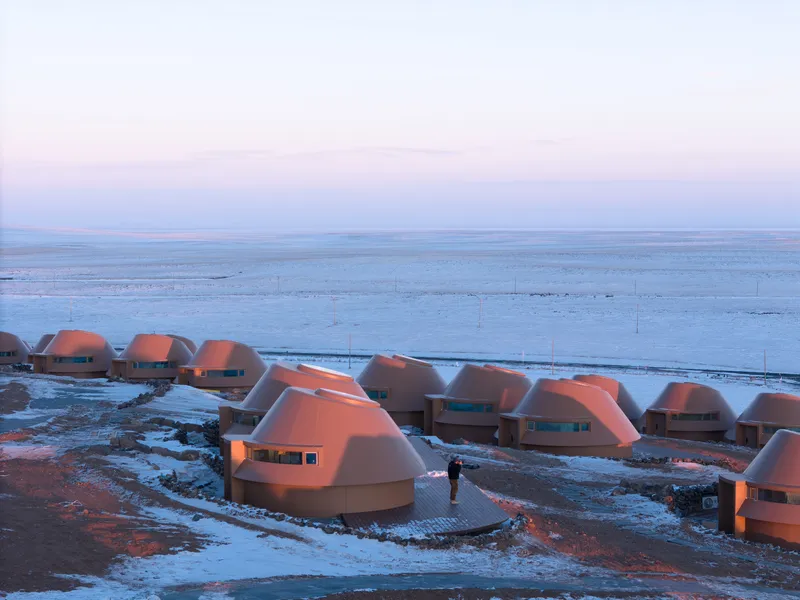
Figures appear occasionally in the photographs, and their presence recalibrates everything. A person standing beside a dome on a snow-covered ridge at golden hour reveals the true scale of these structures: they are intimate, almost domestic, barely larger than the body they shelter. A solitary figure walking between units at dusk captures the experiential core of the project, the meditative act of traversing open ground to reach your room.
There is something deliberately anti-luxury about this. Most high-end hotels eliminate friction, wrapping guests in seamless corridors and climate-controlled transitions. Here, the journey between spaces exposes you to wind, snow, and silence. The architecture demands participation. You do not merely stay at this hotel; you inhabit a landscape.
Atmosphere and Extreme Conditions

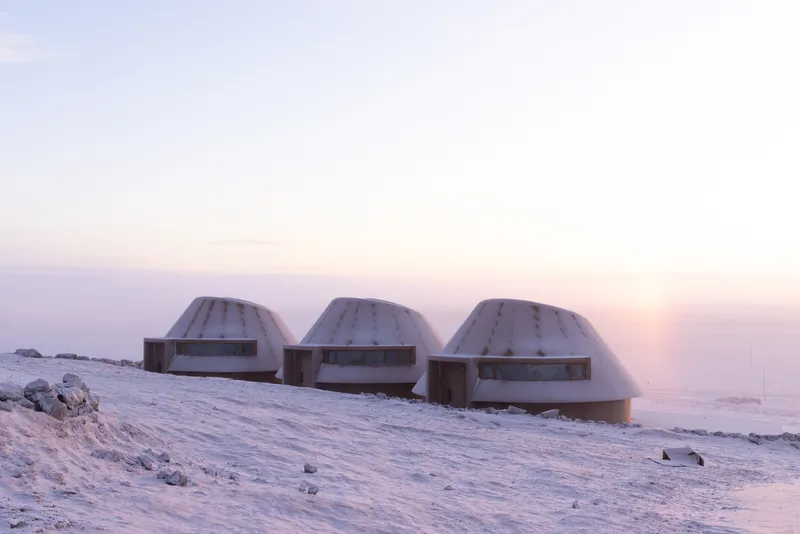

The Arch-Exist photographs capture the project across a range of atmospheric conditions, from dense fog to blazing sunsets, and the architecture performs differently in each. In heavy fog, the dome rows dissolve into abstraction, their glazed facades barely distinguishable from the surrounding white. At sunset, the forms become sculptural silhouettes against bands of amber and violet. The horizontal ribbon windows register as dark lines in bright conditions and as glowing seams at night.
Fog, in particular, reveals the genius of the dispersed plan. When visibility drops, the settlement contracts perceptually. You can see only the nearest structures, and the experience shifts from panoramic to intimate. The architecture was designed for this: not for the clear-sky postcard moment, but for the far more common condition of reduced visibility and biting cold.
Plans and Drawings
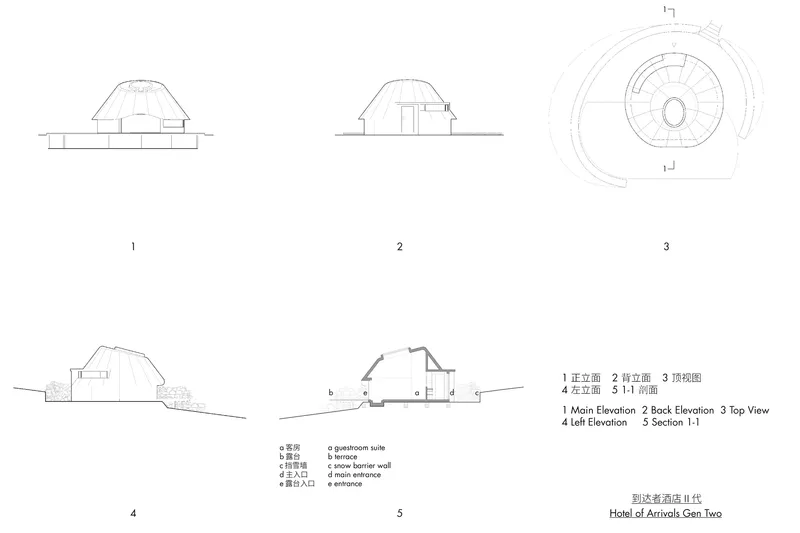


The section drawings clarify how the domes embed themselves into sloping terrain, with floor levels stepping down to follow the grade. Multiple entrances allow guests to approach from different directions depending on the path network, reinforcing the non-hierarchical character of the settlement. The site plan, rendered with contour lines and tree positions, demonstrates how carefully the buildings were placed to minimize grading while maintaining sightlines across the volcanic topography.
The section showing two domes nestled side by side on a hillside is particularly revealing. The structures nestle into the slope rather than perch on it, reducing their visual profile from a distance and gaining thermal mass from the earth contact. It is a strategy borrowed from vernacular architecture across cold climates, executed here with contemporary precision.
Why This Project Matters
The Volcano-In Hotel of Arrivals matters because it proposes a genuinely different model for hospitality in fragile landscapes. Rather than concentrating program into a single building that dominates its site, PLAT ASIA distributed it into a field condition, a constellation of small shelters that allows the ground between them to breathe, recover, and remain legible as landscape. The ecological restoration mission is not an add-on; it is the generative logic of the entire plan.
It also matters because it takes the extreme climate of Inner Mongolia seriously as a design parameter rather than a problem to be solved with insulation and mechanical systems alone. The architecture embraces exposure. It asks guests to walk through snow, to feel wind, to notice the light changing. In an industry that increasingly promises frictionless luxury, this is a provocation, and a welcome one. The domes on the volcanic plain are small, quiet, and deeply intentional.
Volcano-In Hotel of Arrivals by PLAT ASIA. Located in Xilingol League, China. 1,634 m². Completed 2025. Photography by Arch-Exist.
About the Studio
Share Your Own Work on uni.xyz
If projects like this are the kind of work you want to make, uni.xyz is a place to publish your own, find collaborators, and enter design competitions.




Popular Articles
Popular articles from the community


Conexión: Biophilic Design Reimagines High-Rise Living in Hong Kong
Conexión reimagines high-rise living in Hong Kong through biophilic design, green facades, shared spaces, daylight, water and nature within.

Hill & Cross Opera: Sculptural Opera House Architecture Shaped by Tallinn’s Landscape and Identity
Hill & Cross Opera reimagines opera house architecture in Tallinn through its sculptural hill, civic plaza, glass wave and a luminous cross.

Riyadh For All: Intergenerational Urban Design for Active Aging in Rabat
Riyadh For All reimagines urban design in Rabat with intergenerational co-living, adaptive courtyards, and Moroccan cultural exchange today.

The Musturak Paradise: Senior Living Architecture for a Connected Future in Temara, Morocco
The Musturak Paradise reimagines senior living architecture in Temara via private homes, social spaces, culture, community, and shared care.

Similar Reads
You might also enjoy these articles

Bao Huynh Watercolor Atelier: A Serene Art Retreat in Hội An
Bao Huynh Watercolor Atelier in Hội An blends multifunctional art spaces, sustainable design, local materials, and family-friendly living in a serene environment.

Atelier Macri Concept Store Interior Design by CASE-REAL
Atelier Macri store features a "ko" counter, walnut wood details, cork displays, blending retail, gallery, and seamless customer experiences.

Manuel Vargas Izquierdo Stadium and High-Performance Sports Center: Architectural Excellence in Jalpa de Méndez
The Manuel Vargas Izquierdo Stadium blends sustainable design, inclusive sports facilities, and cultural-inspired architecture, revitalizing Jalpa de Méndez’s public spaces.

KAKR Buluh Awar Hall: Revitalizing Community and Ecology Through Bamboo Architecture
Community built bamboo hall revitalizes Buluh Awar village, empowering youth, restoring ecology, celebrating vernacular craftsmanship through sustainable architecture and culture.


Comments (0)
Please login or sign up to add comments
No comments yet. Be the first to comment!