
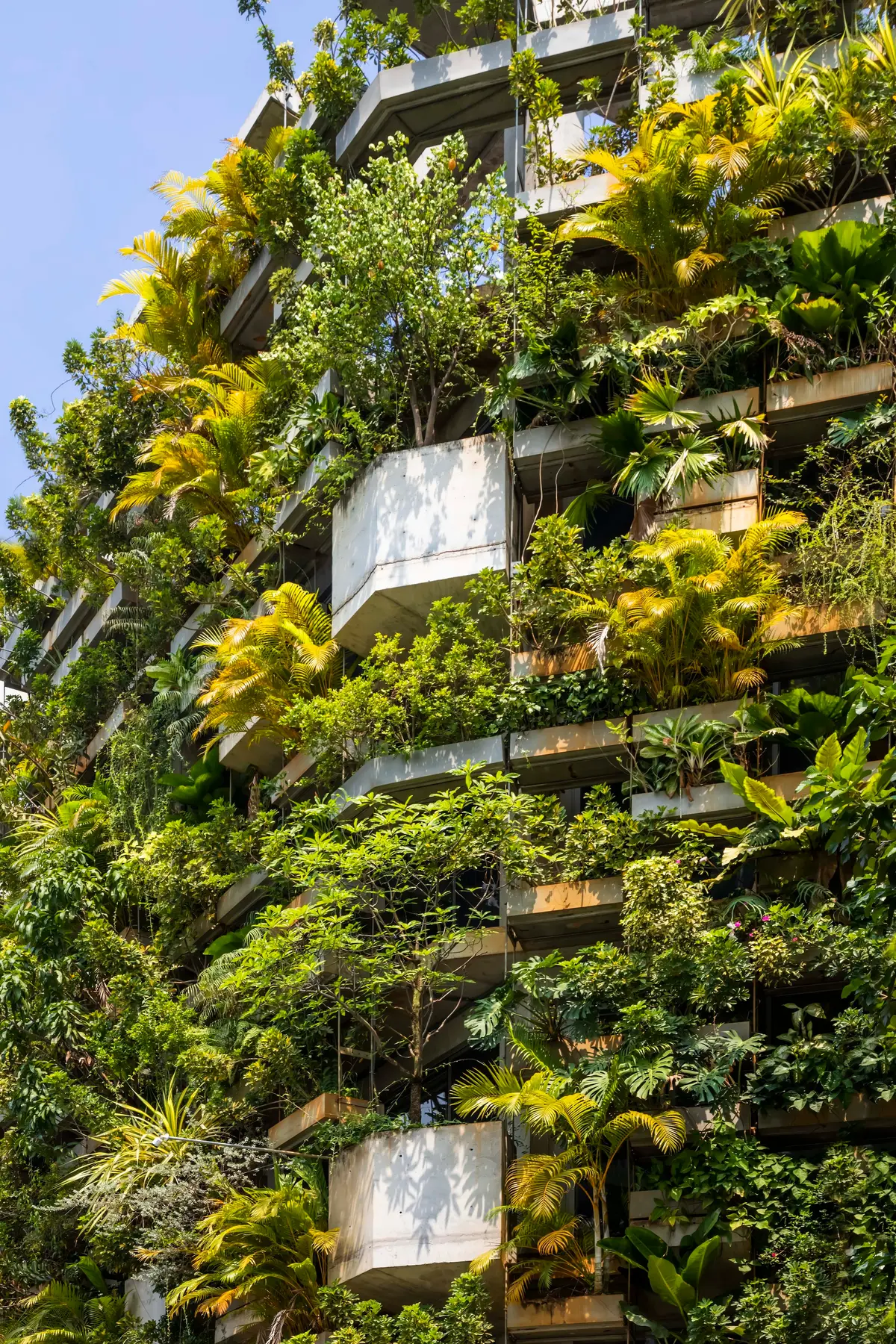
VTN Architects Wraps Their Own Ho Chi Minh City Studio in a Vertical Tropical Forest
A six-story office in Vietnam's Thu Duc district uses modular planters and passive cooling to achieve a 190 percent green ratio.


When an architecture firm designs its own headquarters, the result tends to be either a cautious showroom of greatest hits or a genuinely radical test bed. VTN Architects has landed firmly in the second camp. Their Urban Farming Office in Ho Chi Minh City's Thu Duc district is a six-story concrete frame wrapped in so much vegetation that the building's green coverage exceeds the site area by 90 percent. That number, a 190 percent green ratio, is not decorative ambition. It is a measurable strategy for food production, microclimate control, and a pointed argument that density and ecology do not have to be at odds.
Vietnam's cities were once blanketed by tropical forest. Rapid urbanization has stripped them of that heritage, concentrating heat, pollution, and flooding into the same neighborhoods that most desperately need relief. Vo Trong Nghia, the firm's founder, has been circling this problem for years. The Urban Farming Office is his most self-referential answer yet: a working studio where the architects literally sit inside the argument they are making. The planters yield roughly 1.1 tons of harvest annually. The building earned LEED Gold certification. And the daily experience of working in it, shaded by palms and ferns rather than mechanical louvers, makes the case far more persuasively than any rendering ever could.
A Green Curtain on a Corner Site
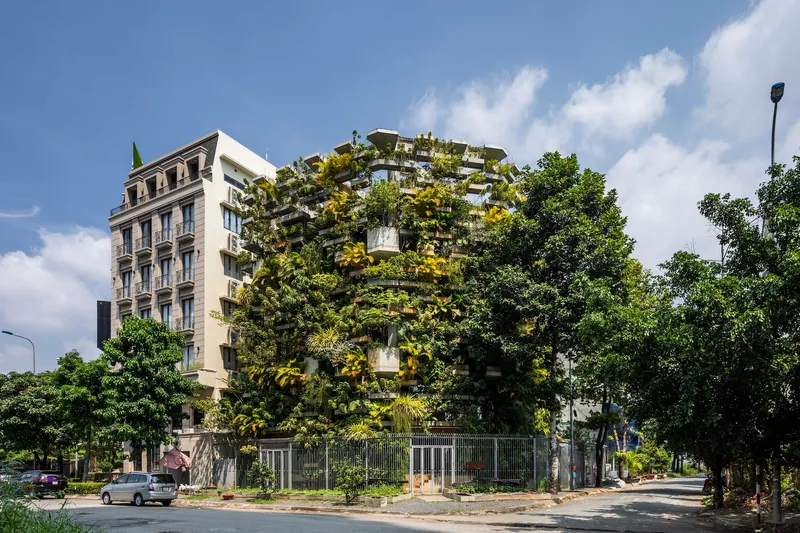
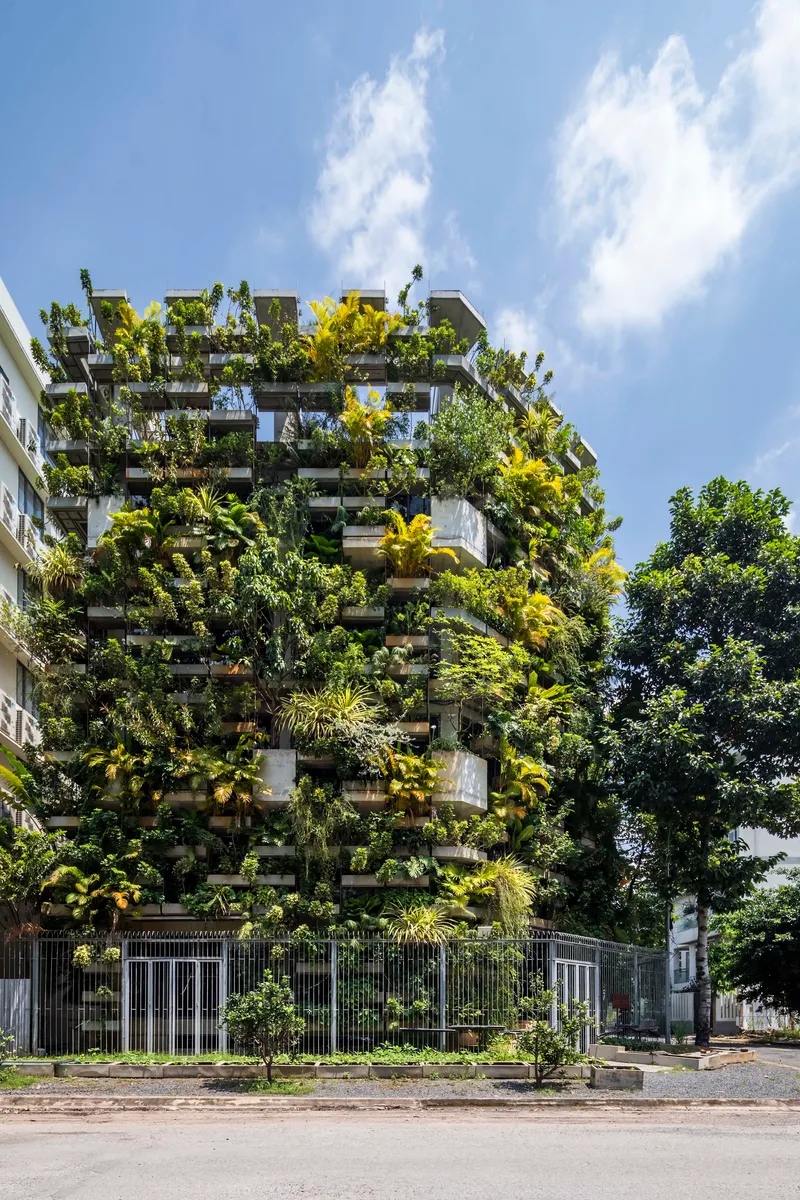
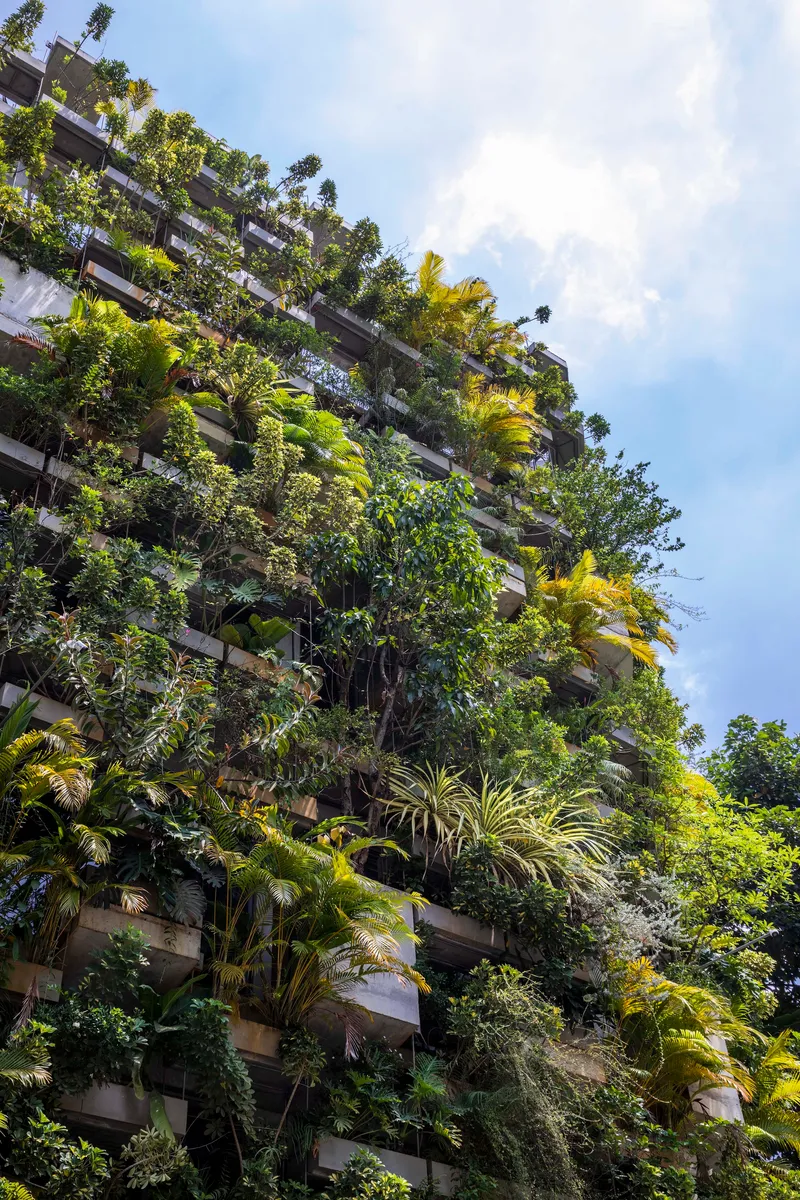
From the street, the building reads as a stack of cantilevered concrete slabs from which an absurd quantity of tropical vegetation pours. Palms, ferns, broad-leafed plants, and fruit trees cascade down the southern facade, creating a living curtain that filters sunlight before it reaches the glazed interior. The corner site gives the tower two prominent street faces, and both are covered: there is no presentable front and neglected back here. The northern wall takes a different tack entirely, a solid double-layered brick construction with small openings that drives cross-ventilation through the floor plates.
The visual effect is immediate and startling. Against the low-rise commercial fabric of the neighborhood, the building looks less like an office and more like a cliff face colonized by jungle. At twilight, interior light leaks through the foliage in patches, reinforcing the sense that the architecture is hosting the plants rather than the other way around.
Modular Planters and the Steel Skeleton That Holds Them
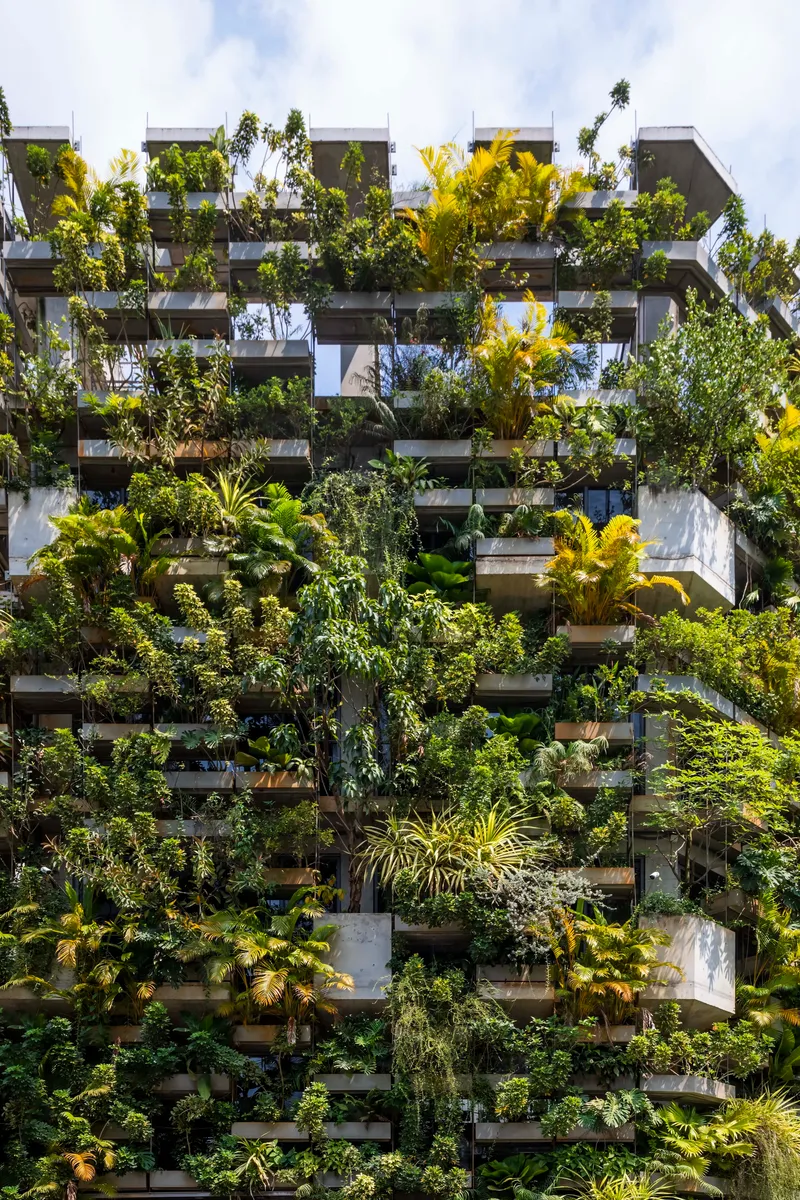
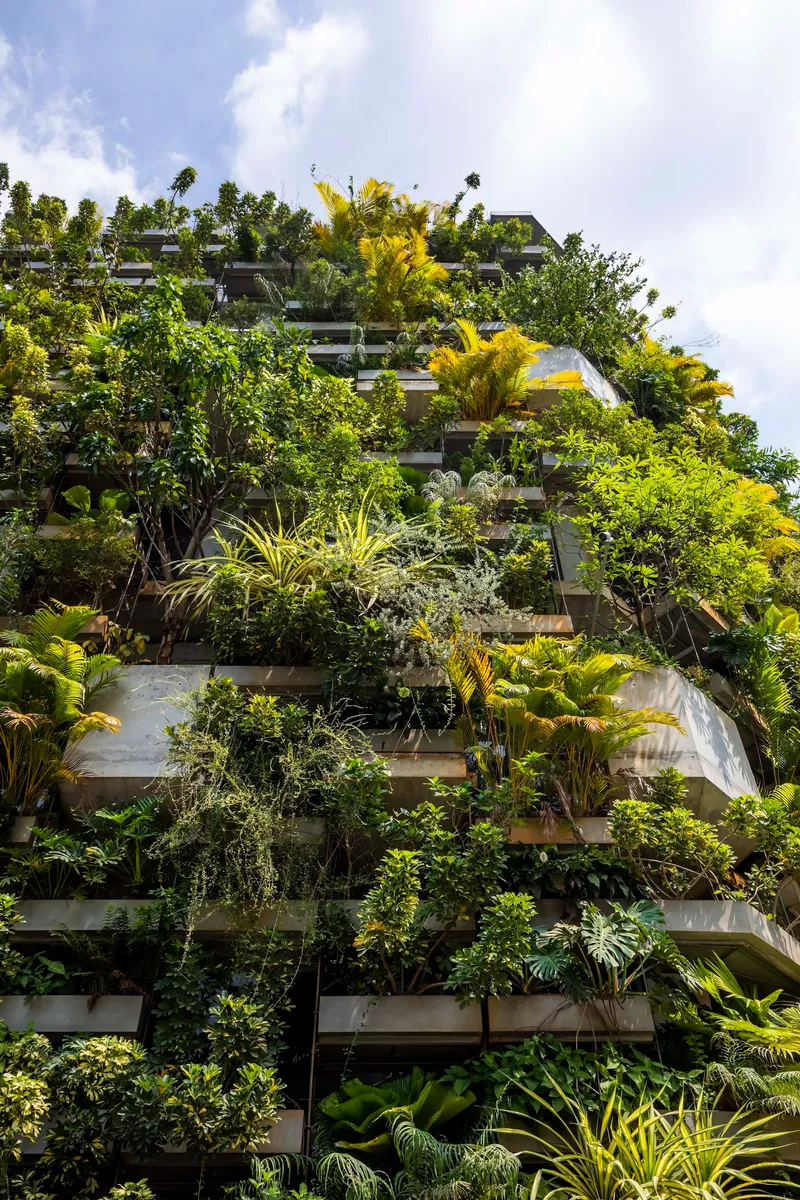
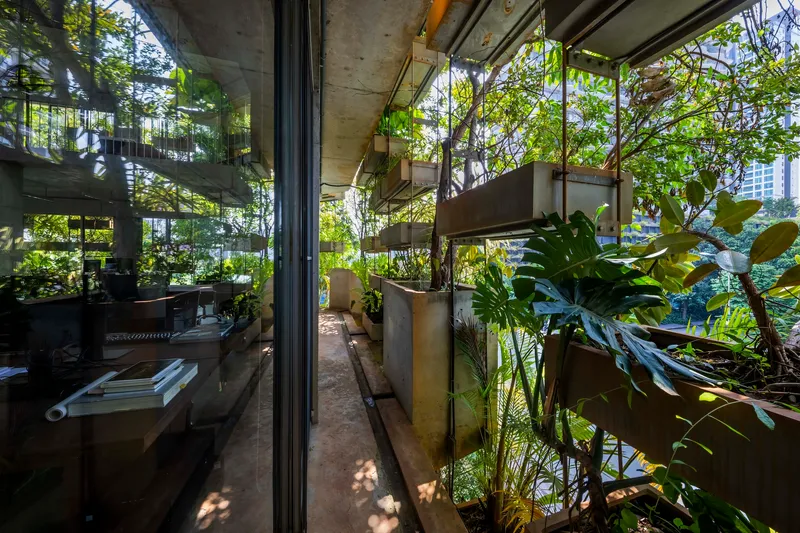
The green facade is not simply concrete balconies filled with soil. A thin, shelving-like steel structure hangs off the primary concrete frame, supporting modular planter boxes that can be replaced, repositioned, or swapped out as plants grow or seasons shift. The spacing between planters varies by floor, calibrated to annual daylight patterns so that each species receives appropriate exposure. It is precision agriculture scaled to the side of a building.
The concrete troughs themselves are robust enough to support small trees, while the steel supports remain visually light, almost disappearing behind the foliage they carry. The modularity matters beyond aesthetics: damaged planters can be removed without disturbing neighbors, and the entire system can adapt over time as the architects learn what thrives and what doesn't. A rainwater collection system irrigates the plants, and the evaporation off wet soil and leaves actively cools the incoming air, supplementing the passive ventilation strategy.
The Central Atrium as Vertical Connector
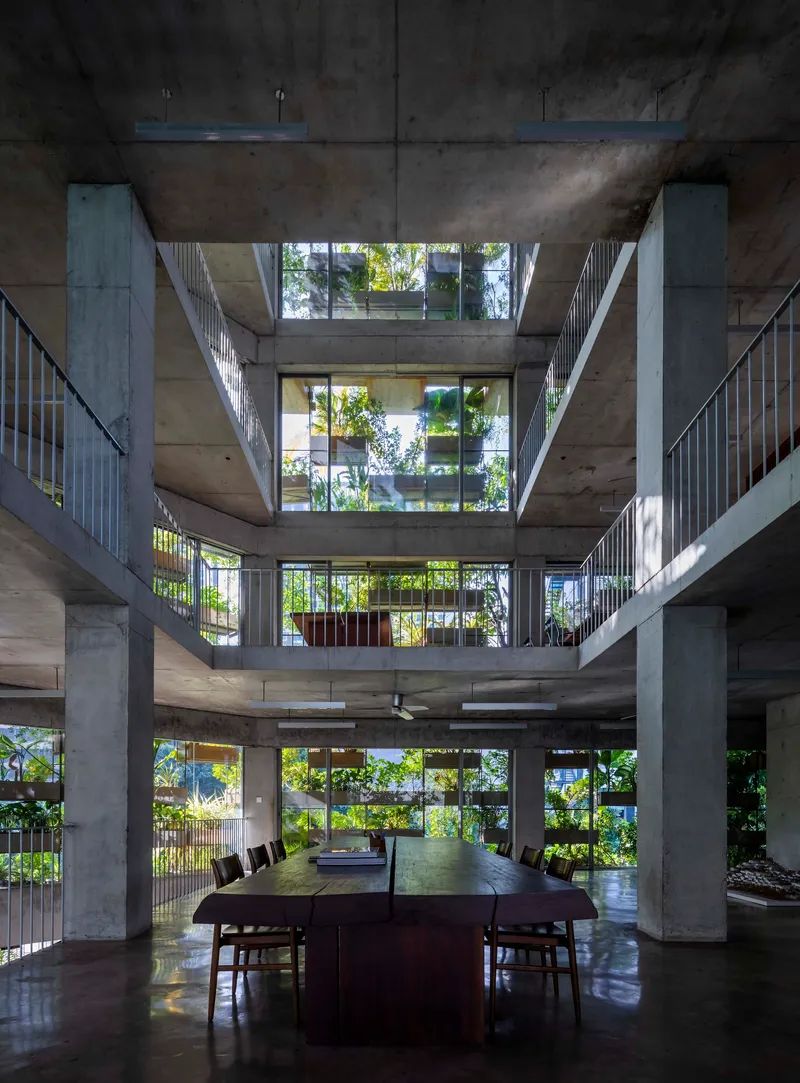
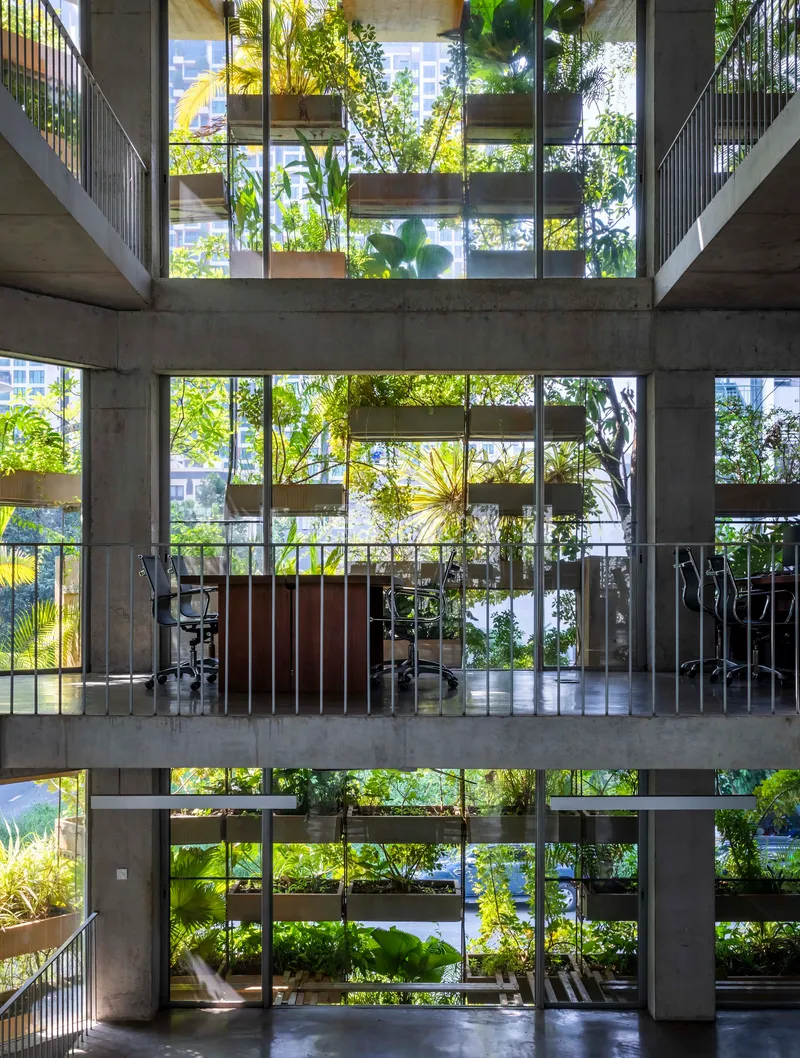
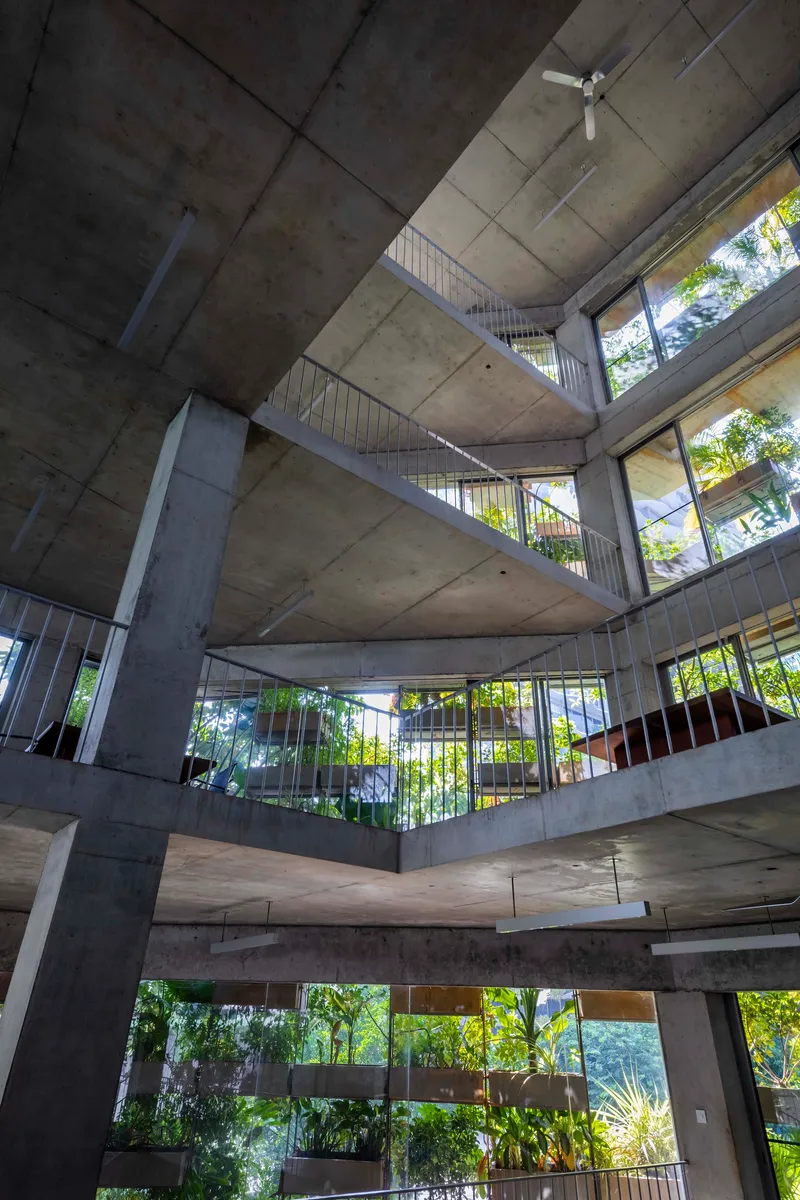
Inside the 300 square meter trapezoidal footprint, the section does the heavy lifting. Rectangular voids are punched through the concrete floor slabs in a staggered pattern, creating an atrium-like vertical connection that links all six levels visually and thermally. Looking straight up through the building, you see a rhythm of exposed concrete edges, metal balustrades, and planted terraces, a column of light and air that pulls the eye upward and hot air along with it.
The staggering is deliberate. Rather than a single open shaft, the voids shift position from floor to floor, so every workspace has a line of sight to at least one opening while maintaining enough solid floor area to be functional. The effect is of being inside a geological formation, layered and eroded, with vegetation colonizing every available ledge.
Working Among the Trees
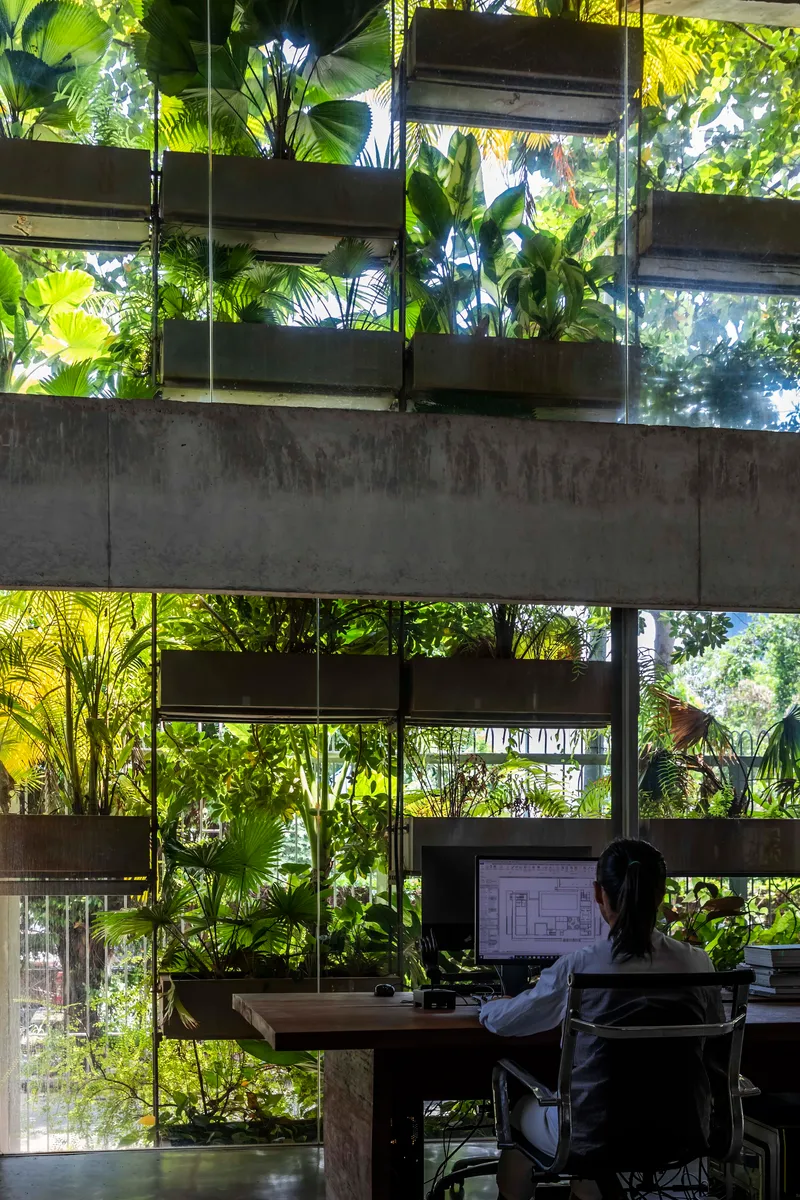
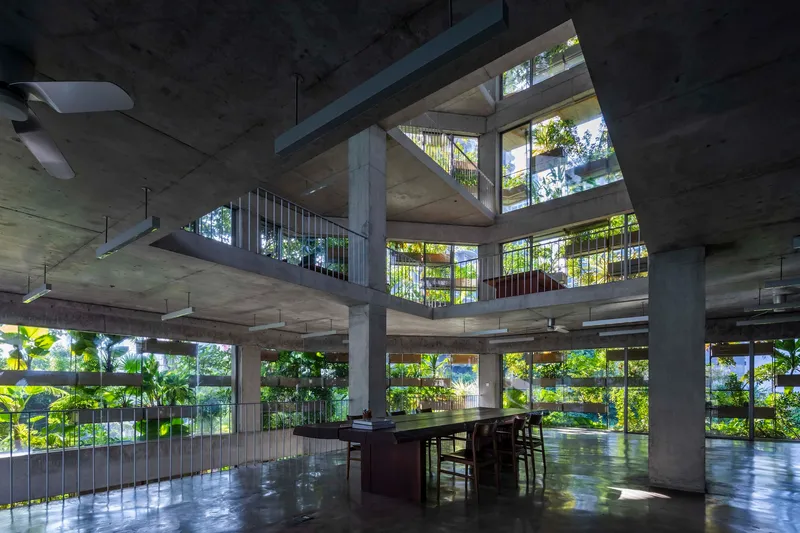
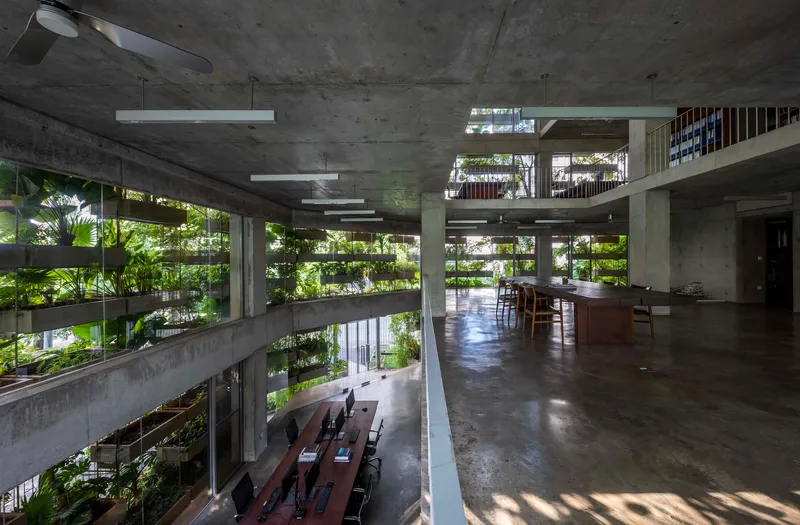
The workspaces themselves are deliberately restrained. Polished concrete floors, exposed concrete ceilings, wooden desks, and metal railings form the palette. There is no drop ceiling, no carpet tile, no acoustic panel in sight. The vegetation does the acoustic and thermal work that those products normally handle, absorbing sound, shading glazing, and cooling air through transpiration. Full-height sliding glass doors on the balcony edges let occupants move between desk and terrace with a single gesture.
Sitting at a desk here means being flanked by planting boxes filled with ferns and palms. The dappled light that filters through the green curtain shifts throughout the day, mimicking the experience of working beneath a forest canopy. It is a radical departure from the sealed, air-conditioned office norm in Southeast Asia, and one that only works because the passive strategies, cross-ventilation from the north wall, evaporative cooling from the planters, operable glazing throughout, are genuinely effective.
Communal Spaces and the Rooftop Garden
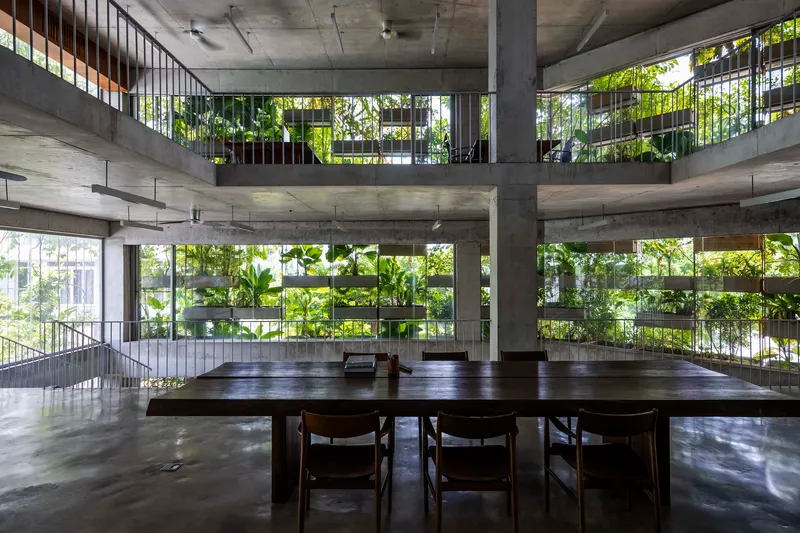
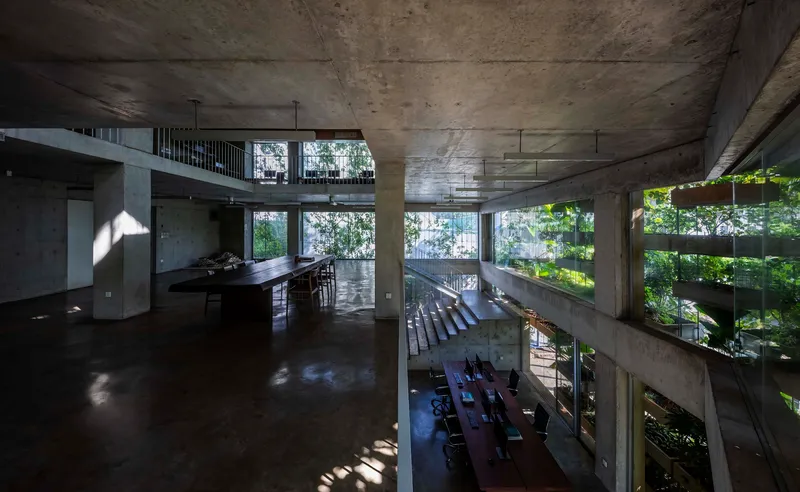
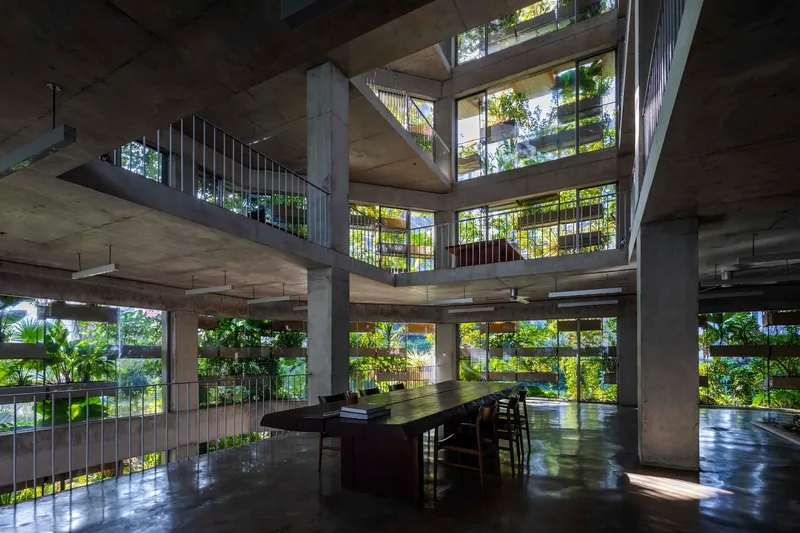
Alternating floors are dedicated to meeting rooms and communal areas. A dining space on one of the upper levels features a long wooden table beneath exposed concrete beams, framed by vertical greenery on two sides. There is nothing performative about it: this is where the studio eats lunch, harvested in part from the building's own planters. The rooftop garden extends the growing area further, hosting locally appropriate fruit trees, vegetables, and herbs maintained with organic methods.
The kitchen and dining area overlooks the lower levels through the atrium void, maintaining the building's insistence on visual and spatial continuity. You are never enclosed in a room here; you are always aware of the floors above and below, the plants growing along the perimeter, and the city beyond.
The Concrete Staircase as Spatial Hinge
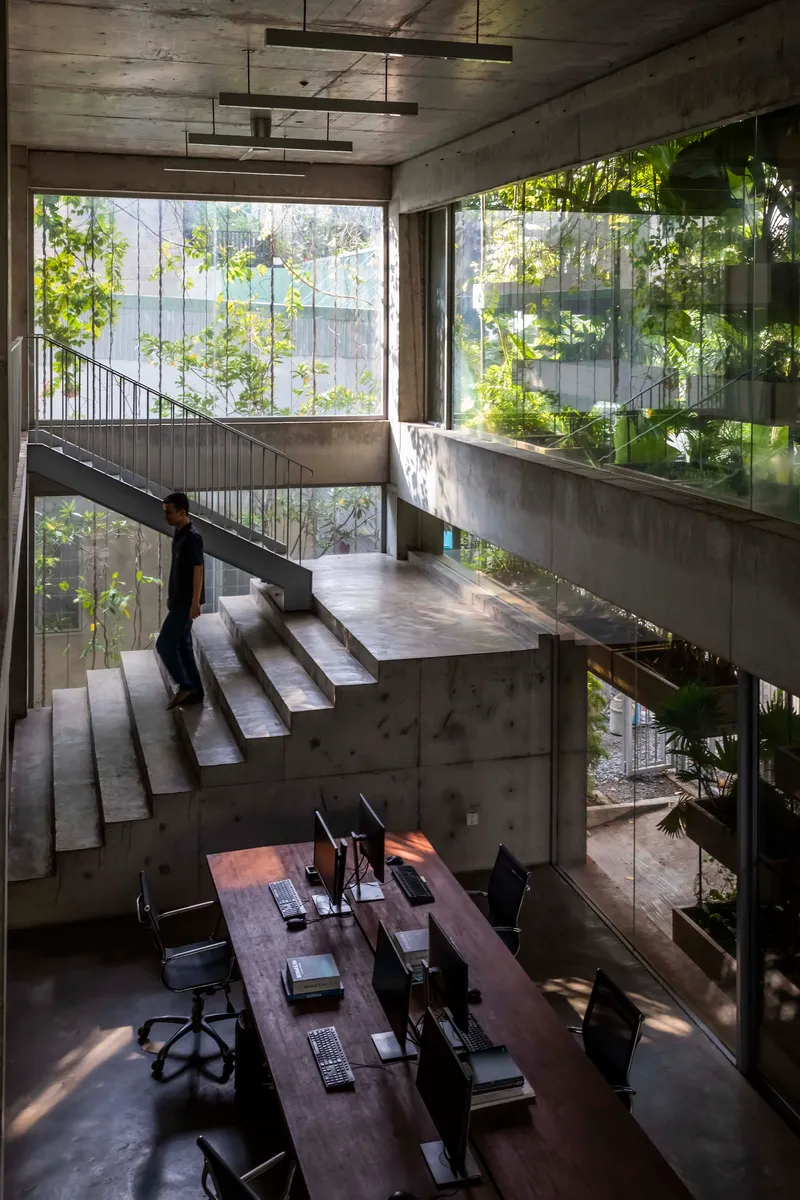
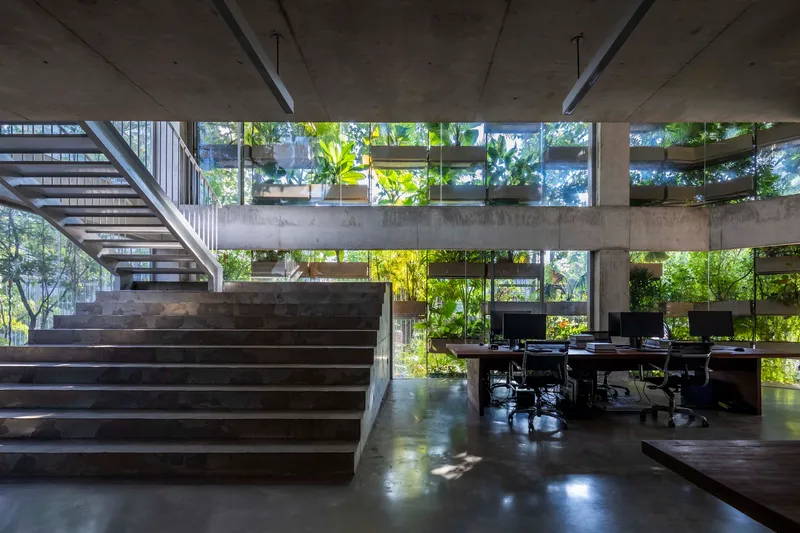
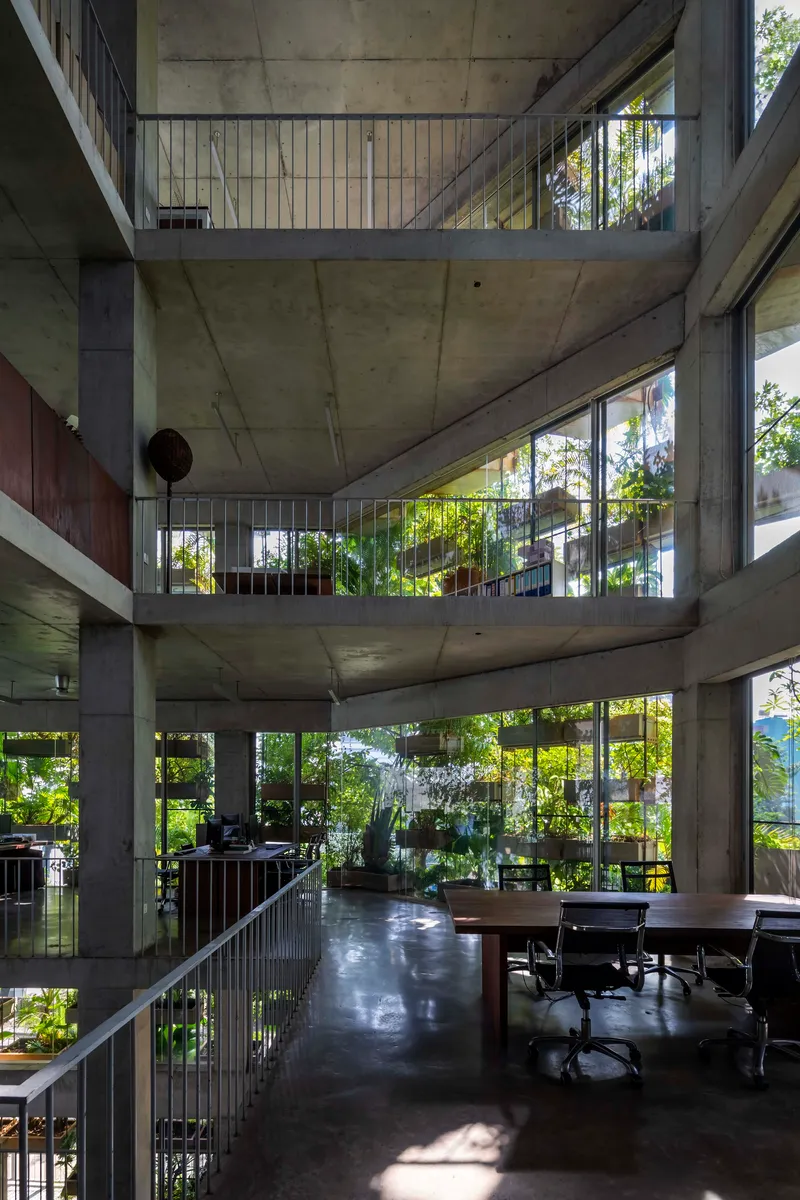
A wide concrete staircase at the ground level narrows to a steel-framed upper flight at half the width, a simple move that conserves floor area on the upper stories while giving the entrance a generous, almost civic scale. The stair runs alongside the open workspace, so ascending and descending becomes a social act: you pass desks, catch glimpses of meetings through glazed partitions, and move through shifting bands of filtered green light.
The transparency of the stair zone, aided by full-height glazing facing the planted terraces, makes circulation feel like an extension of the workspace rather than a service corridor tucked behind a fire door. It reinforces the building's central idea: there are no leftover spaces here, only degrees of immersion in the vertical garden.
Street Presence After Dark
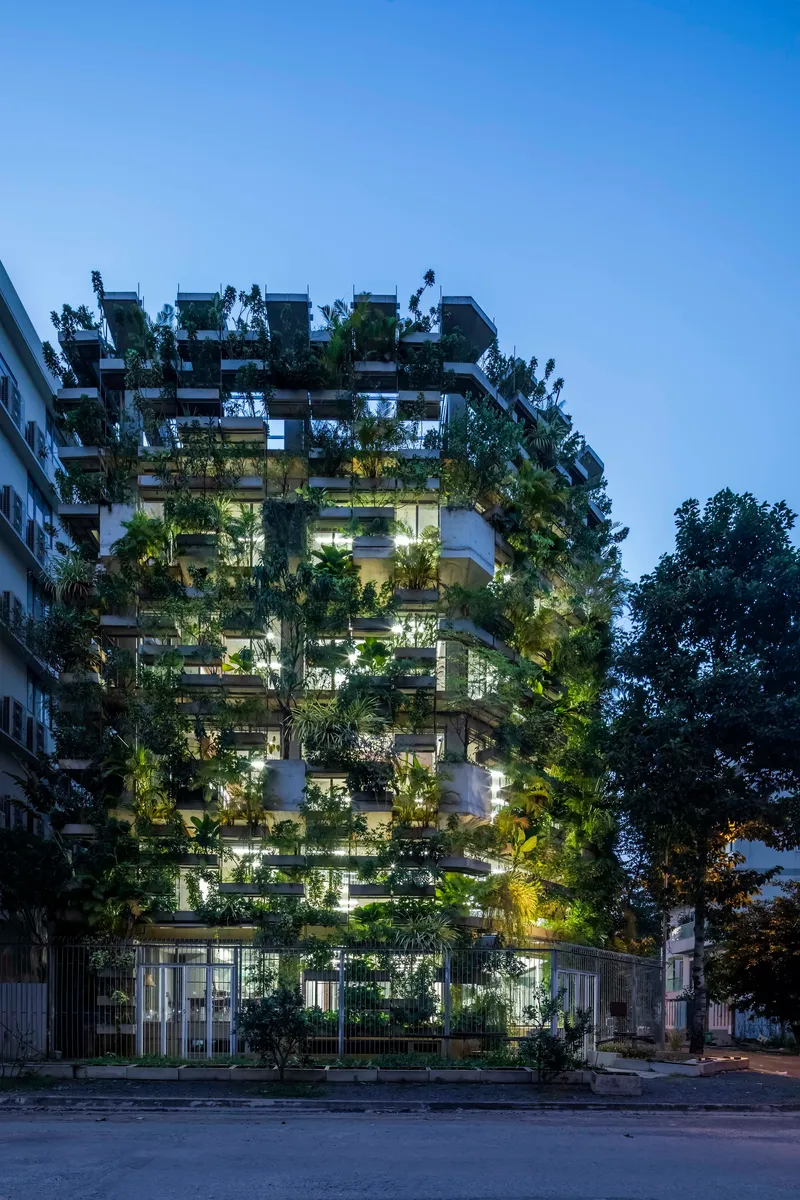
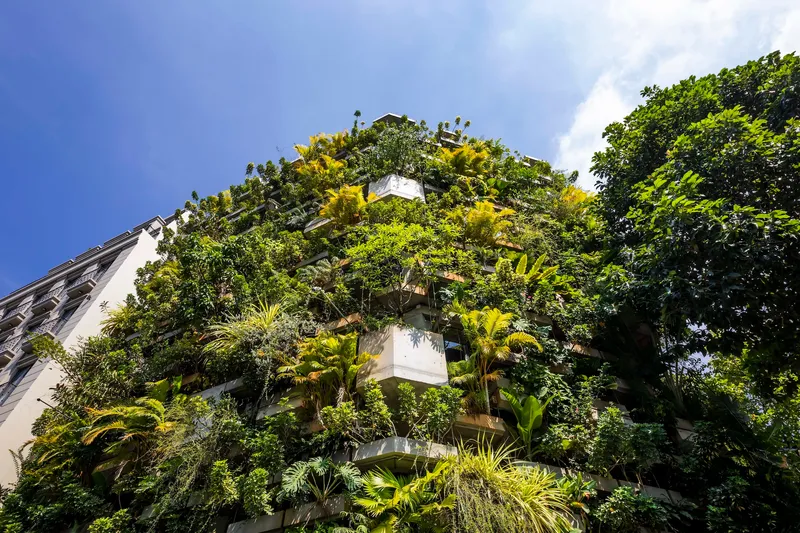
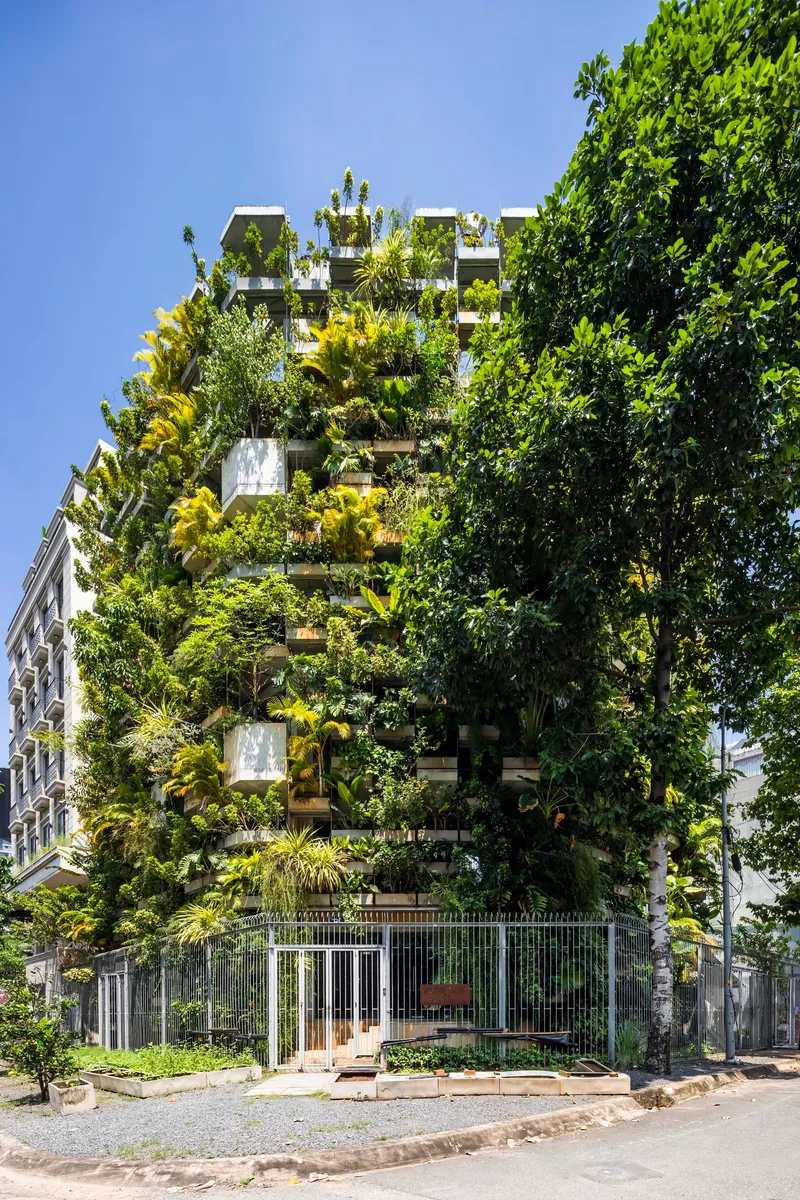
At twilight, the building takes on a different character. Interior lights glow through the dense foliage, turning the facade into a lantern wrapped in leaves. The street elevation reveals the full depth of the planting layers: palms at the outermost edge, ferns and broad-leafed species tucked closer to the glazing, and the warm glow of occupied workspace behind. From behind the low perimeter fence and entry gate, the tower reads as an inhabited treehouse, an absurd and wonderful thing to encounter on a commercial street in Ho Chi Minh City.
Plans and Drawings
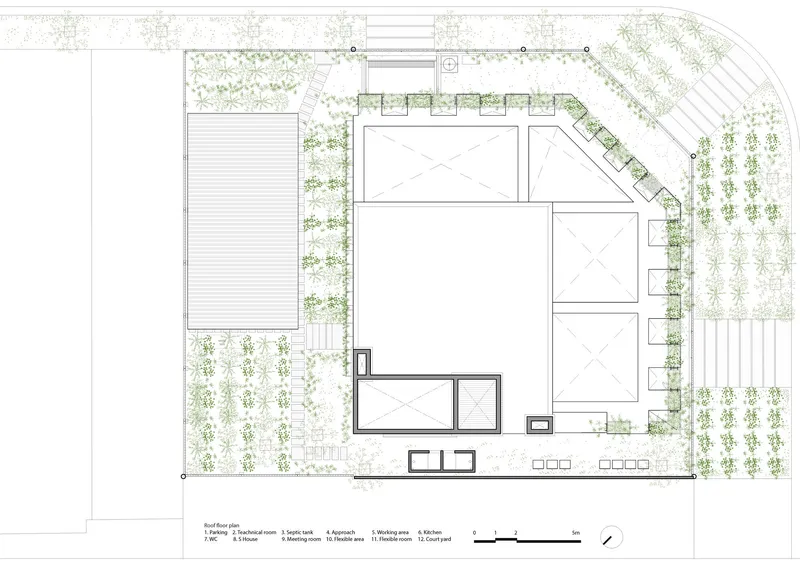
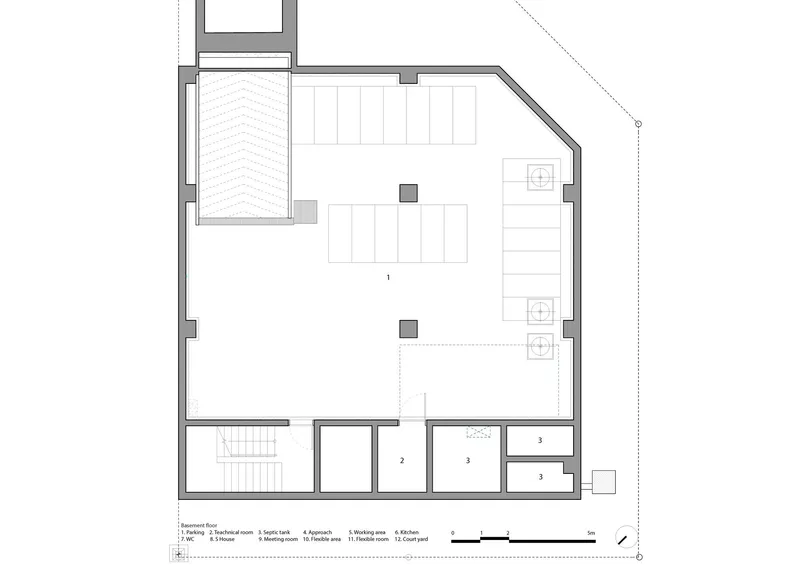
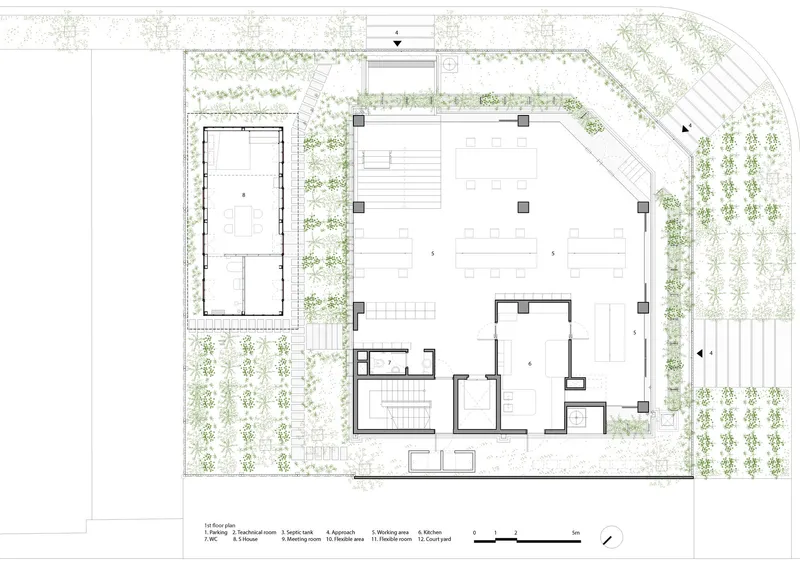
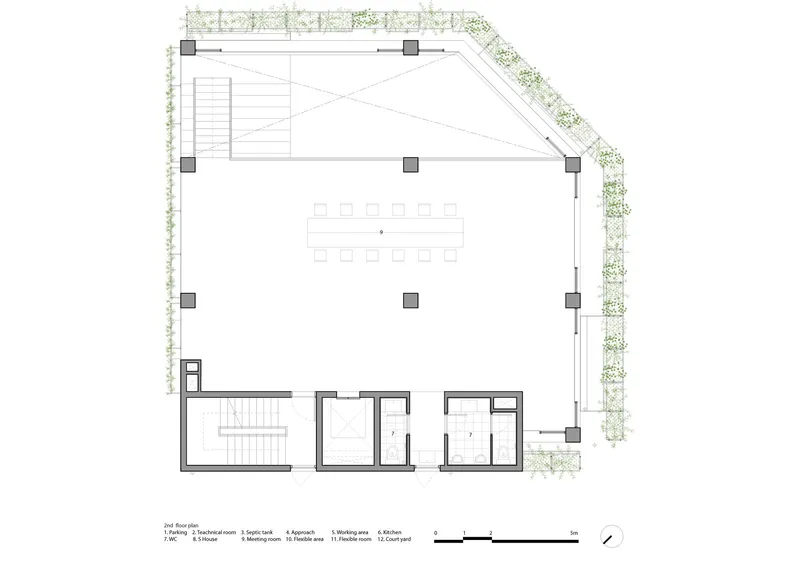
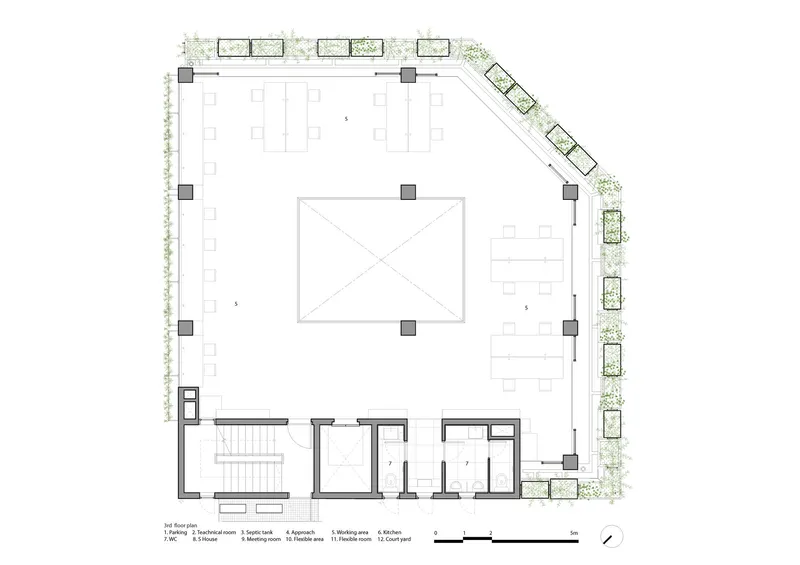
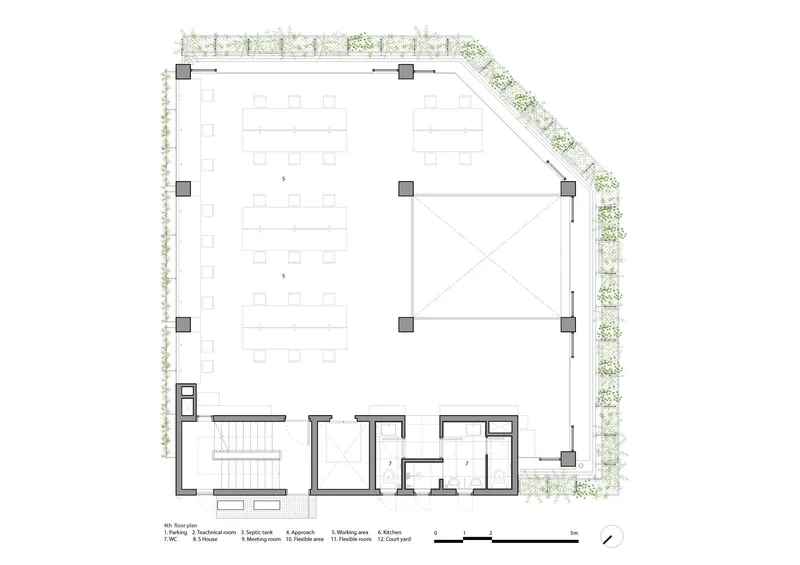
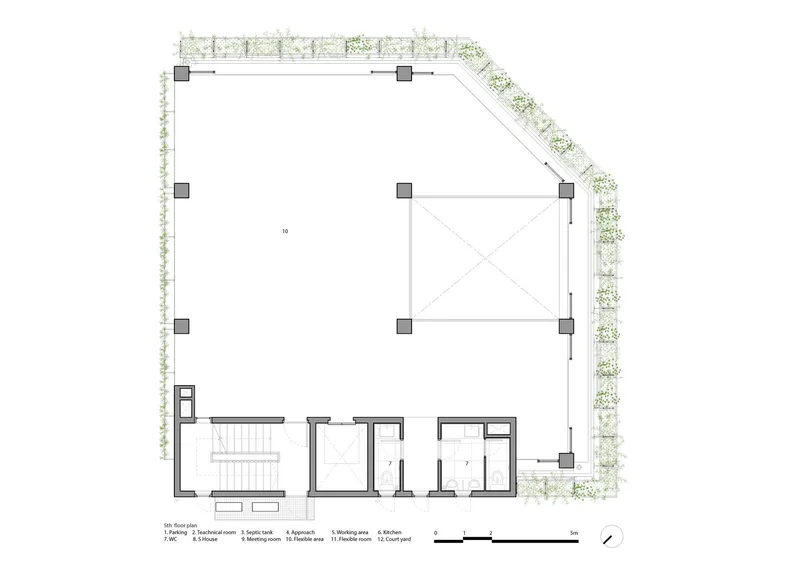
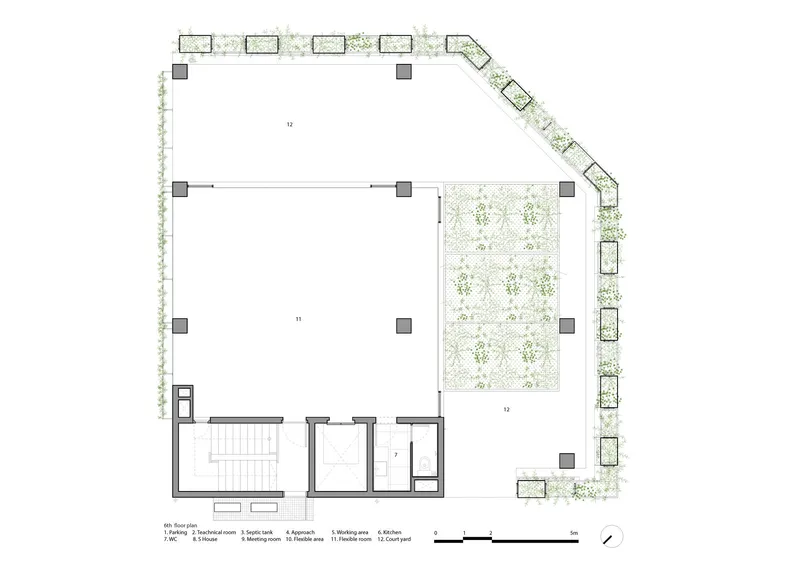
The plan sequence reveals how much the trapezoidal footprint dictates the interior logic. The garage and central stairwell anchor the lowest level; the ground floor opens to a pool terrace and planted perimeter beds on three sides. Moving upward, open workspaces alternate with more compartmentalized office zones, always organized around the shifting central atrium void. Corner planters and perimeter landscaping are present on every floor, confirming that the green strategy is not a facade appliqué but a fully integrated spatial system. The site plan shows the building pressed to its corner, maximizing the planted zones on the remaining site area.
Why This Project Matters
The Urban Farming Office matters because it refuses to separate the argument from the evidence. Plenty of firms advocate for biophilic design; VTN Architects made themselves live inside it, daily, for years. The LEED Gold certification validates the energy performance, the 1.1 ton annual harvest validates the agricultural premise, and the fact that the studio has continued to work productively in a naturally ventilated, plant-filled concrete frame in tropical Vietnam validates the comfort claim. These are not renderings. They are results.
More broadly, the project demonstrates that vertical urban farming does not require high-tech hydroponic towers or speculative infrastructure. A reinforced concrete frame, a steel shelving system, modular planters, and locally sourced tropical species are enough. The technology is simple; the commitment is what's difficult. By placing this building on a public corner rather than a research campus, VTN Architects have made it impossible to ignore. Every passerby, every delivery driver, every neighbor gets to watch a building grow. That is advocacy at the most literal, most persuasive scale.
Urban Farming Office by VTN Architects, Ho Chi Minh City (Thu Duc District), Vietnam. 1,386 m². Completed 2022. Photography by Hiroyuki Oki.
About the Studio
Share Your Own Work on uni.xyz
If projects like this are the kind of work you want to make, uni.xyz is a place to publish your own, find collaborators, and enter design competitions.


Popular Articles
Popular articles from the community

Manzana Morphosis: Stretching Barcelona's Grid into a Living Landscape for 2050
A radical reworking of the Eixample manzana turns density into a tool for generous public space, vertical ecology, and environmental performance.

Aquadapt: An Underwater Habitat That Rewrites Its Rooms by the Hour
Curved modules ring the seabed while one shell shifts from breakfast room to cinema, farm and football pitch as residents' needs change.


Cube Design Draws an Ecological Corridor Between Two Shenzhen Hills with the Nankai Building
Beside Shenzhen's container docks, the Nankai Building pairs stacked balconies with a climbing green screen to connect two hillsides across its height.

FCC Arquitectura Expands a Portuguese Granite House with a Board-Marked Concrete Wing
In Portugal, JV House pairs a cleaned-up whitewashed and granite dwelling with a timber-shuttered concrete extension, courtyards and a garden pool.

Similar Reads
You might also enjoy these articles

LAVA Architecten Gives Vocational Education a Sawtooth-Roofed Face on a Mechelen School Campus
In Mechelen, Belgium, a 2,053 m² STEM school on a 6×6 m grid turns workshops and classrooms into rooms that can be rearranged as teaching changes.

KEMA Studio Turns a Derelict Marvila Attic into a 60 m² Lighthouse Apartment Above Lisbon
In Lisbon's Marvila district, a rebuilt roof, four skylights and two plywood volumes turn an unlivable attic into a bright home facing the Tagus.

Pixel Gardens: One Repeated Module Stacked Into a Terraced Social Housing Tower for Famagusta
Salem Bader's shortlisted housing tower builds a vertical neighbourhood from one repeated module, offsetting units to carve terraces, light and air.

Bao Huynh Watercolor Atelier: A Serene Art Retreat in Hội An
Bao Huynh Watercolor Atelier in Hội An blends multifunctional art spaces, sustainable design, local materials, and family-friendly living in a serene environment.

Explore Urban Farm Competitions
Discover active competitions in this discipline

Challenge to reimagine the Iron Throne

Photograph architecture without architects

Illustrate the lost glory of Angkor Wat - Render Challenge

Design challenge to reuse E-waste
Comments (0)
Please login or sign up to add comments
No comments yet. Be the first to comment!