
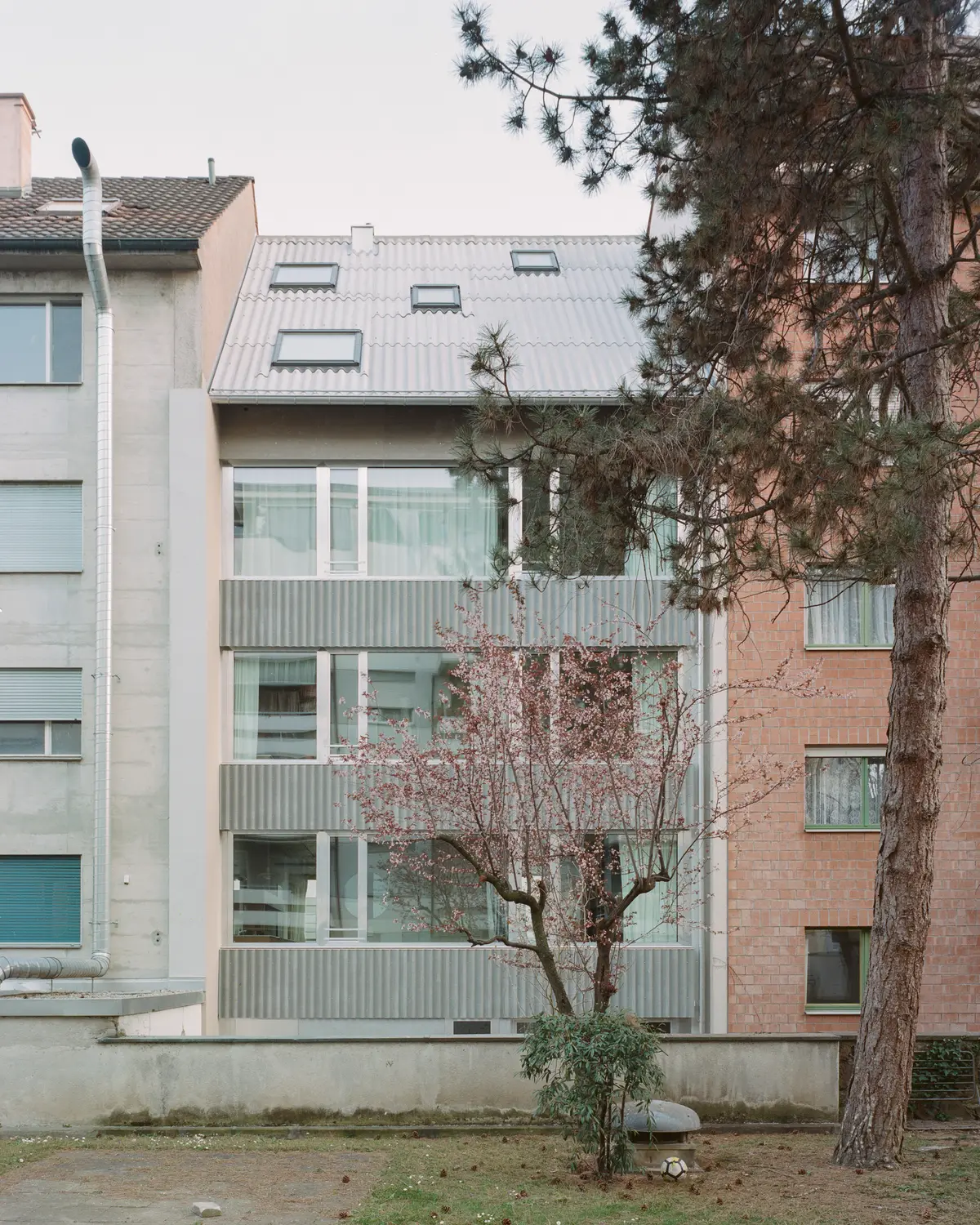
Wallimann Reichen Packs a Loft House in Miniature into a Tight Basel Plot
Four small apartments and a ground-floor studio occupy 450 square meters in the dense Kleinbasel workers' quarter.


In the Matthäus quarter of Kleinbasel, where small craft workshops once hummed behind narrow residential fronts, a plot of roughly 7 by 10 meters does not leave much room for ambiguity. Wallimann Reichen, the Basel practice led by Nicole Wallimann and Christoph Reichen, replaced a structurally compromised older building on this site with a four-story volume that pushes right up against the constraints of local building law, including a mandatory 45-degree sunlight incidence angle that sculpts the roof profile. The result, completed in 2021 on a budget of 1.8 million CHF, is a building that treats compactness not as a limitation but as a generative condition.
What makes the Blaesi House interesting is how it refuses to feel small. An off-center circulation core organizes each standard floor as a continuous loop, letting residents move through rooms without dead ends or corridors that consume precious area. South-facing lift-and-slide windows turn dining spaces into open loggias when weather permits, compensating for the absence of balconies. The building's material palette, anthracite corrugated fiber cement outside and white-painted brick masonry inside, is deliberately restrained, letting proportion and daylight do the expressive work. It is a loft house in miniature format, and it earns the comparison.
Streetscape Calibration
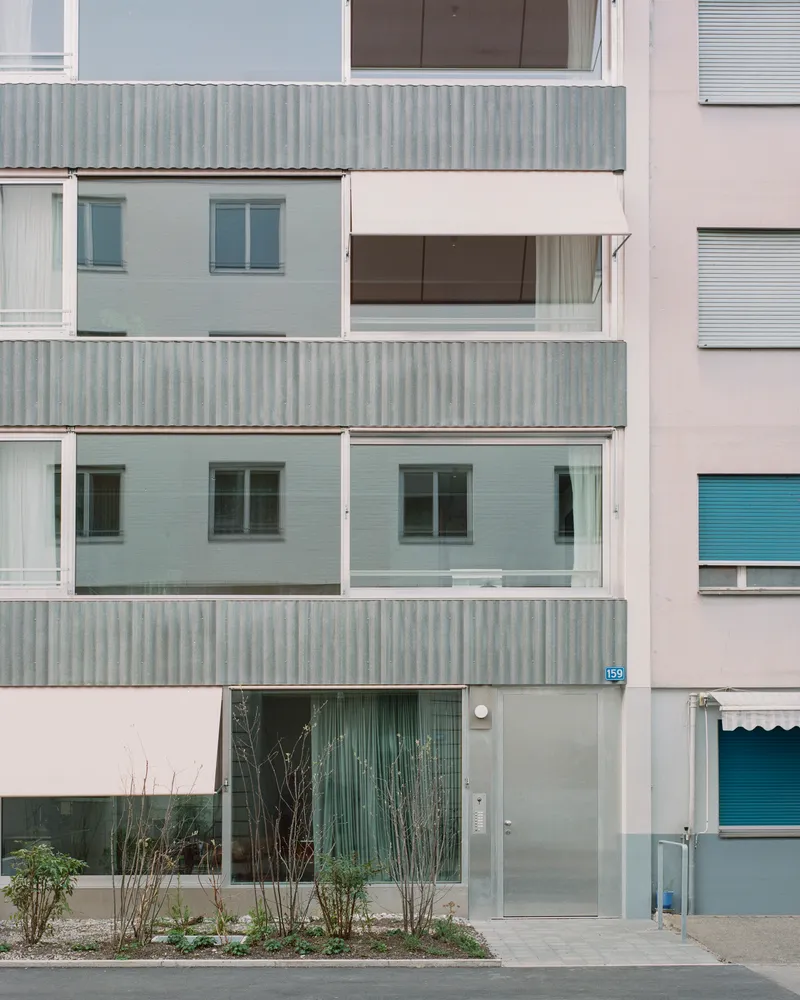
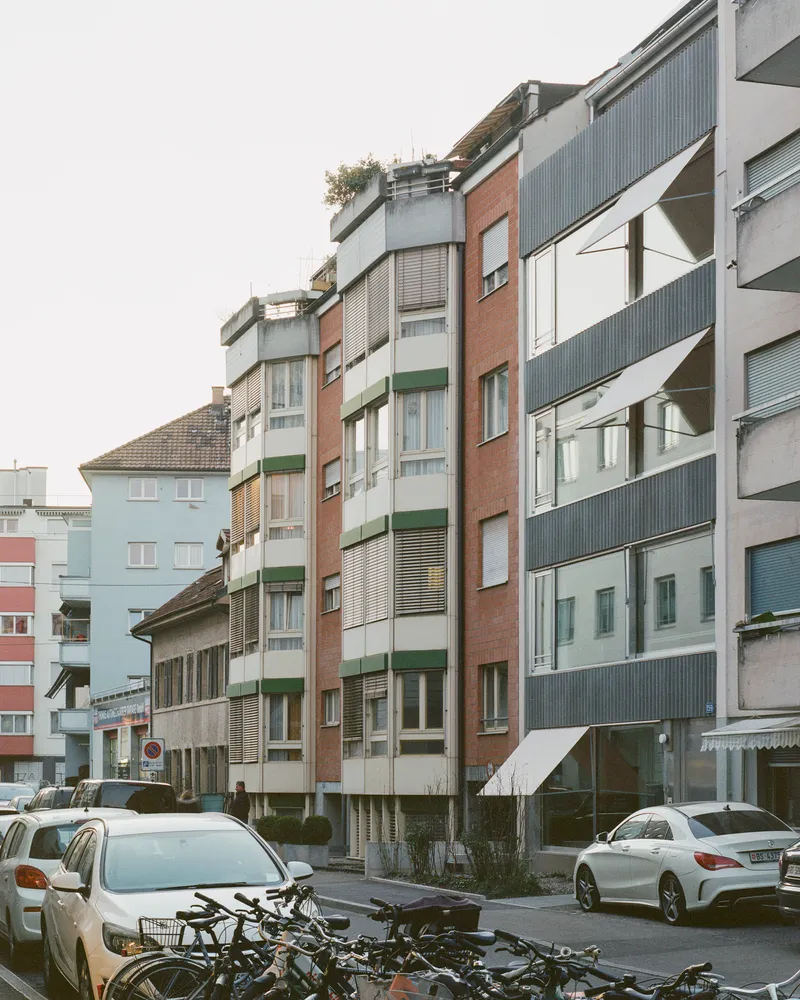
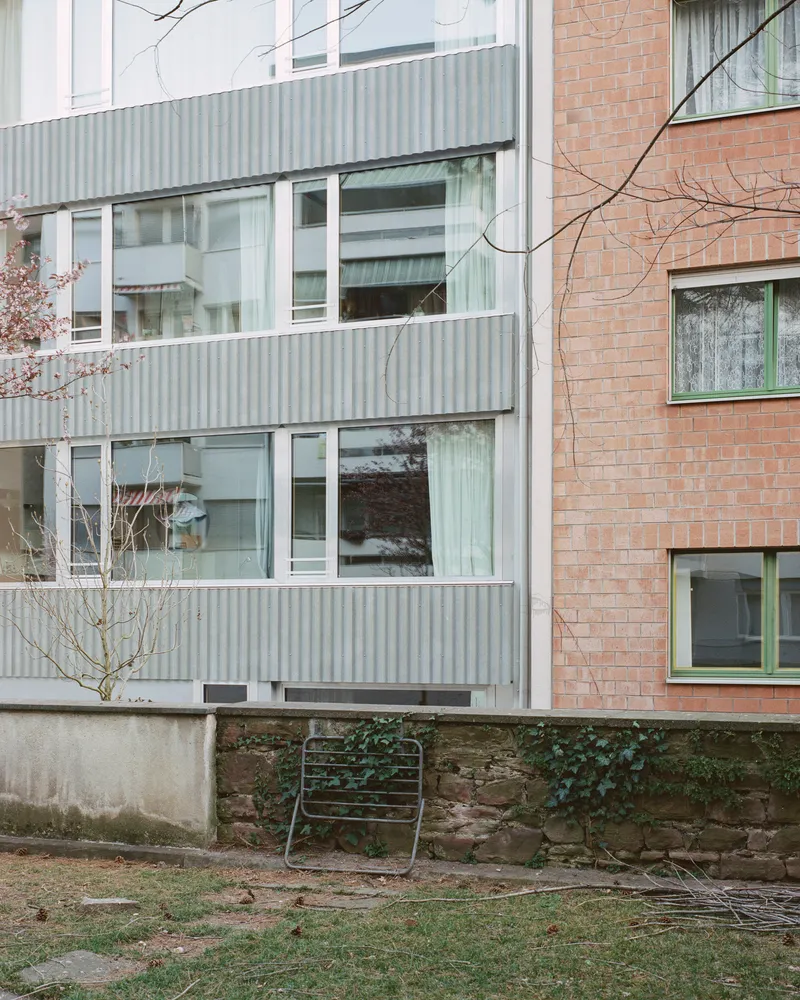
The Kleinbasel block is a patchwork: brick party walls, plastered facades, metal balconies, the occasional industrial remnant. Wallimann Reichen calibrate the new facade to this context without mimicking it. Horizontal bands of corrugated fiber cement in dark anthracite set a rhythm that echoes the fenestration proportions of neighboring buildings, while aluminum-framed windows sit flush in the plane. The corrugation catches light differently throughout the day, giving the surface a quiet liveliness that flat cladding would lack.
Rose-colored awnings, visible when deployed, are a small but telling gesture: they reference the color scheme of the adjacent building, a nod that signals awareness of the street as a shared composition. Ground-level planting softens the threshold. From across the road, the building reads as both new and familiar, occupying its slot with the confidence of something that has always been there.
The Roof as Negotiation
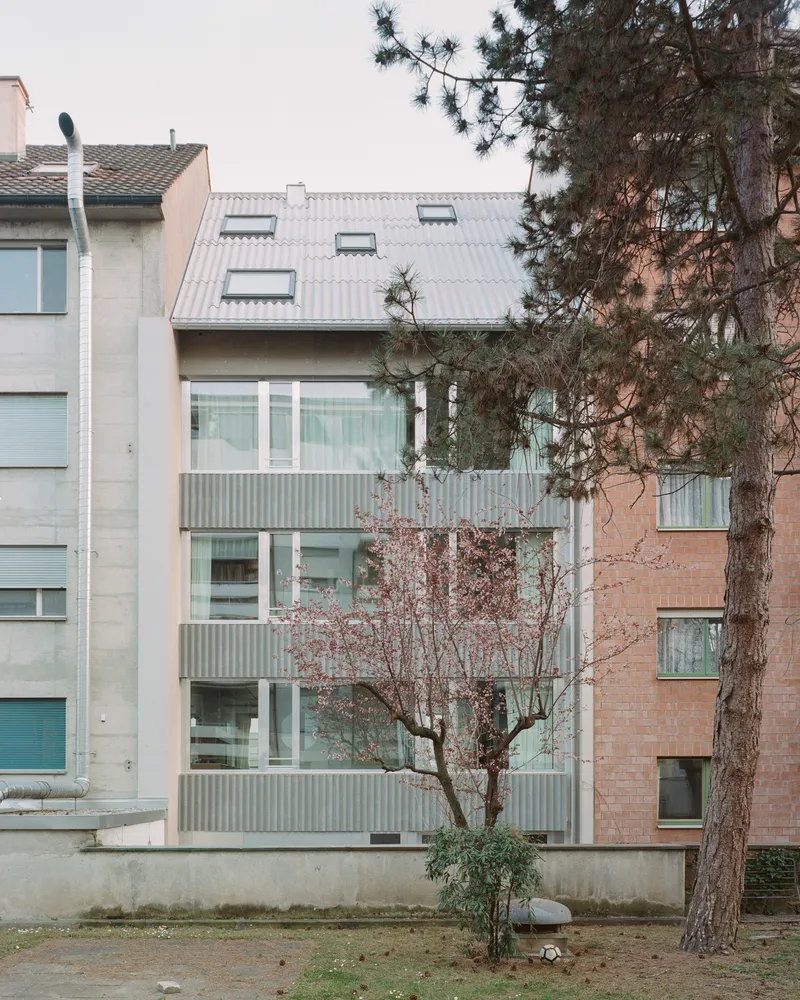
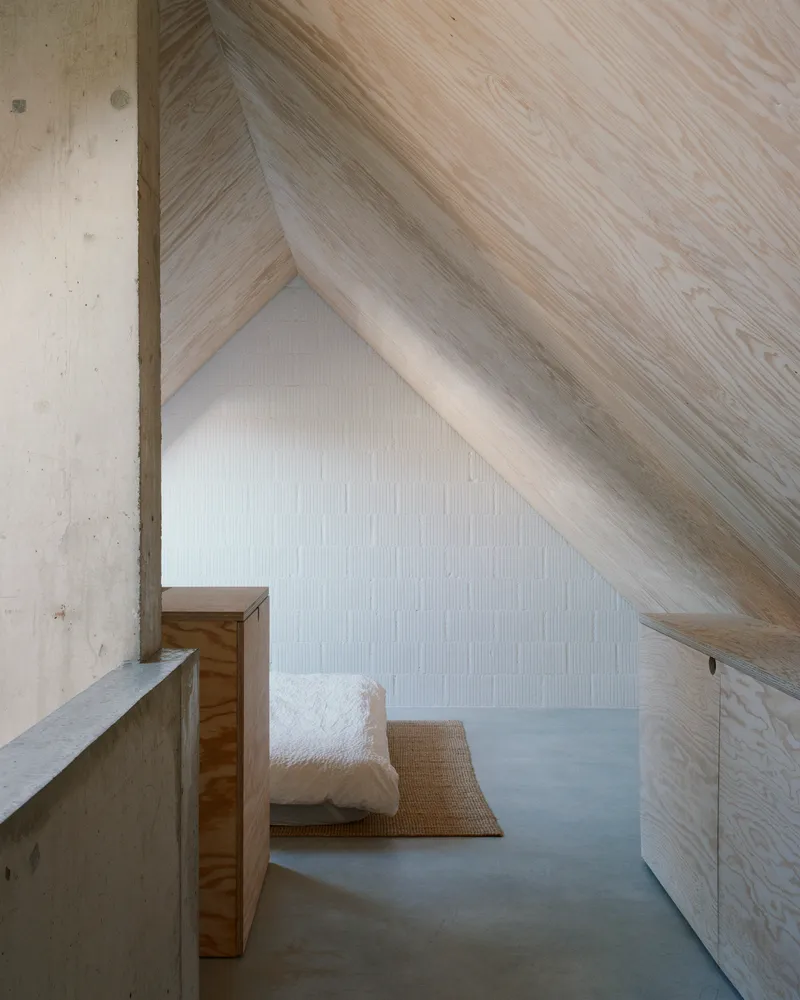
The gabled profile is not a stylistic choice. Basel's building regulations enforce a sunlight angle that literally carves the upper volume, and Wallimann Reichen maximize the envelope within those constraints to create a maisonette attic apartment. Tilted dormers puncture the sloped roof, pulling light into the uppermost rooms without exceeding the permitted massing. Inside, the diagonal wood-clad ceiling of the attic space compresses and expands as you move through it, turning regulation into spatial drama.
A cushion on a woven mat beneath a low window: the attic photograph captures the intimacy that this kind of small-scale housing can achieve when the architect treats every cubic meter as finite and valuable. The concrete walls ground the room while the timber ceiling warms it. There is nothing superfluous here.
Loop Plans and Perceived Generosity
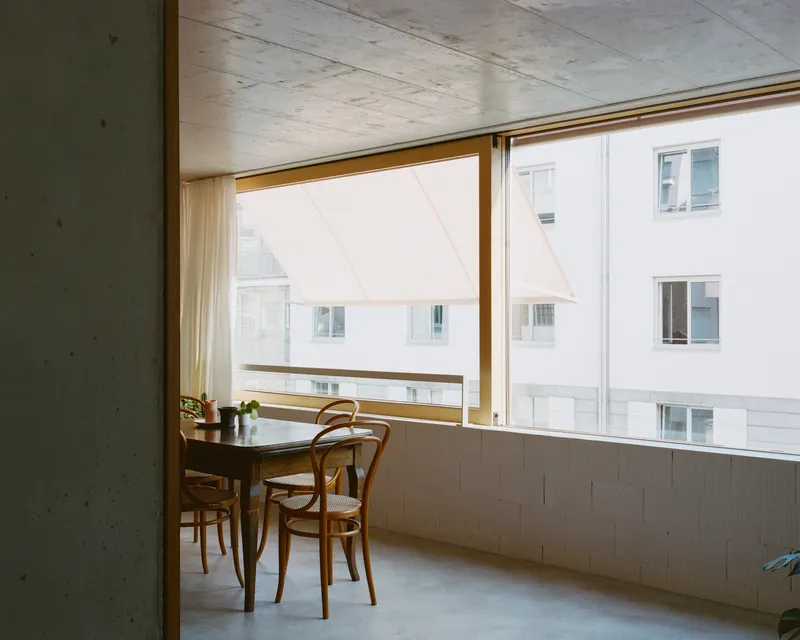
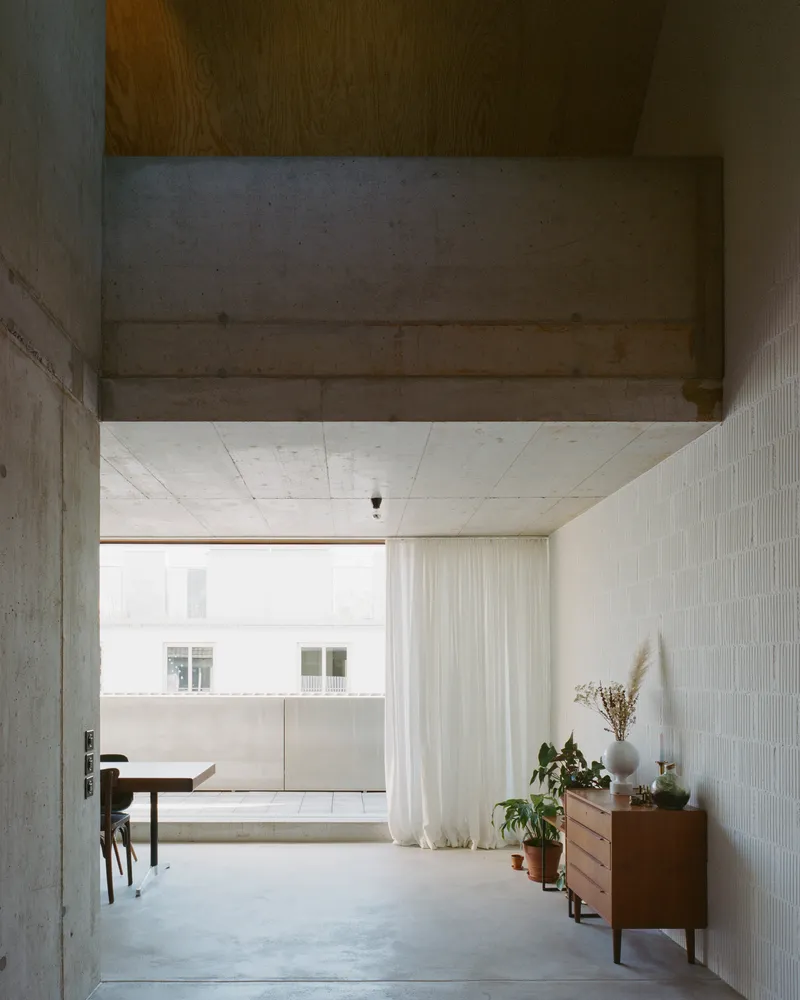
The standard floor plan hinges on a single move: placing the circulation core off-center so that the remaining space wraps around it as a continuous loop. Kitchen flows along the eastern fire wall into bathroom, living area opens toward the south windows, and you can always keep walking. In an apartment this compact, the elimination of corridors is not a luxury; it is the difference between feeling cramped and feeling free. The open floor plan reads as a loft precisely because of this circulatory continuity.
Exposed concrete ceilings and gray cement screed provide a consistent material datum across all rooms, while colorless lacquered MDF panels for kitchens and sliding doors keep the built-in elements visually quiet. The bentwood chairs at the window, the wooden sideboard against sheer curtains: these interiors reward restraint with a sense of calm that more decorated spaces rarely achieve.
Material Honesty at Close Range
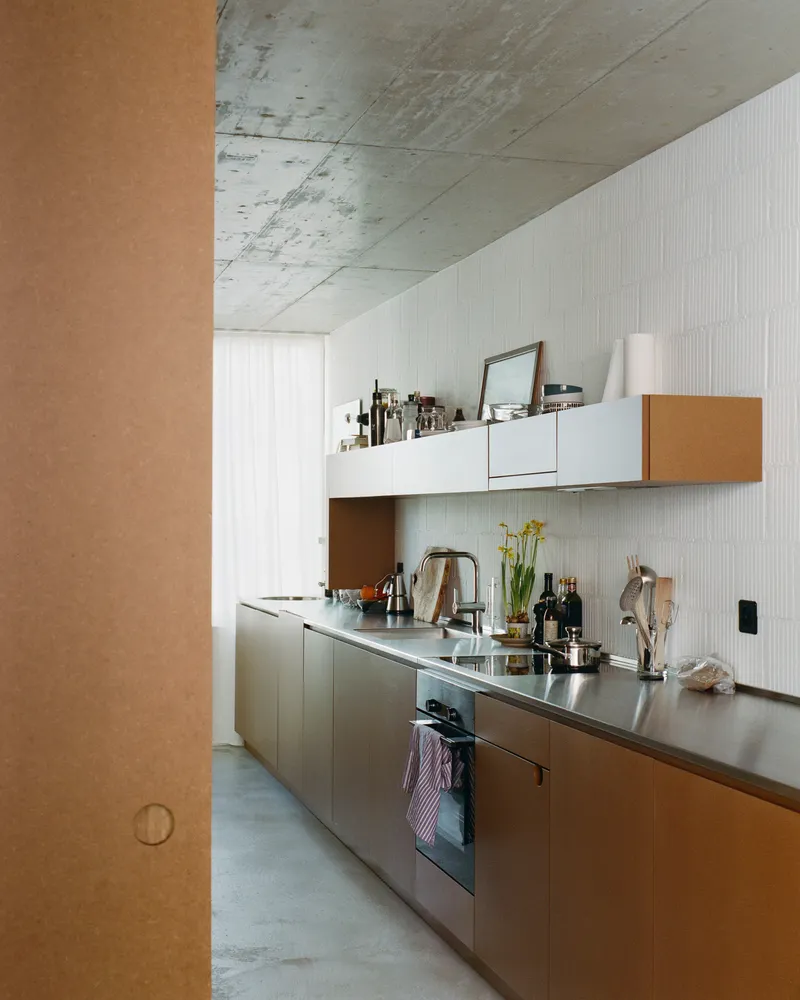
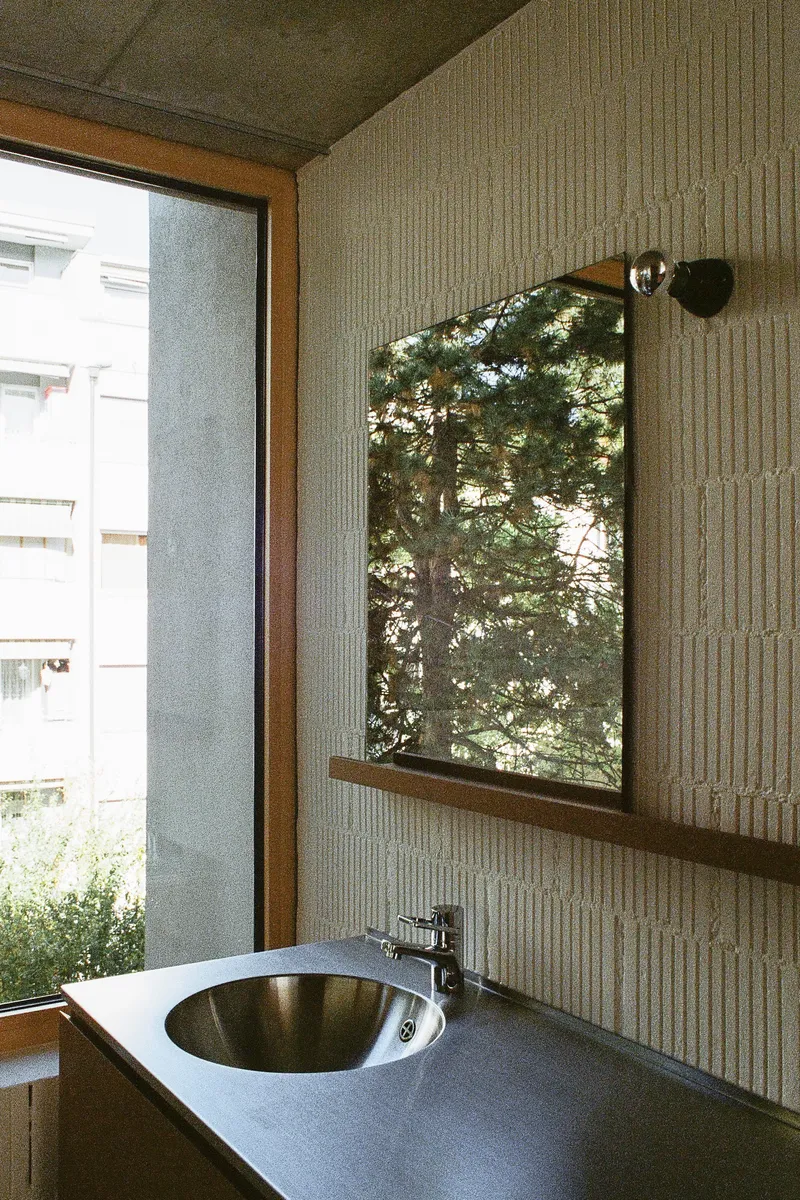
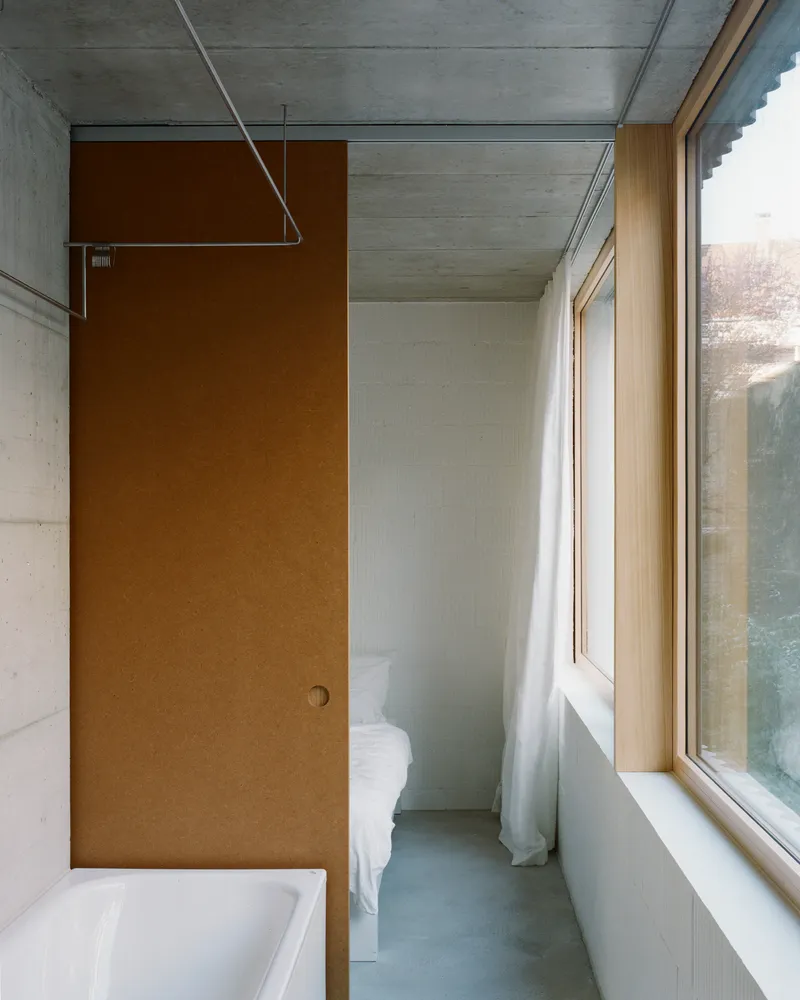
The galley kitchen is pure pragmatism: stainless steel countertops under an exposed concrete ceiling, with natural daylight entering from the side. There is no backsplash tile pattern, no accent color. The surfaces are what they are. In the bathroom, a circular steel sink sits below a window framing bare winter branches, and the composition is almost Japanese in its economy. The compact bedroom deploys a timber door and a cast concrete ceiling under a window alcove that does double duty as headboard zone and light source.
These are not expensive materials. Industrial masonry, cement screed, MDF, and aluminum windows belong to a construction economy that prioritizes durability and legibility over finish. Wallimann Reichen demonstrate that when dimensions are tight, material consistency becomes the primary tool for spatial coherence. Every surface earns its place.
The Ground-Floor Studio
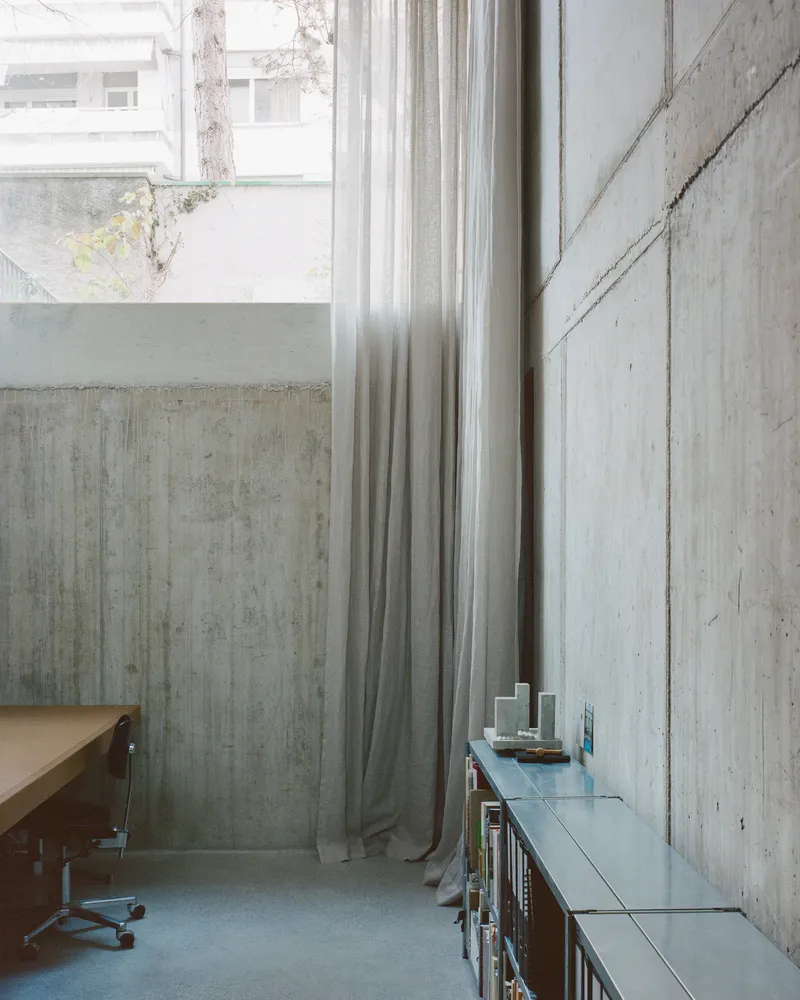
Kleinbasel's historic character depends on mixed-use ground floors: workshops, studios, small businesses animating the street. The Blaesi House continues this tradition with a two-story studio that includes a ground-level meeting area connected by staircase to an overheight basement workspace. The program is not incidental; it is a direct response to the neighborhood's DNA.
The studio's concrete walls and floor-to-ceiling linen curtains create a workspace that can be partitioned or opened at will. A narrow desk against the wall, filtered daylight, and nothing else: this is an architecture of productive austerity. The building does not merely house people above and work below; it weaves the two together through a shared material language and a single structural logic.
Plans and Drawings
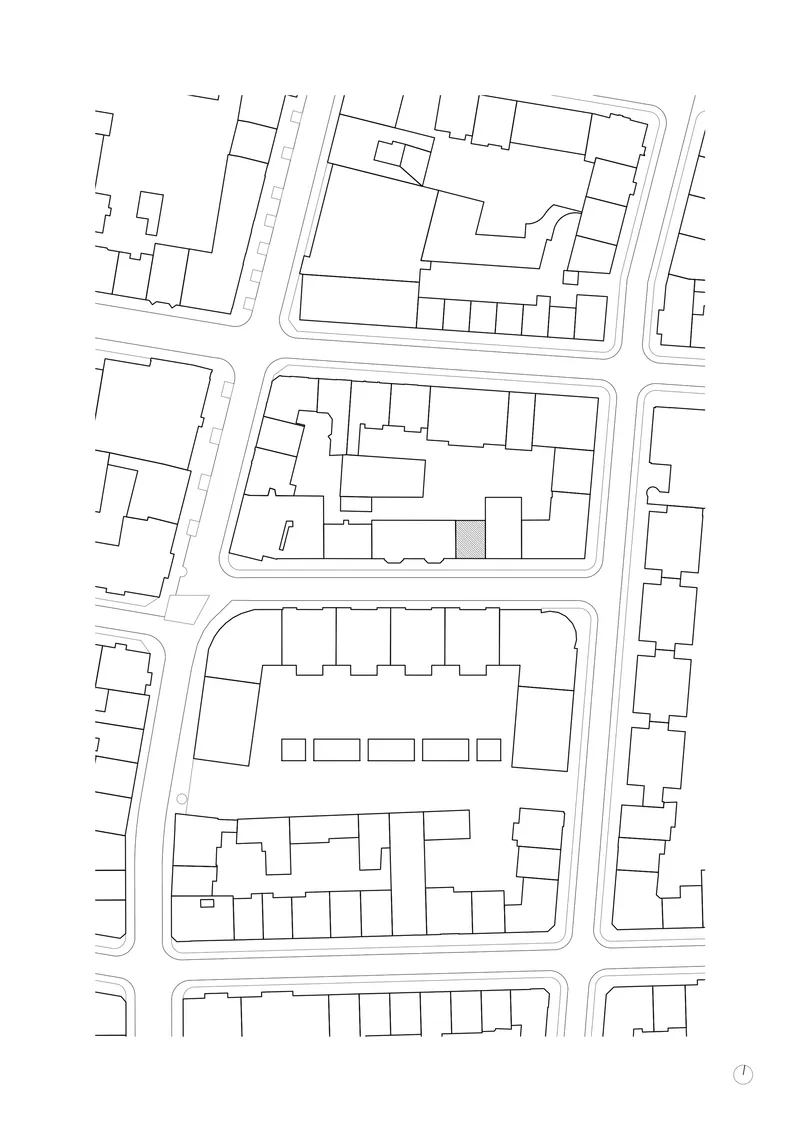
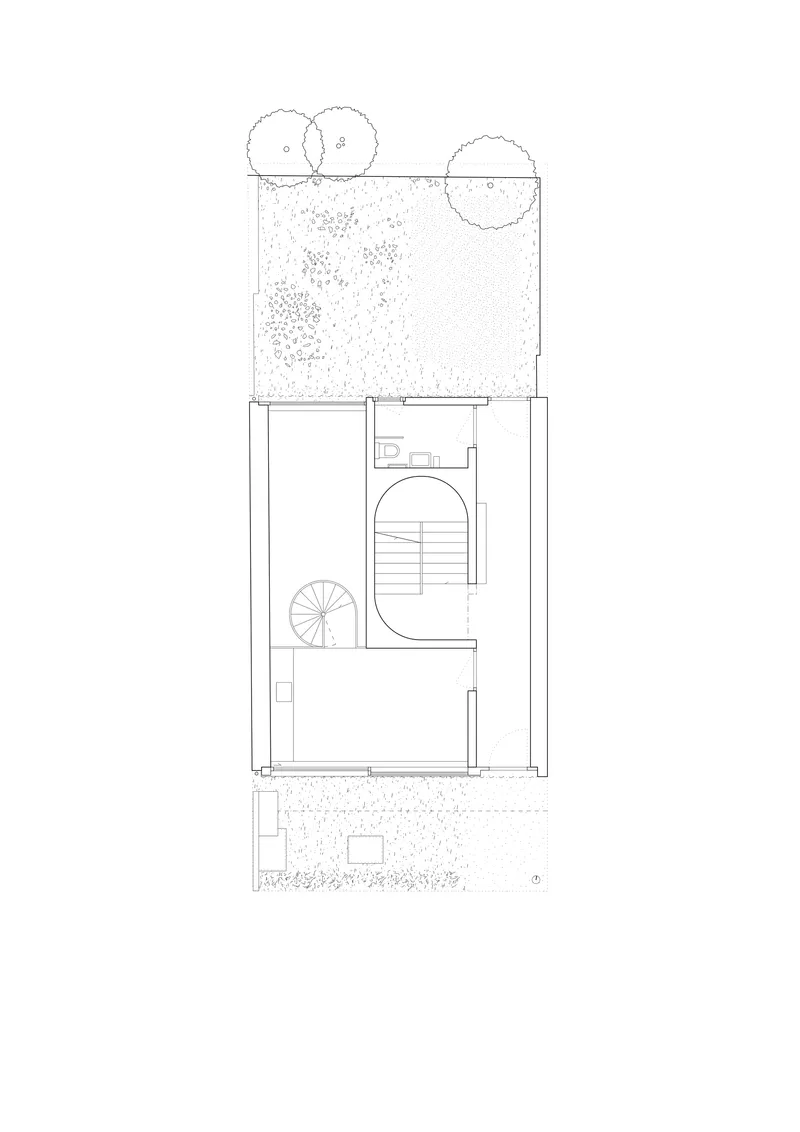
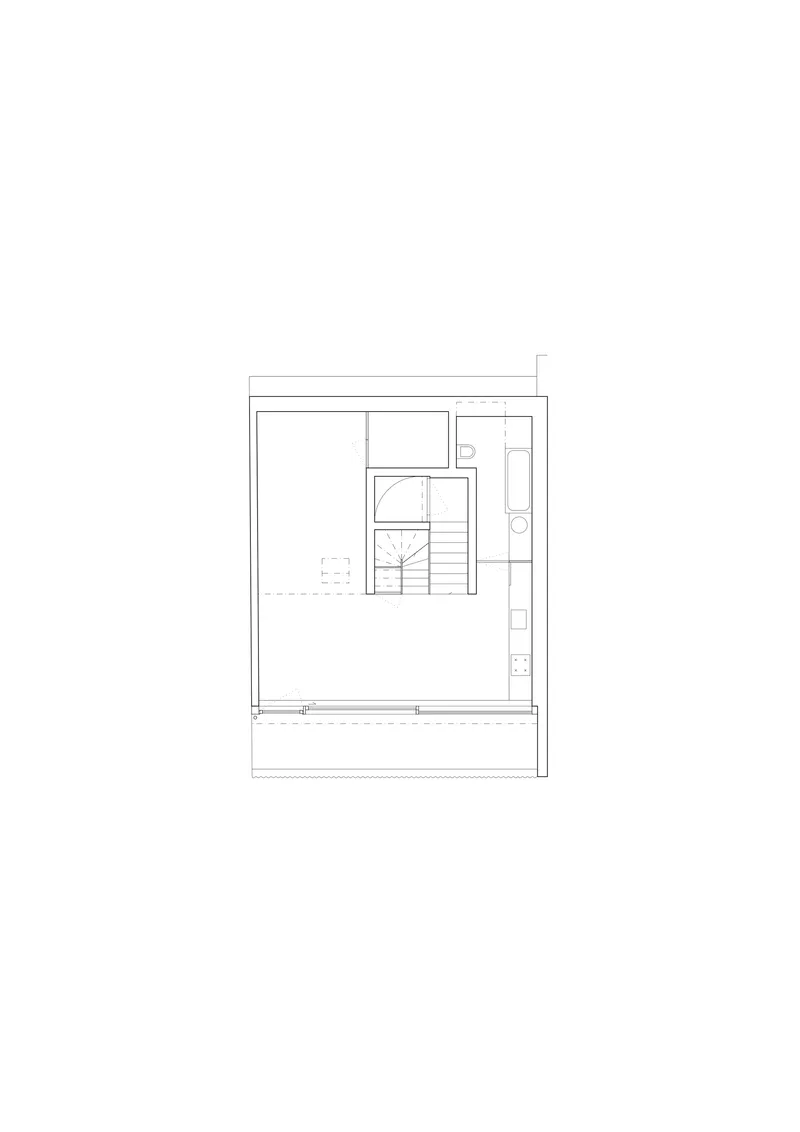
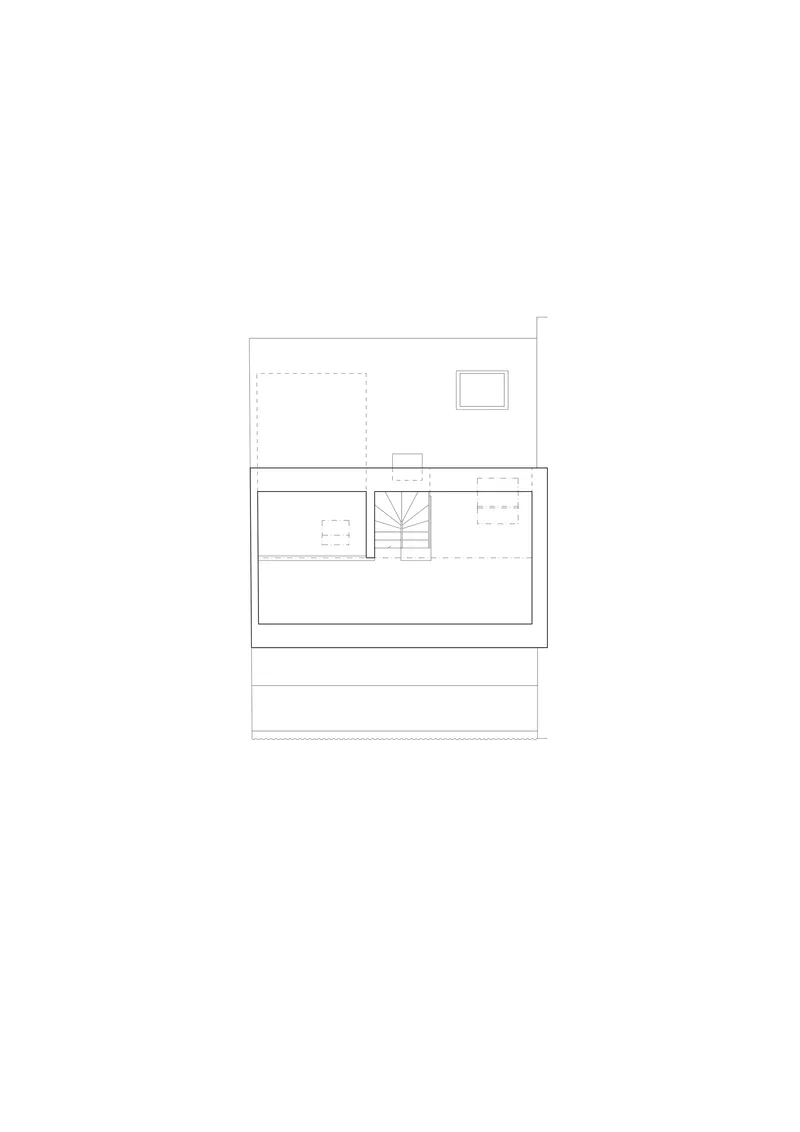
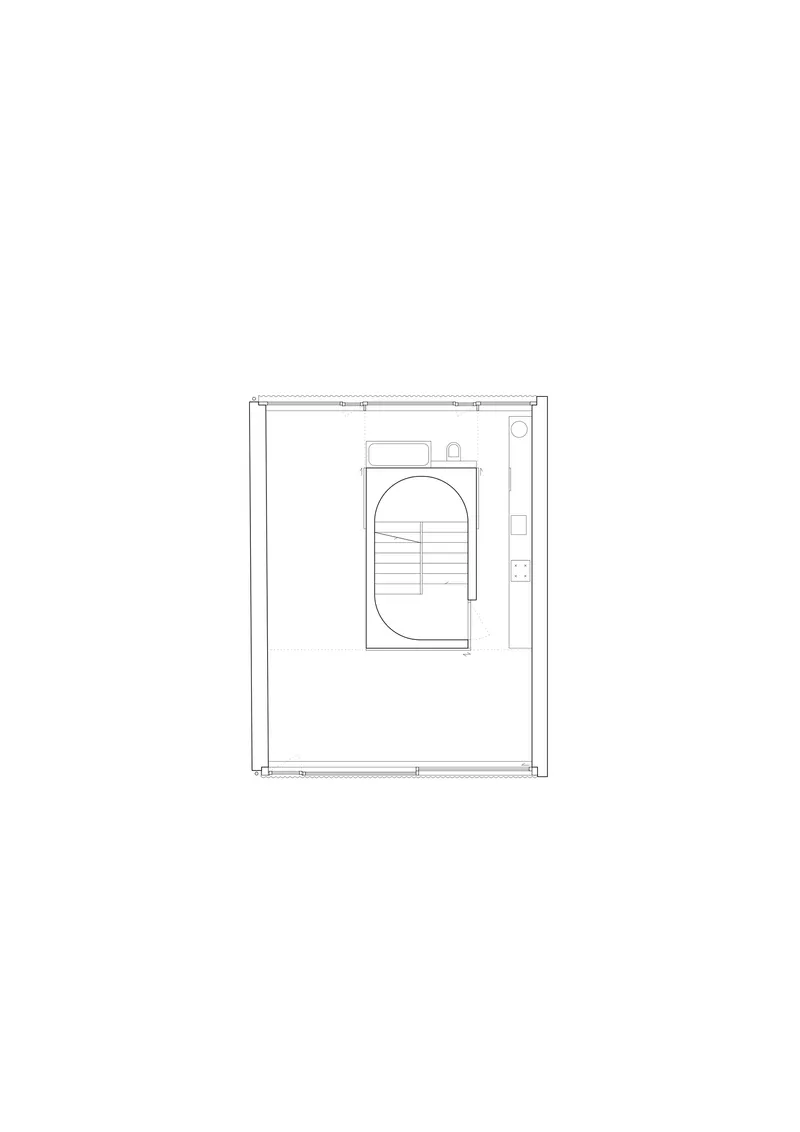
The site plan reveals the building's predicament: a slender rectangle wedged into an urban block with minimal setbacks on all sides. The floor plans, read in sequence from ground to attic, show how the off-center spiral stair organizes each level differently while maintaining the loop principle. The narrow service zone, containing kitchen and bathroom, stacks consistently along the eastern party wall, freeing the remaining plan for inhabitation.
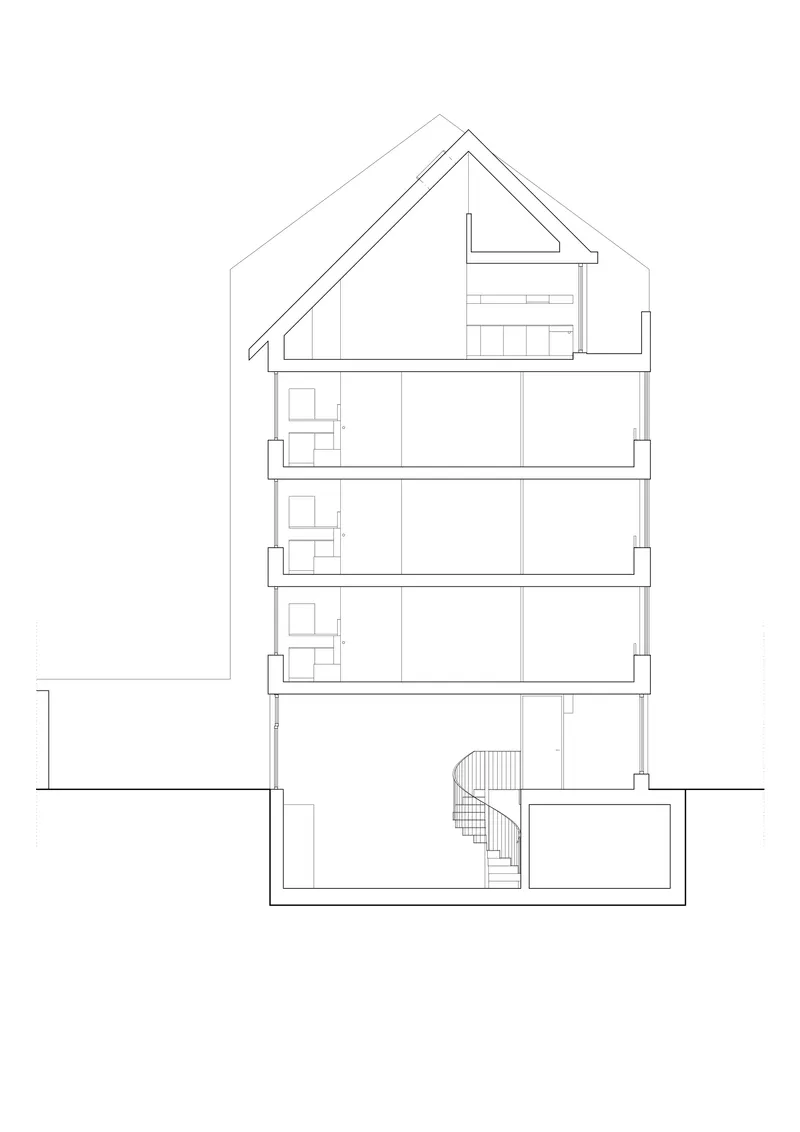
The section drawing is the most revealing document. Four stories plus basement, a gabled roof cut to the mandated sunlight angle, and a spiral stair threading through the entire height. The basement studio's double height becomes legible here, as does the compression of the attic maisonette. Every vertical centimeter is accounted for. At 1,408 cubic meters of total volume, this is architecture measured not in impressions but in cubic capacity.
Why This Project Matters
The Blaesi House is a counter-argument to the notion that dense urban infill requires either heroic formal gestures or resigned minimalism. Wallimann Reichen operate in a third space: rigorous pragmatism that produces genuine spatial pleasure. The loop plan, the maximized roof volume, the material consistency from basement to attic, these are not innovations in the flashy sense but disciplined applications of well-understood principles to a genuinely difficult site. The building proves that a 7-by-10-meter footprint can feel generous if the architect respects the intelligence of the plan.
At a moment when European cities are grappling with housing density, affordability, and the preservation of neighborhood character, a project like this offers a credible model. It maintains the mixed-use ground floor, it fits four apartments into a volume that reads as a single house, and it costs 1.8 million CHF, roughly what a single luxury apartment fetches in central Basel. The building does not announce itself. It simply works, floor by floor, room by room, and that is exactly what Kleinbasel needs.
Blaesi House & Studio by Wallimann Reichen (Nicole Wallimann, Christoph Reichen), Basel, Switzerland. 450 m², completed 2021. Photography by Rory Gardiner, Ivo Stani, and Lukas Kissling.
About the Studio
Share Your Own Work on uni.xyz
If projects like this are the kind of work you want to make, uni.xyz is a place to publish your own, find collaborators, and enter design competitions.


Popular Articles
Popular articles from the community


David Ortega Stacks a Two-Story Mexico City Penthouse Around a Steel Stair and a Pergola-Shaded Roof Terrace
In Colonia Roma, a 300 m² penthouse uses oak joinery, a planted steel stair and a slatted roof pergola to make a new-build apartment feel like a house.


Singing Woman: An Opera House That Performs Before the Curtain Rises
Ovidiu Cristian Pavel's conceptual opera house translates Estonia's choral identity into a sculpted waterfront landmark facing the Baltic Sea.

graciastudio Turns a Viewless Tijuana Lot Inward Around a Courtyard of Concrete, Timber and Trees
In Tijuana, Jorge Gracia's GA2 House stacks a timber-clad private floor over exposed concrete and replaces a missing view with a planted interior patio.

Cube Design Draws an Ecological Corridor Between Two Shenzhen Hills with the Nankai Building
Beside Shenzhen's container docks, the Nankai Building pairs stacked balconies with a climbing green screen to connect two hillsides across its height.

Similar Reads
You might also enjoy these articles

LAVA Architecten Gives Vocational Education a Sawtooth-Roofed Face on a Mechelen School Campus
In Mechelen, Belgium, a 2,053 m² STEM school on a 6×6 m grid turns workshops and classrooms into rooms that can be rearranged as teaching changes.

KEMA Studio Turns a Derelict Marvila Attic into a 60 m² Lighthouse Apartment Above Lisbon
In Lisbon's Marvila district, a rebuilt roof, four skylights and two plywood volumes turn an unlivable attic into a bright home facing the Tagus.

Pixel Gardens: One Repeated Module Stacked Into a Terraced Social Housing Tower for Famagusta
Salem Bader's shortlisted housing tower builds a vertical neighbourhood from one repeated module, offsetting units to carve terraces, light and air.

Bao Huynh Watercolor Atelier: A Serene Art Retreat in Hội An
Bao Huynh Watercolor Atelier in Hội An blends multifunctional art spaces, sustainable design, local materials, and family-friendly living in a serene environment.

Explore Plug-In House Competitions
Discover active competitions in this discipline

Challenge to design mud housing for contemporary communities

Challenge to reimagine the Iron Throne

Photograph architecture without architects

Illustrate the lost glory of Angkor Wat - Render Challenge
Comments (0)
Please login or sign up to add comments
No comments yet. Be the first to comment!