
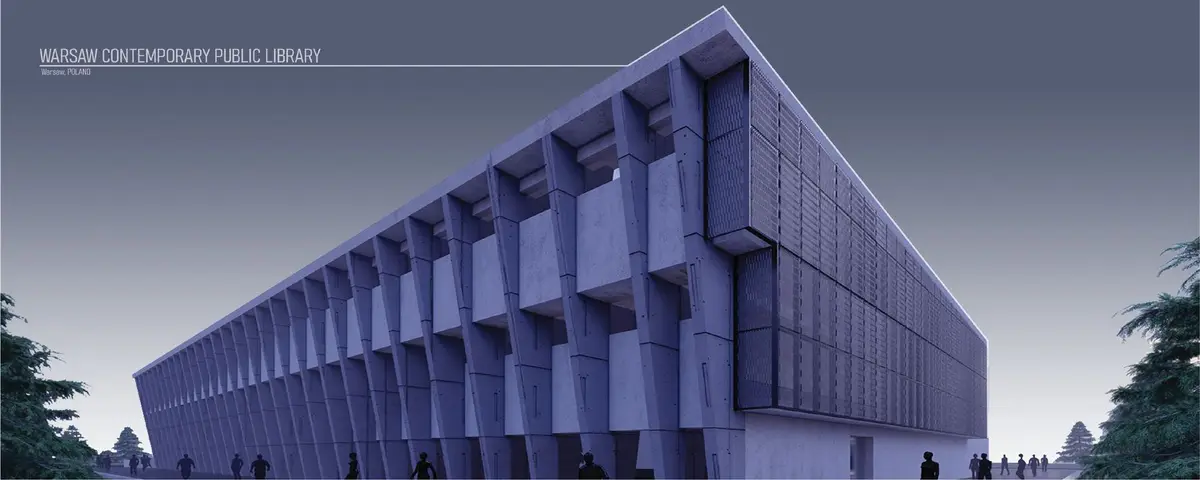
Warsaw Contemporary Public Library: Civic Architecture That Leads with Restraint
A shortlisted Libgen 2019 entry organizes three floors of public programming around daylight, landscaped corridors, and quiet confidence.


Strip away the spectacle and what remains is the harder question: can a public library hold its ground through spatial clarity alone? The Warsaw Contemporary Public Library answers with a building that refuses excess, organizing its massing to pull daylight from multiple directions while weaving landscaped corridors into the urban fabric. The result is a three-level civic institution where passive environmental strategies and layered social programming reinforce each other at every turn.
Designed by Sercan Hatırnaz, this project was shortlisted in the Libgen 2019 competition. Sited in Warsaw, Poland, the proposal reimagines the contemporary public library not as a monument but as a prototype for civic architecture, one where sustainability is embedded as a core principle rather than applied as a veneer.
A Plaza That Extends the Public Interface
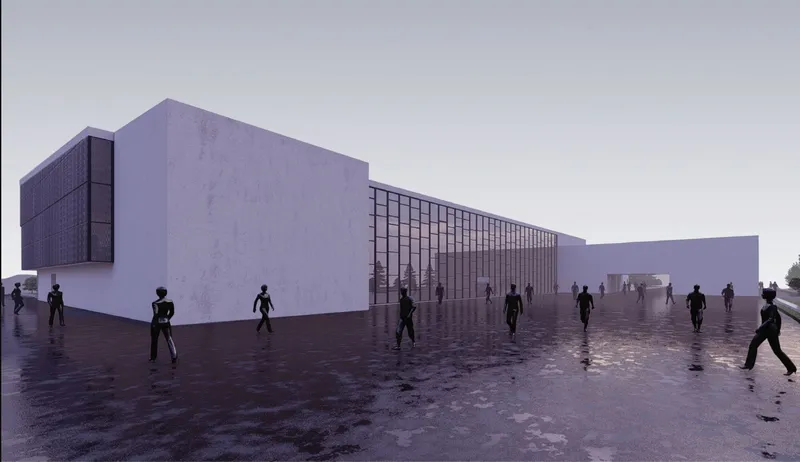
The rendered plaza view captures the building's relationship to its immediate ground plane. Silhouetted figures cross wet pavement beneath an overcast sky, and the library reads as a long, low presence rather than a vertical assertion. This is deliberate. By keeping the massing horizontal and permeable, the design allows the outdoor landscape to operate as a genuine extension of the library's programme. An outdoor café on the ground floor bleeds into this public realm, blurring the threshold between civic institution and urban square. The green interstitial spaces visible along the building's edges serve double duty: they regulate the microclimate and manage stormwater runoff while giving visitors tranquil zones for reflection.
Gridded Concrete and Deep Recesses at the Corner Facade
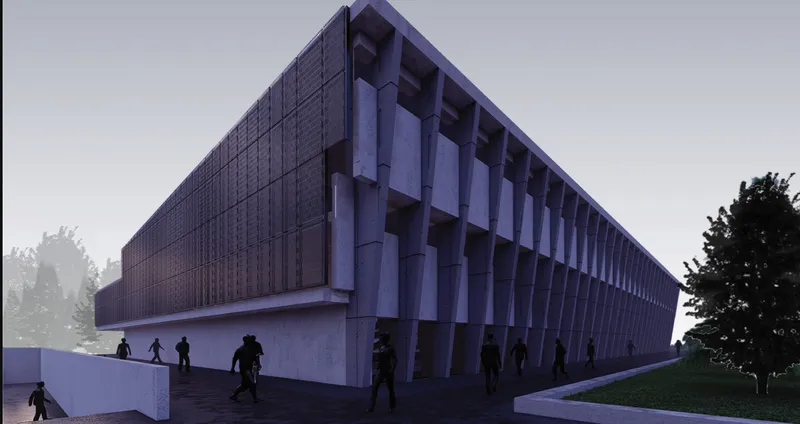
The corner facade reveals the building's architectural rhythm most clearly. Gridded concrete panels define the exterior, their deep recesses creating shadow lines that shift throughout the day. Large glazed openings sit within this structural framework, establishing the transparency that is central to the design's intent: visual and functional connection between interior collections and the outdoor landscape. People gathered near the entrance give a sense of the scale, and the proportions are generous without being imposing. The clean material palette, concrete and glass working in tandem, avoids ornamentation and lets the logic of the structure speak.
Behind this facade, the ground floor houses Collection 1 for general books and browsing, a public bookstore, ample storage, and an auditorium complete with stage and backstage facilities. These programme elements anchor the library as both a cultural venue and a daily destination. The office lobby at this level keeps administrative circulation separate from public flow, a small decision that pays off in the building's overall legibility.
The Elevated Terrace as Threshold Between Floors
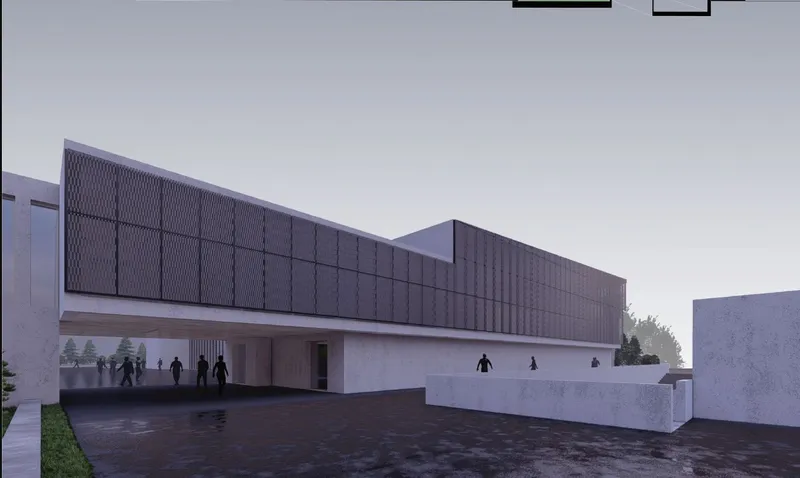
An elevated concrete terrace with metal screen panels introduces a secondary outdoor layer above the ground plane. Figures move along this promenade, and the screens filter light while providing a measure of privacy for the spaces behind them. The terrace functions as a transitional zone between the first floor, which houses Collections 2 and 3 alongside a public innovation lab (P-lab) for creative experimentation and digital learning, and the second floor above, designed for focused academic work with Collection 4 and a suite of private reading rooms. Circulation through the building reads as intuitive; each level's programming targets a different mode of engagement, from casual browsing to concentrated study.
The metal screens on this terrace are not merely decorative. They contribute to the building's passive cooling strategy, shading the facade during peak hours and reducing heat gain on the upper floors. Combined with the landscaped corridors at ground level and the extensive glazing calibrated to maximize natural light without glare, these elements form a coherent environmental approach. The architecture does not announce its sustainability; it simply performs.
Three Floors, Three Modes of Public Life
The vertical organization is worth examining as a design decision in itself. The ground floor is the most extroverted: bookstore, café, auditorium, and general collection all oriented toward maximum public access. The first floor shifts toward production and collaboration with the P-lab and administrative offices. The second floor retreats entirely into private reading rooms and a specialized collection, creating what the designer describes as pockets of silence and concentration. This gradient from social to solitary is not novel, but it is executed with precision, and it ensures that the library accommodates browsing, attending events, studying, and collaborating without spatial conflict.
Why This Project Matters
The Warsaw Contemporary Public Library is compelling because it treats sustainability and civic generosity as the same ambition. Passive lighting, ventilation, microclimate regulation, and stormwater management are not technical add-ons; they shape the building's form, its landscaped corridors, and the experience of moving through its floors. The architecture does not compete for attention. It earns it through the quality of the spaces it offers and the intelligence of its environmental logic.
Hatırnaz frames this proposal as a prototype for future civic buildings, and the claim holds up. By embedding sustainability as a generative force rather than a constraint, the project suggests that the next generation of public institutions can be both ecologically responsible and spatially rich. In a competition field often drawn to dramatic gestures, this entry's quiet confidence stands out as a more durable kind of ambition.
View the Full Project
About the Designers
Designer: Sercan Hatırnaz
Enter a Design Competition on uni.xyz
uni.xyz runs architecture and design competitions year-round that reward proposals with spatial conviction and real site intelligence.
Project credits: Warsaw Contemporary Public Library by Sercan Hatırnaz Libgen 2019 (uni.xyz).


Popular Articles
Popular articles from the community


David Ortega Stacks a Two-Story Mexico City Penthouse Around a Steel Stair and a Pergola-Shaded Roof Terrace
In Colonia Roma, a 300 m² penthouse uses oak joinery, a planted steel stair and a slatted roof pergola to make a new-build apartment feel like a house.

U.GA Architects Wraps an Oval Rooftop Pool in Curved Board-Formed Concrete on Busan's Jeollidan-gil
In Busan's Jeonpo-dong, a 454 m² mixed-use block stacks a neighborhood facility, guest rooms and an oval rooftop pool inside spiraling concrete walls.

LT2A and OPEN Architectes Thread a Brick and Glass High School Through a Wooded Belgian Campus
In Braine-l'Alleud, a 3,000 m² wing for Collège Cardinal Mercier pairs pale brick with a glazed colonnade, deferring to a small chapel and a dense wood.

Jaramillo Van Sluys Arquitectura and Urbanismo Turn a Demolished Registry Lot in Quito into an Orchard Plaza
In Quito's Centro Histórico, a 2,800 m² plaza exposes the San Agustín convent wall and redraws its lost Augustinian orchard in volcanic stone.

Similar Reads
You might also enjoy these articles


Vereda Arquitetos Renovates a 40-Square-Meter Apartment Inside Niemeyer's Copan Building
A compact unit in São Paulo's most iconic residential tower gets a material overhaul that pairs exposed concrete with bold blue Formica.

Shakur's House: Exposed Brick as an Interior Organiser in a 168 m² Mashhad Residence
Brick moves indoors in this Mashhad residence, where masonry walls, glass partitions and teal planes sequence a compact home without closing it off.

Day and Night Park: A Time-Based Urban Newsstand in Beijing
A temporary urban newsstand in Beijing blending travel, light, and reading through poetic colors, compact form, and community-focused design.

Modernist Patio Renovation in El Masnou, Barcelona by Oliver Segura Arquitectura + Cebrià Arquitectura
Modernist patio renovation blending tradition and innovation with a movable pool, leveled floors, and Catalan materials in El Masnou.


Comments (0)
Please login or sign up to add comments
No comments yet. Be the first to comment!