
WE_STACK
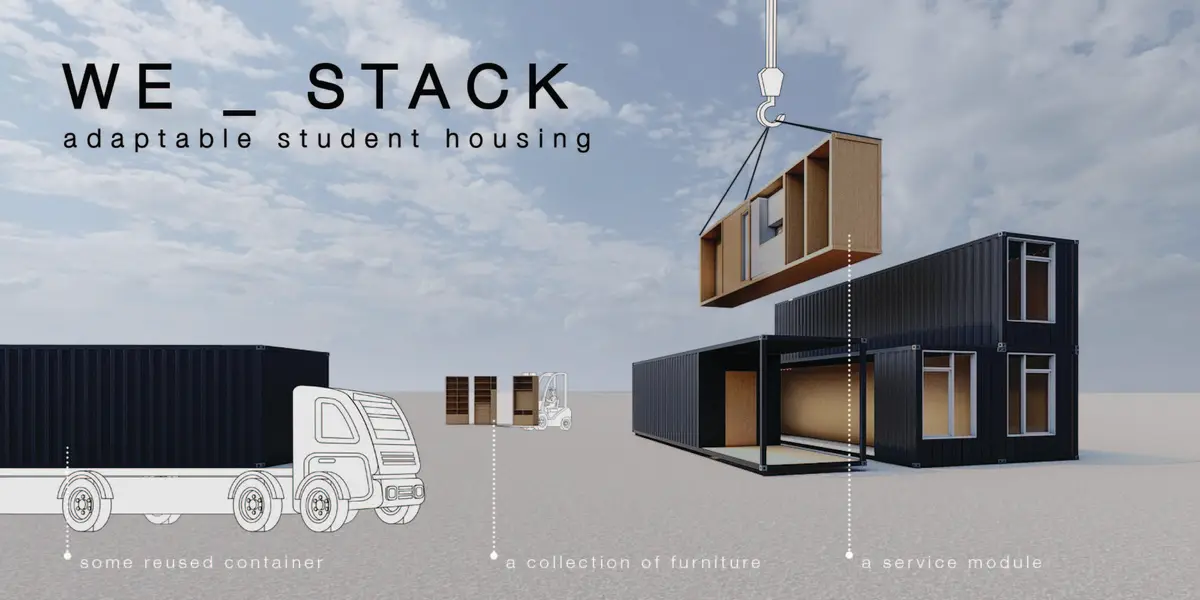
We stack is a modular system to create affordable students housing around the world. Thanks to its modularity on several levels, it can be adapted to any plot, density, culture and landscape.

INTRODUCTION -
The world of container homes is expected to reach a market size of $73,000 million by 2025 from $44,000 million in 2017. The growing demand for these shipping boxes can be seen by the fact that they are cost-effective, customizable and durable at the same time. However, according to the Environmental Protection Agency (EPA), a lot of them end up in landfills. Therefore, our idea is unique because it facilitates more use of the containers by utilizing every bit of them created into modules, with the flexibility of rearranging these modules & replicating them to different locations.
Factors taken into consideration while formulating the concept -
1. Stackability - We see the stackability of the container as its biggest strength therefore, it is used as the structural framing of the building. The biggest difficulties when reusing containers is that the used containers often have damaged facades. To be able to reuse as many as possible, the design allows to remove these damaged sections of the facade yet utilizing the stackable structure.
2. Flexibility – in terms of location, occupants, the number of dwelling units, access to services and utilities, which the design can adapt to the needs.
3. Prefabricated units – The modules are easy to transport and fix on the desired site across different conditions and needs. Once the building is not needed anymore, modules can be reused for the construction of another building with the same system.
4. Community living – enhanced living standards with a sense of belongingness.
5. Quality of living – living big with spatial restrictions, customized living space with privacy, ensuring comfort conditions.
And therefore, we came up with the concept of “Modularity – across several levels”.
Modular containers → Modular services → Modular furniture.
This concept is not restricted to a building but is rather a system that can produce a variety of solutions. This means all containers come with a standard dimension but have the flexibility to be scaled down to services. The furniture for interiors has the flexibility to be used according to different functions and different density. This consideration has been made keeping in mind the needs of the students so that the quality of life can be maintained without any compromise. For instance, a bedroom can be fused into the living room to have a bigger space. Also, the students can have the possibility to choose the modular furniture based on their requirements, reducing their need to buy more stuff even if they stay for a limited time.
Furthermore, larger units can be scaled according to density requirements and occupant preferences. Overall, the modules are prefabricated and can be arranged to any site, irrespective of the location. The strategy is to minimize construction on-site, thereby reducing labor costs and optimizing time. All the modular units will be factory-made and pre-fabricated to assemble on-site based on the requirement. This makes it cost-effective, quicker to construct, mobile and modular all together utilizing to its full potential.
PROCESS OF IDEATION AND PLANNING -
The organization of elements has been put purposefully based on the idea of replicability and flexibility. The structure is unique in itself yet can be reiterated to different sites based on functional preferences in an urban setting. The interiors and exteriors have the possibilities to change functions and customize them to fit into any module. For example, the terrace appears as an element to provide semi-private outdoor space to each apartment unit; at the same time, this space can be used as an extended common area for another room for accommodating higher density. Windows and doors are customized to fit into any module, maximizing natural light and ventilation. The modularity of functions helps in arranging containers with respect to each unique site, utilizing every space of it and achieving a higher quality of life.
The story of IKEA furniture inspired us in our concept of modularity. And we wanted it to translate into several scales. So with our design, we tried to achieve it by utilizing the corners of containers as a benchmark. The corners help in supporting stacking by distributing the load evenly. It can be scaled up into multiple containers and used for different densities. Furthermore, the idea can have the possibility to upgrade into a neighborhood to have a bigger community. So there are potential possibilities to upscale for future expansion. It also gives an opportunity for the investor to improve an area based on the need and utilities.
METHOD OF DESIGN AND TRIALS TOWARDS OUTCOME -
We tried multiple iterations both in tools as well as physical modelling to understand and scale the space, its functions, flexibility to interchange spaces, inter-connections with services and ease of access & the possibility to unite them as clusters.
Experimental design was followed as an investigative method to analyze the concept and move forward. Each team member tried a different design process concerning form, functions, massing, challenging the conventional practices with the help of playing tools, for example – Jenga. It, later on, shifted to software tools to exercise interior spacing. We also tried to look for inspirations building blocks on several tools to gather ideas in a holistic manner. We have compared and contrasted the earlier ideas to combine the most successful ones that enhanced one another. Finally, we agreed upon ideas after going back and forth with the methods and tools of design to encapsulate the design process.
To follow the shipping container’s structure, the service module’s structural frame is made of steel, as well as the stairs and exterior landing platforms. Steel is also a great material because it can be 100% recycled infinite times without losing its quality. To make the interior cozy, sustainably sourced light wood was chosen for built-in furniture and some walls.
CONCLUSION -
Our design has the potential to be rearranged and transformed into varied uses/needs. It can work as a temporary structure to cater to an interim period. The modularity of the structure can make it beneficial to scale up projects for future needs and places. It can be decoupled/disassembled into separate units and transported to other places for reuse or put into other requirements. It can help build a community living culture, emphasizing the importance of space management, community belongingness, and social cohesion. The community can develop into residents, volunteers, students, scholars and even tourists.

Popular Articles
Popular articles from the community


The Amber Palace Opera: A Geological Fiction Surfaces on Tallinn's Baltic Waterfront
Pierre Brillard reimagines a Baltic legend as a public landscape, opera house, and waterfront promenade rooted in Tallinn's coastal identity.


FCC Arquitectura Expands a Portuguese Granite House with a Board-Marked Concrete Wing
In Portugal, JV House pairs a cleaned-up whitewashed and granite dwelling with a timber-shuttered concrete extension, courtyards and a garden pool.

Singing Woman: An Opera House That Performs Before the Curtain Rises
Ovidiu Cristian Pavel's conceptual opera house translates Estonia's choral identity into a sculpted waterfront landmark facing the Baltic Sea.

Cube Design Draws an Ecological Corridor Between Two Shenzhen Hills with the Nankai Building
Beside Shenzhen's container docks, the Nankai Building pairs stacked balconies with a climbing green screen to connect two hillsides across its height.

Similar Reads
You might also enjoy these articles

Vereda Arquitetos Renovates a 40-Square-Meter Apartment Inside Niemeyer's Copan Building
A compact unit in São Paulo's most iconic residential tower gets a material overhaul that pairs exposed concrete with bold blue Formica.

Shakur's House: Exposed Brick as an Interior Organiser in a 168 m² Mashhad Residence
Brick moves indoors in this Mashhad residence, where masonry walls, glass partitions and teal planes sequence a compact home without closing it off.

Day and Night Park: A Time-Based Urban Newsstand in Beijing
A temporary urban newsstand in Beijing blending travel, light, and reading through poetic colors, compact form, and community-focused design.

Modernist Patio Renovation in El Masnou, Barcelona by Oliver Segura Arquitectura + Cebrià Arquitectura
Modernist patio renovation blending tradition and innovation with a movable pool, leveled floors, and Catalan materials in El Masnou.


Comments (0)
Please login or sign up to add comments
No comments yet. Be the first to comment!