
Weather the Storm
A learning center to prevent human trafficking

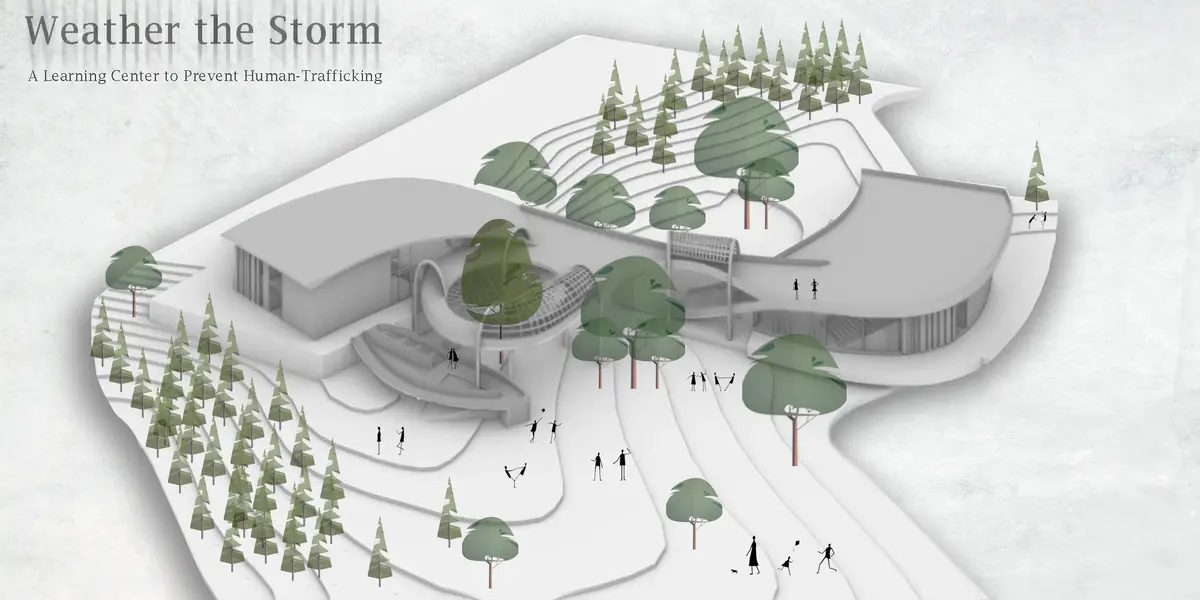
This project is a story about observation, understanding and accepting challenges for best results. The starting point of narrating this story was understanding the elements, limitation and opportunities for questioning “what if?”. What if people walk on the roof of the building? What if a bridge embraces a tree? What if people gather in a same place, teach and learn regardless their various ages, jobs, education? All elements of this story, trees, ground slope, wind, sunlight, rain etc, play their own roles to improving the quality of the project. We tried to design an education center that education occurs not only in the classes but also in other parts of the building and landscape. Learning starts since entering the site and continues to classes, workshops and library. In the designing of this learning center all the residences of the village are considered including disable people, children and elderlies. For example, designing an agricultural field in the site gathers people from different generations for learning and transferring experiences. One of the important elements of our story are trees. Not only they are not removed for the project but also converted to a major element of dynamism. A bridge which is turned around a tree shows the reconciliation of human with nature, technology with memories and traditions. The bridge leads children to the nature from building. The bridge connects two buildings as well so leads people to the roof of the other building. If there is not a way on the ground, find it in the sky. This project is a complex of new experiences for children. They will always find something to discover! Such as the central building which rises again as soon as reaching to the ground.
Accessing to the site is possible from several directions and the designation let people enter the landscape without entering the building if they prefer. We tried to use all parts of the site and not leave any part. Concerning the collective Indian ceremonies, open and semi open spaces on the bridges and in the park can be considered useful.
The orientation of the wind and sun light and the amount of precipitation are regarded in the designation. Due to the heavy rainfall in Chhattisgarh, the buildings are located upper than the level of the ground to avoid humidity and any problem with ventilation. Although the slope of the roof prevents gathering water and penetrating humidity to the building.
Because of the shape of the site, we considered two buildings in northern and southern parts and connected them with a bridge, from the balcony of the southern building to the roof of the northern one. Some parts of the bridge is covered with Wicker roofs to protect people against wind, rain etc. Native Indian wicker has a good resistant against rot. There are also some stairs in the site for reaching to the roof of the northern building. The buildings have two stories with 4.5 height and 5 meters thickness of the roofs. The northern and southern buildings are located on the altitude of 1 m and 6 respectively. The form was designed in a way to need the least excavation and embankment. The materials of the building and bridge are wood and concrete. The material of the building were selected in accordance to the form of the building, local climate, local economy and accessibility.
The roof of the northern building sloped towards south so the photovoltaic cells can be oriented in a suitable degree with the ground. Using photovoltaic cells provides the opportunity for supplying a part of the energy of the building with solar energy.
The windows are designed as curtain walls and for the southern ones, a light shelf is designed to prevent the sharp light from entering the building. A farmland is located in the northern part of the site and the crops are tomatoes, chili peppers and strawberries, which are the native crops of chhattisgarh and due to the fact that these crops have low height, they are suitable for children to work on. Every building has classes and workshops for students, with the goal of educating and learning various skills, such as agriculture, art and modern science like programming.
There is ramp, elevator, and bathrooms designed for disabled people.
In the northern part of the site, there is an open park which is located one meter lower in level than the argicultural land in order to keep the field safe from children.

Popular Articles
Popular articles from the community


Lunar Spiral: Space Architecture Shaped by the Mathematics of the Universe
Lunar Spiral reimagines space architecture through Fibonacci geometry, lunar regolith, levitating habitats, and self-sustaining Moon living.

Little Red Riding Hood: Architectural Design as a Journey Through Fear, Light, and Storytelling
Little Red Riding Hood reimagines the fairy tale through architectural design shaped by fear, light, scale, memory, uncertainty, and choice.

Conexión: Biophilic Design Reimagines High-Rise Living in Hong Kong
Conexión reimagines high-rise living in Hong Kong through biophilic design, green facades, shared spaces, daylight, water and nature within.
ALGAL REALM: A Bio-Integrated Lunar Habitat Design for Life Beyond Earth
ALGAL REALM reimagines lunar habitat design with algae-powered life support, 3D-printed regolith, and vertical living for a lunar future.

Similar Reads
You might also enjoy these articles

The Rhythm of Seasons
A Farmers' Market Connecting Nature and the City

More Than a Building-Designing a Living System
More Than a Building-Designing a Living System
Base Beyond
DESERT COMPOUND ARID: TOURISM OF ABSENCE AND ABUNDANCE


Comments (0)
Please login or sign up to add comments
No comments yet. Be the first to comment!