

Bovenbouw Sculpts a Passive House in Brussels from Five Sizes of One Brick
On a shallow plot wedged between apartment towers, a four-story family home channels Art Nouveau plasticity through obsessive brickwork.


Replacing a single-story warehouse on one of Brussels' tightest plots, Bovenbouw stacked an entire family home vertically and wrapped it in a brick envelope so meticulously contoured it looks almost carved. The Werfstraat Passive House rises 50 feet from cobblestones to cornice, slotting between neighboring apartment blocks as if it has always been there, yet announcing itself through the subtle shimmer of alternating glazed and unglazed bricks. Completed in 2020, the project achieves certified Passive House performance without sacrificing the sculptural ambition that Brussels' architectural tradition practically demands.
What makes this project genuinely unusual is how a single conventional brick, cut to five different sizes, generates all the texture, curvature, and structural logic of the facade. Stretchers span above and below windows, headers run in horizontal ribbons between floors, and "sailors" expose their broad undersides at key moments. The result is not ornament applied to structure but structure performing as ornament, a distinction that connects the building to the neighborhood's Art Nouveau stone facades without resorting to historicism. The budget of €880,000 (excluding VAT and fees) makes the level of craft even more remarkable.
Between Factory and Mansion
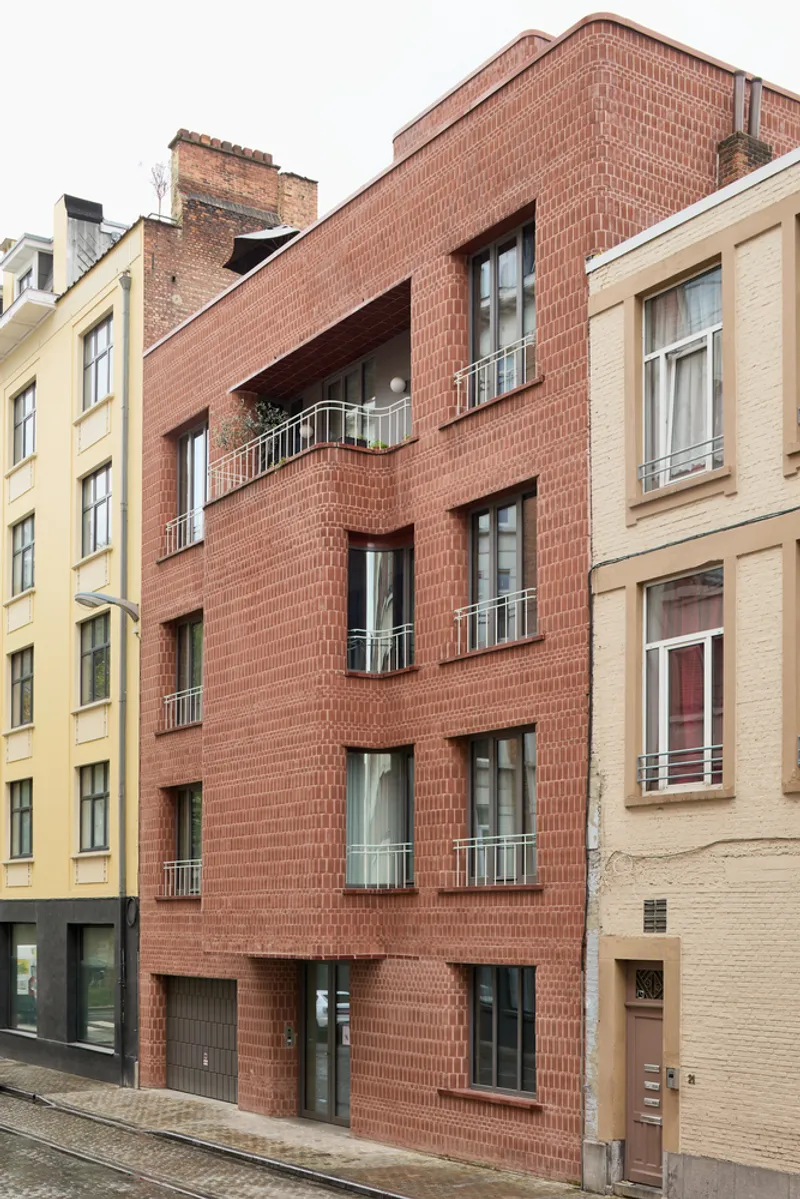
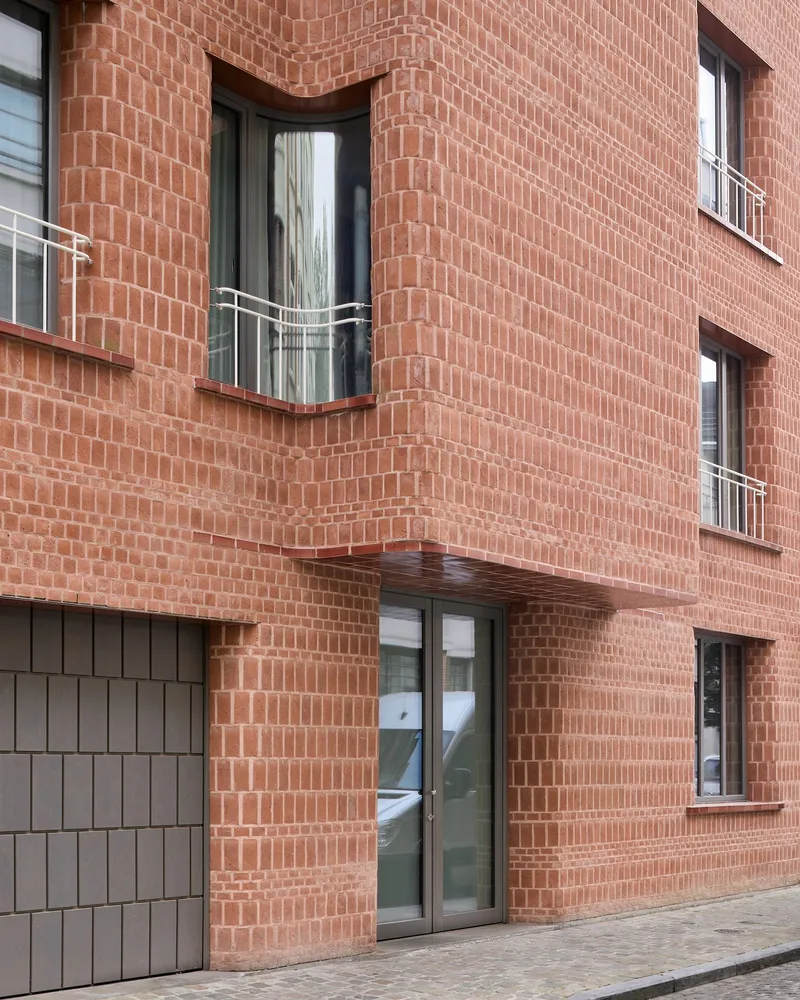
The neighborhood holds two building types in uneasy coexistence: industrial workshops and bourgeois mansions. Bovenbouw refused to choose. The repetitive window cadence and the flat, no-nonsense bay read as workshop vernacular, while the glazed brick sills, the curved reveals, and the overall vertical proportion belong to a city house. A blind protrusion over the entrance creates lateral curved windows that offer oblique views down the narrow street, a move borrowed from the Brussels bay window tradition but deployed here to solve a daylight problem rather than project status.
Because the plot is so shallow, every square meter of facade had to work for both light and privacy. The south-facing terrace on the uppermost floor sits on top of that same blind bay, turning a structural necessity into the home's best outdoor space. Nothing is arbitrary. The facade height matches the cornice lines of its taller neighbors just enough to hold the street wall, while the red-brown brick and its occasional glaze keep the surface alive under Brussels' perpetually shifting skies.
The Curving Stair as Engine
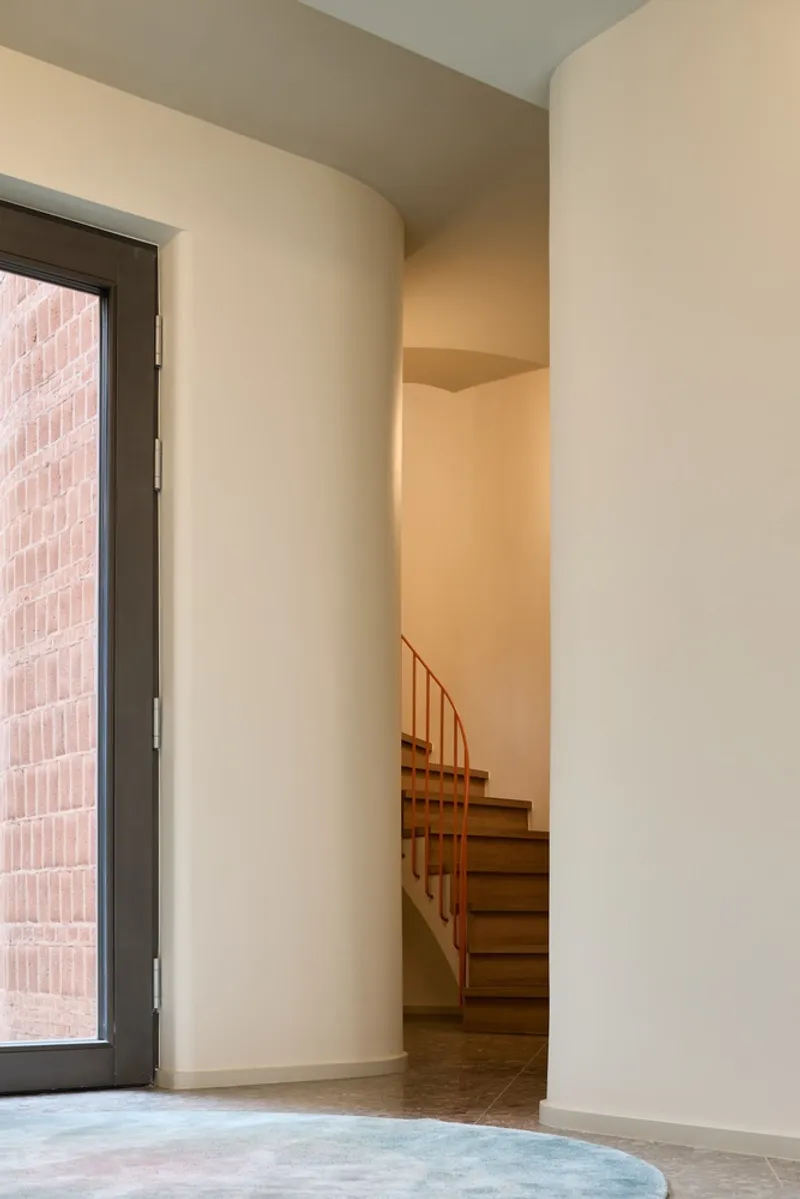
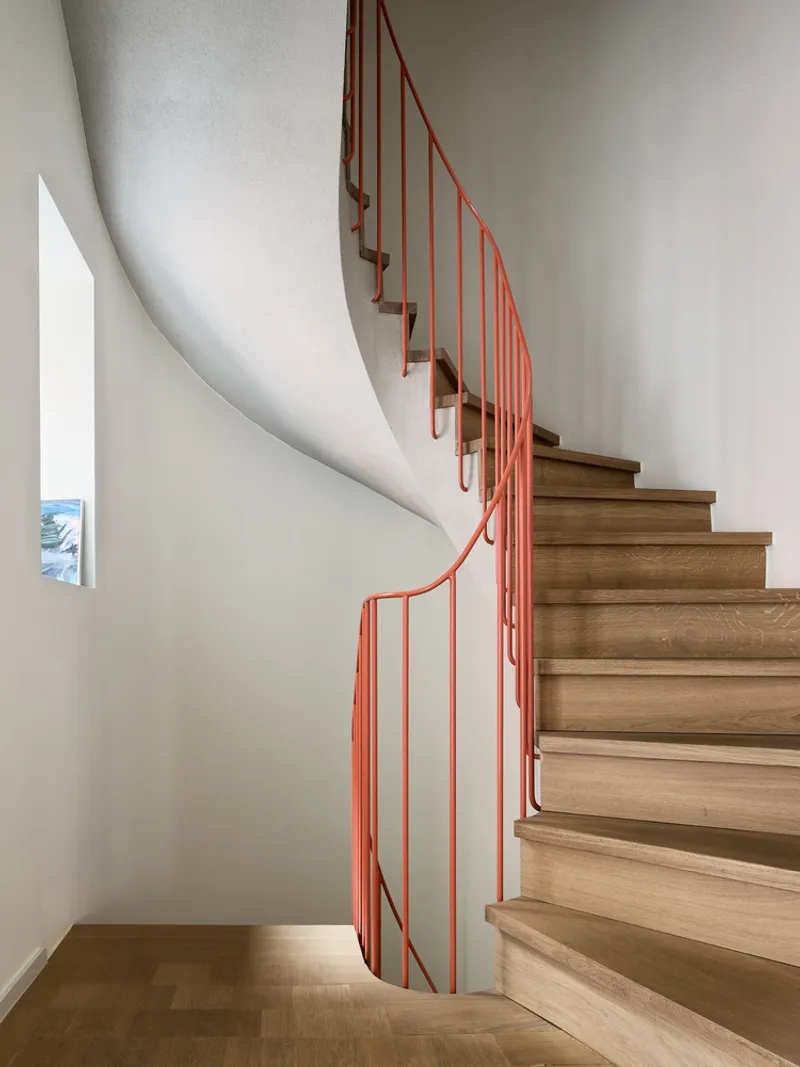
Positioned eccentrically at the back of the plan, the oval staircase is the spatial engine of the entire house. From the ground-floor entrance, rounded plaster walls guide you into its orbit without a single hard corner. The warm coral-colored metal balustrade spirals upward through all four stories, acting as both wayfinding device and the most persistent color accent in the interior. Bovenbouw treats this rounding as a leitmotif: every door reveal, every internal corner picks up the same softened geometry, so the transition from exterior curvature to interior flow feels seamless.
The staircase also solves a practical problem. With the living room and kitchen placed on the uppermost floor to capture the best light, vertical circulation needed to feel effortless rather than laborious. The oak block parquet underfoot, the generous landing dimensions, and the natural light spilling down from above all conspire to make climbing four stories feel like moving through a series of rooms rather than scaling a tower.
Living at the Top
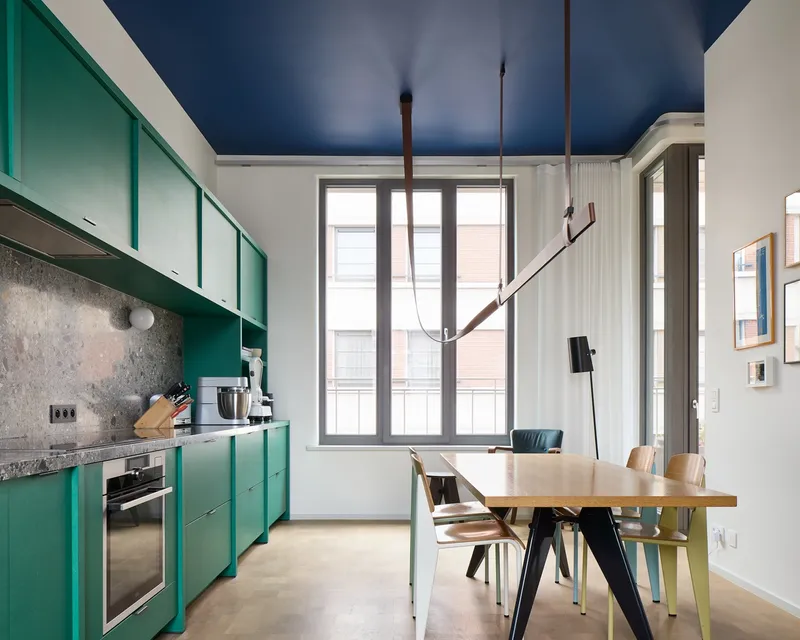
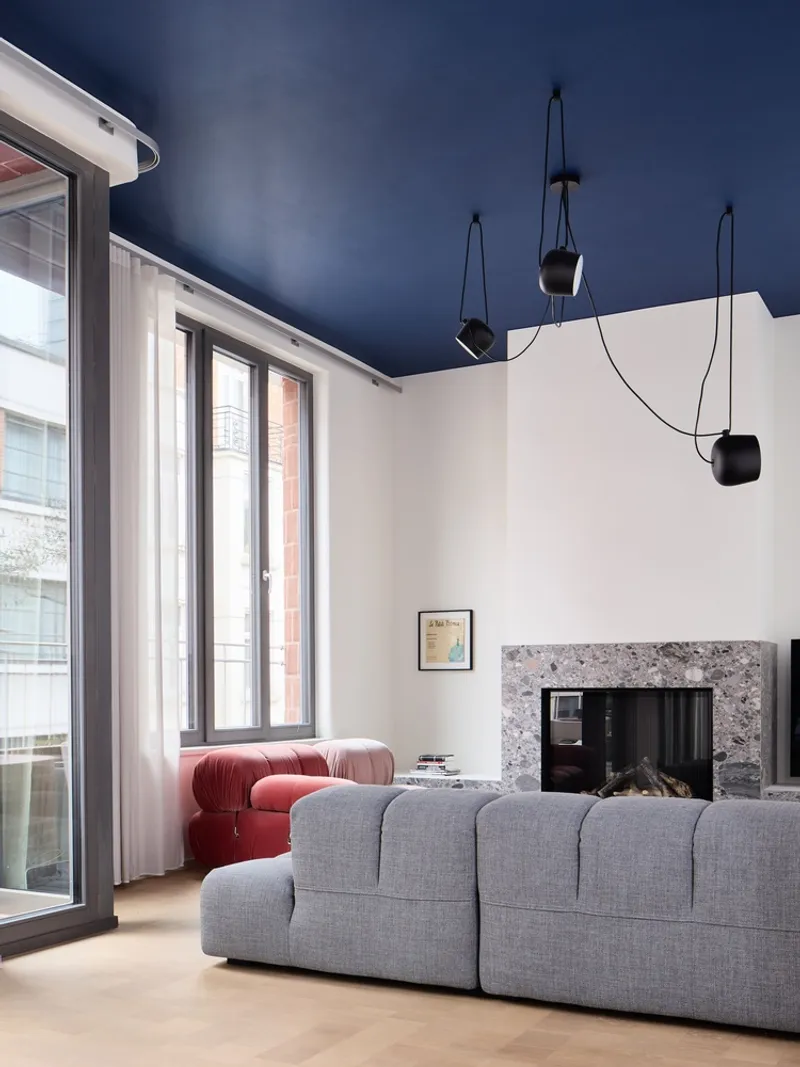
Inverting the conventional Brussels town house, Bovenbouw places the kitchen and living room on the third floor, the piano nobile repositioned at the rooftop. The payoff is immediate: sunlight floods in from the south, the deep blue ceiling compresses the space just enough to make it feel intimate rather than lofty, and the south-facing balcony extends the room outdoors. Green cabinetry in the kitchen and Breccia Alba marble on the worktop and fireplace wall give these rooms a material richness that contrasts sharply with the restrained palette of the lower floors.
The fireplace wall is worth a closer look. The terrazzo-like stone surround and the marble facing establish a vertical axis that anchors the living room, while pendant lights drop from that saturated blue ceiling to define the seating zone below. There is a deliberate tension between the warmth of the materials and the coolness of the color, a palette decision that keeps the interior from tipping into either coziness or austerity.
Intimate Rooms, Bold Color
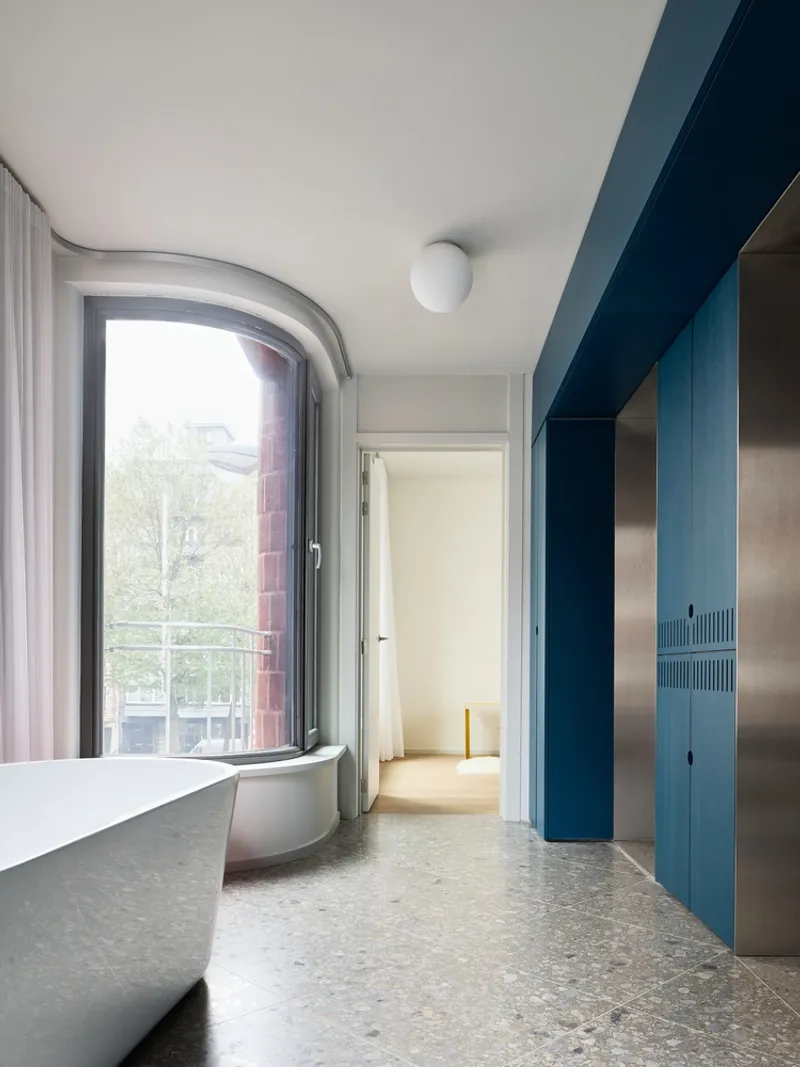
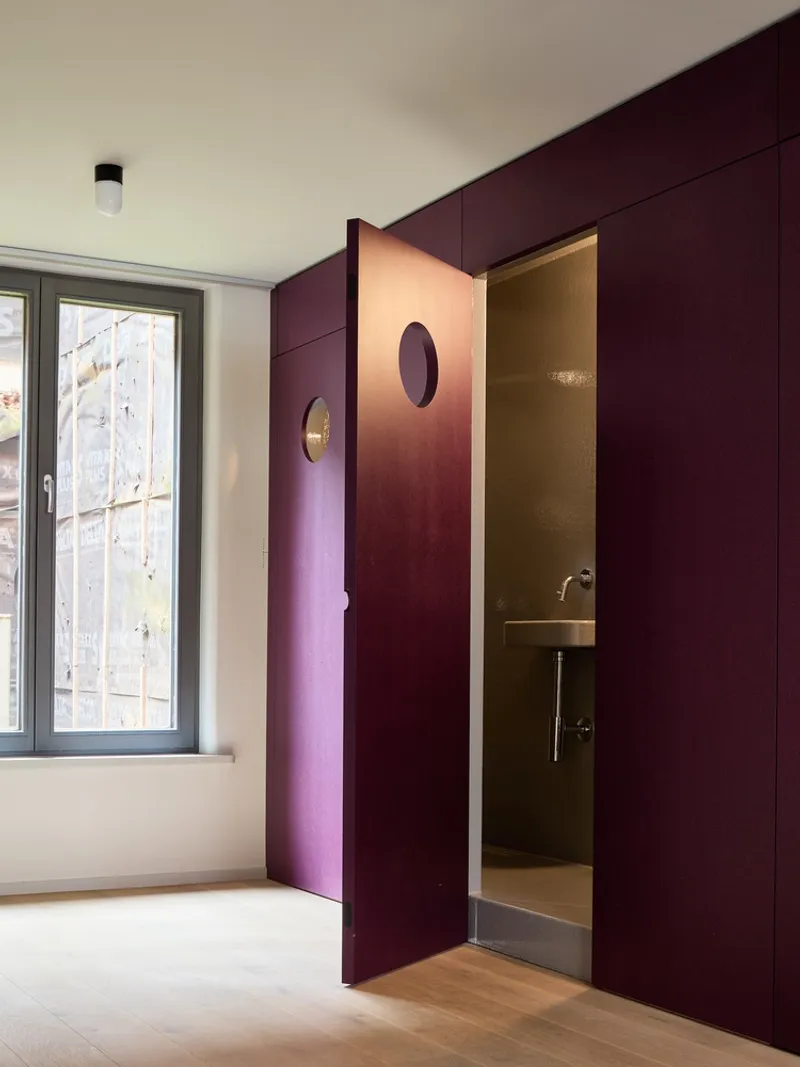
Bovenbouw treats each floor as a self-contained world. The parents' suite on the second floor pairs an arched window with a freestanding bathtub, blue cabinetry, and terrazzo flooring to create a room that feels more like a boutique hotel suite than a typical Belgian bedroom. Elsewhere, a deep burgundy paneled wall conceals a pivoting door into a compact bathroom fitted with brass fixtures. These moments of dense color and material specificity reward close attention; they suggest a design team that cared as much about the experience of opening a door as about the profile of a brick.
The ground and first floors are planned with future adaptability in mind. A guest room and garage at street level, children's rooms and a shared playroom above: the arrangement means these two floors could be split off as a rental studio unit without disrupting the family quarters above. In a city where housing pressure is relentless, building in that kind of flexibility from day one is as forward-thinking as any Passive House certification.
Plans and Drawings
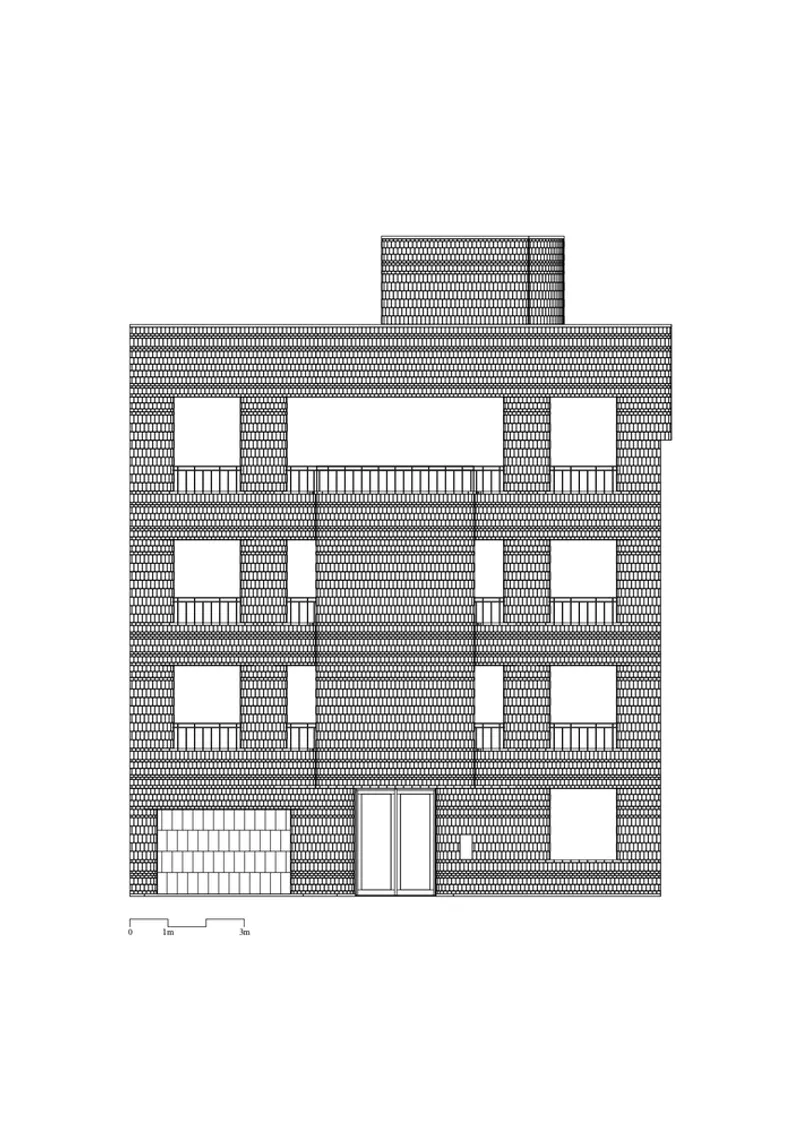
The elevation drawing reveals the full discipline of the brick pattern. You can trace the shift from stretcher courses around openings to header ribbons between floors, and see how the sailors mark thresholds. The drawing also makes legible something the photographs can only hint at: the precise way the facade thickens at the bay window and thins at the recessed balconies, creating a depth that animates the street elevation far beyond what a flat plane could achieve.
Why This Project Matters
Passive House certification is often treated as an invisible layer, something that happens behind the insulation and the membranes. At Werfstraat, Bovenbouw proves that high-performance envelopes and expressive brickwork are not mutually exclusive. The air cavity behind the outermost wythe handles thermal bridging while the five brick sizes handle everything else: ornament, weather protection, structural expression, and a conversation with the city's Art Nouveau legacy. The building process was, by the architects' own admission, terribly time-consuming, but the payoff is a facade that rewards every glance.
More broadly, the project offers a replicable argument for density without sacrifice. A four-story family home on a shallow urban lot, certified to the most demanding energy standard, built within a reasonable budget, and designed to be subdivided if circumstances change: that is a genuinely useful model for European cities grappling with housing, heritage, and climate simultaneously. Bovenbouw did not solve all three problems at once by accident. They solved them by treating craft, program, and performance as aspects of a single design problem.
Werfstraat Passive House by Bovenbouw. Located in Brussels, Belgium. Completed in 2020. Photography by David de Bruijn.
About the Studio
Share Your Own Work on uni.xyz
If projects like this are the kind of work you want to make, uni.xyz is a place to publish your own, find collaborators, and enter design competitions.




Popular Articles
Popular articles from the community


The Ocean Hive: Sustainable Architecture for a Self-Sufficient Civilization at Sea
The Ocean Hive imagines sustainable architecture at sea, where modular habitats, algae, wave power and ocean waste sustain a growing colony.

Riyadh For All: Intergenerational Urban Design for Active Aging in Rabat
Riyadh For All reimagines urban design in Rabat with intergenerational co-living, adaptive courtyards, and Moroccan cultural exchange today.

AL-JANNAH: Sustainable Architecture and Permaculture for Afghan Widows
AL-JANNAH uses sustainable architecture and permaculture to create resilient oasis of housing, learning, work and renewal for Afghan widows.

Co-Life: Senior Housing Design That Reconnects Older Adults With the City
Co-Life reimagines senior housing design through healing gardens, shared streets, workshops, and a sustainable community across generations.

Similar Reads
You might also enjoy these articles


Hodi-Mandai Geram
Project Function: Preservation and revitalization of the Intangible heritage and socio-spatial identity of the Hodi by Housing, Cultural Memory Center, Sacred Grove, landscape, local tourism economy


Olio Towers: A Mid-Rise for Performers That Fuses Housing, Rehearsal, and Stage
Located blocks from Houston's Theater District, this modular tower stacks living units around a central performance atrium.

Oasis: Modular Green Housing Carved into Dhaka's Urban Fabric
A shortlisted Plugin Housing entry reclaims unauthorized settlements in Dhaka with stepped concrete volumes, green roofs, and ventilation-driven design.

Black Hole: A Floating Megastructure for the Post-Physical Era
Emiliano Mazzarotto envisions a spherical, self-scaling arena where e-sports, digital hotels, and holographic stadiums replace traditional public space.

Explore Passive Architecture Competitions
Discover active competitions in this discipline



Challenge to reimagine the Iron Throne


Photograph architecture without architects


Illustrate the lost glory of Angkor Wat - Render Challenge


Design challenge to reuse E-waste
Comments (0)
Please login or sign up to add comments
No comments yet. Be the first to comment!