

Omar Gandhi Perches a Corten Steel Retreat Over Nova Scotia's Gaspereau River Valley
At just 1,500 square feet, White Rock House channels hunting cabins and duck blinds into a precise hilltop sanctuary in the forest.


Some architects build retreats as trophies. Omar Gandhi built one as therapy. White Rock House sits atop a steep rocky incline overlooking the Gaspereau River Valley in Nova Scotia, a landscape of vineyards, apple orchards, and dairy farms on the unceded territory of the Mi'kmaq people. Gandhi designed the 1,500 square foot cabin for his own use, his employees, and friends, with the explicit goal of supporting mental health through architecture. The building is reached only by foot along a gravel path after a long, winding driveway through the forest ends in a sharp hairpin turn. That deliberate slowdown from car to body sets the tone for everything that follows.
What makes White Rock House genuinely interesting is how it inverts the typical retreat formula. Instead of opening up to nature from the moment you arrive, it begins in darkness. The ground floor is intimate, dimly lit, almost cave-like. Only when you climb to the second level does the valley crack open through cantilevered glazing framed in weathered steel. The building is a sequence, not a snapshot. It borrows from the logic of hunting cabins and duck blinds: small, deliberate openings positioned to frame exactly what matters, nothing more.
A Corten Volume Rooted in Rock
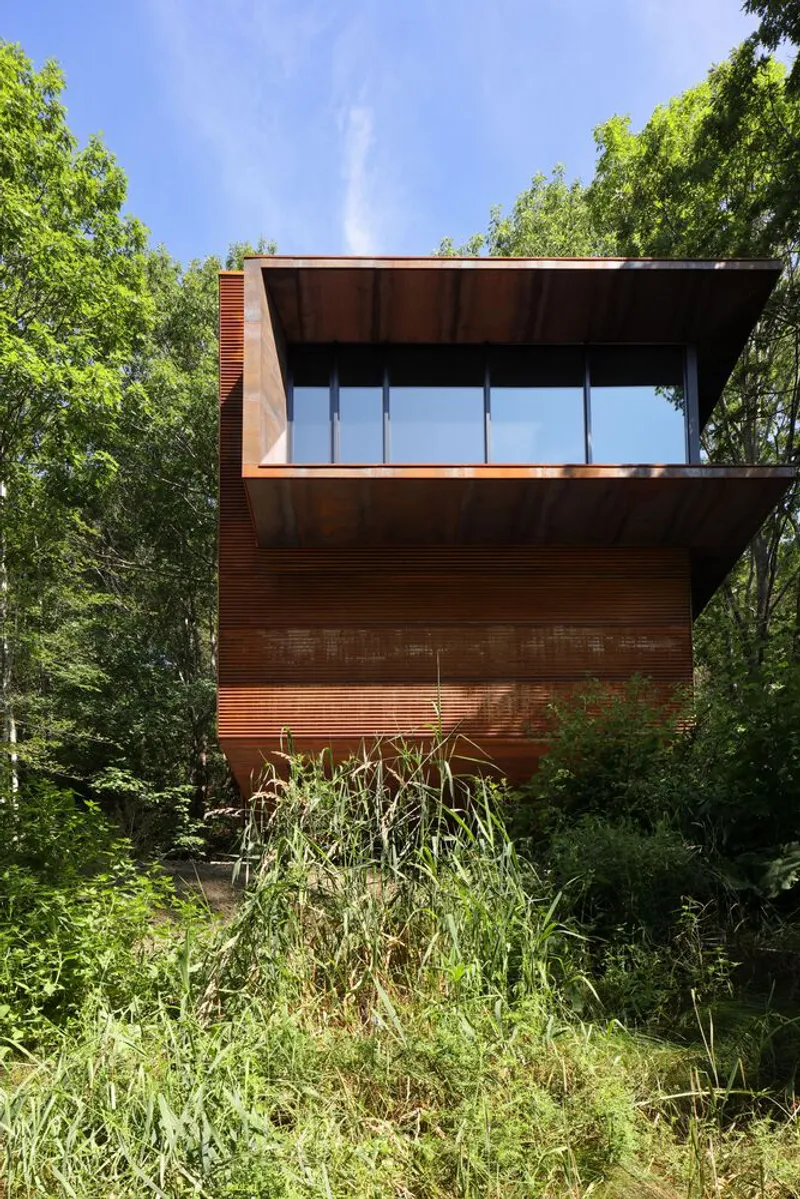
The exterior reads as a single monolithic volume of corten steel, its oxidized surface deliberately echoing the reddish hematitic stain that coats quartzite fractures throughout the region. The larger upper volume rests on slender legs above the hillside, while a smaller entry volume recesses beneath it, appearing to emerge directly from the rock below. The effect is geological as much as architectural: the house looks like it has always been part of this ridge.
Horizontal banding on the corten cladding gives the facade a striated quality that plays against the vertical density of surrounding trees. The form is deliberately simple, a box with carefully positioned openings rather than an exercise in formal gymnastics. Specialty steel fabrication by Urban Handcrafts and Filo Tim ensured the cantilevered steel surround at the second floor's largest window reads as a single continuous hoop, projecting beyond the main volume to frame the valley view like a visor.
Compression Before Release
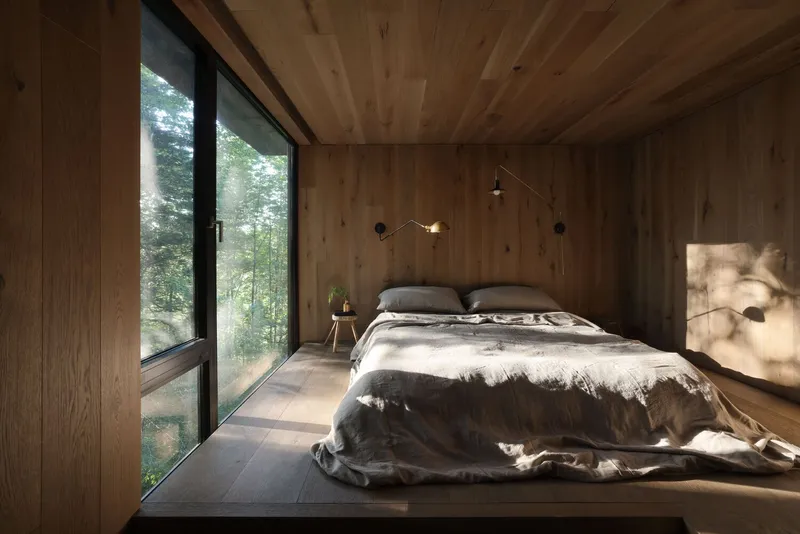
The ground floor operates on a principle of compression. Bedrooms and a bathroom are lined in smoked oak, with timber surfaces wrapping walls and ceilings to create spaces that feel enclosed, warm, and deliberately protective. Floor-to-ceiling windows exist here too, but they look straight into the dense forest canopy rather than opening to distant views. Light enters filtered through leaves, dappled and shifting. It is the architecture of rest, not spectacle.
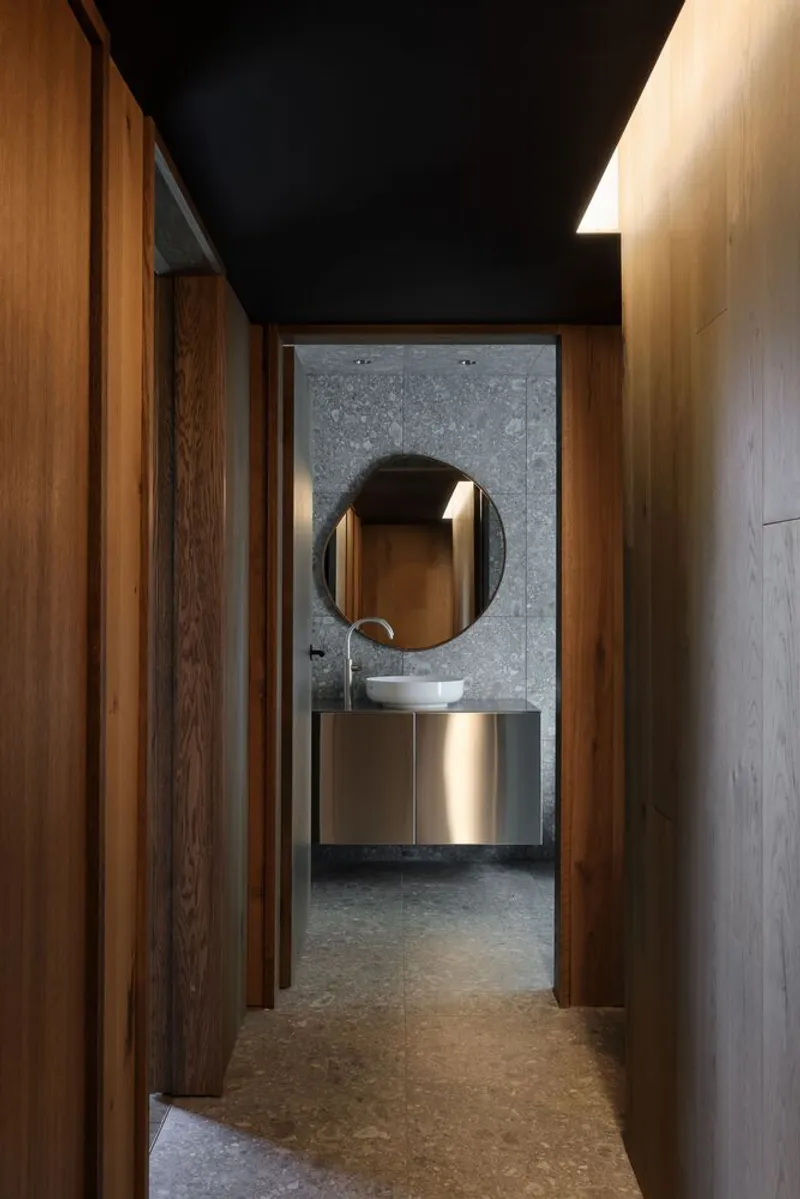
A corridor lined in the same warm timber leads to a bathroom where the palette shifts to polished concrete and brass, a material transition that signals utility without breaking the atmosphere. Industrial light fixtures are wall-mounted throughout, keeping the ceiling plane clean and uninterrupted. The restraint is consistent: every element earns its place.
The Upper Floor Opens Wide

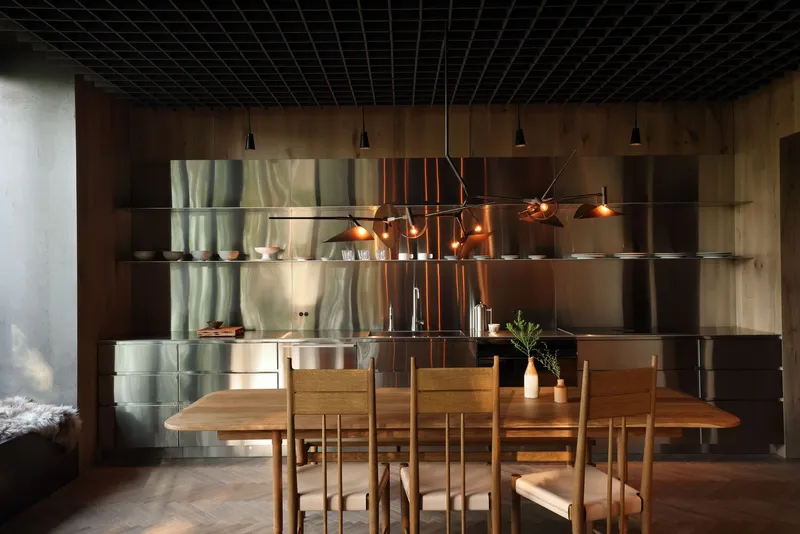
Ascending from the dim stairwell to the second level is the building's pivotal moment. The ceiling lifts to reveal a black gridded plane, the light changes from amber to bright daylight, and tall windows pull the Gaspereau Valley into the room. After the deliberate introversion of the ground floor, the effect is visceral. Gandhi understands that a view means more when you have been denied it.
The open plan living and dining area occupies the full footprint. The kitchen is organized cleverly: low elements remain visible from the main space, while taller appliances like the refrigerator, freezer, and wine cabinet are tucked into an adjacent pantry so they never interrupt the sightlines. Stainless steel shelving runs along the west wall, doubling as display and storage. Copper pendant lights hang from the dark ceiling grid, their warm tone picking up the corten that frames the window beyond.
Material Honesty at Every Scale
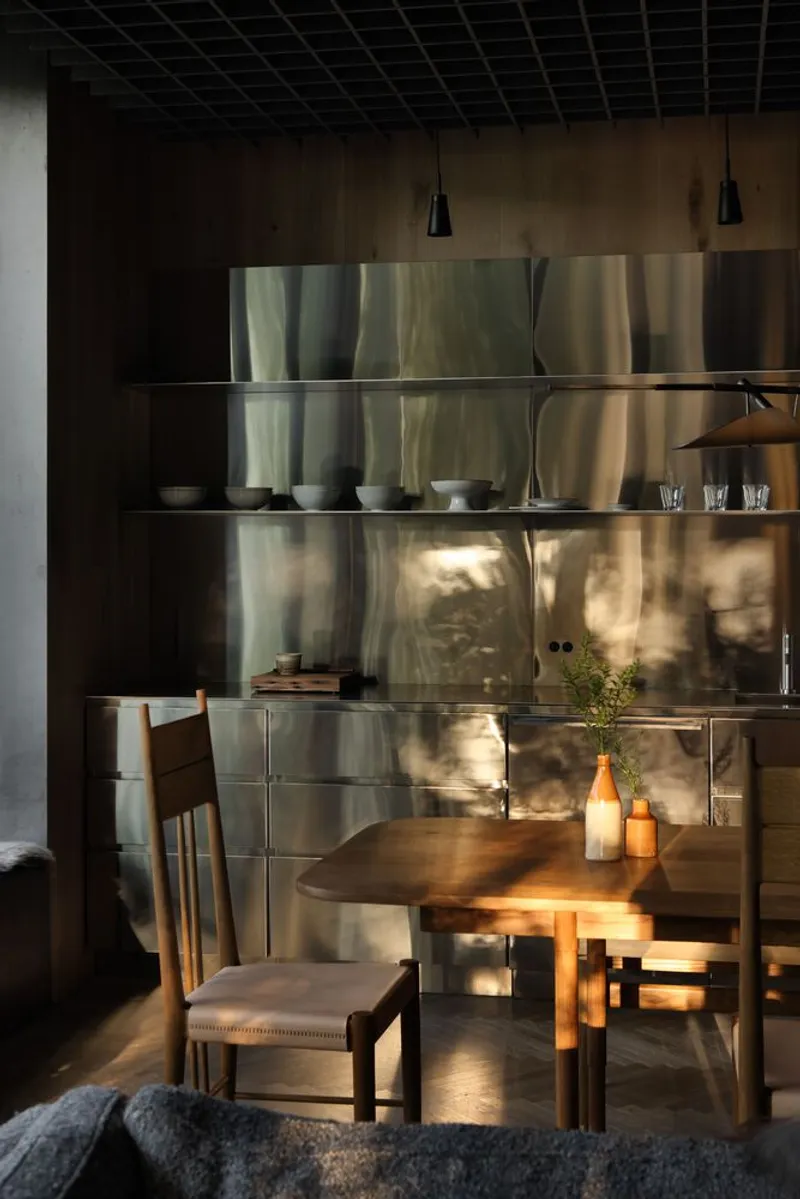
The stainless steel shelving unit is worth pausing on. Dappled sunlight plays across its surface and the ceramics and glassware it holds, turning a functional element into something almost meditative. Raw steel shelving on the ground floor and stainless steel on the upper floor create a coherent material language that connects to the corten exterior without mimicking it. Each metal is allowed to age and react to light on its own terms.
Smoked oak, raw steel, stainless steel, corten, concrete, brass: the palette is tight but never monotonous because each material occupies a specific role in the building's spatial hierarchy. The warmer, softer materials belong to the private ground floor. The harder, more reflective surfaces define the communal upper level. It is a legible system, not a mood board.
Plans and Drawings
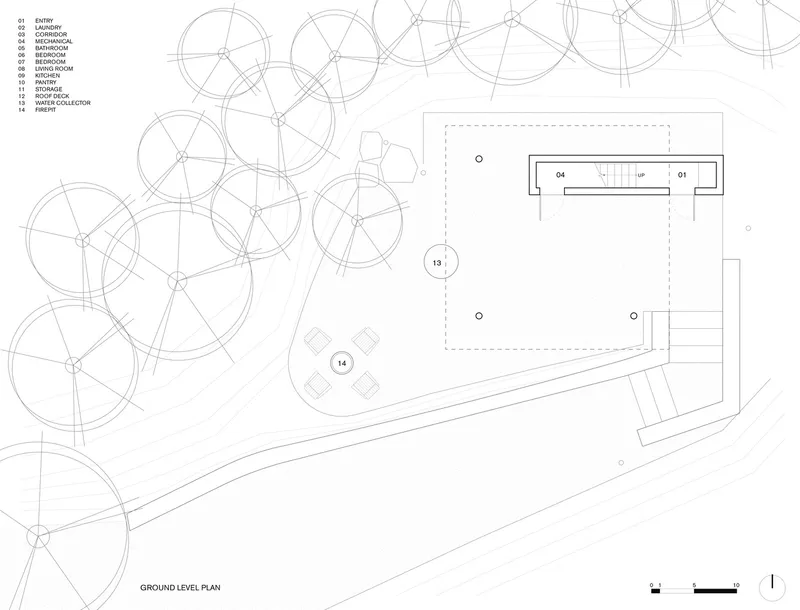
The ground level plan confirms the precision of the spatial strategy. Two rectangular volumes sit along the angled site boundary, with circular tree canopies dotting the drawing as a reminder that the landscape is not backdrop but co-author. The footprint is compact, oriented to capture specific views while leaving the steep hillside and its generations of decomposing tree limbs largely undisturbed. Rainwater collection and storage for irrigation keeps the building's ecological footprint as light as its physical one.
Why This Project Matters
White Rock House matters because it treats retreat architecture as a sequence rather than a destination. Too many rural projects fixate on the money shot, the panoramic window, the cantilevered deck, without choreographing the experience of arriving, entering, and inhabiting. Gandhi designed this building as a sensory progression from forest path to dark ground floor to bright upper room to rooftop among Japanese maples. The architecture controls time as much as space.
It also matters as a statement about scale. At 1,500 square feet, White Rock House proves that a retreat does not need to sprawl to be generous. Its power comes from precision: the right opening in the right wall, the right material at the right threshold. In a profession that often conflates ambition with size, this is a useful corrective, a building that is exactly as big as it needs to be and not a square foot more.
White Rock House by Omar Gandhi Architect, Gaspereau Valley, Nova Scotia, Canada. 1,500 sq ft. Completed 2023. Photography by Ema Peter.
About the Studio
Share Your Own Work on uni.xyz
If projects like this are the kind of work you want to make, uni.xyz is a place to publish your own, find collaborators, and enter design competitions.


Popular Articles
Popular articles from the community


U.GA Architects Wraps an Oval Rooftop Pool in Curved Board-Formed Concrete on Busan's Jeollidan-gil
In Busan's Jeonpo-dong, a 454 m² mixed-use block stacks a neighborhood facility, guest rooms and an oval rooftop pool inside spiraling concrete walls.

Juan García Correa, John González and Claudia Rueda Sink a Circular Amphitheater into a Manizales Engineering Building
On the La Nubia campus in Manizales, Colombia, the S1 Building folds labs and offices into a hillside of ramped lawns that double as a campus route.

longwave studio Reorganizes a 112 m² Tainan Apartment Around the Daily Routines of a Family and Two Cats
In Tainan, Taiwan, birch plywood, rust-red furniture and a freestanding plaster wall link arrival, storage, work and family life in one apartment.

David Macias Steps a Doorless Stone and Plaster House Down a Tropical Colombian Hillside
In the humid hills of Colombia, Threshold House replaces the front door with an open void and terraces its 850 m² down the slope instead of fighting it.

Similar Reads
You might also enjoy these articles


Hodi-Mandai Geram
Project Function: Preservation and revitalization of the Intangible heritage and socio-spatial identity of the Hodi by Housing, Cultural Memory Center, Sacred Grove, landscape, local tourism economy


Olio Towers: A Mid-Rise for Performers That Fuses Housing, Rehearsal, and Stage
Located blocks from Houston's Theater District, this modular tower stacks living units around a central performance atrium.

Oasis: Modular Green Housing Carved into Dhaka's Urban Fabric
A shortlisted Plugin Housing entry reclaims unauthorized settlements in Dhaka with stepped concrete volumes, green roofs, and ventilation-driven design.

Black Hole: A Floating Megastructure for the Post-Physical Era
Emiliano Mazzarotto envisions a spherical, self-scaling arena where e-sports, digital hotels, and holographic stadiums replace traditional public space.

Explore Architecture Competitions
Discover active competitions in this discipline

Challenge to reimagine the Iron Throne

Photograph architecture without architects

Illustrate the lost glory of Angkor Wat - Render Challenge

Design challenge to reuse E-waste
Comments (0)
Please login or sign up to add comments
No comments yet. Be the first to comment!