
Wiercinski-Studio Strips a 1932 Poznań Villa Back to Its Bones and Rebuilds It in Steel, Oak, and Granite
In Poznań's historic Grunwald district, 45 bespoke fittings and a fearless material palette revive a pre-war villa without erasing its past.


Most villa restorations in heritage districts play it safe: plaster over the cracks, match the window trim, move on. P81 House does the opposite. wiercinski-studio, led by Adam Wiercinski, took a 1932 multi-apartment villa in Poznań's Grunwald neighborhood and peeled it open, stripping plaster to expose original brickwork and pulling out an entire ground-floor load-bearing wall to create a single flowing living space. The gesture is radical, but the reverence for the building's pre-war fabric is genuine: cornices, sills, and wooden floors survived the intervention, while concrete infills now trace the ghost outlines of walls that didn't.
What makes the project interesting is its commitment to going all the way. The scope covers the facade, a new corrugated-metal entrance volume, custom landscaping, and no fewer than 45 bespoke furniture pieces and fittings. The material vocabulary, steel, oak, local Strzegom granite, corrugated metal, reads as industrial yet warm. It's a house that treats honesty as a design strategy: every scar and seam tells you something about what the building was, and what it took to make it livable again at 300 square meters.
Street Presence: Brick, Concrete, and a New Metal Skin
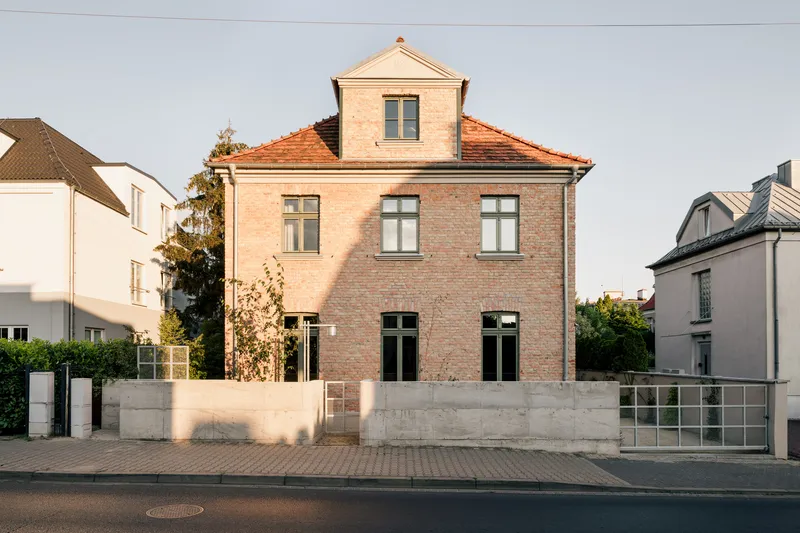
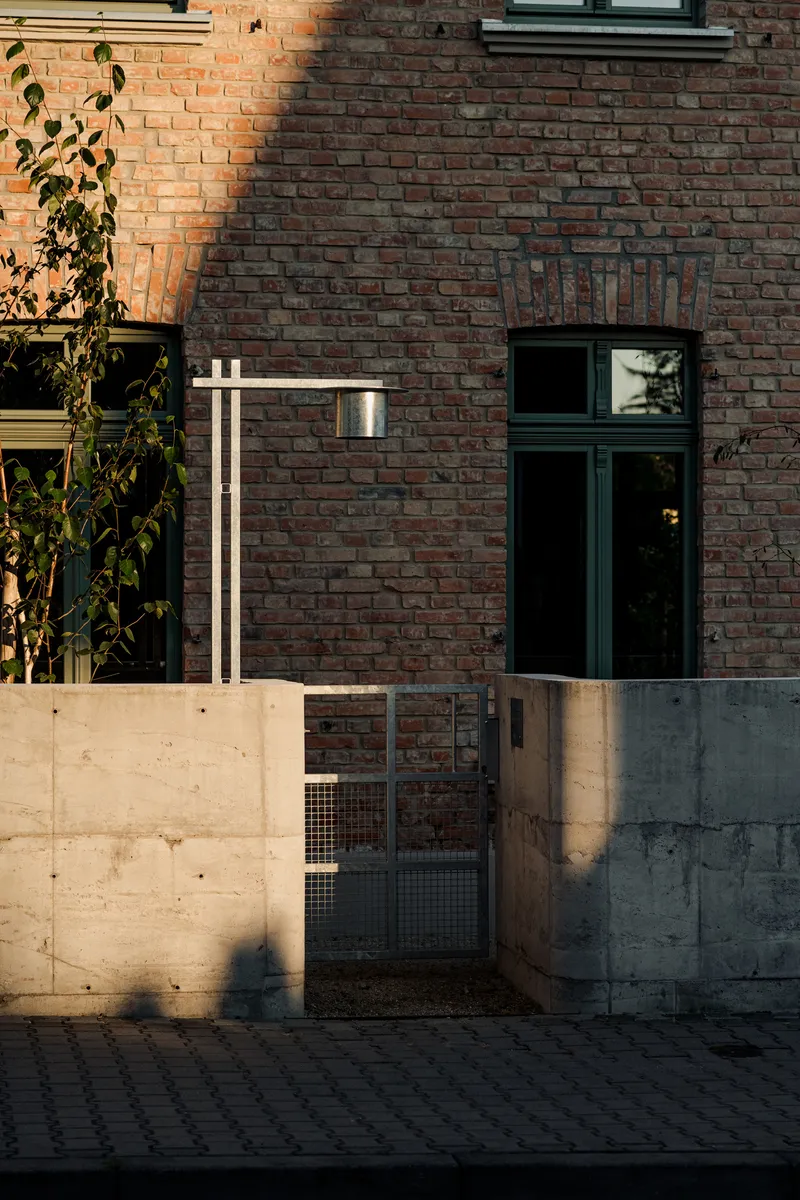
From the street, P81 House registers as unmistakably pre-war: three stories of red brick, an orange tile roof, the proportions of a solid Grunwald-district villa. A low concrete wall wraps the street boundary, replacing whatever picket-and-hedge arrangement preceded it with something more forthright. Steel gates and a mesh panel sit flush with the brickwork. New windows replicate the original classical divisions, so the facade reads as restored rather than renovated.
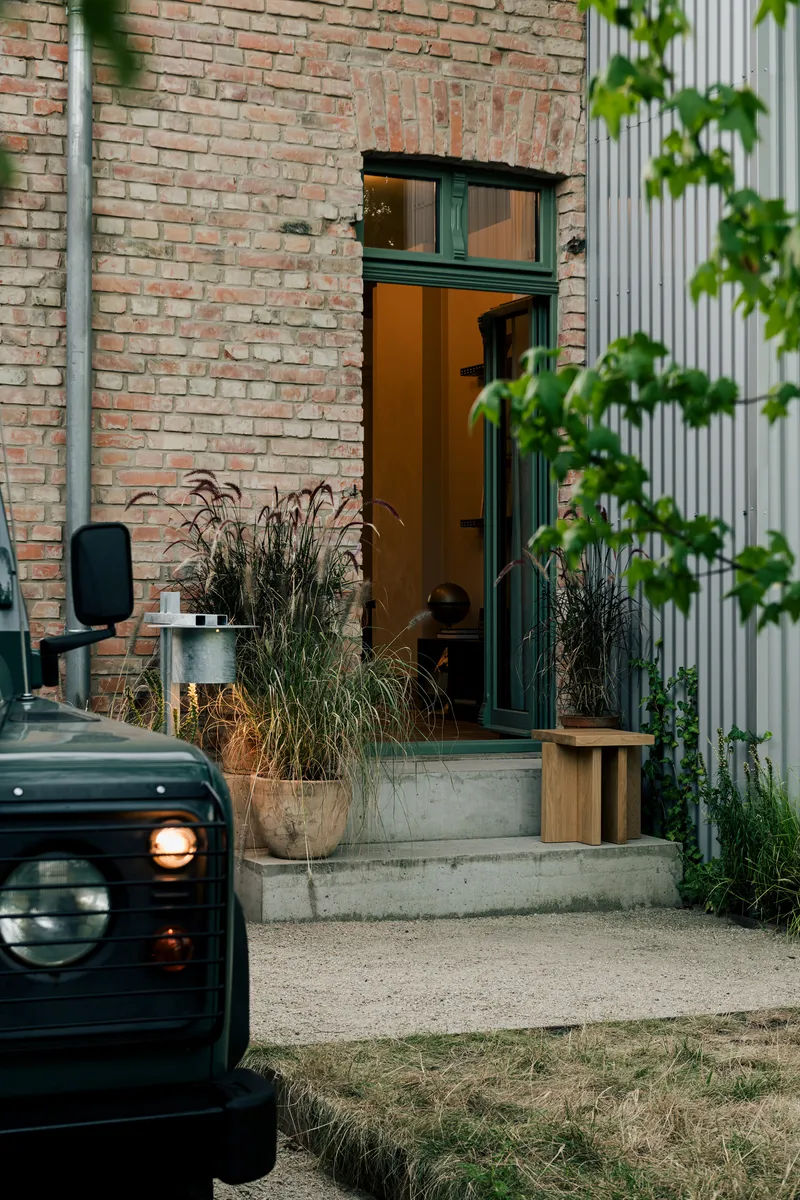
The entry sequence is where the project's contemporary ambitions first surface. A weathered brick wall frames the entrance, flanked by potted grasses and the kind of understated landscaping that signals intent without shouting. Custom lantern-like light fittings line the path, another of those 45 bespoke elements that collectively give the house its personality.
The Corrugated Volume: Industrial Graft on a Historic Body
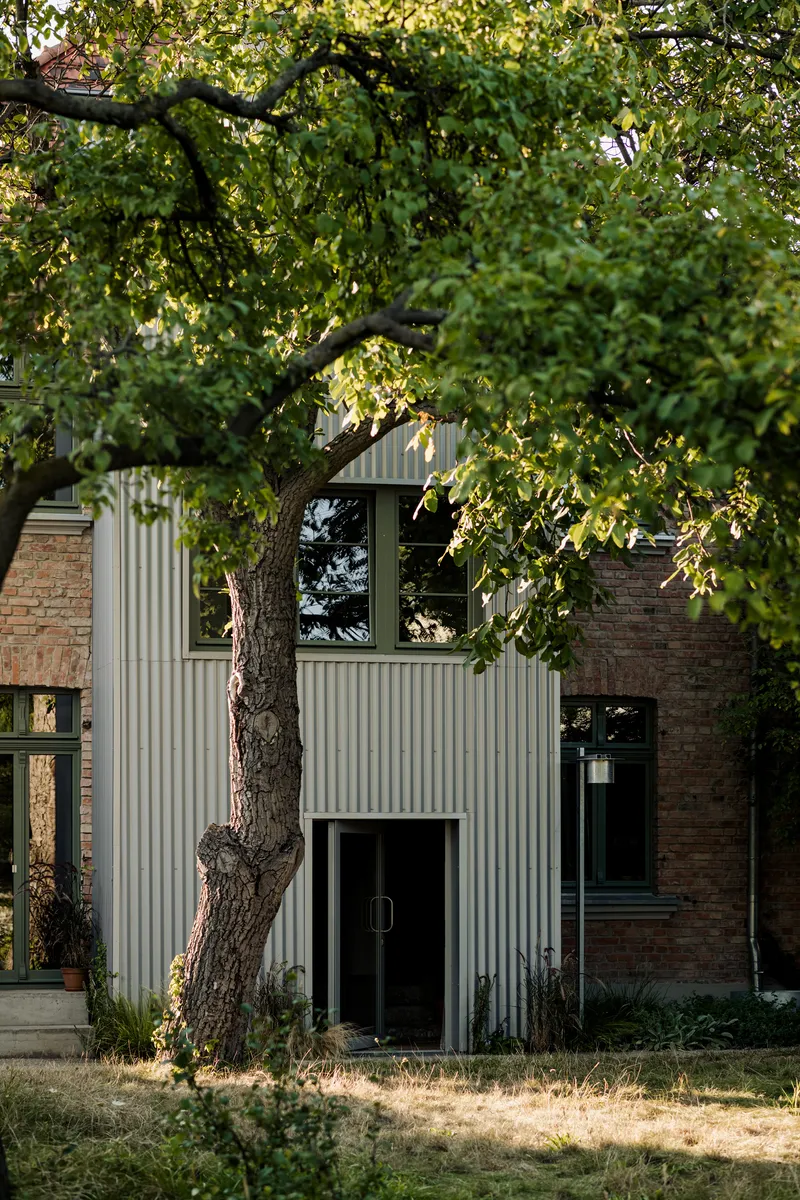
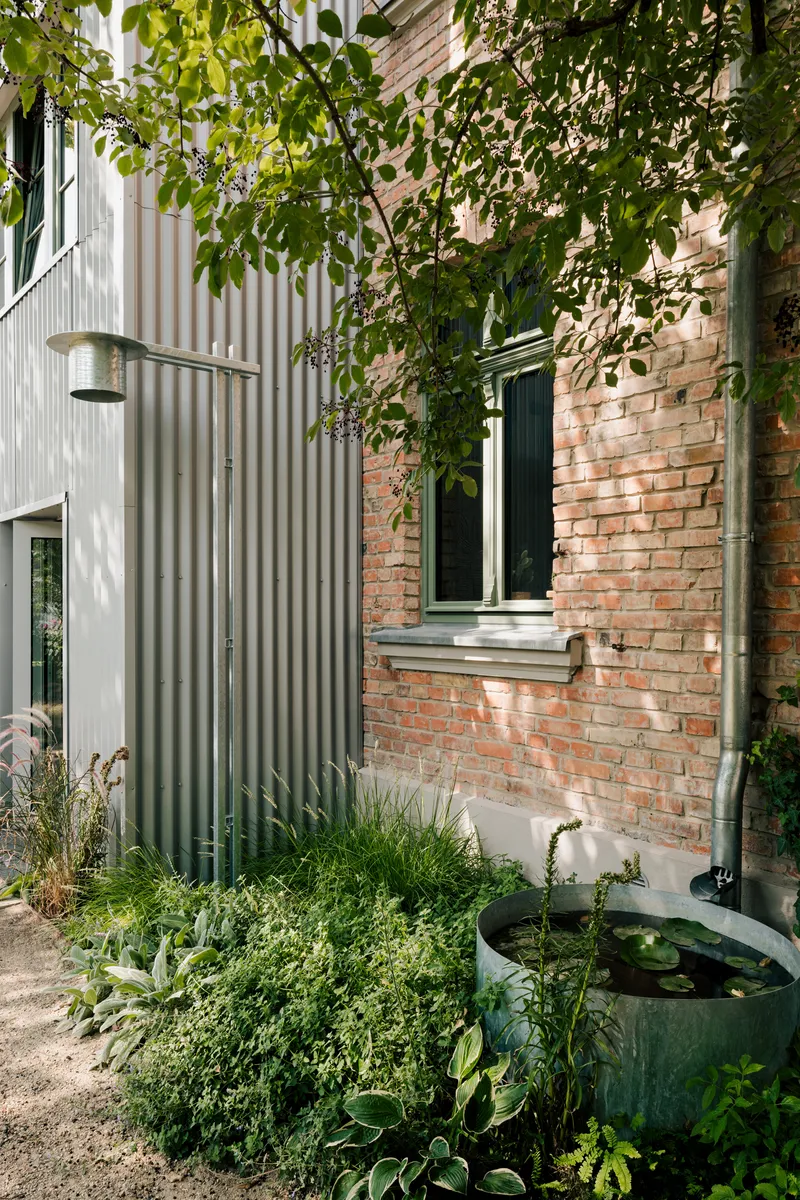
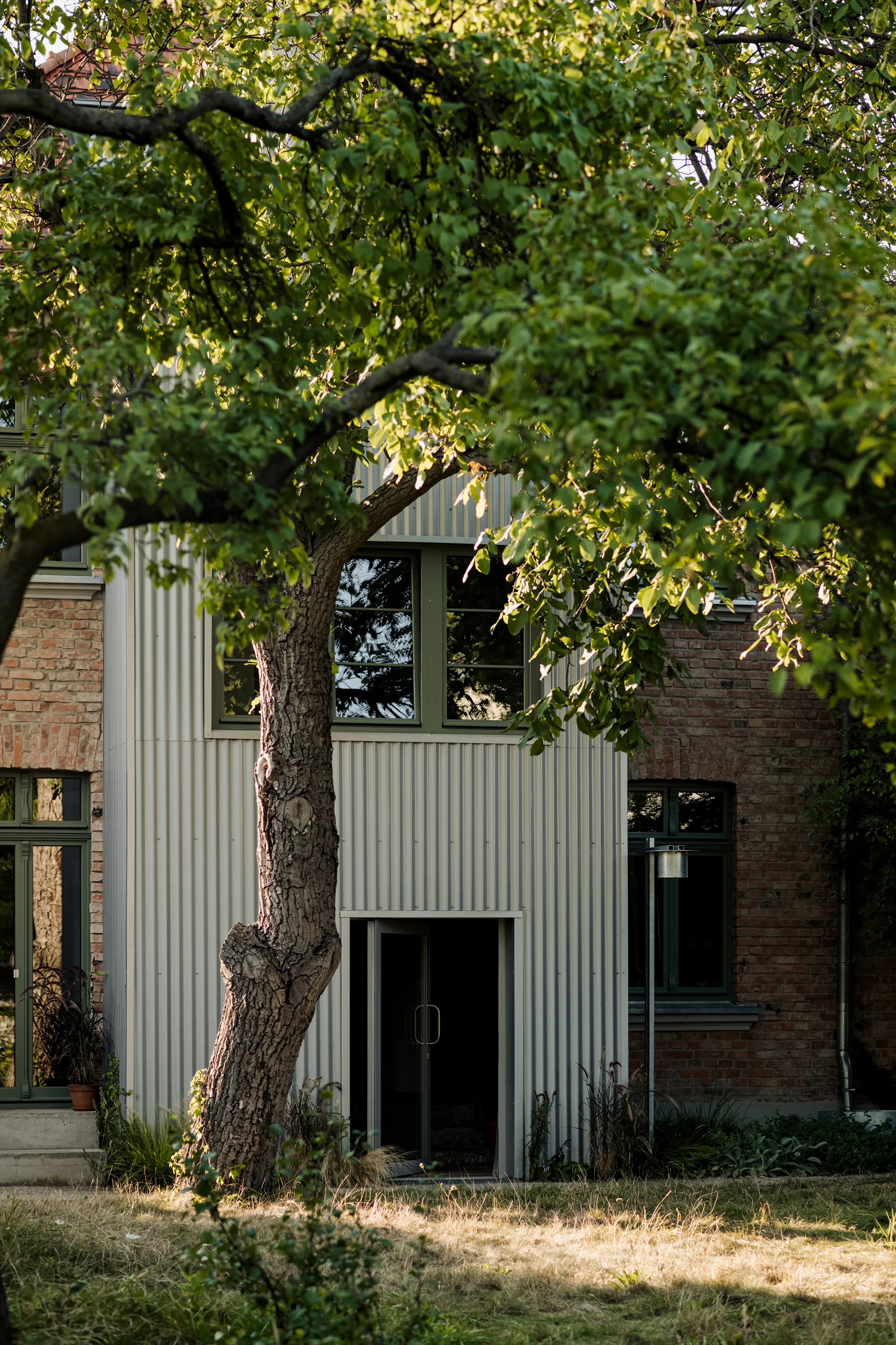
The new corrugated-metal volume wrapping the entrance and stairwell is the most architecturally assertive move in the project. It reads as a frankly modern addition, its ribbed surface and matte finish contrasting sharply with the aged brick. At dusk, the two materials create a dialogue that is less about harmony than mutual respect: neither pretends to be the other.
The garden beds adjacent to this volume, planted with ornamental grasses in corten-edged planters with a small water basin, soften the junction between old and new. The landscaping isn't decorative filler; it's doing real spatial work, establishing a threshold zone that mediates between the public street and the private interior.
One Room to Rule Them: The Open Ground Floor
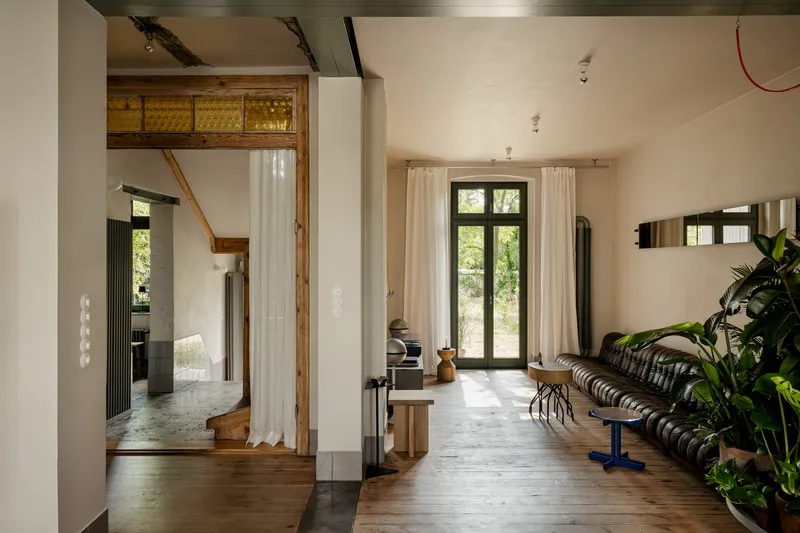
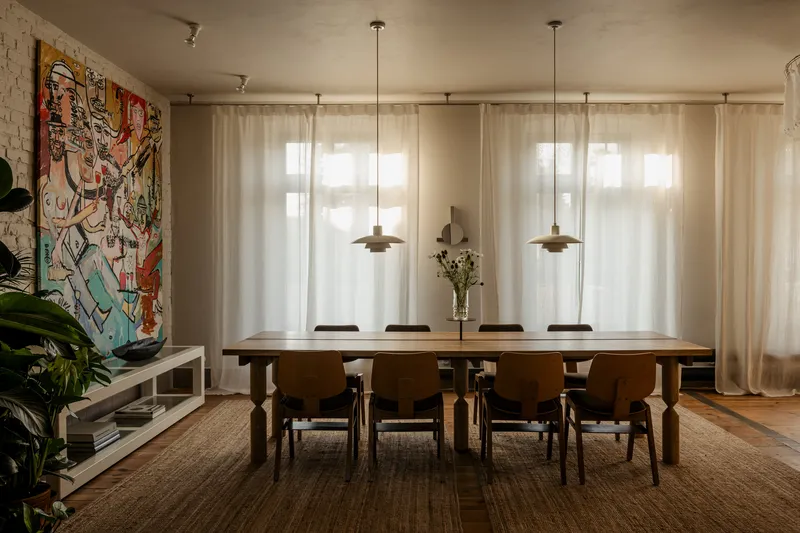
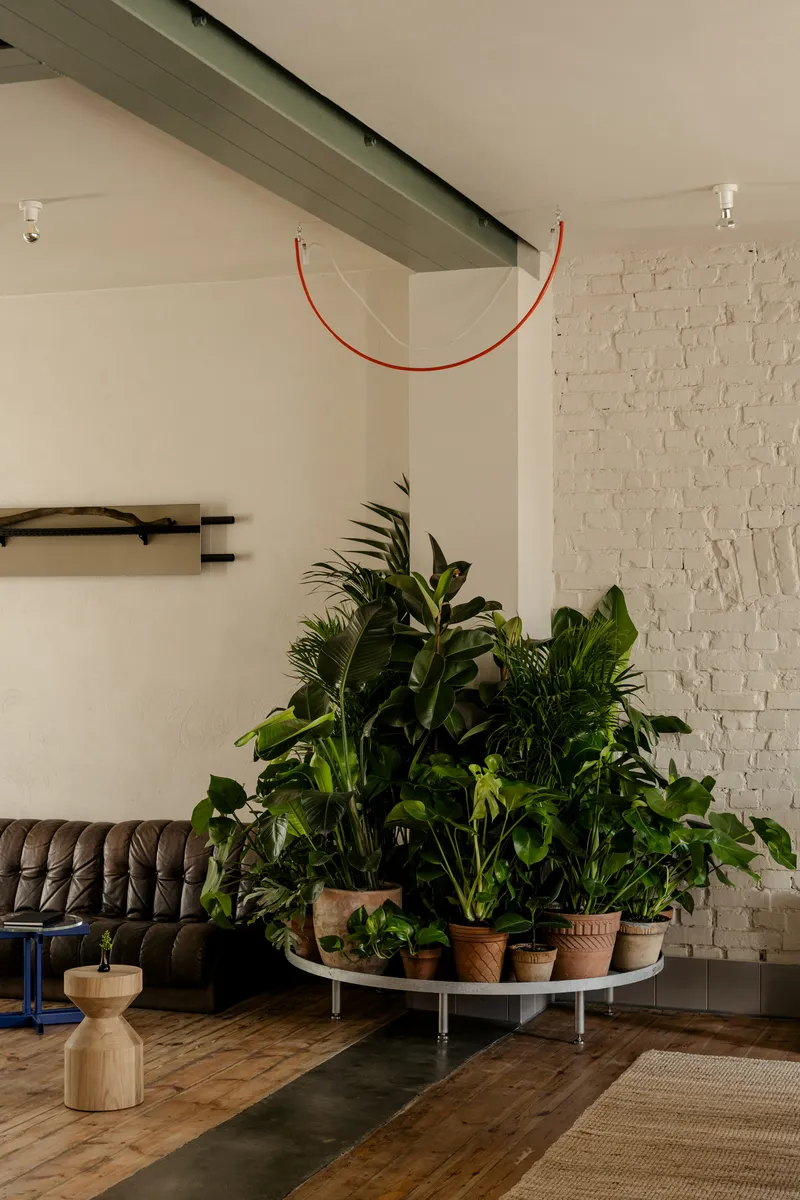
Removing a central load-bearing wall and replacing it with a pale green-painted steel beam is the structural heart of the renovation. The result is a single open volume that unites living, dining, and kitchen. Tall black-framed doors open onto the garden, flooding the space with light filtered through sheer white curtains. Exposed timber framing in the ceiling gives the room a sectional richness that most open-plan conversions lack.
The steel beam does more than hold the building up. Painted a deliberate olive green, it becomes a visible design element, a reminder that structure was renegotiated here. Below it, a curved plant platform holds potted greenery, turning what could have been a purely technical fix into a spatial event. The room breathes in a way that the original multi-apartment configuration never allowed.
Two Kitchens and a Material Palette That Earns Its Keep
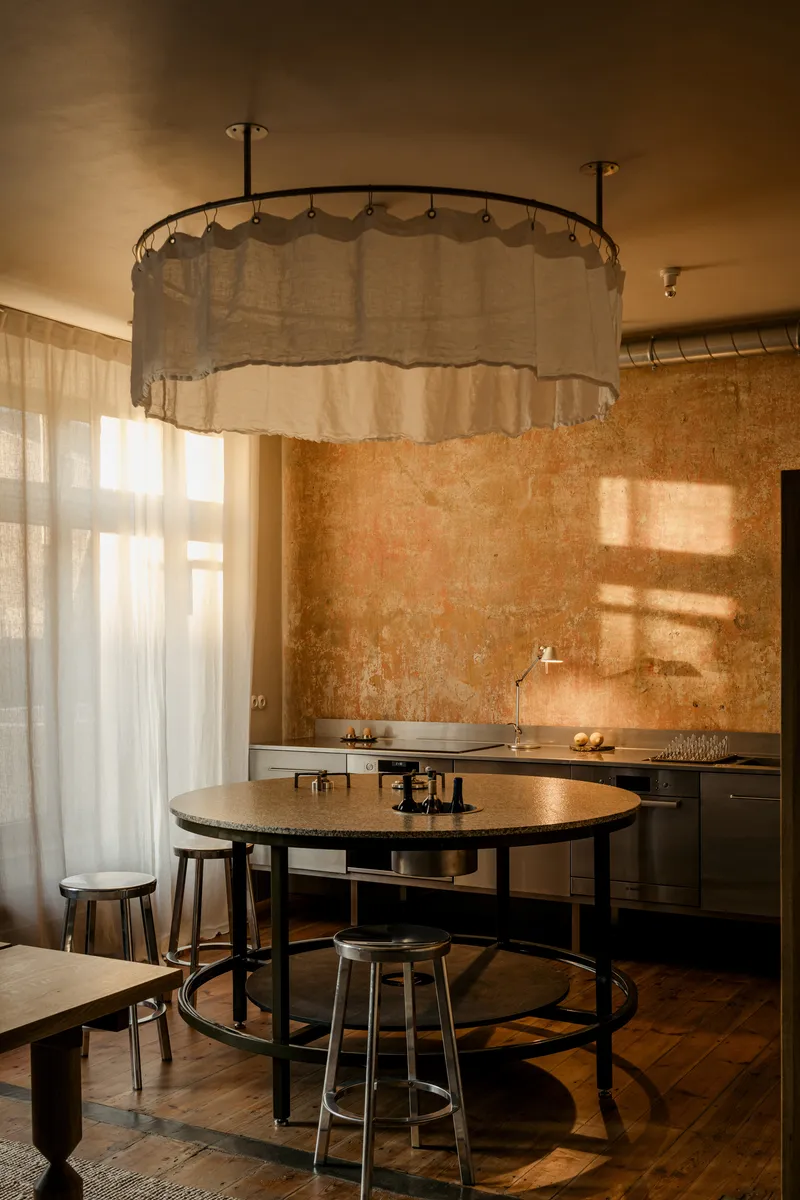
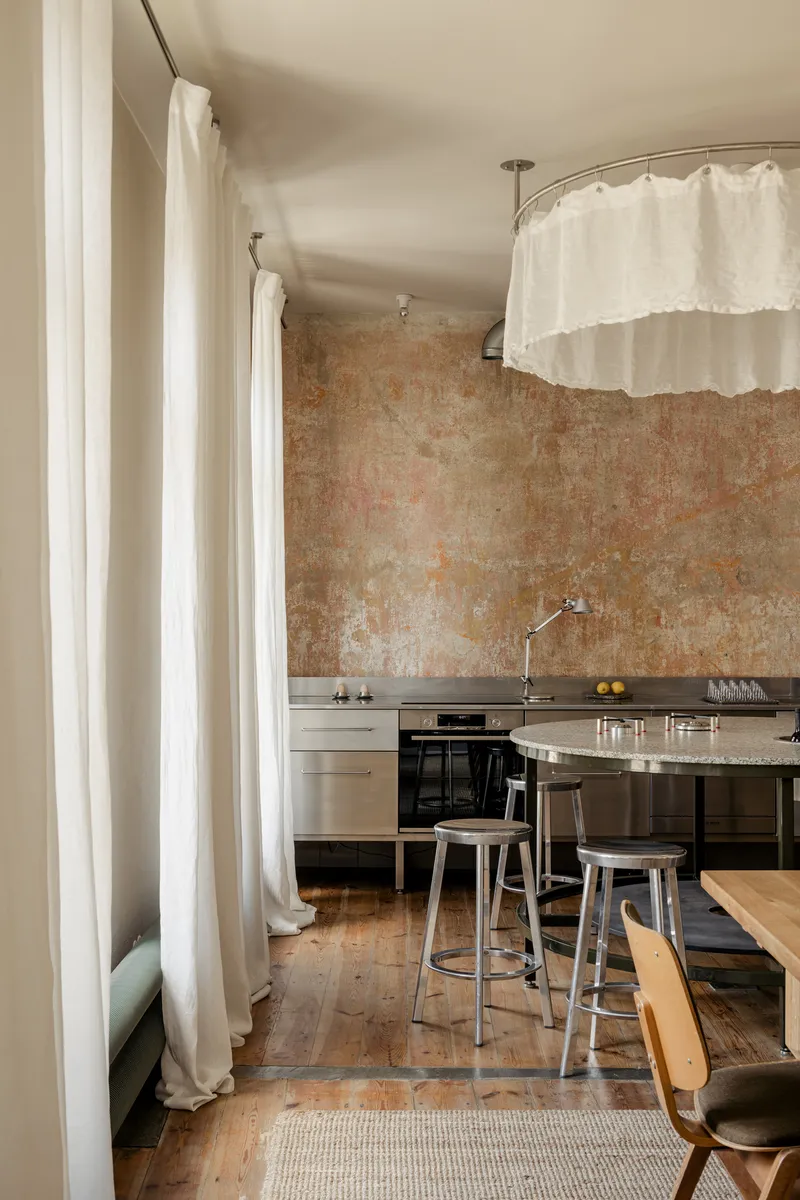
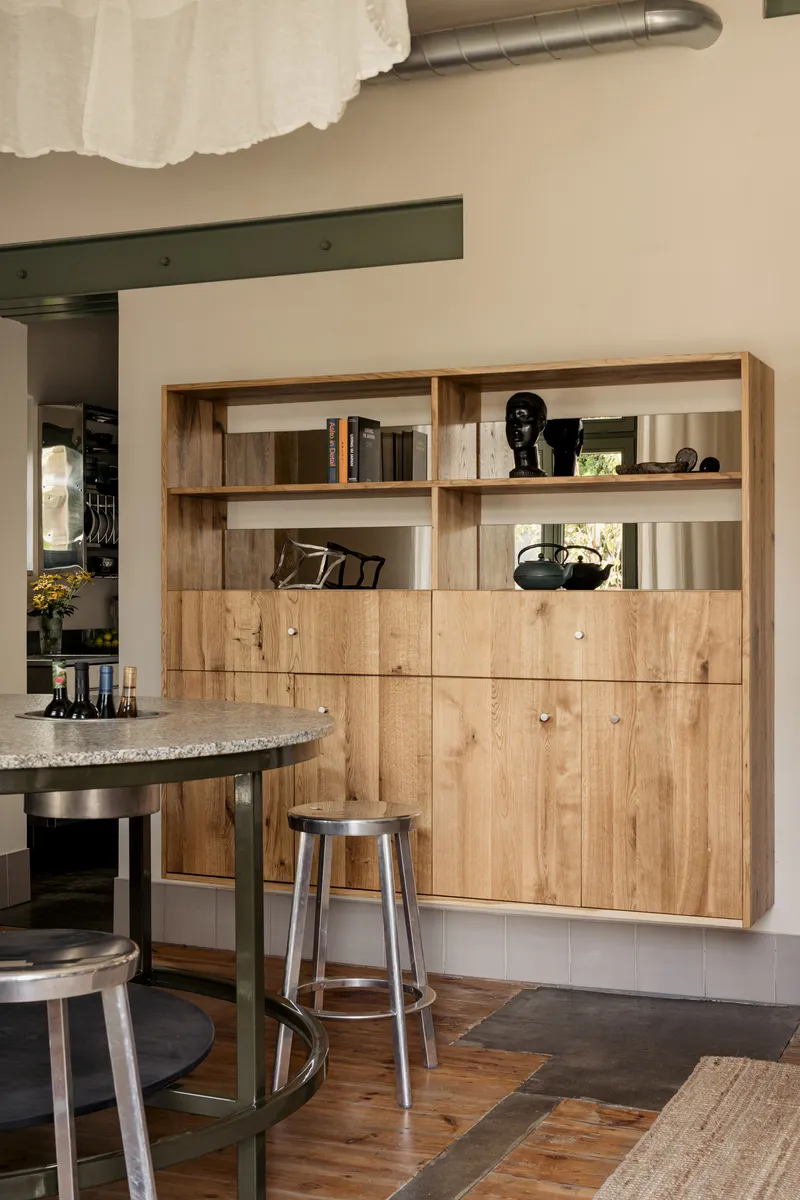
The program includes a primary kitchen, visible and social, and a secondary "hidden" kitchen that absorbs the mess of real cooking. The primary kitchen features a circular fabric canopy light fixture above a round table, set against a textured plaster wall that retains its weathered character. White fabric curtain dividers separate zones without closing them off, keeping the ground floor legible as one continuous space.
Built-in timber shelving with open upper shelves and closed lower cabinets sits beside what appears to be a terrazzo-topped island. The interplay of reclaimed timber floorboards, stainless-steel counters, and solid oak surfaces gives each zone a distinct tactile identity while maintaining the house's overarching commitment to honest, workable materials. Nothing here is applied as a finish; everything is the thing itself.
Living with Scars: The Art of Selective Preservation
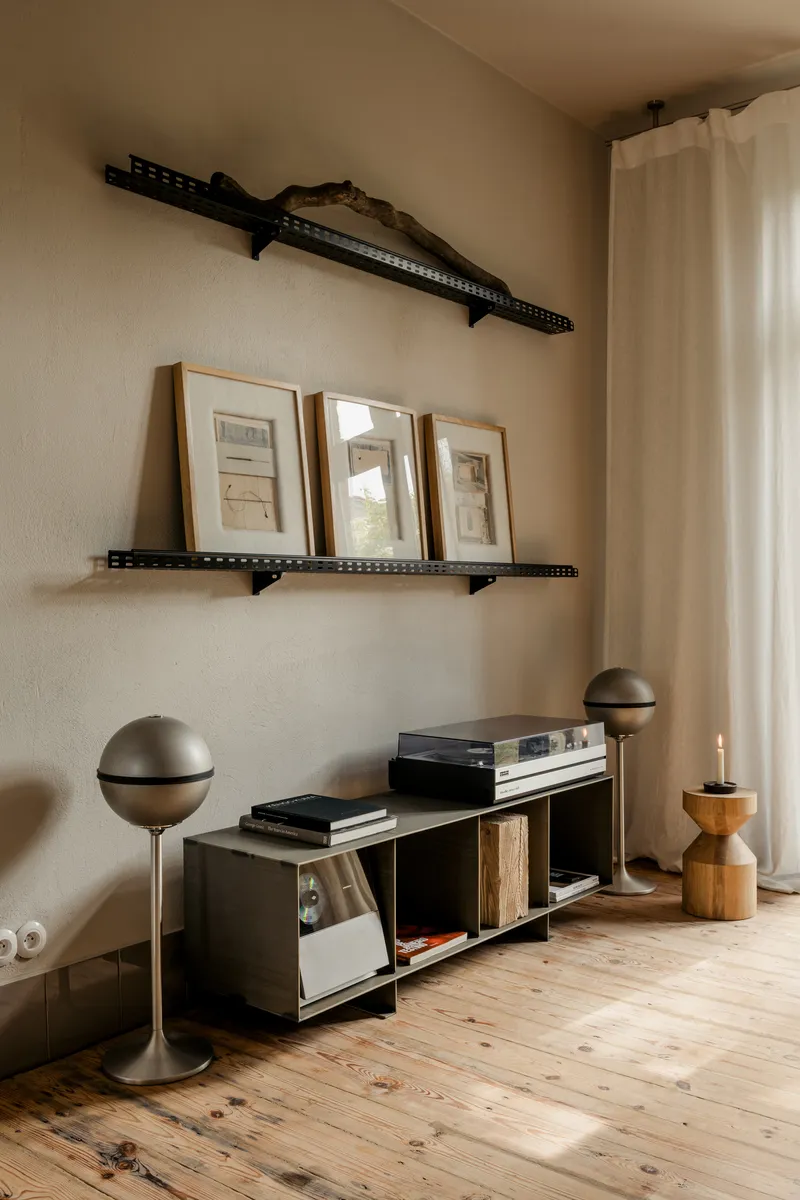
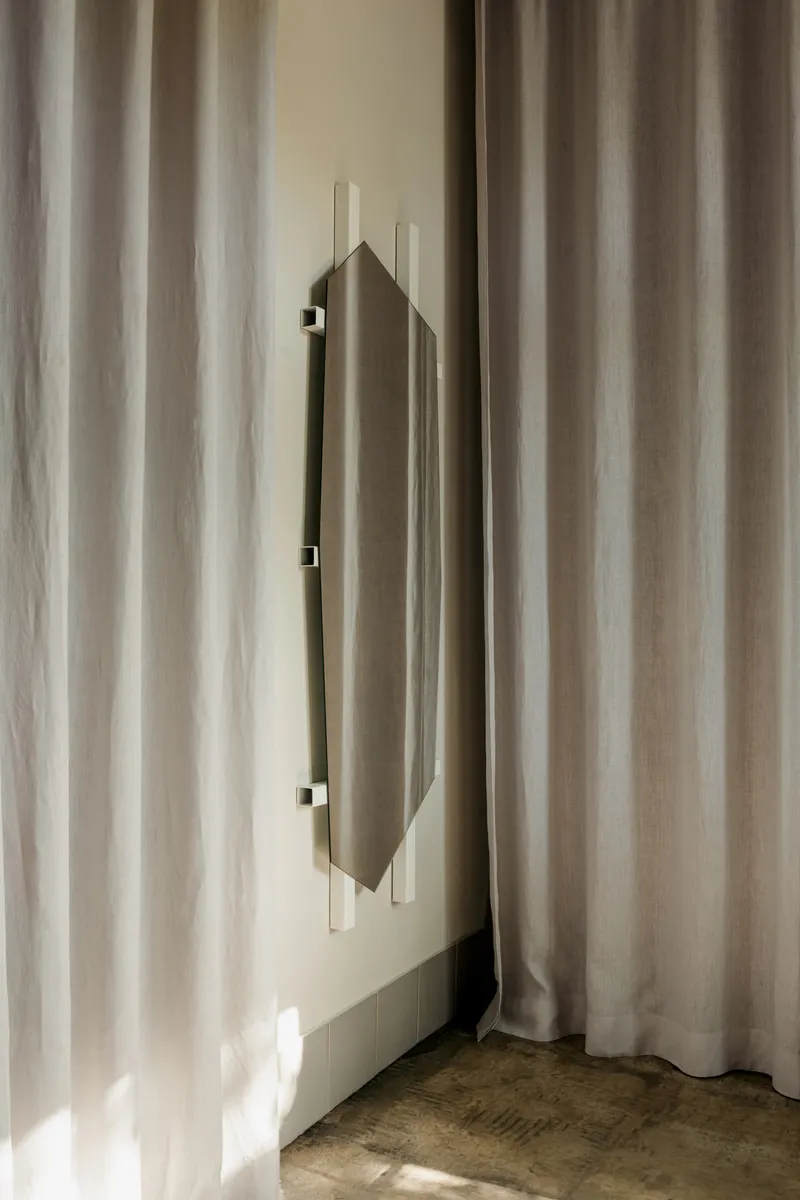
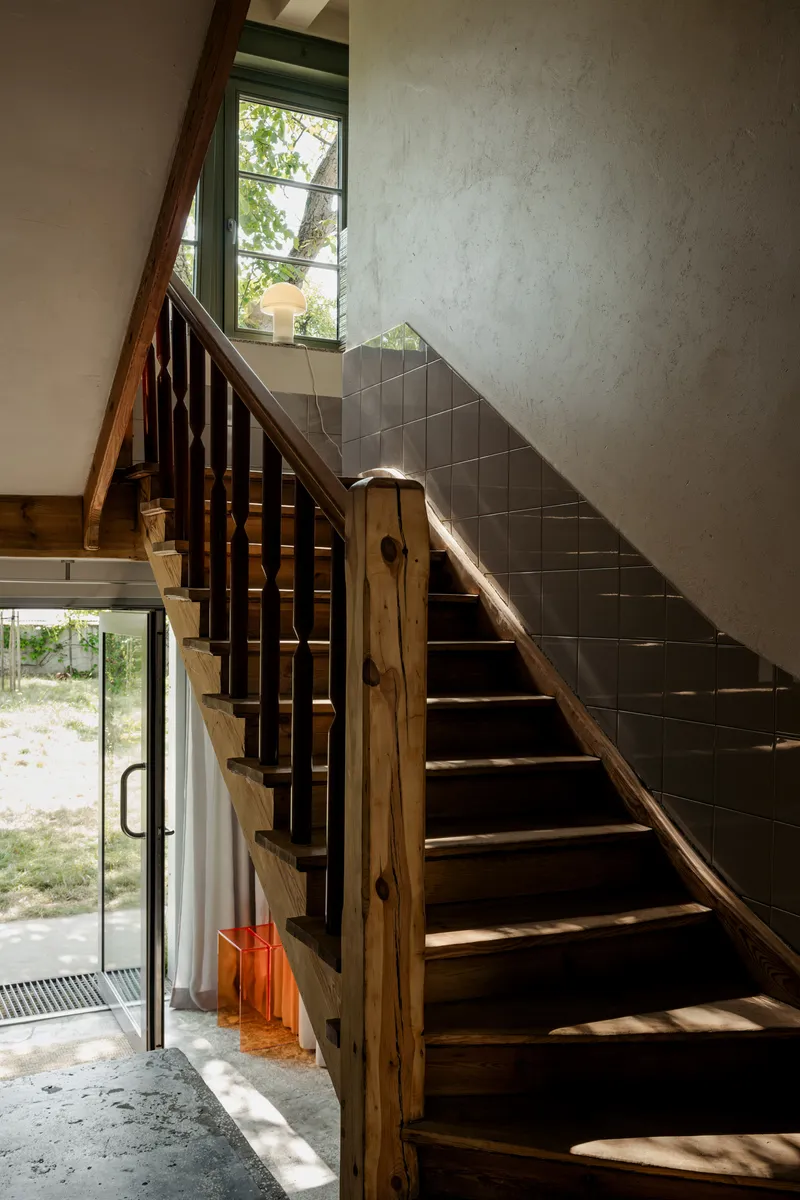
The living area pairs black metal wall shelves displaying framed artworks with a low media console, a setup that could read as generic if it weren't for the bespoke steel hi-fi cabinet reportedly designed for the owners. The details accumulate: a vertical door pull on a pale wall framed by sheer curtains, a timber staircase with dark-painted treads and olive tile wainscoting catching afternoon light. Each element was designed or selected, not sourced from a catalog.
Concrete infills in the flooring mark where old partition walls once stood. It's a subtle but important gesture, turning demolition into a kind of drawing. The house remembers its previous configuration even as it operates as something entirely different. This is preservation as narrative, not as nostalgia.
Bathrooms in Terrazzo, Granite, and Painted Brick
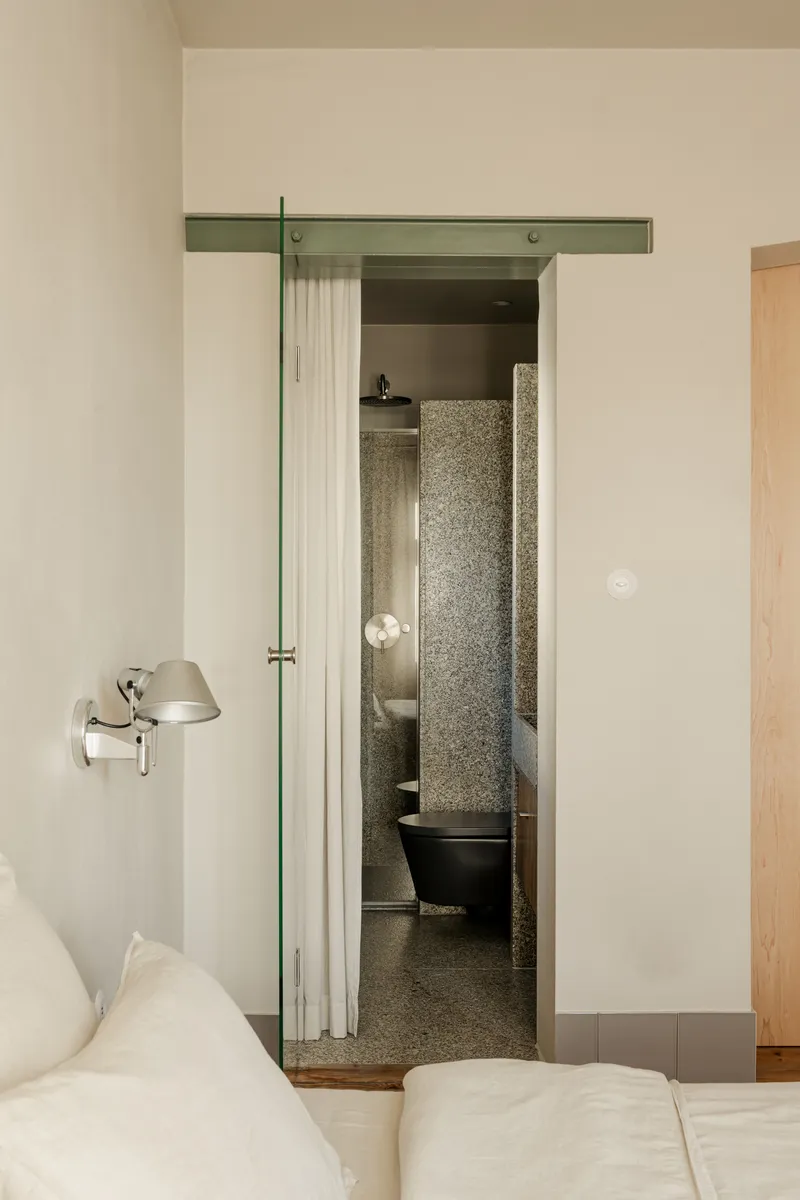
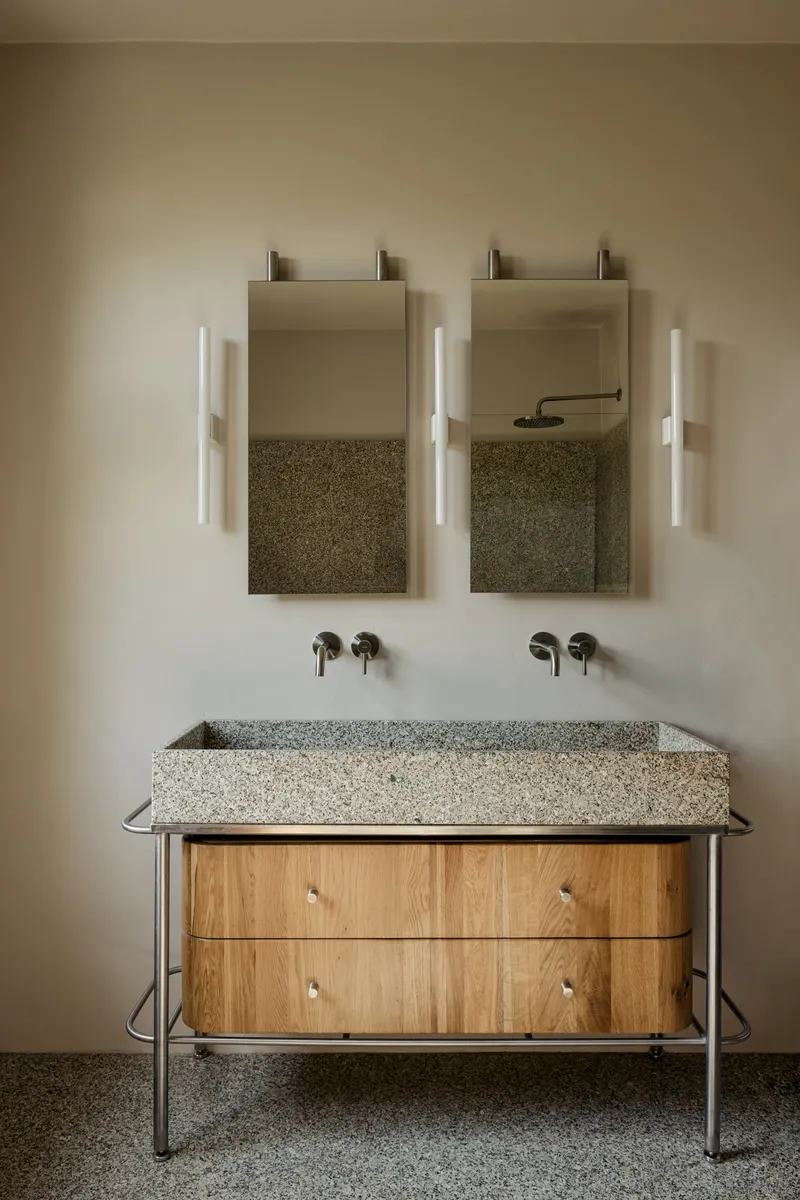
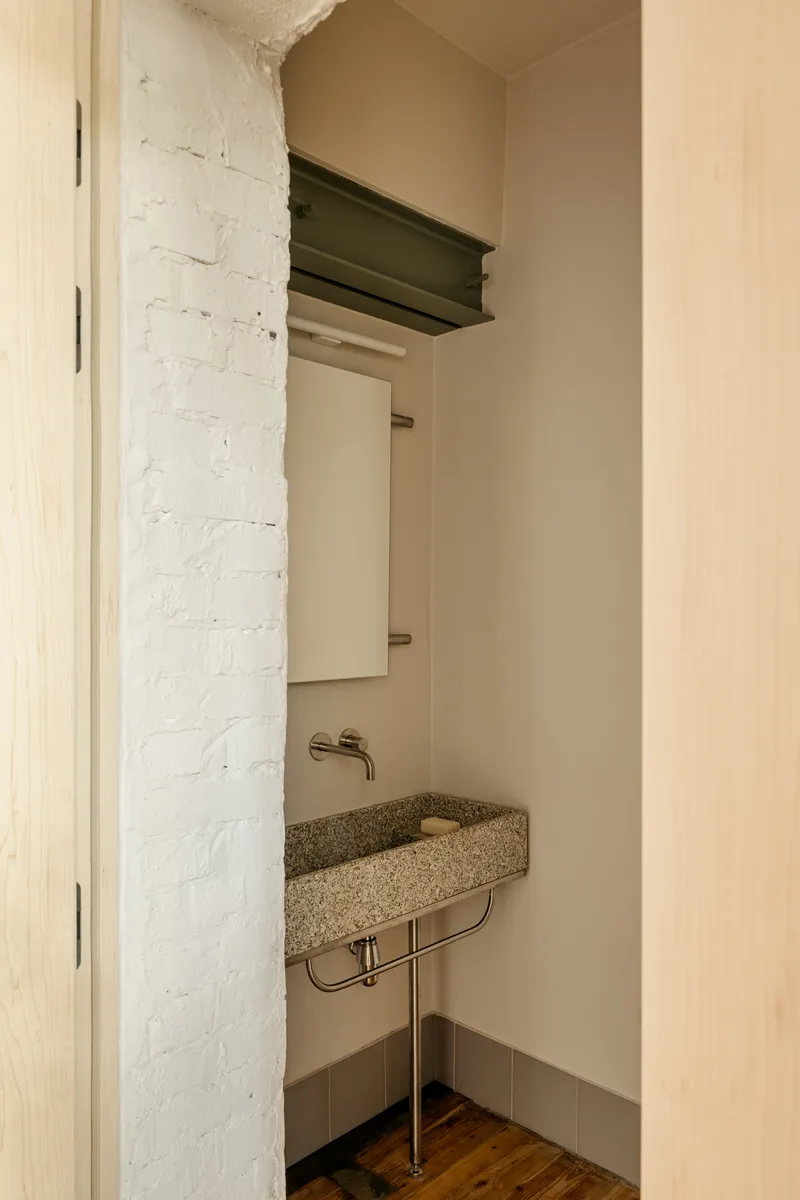
The bathrooms are where the project's material palette reaches its most concentrated expression. Local Strzegom granite appears on floors, windowsills, and sinks, grounding these rooms in a specifically Polish material tradition. A double vanity with a terrazzo surface on a tubular steel frame sits below wall-mounted mirrors and sconces, its industrial elegance consistent with the house's broader language.
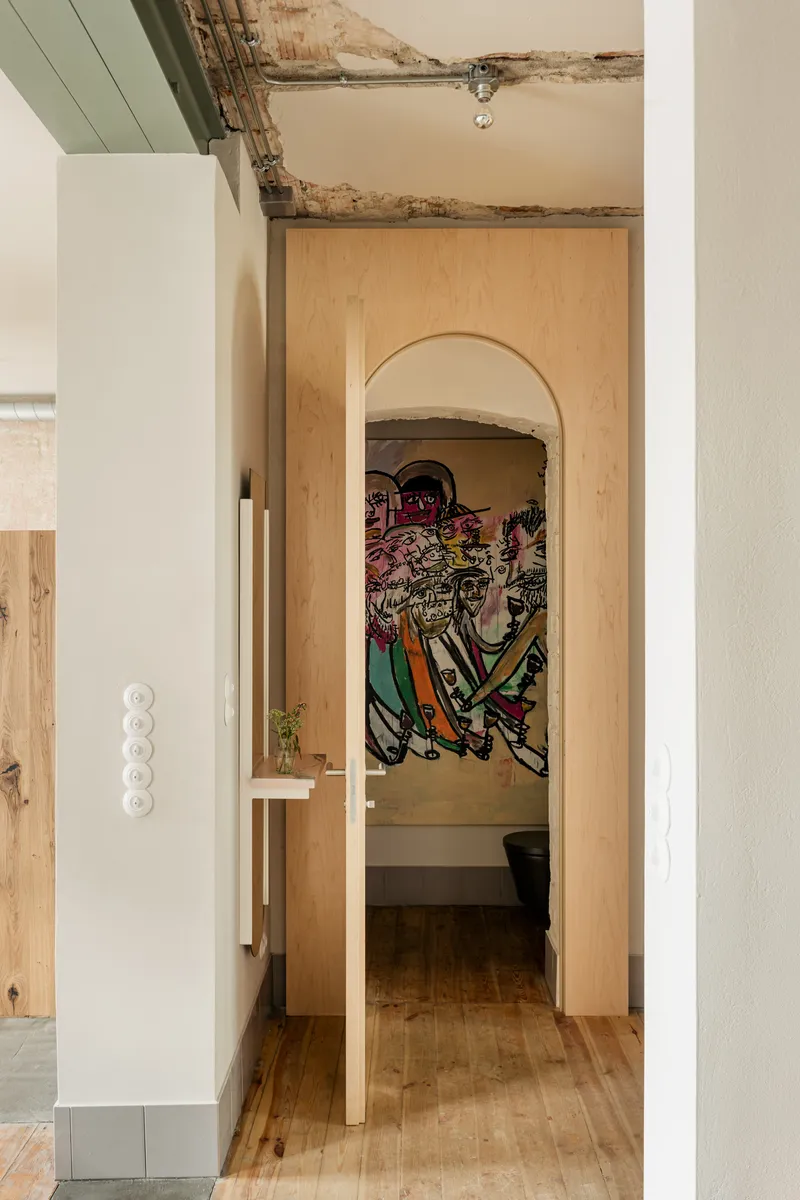
A compact powder room pairs a terrazzo basin on a metal stand with a painted brick wall, and the arched plywood doorway into one bathroom reveals exposed ceiling beams and a colorful mural that brings a rare moment of playfulness to an otherwise disciplined interior. A freestanding black tub, visible through a bedroom doorway, anchors the upper-floor bathing space with quiet drama.
Garden and Boundary: Landscape as Architecture
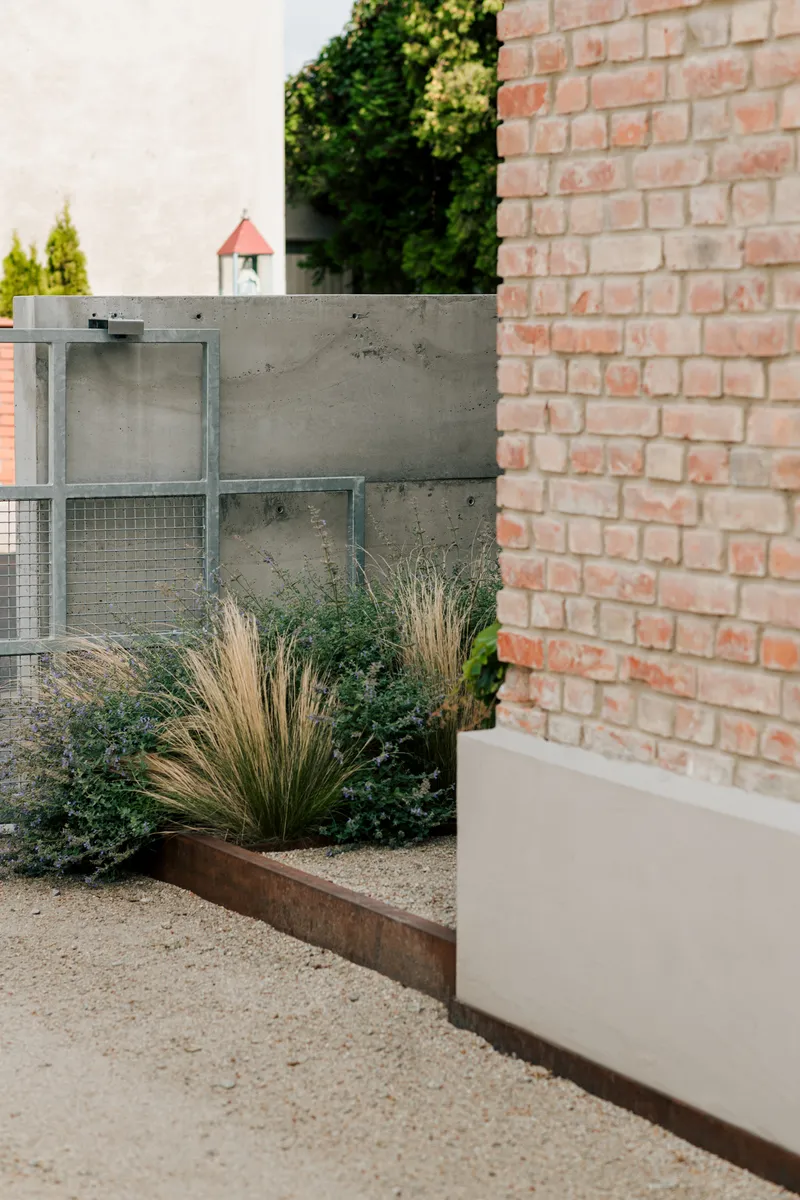
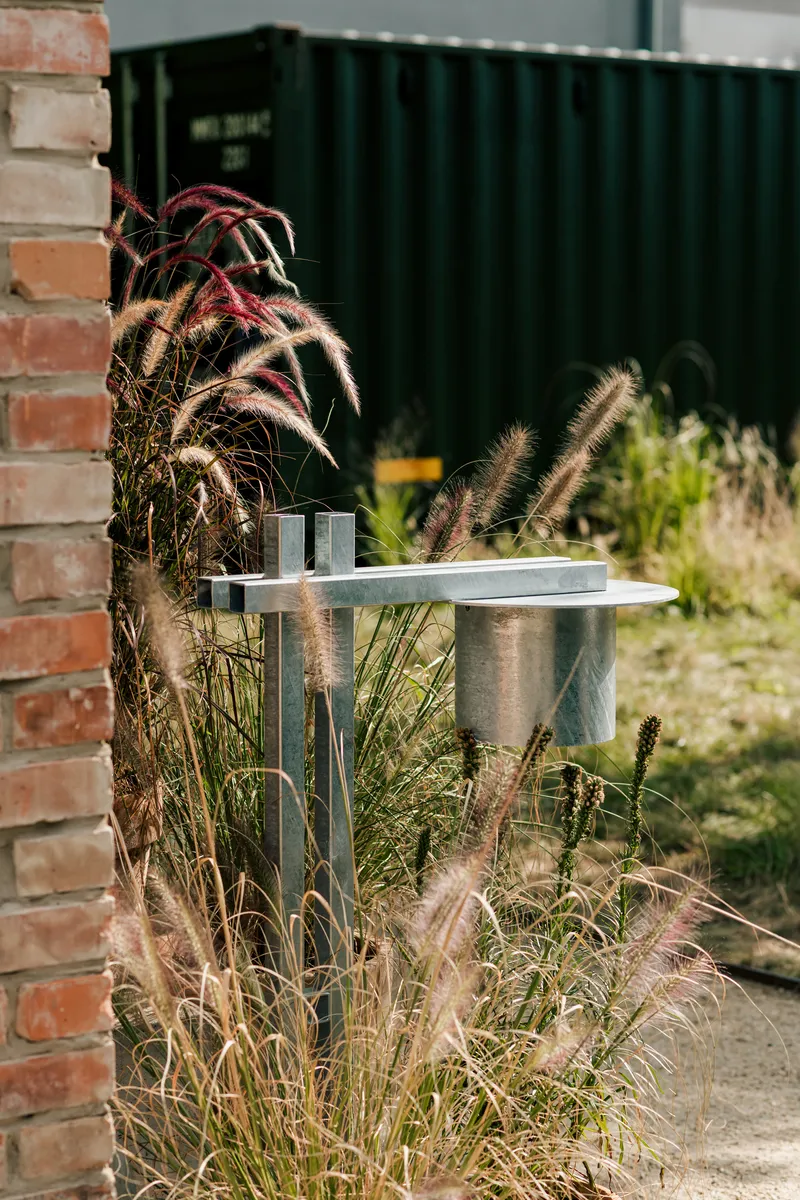
The landscape strategy treats the garden not as leftover space but as a designed extension of the house. A concrete wall and brick facade are softened by ornamental grasses in corten-edged beds. An outdoor tap on a galvanized post, surrounded by planting, is the kind of detail that reveals how thoroughly the team considered every point of contact between residents and site.
Inside, moments like the arched plywood doorway into a bathroom alcove, with its exposed beams and mural, reinforce the idea that every threshold in this project has been reconsidered. The house doesn't just move between old and new; it moves between solemnity and surprise.
Plans and Drawings
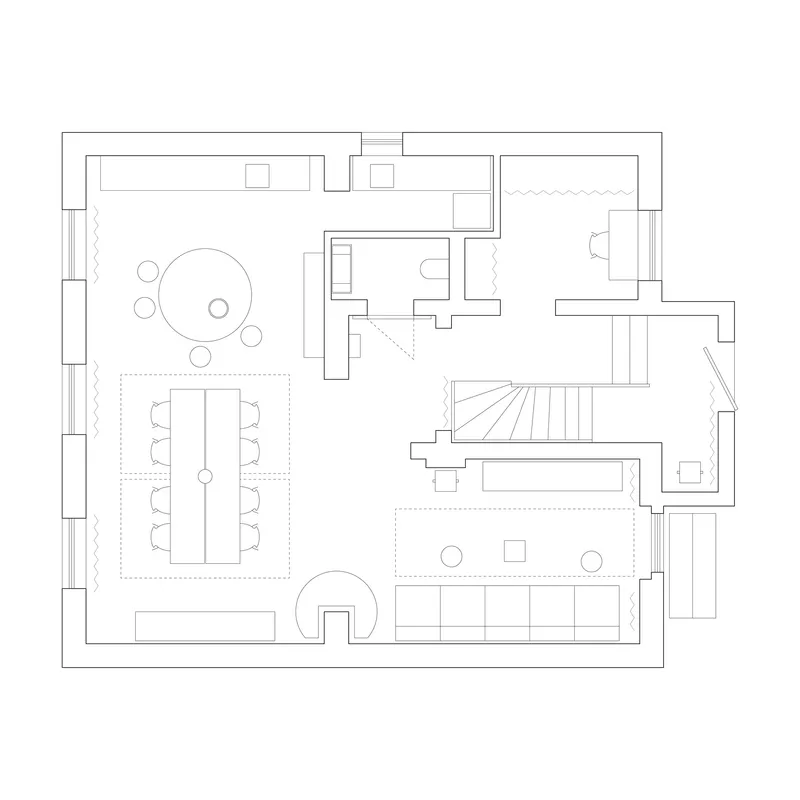
The floor plan confirms what the photographs suggest: the ground floor is organized around a single generous volume anchored by a central stair and bathroom core. The open living and dining areas wrap around this core, with the kitchen zones occupying one end and the garden-facing living space the other. The plan's clarity is what makes the material and furniture experiments legible rather than chaotic.
Why This Project Matters
P81 House belongs to a growing category of European residential projects that refuse the binary between faithful restoration and total reinvention. By exposing original brickwork, embedding concrete traces of demolished walls, and introducing a corrugated-metal volume alongside classical window proportions, wiercinski-studio proposes that a building's history and its future can coexist as legible, physical facts. The approach demands more from the architect and more from the client, but the payoff is a house with genuine depth.
The project's other lesson is about the power of scope. Designing 45 bespoke fittings, specifying local granite for bathroom sinks, and extending the design language from steel gates to garden lanterns means that the house operates as a total work rather than a collection of good decisions. In a market saturated with piecemeal upgrades, P81 House makes the case that the most meaningful renovations are the ones that touch everything.
P81 House by wiercinski-studio (lead architect: Adam Wiercinski). Poznań, Poland. 300 m². Completed 2024. Photography by Oni Studio.
About the Studio
Share Your Own Work on uni.xyz
If projects like this are the kind of work you want to make, uni.xyz is a place to publish your own, find collaborators, and enter design competitions.



Popular Articles
Popular articles from the community


The Ocean Hive: Sustainable Architecture for a Self-Sufficient Civilization at Sea
The Ocean Hive imagines sustainable architecture at sea, where modular habitats, algae, wave power and ocean waste sustain a growing colony.

Conexión: Biophilic Design Reimagines High-Rise Living in Hong Kong
Conexión reimagines high-rise living in Hong Kong through biophilic design, green facades, shared spaces, daylight, water and nature within.

The Musturak Paradise: Senior Living Architecture for a Connected Future in Temara, Morocco
The Musturak Paradise reimagines senior living architecture in Temara via private homes, social spaces, culture, community, and shared care.

Play: Fragments of Their World
Familiar architecture becomes modular playground design, creating safe spaces where displaced children can learn, connect, imagine and play.


Similar Reads
You might also enjoy these articles

Bao Huynh Watercolor Atelier: A Serene Art Retreat in Hội An
Bao Huynh Watercolor Atelier in Hội An blends multifunctional art spaces, sustainable design, local materials, and family-friendly living in a serene environment.

Atelier Macri Concept Store Interior Design by CASE-REAL
Atelier Macri store features a "ko" counter, walnut wood details, cork displays, blending retail, gallery, and seamless customer experiences.

Manuel Vargas Izquierdo Stadium and High-Performance Sports Center: Architectural Excellence in Jalpa de Méndez
The Manuel Vargas Izquierdo Stadium blends sustainable design, inclusive sports facilities, and cultural-inspired architecture, revitalizing Jalpa de Méndez’s public spaces.

KAKR Buluh Awar Hall: Revitalizing Community and Ecology Through Bamboo Architecture
Community built bamboo hall revitalizes Buluh Awar village, empowering youth, restoring ecology, celebrating vernacular craftsmanship through sustainable architecture and culture.


Explore Power Generation Competitions
Discover active competitions in this discipline


Challenge to design mud housing for contemporary communities


Challenge to reimagine the Iron Throne


Photograph architecture without architects


Illustrate the lost glory of Angkor Wat - Render Challenge
Comments (0)
Please login or sign up to add comments
No comments yet. Be the first to comment!