
Wood Marsh Expands the Potter Museum with Civic Grace
A mirrored glass pavilion and vaulted galleries extend the University of Melbourne's art museum into a new era of public engagement.


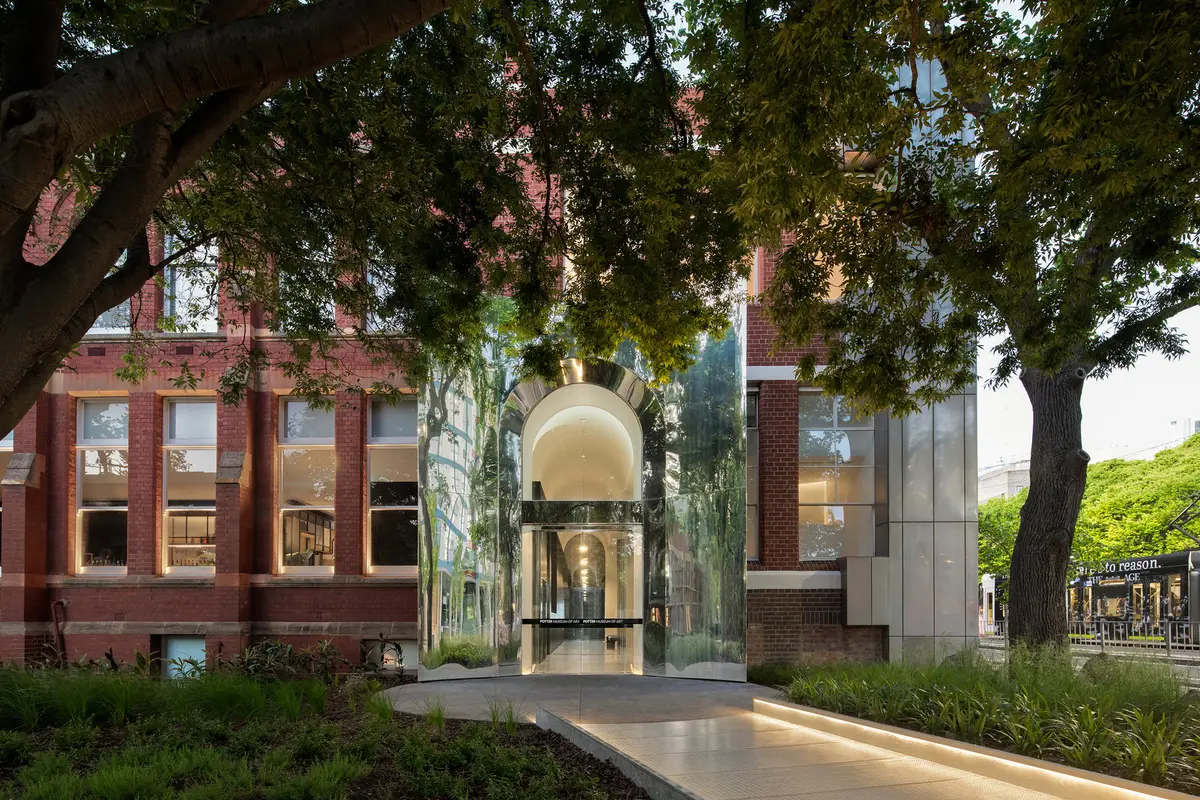
The University of Melbourne's Parkville campus has long been defined by its heritage brick buildings and dense canopy of deciduous trees. Inserting a contemporary art museum expansion into that setting is a test of architectural judgment: how much presence can a new building claim without disrupting the specific character of a university precinct that derives its identity from restraint? Wood Marsh's answer at the Ian Potter Museum of Art is a polished glass pavilion that occupies the threshold between two existing red brick wings, acting less as a building and more as a connective membrane.
What makes the project genuinely compelling is the way it manages two seemingly opposed ambitions at once. From the street, the mirrored arch entrance nearly disappears into its surroundings, reflecting foliage, sky, and the brick facades on either side. Step inside, and the interiors shift to a language of vaulted white ceilings, cylindrical concrete columns, and carefully calibrated material contrasts that signal seriousness about the art that will occupy these rooms. The building is at once deferential and self-assured, a rare combination in institutional architecture.
A Threshold Made of Reflections
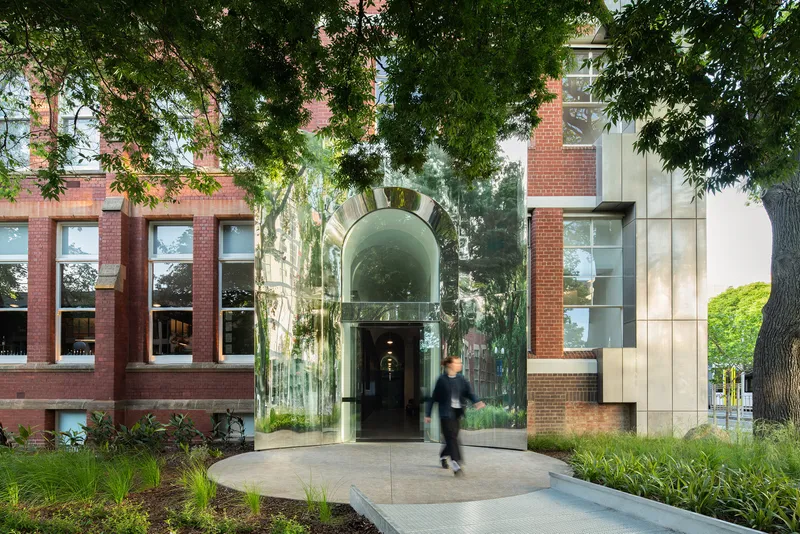
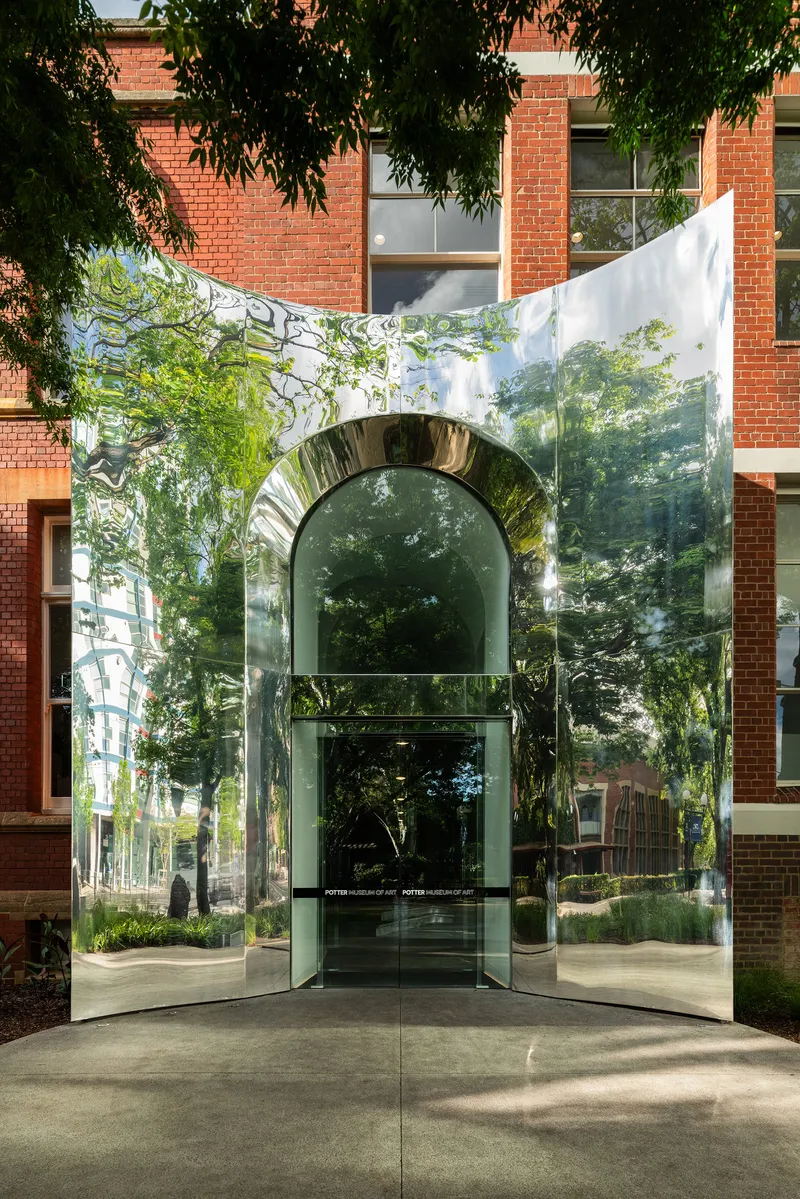
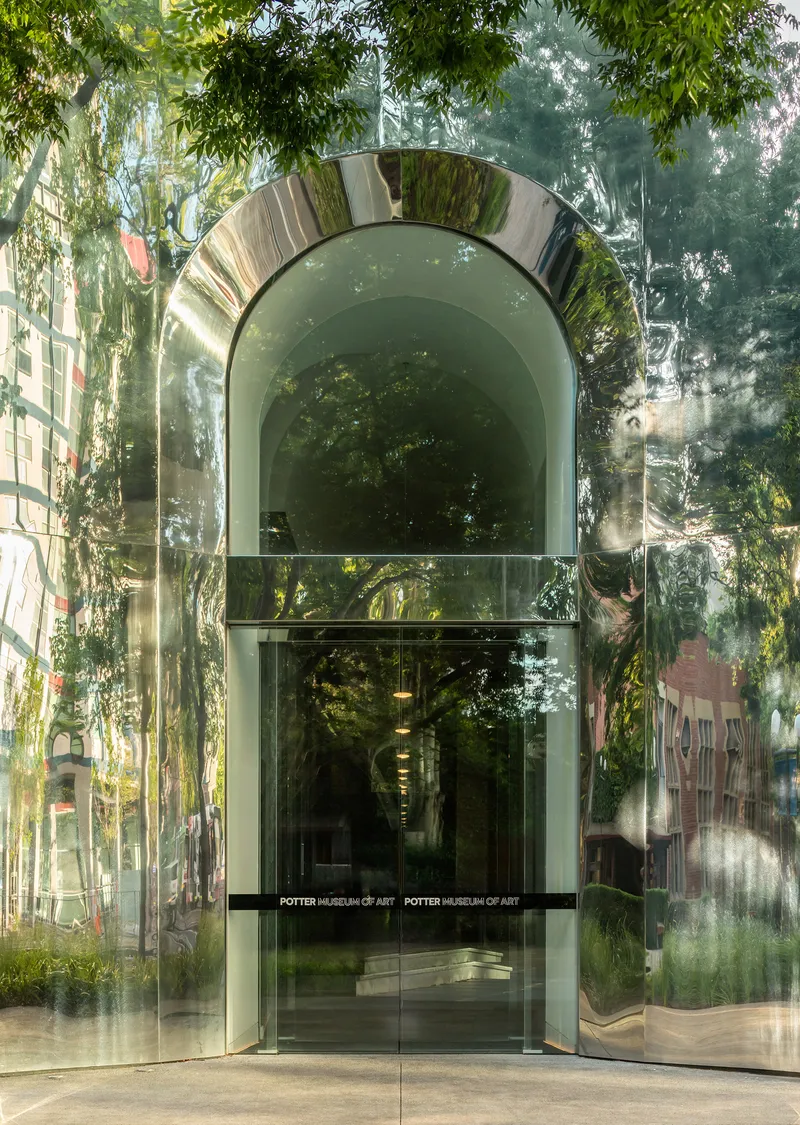
The glass entry pavilion is the project's defining gesture. Its arched profile echoes the fenestration patterns of the existing brick buildings while the polished metal canopy reflects foliage, passersby, and cloud cover in a constantly shifting image. The result is a portal that reads differently at every hour of the day and across the seasons. In autumn, bare branches pattern its surface; in full summer, it becomes a frame of dense green.
Wood Marsh has clearly studied the mirrored canopy not just as an aesthetic choice but as a contextual strategy. By dematerializing the junction between old and new, the pavilion avoids the visual collision that heavy contemporary insertions often produce. The arch form itself is borrowed vocabulary, drawn from the pointed arches visible along the heritage elevations, but rendered in industrial glass and polished steel, it reads as quotation rather than pastiche.
The Arch as Urban Marker
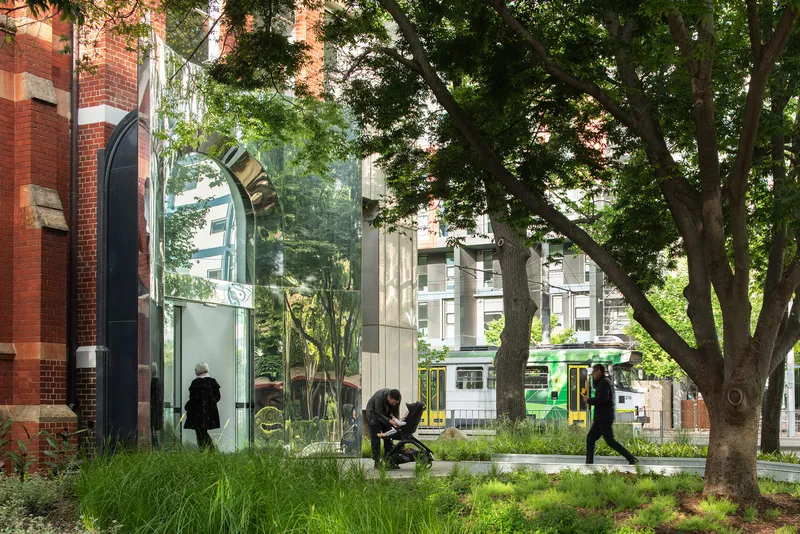
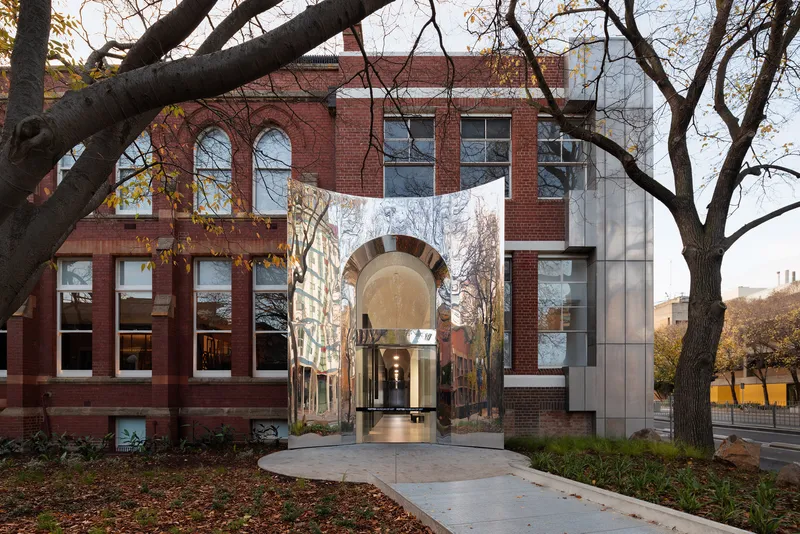
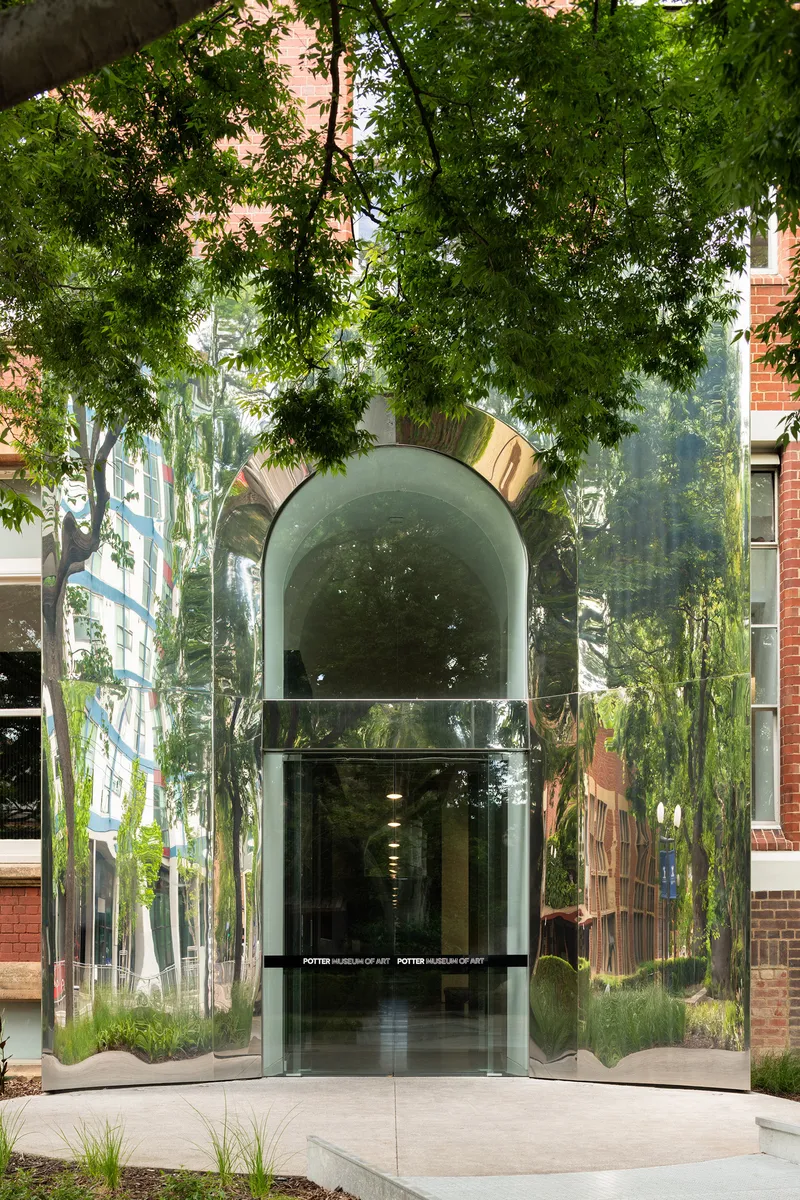
Seen from the street, the museum expansion announces itself with restraint. Pedestrians, a passing tram, and the thick canopy of mature trees dominate the foreground. The arched glass entrance sits in the middle distance, catching light and drawing attention without competing with the campus landscape. That sense of proportion matters: this is a university museum, not a landmark destination, and its street presence correctly calibrates to its role.
At dusk, the balance shifts. The interior lighting begins to glow through the curved glass, and the pavilion becomes a lantern lodged between the solid brick masses. The mirrored canopy picks up the warm tones of the sky. It is a building with two distinct public faces, one for daylight and one for evening, and both are convincing.
Vaulted Galleries and Concrete Rhythm
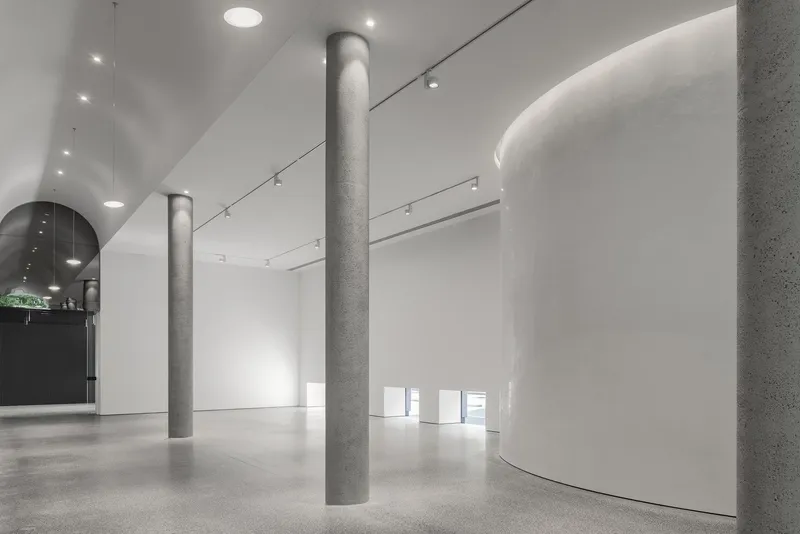
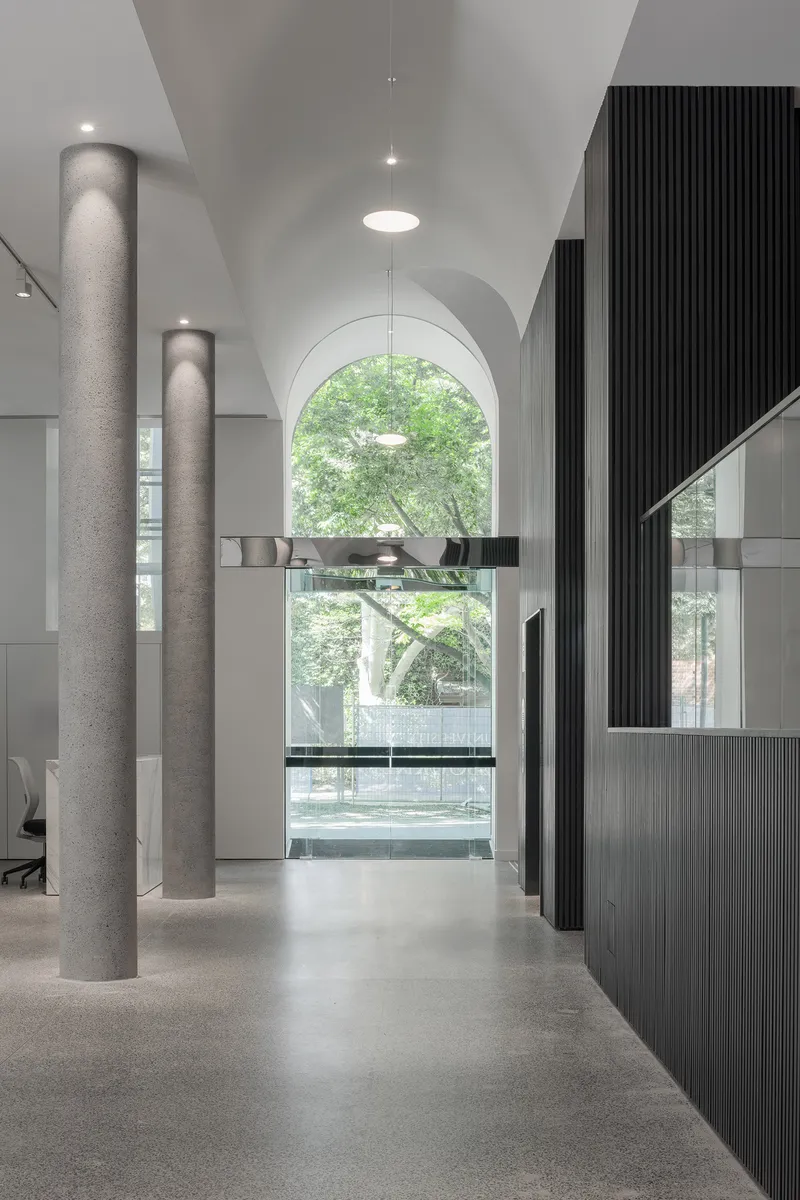
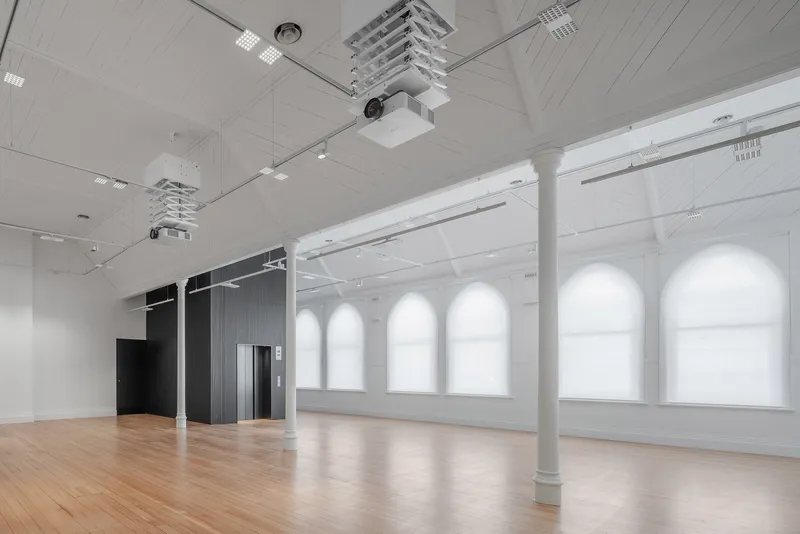
The primary gallery spaces are organized around a procession of cylindrical concrete columns beneath vaulted white ceilings. The columns are robust, almost overscaled for the room dimensions, but that weight is intentional: it gives the galleries a civic gravity that thinner structural members would not achieve. The vaulted ceilings recall older institutional typologies, from train stations to libraries, without quoting any specific precedent.
Arched wall niches along the glazed facade and framed views toward exterior greenery ensure that the interior never feels sealed off from its campus context. The balance between controlled gallery light and occasional outward glimpses is well managed, offering curators flexibility while reminding visitors that the art lives within a landscape, not in a vacuum.
Material Palette: Terrazzo, Marble, and Restraint
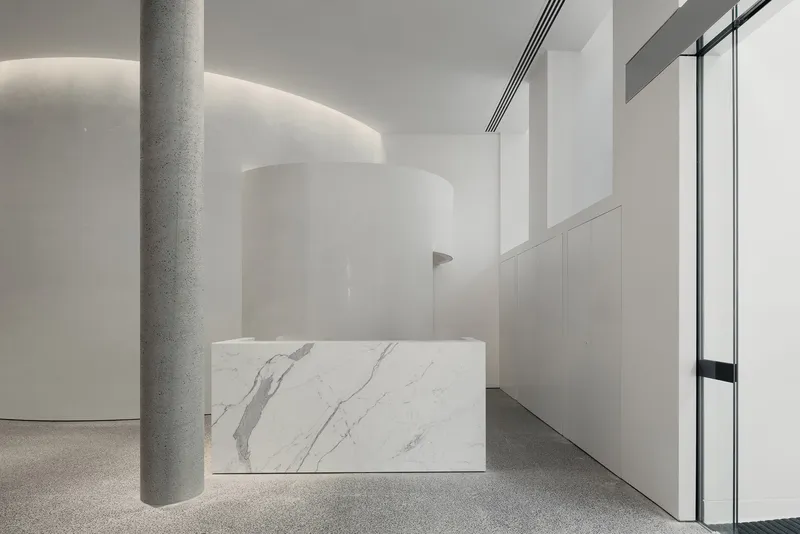
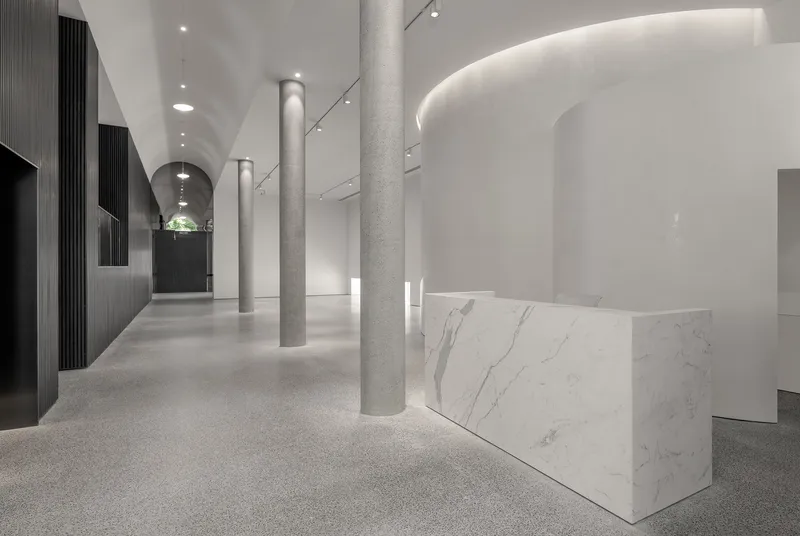
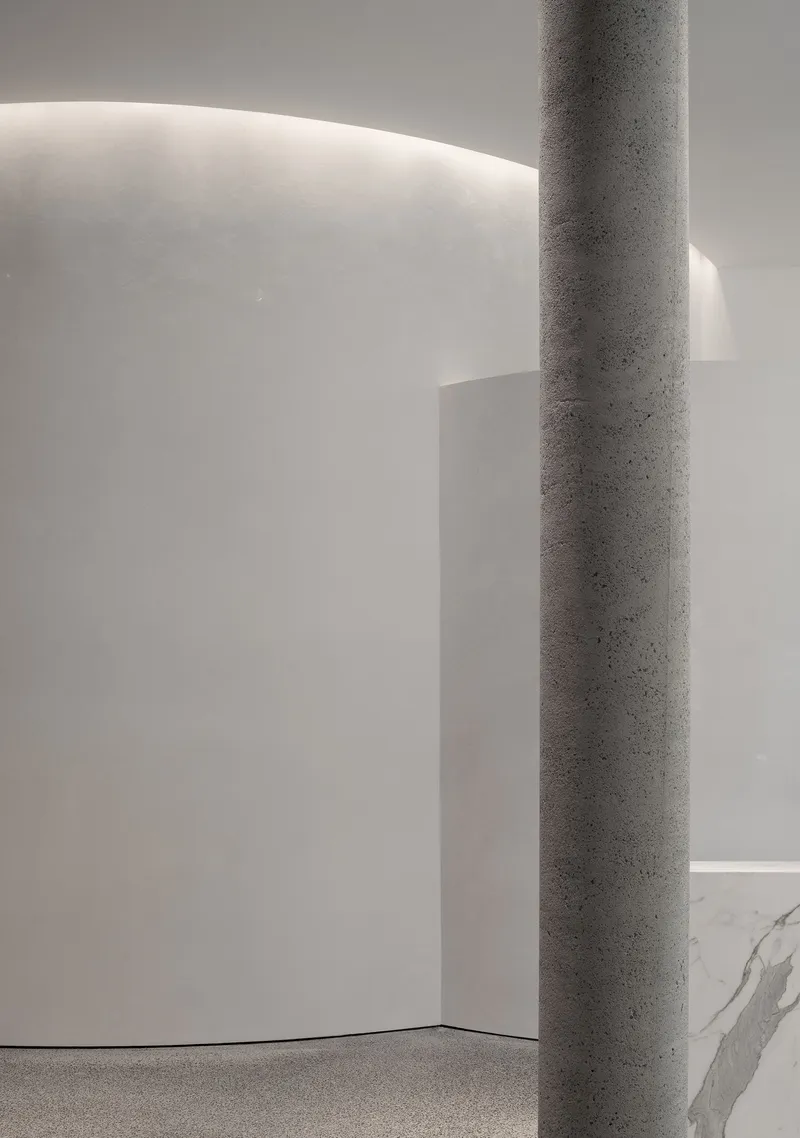
At the reception area, the material language tightens. Terrazzo columns with a warm aggregate meet a marble desk veined in grey, while curved white plaster walls receive soft cove lighting from above. The detailing here is precise and understated: no material is asked to do more than one job, and the transitions between surfaces are handled with the clean, almost obsessive care that has become a Wood Marsh signature.
The veined marble and terrazzo are selected to read as geological rather than luxurious. Against the white plaster volumes and warm timber flooring elsewhere in the building, they anchor the entrance sequence with a sense of permanence. It is a considered choice for a museum that must serve both as a public threshold and a serious institutional space.
Dark Corridors and Vertical Texture
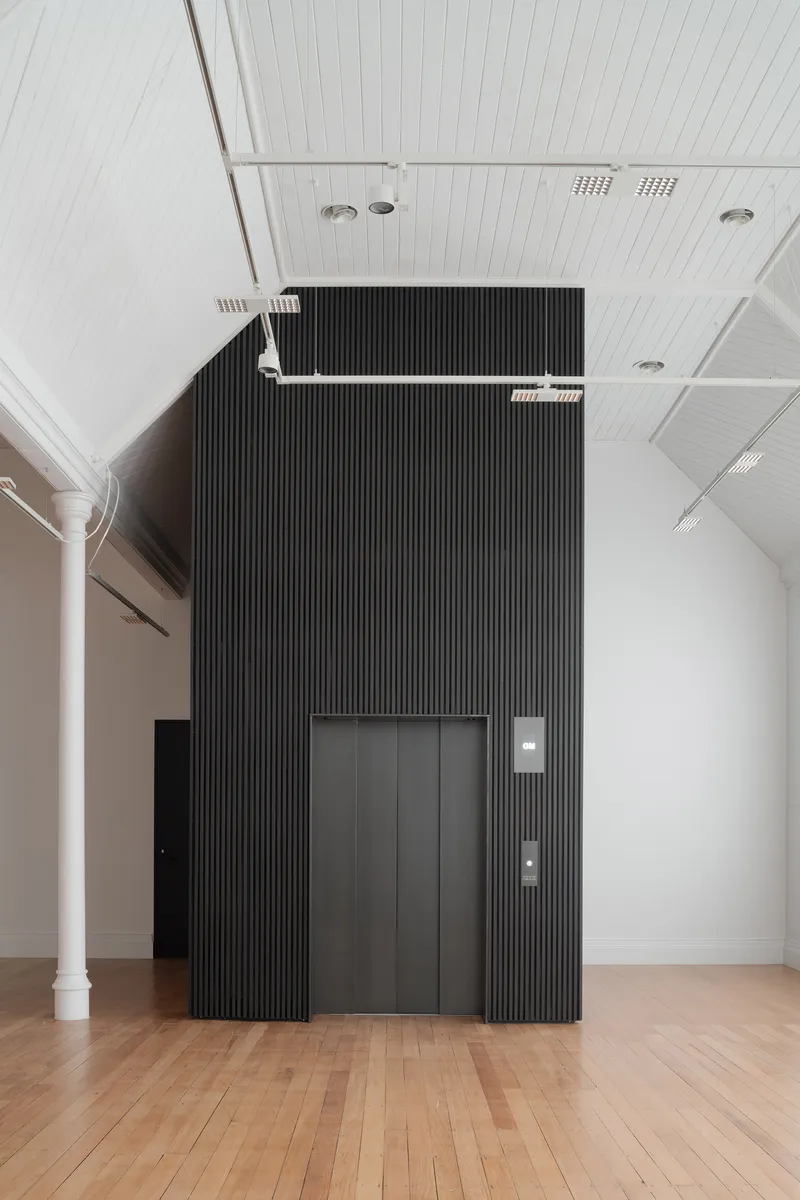
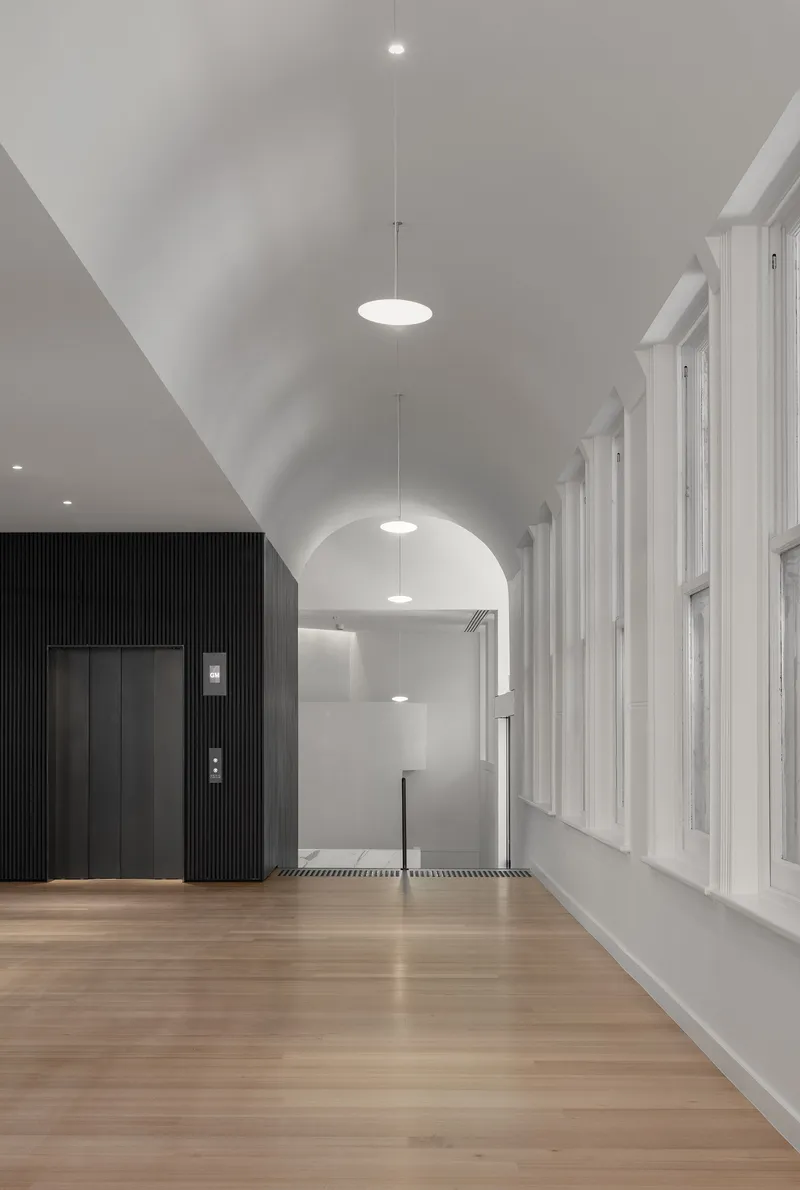
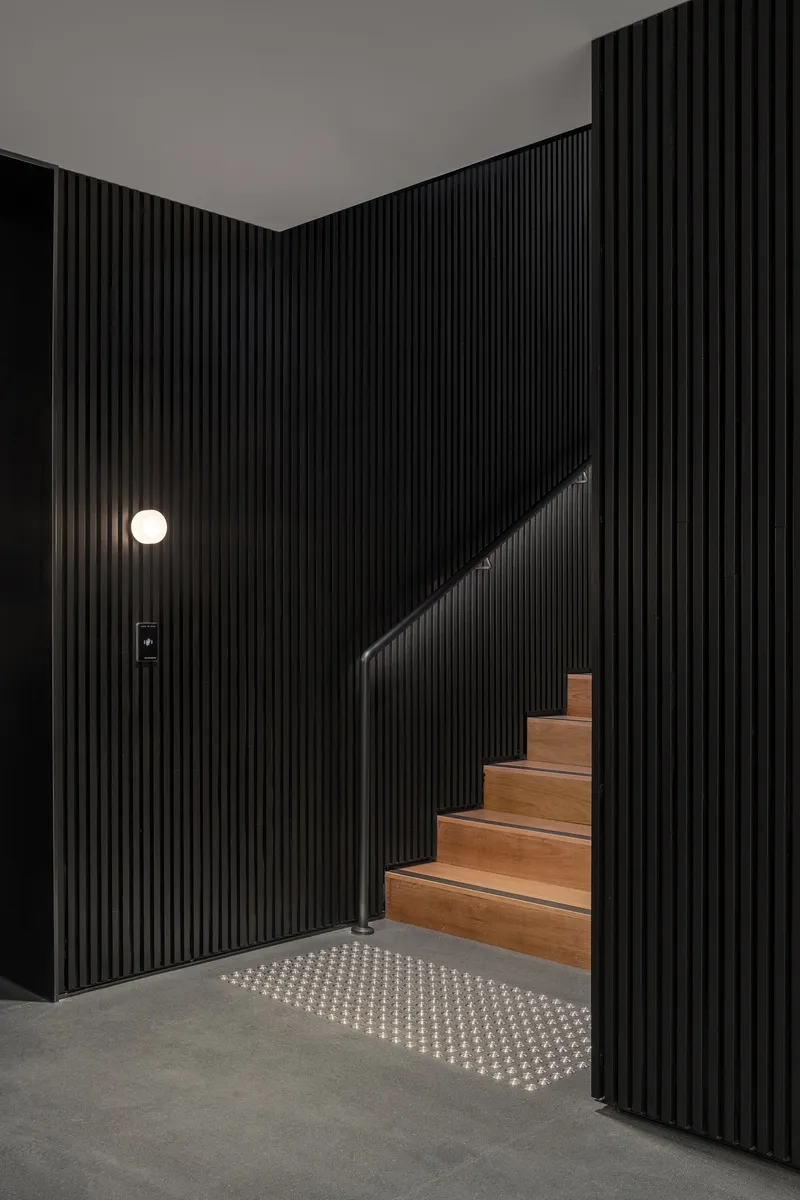
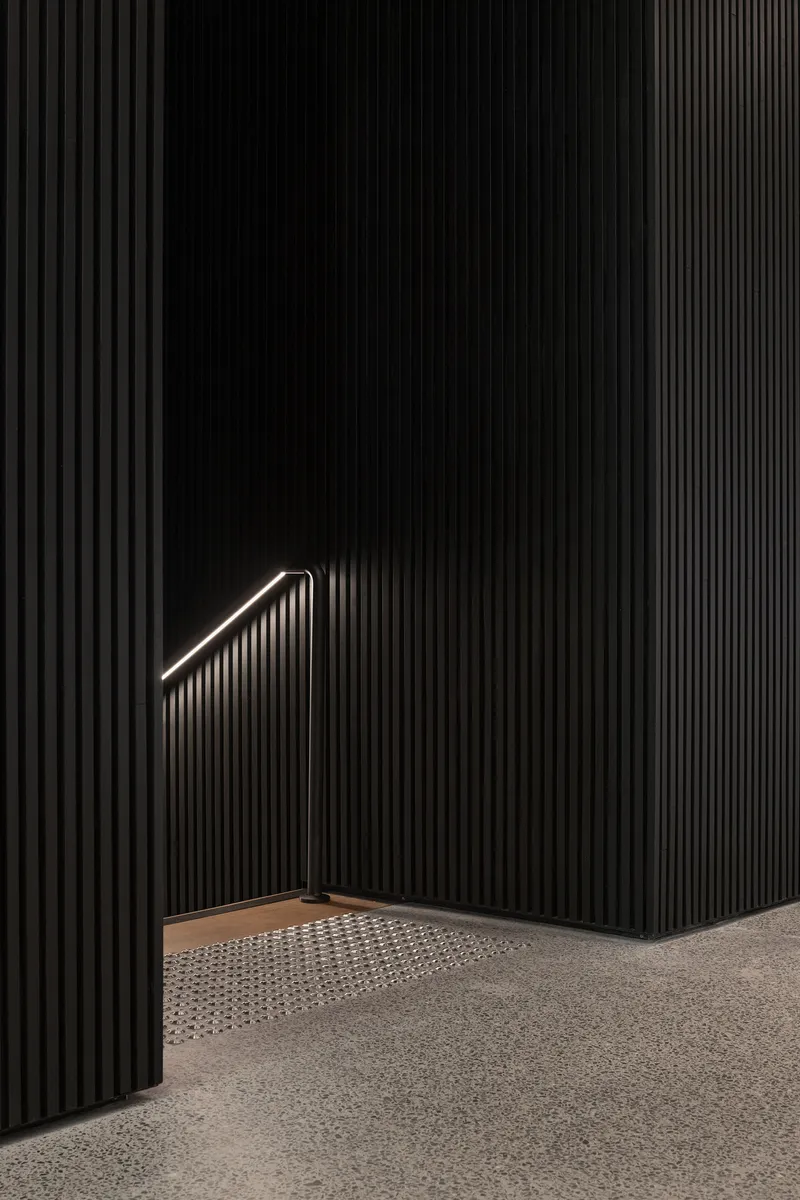
Not every space in the museum is bathed in white light. The elevator core, wrapped in black ribbed cladding, introduces a tonal counterpoint that recurs in corridors, stair enclosures, and service areas. Vertically fluted dark panels line the stairwells, where illuminated floor grilles and triangular handrails offer small moments of precision. These darker zones compress the spatial experience before releasing visitors back into the generous gallery volumes.
The timber staircase ascending between black fluted walls is a particularly effective sequence, its warmth held in tension by the enclosing darkness. A single circular wall sconce provides just enough orientation without flooding the passage with light. These interstitial spaces are often neglected in museum design; here, they are treated as deliberate episodes in the visitor's journey.
Support Spaces and Programmatic Depth
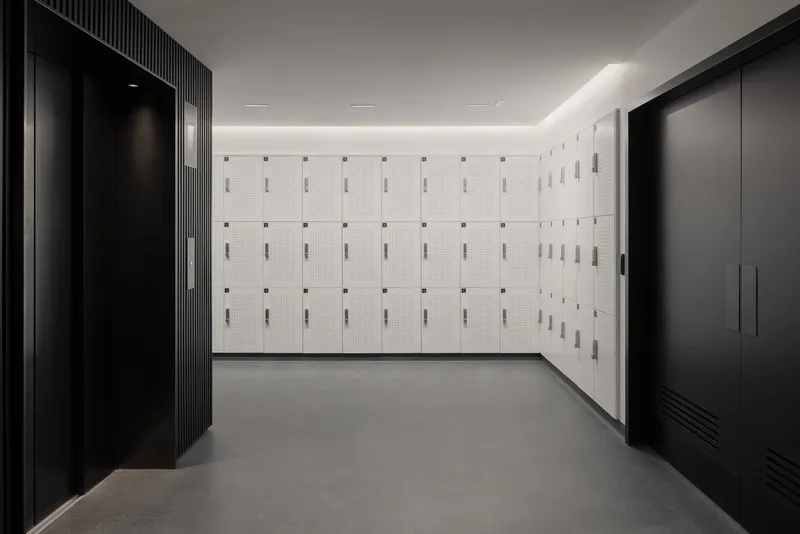
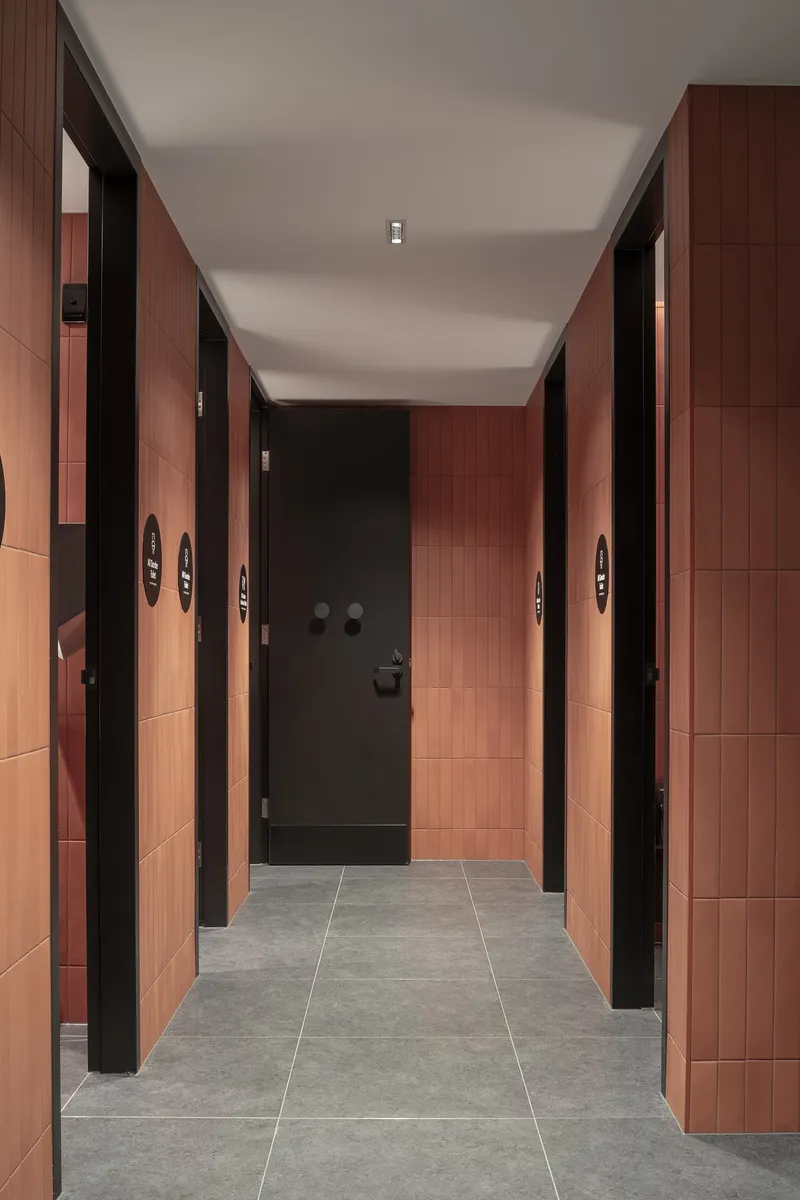
The building's educational mission extends beyond the galleries. A locker room with white perforated metal doors, a corridor lined in terracotta tiles, and carefully detailed service passages demonstrate that Wood Marsh applied the same level of attention to the support program as to the public rooms. Perforated floor panels, recessed lighting, and the consistent use of vertically textured surfaces ensure that even the most utilitarian areas feel resolved.
For a university museum, these back-of-house and education-adjacent spaces are where daily life actually happens: students stowing bags, staff moving between seminar rooms and storage. Getting these details right is not glamorous work, but it determines whether a building feels genuinely designed or merely styled.
Gallery Detail and Spatial Modulation
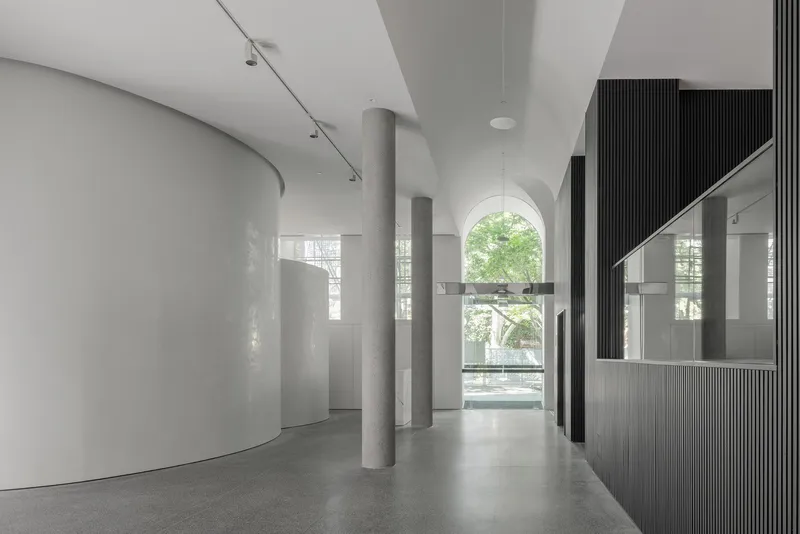
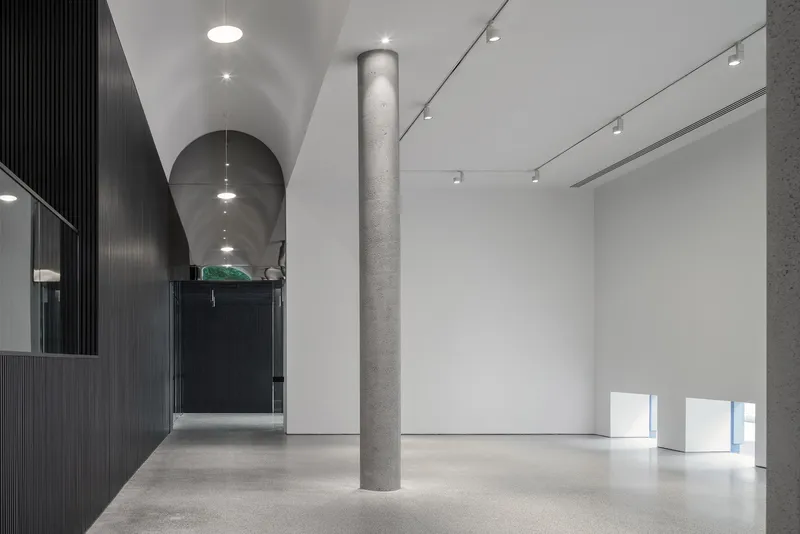
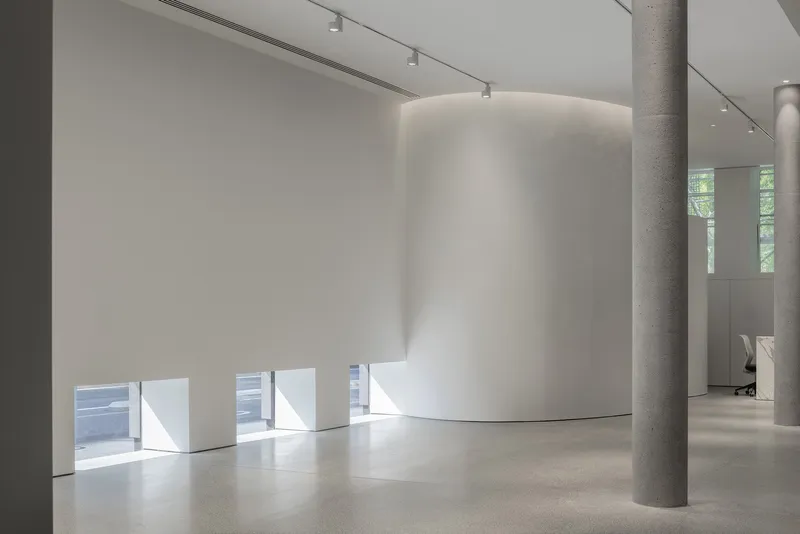
Close-up views reveal the subtlety of the gallery architecture. Horizontal window slots at floor level introduce ground-hugging light that washes across polished concrete floors, while low rectangular openings in white walls hint at adjacent rooms without fully revealing them. These apertures create a layered sense of depth, drawing visitors forward through the building.
The curved white plaster volumes that house services and storage within the gallery floors are sculpted with just enough softness to break the otherwise rectilinear logic. Concrete columns, smooth and unadorned, stand as vertical anchors throughout. The overall effect is a gallery architecture that is quiet enough to recede behind exhibited work but spatially rich enough to reward exploration on its own terms.
Plans and Drawings
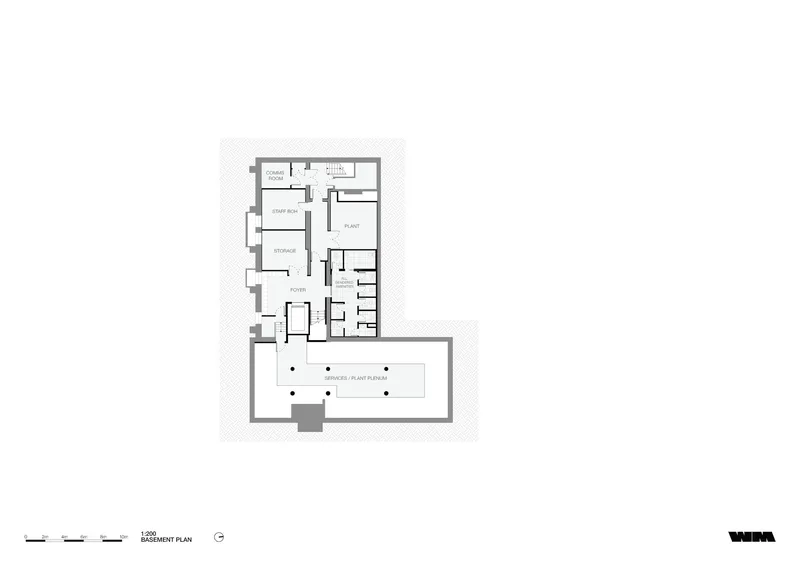
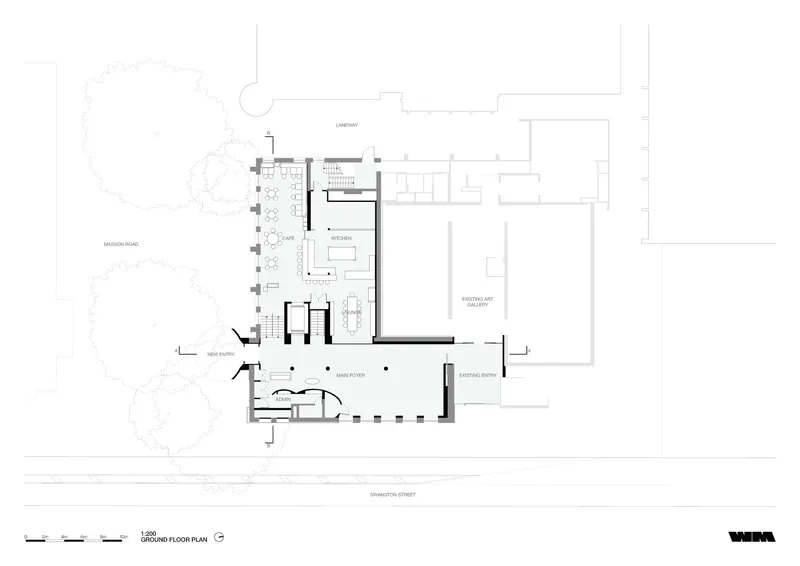
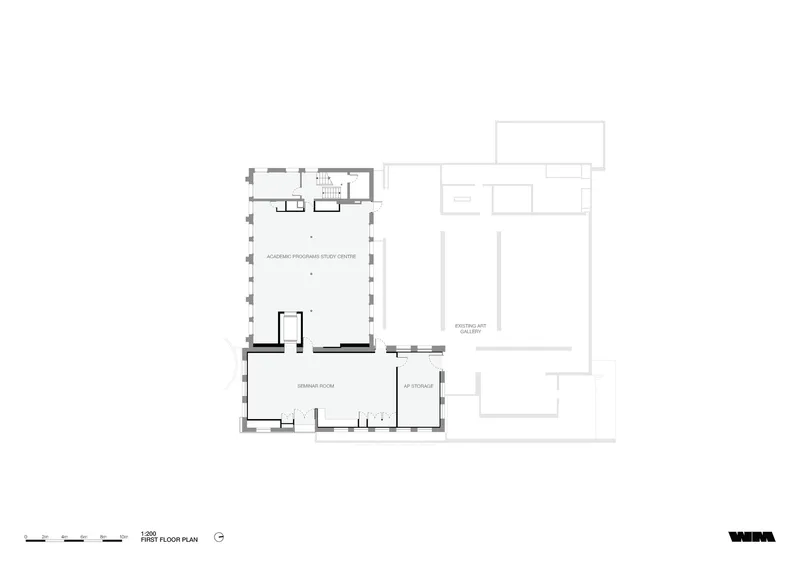
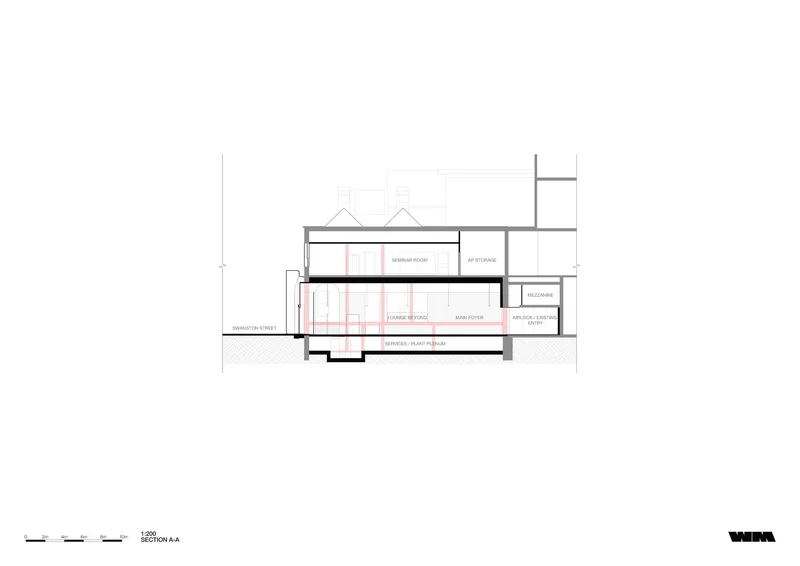
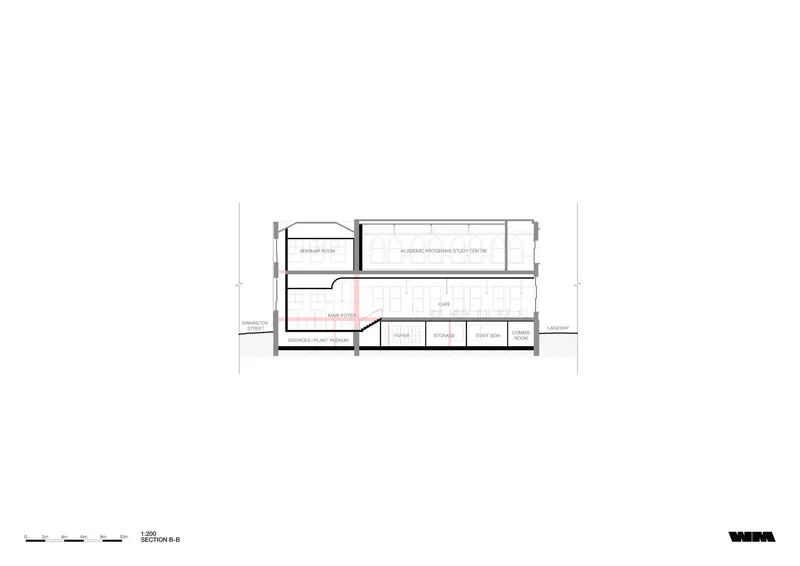
The floor plans clarify the building's organizational logic. The ground floor positions the main entry and primary gallery along the central axis, with a kitchen and connection to the existing art gallery flanking it. Above, the first floor accommodates an academic program study center, seminar room, and art storage, embedding the museum's educational mission directly into its upper level. Below ground, a court, storage, and corridor circulation open onto an outdoor terrace, providing operational breathing room that the compact site would otherwise deny.
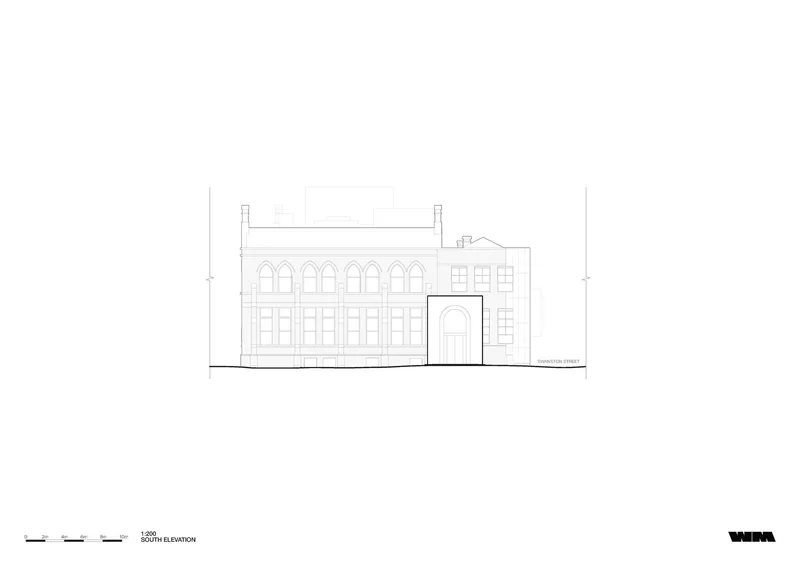
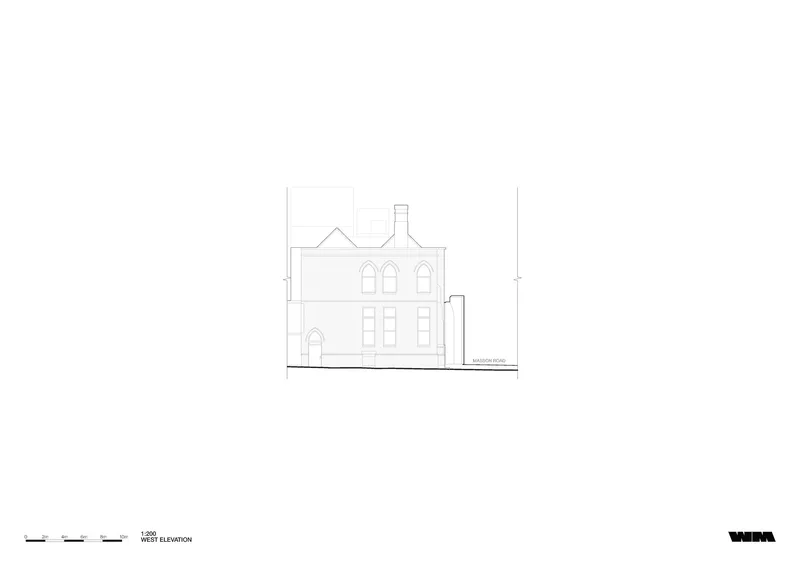
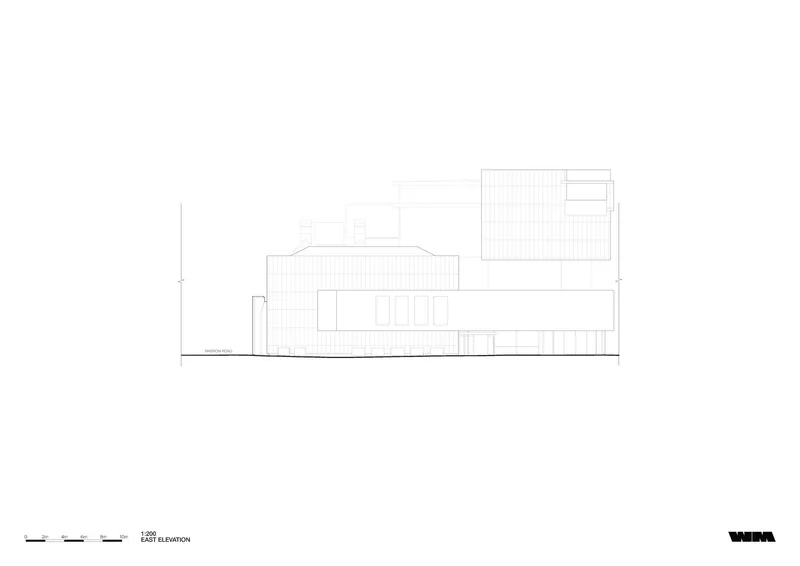
The elevations and sections reveal the care taken with the building's massing. The south elevation shows how the arched fenestration pattern of the new work mirrors the existing pointed arches, while the sections expose a split-level interior arrangement that threads multiple programs through surprisingly compact floor plates. The east elevation's horizontally layered composition with vertical cladding and recessed openings gives the building a secondary face that reads as quieter and more utilitarian, appropriate for its service orientation.
Why This Project Matters
University museums occupy a peculiar position in the cultural landscape. They must serve research, pedagogy, and public engagement simultaneously, often on constrained sites surrounded by buildings they cannot alter. Wood Marsh's expansion of the Potter Museum demonstrates that these constraints can be productive rather than limiting. The mirrored glass pavilion is a genuine invention, solving the problem of connecting heritage fabric to new space while creating an entrance that actively engages with its landscape.
More broadly, the project suggests an alternative to the two dominant modes of institutional architecture in Australia: neither the bombastic sculptural statement nor the timid background building. Wood Marsh has found a register that is confident in its formal moves, meticulous in its material choices, and respectful of context without being subservient to it. For a museum that must serve the University of Melbourne for decades to come, that middle ground feels exactly right.
Potter Museum of Art by Wood Marsh, Parkville, Australia. Completed 2025. Photography by Fergus Floyd.
About the Studio
Share Your Own Work on uni.xyz
If projects like this are the kind of work you want to make, uni.xyz is a place to publish your own, find collaborators, and enter design competitions.


Popular Articles
Popular articles from the community


Manzana Morphosis: Stretching Barcelona's Grid into a Living Landscape for 2050
A radical reworking of the Eixample manzana turns density into a tool for generous public space, vertical ecology, and environmental performance.
Opera by the Sea Estonia: Three Shells Dissolving Architecture into Tallinn's Coastline
A winning opera house proposal replaces monumental form with interconnected shells that blur the boundary between building, park and Baltic Sea.

Singing Woman: An Opera House That Performs Before the Curtain Rises
Ovidiu Cristian Pavel's conceptual opera house translates Estonia's choral identity into a sculpted waterfront landmark facing the Baltic Sea.
Extended Shell: Retrofitting Kolkata's Balconies as Living Urban Thresholds
A modular retrofit system recovers the social and environmental intelligence of Kolkata's historic verandas for contemporary Park Street residents.

Similar Reads
You might also enjoy these articles

Pixel Gardens: One Repeated Module Stacked Into a Terraced Social Housing Tower for Famagusta
Salem Bader's shortlisted housing tower builds a vertical neighbourhood from one repeated module, offsetting units to carve terraces, light and air.

Bao Huynh Watercolor Atelier: A Serene Art Retreat in Hội An
Bao Huynh Watercolor Atelier in Hội An blends multifunctional art spaces, sustainable design, local materials, and family-friendly living in a serene environment.

Atelier Macri Concept Store Interior Design by CASE-REAL
Atelier Macri store features a "ko" counter, walnut wood details, cork displays, blending retail, gallery, and seamless customer experiences.

Manuel Vargas Izquierdo Stadium and High-Performance Sports Center: Architectural Excellence in Jalpa de Méndez
The Manuel Vargas Izquierdo Stadium blends sustainable design, inclusive sports facilities, and cultural-inspired architecture, revitalizing Jalpa de Méndez’s public spaces.

Explore Museum Typology Competitions
Discover active competitions in this discipline

Challenge to design public laboratory

Bring back Drive In's
Comments (0)
Please login or sign up to add comments
No comments yet. Be the first to comment!