
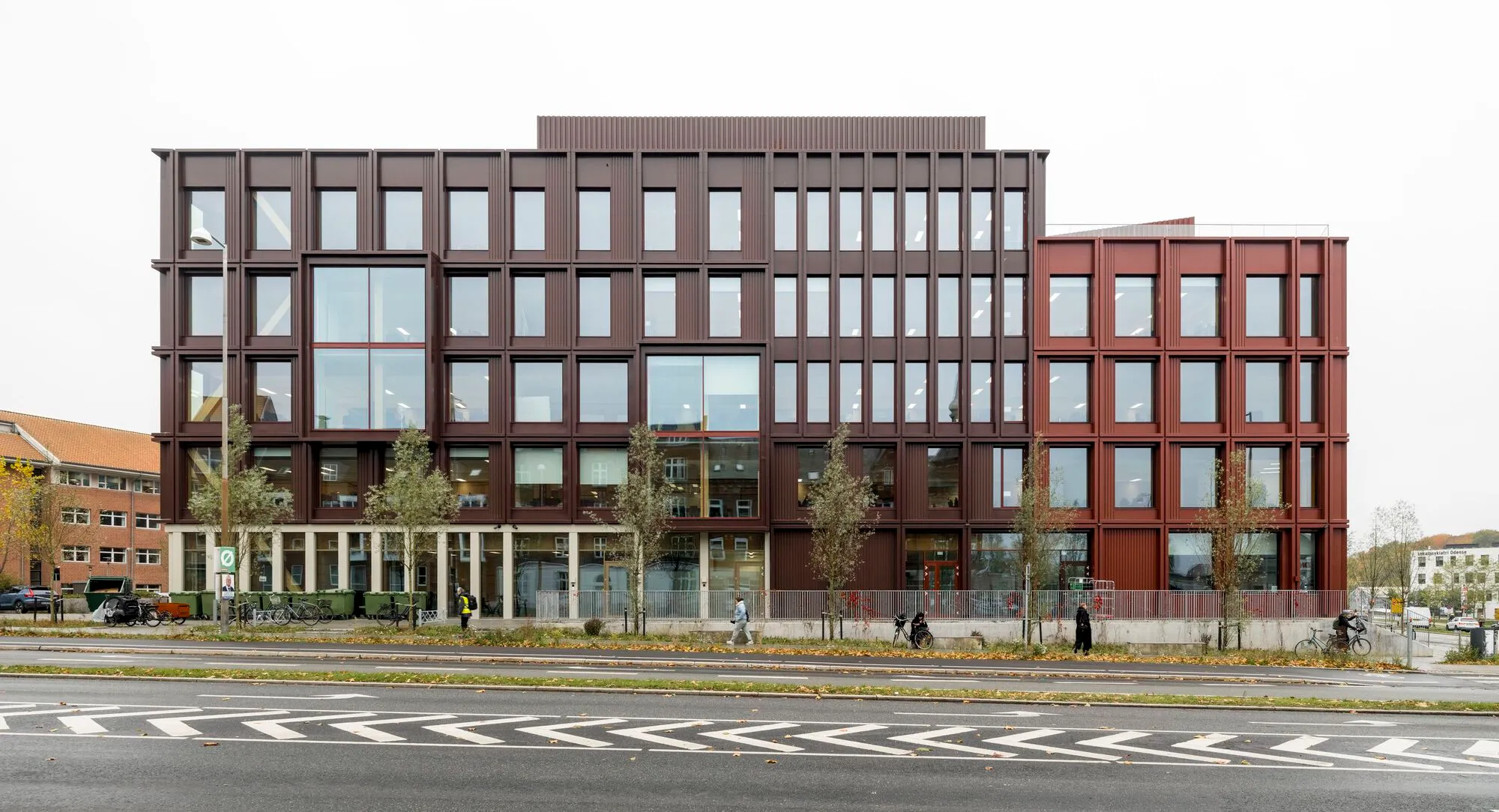
WoodHub By C.F. Møller: Denmark’s Largest Timber Office Building
WoodHub in Odense, Denmark, is Denmark’s largest timber office building, combining sustainable glulam and CLT construction with flexible, green, climate-conscious workspaces.


Located in the heart of Odense, Denmark, WoodHub by C.F. Møller Architects represents a landmark in sustainable public architecture. Completed in 2025, this pioneering office building gathers multiple government agencies under one roof, providing modern, flexible, and climate-responsible workspaces for 1,600 public employees. As Denmark’s largest timber office building, it is celebrated as a national flagship for low-carbon construction, setting a benchmark for sustainable architecture and large-scale timber design.

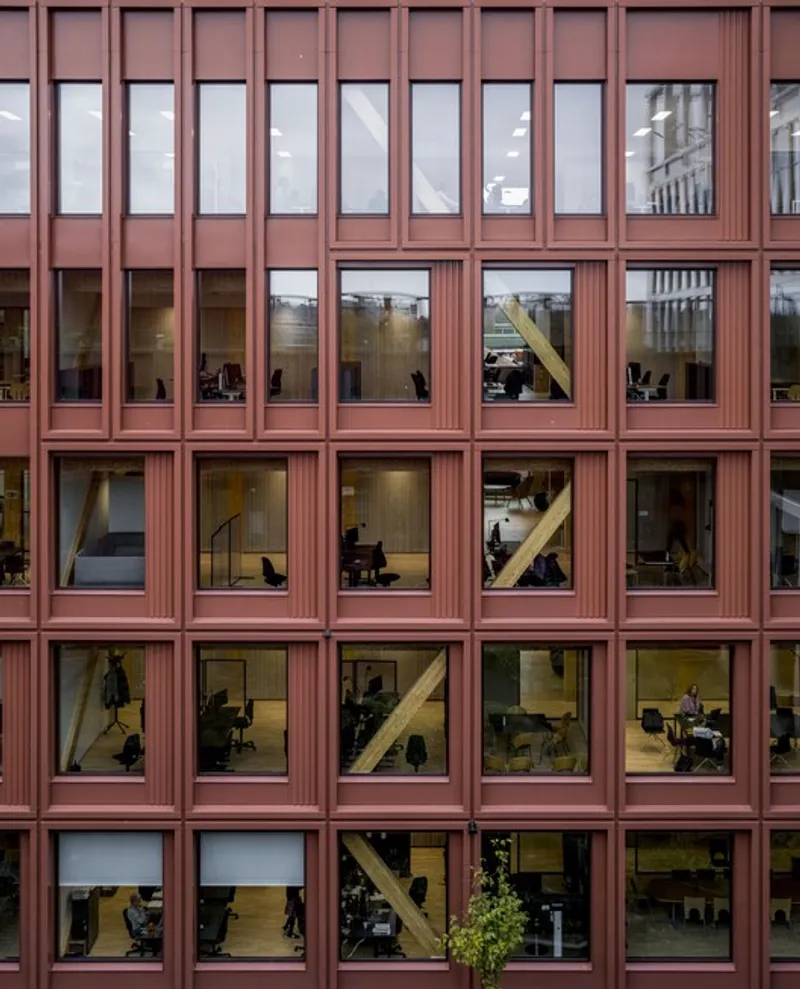
Sustainable Timber Construction & Carbon Reduction
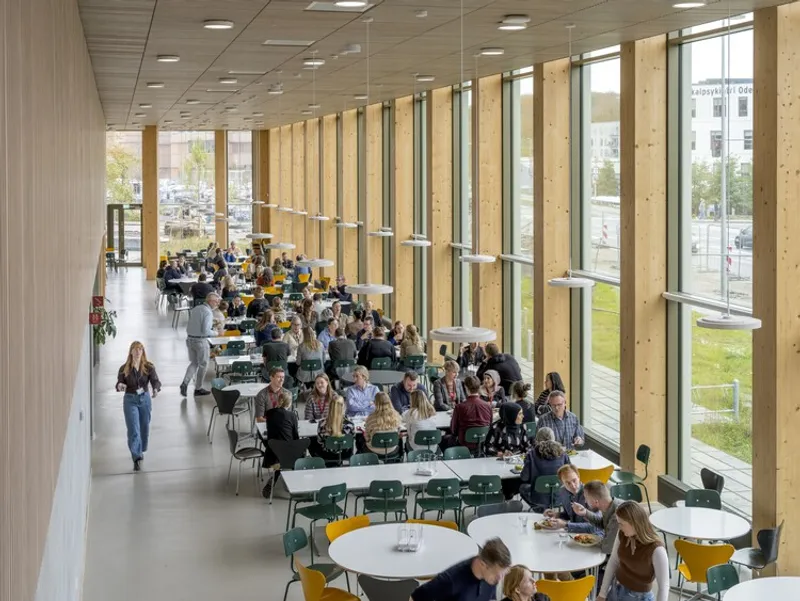
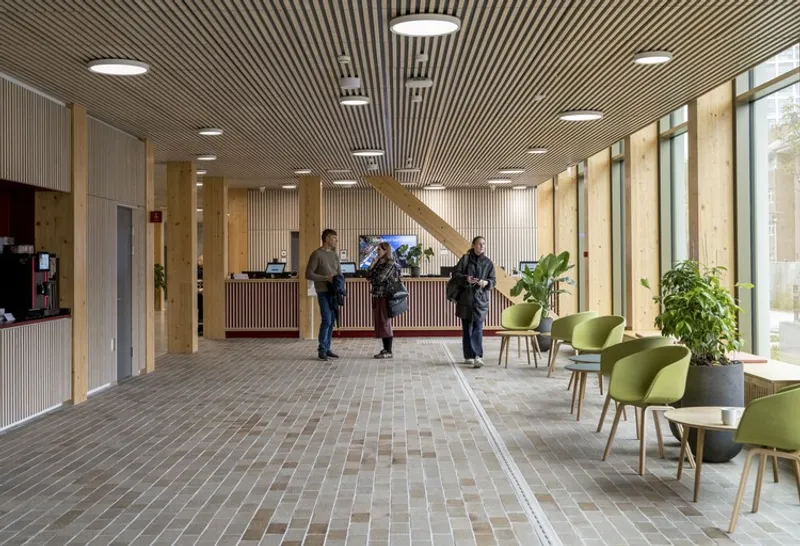
The building’s 31,000 m² solid timber structure dramatically reduces the lifetime CO₂ emissions by approximately 5,400 tonnes compared to conventional construction. Exposed glulam columns and CLT (cross-laminated timber) floors are not only structural elements but also serve as carbon storage, delivering both technical efficiency and sensory warmth. The visible timber structure enhances indoor environmental quality while demonstrating the aesthetic potential of large-scale timber construction.
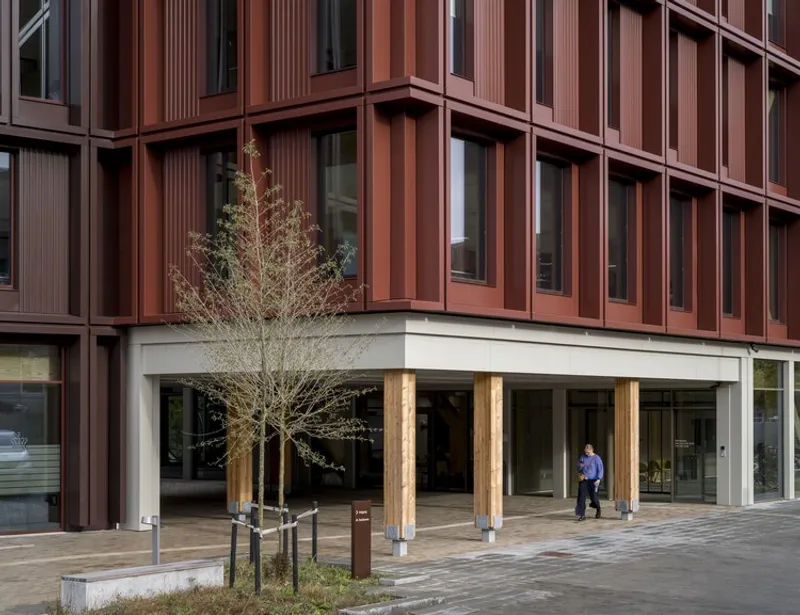
Contextual Design & Façade Strategy
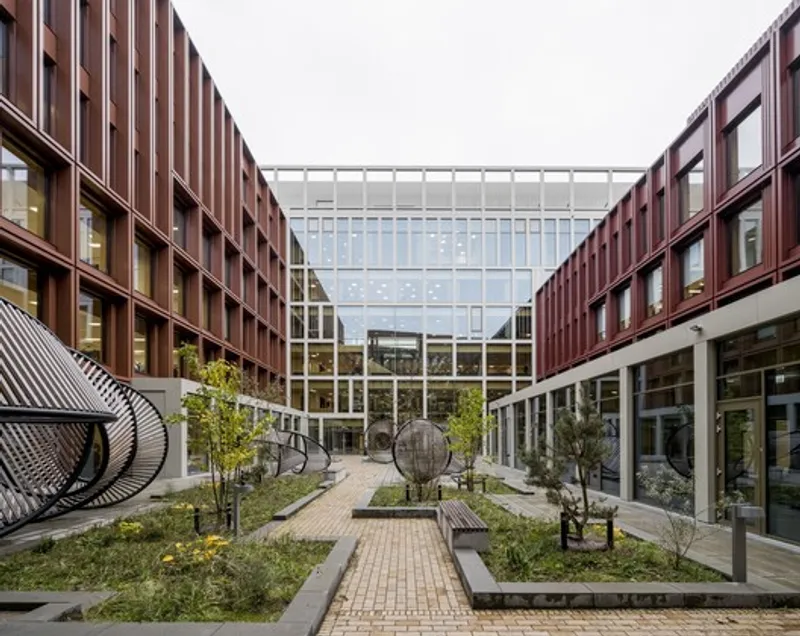
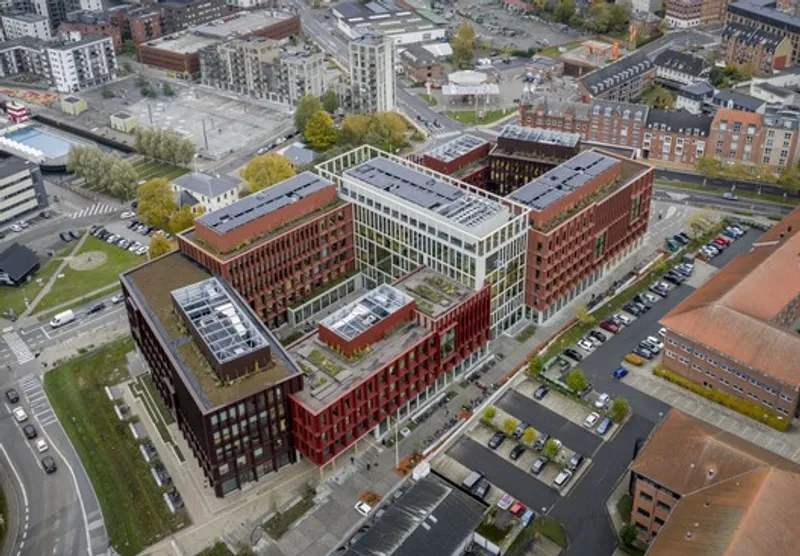
The façades use recycled aluminium panels in warm red-brown tones that harmonize with the surrounding brick buildings. Varied façade depths are carefully aligned with the sun path, providing passive shading that minimizes energy use while maximizing natural daylight. This design strategy ensures thermal comfort throughout the building without relying on mechanical screening, highlighting bioclimatic architecture principles.
Spatial Organisation: Work, Collaboration, and Urban Integration
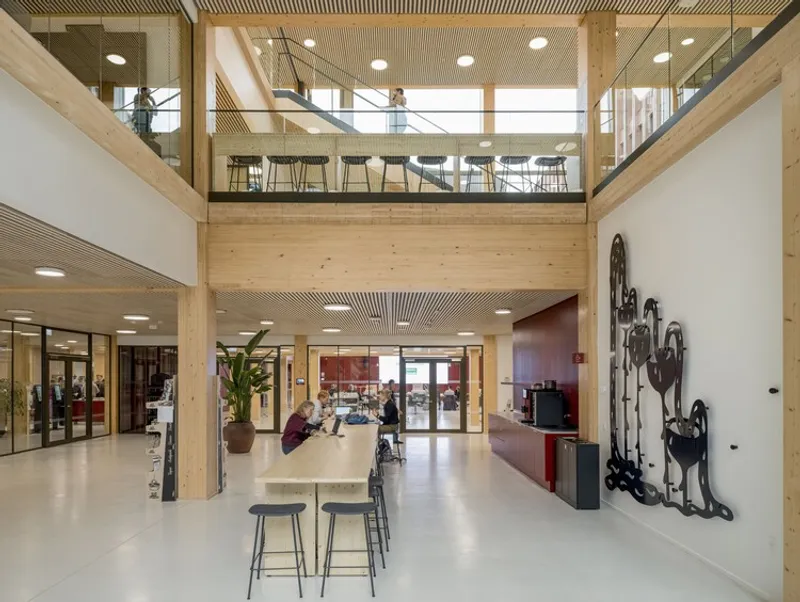
WoodHub’s layout is organized around two staggered C-shaped office wings facing east and west, rising from three to six floors. These wings converge in a seven-storey central hub, which houses meeting rooms designed to foster knowledge sharing and collaboration. The flexible interiors can be reconfigured over time, supporting adaptive reuse and long-term functionality.
At ground level, the building seamlessly integrates public front-office functions, a canteen, and a meeting center, connecting urban life with the building’s inner courtyard. Nooks and recreation spaces along the façade create dynamic interfaces between the public realm and workplace, encouraging interaction and social engagement.

Green Spaces & Biodiversity
Roof terraces, courtyard gardens, and raised green areas extend workspaces outdoors, providing spaces for breaks, informal meetings, and community engagement. These green interventions enhance biodiversity, support employee well-being, and strengthen the building’s connection with nature, embodying the philosophy of blending work, city, and environment.

National Impact & Architectural Significance
WoodHub is widely regarded as a benchmark in low-carbon, large-scale timber construction, inspiring future projects across Denmark and internationally. It demonstrates that public architecture can simultaneously prioritize sustainability, aesthetics, functionality, and community engagement. The project reinforces C.F. Møller’s leadership in climate-conscious design and innovative timber architecture.
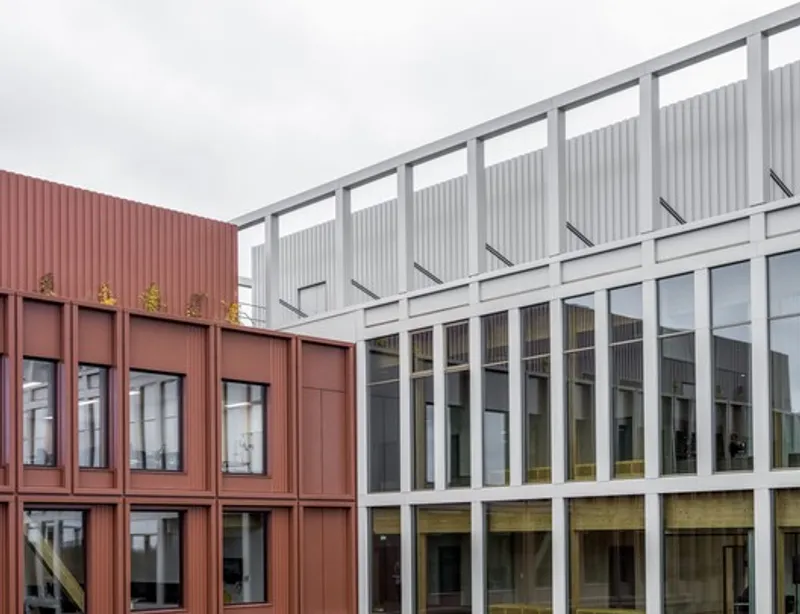
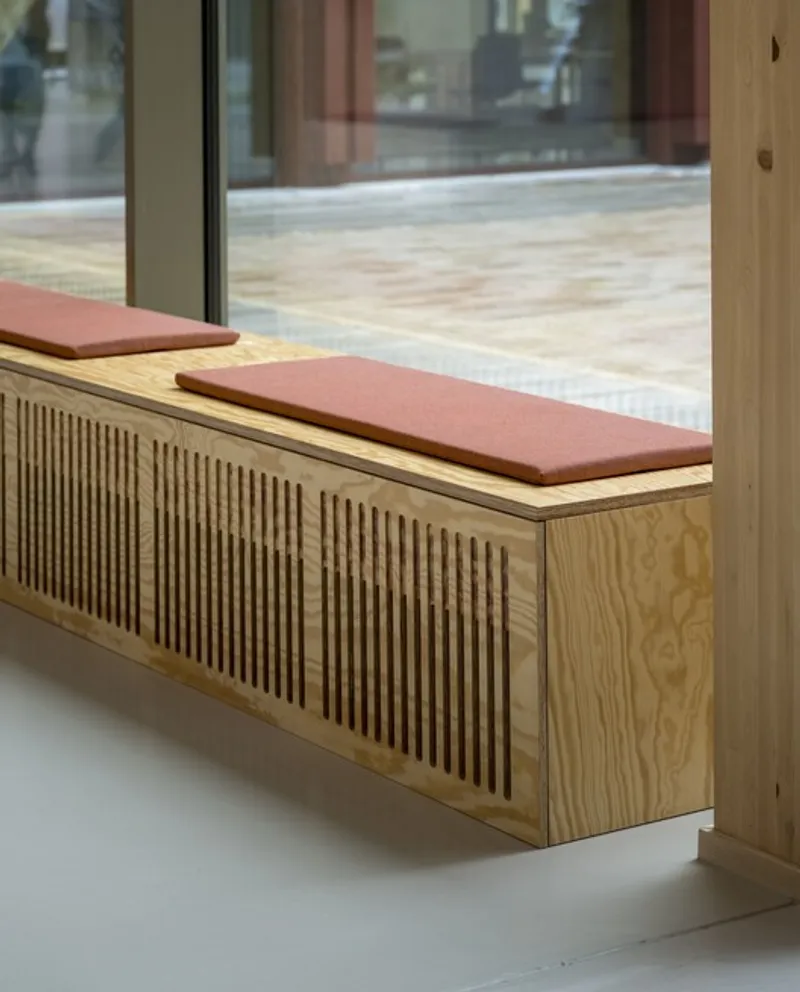
All the photographs are works of
Rasmus Hjortshøj




Popular Articles
Popular articles from the community


Conexión: Biophilic Design Reimagines High-Rise Living in Hong Kong
Conexión reimagines high-rise living in Hong Kong through biophilic design, green facades, shared spaces, daylight, water and nature within.

The Musturak Paradise: Senior Living Architecture for a Connected Future in Temara, Morocco
The Musturak Paradise reimagines senior living architecture in Temara via private homes, social spaces, culture, community, and shared care.

The Ocean Hive: Sustainable Architecture for a Self-Sufficient Civilization at Sea
The Ocean Hive imagines sustainable architecture at sea, where modular habitats, algae, wave power and ocean waste sustain a growing colony.

The Earth Pod: 3D Printed Homes for Resilient Refugee Communities
The Earth Pod reimagines refugee housing through 3D printed homes made from clay, combining resilience, self-sufficiency, and rapid shelter.


Similar Reads
You might also enjoy these articles


FAMM Arquitectura Organizes Ten Villas Around Courtyards and Jungle in Nosara, Costa Rica
El Molino pairs two elongated volumes with deep overhangs and timber louvers to build a compact coastal community five minutes from the beach.

Oscar Niemeyer's Ibirapuera Park Pavilions Define São Paulo's Cultural Identity in Concrete and Curve
A constellation of modernist volumes set within São Paulo's most important urban park, conceived for the city's 400th anniversary in 1954.
How Henri Picq's 1889 Paris Pavilion Traveled 11,000 Kilometers to Become Santiago's Artequín Museum
A prefabricated iron and glass pavilion built for the Paris Universal Exposition found a second life as a children's art museum in Chile.

Sanjay Puri Architects Wraps a Jaipur Office Tower in Capsule-Shaped Green Buffers
A nine-level climate-responsive workplace near Jaipur Airport uses stacked planter terraces and aluminium screens to fight 40°C heat.

Explore Public Architecture Competitions
Discover active competitions in this discipline



Challenge to reimagine the Iron Throne


Photograph architecture without architects


Illustrate the lost glory of Angkor Wat - Render Challenge


Design challenge to reuse E-waste
Comments (0)
Please login or sign up to add comments
No comments yet. Be the first to comment!