
Working is (back) home
A historic overview on the relation between architecture and work.
Old buildings don’t only show us the esthetics of past times but also tell us stories about the people once using or inhabiting these structures. Buildings can become capsules containing information about how people lived and their lives can retroactively be constructed by researching the buildings they used. Buildings can even reflect and embody ideologies and tell us information about socio-cultural situations of historic times. The way we live and work is reflected and manifested by our architecture in the way that our facial expressions reflects our emotions. This essay will explore the history of architecture in relation to the way people work. When looking into the history of architecture we might have a better shot at looking into the future.
When looking at architecture it’s important to acknowledge that architecture is not the driving force behind society but rather a force driven by society. Architecture is all about understanding the human need and turning this into the physical form. Architects are capable to create a real impact on the way people live and behave. But to create future-proof buildings that won’t be nonsensical it’s important to look beyond day-to-day life and see what lies ahead. Looking at history is one of the most powerful tools that we have in letting us grasp larger time spans and helps us look across the horizon.
Working is one of the most basal aspects of the human condition, it has always existed and presumably will always exist. With the emergence of money, the industrial revolution, the five-day workweek, market capitalism, and numerous others factors our lives and working lives have become separate entities, and with that so have our living and working spaces. When COVID-19 locked us down it was the first time for most people to spend such long periods in their homes. The boundaries between working life, family time, and even time off had blurred. But it wasn’t for the first time. Many early humans searched for plants and hunted for food. One of our predecessors, the Homo ergaster, translating to the working man is even named after this trait. It was the first hominoid to create tools and to make fire. To them, living was working and working was living.
The first people who transitioned from hunter-gatherers to more sedentary agricultural farmers started building durable homes for residing longer periods of time. This process happened somewhat simultaneously at multiple places on the planet almost 12,000 years ago. Therefore can be stated that farms are the oldest topology of architecture known to man. Modern-day farmers can be seen as one of the last groups of people whose working and non-working lives reside so closely together. But their pre-historic predecessors took it even a step further. Their living spaces and animals were often to be found in the same room. One can only imagine the smell and noise the cattle would bring in a bedroom/living room shared by an entire family. This building type has existed for thousands of years and in England is named the medieval longhouse. The remains found of these longhouses oddly resemble the archetypical farmhouse of today. Of course, the materials differ from the ones built in de bronze age and medieval ages and the floorplan these days include separate rooms but their shape echo true in modern times. A statement could be made that these first farmers still impact the way we live and work in this time. These first farmers had a working life that coincided with their family life as shown in their architecture. It is worthwhile to explore their lives and the difference between the lives of modern-day people to learn more about ourselves.
Architecture is influenced by numerous historic events and societal shifts. When it comes to working the agricultural revolution brought us into our houses. Then came the industrial revolution of the 18th century to take us out. This change didn’t happen everywhere and wasn’t instant. It took a process of centuries to manifest. In my country, The Netherlands this process is visible when looking at the so-called homeweavers. For decades these weavers had their own weaving looms in their houses to create fabrics. People these days were mainly self-sufficient but weaving loom could provide a nice extra.
In the 18th century these weavers had become more professional and their cliental often mainly consisted of a single wealthy buyer. The cloth they sold became their main source of income. And their house functioned as homes and a sort of factory. The different functions of the house were visible in the architecture of the homes of the weavers. The windows of these houses were exceptionally large for the time, letting in as much daylight as possible. These weavers were often in business between 10 and 15 hours a day depending on the number of sun hours. Homeweavers weren’t directly out of business when the steam-driven looming machine was invented in 1750 in Great Britain. It took until 1827 for the first steam-driven machine to come to the city of Tilburg in North-Brabant. Eventually, more and more people started working in factories and the last home weaver of Tilburg stopped in 1940. Painter Vincent Van Gogh was fascinated by the homeweavers and made 16 paintings and drawings of these workers in their homes. Most of the homeweaver eventually started working in factories where they usually worked under harsh circumstances starting at a young age.
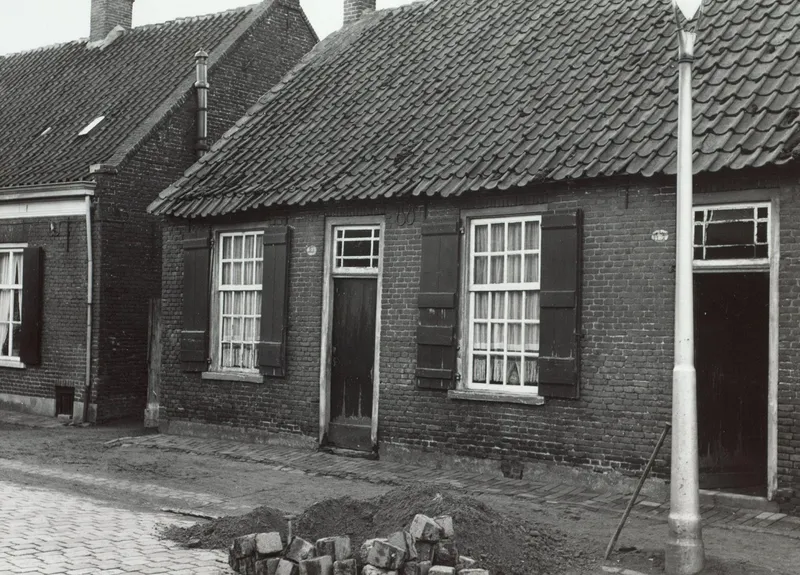 Weavers home with with large windows.

Painting of a homeweaver
by Van Gogh (1884).
In the middle ages, the invention of money and technological progression had given rise to professions like blacksmiths, masons, and carpenters. People opened up shops that usually were situated on the ground floor of houses that people lived in. This typology of homes had been a blueprint for the way people lived and worked for centuries. Family life and work were strongly connected as the children of these craftsmen were often part of the business. Until the industrial revolution, it was in almost universal use, that a shop was called ‘house’, with sub-sets of ale-house, bake-house etc. But through the twentieth century the term ‘house’ gradually came to mean a building in which we cook, eat, sleep, bathe and watch TV. Nobody thinks about work when hearing the word house these days.
With the rise of capitalism and the market economy, even more has changed. Companies have become bigger and even multinational. After the invention of the car distances traveled from home to work have been getting longer. These factors have given rise to the suburbs and have shaped the entire urban plans of many cities. Another architectural invention that shaped the way we work is the open-plan office (bullpen). The open-plan office was invented in Germany in the 1950s. The so-called Burölandschaft (desk landscape) can be seen as a direct corollary of a political view of the time that was more open and less hierarchal. As is reflected by the uniform array of desks. In the 1960s the cubical was invented. People at that point had boxed themselves in. The difference between the first farmers and the working class of the 20th century can’t seem to be bigger.
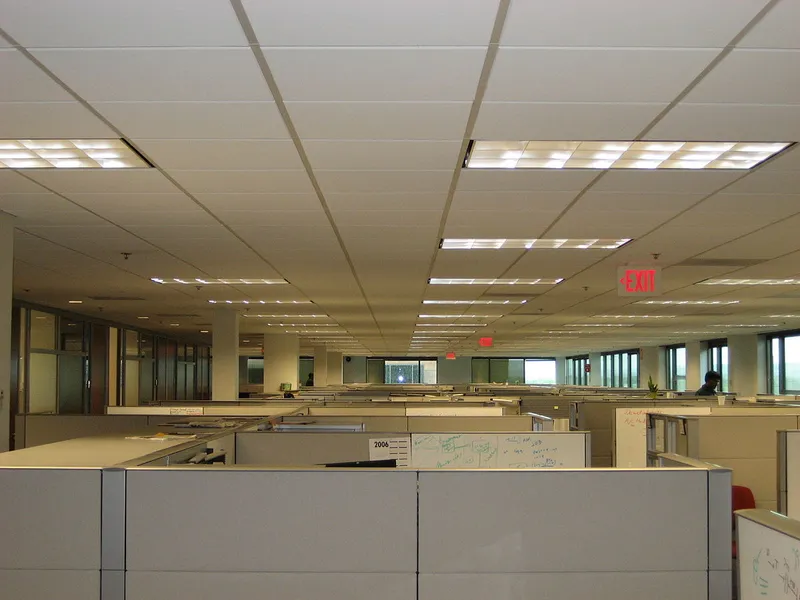
In the past century, we have seen a gradual but sure transition in the way people work. In the past couple of decades, things are speeding up. Another revolution seems to be happening in the form of radical digitalization. COVID-19 seems to react as a catalyst for even further acceleration. Is the digital revolution going the be revolution that brings us back home?

Popular Articles
Popular articles from the community


The Amber Palace Opera: A Geological Fiction Surfaces on Tallinn's Baltic Waterfront
Pierre Brillard reimagines a Baltic legend as a public landscape, opera house, and waterfront promenade rooted in Tallinn's coastal identity.

Faces of the Soviet Avant-Garde: Turning Moscow's Street Names into an Open-Air Museum
A network of sculptural installations across a Moscow residential district transforms forgotten architect names into spatial encounters with cultural memor
Cloaked Colonization: A Mobile Underwater Habitat That Moves Like a Fish
Micah Abaya's shortlisted EHC Pacific entry reimagines ocean settlement as a dispersed network of self-sustaining architectural organisms.

Temporary Home for Dogs: A Reversed Zoo Rethinks Animal Shelter Architecture
In Bucharest, a sinuous corridor and freed landscape flip the logic of containment, designing a shelter that works to make itself unnecessary.

Similar Reads
You might also enjoy these articles

Open letter to community of UNI
A set of important news for our existing participants and community of UNI worldwide.
The Amber Palace Opera: A Geological Fiction Surfaces on Tallinn's Baltic Waterfront
Pierre Brillard reimagines a Baltic legend as a public landscape, opera house, and waterfront promenade rooted in Tallinn's coastal identity.
Dynamic Modules Shelter: A Telescopic Ring for Mountain Pilgrimage
A circular modular framework of steel, bamboo, and fabric grows vertically with demand, wrapping communal ground in adaptable shelter.

Singing Woman: Contemporary Architecture Inspired by Estonia’s Voice and the Sea
Singing Woman turns Estonia’s song culture into flowing opera house architecture, blending public life, landscape, sea, and national memory.


Comments (1)
Please login or sign up to add comments
Good work, the role of architecture in workspace design is conveyed in a relatable manner. The letter looks at history with a specifed aspect of work and presents a clear picture to the audience.