

Yonder Designs a Timber House That Grows on an Allgäu Hillside
House S in Oberreute starts as a holiday retreat with plans to expand into a full retirement home among Bavarian peaks.


A house that grows is a seductive proposition. For a Berlin couple eyeing a steep plot in the village of Irsengund, the idea was straightforward: build a holiday home on a modest budget, then add floors over time until the place becomes a permanent retirement residence. Yonder – Architektur und Design took that brief and translated it into a compact, solid timber volume perched on a hillside in Oberreute, a contemplative climatic spa town in Germany's Allgäu region. The result, House S, is a 231 square meter structure that reads as simultaneously finished and provisional, a building designed from day one to be incomplete.
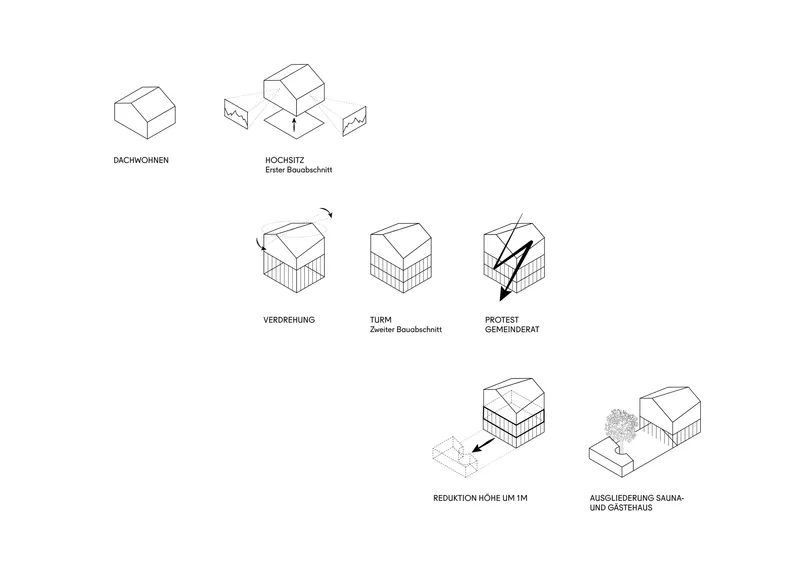
What makes the project genuinely interesting is how the architects negotiated between ambition and constraint. The local council opposed initial plans for maximum height and minimum floor area, forcing the team to drop a floor. Rather than treat this as a loss, Yonder absorbed the reduction (the total height shrank by just one meter) and carved the extra volume into something more generous: a large open living space, a small sauna annex, and a roof conceived as an elevated hide surveying the Vorarlberg peaks. The building does not feel compromised. It feels like a well-played hand.
A Timber Volume on a Steep Slope
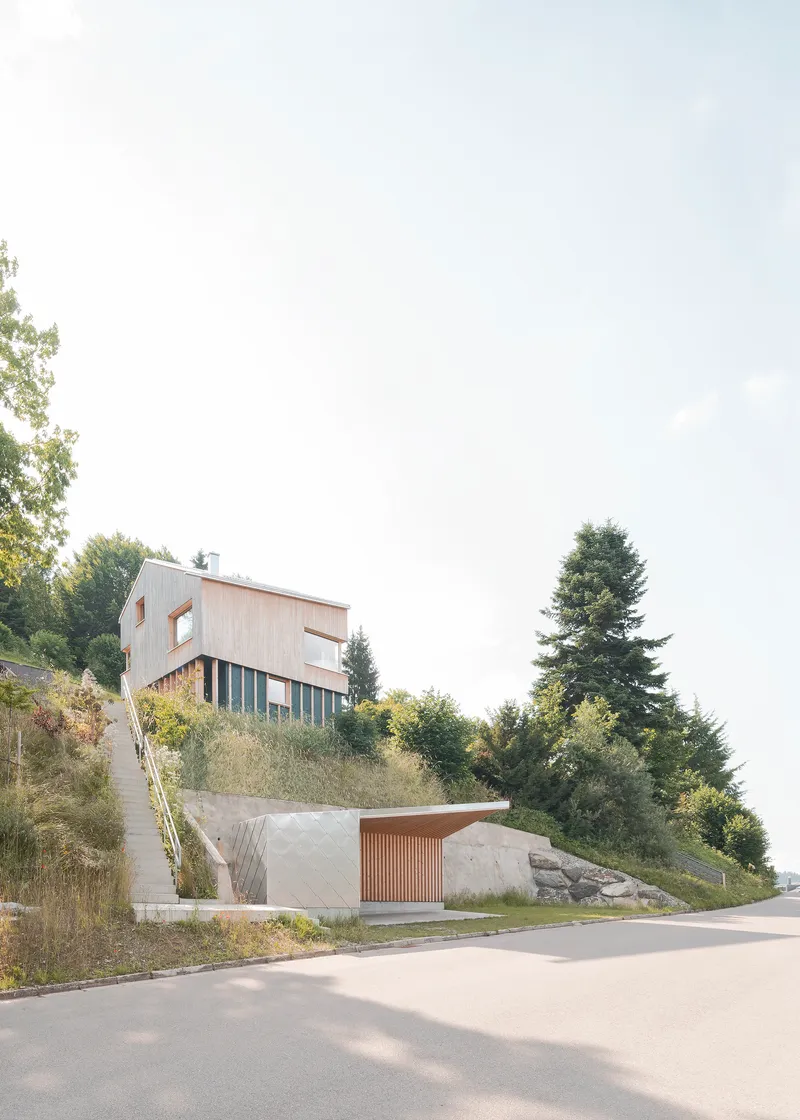
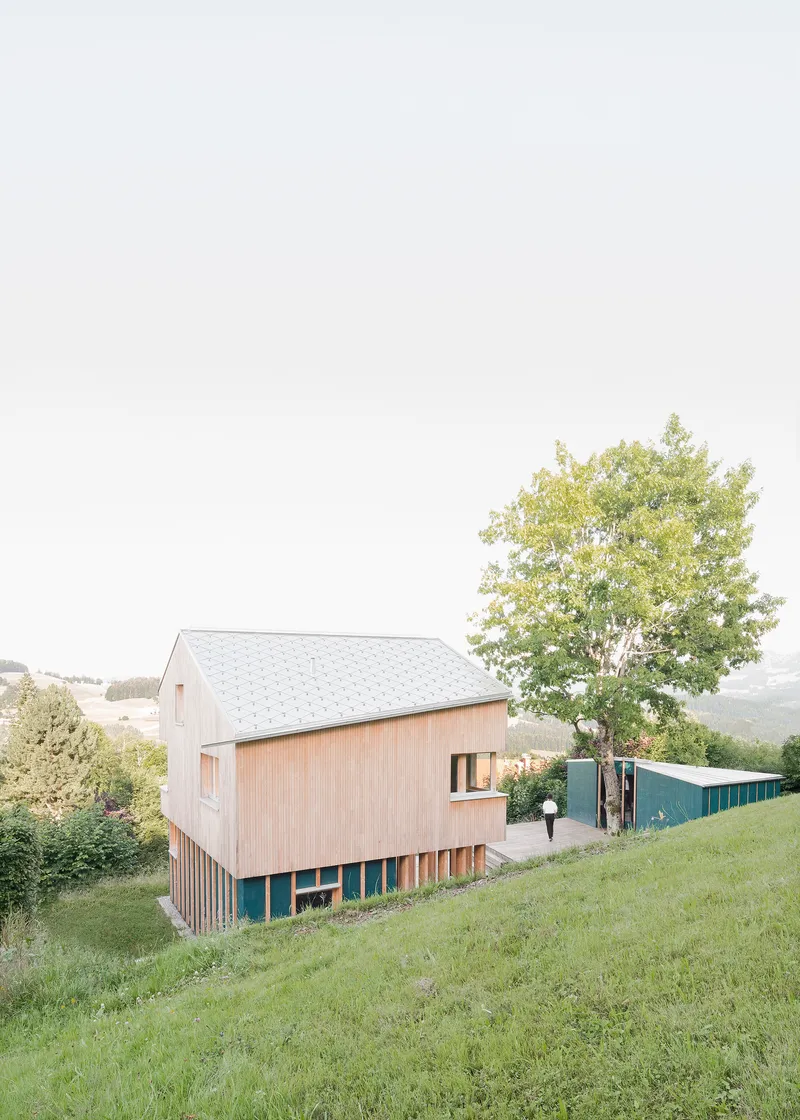
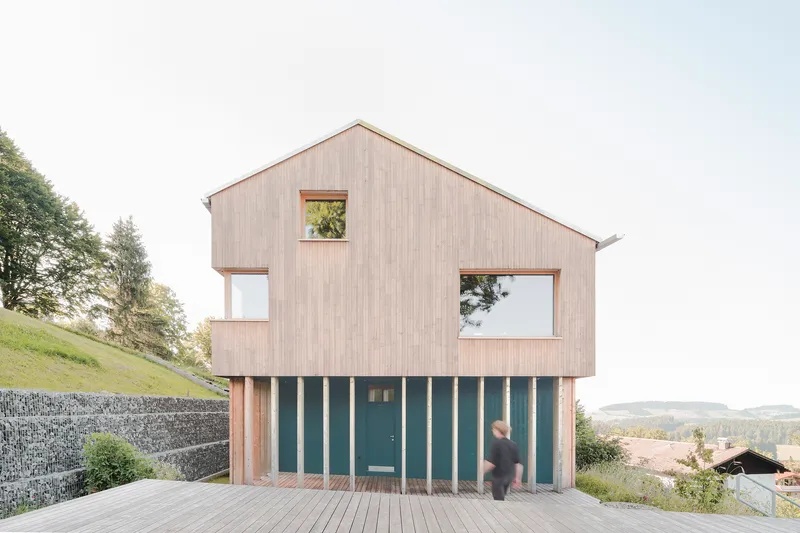
From the street, House S presents itself as a timber-clad gabled volume lifted off the hillside on slender vertical slats, hovering above a concrete base that houses the carport at road level. The split between heavy base and lightweight upper body is a direct response to the steep terrain: the concrete anchors the building to the slope while the timber box floats above the grade, orienting itself toward the panoramic view. The vertical cladding runs continuously, wrapping the walls and the slatted screen at ground level into a single material gesture.
The approach from below, climbing toward the entrance, reinforces the sense of elevation. You arrive at the foot of the property and ascend to the living level, a choreography that mirrors the building's own ambition to grow upward over time. The gabled profile is traditional in outline but stripped of ornament, sitting comfortably among its Allgäu neighbors without mimicking them.
The Blue Pavilion and the Courtyard Tree
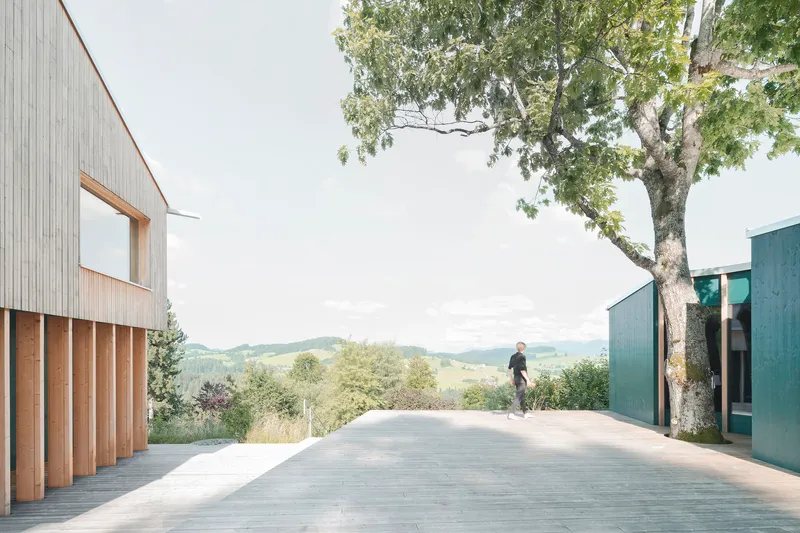
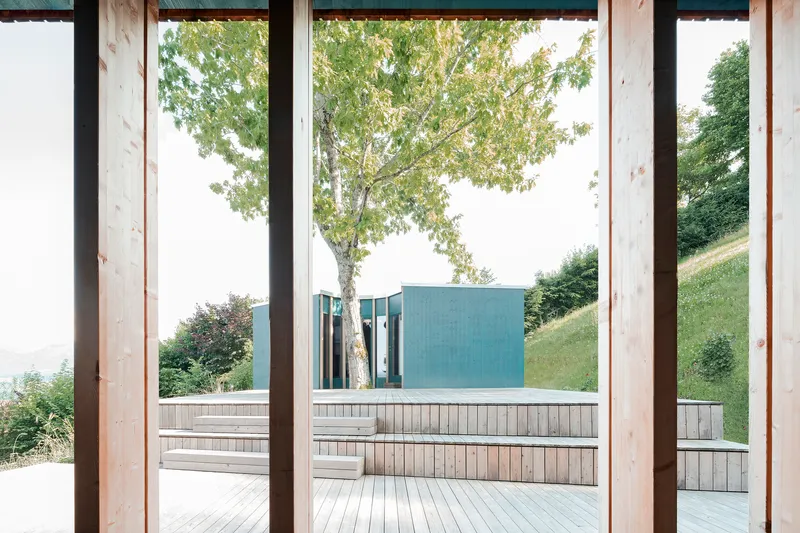
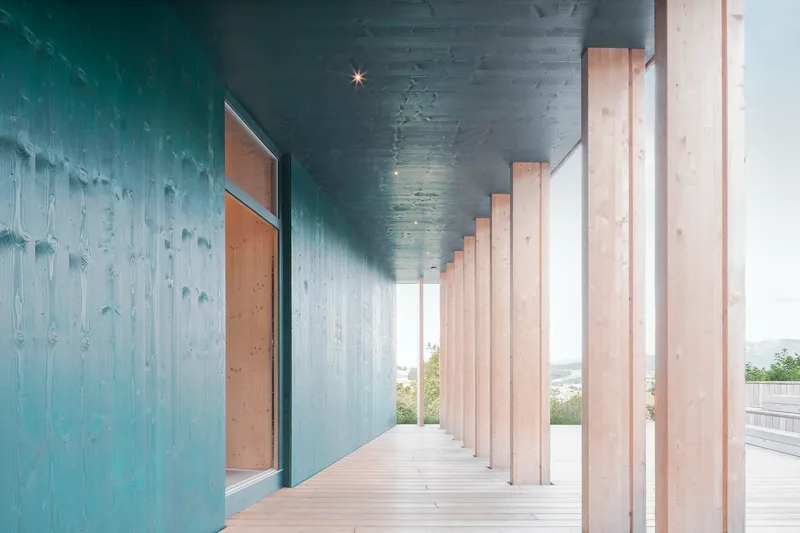
One of the project's most distinctive moves is the small annex, a blue-stained timber pavilion that houses the sauna. It sits beside the main volume, separated by a courtyard that preserves an existing mature tree. The two buildings form a loose compound rather than a single monolith, creating sheltered outdoor space between them. The blue coloring is a bold choice in a region where timber buildings tend toward natural finishes or white render, but it works because the pavilion is modest in scale and reads as a garden folly rather than a provocation.
The covered colonnade running between the two volumes, with its rhythm of timber columns and blue-stained walls, produces an unexpectedly civic threshold. It recalls the covered passages of alpine farmsteads, where connecting structures between barn and house created transitional zones for daily life. Here the passage links leisure (sauna) to domesticity (main house), with the courtyard tree standing as a kind of witness between the two.
Terrace Life at Altitude
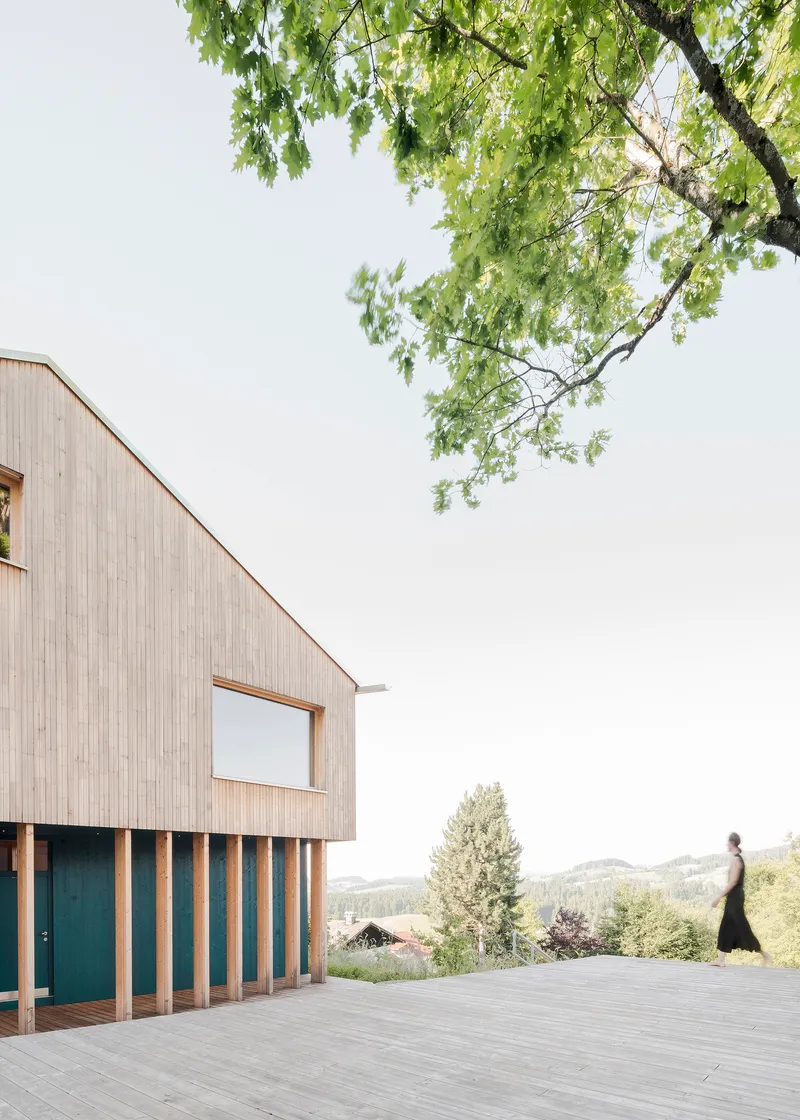
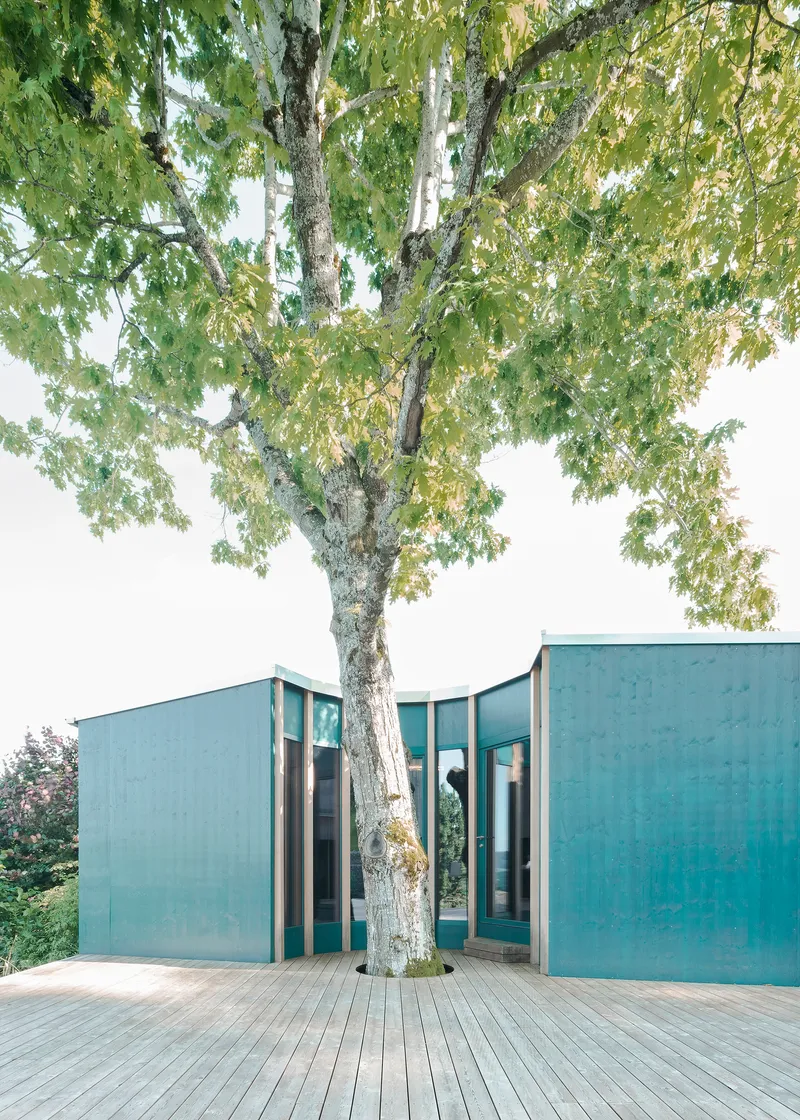
The timber deck terrace extends the living space outdoors, framed by vertical slat screens that filter views while providing a degree of privacy from the village. A patinated metal wall wraps around the existing tree trunk, integrating it into the architecture rather than treating it as an obstacle. The detailing is careful: the slats align with the facade cladding, and the deck boards run perpendicular, creating a visual distinction between wall and floor without introducing a new material.
Overhanging branches from the courtyard tree drape across the deck, softening the geometry. On a clear day, the terrace offers unobstructed views across the Allgäu hills toward the Vorarlberg peaks in Austria, a payoff that justifies the careful orientation of the entire building. The roof conceived as a raised hide is not metaphorical: from the upper levels, the landscape genuinely unfolds like a panorama from a mountaintop observation point.
Solid Wood Interior and the Rotated Roof
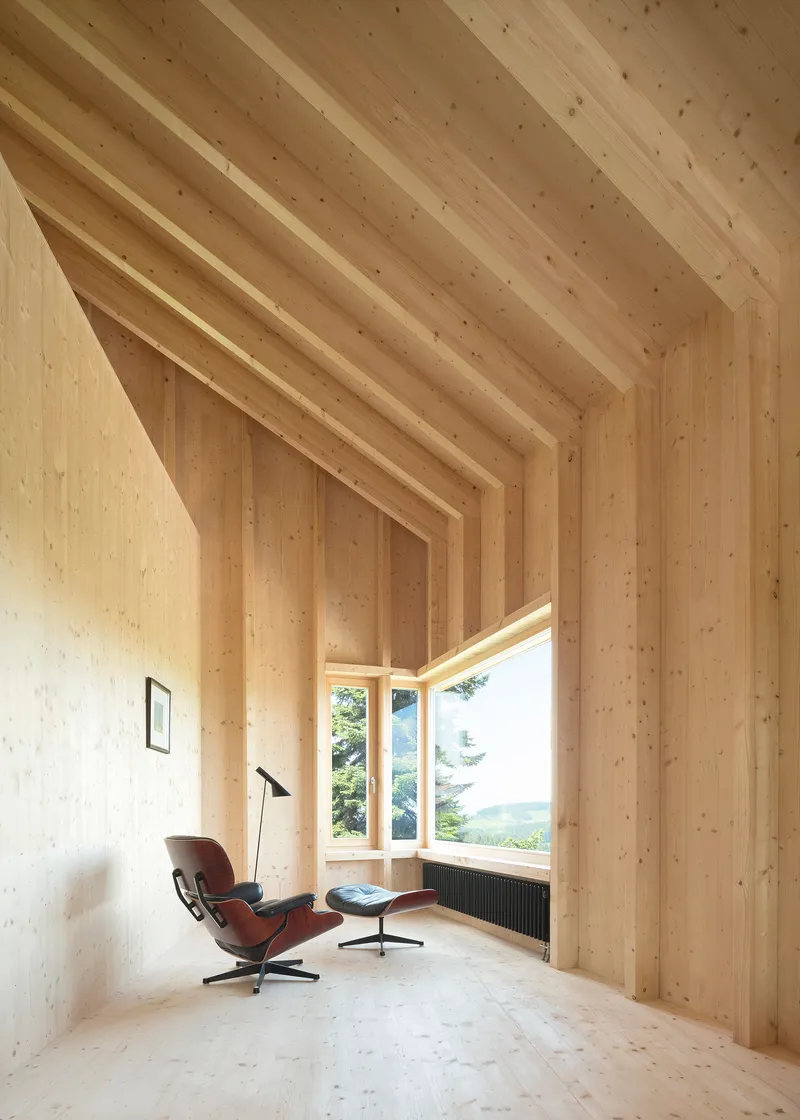
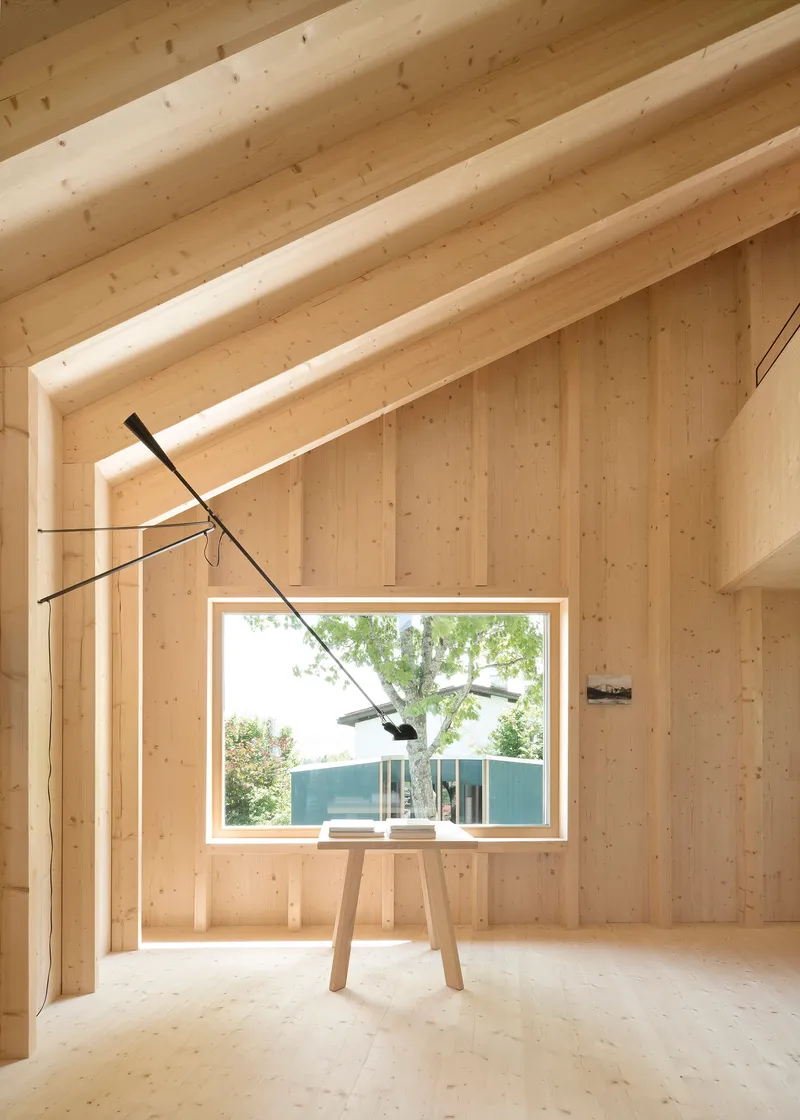
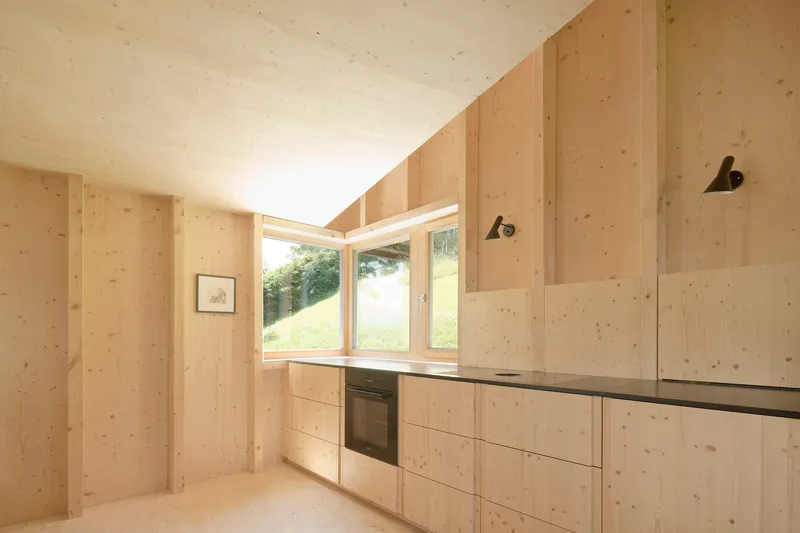
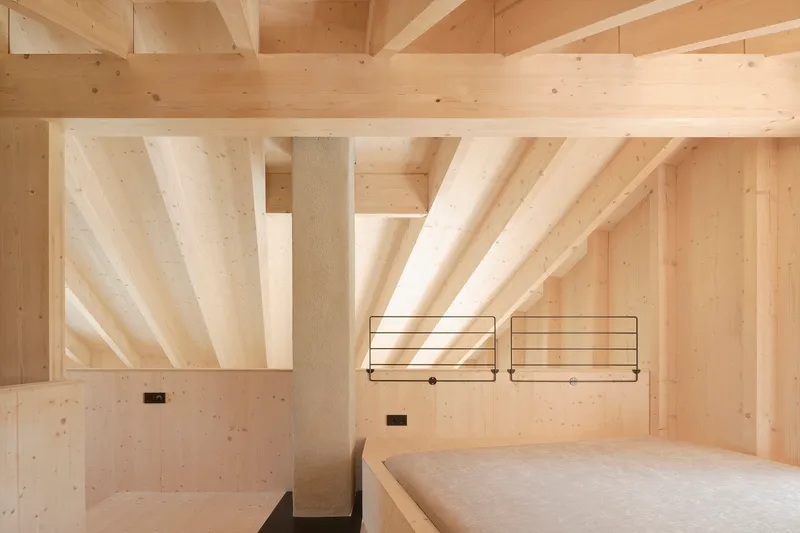
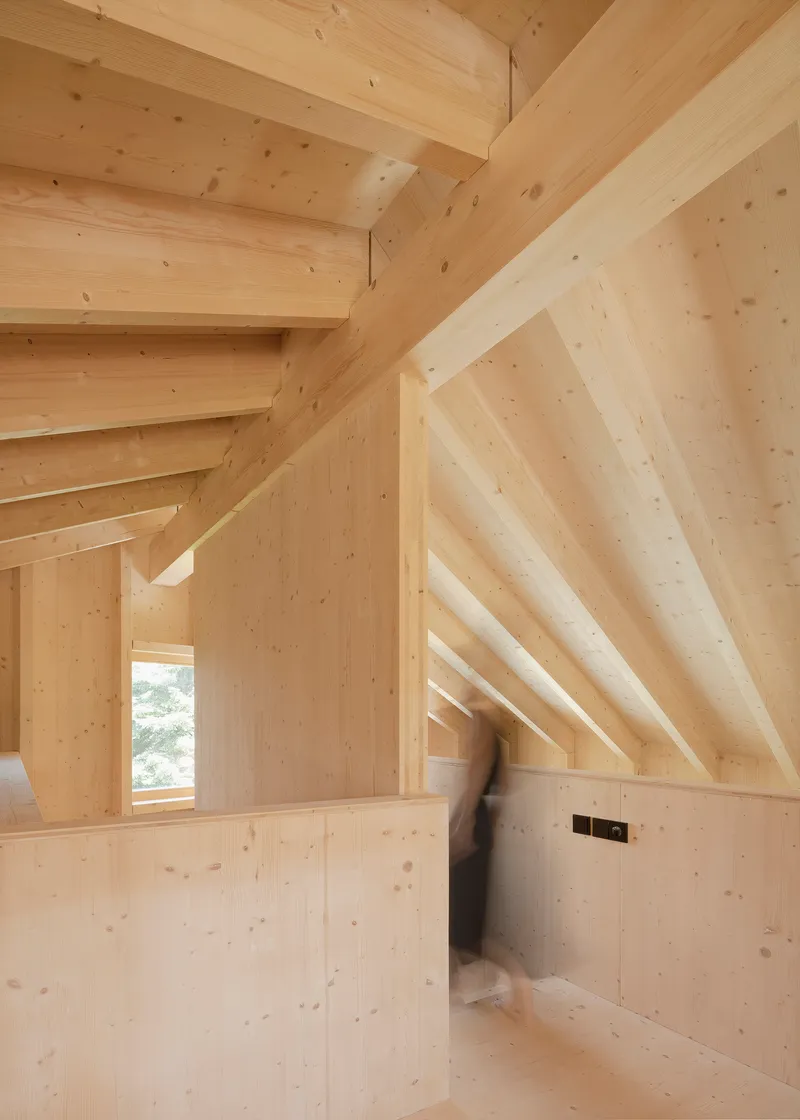
Inside, the solid wood construction is left fully exposed. Walls, ceiling, and structure are all one material, creating a warm, enveloping atmosphere that avoids the sterility of drywall-clad timber houses. The key spatial invention happens at the living level under the roof, where the interior geometry is rotated relative to the outer walls of the rectangular plan. This rotation eliminates the need for corridors or circulation areas: spaces flow into one another through conical openings and deliberately varied ceiling heights.
The double-height room with its picture window is the heart of the house, framing the blue pavilion outside while a cantilevered black pendant light anchors the vertical space. Clerestory windows in the kitchen pull in light from above, illuminating the grassy hillside as if it were a painting hung at the top of the wall. These moments of framed landscape are not accidental; they reward each room with a specific relationship to the site.
Ascending Through Timber
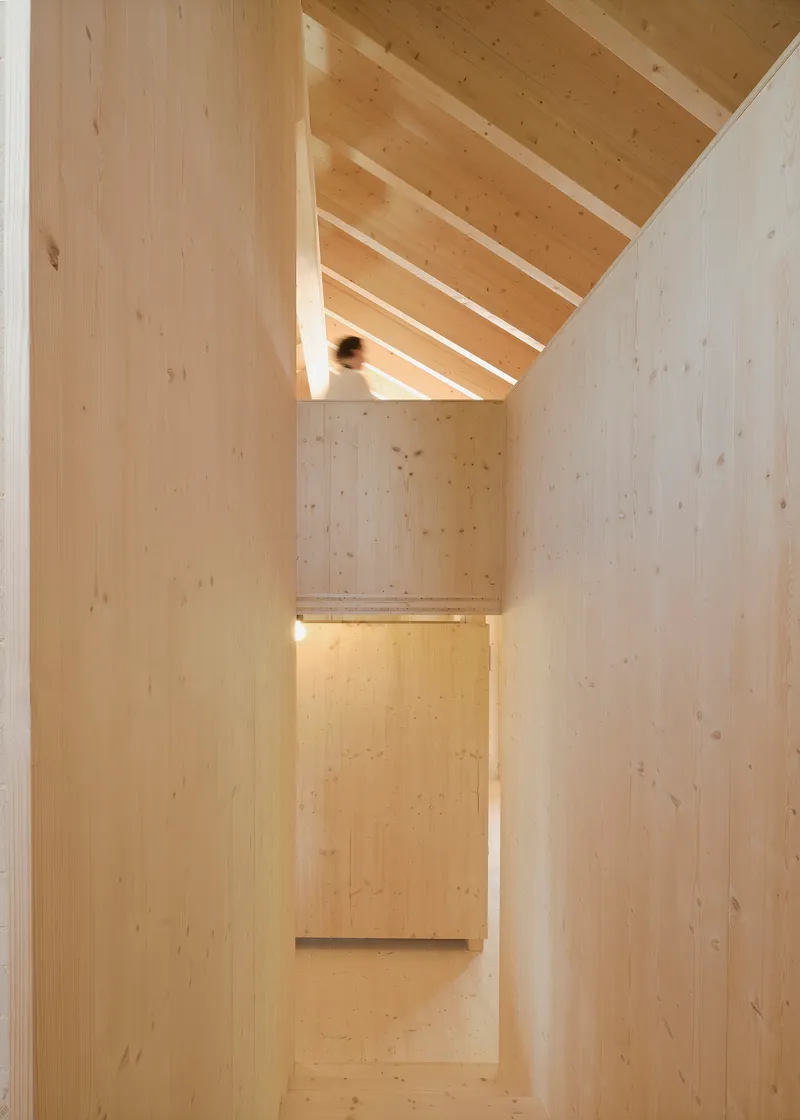
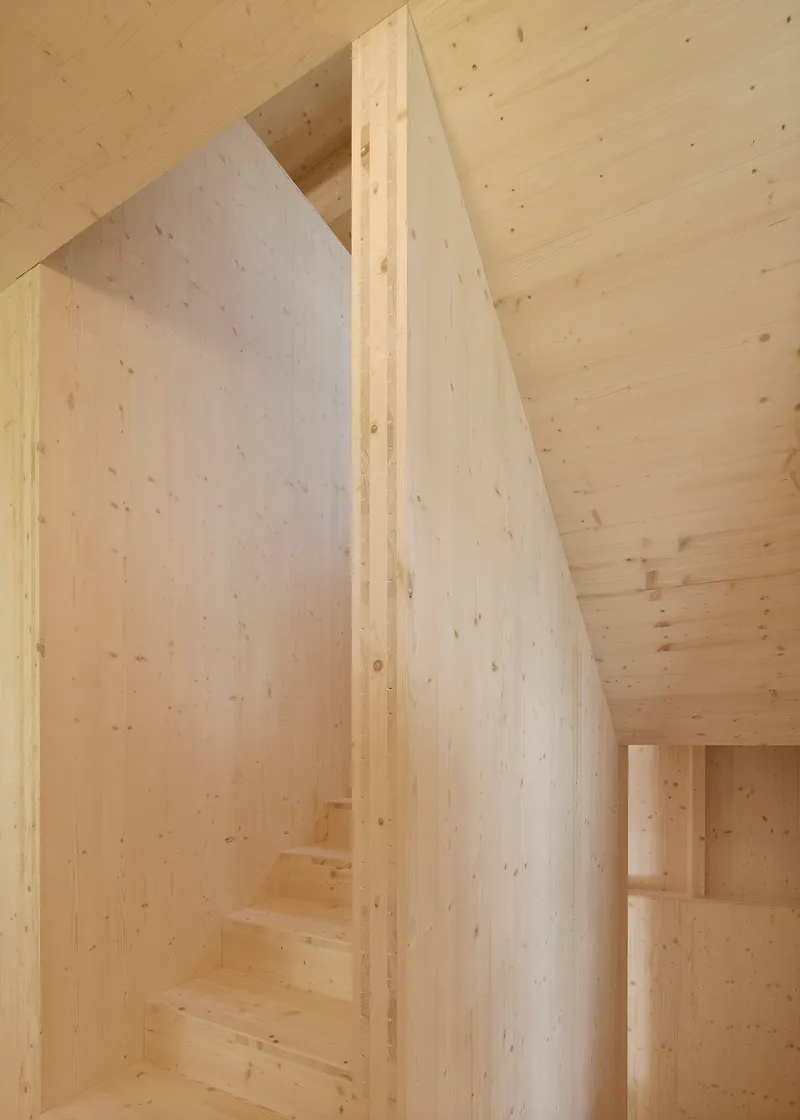
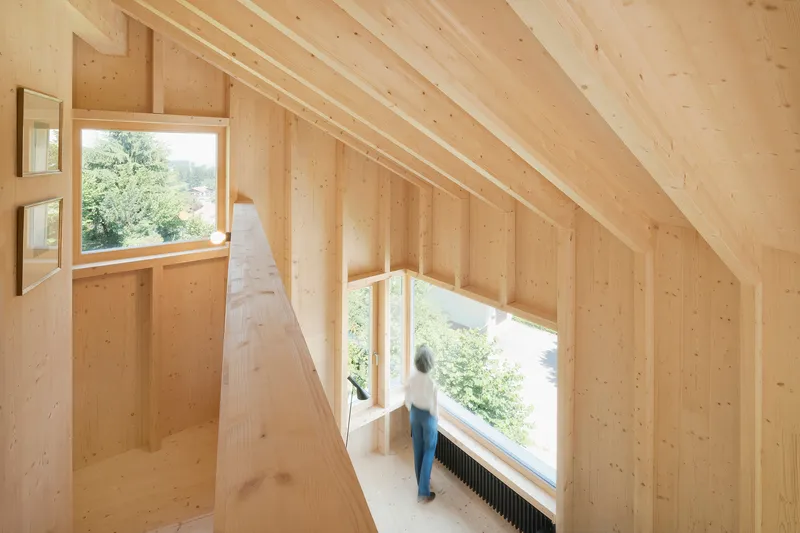
The stairwell is where the structure reveals itself most directly. Exposed beams, angled plywood walls, and the pitched roof overhead create a compressed vertical sequence that opens dramatically at the upper landing. The stair is not merely functional; it is a spatial instrument that prepares you for the view at the top. Moving from the enclosed lower levels upward into light and panorama replicates the experience of ascending the hillside from the street.
At the upper hallway, a figure standing at the window becomes a silhouette against the landscape. The framing is precise: the window is positioned to capture the horizon line, not the foreground, pulling your eye outward and establishing the elevated vantage point that Yonder set out to achieve.
Color, Detail, and the Preserved Tree
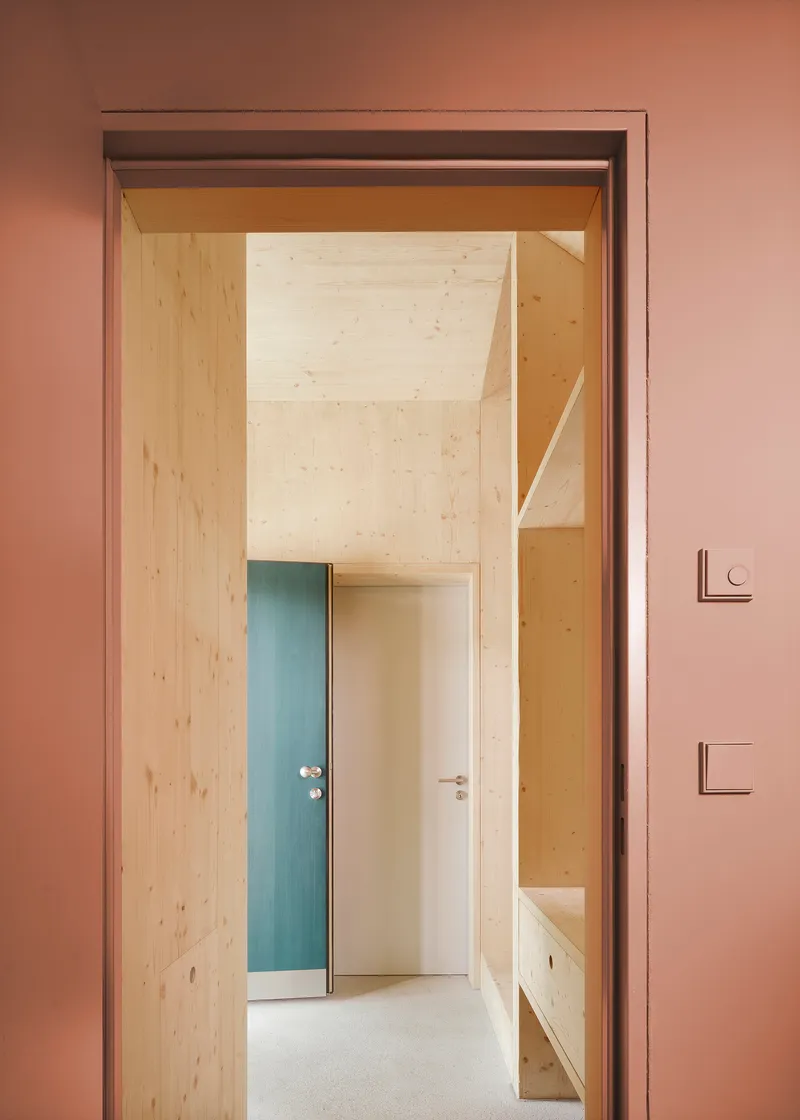
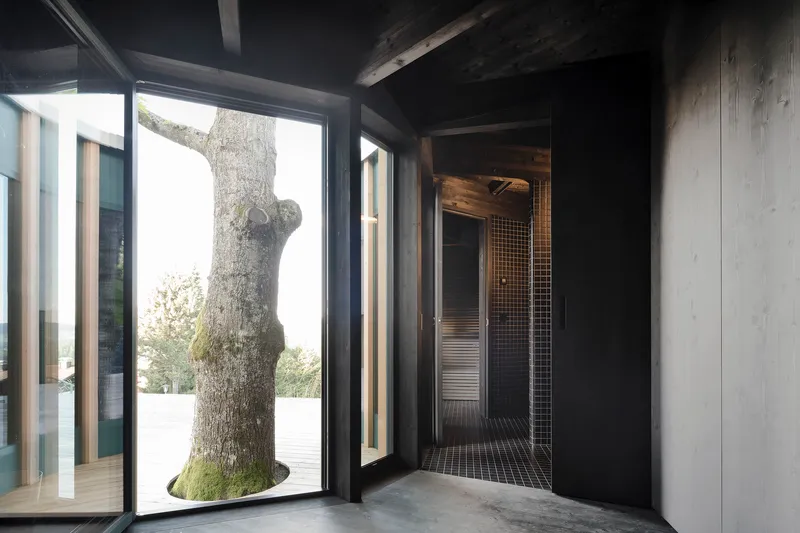
Unexpected color punctuates the otherwise all-timber palette. A pink wall in an interior corridor, blue and white doors, and the dark timber frame of the entry vestibule introduce variety without disrupting the material unity. These touches feel personal rather than programmatic, as if the clients' Berlin sensibility found its way into the alpine shell. The entry vestibule itself is a small architectural event: a dark frame encloses a preserved tree trunk visible through glass, turning a practical constraint into a totemic threshold.
The bedroom is minimal to the point of restraint, with exposed beams and light wood walls framing thin steel bedside fixtures. There is no attempt to create luxury through excess; the quality comes from the timber itself and the precision of its joinery. Structural engineering by merz kley partner ensured the solid wood system could accommodate the rotated geometries, and the detailing throughout bears this out.
Plans and Drawings
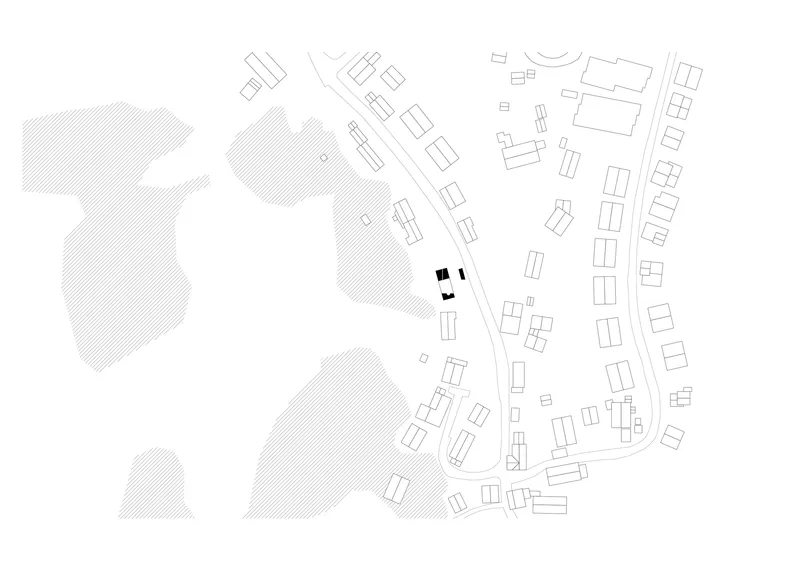
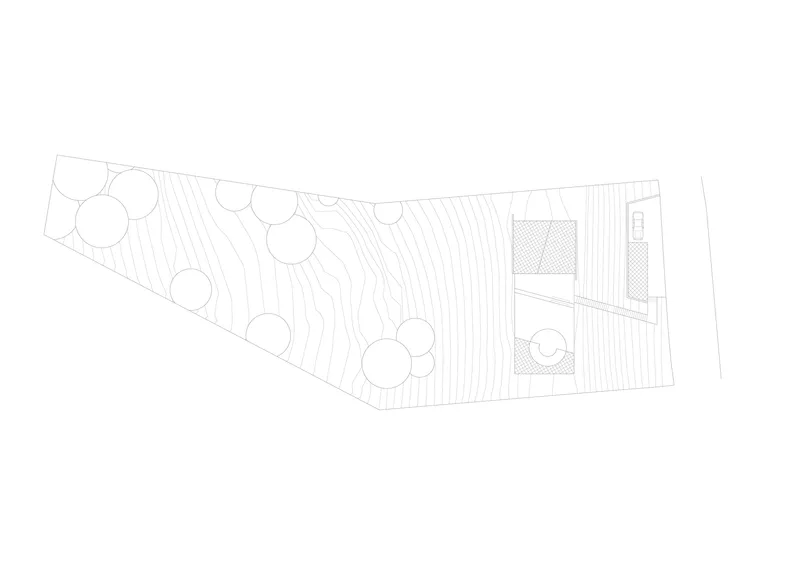
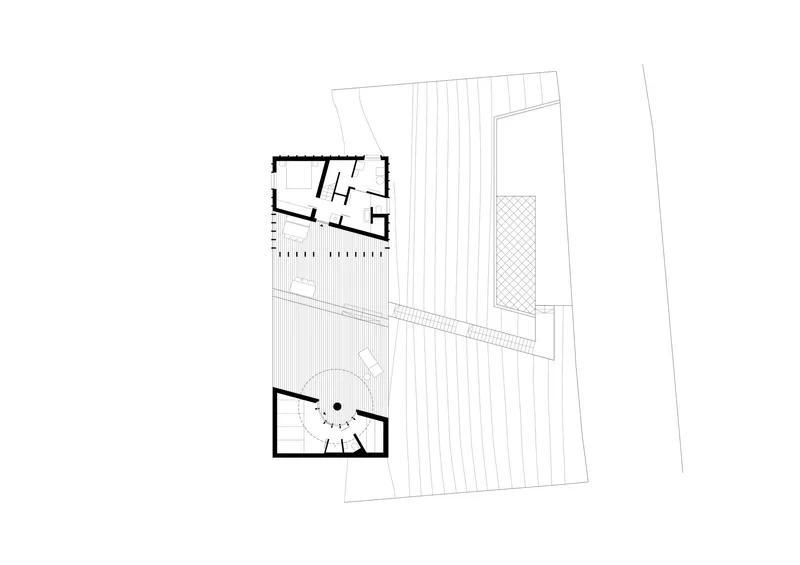
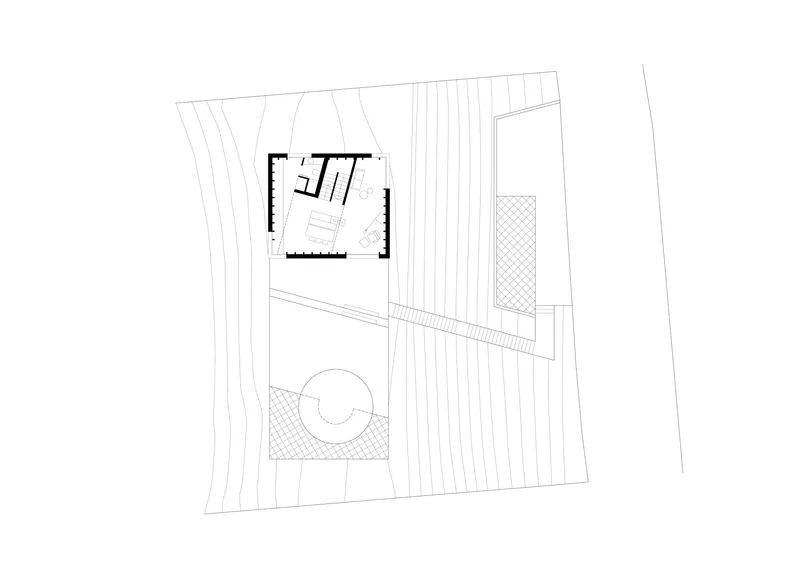
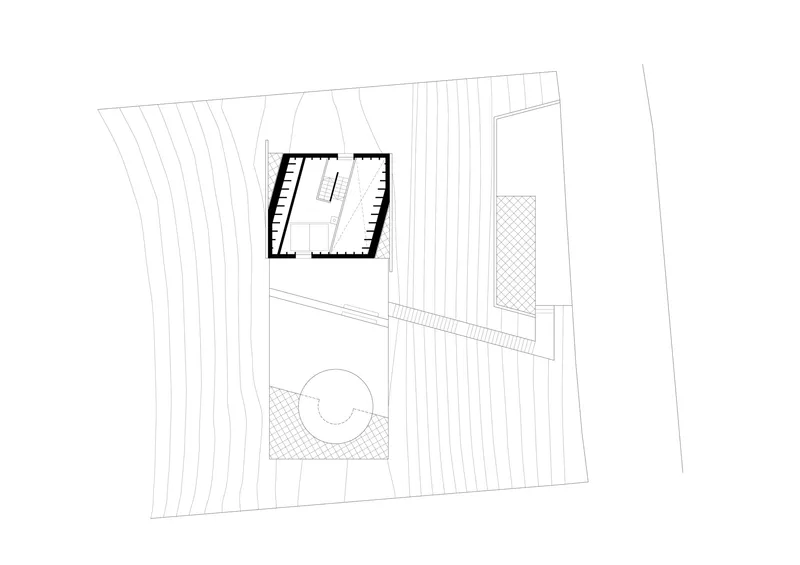
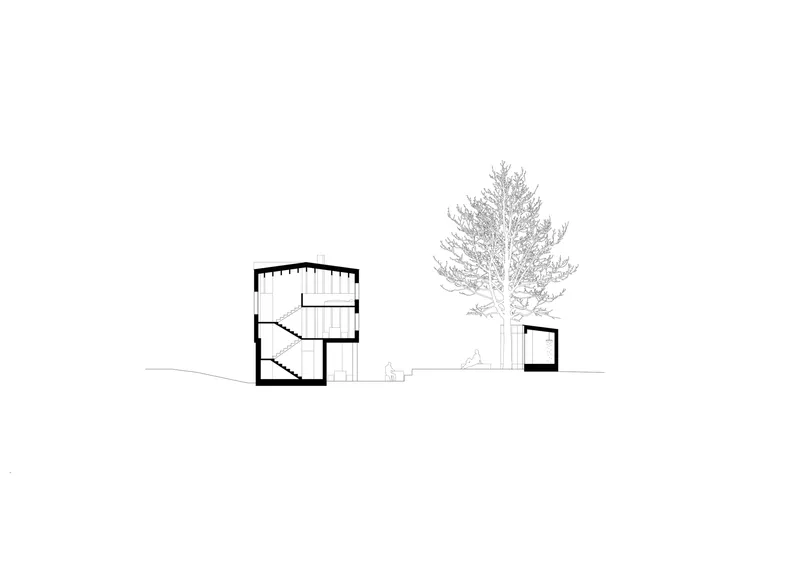
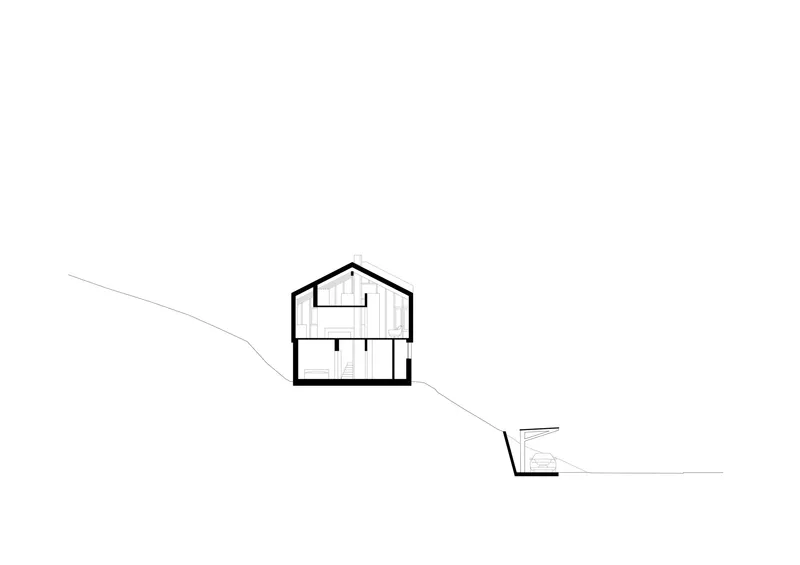
The site plans reveal the building's relationship to the village fabric: a compact cluster set among diagonal streets and scattered neighbors, oriented to capture the slope and the view. The ground floor plan shows two angled volumes connected by a diagonal pathway around a circular courtyard, while the upper floor sits as a single rectangular volume above. The roof plan confirms the parallelogram geometry with its vertical louvers, and sections through the building illustrate the layered response to the terrain, with the main house stepping up from the lower carport structure.
The isometric diagram sequence is particularly telling. It traces the design development from a simple gabled box through the rotation of the interior, the addition of the annex, and the articulation of the courtyard. Each step is legible as a design decision rather than a formal flourish, and together they explain how a modest brief yielded a spatially complex home. The section drawings also hint at the future: the structure is dimensioned to accept additional floors, a promise embedded in the bones of the building.
Why This Project Matters
House S is a corrective to the notion that rural timber houses must be either nostalgic reproductions or aggressive formal statements. Yonder found a third path: a building that is structurally honest, spatially inventive, and deeply tied to its hillside site without resorting to cliché. The rotated interior, the blue sauna pavilion, and the preserved courtyard tree are all decisions that elevate a small holiday home beyond its program. They make the house specific to this plot, this view, and this couple's ambitions.
The concept of a house that grows is rarely taken seriously in contemporary practice, where projects tend to be conceived as finished objects. Here, the incompleteness is structural: the building awaits future floors, future rooms, a future life. That openness to change, built into solid timber on a Bavarian hillside, is what separates House S from the many competent wooden houses published each year. It is a building that trusts time.
House S by Yonder – Architektur und Design. Oberreute, Germany. 231 m². Completed 2021. Photography by Brigida González.
About the Studio
Share Your Own Work on uni.xyz
If projects like this are the kind of work you want to make, uni.xyz is a place to publish your own, find collaborators, and enter design competitions.


Popular Articles
Popular articles from the community


U.GA Architects Wraps an Oval Rooftop Pool in Curved Board-Formed Concrete on Busan's Jeollidan-gil
In Busan's Jeonpo-dong, a 454 m² mixed-use block stacks a neighborhood facility, guest rooms and an oval rooftop pool inside spiraling concrete walls.

LT2A and OPEN Architectes Thread a Brick and Glass High School Through a Wooded Belgian Campus
In Braine-l'Alleud, a 3,000 m² wing for Collège Cardinal Mercier pairs pale brick with a glazed colonnade, deferring to a small chapel and a dense wood.

Architekt Andreas Gruber Scatters 23 Dark Timber Chalets Across a South Tyrolean Forest Edge
In Molini di Tures, Amonti Chalets breaks a resort into a hamlet of gabled timber houses, with parking, storage and services pushed into the slope.

David Macias Steps a Doorless Stone and Plaster House Down a Tropical Colombian Hillside
In the humid hills of Colombia, Threshold House replaces the front door with an open void and terraces its 850 m² down the slope instead of fighting it.

Similar Reads
You might also enjoy these articles


LAVA Architecten Gives Vocational Education a Sawtooth-Roofed Face on a Mechelen School Campus
In Mechelen, Belgium, a 2,053 m² STEM school on a 6×6 m grid turns workshops and classrooms into rooms that can be rearranged as teaching changes.

KEMA Studio Turns a Derelict Marvila Attic into a 60 m² Lighthouse Apartment Above Lisbon
In Lisbon's Marvila district, a rebuilt roof, four skylights and two plywood volumes turn an unlivable attic into a bright home facing the Tagus.

Pixel Gardens: One Repeated Module Stacked Into a Terraced Social Housing Tower for Famagusta
Salem Bader's shortlisted housing tower builds a vertical neighbourhood from one repeated module, offsetting units to carve terraces, light and air.

Bao Huynh Watercolor Atelier: A Serene Art Retreat in Hội An
Bao Huynh Watercolor Atelier in Hội An blends multifunctional art spaces, sustainable design, local materials, and family-friendly living in a serene environment.

Explore Power Generation Competitions
Discover active competitions in this discipline

Challenge to design mud housing for contemporary communities

Challenge to reimagine the Iron Throne

Photograph architecture without architects

Illustrate the lost glory of Angkor Wat - Render Challenge
Comments (0)
Please login or sign up to add comments
No comments yet. Be the first to comment!