
Zamalka Into The Future: A Model of Sustainable Urban Regeneration Architecture
Reimagining post-war Syria through sustainable urban regeneration, adaptive reuse, and social rooftops that reconnect community life.


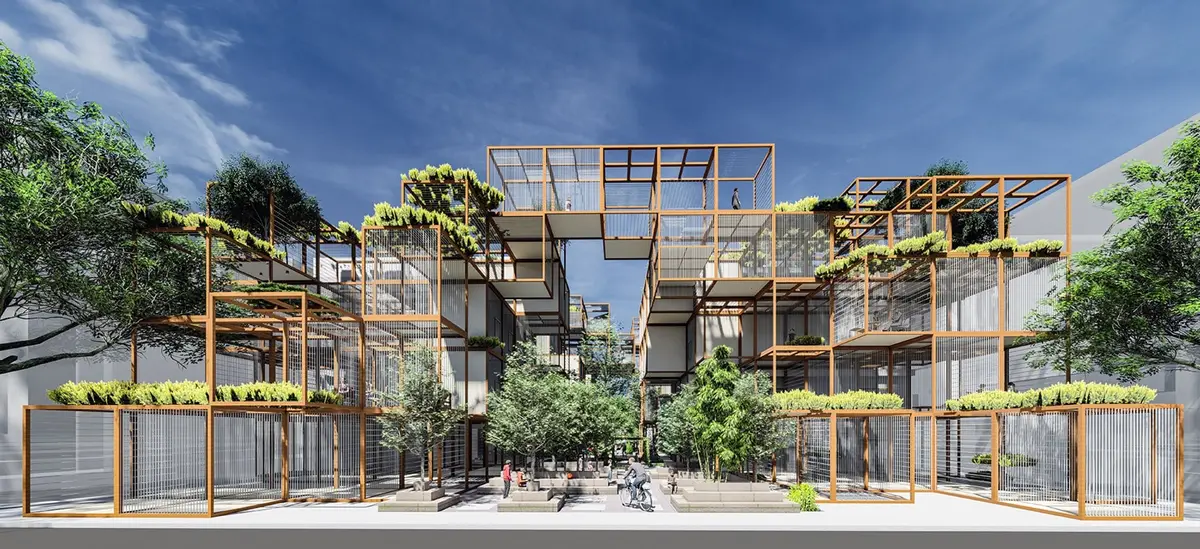
In the evolving discourse of sustainable urban regeneration architecture, the project Zamalka Into The Future: Re-Coding Post-War Syria stands as a critical exploration of how architecture can respond to conflict, loss, and the urgent need for reconstruction. Developed as part of the Reparametrize Studio’s ongoing research, this proposal redefines rebuilding not as replication, but as transformation.
Recognized as a Jury Commendation entry of Habitats '20, the project addresses the Syrian town of Zamalka with a forward-looking framework that integrates rehabilitation, adaptive reuse, and new architectural interventions.
Re-Coding the Post-War Urban Fabric
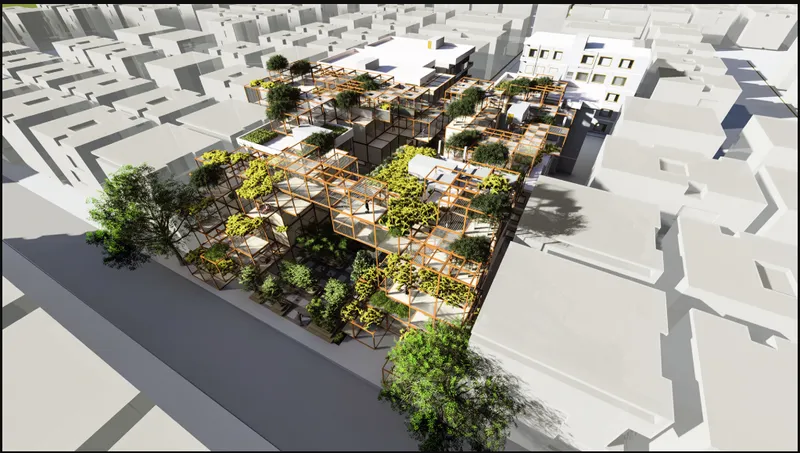
Rather than approaching reconstruction through tabula rasa planning, the project adopts a layered regeneration strategy. It proposes the renovation of six existing buildings alongside the insertion of two new structures in previously destroyed zones. This dual approach ensures continuity of memory while enabling spatial innovation.
The design operates within the existing urban grain, respecting its scale and rhythm while introducing a contemporary architectural language. This method aligns with current best practices in urban regeneration architecture, where preservation and intervention coexist.
The Social Rooftop: A New Public Realm
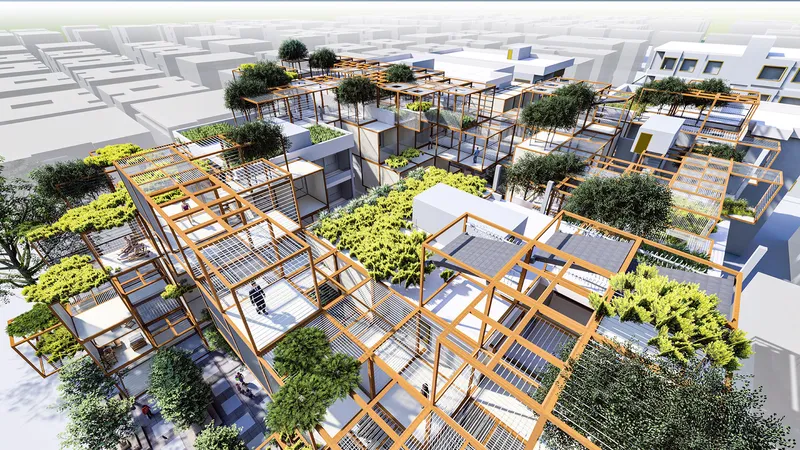
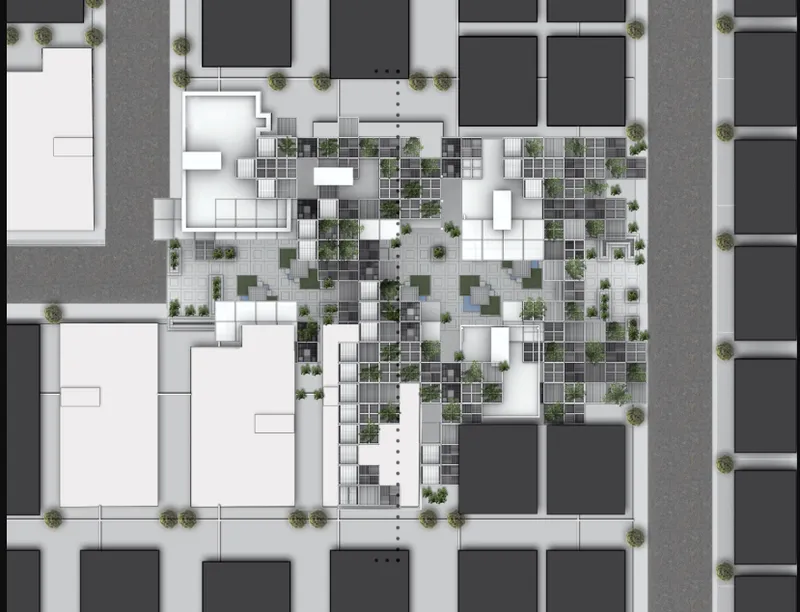
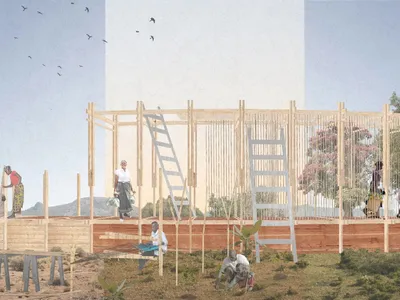
At the core of the proposal lies the concept of the “Social Rooftop”, a multi-layered spatial system that transforms rooftops into active communal zones. These elevated platforms function as extensions of public space, fostering interaction, recreation, and ecological integration.
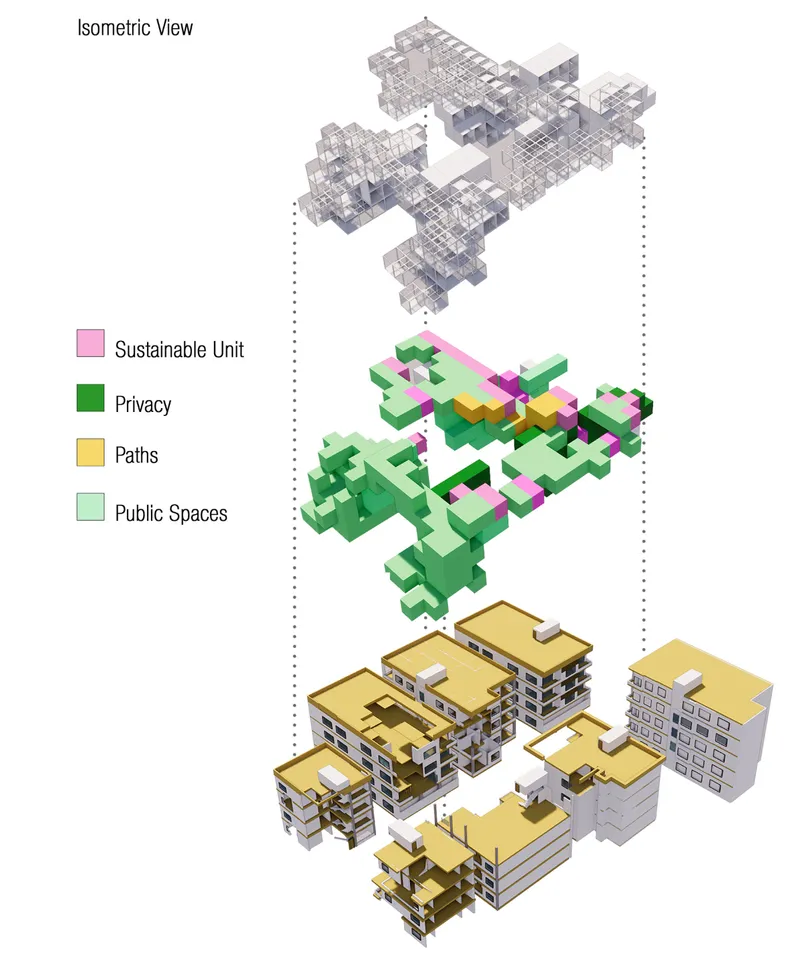
The rooftop network is not merely an architectural gesture but a social infrastructure. It introduces gradients of privacy, allowing residents to navigate between intimate domestic zones and shared collective environments.
This strategy responds to the scarcity of ground-level public spaces in dense post-war conditions, effectively redefining verticality as a social asset.
Modular Framework and Adaptive Systems
The project employs a modular structural grid, visible in the lightweight framework that overlays existing buildings. This grid enables flexibility, scalability, and phased construction, making it particularly suited for post-conflict contexts where resources and timelines are uncertain.
The architectural language is intentionally open-ended. It accommodates changing needs over time, supporting a dynamic urban ecosystem rather than a fixed masterplan.
Green terraces, shaded walkways, and permeable layers contribute to environmental performance, reinforcing the project's alignment with sustainable architecture principles.
Reconnecting Community Through Architecture
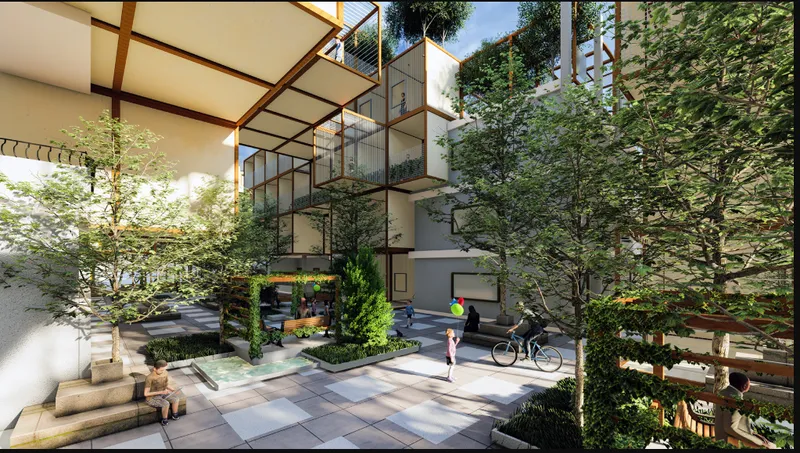
Beyond its physical interventions, the project addresses the intangible dimension of reconstruction: social cohesion. By introducing shared spaces across rooftops and courtyards, it encourages interaction among residents, rebuilding trust and collective identity.
Circulation paths are designed to weave through multiple levels, creating a continuous network that links private units with public zones. This interconnected system fosters a sense of belonging and accessibility.
Infrastructure and Public Space Integration
The proposal extends beyond buildings to include urban infrastructure and public realm development. Streets, courtyards, and transitional spaces are reimagined as active environments that support daily life.
The integration of greenery across multiple levels enhances microclimatic conditions while contributing to visual and psychological well-being. The project demonstrates how landscape and architecture can operate as a unified system in post-war regeneration.
A Prototype for Future Reconstruction
Zamalka Into The Future is not limited to a single site. It presents a replicable model for other post-conflict regions, offering a framework that balances heritage, adaptability, and innovation.
Its emphasis on modularity, community engagement, and sustainable systems positions it within a broader global conversation on resilient architecture.
This project exemplifies how sustainable urban regeneration architecture can move beyond reconstruction to create meaningful, future-oriented environments. By transforming rooftops into social landscapes and embedding flexibility into its design, it redefines how cities can heal and evolve after disruption.
In Zamalka, architecture becomes more than a tool for rebuilding. It becomes a medium for reconnecting people, reactivating space, and reimagining the future.


Popular Articles
Popular articles from the community


Co-Life: Senior Housing Design That Reconnects Older Adults With the City
Co-Life reimagines senior housing design through healing gardens, shared streets, workshops, and a sustainable community across generations.

Little Red Riding Hood: Architectural Design as a Journey Through Fear, Light, and Storytelling
Little Red Riding Hood reimagines the fairy tale through architectural design shaped by fear, light, scale, memory, uncertainty, and choice.

The Ocean Hive: Sustainable Architecture for a Self-Sufficient Civilization at Sea
The Ocean Hive imagines sustainable architecture at sea, where modular habitats, algae, wave power and ocean waste sustain a growing colony.

Co-life: Sustainable Architecture for Age-Friendly Community Living
Co-life reimagines sustainable architecture for seniors through courtyards, rammed earth, shared gardens, and spaces designed for belonging.

Similar Reads
You might also enjoy these articles

Eco Chapel: A Green Architecture Pavilion Designed in Symbiosis with the Forest
Eco Chapel uses green architecture to weave prayer, learning and reuse into a forest pavilion shaped by modular hexagonal canopies for life.
Kaffeebühnen: Coffee Shop Architecture Designed as a Civic Stage Between Vienna’s City and Park
Kaffeebühnen turns coffee shop architecture into a civic stage, linking Vienna’s park edge, urban life, warm timber yards, and coffee craft.
Healing Façade: Sustainable Architecture for Reforestation, Community, and Sacred Ecology in Ethiopia
Healing Façade reimagines sustainable architecture as a living wall that restores soil, catches water and renews Ethiopia's forest churches.


Urban Forest: A Vertical Ecosystem for 5,000 Workers in Singapore's Changi Business Park
Radially stacked pods and layered green decks turn a 7-acre plot into 47 acres of ecological workspace projected for 2040.


Comments (0)
Please login or sign up to add comments
No comments yet. Be the first to comment!