
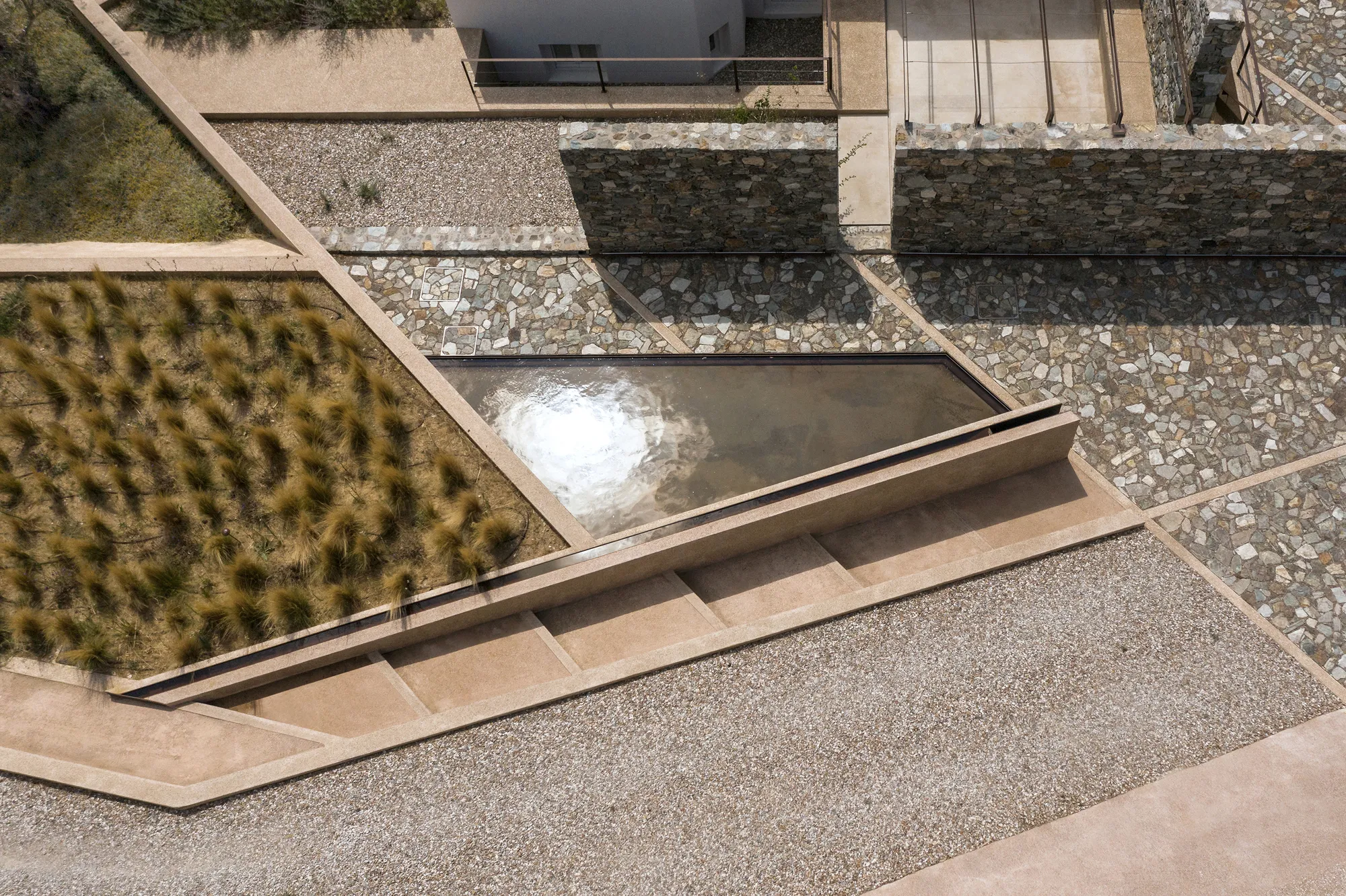
Zapantiotis Fotis Terraces Three Beach Houses into the Rocky Shore of Serifos
On the Cycladic island of Serifos, local stone and red-sand concrete stitch three vacation residences into the slope above Vagia Beach.


Serifos is not Santorini. It lacks the postcard clichés and the cruise-ship crowds. What it has is wind, rock, and a mining past that left the island's terrain scarred and honest. At Vagia Beach, Zapantiotis Fotis Associated Architects took on a problem that was already half-built: three vacation residences in an existing complex that had been constructed higher than local regulations allowed, an attempt by previous builders to escape a punishing water table. The task was not simply to finish these houses but to reconcile their awkward elevation with the beach below, all without bulldozing the landscape into submission.
The result, completed in 2022, is a 500 m² complex that reads less like three separate homes and more like an inhabited retaining wall. A broken line of local dry stone connects the residences into a single visual mass, stepping the grade down toward the water through two successive terraces. Materials do most of the talking: stone quarried on the island, concrete tinted with red sand pulled from the excavations themselves, and a network of powder-coated metal frames that hold reed canopies above every outdoor space. It is a project that treats its site with the rigor of civil engineering and the sensitivity of landscape architecture, and it earns its place on the hillside.
A Landscape of Walls
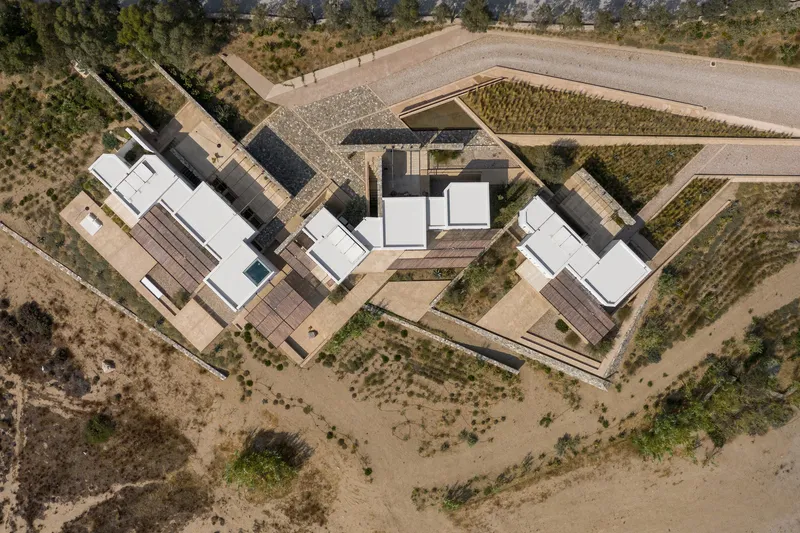
From the air, the complex looks geological. The drone view reveals that the three white roof volumes sit within a matrix of stone retaining walls and gravel pathways, almost indistinguishable from the agricultural terracing that characterizes Cycladic hillsides. That is the point. Rather than sitting on the landscape, the houses are embedded in it. The western terraces function as retaining structures, forming cube-shaped formations that manage the grade change or channeling movement down to dry stone walls below.
The stacked stone surfaces are not decorative. They do real structural work, holding back soil and managing the height difference that the original construction created. By extending this logic outward from the buildings, the architects blur the boundary between architecture and infrastructure, between garden wall and foundation.
Steel and Reed: The Canopy System
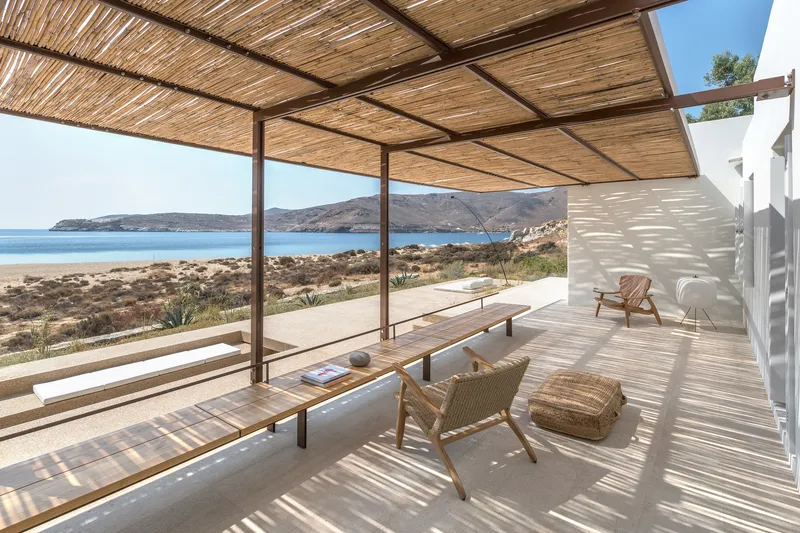
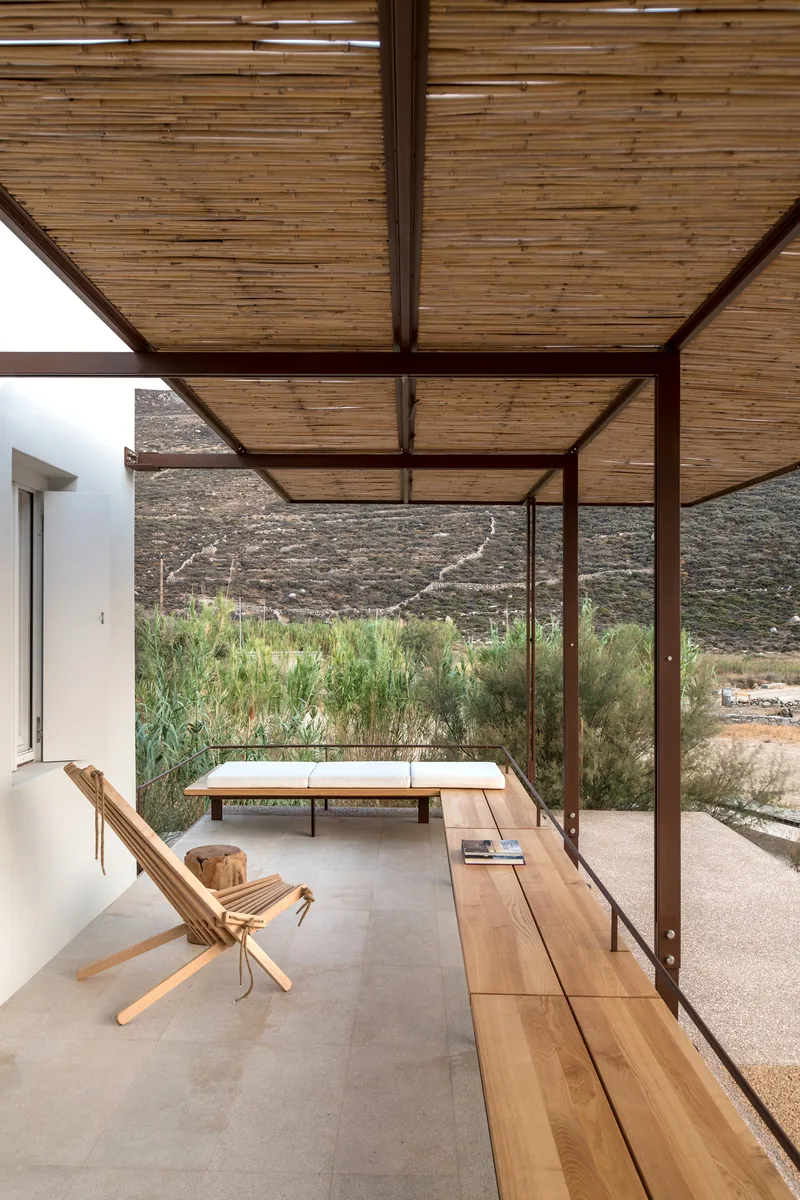
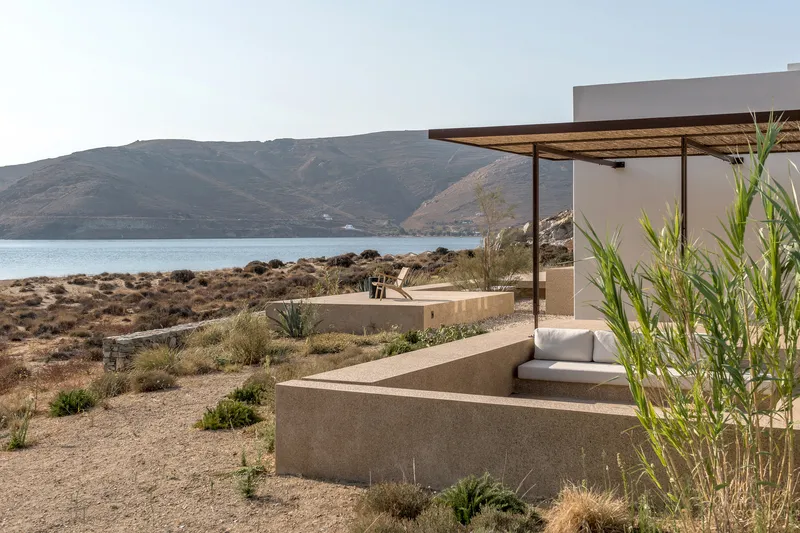
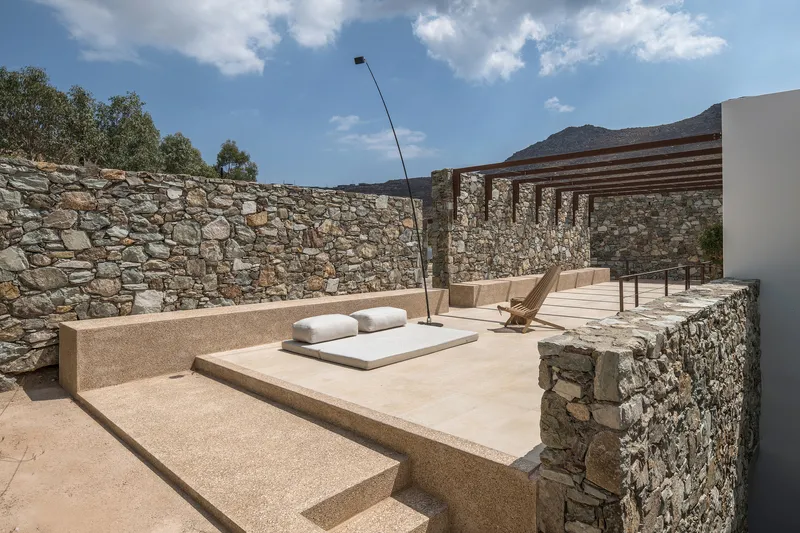
The metal construction throughout the complex deserves close attention. Gamma-shaped steel supports, where the vertical member forms a column and the horizontal becomes a beam, carry canopies of woven reeds across every terrace. These are not pergolas in the decorative sense. On Serifos, where the meltemi winds can make an exposed terrace unusable, the canopies function as genuine shelter. The 8mm flanges are bolted directly to the building beams, and a double corner cross-section of 30/30/3mm supports the reed infill.
The detailing is industrial and unashamed of it. The architects cite Serifos' mining tradition as a direct reference, and it shows in the exposed hardware, the galvanized-then-powder-coated finishes, the 5mm sheet metal frames. Nothing pretends to be handmade when it is not. The reeds, which are genuinely crafted, gain presence precisely because they sit within this honest metalwork.
Terraces That Descend
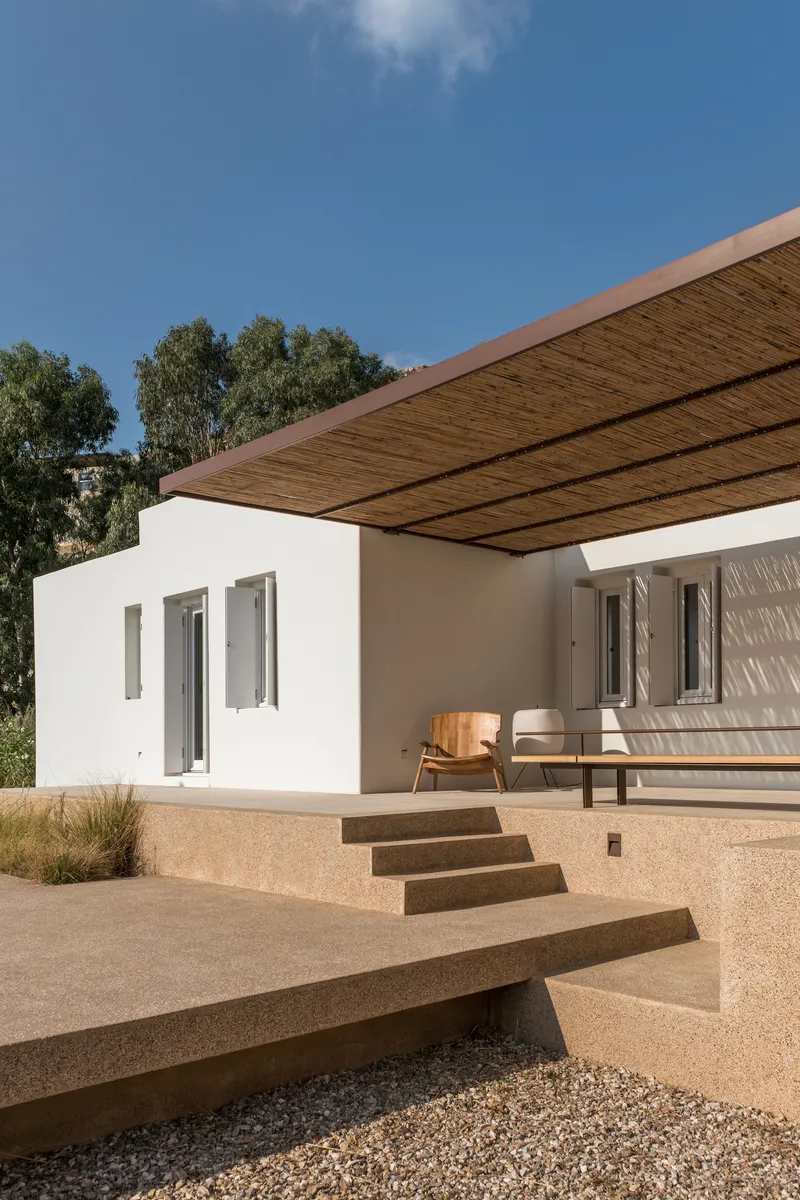
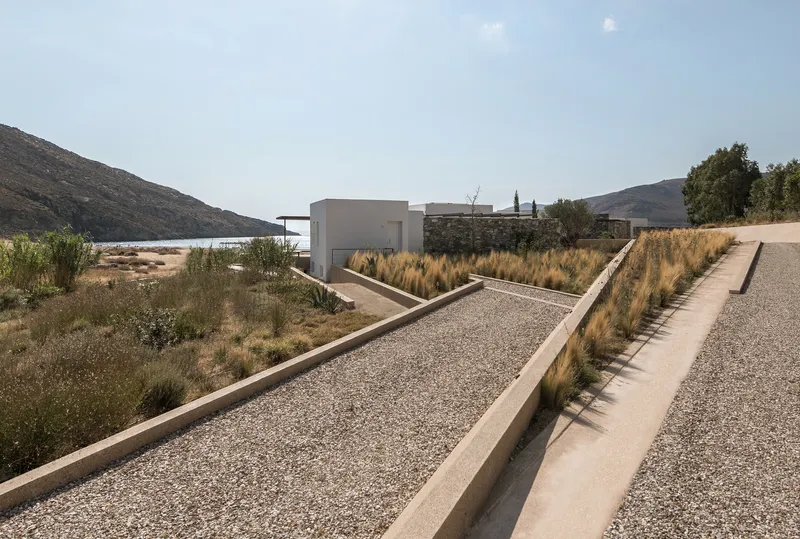
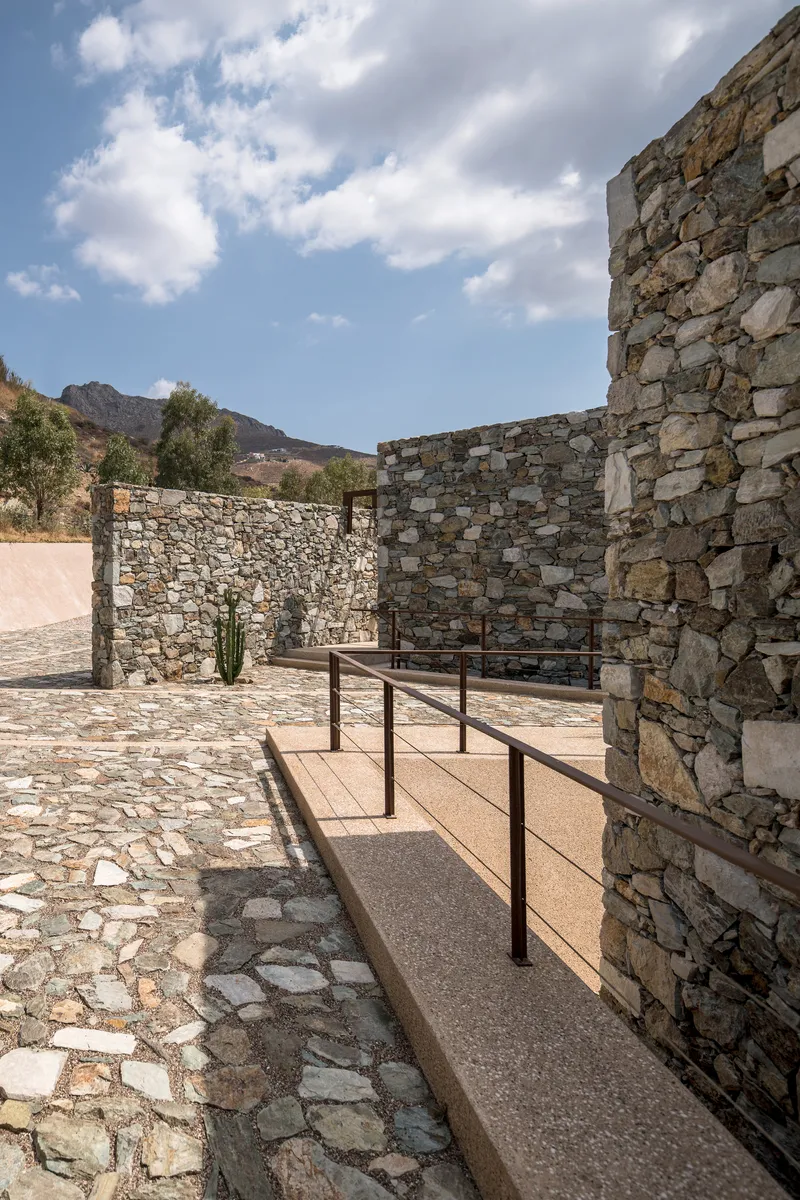
The spatial logic is sequential and cinematic. The ground level of each residence connects first to a shaded terrace at the same elevation, then steps down to a wider, lower terrace oriented west toward the bay. Bush-hammered, sand-colored concrete defines these platforms, and the texture is rough enough to read as carved stone rather than poured slab. Gravel fills the joints between levels, softening the geometry and allowing drainage.
The ramp in the central courtyard, flanked by textured masonry walls and a simple metal railing, captures the project's character perfectly. It is neither monumental nor modest. It is the architecture of practical movement through a difficult site, and it treats that movement as something worth designing well.
Water as Organizing Element
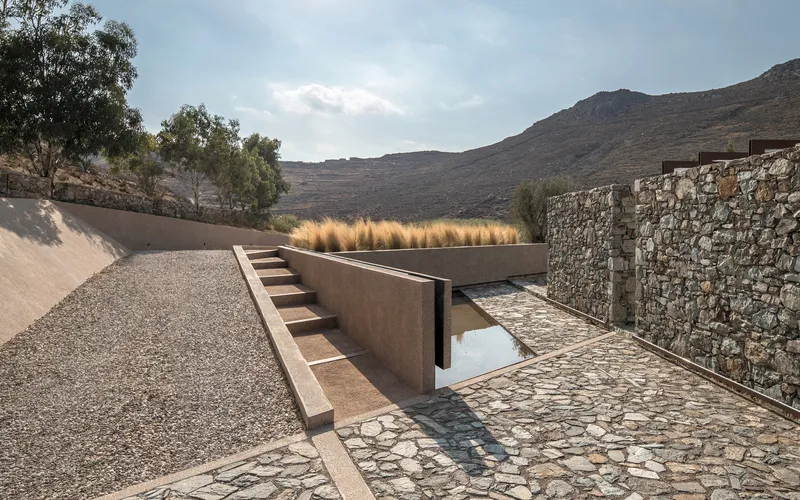
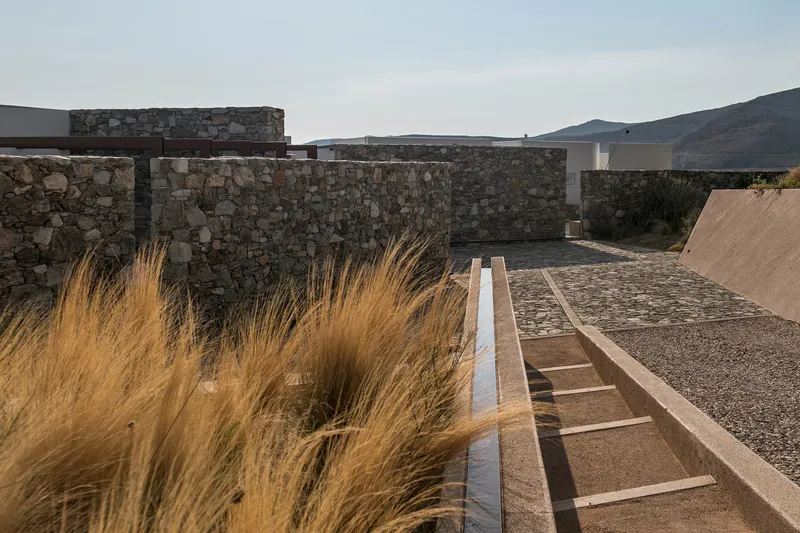
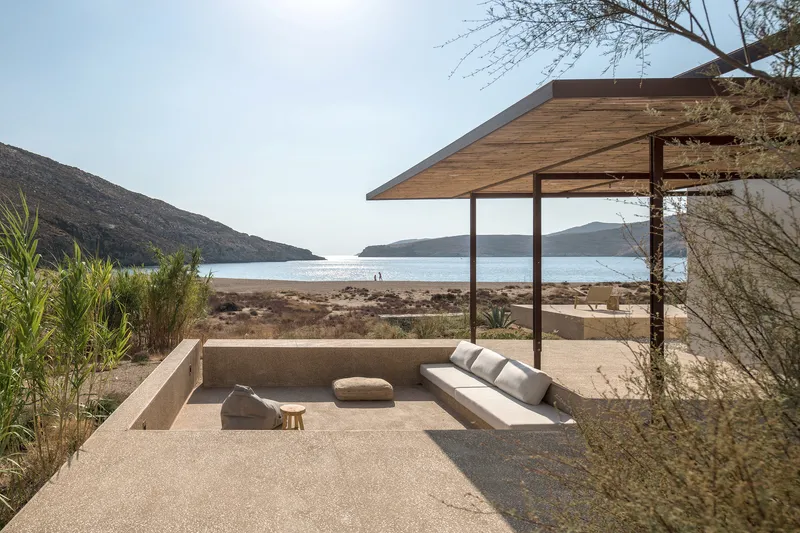
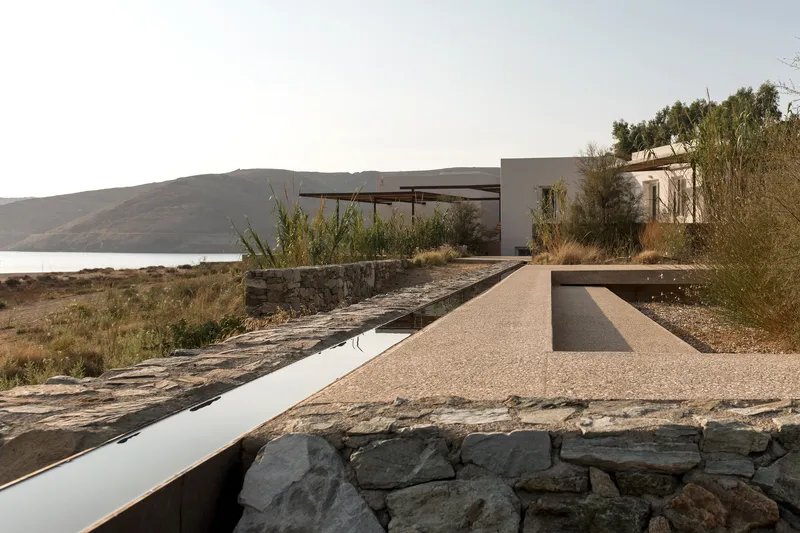
Water appears repeatedly as a design device. A sunken courtyard pool, framed by gravel paths and stone walls, sits quietly beneath the hillside. A linear water channel runs beside dry grasses, drawing the eye toward the distant hills. A fountain at the center of the common courtyard serves as the reference point for the entire complex. These are not luxury amenities. They are spatial anchors, moments of stillness set against the wild grasses and the wind.
The irony is that water was also the problem. The high water table forced the original structures upward, creating the height discrepancy that the entire design had to resolve. By bringing water back into the project on its own terms, as controlled channels and reflective pools, the architects transform the site's liability into one of its most compelling features.
Interior Craft: Terrazzo, Timber, and Restraint
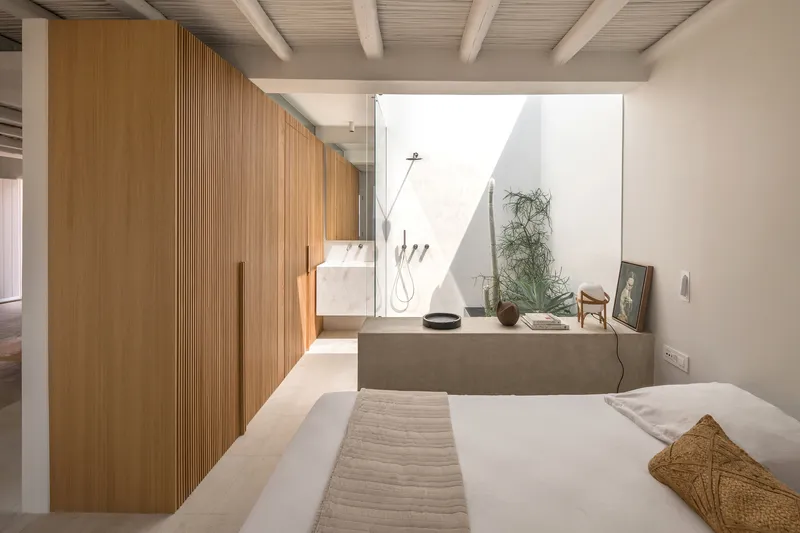
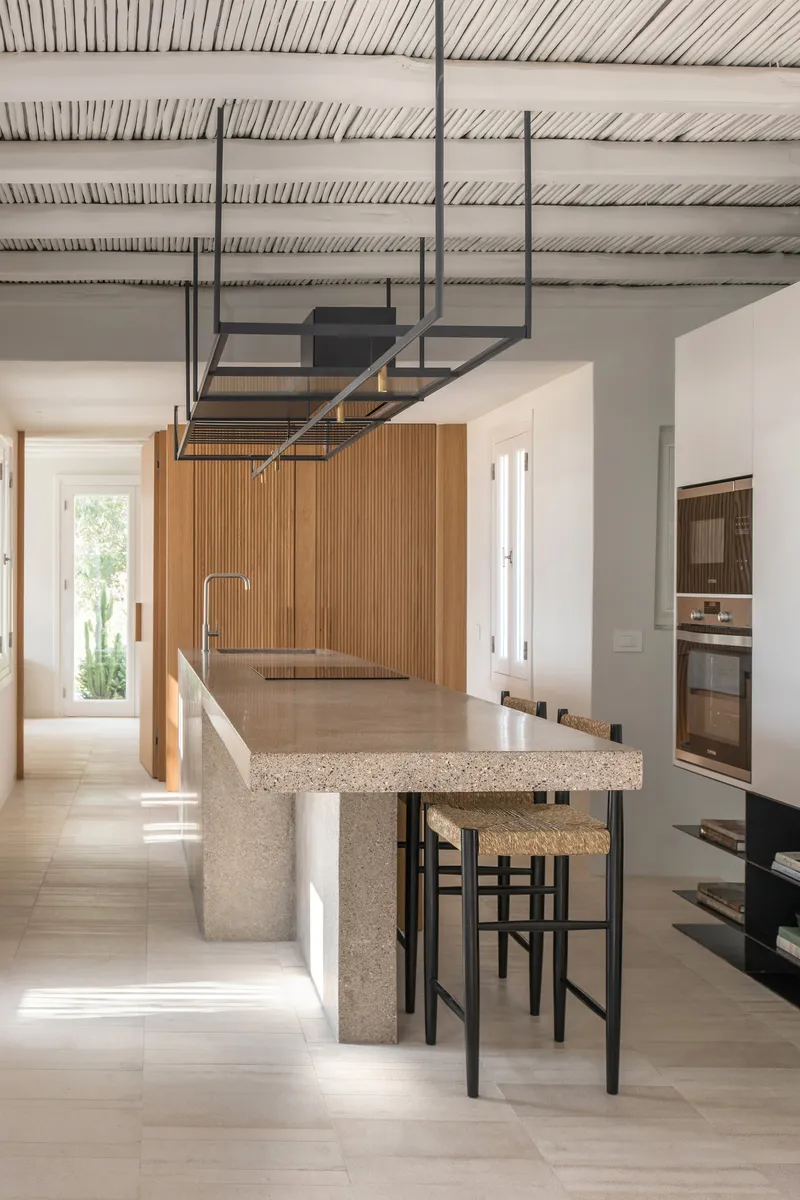
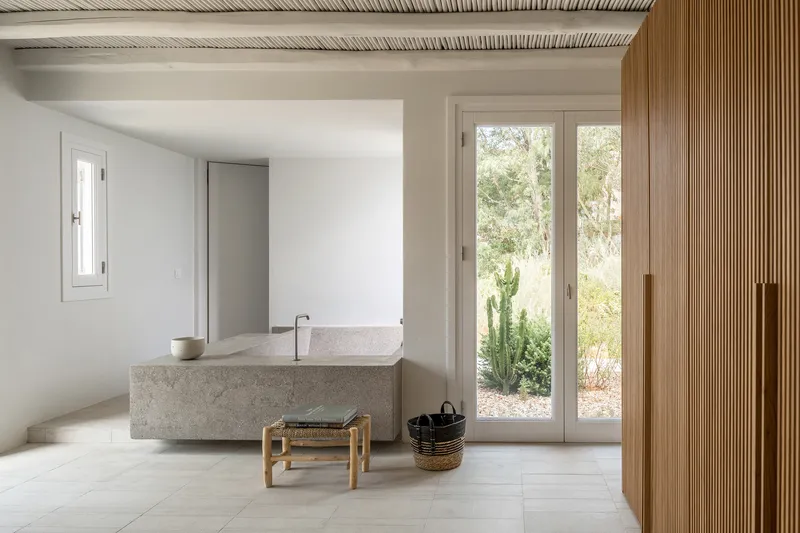
Inside, the material palette narrows to terrazzo, timber, and white plaster. The terrazzo appears on countertops, bathtubs, and wall ledges, its aggregate catching light differently in each room. Exposed timber ceiling beams run in parallel, their rhythm visible from bedrooms through to the planted courtyards beyond glazed doors. Vertical timber slat partitions divide sleeping areas from bathing areas without closing them off, a move that makes each room feel larger than its footprint.
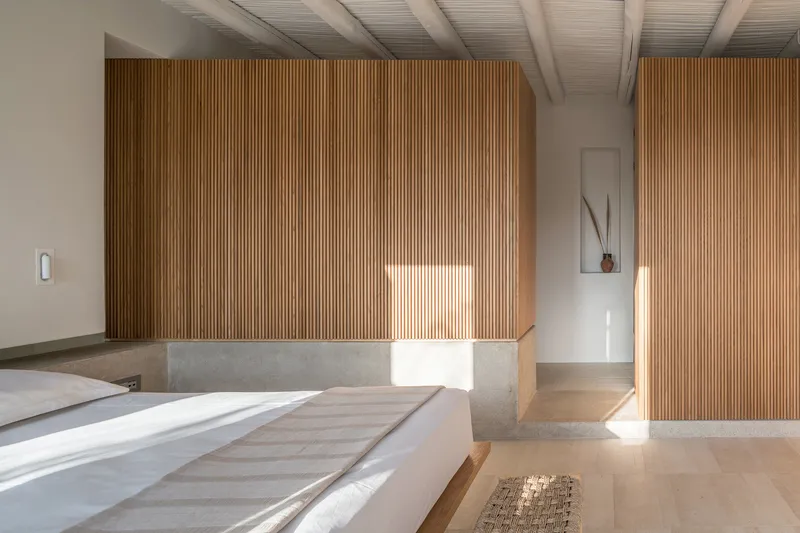
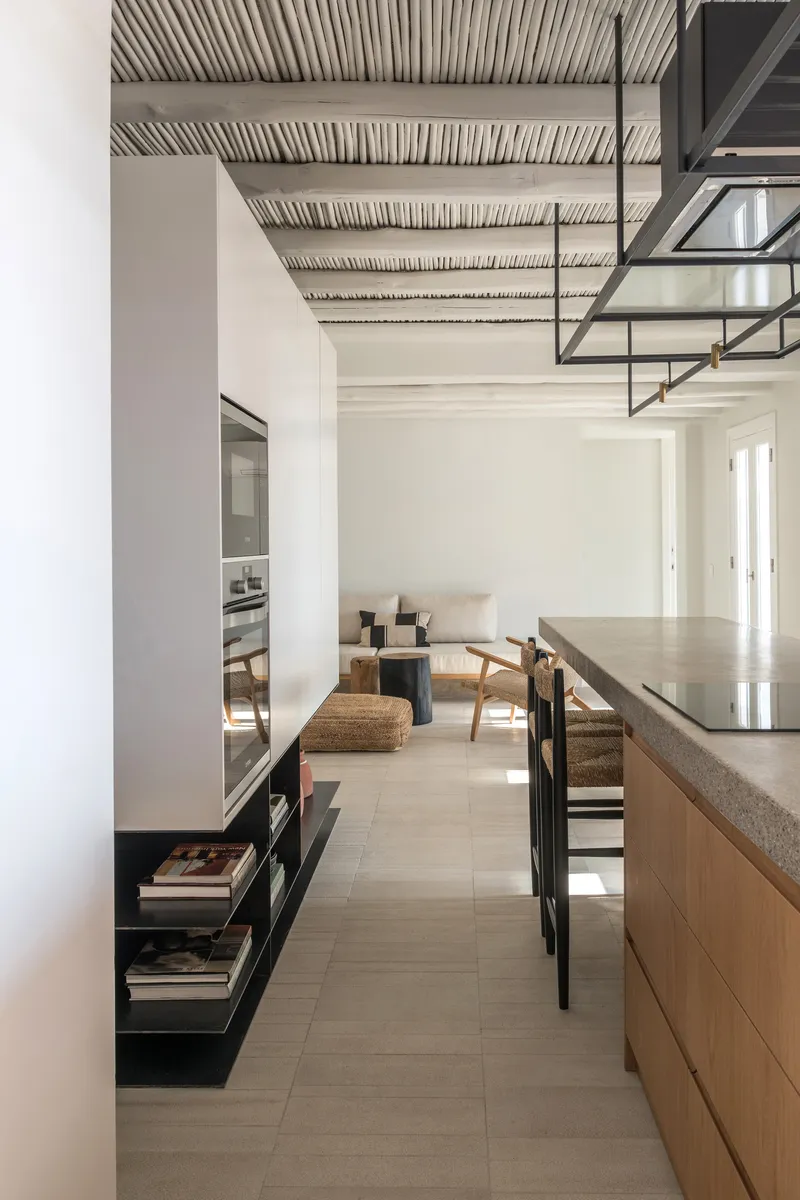
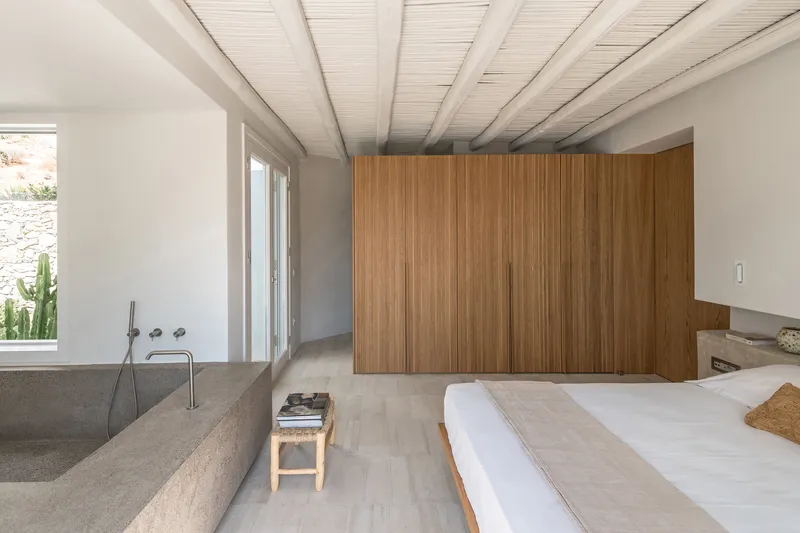
A curved timber slat wall wraps one bedroom volume, its gentle radius creating a sense of enclosure without the heaviness of masonry. In the kitchen, a steel mezzanine staircase floats above a terrazzo island, connecting levels with the same structural directness that characterizes the exterior metalwork. The interiors are warm but disciplined. Nothing is placed without purpose, and every joint is legible.
Corridors and Thresholds
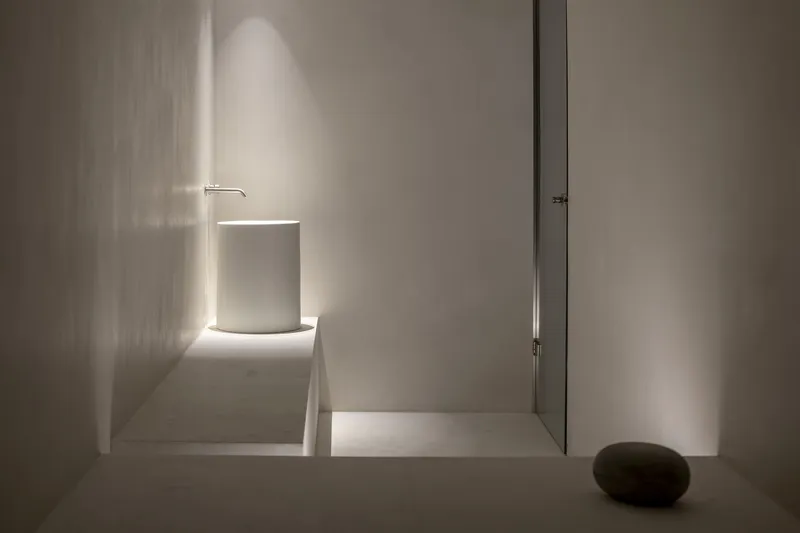
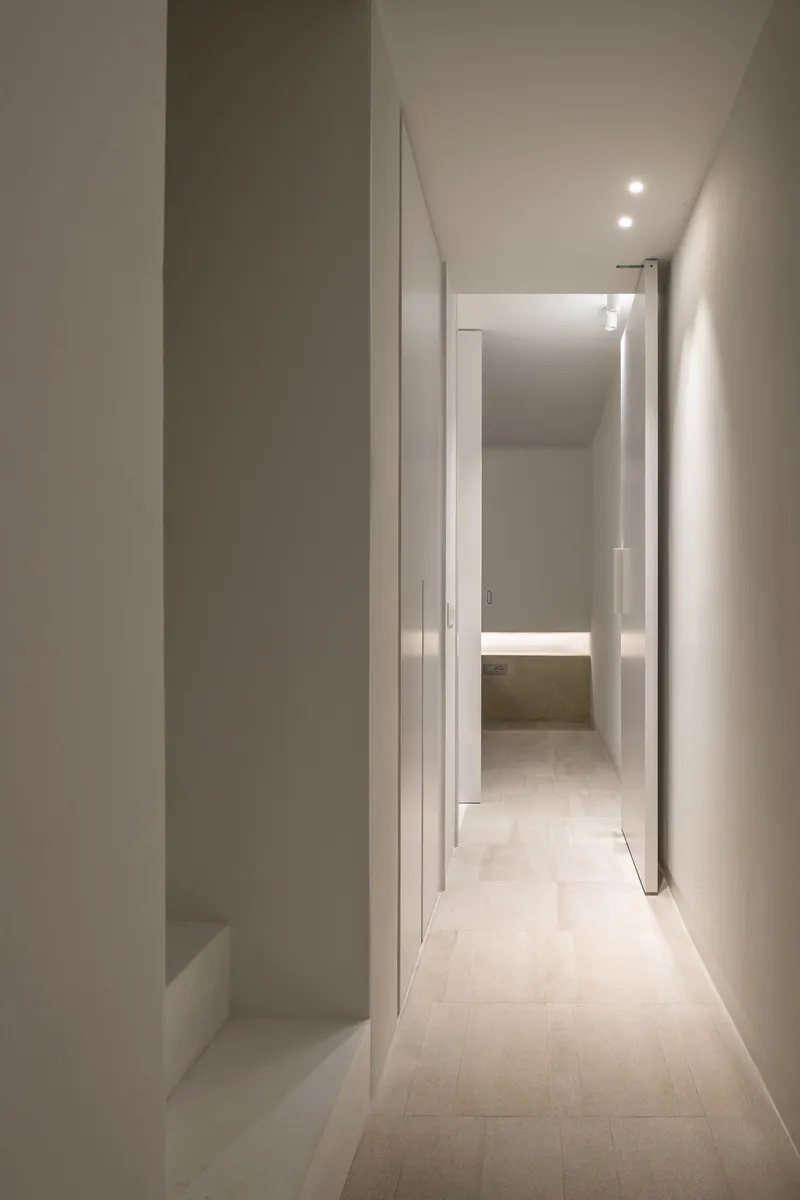
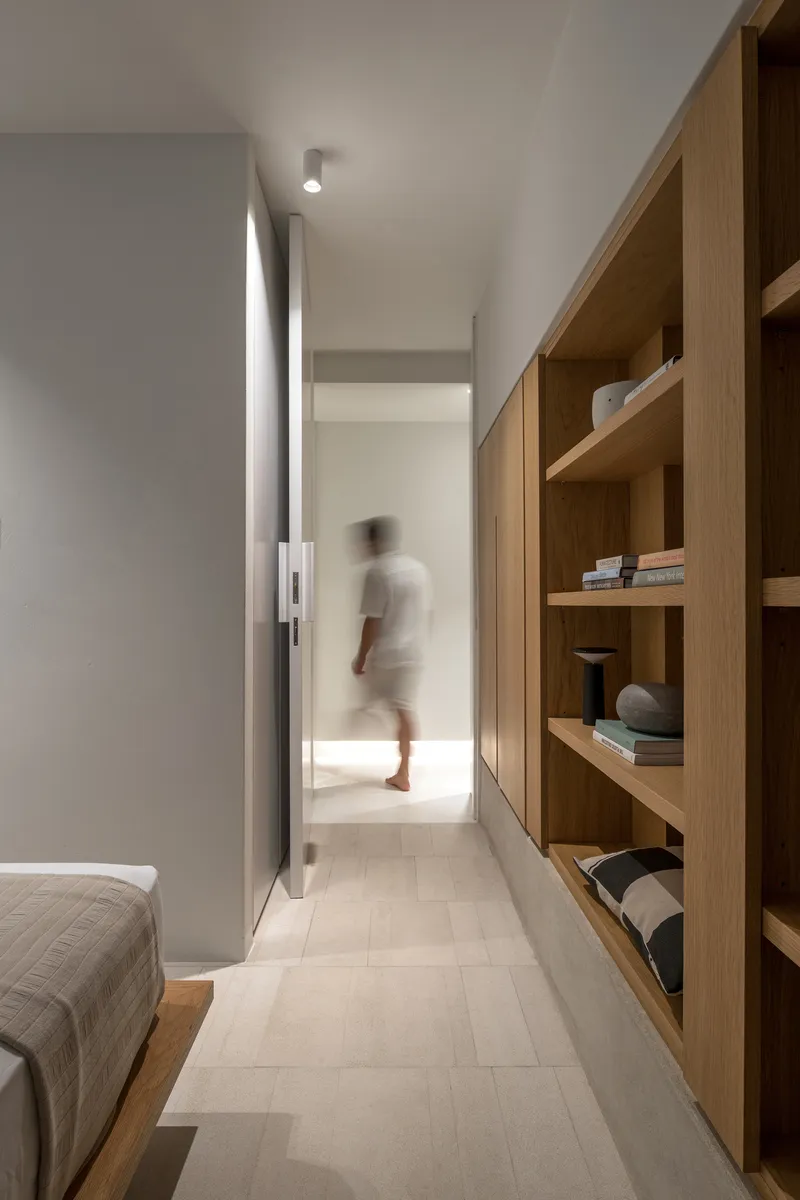
The circulation spaces deserve their own section because they are among the most considered elements of the project. Long corridors compress and release, framed by layered white doorways with concealed lighting strips at floor level. A backlit cylindrical volume punctuates one hallway, its glow creating a lantern-like moment in an otherwise minimal passage. These are summer houses, but the architects have given their transitional spaces the kind of attention usually reserved for galleries or museums.
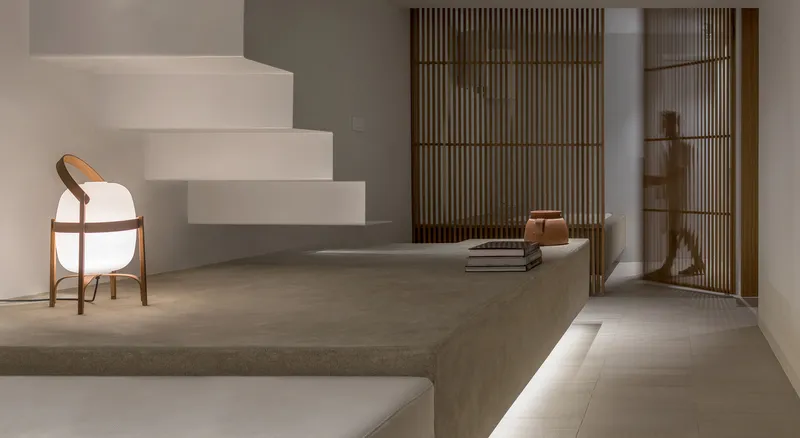
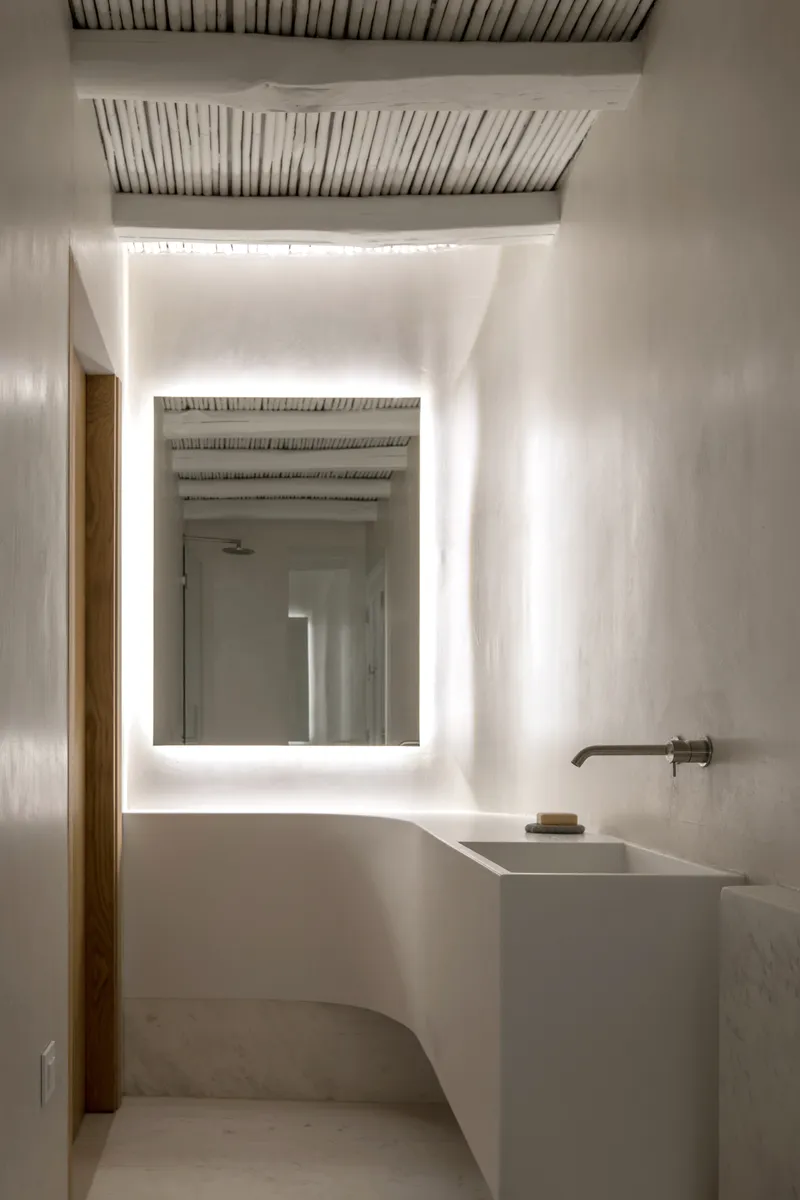
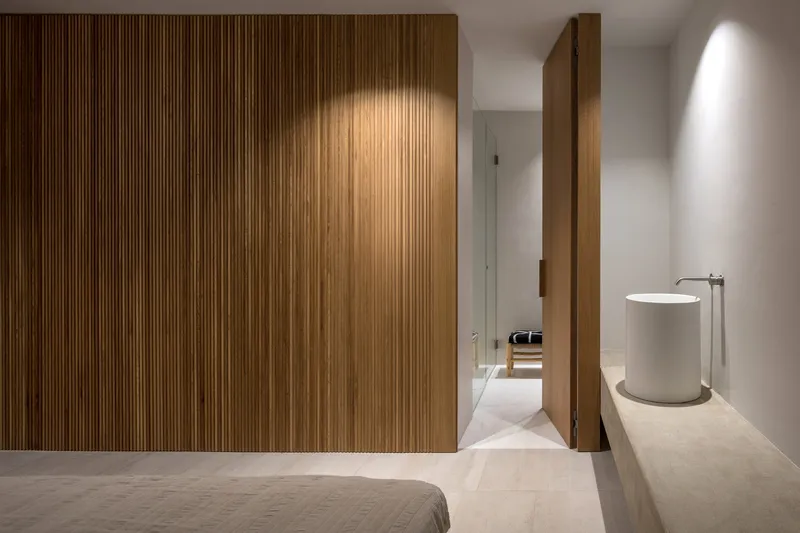
The cantilevered plaster stairs, the slatted wooden screens, the backlit bathroom mirror: each detail contributes to a consistent atmosphere of calm precision. The indirect cove lighting throughout avoids the harshness of exposed fixtures, casting even washes along timber ceilings and plaster walls. It is a palette of light as much as material.
Outdoor Rooms at the Edge
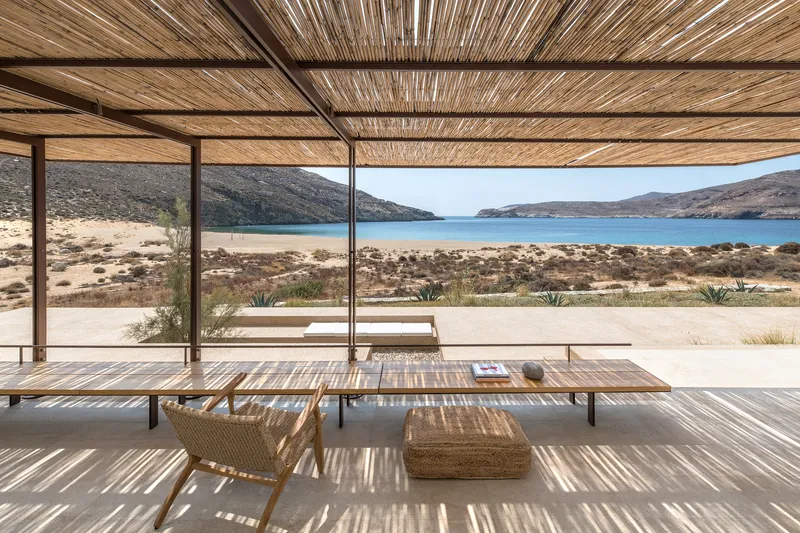
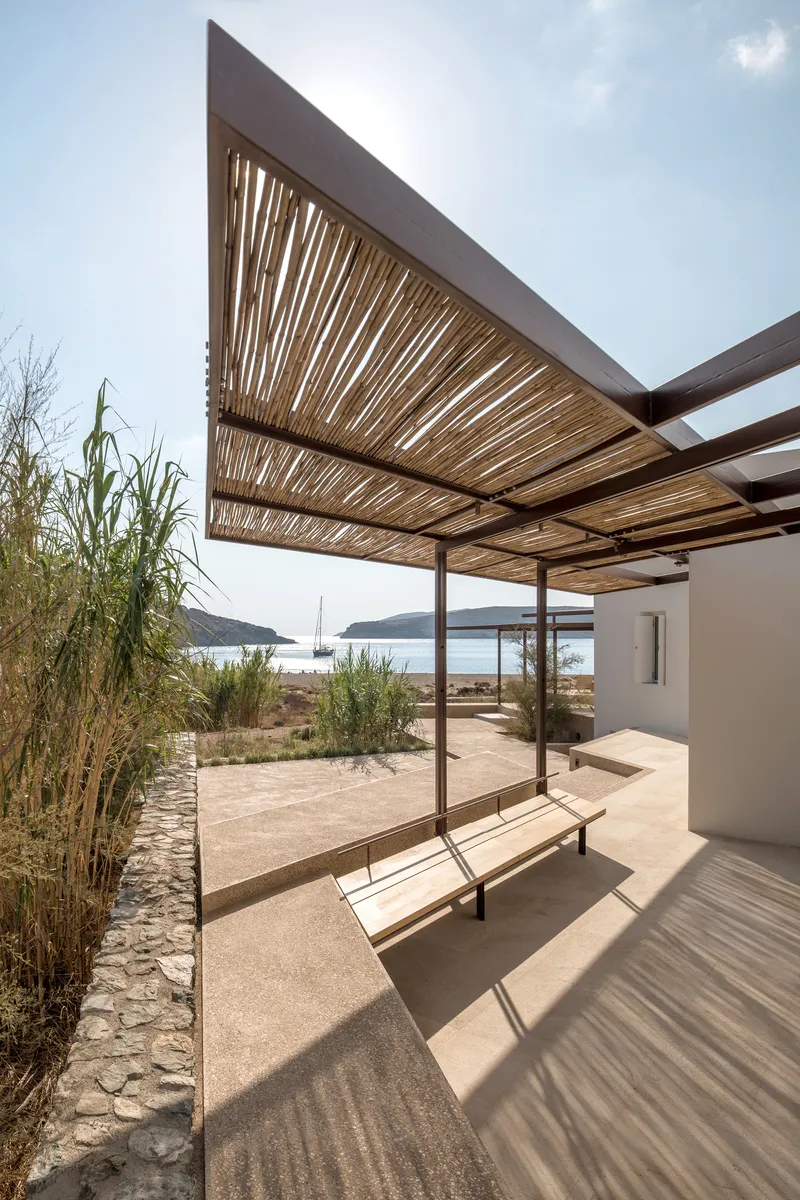
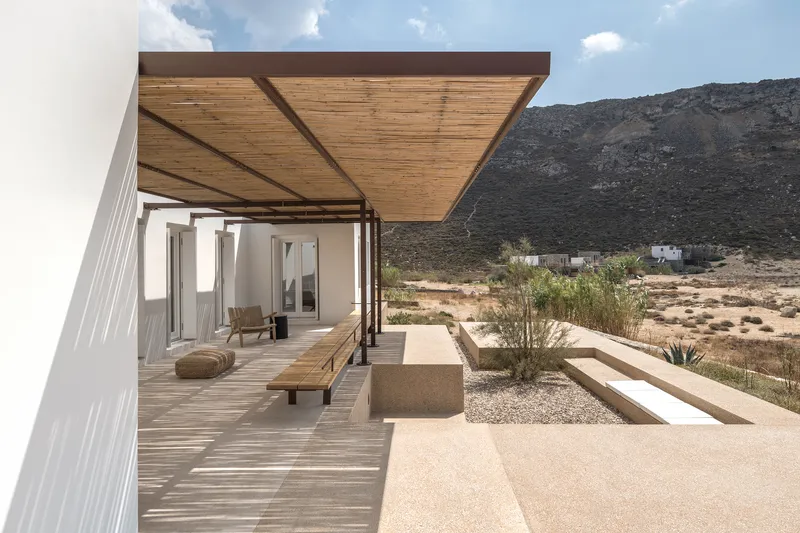
The outdoor dining space, with its long table set beneath a woven reed ceiling, might be the project's finest single moment. The view runs across coastal terrain to the bay, filtered through a steel frame that never competes with the landscape. It is an outdoor room in the truest sense, fully sheltered and fully open at the same time. The inner patios, conceived as intermediate spaces for summer living, extend this idea throughout the complex, creating a continuous gradient from enclosed bedroom to semi-covered terrace to open sky.
A cantilevered timber canopy shelters planted terrace beds against a white masonry volume, the geometry sharp enough to hold its own against the arid hillside beyond. Every outdoor space is oriented west, catching the evening light and the prevailing breeze. These are houses designed around the hours between four and nine in the evening, when the Aegean heat breaks and the stone walls begin to glow.
Plans and Drawings
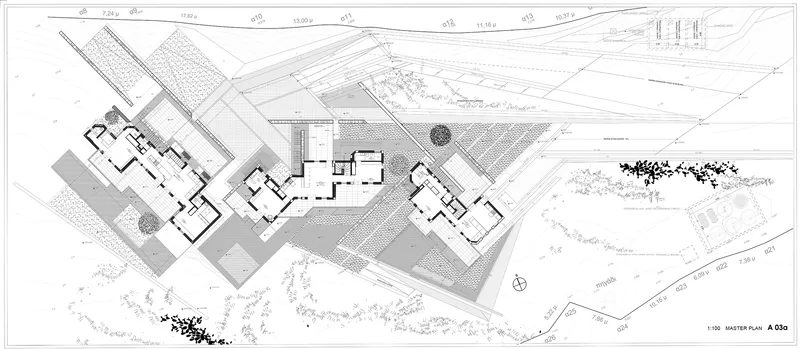
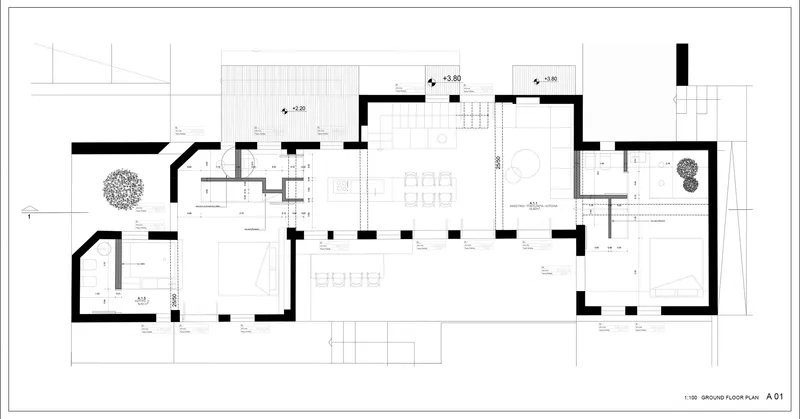
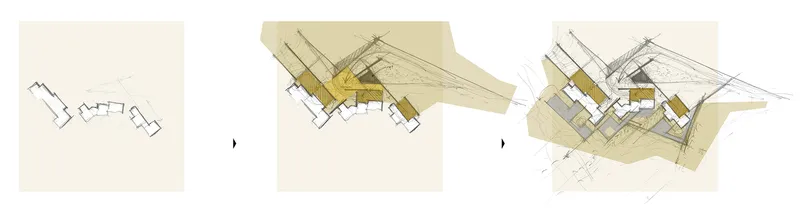
The site plan confirms what the photographs suggest: the three residential volumes are arranged along the slope in a staggered formation, connected by the continuous stone wall that gives the complex its unity. The ground floor plan reveals open living and dining areas oriented toward the bay, with service spaces tucked against the uphill side. The axonometric sequence is particularly instructive, showing three stages of roof form development and making legible how each massing volume relates to its neighbors.
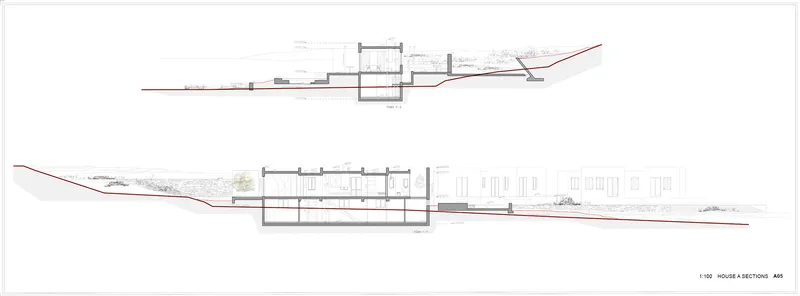
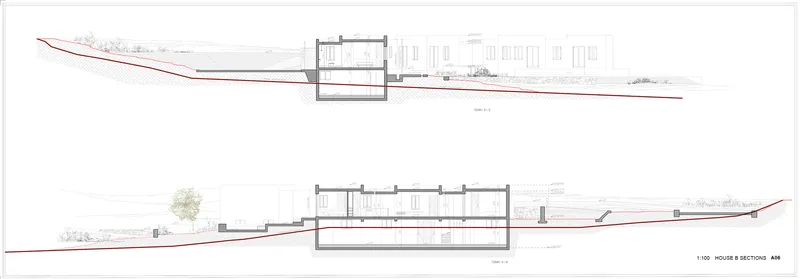
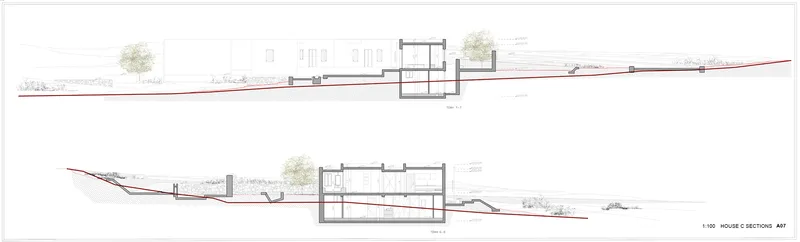
The three section drawings illustrate the project's essential strategy: the buildings are set into the descending terrain, their floors stepping down to negotiate the grade change. The relationship between interior levels and the landscape outside is clear and purposeful. Each section shows a different condition, from the tight hillside embedding to the more open terracing toward the beach.
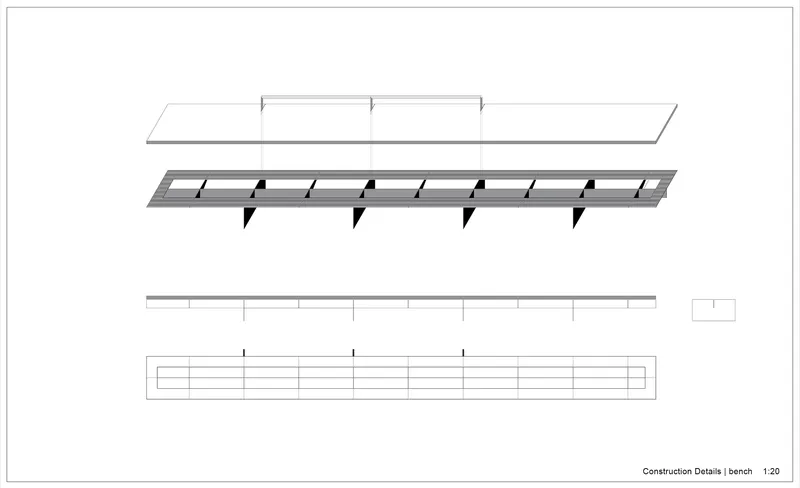
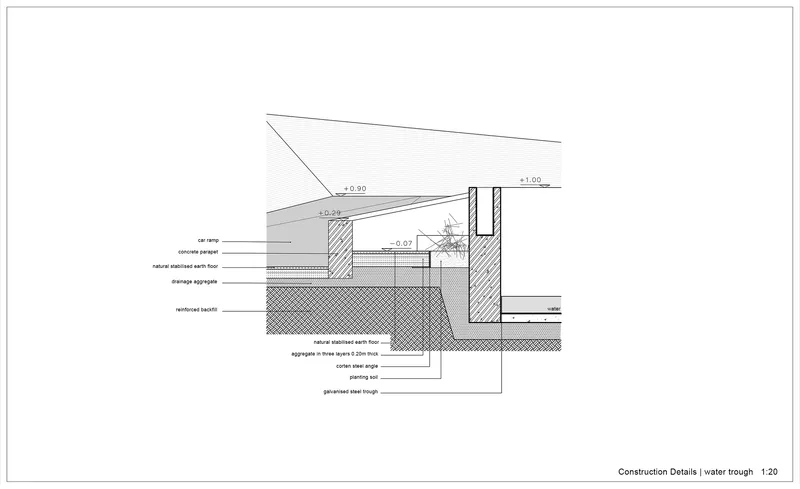
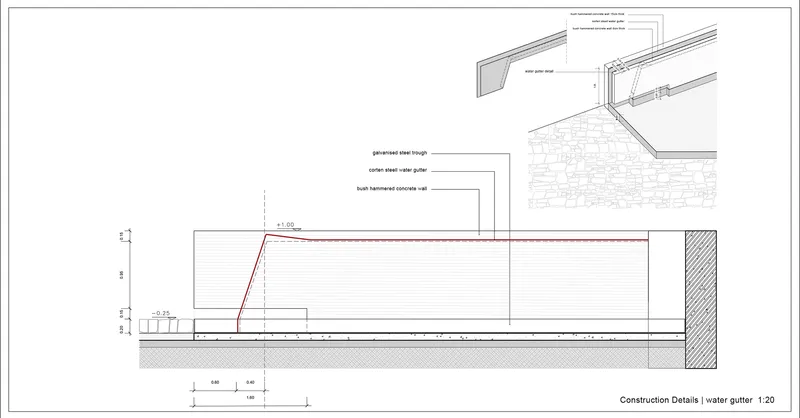
The construction details are unusually specific and worth studying. A bench assembly drawing shows angled support brackets and layered components. Two water trough details reveal concrete parapets, drainage aggregate layers, steel troughs, and handmade concrete walls. This level of documentation signals a practice that understands how design lives or dies in the specifics of fabrication.
Why This Project Matters
The Alfa Vagia Beach Houses matter because they demonstrate how to correct a building mistake without erasing it. The original structures were set too high, a pragmatic response to a difficult water table that left them stranded above the beach. Rather than demolishing and starting over, Zapantiotis Fotis Associated Architects used terracing, stone walls, and careful grading to stitch the buildings back into their site. It is a lesson in working with what exists, finding architectural intelligence in the act of repair rather than in the fantasy of the blank slate.
More broadly, the project offers a counter-model to the Cycladic vacation house as a white cube dropped onto a hilltop for the view. Here, the view is earned through descent, through a sequence of thresholds and level changes that make arriving at the western terrace feel like a journey completed. The materials, drawn from the island's own geology and industrial history, ground the architecture in a specific place. Serifos is not Mykonos, and these houses know it. They sit low, build with what is at hand, and let the wind do the rest.
Alfa Vagia Beach Houses by Zapantiotis Fotis Associated Architects. Vagia Beach, Serifos, Greece. 500 m². Completed 2022. Photography by Giorgos Sfakianakis.
About the Studio
Share Your Own Work on uni.xyz
If projects like this are the kind of work you want to make, uni.xyz is a place to publish your own, find collaborators, and enter design competitions.



Popular Articles
Popular articles from the community


Co-Life: Senior Housing Design That Reconnects Older Adults With the City
Co-Life reimagines senior housing design through healing gardens, shared streets, workshops, and a sustainable community across generations.

Play: Fragments of Their World
Familiar architecture becomes modular playground design, creating safe spaces where displaced children can learn, connect, imagine and play.

The Earth Pod: 3D Printed Homes for Resilient Refugee Communities
The Earth Pod reimagines refugee housing through 3D printed homes made from clay, combining resilience, self-sufficiency, and rapid shelter.

Lunar Spiral: Space Architecture Shaped by the Mathematics of the Universe
Lunar Spiral reimagines space architecture through Fibonacci geometry, lunar regolith, levitating habitats, and self-sustaining Moon living.


Similar Reads
You might also enjoy these articles

Bao Huynh Watercolor Atelier: A Serene Art Retreat in Hội An
Bao Huynh Watercolor Atelier in Hội An blends multifunctional art spaces, sustainable design, local materials, and family-friendly living in a serene environment.

Atelier Macri Concept Store Interior Design by CASE-REAL
Atelier Macri store features a "ko" counter, walnut wood details, cork displays, blending retail, gallery, and seamless customer experiences.

Manuel Vargas Izquierdo Stadium and High-Performance Sports Center: Architectural Excellence in Jalpa de Méndez
The Manuel Vargas Izquierdo Stadium blends sustainable design, inclusive sports facilities, and cultural-inspired architecture, revitalizing Jalpa de Méndez’s public spaces.

KAKR Buluh Awar Hall: Revitalizing Community and Ecology Through Bamboo Architecture
Community built bamboo hall revitalizes Buluh Awar village, empowering youth, restoring ecology, celebrating vernacular craftsmanship through sustainable architecture and culture.



Comments (0)
Please login or sign up to add comments
No comments yet. Be the first to comment!