

ZJA Crowns Amsterdam's 1911 Diamond Exchange with a Faceted Glass Dome
A parametric glass rooftop addition transforms a fire-damaged Art Nouveau landmark at Weesperplein into a flexible creative hub.


Gerrit van Arkel's Diamond Exchange opened in 1911 at the height of Amsterdam's diamond trade, a Jugendstil monument of bay windows, loggias, and a striking bell tower. Over the next century, fires, clumsy additions, and neglect stripped it back to a shell. A 1956 blaze destroyed the original top floor entirely, and the building's original blueprints were lost. When ZJA, led by Rein Jansma, Erik Smits, Mike van Houtum, and Jack Bakker, took on the renovation, they had to reconstruct Van Arkel's towers, roof edge, and tympana from archival facade drawings, old photographs, and a measuring tape, combining modern techniques with traditional crafts.
What makes Capital C compelling is the clarity of the brief and the discipline of the answer. ZJA set three objectives: restore the original qualities of the Diamond Exchange, adapt the interior for modern flexible office use, and build a contemporary public addition. The result is a glass and steel grid shell dome called the High Light, a faceted structure whose diamond-like geometry explicitly references the building's history as the center of the international diamond trade. No two components in the parametric structure are the same. It is engineered by Octatube, structurally designed by Pieters Bouwtechniek, and form-found using ZJA's in-house computational software that predetermined basic parameters and then sought the ideal shape step by step. The old building takes the spotlight; the dome plays a supporting, luminous role.
A Dome That Earns Its Keep
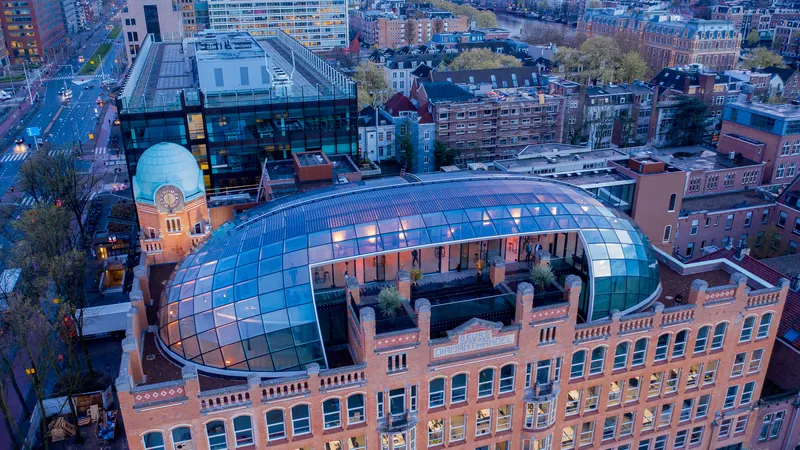

Seen from the street at twilight, the High Light dome glows above the restored brick facade like a lantern set on a pedestal. The double curvature of the grid shell is the key structural move: it allows large spans without columns, creating uninterrupted interior space beneath. ZJA raised the floor on the sixth level so the dome could appear more free and slender from below, a subtle trick that pays off in photographs and in person. Solar cells are integrated directly into the dome glass, generating energy while providing sun protection, and an underfloor heating and cooling system regulates the climate inside the canopy.
The dome is not ornamental. It houses an event space and terrace on the seventh floor that can accommodate up to 400 guests, with movable walls that allow the room to transform into an exhibition area or break out into smaller rooms. That functional ambition, combined with the engineering rigor of the parametric shell, keeps the addition from feeling like a trophy.
Under the Canopy

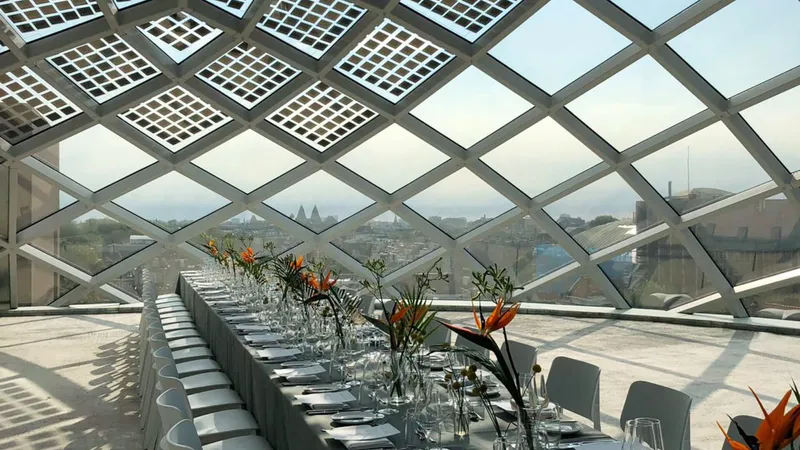
From inside, the barrel-vaulted glass canopy reads as a lattice of diamond-patterned steel ribs holding faceted glass panels, flooding the top-floor dining and event hall with diffused daylight. The view outward is deliberately hazy, filtering Amsterdam's skyline into a soft backdrop rather than a competing spectacle. It is a space designed to host rather than to impress, which, paradoxically, makes it more impressive.
Where the canopy meets the historic brick facade, the relationship is articulated cleanly. The glass structure sits on top of and behind the restored masonry, never competing with Van Arkel's decorative language. The old building walls become interior surfaces, visible from the dining hall as a textural counterpoint to the smooth steel grid overhead.
Flexible Workspaces Within a Monument
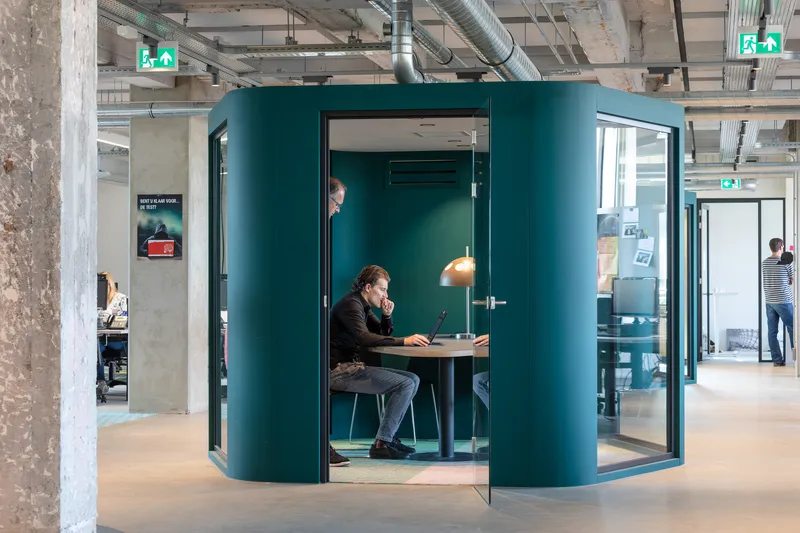
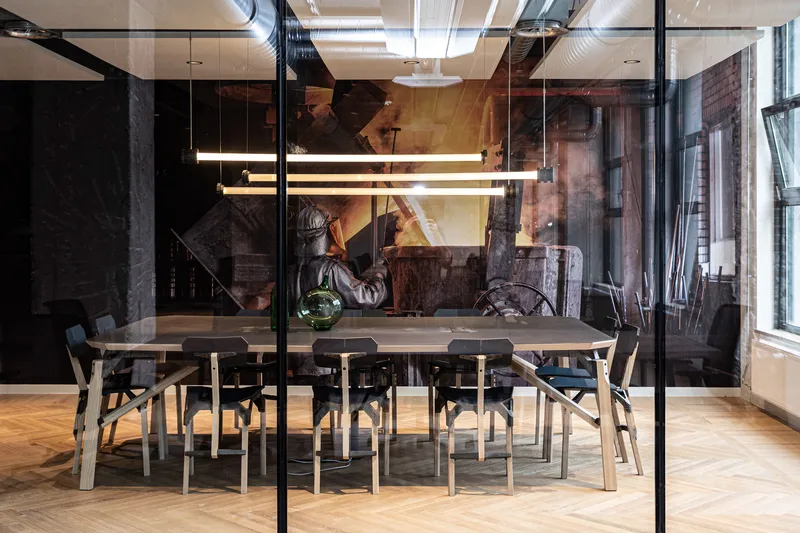
The interior office floors deliver on the second objective with directness. Exposed services run above acoustic ceilings, parquet flooring provides warmth underfoot (some of it made from 3D-printed recycled beer bottles), and freestanding meeting pods in teal paint sit confidently in open-plan layouts. Glass-partitioned meeting rooms with timber furniture maintain visual continuity across the floor plates. None of this is revolutionary, but it is well-calibrated: a modern flexible workspace slotted into a national monument without the usual tension between preservation requirements and tenant expectations.
The building is entirely plastic-free in its operations, using no disposable plastic items. A green roof acts as a rainwater buffer while increasing biodiversity, filtering fine dust, and retaining CO2. These are practical environmental measures rather than headline sustainability gestures, and they suit the project's broader ethos of doing serious work without performance.
Art Woven Through Circulation
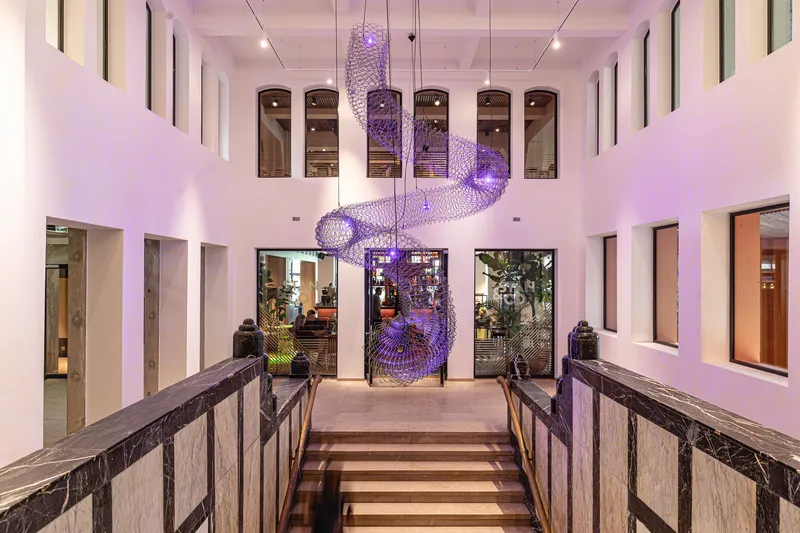
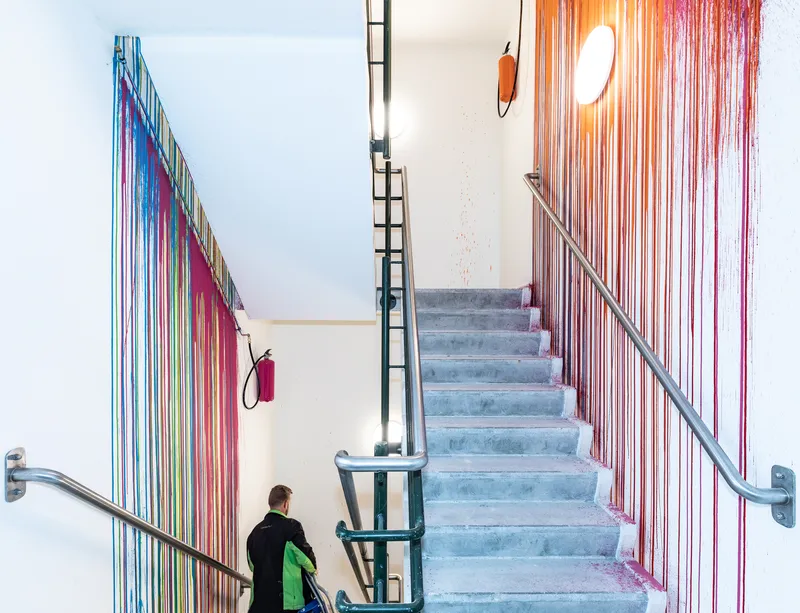
About 20 artists contributed site-specific works distributed throughout the building, from the entrance hall and stairwells to meeting rooms, the terrace, and even the parking garage. In the double-height atrium, a purple mesh sculpture hangs from the ceiling above timber stair railings, turning a moment of vertical circulation into a civic encounter. On a concrete staircase elsewhere in the building, a cascading installation of multicolored cords drops down white walls, giving a purely functional fire escape the character of a gallery.
The decision to commission art for secondary spaces rather than concentrate it in a single lobby gesture is significant. It distributes surprise across the building, rewarding exploration and making daily routines through the stairwells slightly less routine. In a building that already has a spectacular dome, placing art in the leftover spaces is an act of generosity toward the everyday user rather than the visitor.
The Dining Hall as Social Instrument

The top-floor dining space, positioned beneath the latticed curved ceiling with floor-to-ceiling glazing along one side, is clearly intended as the building's social engine. It serves as a restaurant, event venue, and pop-up gallery depending on configuration. The movable wall system is genuinely flexible rather than theoretically flexible; the space has been documented hosting seated dinners, standing receptions, and exhibitions since opening.
Locating this program directly under the dome was the right call. It gives the public a reason to enter the building that goes beyond curiosity about architecture. The original Diamond Exchange was a place of trade and encounter, and Capital C, now hosting creative tenants and public events, maintains that social function in a different economic register.
Plans and Drawings
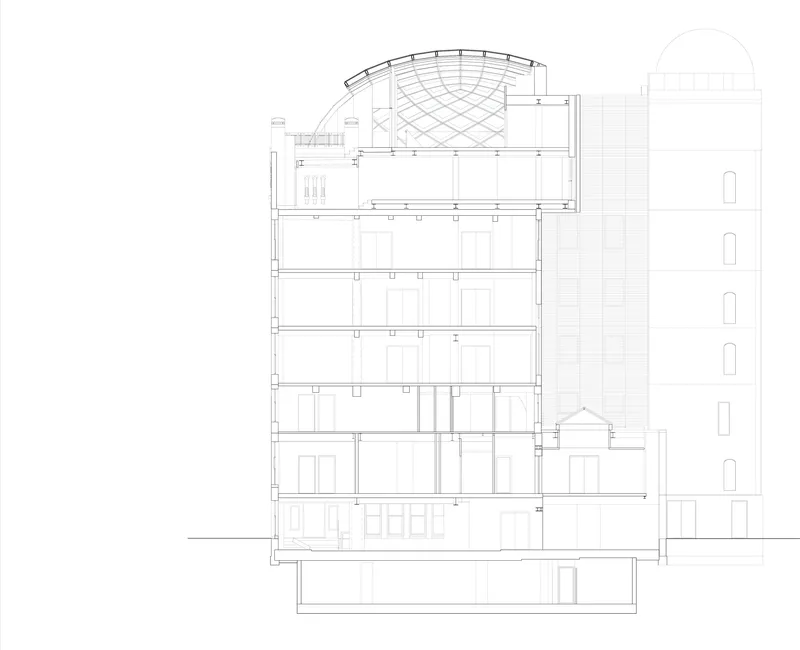

The section drawings reveal the full ambition of the intervention. The arched glazed roof floats above the existing masonry structure, with the additional floors legible as insertions between the historic envelope and the new canopy. The adjacent cylindrical tower, reconstructed from Van Arkel's archival drawings, anchors the composition on the corner. The sections also make clear how the basement was made accessible and extra floors were added without distorting the proportions of the original facade. The dome's structural depth is surprisingly shallow for its span, a direct consequence of the double-curvature grid shell logic.
Why This Project Matters
Capital C demonstrates that heritage renovation does not require choosing between archaeological fidelity and architectural ambition. ZJA's strategy of restoring what was lost, modernizing what was hidden, and adding something genuinely new on top is not a compromise: it is a design position. The High Light dome works because it knows its place. It defers to the historic facade from the street while commanding the skyline from above, and it delivers usable public space rather than symbolic gesture.
The project also offers a useful model for how parametric design tools can serve conservation. ZJA's in-house form-finding software did not generate spectacle for its own sake; it produced a structurally efficient, materially lean canopy that could be built atop a 108-year-old national monument without overloading it. In a discipline increasingly defined by computation, Capital C is a reminder that the most convincing applications of digital design are the ones that solve specific, stubborn problems rather than broadcast novelty.
Diamond Exchange Capital C Amsterdam by architectural studio ZJA (lead architects Rein Jansma, Erik Smits, Mike van Houtum, Jack Bakker). Amsterdam, The Netherlands. 9,488 m². Completed 2019. Photography by Jan Willem Kaldenbach, Rikst Slingerland, and The Social Studio.
About the Studio
Share Your Own Work on uni.xyz
If projects like this are the kind of work you want to make, uni.xyz is a place to publish your own, find collaborators, and enter design competitions.


Popular Articles
Popular articles from the community

Temporary Home for Dogs: A Reversed Zoo Rethinks Animal Shelter Architecture
In Bucharest, a sinuous corridor and freed landscape flip the logic of containment, designing a shelter that works to make itself unnecessary.

The Amber Palace Opera: A Geological Fiction Surfaces on Tallinn's Baltic Waterfront
Pierre Brillard reimagines a Baltic legend as a public landscape, opera house, and waterfront promenade rooted in Tallinn's coastal identity.
Extended Shell: Retrofitting Kolkata's Balconies as Living Urban Thresholds
A modular retrofit system recovers the social and environmental intelligence of Kolkata's historic verandas for contemporary Park Street residents.
Cloaked Colonization: A Mobile Underwater Habitat That Moves Like a Fish
Micah Abaya's shortlisted EHC Pacific entry reimagines ocean settlement as a dispersed network of self-sustaining architectural organisms.

Similar Reads
You might also enjoy these articles

Pixel Gardens: One Repeated Module Stacked Into a Terraced Social Housing Tower for Famagusta
Salem Bader's shortlisted housing tower builds a vertical neighbourhood from one repeated module, offsetting units to carve terraces, light and air.

Bao Huynh Watercolor Atelier: A Serene Art Retreat in Hội An
Bao Huynh Watercolor Atelier in Hội An blends multifunctional art spaces, sustainable design, local materials, and family-friendly living in a serene environment.

Atelier Macri Concept Store Interior Design by CASE-REAL
Atelier Macri store features a "ko" counter, walnut wood details, cork displays, blending retail, gallery, and seamless customer experiences.

Manuel Vargas Izquierdo Stadium and High-Performance Sports Center: Architectural Excellence in Jalpa de Méndez
The Manuel Vargas Izquierdo Stadium blends sustainable design, inclusive sports facilities, and cultural-inspired architecture, revitalizing Jalpa de Méndez’s public spaces.

Explore Amsterdam Impressionism Competitions
Discover active competitions in this discipline

Challenge to design luxury tourism on rails

VR headsets Storefront design competition

Designing a staircase for a client
Comments (0)
Please login or sign up to add comments
No comments yet. Be the first to comment!