
Znamy się Turns a Kraków Restaurant into a Sensory Map of the Swedish Landscape
Dala Restaurant in the Kazimierz district channels cinnamon, saffron, and Nordic forests into 145 square meters of hospitality.


Most restaurant interiors start with a mood board of colors and textures. Znamy się started with a smell. For Dala Restaurant, the Kraków studio built its design logic around the olfactory profile of cinnamon, saffron, and cardamom, translating spice into spatial experience. The result is a 145-square-meter interior in the Kazimierz district that reads like a topographic survey of Sweden: deep coniferous greens, lake-water clarity, and the earthy reds of traditional wooden cottages, all compressed into a single address on ul. Krakowska.
What makes Dala genuinely interesting is how it refuses to stay one thing throughout the day. Mornings bring a sun-drenched bakery where passersby watch buns being shaped through large street-facing windows. By evening, the same room pivots to a candlelit wine sanctuary. The architecture does not change; the light does, and every material in the space has been chosen to respond differently to sun versus flame. That kind of temporal range is rare in hospitality design, and it is the real accomplishment here.
A Facade That Invites Without Shouting
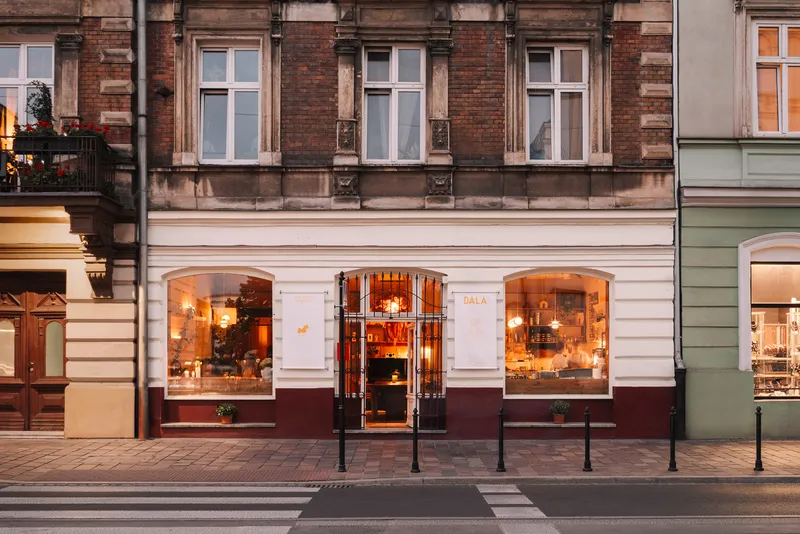

The street elevation plays it smart. A dark maroon base anchors the arched storefront windows beneath the existing white stucco of the Kazimierz building, establishing the restaurant's presence without competing with its historic neighbors. The palette signals warmth and depth from outside, preparing the eye for what comes next. A timber-framed window nook with a perforated metal panel lets seated guests maintain visual contact with the street while remaining sheltered, turning the edge condition between inside and out into a desirable seat rather than a drafty compromise.
The Front Room: Kitchen, Dining Room, Living Room

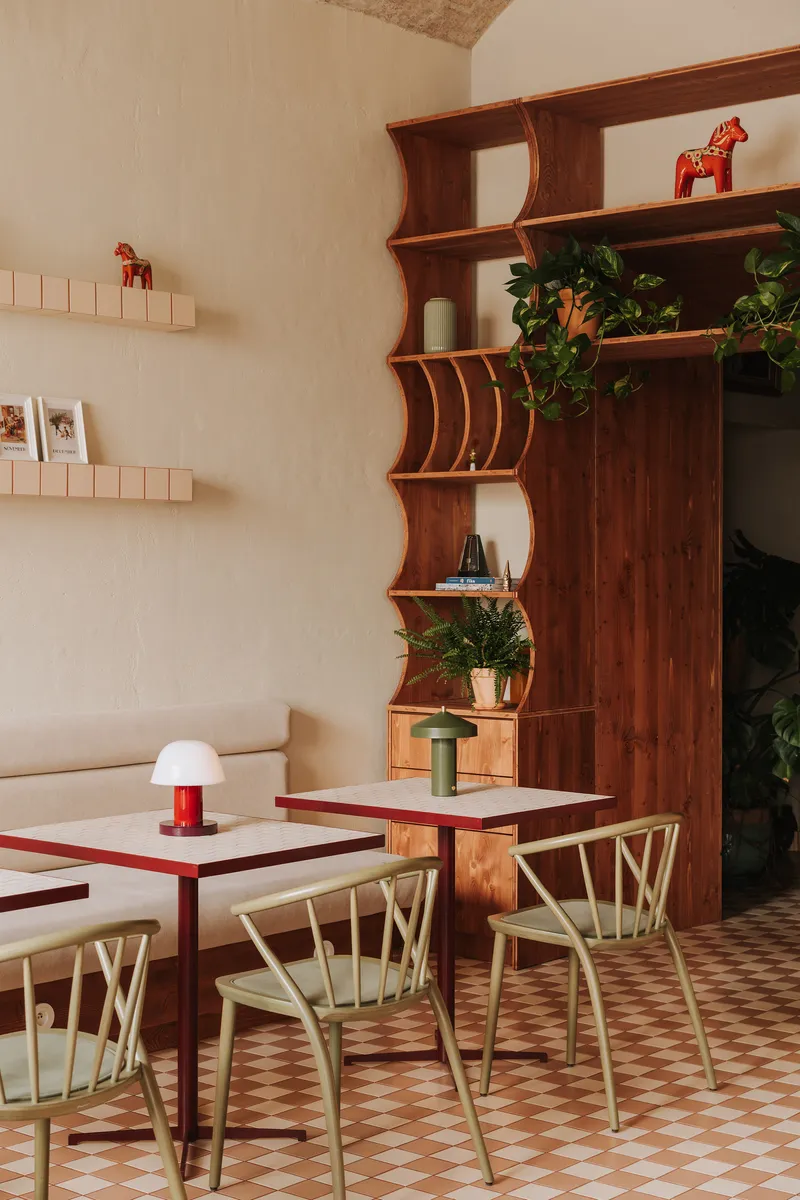
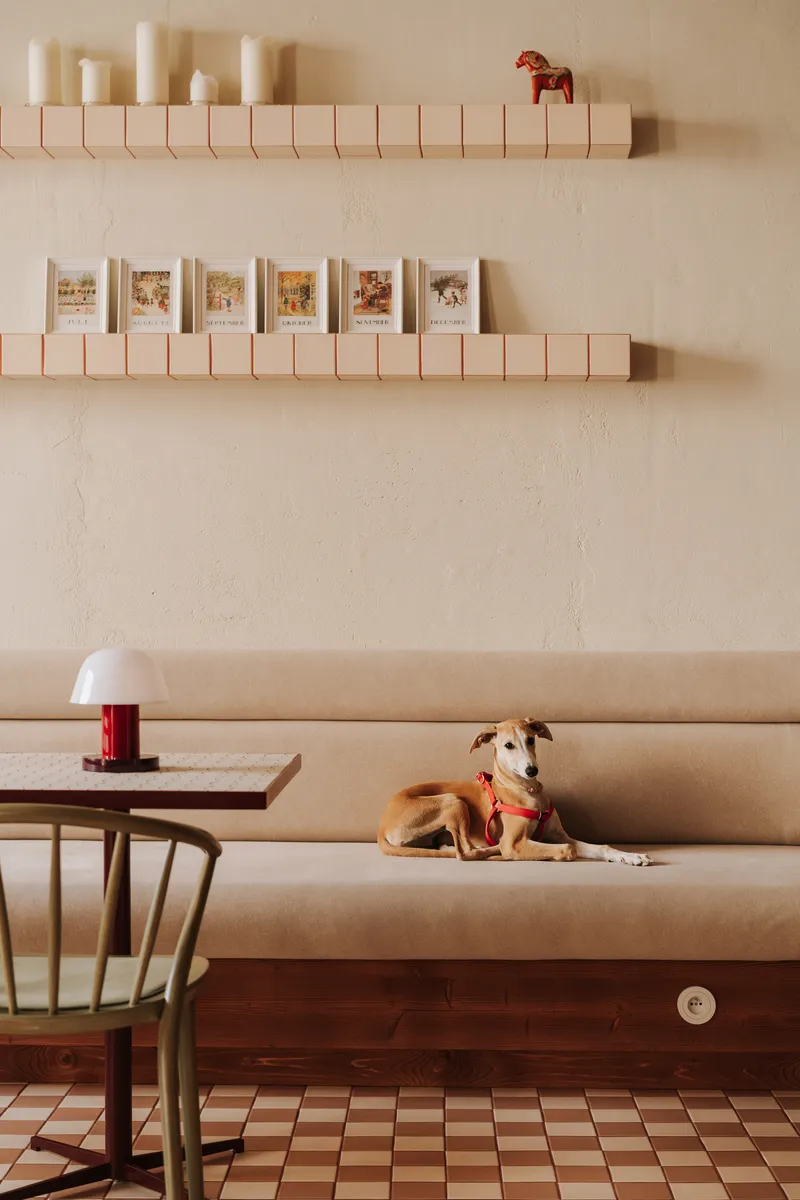
The front of the house operates with the fluid logic of a home. Kitchen, dining room, and lounge coexist without hard boundaries. Dark wooden shelving with rounded, cylindrical edges runs through the space like a continuous piece of furniture, simultaneously organizing circulation, displaying ceramics and potted plants, and providing the visual rhythm that a residential bookcase would. The cylindrical backrests recall cinnamon sticks, a detail that sounds precious on paper but reads as simply warm in person.
Built-in banquettes and open shelves above them create intimate alcoves within the larger volume. A dog resting on one of the upholstered benches in the photographs is not incidental; it confirms the domesticity the designers were after. The chequered tile floor throughout ties the zones together and provides a graphic counterpoint to all the organic curves above.
The Service Counter as a Cabinet of Curiosities

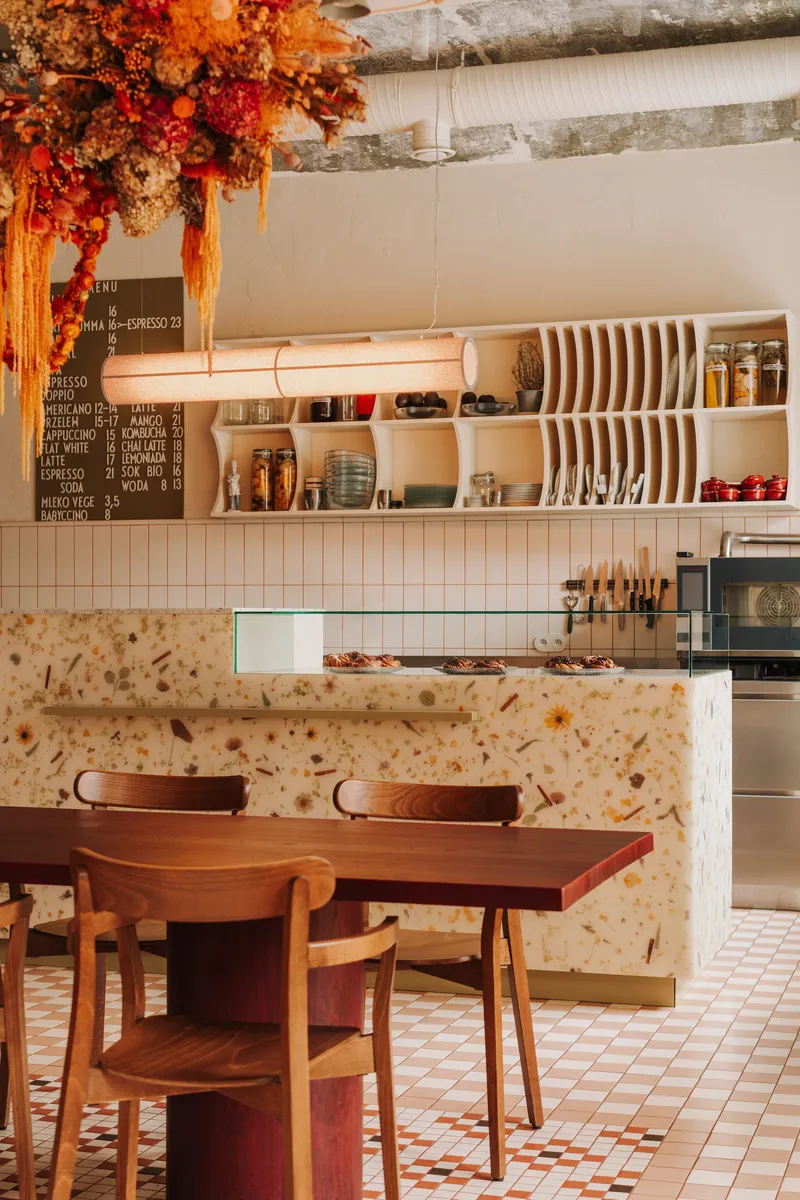

The bar and service counter deserve their own discussion because Znamy się treated them as the centerpiece of the design. Clad in a custom terrazzo with real flowers preserved in resin, the counter surface is both functional workspace and display object. Suspended above it, dried floral arrangements with ribbon streamers cascade from exposed ceiling joists, creating a layered canopy that scales down the height of the room while adding movement and scent.
The detail of pressing actual botanical material into the counter resin is a commitment. It means every surface is unique and irreproducible. It also means maintenance will be a conversation eventually, but that is a trade-off the studio clearly accepted in favor of specificity. The timber shelving behind the counter, with vertical slats holding plates and kitchenware, completes the picture: everything is visible, nothing is hidden, and the tools of hospitality become decoration.
Cinnamon Ceilings and the Vaulted Rear


The spatial drama intensifies as you move deeper into the restaurant. A vaulted ceiling painted in terracotta orange compresses the room and saturates it with reflected warmth, an effect that will only deepen under candlelight in evening hours. The existing brick barrel vault in the rear is left exposed, its texture meeting a curved timber shelving unit that frames a doorway with an almost ecclesiastical quality. The transition from the front room's domestic ease to this more atmospheric zone is handled through materiality rather than signage or abrupt changes in plan.
Znamy się cites Stockholm's subway stations, with their raw rock walls and bold art, as a reference for the rear area. The connection is not literal, but the shift toward a more cavernous, almost geological quality of space is unmistakable. It works because the palette remains consistent. Red tones, natural timber, and greenery carry through, so the transition feels like moving deeper into the same world rather than stepping into a different one.
Curtains, Light, and the Art of Soft Division
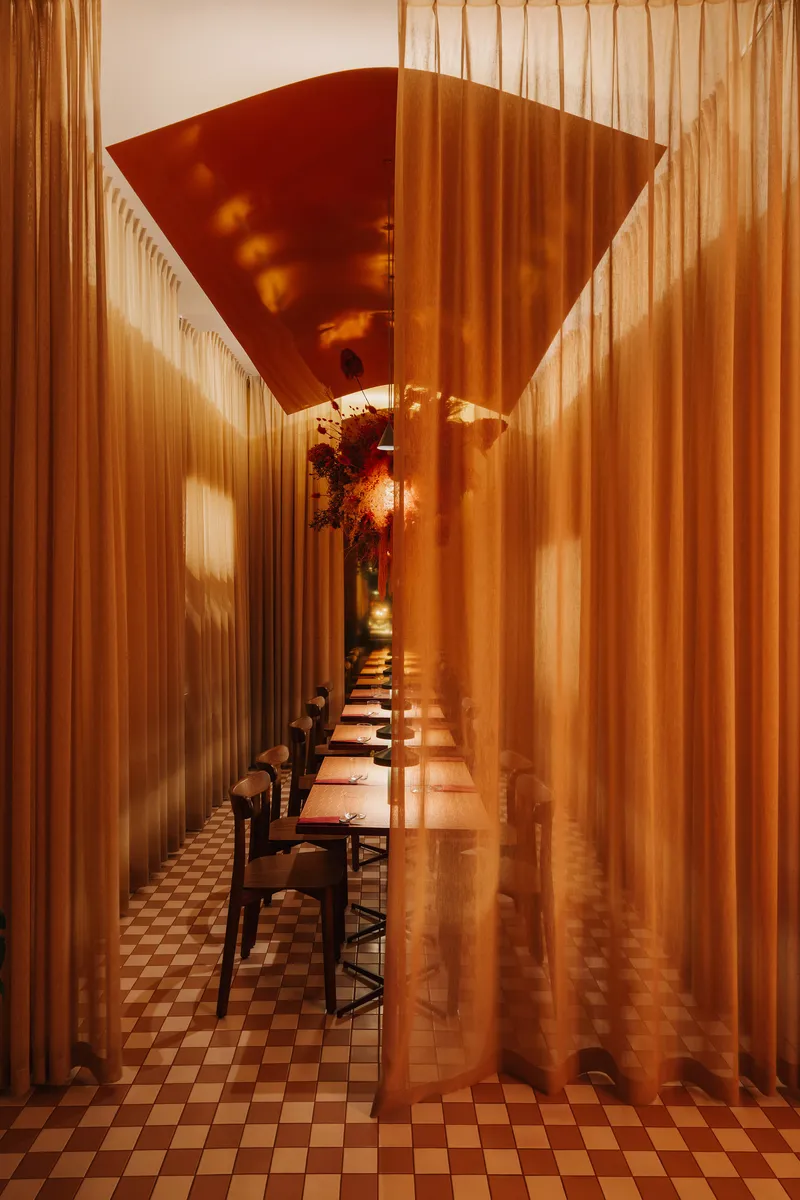
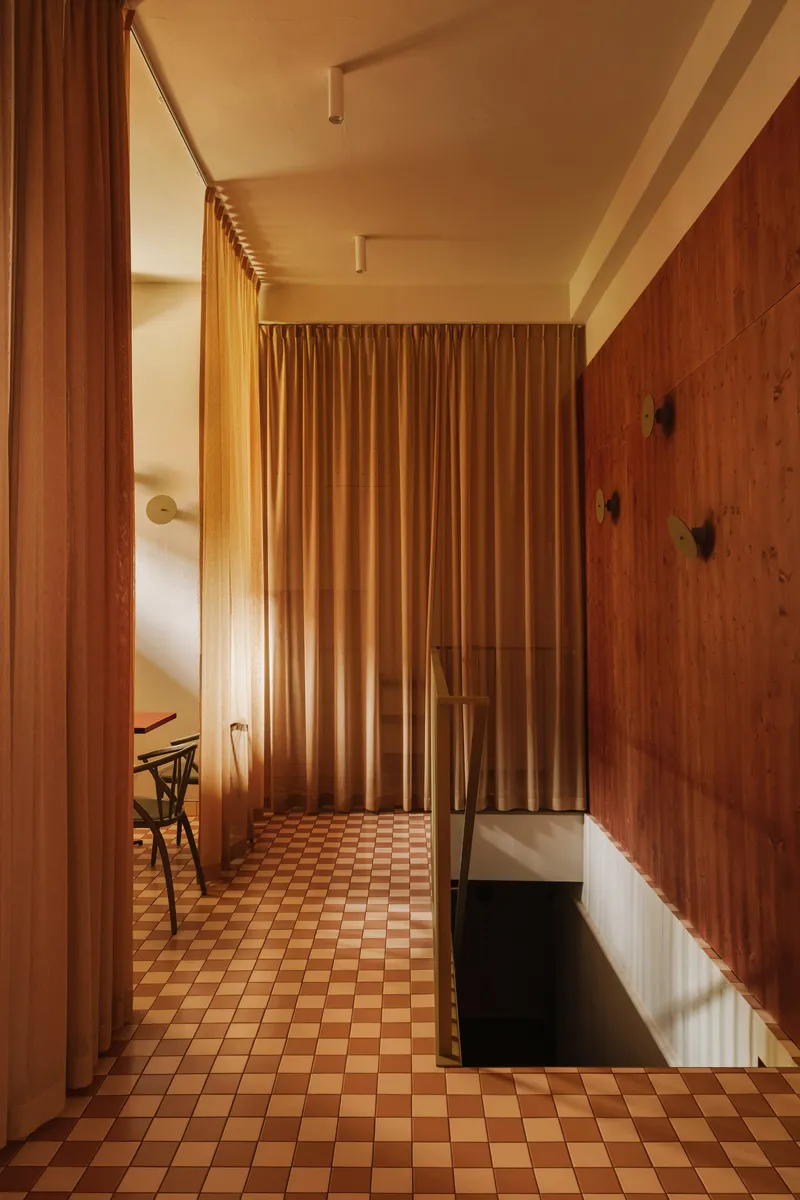

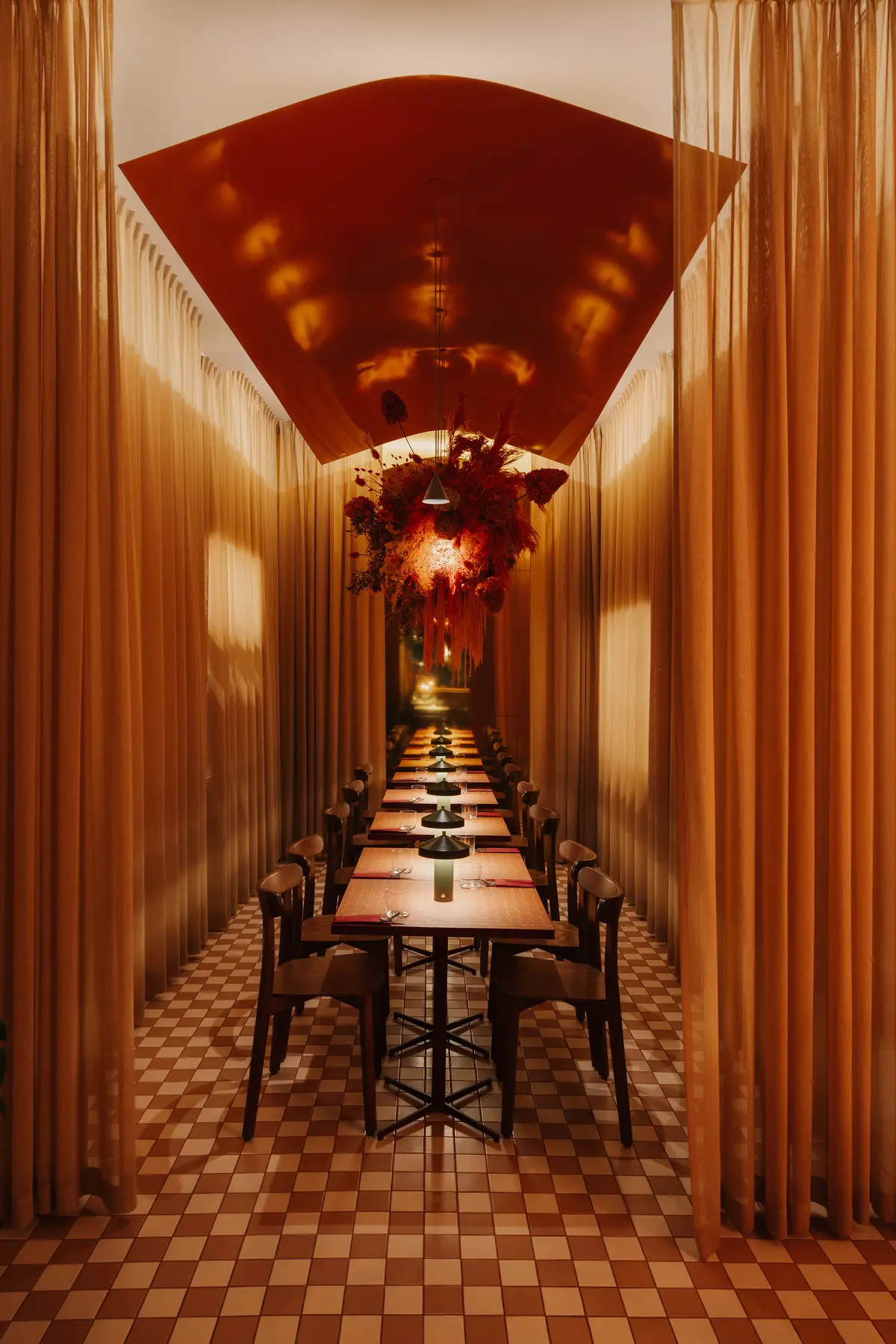
Translucent curtains do much of the spatial heavy lifting in this project. Sheer green panels hang floor to ceiling, filtering afternoon light into a diffused glow while softly partitioning the long corridor section from the main dining areas. They billow slightly with foot traffic and ventilation, introducing movement that no rigid partition could provide. The red ceiling panel visible beyond the curtain line creates a compressed, almost theatrical corridor that pulls the eye toward the suspended floral arrangement at its far end.
Small moments reinforce the approach. A timber doorway frames a two-top table in soft afternoon sunlight with the precision of a still-life painting. These are not accidental compositions; the designers clearly considered sightlines and the way light would move across the space at different hours. For a restaurant that transforms from bakery to wine bar across the course of a day, that temporal awareness is essential.
Communal Tables and Suspended Gardens

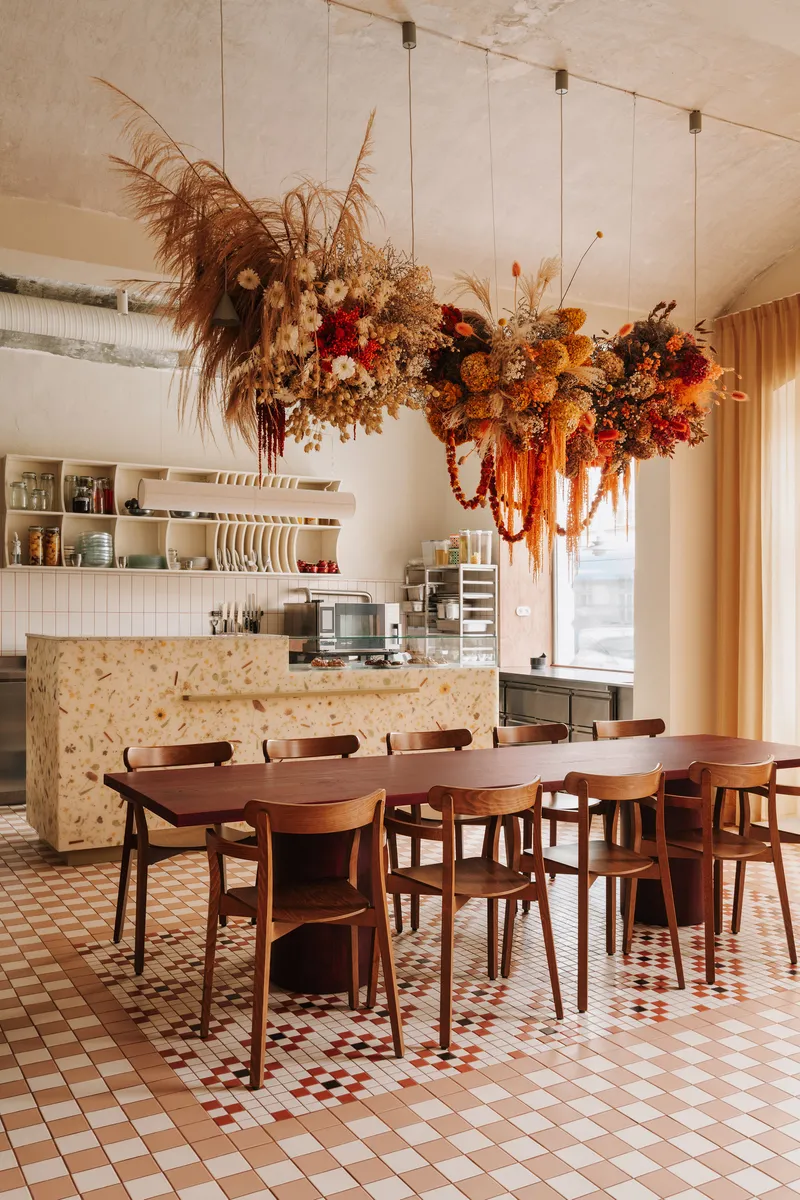
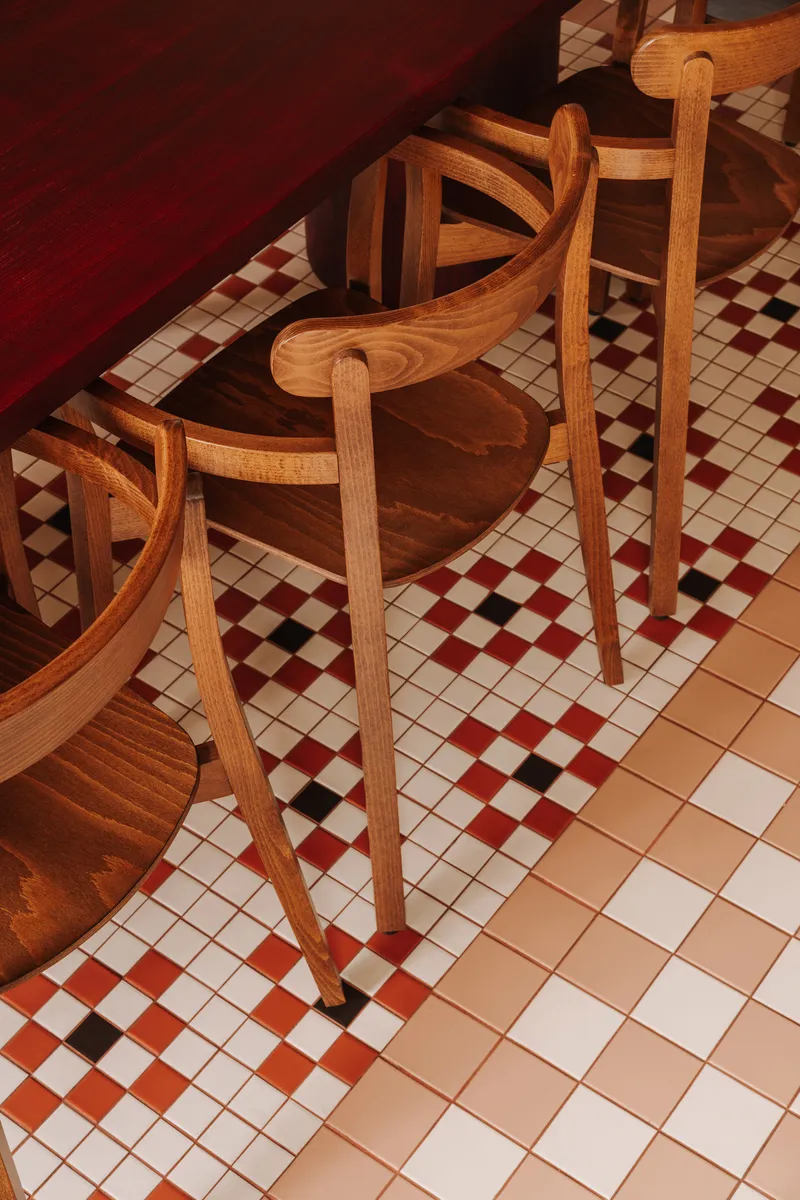
The long timber communal table is Dala's social anchor, designed to encourage the kind of shared, convivial moments that a Swedish fika demands. A massive dried floral arrangement hangs directly above it, marking the table as the room's center of gravity. The arrangement is generous in scale, nearly matching the table's footprint, and it establishes a secondary ceiling plane that makes the communal zone feel distinct without walls.
The overhead view of the diagonal chequered tile floor with timber chairs scattered across it reveals the pattern's true purpose: it energizes a plan that could otherwise read as a series of parallel corridors. The 45-degree rotation of the tile grid against the room's orthogonal walls creates visual tension that keeps the floor from becoming background.
Details That Carry the Concept


At the scale of a door handle, the design remains consistent. A panel embedded with pressed flowers and plant material surrounds a simple pull, turning an everyday touch point into a sensory encounter. The curved timber shelving system, photographed in detail, reveals its construction logic: vertical slats hold plates at precise intervals while the rounded profiles avoid any sharp geometry. Wall-mounted rectangular tile shelves in a contrasting material display candles and printed cards, adding a layer of graphic clarity to the otherwise warm, organic palette.
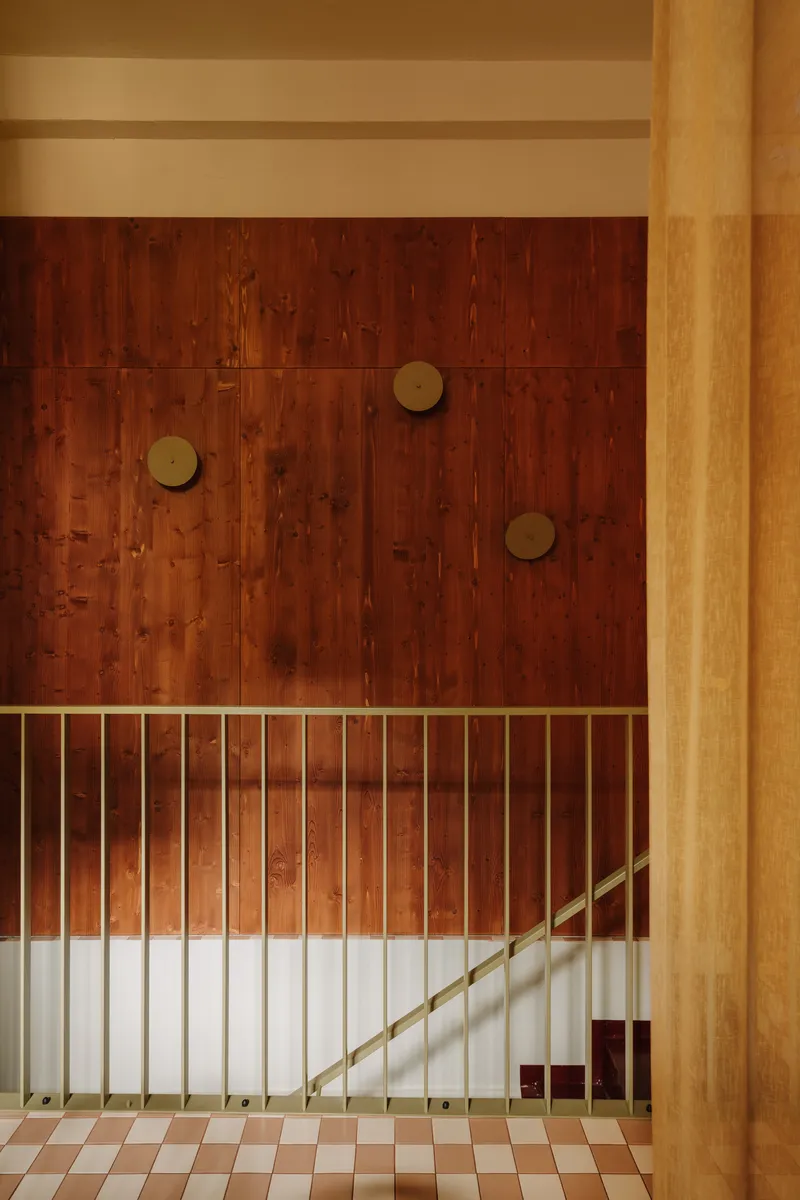
These details matter because they are where the concept either holds or falls apart. A spice-driven design narrative could easily become a gimmick that lives only in the project text. Here it extends to hardware, shelving profiles, table patterns with wavy-line motifs, and even the stairwell, where vertical brass railings and a timber column maintain the tonal continuity.


Plans and Drawings
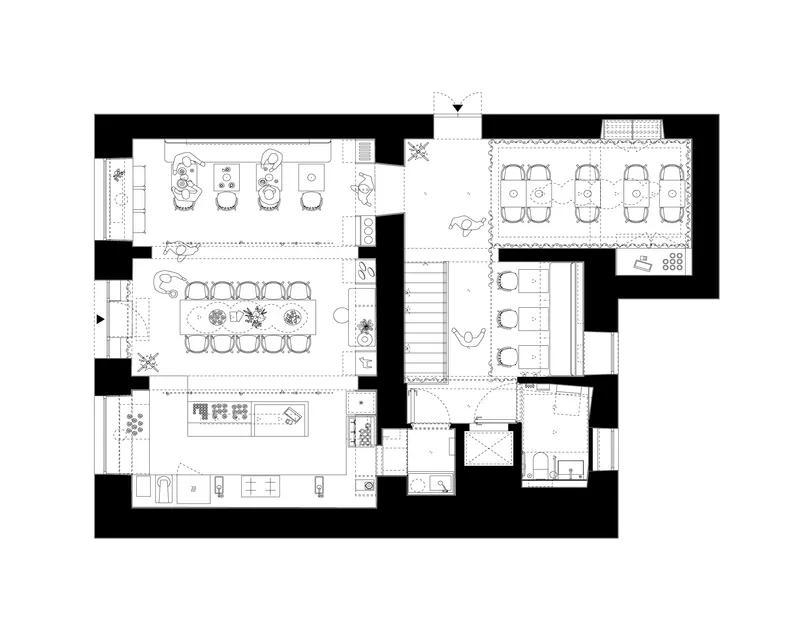
The floor plan confirms what the photographs suggest: the 145 square meters are organized around a central staircase with perimeter service rooms pushed to the edges, freeing up the full width of the street-facing volume for dining. The open plan allows for the day-to-night transformation the studio describes, with no fixed partitions interrupting the flow from front windows to rear vault. It is a compact footprint handled with spatial generosity.
Why This Project Matters
Dala Restaurant demonstrates that themed hospitality design does not have to be literal or reductive. Instead of reproducing Swedish clichés, Znamy się abstracted the Nordic landscape into a material palette and then filtered that palette through the specificity of Kraków's Kazimierz district, with its brick vaults and arched storefronts. The result is a place that feels Swedish without looking like an IKEA showroom, a distinction that depends entirely on the quality of the abstraction.
The decision to design from scent rather than image is the project's most provocative move. Cinnamon becomes cylindrical profiles; saffron becomes a warm red ceiling; cardamom informs the earthy, layered greens of the curtains and plantings. Whether or not visitors consciously register these translations matters less than the cumulative atmosphere they produce: a space that engages the body before the intellect. In 145 square meters, that is a substantial achievement.
Dala Restaurant, designed by Znamy się (Wojtek Nowak, Bogna Kawa-Nowak, Monika Jokiel, Ula Dachnij-Seredynska, Anna Petryszyn), Kraków, Poland. 145 m², completed 2025. Photography by Migdal Studio.
About the Studio
Share Your Own Work on uni.xyz
If projects like this are the kind of work you want to make, uni.xyz is a place to publish your own, find collaborators, and enter design competitions.


Popular Articles
Popular articles from the community


FCC Arquitectura Expands a Portuguese Granite House with a Board-Marked Concrete Wing
In Portugal, JV House pairs a cleaned-up whitewashed and granite dwelling with a timber-shuttered concrete extension, courtyards and a garden pool.


The Amber Palace Opera: A Geological Fiction Surfaces on Tallinn's Baltic Waterfront
Pierre Brillard reimagines a Baltic legend as a public landscape, opera house, and waterfront promenade rooted in Tallinn's coastal identity.

Cube Design Draws an Ecological Corridor Between Two Shenzhen Hills with the Nankai Building
Beside Shenzhen's container docks, the Nankai Building pairs stacked balconies with a climbing green screen to connect two hillsides across its height.

Singing Woman: An Opera House That Performs Before the Curtain Rises
Ovidiu Cristian Pavel's conceptual opera house translates Estonia's choral identity into a sculpted waterfront landmark facing the Baltic Sea.

Similar Reads
You might also enjoy these articles

LAVA Architecten Gives Vocational Education a Sawtooth-Roofed Face on a Mechelen School Campus
In Mechelen, Belgium, a 2,053 m² STEM school on a 6×6 m grid turns workshops and classrooms into rooms that can be rearranged as teaching changes.

KEMA Studio Turns a Derelict Marvila Attic into a 60 m² Lighthouse Apartment Above Lisbon
In Lisbon's Marvila district, a rebuilt roof, four skylights and two plywood volumes turn an unlivable attic into a bright home facing the Tagus.

Pixel Gardens: One Repeated Module Stacked Into a Terraced Social Housing Tower for Famagusta
Salem Bader's shortlisted housing tower builds a vertical neighbourhood from one repeated module, offsetting units to carve terraces, light and air.

Bao Huynh Watercolor Atelier: A Serene Art Retreat in Hội An
Bao Huynh Watercolor Atelier in Hội An blends multifunctional art spaces, sustainable design, local materials, and family-friendly living in a serene environment.

Comments (0)
Please login or sign up to add comments
No comments yet. Be the first to comment!