


Boutique Hotel
Small, design-led hotels that adapt historic buildings, landscapes and unusual sites into intimate guest accommodation.
A boutique hotel is a small, design-led hotel with a distinct character of its own, usually independent or run as if it were, where the architecture, interiors and service are the reason to stay rather than a backdrop to it. Most have fewer than a hundred rooms, and many occupy converted historic buildings or sit in landscapes that shape every room.
What is a boutique hotel?
There is no legal definition, but the usual markers are consistent. Boutique hotels are small-capacity hotels that offer more personal service than typical hotels and typically have fewer than a hundred rooms. They show a strong sense of aesthetic and an un-homogenized character, and they often take a theme from nature, cuisine, history or the culture of the neighbourhood around them.
Three qualities matter more than any room count. The first is independence of spirit: even when a group owns the building, each property is designed for its site instead of rolled out from a brand manual. The second is character: the hotel is meant to be remembered as a place, not a product. The third is design authorship, since a named architect or interior designer usually shapes the whole guest journey from street to bed.
That separates the boutique hotel from the wider family of lodging. Large chain hotels, airport hotels, convention hotels and resorts with hundreds of keys follow different planning and operational logic, which is covered on the page for hospitality buildings. The boutique type sits closer to residential design and to interior design, because a guest experiences it room by room.
A short history of the boutique hotel
The type appeared almost at once in several cities at the end of the 1970s. In London, the actress turned designer Anouska Hempel opened Blakes in South Kensington in 1978, and the hotel still describes itself as renowned as the world's first boutique hotel. In San Francisco, Bill Kimpton opened the Clarion Bedford in 1981.
New York gave the idea its name. In 1984 Ian Schrager and Steve Rubell, the owners of the nightclub Studio 54, opened Morgans Hotel on Madison Avenue in a 1927 building. The French designer Andrée Putman gave its 114 rooms and public spaces a calm, residential look, with checkerboard patterns and furniture sourced from Paris flea markets, which steered away from formulaic institutional design.
"It was Steve (Rubell) who coined the term 'boutique' hotels to differentiate us from the big 'department store' chains. Back then, the hotel market was a barren wasteland."
The next step was theatre. A group including Schrager and Rubell bought the Royalton, an 1898 building that had spent most of the twentieth century as an apartment hotel, and brought in Philippe Starck to remake it. It reopened in October 1988 with a long lobby running between 43rd and 44th Streets that held a bar and grill, and corridors darkened for dramatic effect. With the Royalton and the Paramount, also by Starck, Schrager introduced what became known as "lobby socializing", turning the lobby into a gathering place for guests and New Yorkers alike, and later the "urban resort" with the Delano in Miami Beach.

Through the 1990s and 2000s the idea spread into a broad design-hotel movement, from city townhouses to rural retreats. Its success also drew in the large operators: many chains now run boutique-style sub-brands or buy independent boutique hotels, and Schrager himself went on to create the Edition brand in partnership with Marriott.
Key principles of boutique hotel design
Arrival, and the lobby as a living room
The first minutes decide how a guest reads the whole hotel. Boutique hotels tend to shrink the front desk, soften the threshold and make the lobby a place to sit, work and meet, often shared with people who are not staying there. Lighting, scale and a few strong pieces of furniture do more here than marble.

The room is the product
In a small hotel each room is visible in photographs, reviews and memory, so it has to be designed rather than repeated. Views, the bed wall, the bathroom and the way daylight falls carry the identity. Morgans set the pattern by treating each room as a calm, furnished space rather than a standard unit.

Reusing a historic building
Many boutique hotels live inside buildings that were never hotels: palaces, townhouses, warehouses, schools and farmsteads. The design question is how to fit bathrooms, services, lifts and fire separation into thick old walls without erasing them. The wider discipline is covered under adaptive reuse, and upgrading an older hotel for the same use is refurbishment. In Palma de Mallorca, Jordi Herrero turned Can Oliver, a palace whose origins are traced to the 12th century, into a 2,253 m² five-star boutique hotel, starting with a detailed survey and setting new work as black steel boxes against restored stone and brick.
"The result is a building that reads as an archive you can sleep in, and it mostly avoids the trap of nostalgia."
UNI Editorial, on Hotel Nobis Palma at Can Oliver by Jordi Herrero Arquitecto
Local material and craft
Character is easiest to build from what is near at hand. Stone, brick, timber, tiles and textiles from the region tie a hotel to its place and give guests something they could not find elsewhere. At the Ben Tre Hotel in Vietnam, Sanuki Daisuke Architects wrapped a 30-room hotel in handmade terracotta bricks sourced from local Mekong Delta factories, with gaps between the bricks that cast shifting patterns of light and give shade and privacy.
Food, bar and public life
A good restaurant or bar keeps a small hotel alive in the evening and connects it to the street. It is also where the hotel earns money from people who never book a room, so it often takes the best frontage, the roof or the garden.
Landscape and retreat
Outside cities, the setting is the program. Rooms are placed for a view, a tree or a slope, and buildings are kept small so the land remains the main presence. In Suichang County, China, AT DESIGN's Miwo Hotel fits only seven rooms into 1,120 m² on a mountaintop above tea hills, with water running from an infinity pool down through the building. Near Montepulciano, Mila built a 50 m² treehouse room beside an olive tree so that the tree itself is never touched.

Boutique hotels on uni.xyz
Members approach the type from two directions: new hotels shaped by difficult sites, and old buildings given a second life as small hotels.
Level Minus by Kevin John, from UnIATA '25, reimagines an abandoned quarry in Pune as a boutique hotel and uses the void of the quarry as the generator of form. Embedded in the rock, it balances carved and constructed spaces in a quiet dialogue with the land and the lake.
"Architecture here adapts to terrain, revealing beauty through absence, not imposition."
Kevin John, project statement for Level Minus (UnIATA '25)

Casa de Albergue by Srishti Khatwani, Madhavi Kadam, Samruddhi Shinde and Swarangi Dharmadhikari, a winning entry in the Uncommon competition, is a boutique hostel designed for long-term living and working. It balances private rooms and work areas for extended stays at a fair price, aimed at a new generation of travellers.

Revival of Last British Rotating Stage Theatre by Abeg Rahman, also from UnIATA '25, conserves what the project describes as the last British revolving stage theatre of Asia by reusing its structure, drawing on Dovey's place attachment theory. Its masterplan labels a terrace of old row houses as reused for a boutique hotel, set beside a community field, a mosque and a reflection pond.

La Demeure du Parc by Intercon Bcn upgrades an existing hotel in Fontainebleau, 45 minutes south of Paris, into a boutique hotel. The historic building, with parts dating from the 17th century, was fully restored and its original features such as wooden beams were kept to retain its charm. Singapore Boutique Hotel by Studio Makal works on a thin trapezoidal site in the Central Business District, with steep terrain, conservation guidelines and varying height limits. FOCUS by Samantha Rodriguez, an Editor's Choice in the Pause competition, centres on integration with nature, and its boards pair a meditation center with a boutique hotel.
Challenges and future directions
Small hotels carry big fixed costs. Reception, kitchens, laundry, plant and staff are spread across few rooms, so the design has to work hard on every square metre and on income from food, events and the public. Historic buildings add their own risks: services and fire escape routes are hard to insert, and surveys often reveal more repair than expected.
Success creates a second challenge. As chains adopt the vocabulary of boutique hotels, the distinct character that defined the type is easy to copy as a style and hard to keep as a practice. The answer for designers is specificity: rooms that only make sense on this site, materials from this region, and public spaces that the neighbourhood actually uses.

Climate and wellbeing are pushing the type forward. Passive cooling, shading, local materials and careful landscaping are becoming selling points rather than hidden engineering, and many new retreats combine rooms with spa, meditation or wellness programs.
Boutique hotels for students and designers
A boutique hotel is a compact, complete brief for a thesis: public rooms, private rooms, back of house, a site and a story. Productive angles include converting a vacant building in your own city, a hotel that grows from a local craft or food tradition, a retreat that touches the landscape lightly, or a hybrid of hostel, workspace and long-stay rooms like the projects above. Draw the guest journey first, from street to room, and test it against the service routes before refining the facade.
Briefs for hotels, inns and retreats appear regularly on the uni.xyz competitions page, and the pages on adaptive reuse and interior design linked above cover the two skills the type relies on most. For retreats built around spa and rest, see wellness architecture.
Frequently asked questions
What makes a hotel a boutique hotel?
A boutique hotel is small, design-led and individual. It usually has fewer than a hundred rooms, a strong aesthetic and a character drawn from its building, neighbourhood or landscape, with more personal service than a typical hotel.
How many rooms does a boutique hotel have?
There is no fixed number, but boutique hotels typically have fewer than a hundred rooms, and many have far fewer. Some well-known examples are larger, so room count is a guide rather than a rule.
What was the first boutique hotel?
Blakes in London, opened by Anouska Hempel in 1978, and Morgans in New York, opened by Ian Schrager and Steve Rubell in 1984, are the two most often named. Rubell is credited with coining the term by comparing Morgans to a boutique rather than a department store.
What is the difference between a boutique hotel and a resort?
A resort is usually larger and self-contained, with many facilities on one site. A boutique hotel is smaller and depends on its design and its surroundings, whether a city street or a landscape, for its character.
Can an old building become a boutique hotel?
Yes, and many of the best known do. Palaces, townhouses, warehouses and farm buildings are frequently converted, though fitting bathrooms, services and fire safety into historic fabric is the main design challenge.
References and further reading
- Boutique hotel, Wikipedia
- Blakes London, Blakes Hotel
- Morgans Hotel, Wikipedia
- Royalton Hotel, Wikipedia
- Ian Schrager, Wikipedia
- The man behind boutique hotel idea, IOL


Popular projects
View all 10 projects


Latest journals
View all 78 journals

Studio Font Scatters a Pink Concrete House into Fragments Across the Baja California Desert
Near Todos Santos, three pink concrete guest rooms and an open pavilion of crossing roofs turn a 630 m² off-grid house into a deliberate ruin.

Jordi Herrero Turns Can Oliver, a Medieval Palace in Palma, into a Hotel That Lets Its Walls Tell the Story
In Palma's old town, a 12th-century palace becomes a 5-star hotel where black steel insertions sit against layered stone, brick and bricked-in arches.

Mila Builds a Luxury Treehouse Hotel Room Without Touching the Tree in Tuscany
On a hillside near Montepulciano, a 50-square-meter timber volume rises beside an ancient olive tree to offer canopy-level hospitality.
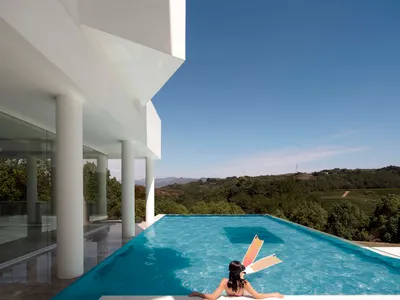
AT DESIGN Nests a Seven-Room Hotel on a Mountaintop in China's Tea Country
Miwo Hotel stacks white cubic volumes above Suichang County's forested hills, framing tea gardens through cave-like pools and infinity edges.


