
Mila Builds a Luxury Treehouse Hotel Room Without Touching the Tree in Tuscany
On a hillside near Montepulciano, a 50-square-meter timber volume rises beside an ancient olive tree to offer canopy-level hospitality.


The idea of a treehouse hotel room sounds romantic until you try to reconcile it with reality. Trees move, rot, and resist the loads that luxury accommodation demands. The client behind a boutique hotel on the Cicolina hill near Montepulciano wanted exactly that contradiction resolved: a guest room that felt like sleeping in a tree, with the comfort level of a five-star suite. Berlin-based Mila, led by architect Jakob Tigges, answered by doing something disarmingly simple. They built next to the tree instead of on it.
Casa Sull'Albero is a 50-square-meter timber volume that climbs a slope beside the largest tree on the property, rising through a generous stairway until its living spaces sit at canopy height. The tree is never a structural member. It remains untouched, free to grow, sway, and shed its leaves against the glass. The architecture does the heavy lifting, literally, while the tree does the atmospheric work. The result is a room where you bathe among branches and wake to the sound of wind through olive leaves, all without a single bolt driven into bark.
Standing Beside, Not Upon
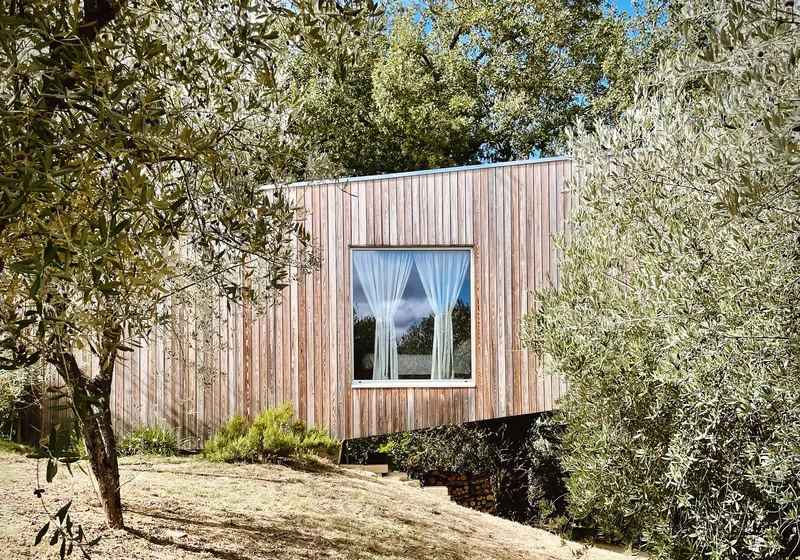
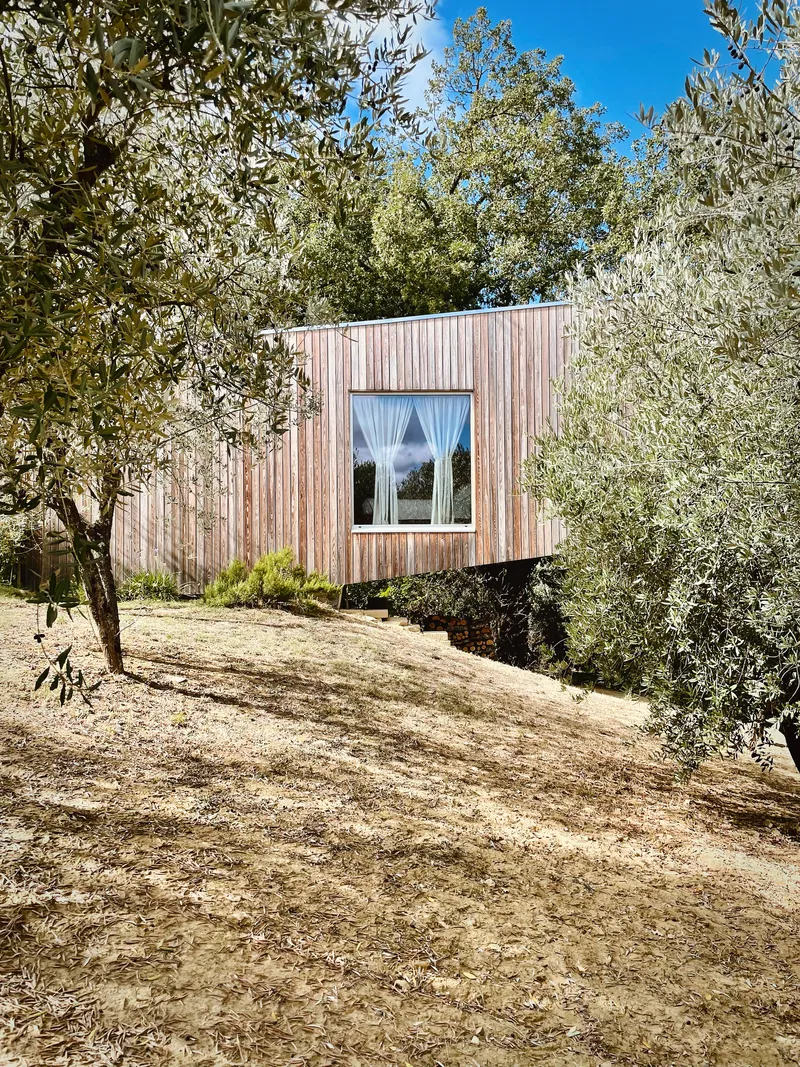
From the ground, the building reads as a narrow timber tower propped on a sloped site among olive groves. Its vertical cladding emphasizes height and reinforces the analogy with a trunk. The proportions are deliberately slender: tall enough to reach the canopy, compact enough to disappear between trees. Mila resists the temptation to sprawl. On a property defined by agricultural openness, the building's tight footprint is an act of restraint that lets the landscape remain the dominant figure.
The siting is the project's most critical decision. By choosing the biggest tree on the property as a neighbor rather than a host, the architects gain all the experiential qualities of elevation and enclosure without the structural gymnastics and ecological damage that a true treehouse entails. It is pragmatism dressed as poetry.
Threshold in the Canopy
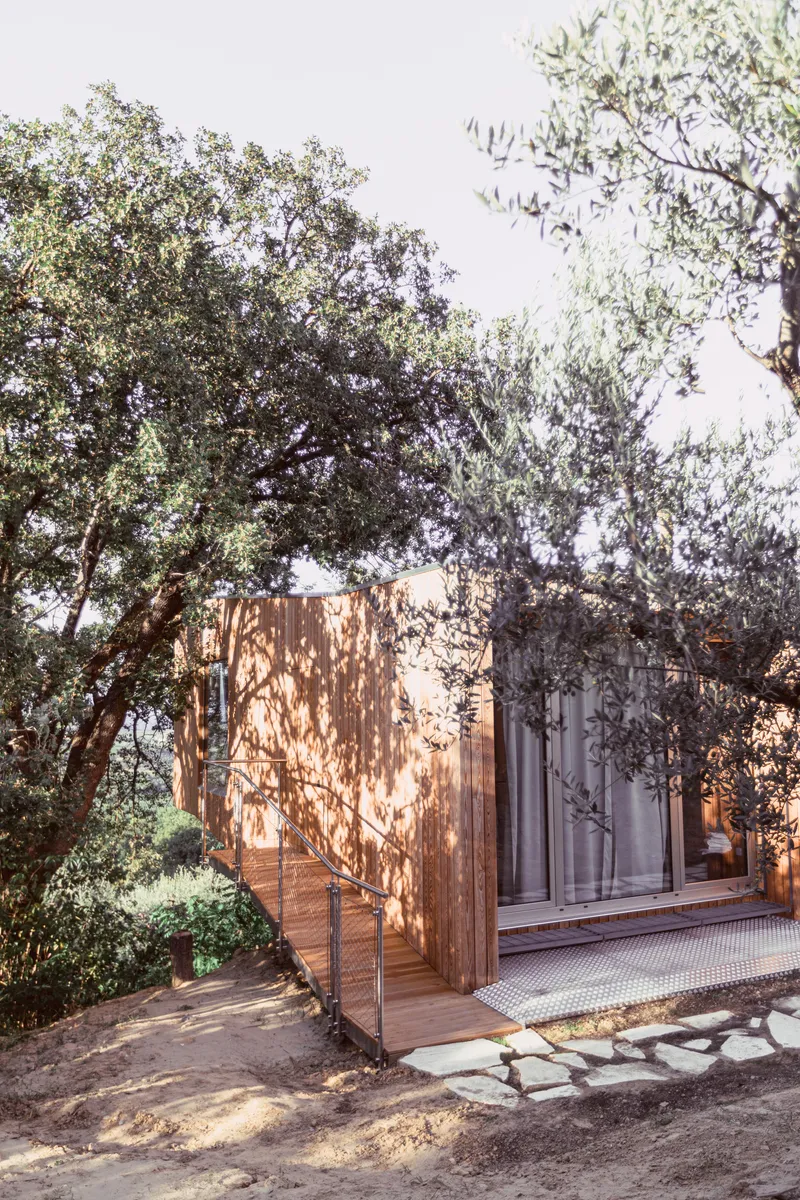
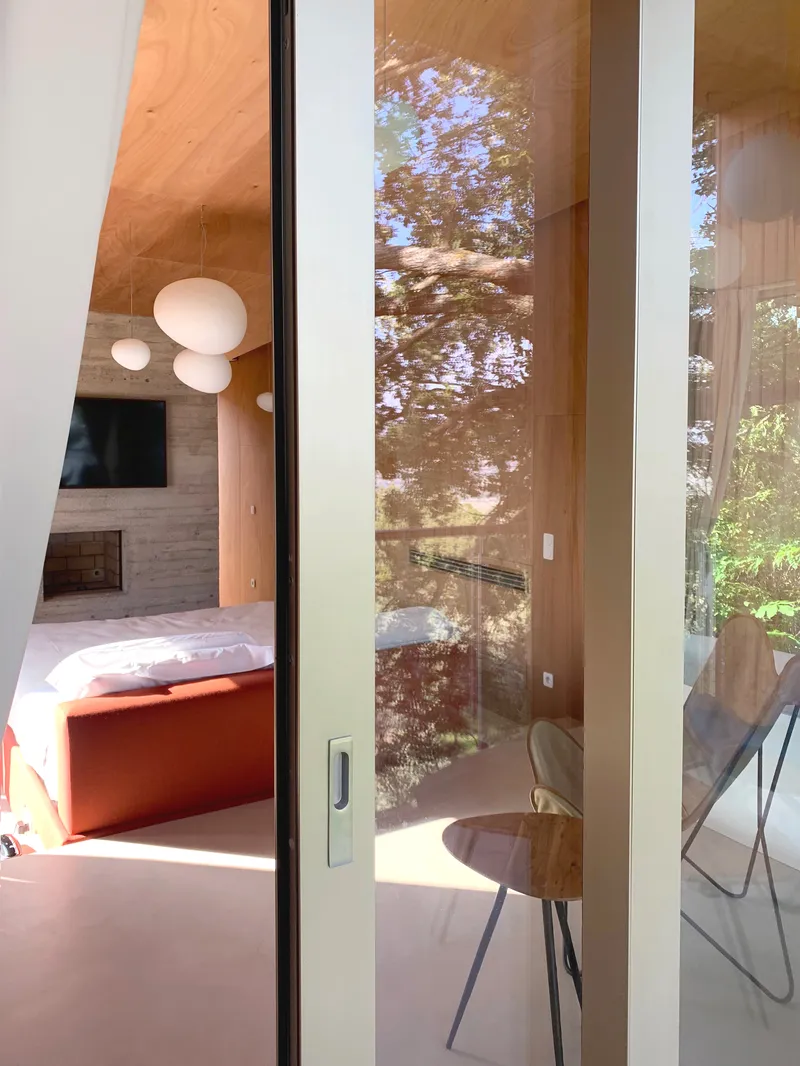
Arrival happens under dappled shade. A timber ramp and deck slide beneath overhanging olive branches, blurring the line between ground and building from the very first step. The entrance is deliberately low-key: no grand door, no lobby gesture. You are simply absorbed into the tree's shadow and then channeled upward.
The glass door at ground level reflects the surrounding trees so completely that the building seems to dissolve at its base. Only when you step through does the interior materialize: plywood ceilings, warm light, a bedroom beyond. Mila uses the reflective quality of glass not as a gimmick but as a genuine spatial tool, making the volume feel less like an intrusion and more like a clearing.
Living at Branch Height
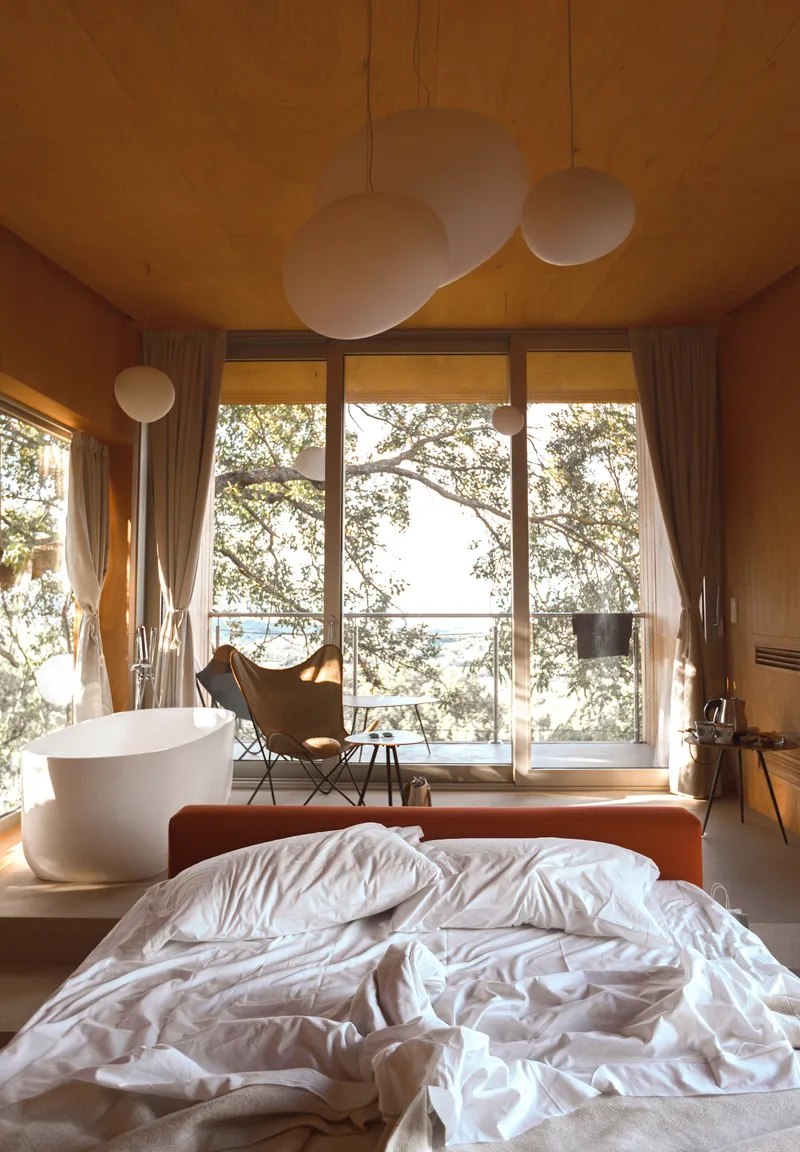
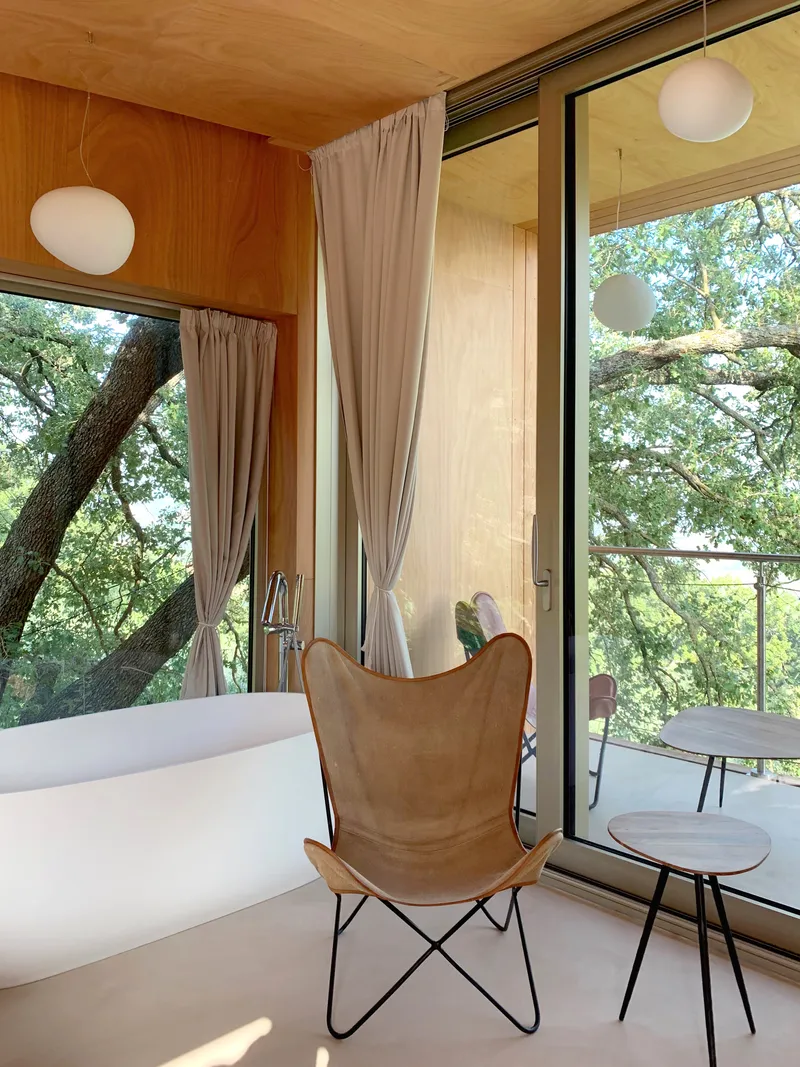
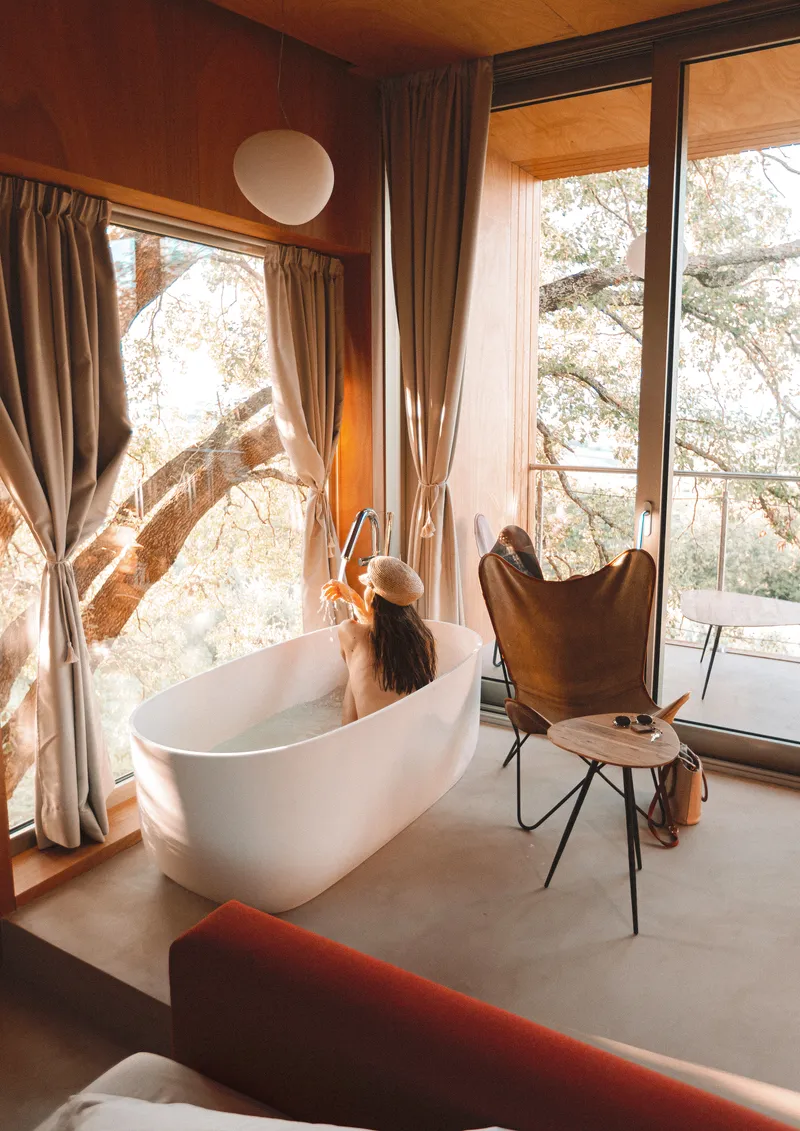
The payoff of the climb is total immersion. Floor-to-ceiling glazing wraps the bedroom and bathroom, pulling branches, sky, and light into every surface. The plywood ceiling continues the warmth of the exterior cladding inward, creating a continuous timber envelope that reads as a kind of lined nest. Spherical pendant lights hang like fruit, understated enough to avoid competing with the view.
The bathtub placement is the project's most provocative moment. Set beside a full-height window, it puts the occupant at eye level with olive leaves. Morning light pours in unobstructed. There is nothing between skin and landscape except a single pane. It is an almost exhibitionist move, made private only by altitude and the density of the surrounding canopy. The architecture here is less about enclosure and more about framing a specific relationship between body and tree.
A Balcony Among Branches
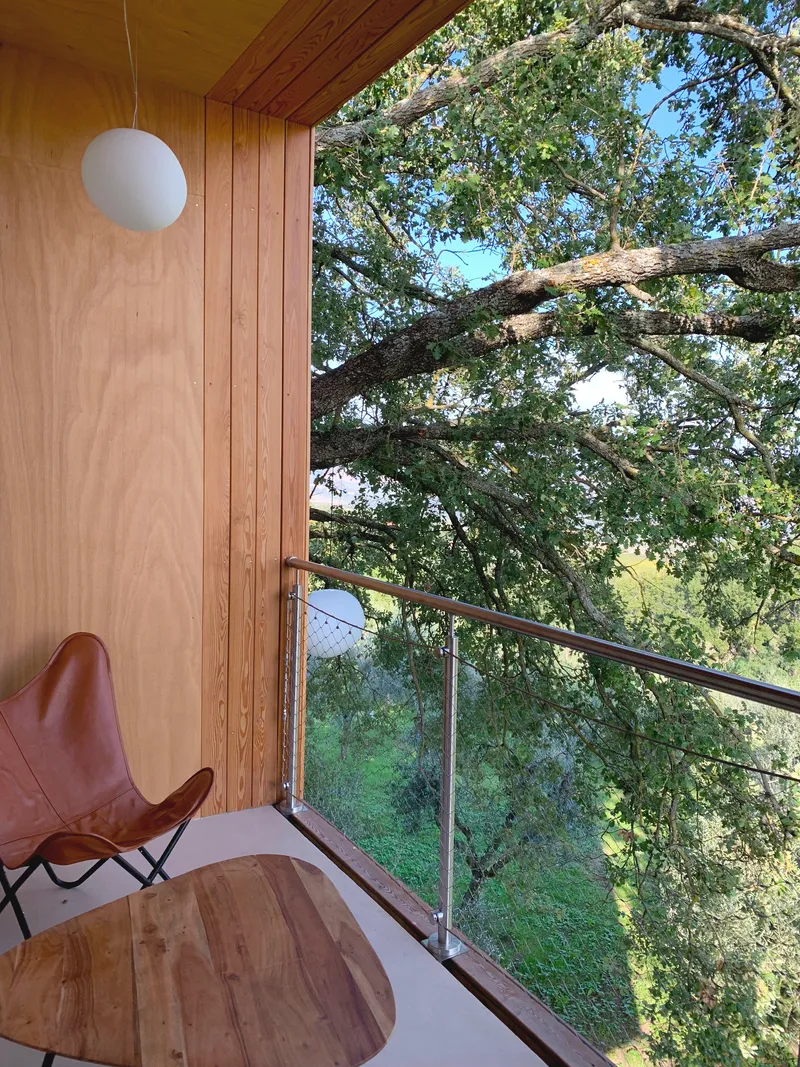
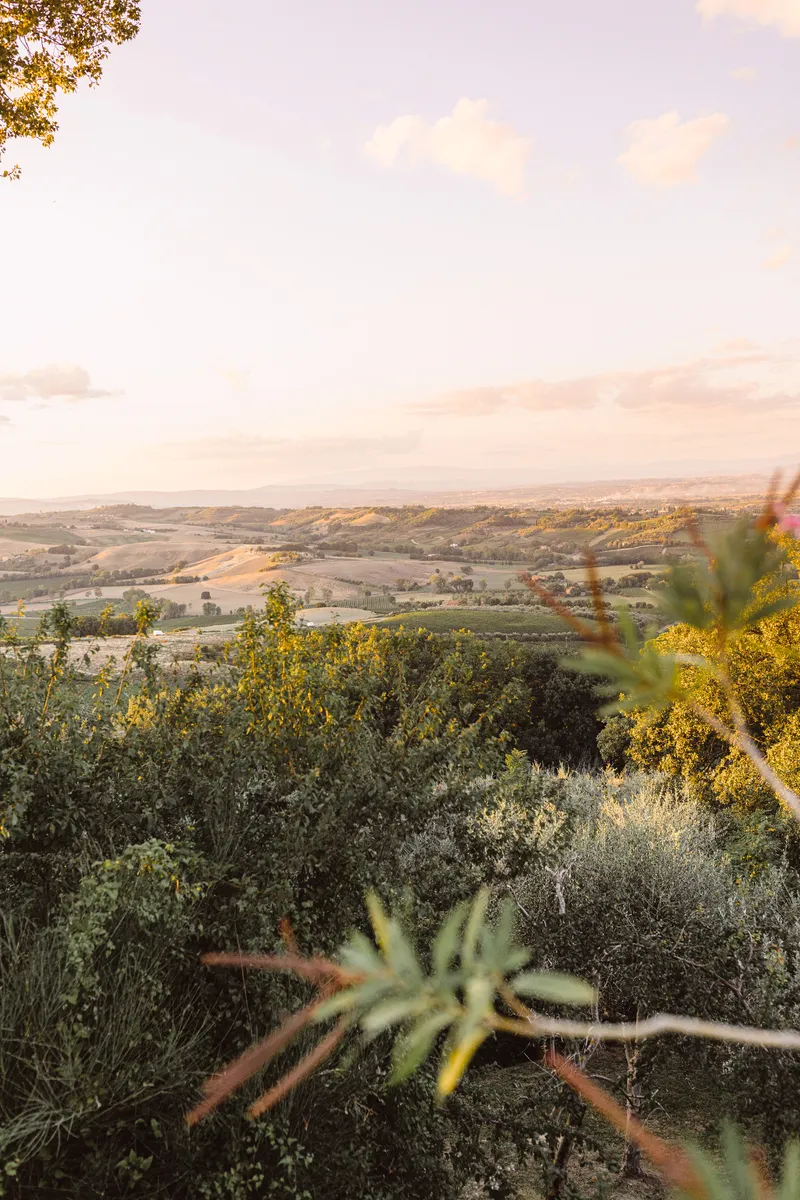
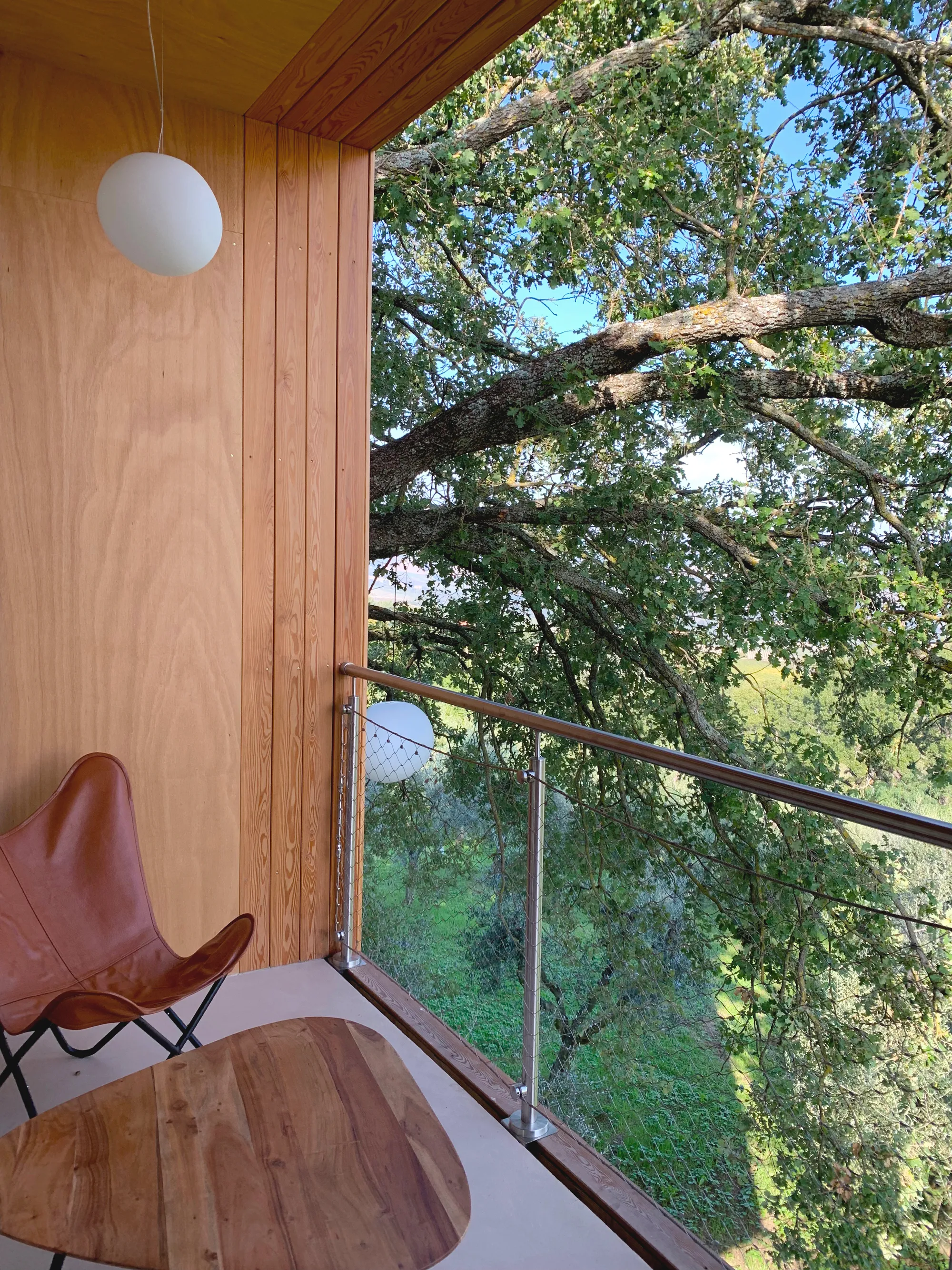
The wood-lined balcony is where the treehouse fantasy becomes fully tangible. A glass railing preserves sightlines down through the canopy while a leather chair invites you to sit and do nothing but watch afternoon light filter through leaves. The detailing is precise but not precious: timber boards, clean joints, no ornamental flourishes. Everything defers to the panorama of rolling Tuscan agricultural landscape stretching toward the horizon at golden hour.
What makes this outdoor space convincing is its proportional restraint. It is just large enough for one person and a drink. The intimacy is the point. A wider terrace would have shifted the experience from perching in a tree to standing on a conventional balcony. Mila understood that the magic of a treehouse lies in compression, not expansion.
Interior Warmth and Material Discipline
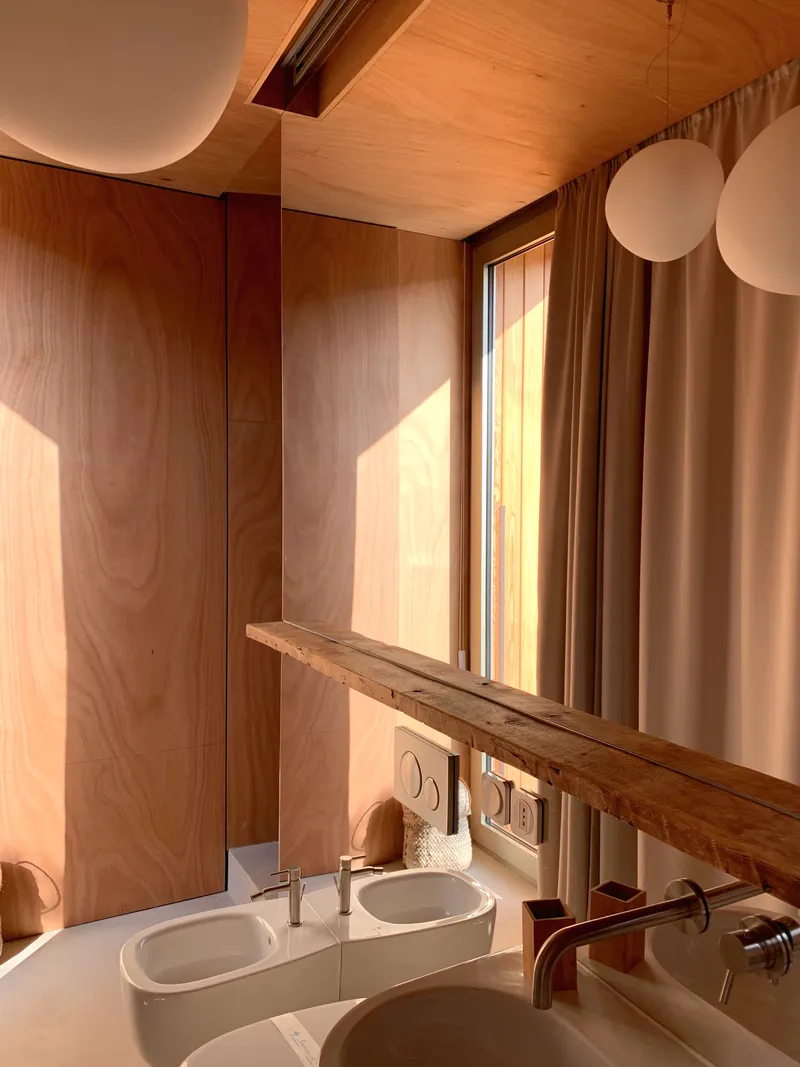
Inside, the material palette is deliberately limited: plywood, timber framing, linen, glass. The bathroom achieves a quiet luxury through proportion and light rather than expensive finishes. Twin sinks sit below a timber-framed mirror that catches warm sunlight through linen curtains. There are no marble slabs, no brass fittings, no signals of conventional hotel opulence. The luxury here is spatial, not material.
This is a significant editorial choice. A client who wants a treehouse hotel room for a boutique property in Tuscany could easily have demanded travertine and heated floors. Mila's restraint keeps the interiors consistent with the exterior language and, more importantly, consistent with the idea of inhabiting a tree. Wood feels right here in a way that stone never would.
Plans and Drawings
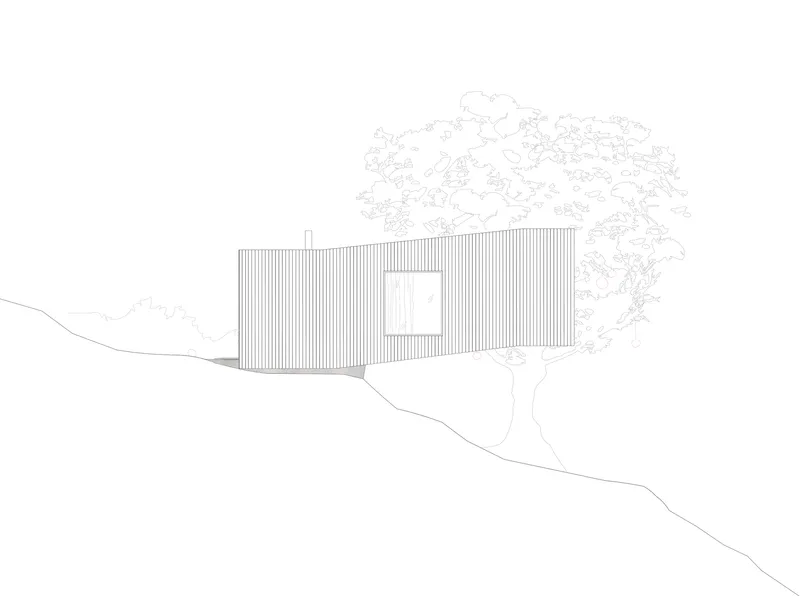
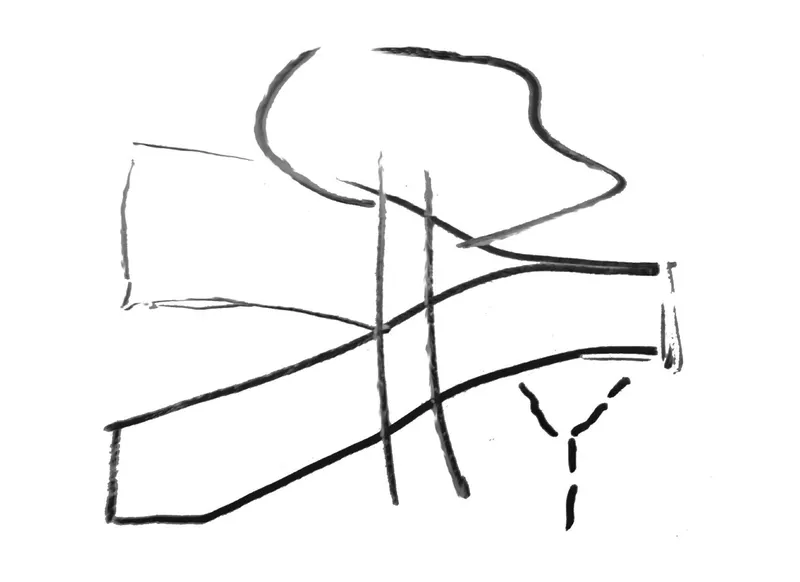
The elevation drawing confirms what the photographs suggest: the building is essentially a wedge driven into the hillside, its height calibrated to meet the canopy of the adjacent tree. The terrain does much of the work, allowing the volume to start low and arrive high without excessive structure. A sketch showing three converging volumes and circulation paths reveals that the plan is more complex than its slender exterior implies. The stair is not simply a vertical connector; it organizes the entire section, pulling the guest upward through a sequence of increasingly open spaces.
Why This Project Matters
Casa Sull'Albero matters because it solves a problem that most architects would either over-engineer or dismiss as frivolous. The treehouse is one of architecture's most potent archetypes, loaded with childhood memory and romantic longing, yet almost always compromised when translated into a real building. Mila sidesteps the structural and ethical problems of building on a living tree by reframing the brief: the goal is not to occupy the tree but to occupy the tree's space. The distinction is subtle but the consequences are significant. The tree survives. The guest gets the view. The building remains buildable.
At just 50 square meters, the project also demonstrates that hospitality architecture does not need to be large to be memorable. The compression of program, the discipline of the material palette, and the precision of the siting all argue that the smallest hotel room on the property may be its most valuable. In a landscape as saturated with beauty as the Tuscan hills near Montepulciano, the architecture wisely does not compete. It lifts you up, points you toward the canopy, and gets out of the way.
Casa Sull'Albero, designed by Mila (lead architect Jakob Tigges, with Luigi Scapin, Silvia Cipirian, and Marc Frederking). Montepulciano, Italy. 50 m². Completed 2019. Photography by Evgeniya Savina and Jakob Tigges.
About the Studio
Share Your Own Work on uni.xyz
If projects like this are the kind of work you want to make, uni.xyz is a place to publish your own, find collaborators, and enter design competitions.




Popular Articles
Popular articles from the community


The Earth Pod: 3D Printed Homes for Resilient Refugee Communities
The Earth Pod reimagines refugee housing through 3D printed homes made from clay, combining resilience, self-sufficiency, and rapid shelter.

The Ocean Hive: Sustainable Architecture for a Self-Sufficient Civilization at Sea
The Ocean Hive imagines sustainable architecture at sea, where modular habitats, algae, wave power and ocean waste sustain a growing colony.

Hill & Cross Opera: Sculptural Opera House Architecture Shaped by Tallinn’s Landscape and Identity
Hill & Cross Opera reimagines opera house architecture in Tallinn through its sculptural hill, civic plaza, glass wave and a luminous cross.

Conexión: Biophilic Design Reimagines High-Rise Living in Hong Kong
Conexión reimagines high-rise living in Hong Kong through biophilic design, green facades, shared spaces, daylight, water and nature within.


Similar Reads
You might also enjoy these articles

Bao Huynh Watercolor Atelier: A Serene Art Retreat in Hội An
Bao Huynh Watercolor Atelier in Hội An blends multifunctional art spaces, sustainable design, local materials, and family-friendly living in a serene environment.

Atelier Macri Concept Store Interior Design by CASE-REAL
Atelier Macri store features a "ko" counter, walnut wood details, cork displays, blending retail, gallery, and seamless customer experiences.

Manuel Vargas Izquierdo Stadium and High-Performance Sports Center: Architectural Excellence in Jalpa de Méndez
The Manuel Vargas Izquierdo Stadium blends sustainable design, inclusive sports facilities, and cultural-inspired architecture, revitalizing Jalpa de Méndez’s public spaces.

KAKR Buluh Awar Hall: Revitalizing Community and Ecology Through Bamboo Architecture
Community built bamboo hall revitalizes Buluh Awar village, empowering youth, restoring ecology, celebrating vernacular craftsmanship through sustainable architecture and culture.


Explore Architecture Competitions
Discover active competitions in this discipline



Challenge to reimagine the Iron Throne


Photograph architecture without architects


Illustrate the lost glory of Angkor Wat - Render Challenge


Design challenge to reuse E-waste
Comments (0)
Please login or sign up to add comments
No comments yet. Be the first to comment!