

AT DESIGN Nests a Seven-Room Hotel on a Mountaintop in China's Tea Country
Miwo Hotel stacks white cubic volumes above Suichang County's forested hills, framing tea gardens through cave-like pools and infinity edges.


Hotels in remote landscapes tend to fall into two traps: they either try to vanish into the terrain or announce themselves so loudly that they overwhelm it. AT DESIGN's Miwo Hotel, perched on a mountaintop in Suichang County, Lishui City, does neither. Its stacked white volumes sit against a backdrop of tea hills, reservoirs, and dense forest like an unapologetic geometric interjection, yet one that is calibrated to channel the landscape rather than compete with it. The result is a 1,120 m² boutique hotel with only seven rooms, where every surface seems engineered to frame a specific view or catch a particular quality of light.
The project's name comes from a Chinese portmanteau fusing "rice grains" and "tree nest," and that duality, between the elemental and the sheltering, runs through every design decision. White-painted concrete reads as pure abstraction from a distance but functions at close range as a reflective canvas for the surrounding greenery. Water threads through the building from an infinity pool on the upper terrace down through interior channels to the entrance, connecting levels both physically and atmospherically. It is a hotel that asks you to slow down, not because it lacks ambition, but because the ambition is directed at perception rather than spectacle.
White Against Green

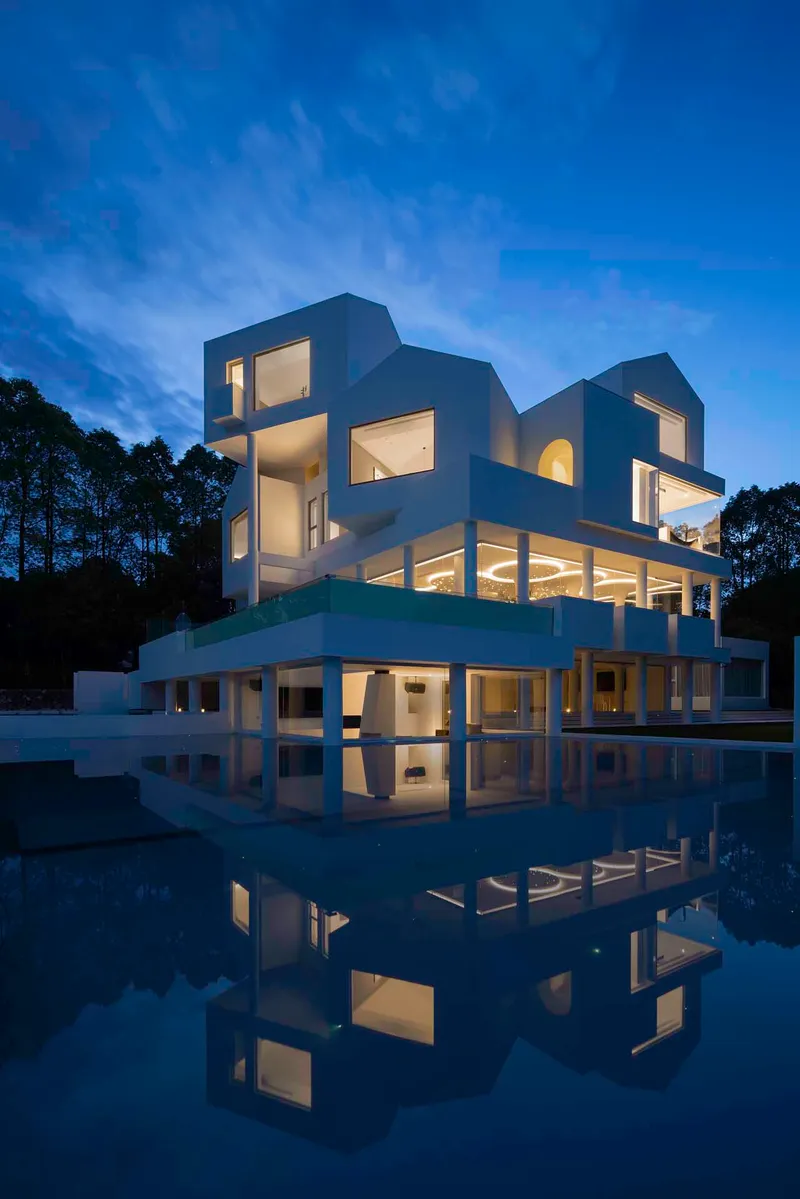
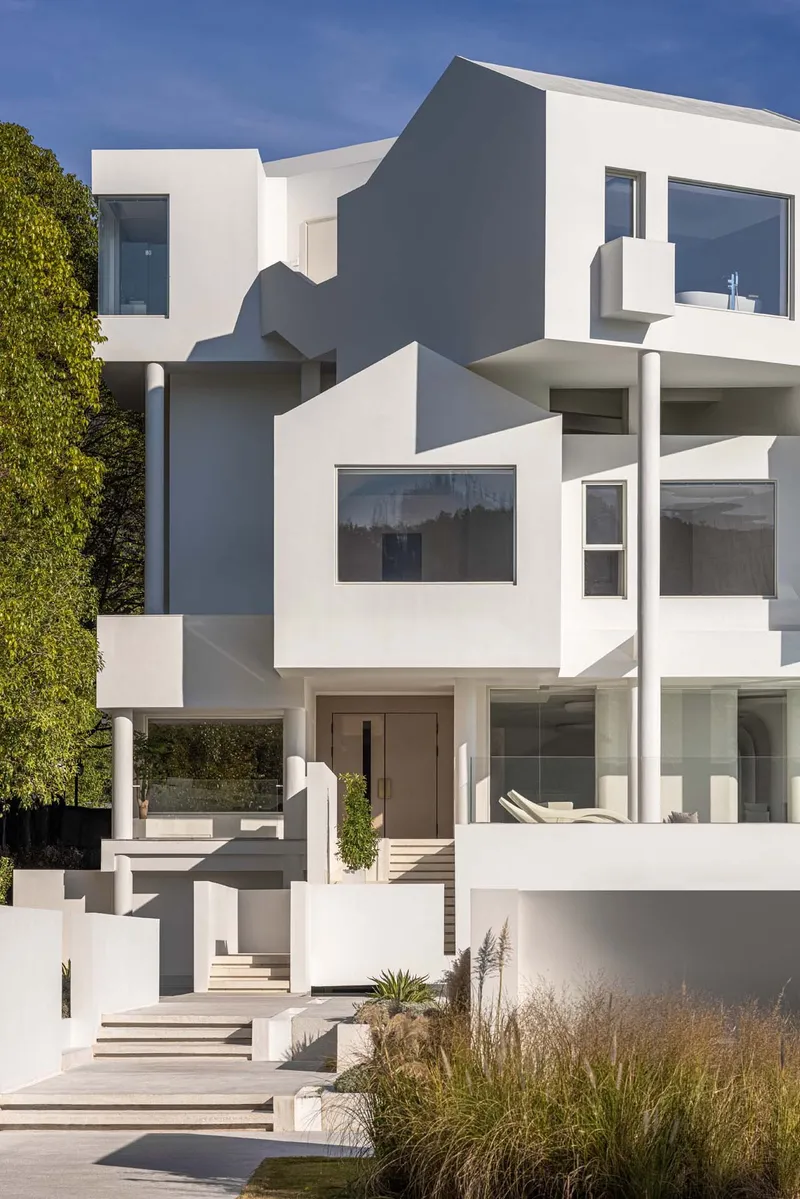
The most striking quality of Miwo Hotel is the deliberate friction between its white-painted surfaces and the lush mountain landscape. AT DESIGN uses white not as a neutral default but as a boundary condition, a way of delineating where architecture begins and forest ends. At dusk, the cubic volumes glow from within, their rectangular apertures becoming lanterns on the hillside. During the day, the same surfaces bounce light into planted terraces and cascading stairs that reference the tiered growth of the surrounding tea gardens.
The terraced front elevation is particularly effective. Stepped planting beds integrate with curved geometries, softening the orthogonal stacking without resorting to organic mimicry. The building doesn't pretend to be a hill; it acknowledges that it is a constructed thing sitting on one.
Water as Architecture
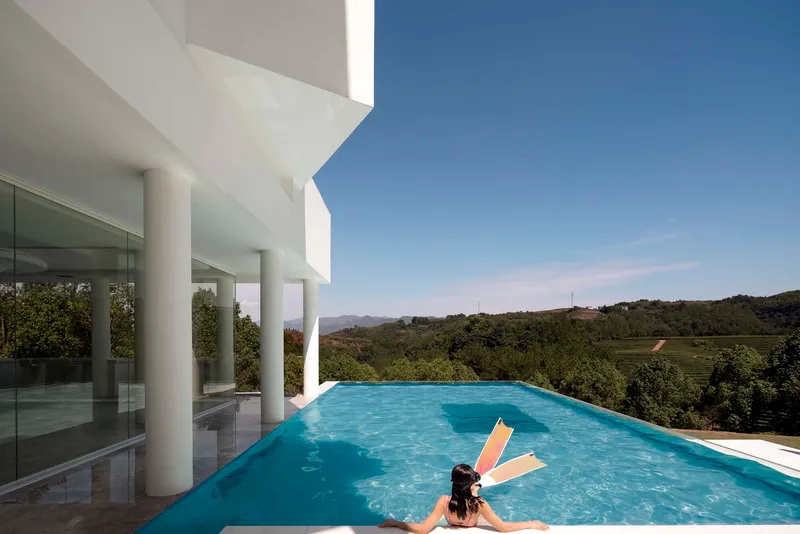
Water does more work here than in most hospitality projects. The infinity pool, supported by white cylindrical columns and overlooking rows of tea gardens and forested ridgelines, is the building's signature image, and deservedly so. A swimmer at the pool's edge is suspended between constructed geometry below and rolling landscape ahead. The pool functions as the medium that dissolves the boundary between inside and outside, which is a concept that could sound like marketing copy but is spatially real here.
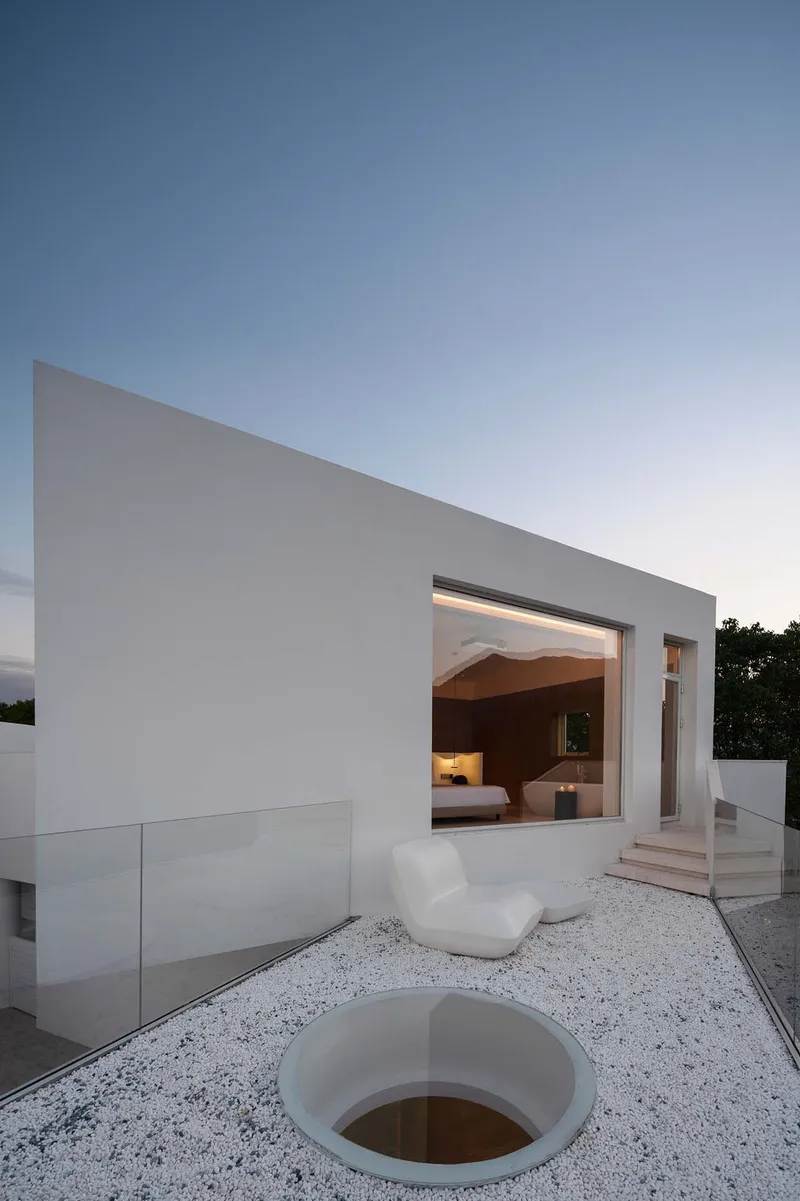
Below, circular skylights punch through terrace surfaces to deliver light into underground spaces, while an inner water system channels flow from upper levels down to the entrance. The region's identity is rooted in hot springs, and AT DESIGN treats water not as an amenity to bolt on but as a circulatory system threaded through the building's section.
Carved Interiors
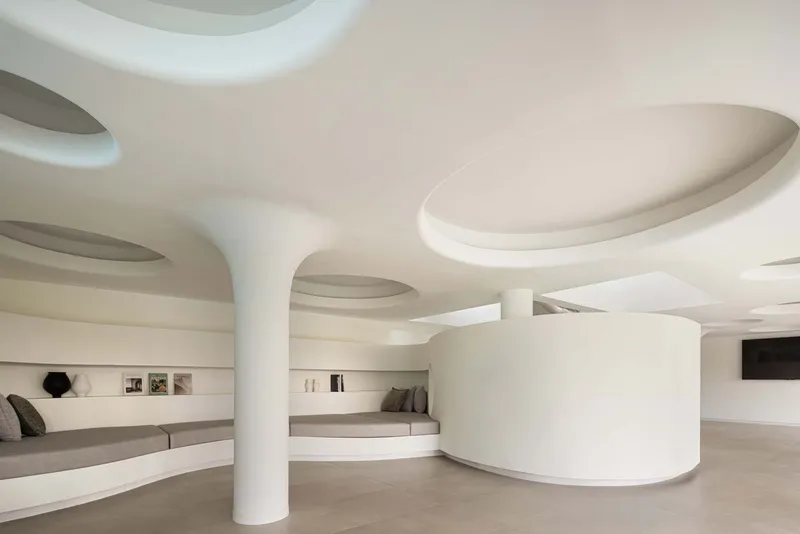
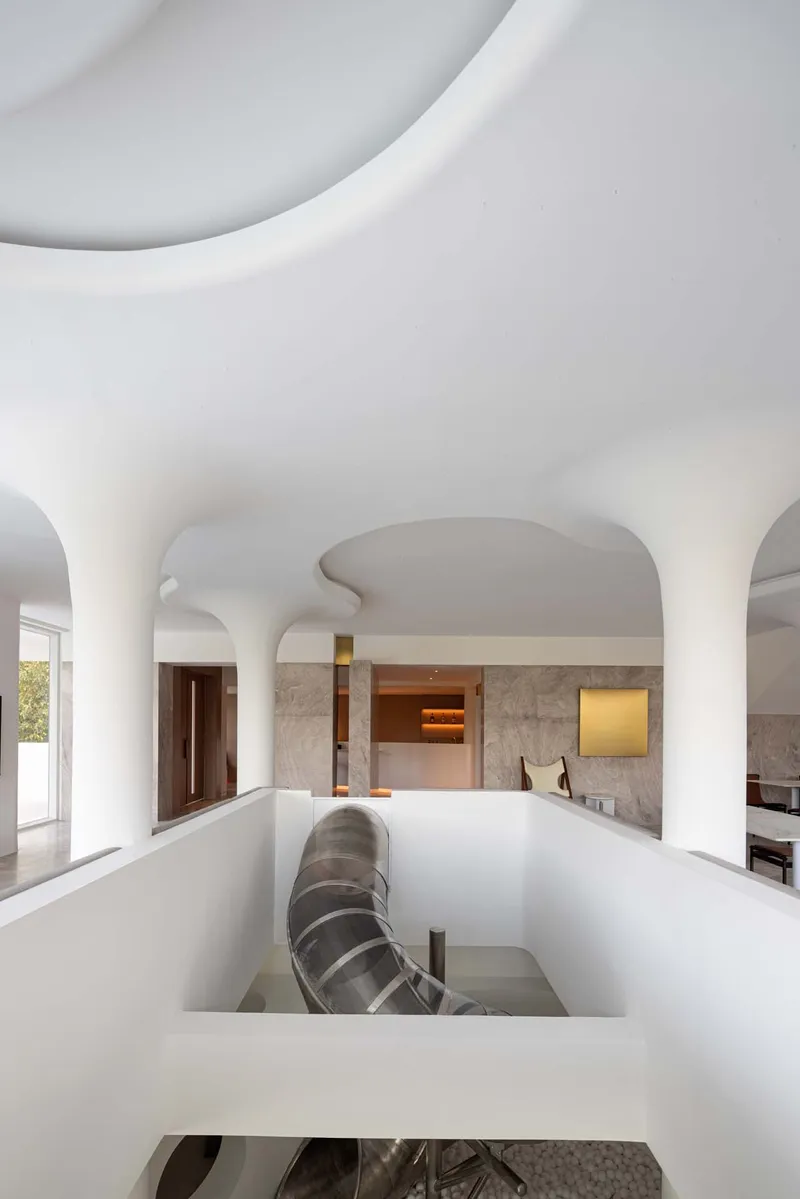

Inside, the palette narrows to white surfaces, marble walls, and wood floors. Columns rise from the ground floor and connect to curved ceiling structures that wrap overhead, creating a sequence of vaulted and scooped geometries that feel carved rather than assembled. In the reception lounge, large circular forms line the ceiling, concealing lighting fixtures while producing a softly modulated glow. A marble wall separates the reception area from a quieter resting zone, using material mass rather than doors to create spatial privacy.
The vertical connections are equally considered. A sculptural stair with curved white walls transitions between levels, while openings punched through floor plates reveal upper levels with stone walls and timber doors. The effect is one of continuous spatial discovery: you see fragments of rooms above and below, and the hotel's compactness, only seven rooms across the building, keeps the scale intimate enough for these glimpses to feel personal rather than theatrical.
Framing the Tea Garden
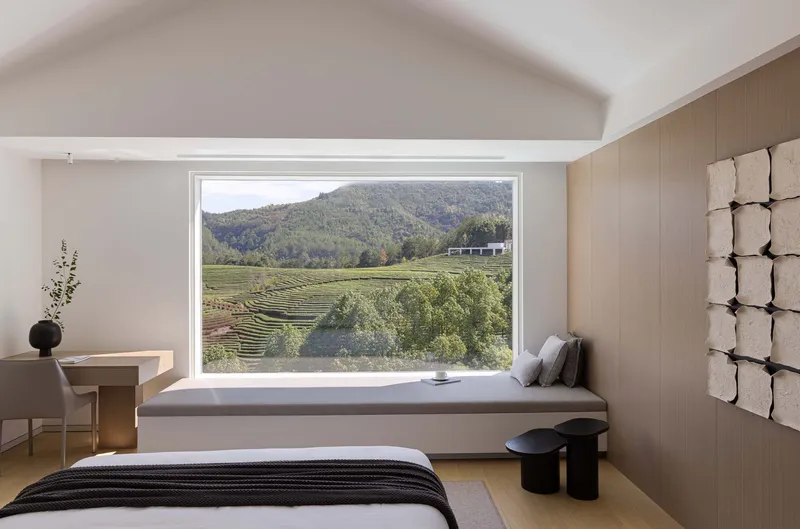
The guest rooms, particularly the three independent family rooms on the third floor, treat the window as a piece of furniture. Wide horizontal openings double as window seats, pulling the terraced vineyard rows and distant hillsides into the room at eye level. Floor-to-ceiling glass is used selectively rather than universally; each opening is oriented for a specific environmental condition or vantage point, which suggests that AT DESIGN considered the view from each room as a design variable, not a checkbox.
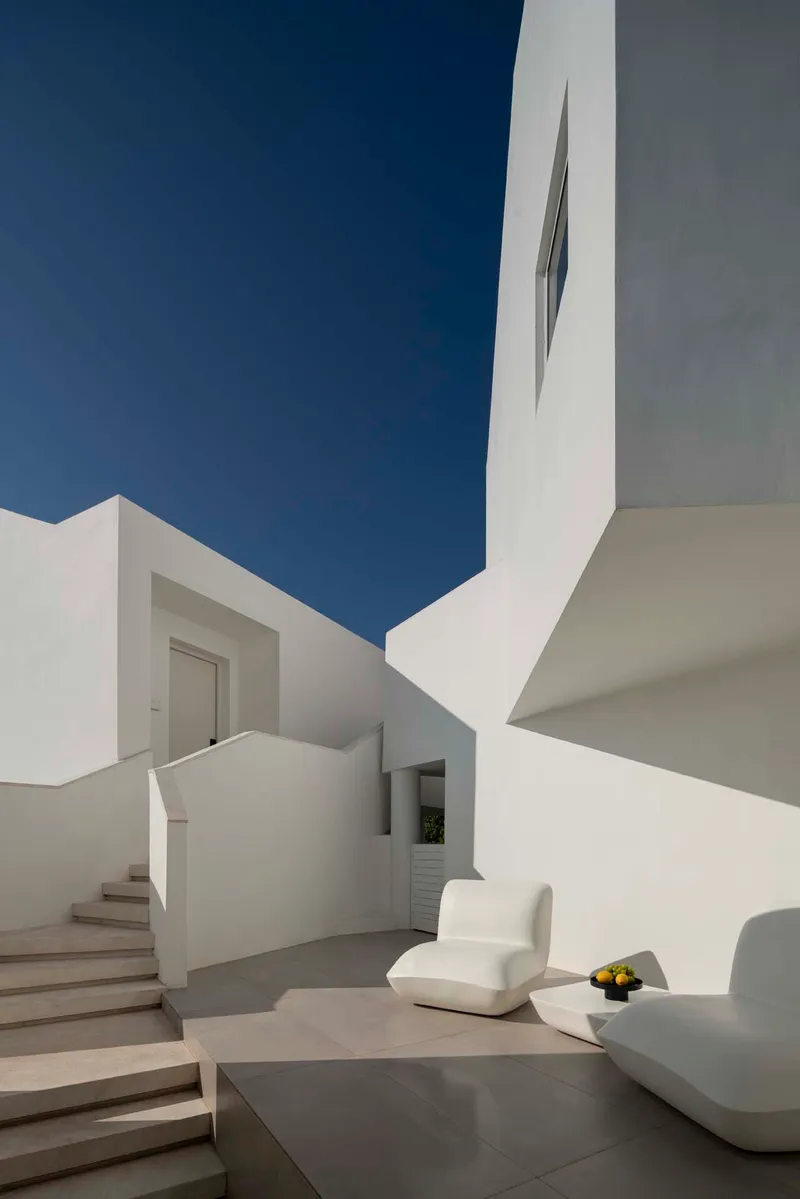
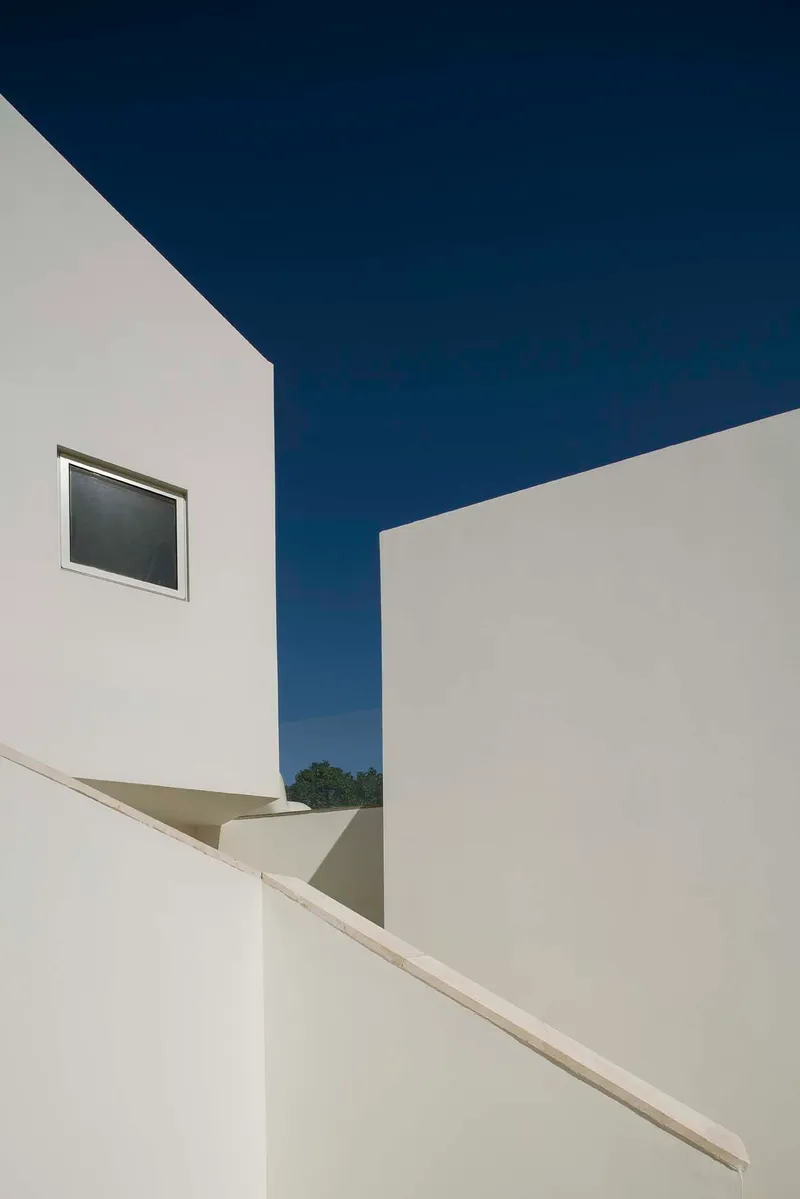
On the exterior terraces, angular white walls frame slices of deep blue sky, compressing the visual field into pure color and geometry. These moments are the hotel at its most minimal: white gravel underfoot, white walls on either side, and sky overhead. The restraint is effective precisely because the surrounding landscape is so lush. The building provides contrast, and the landscape provides content.
Plans and Drawings
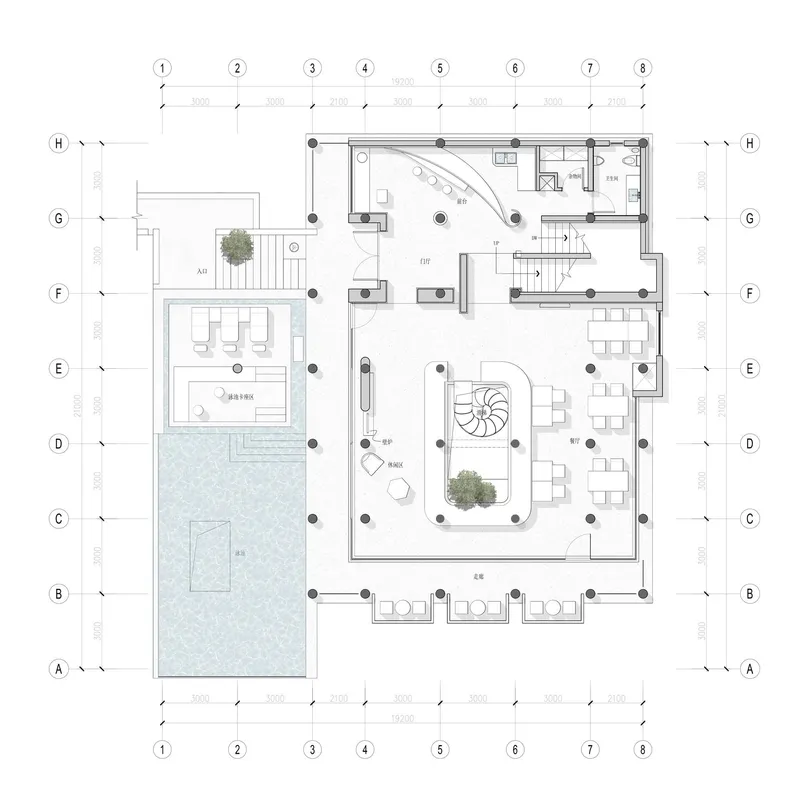
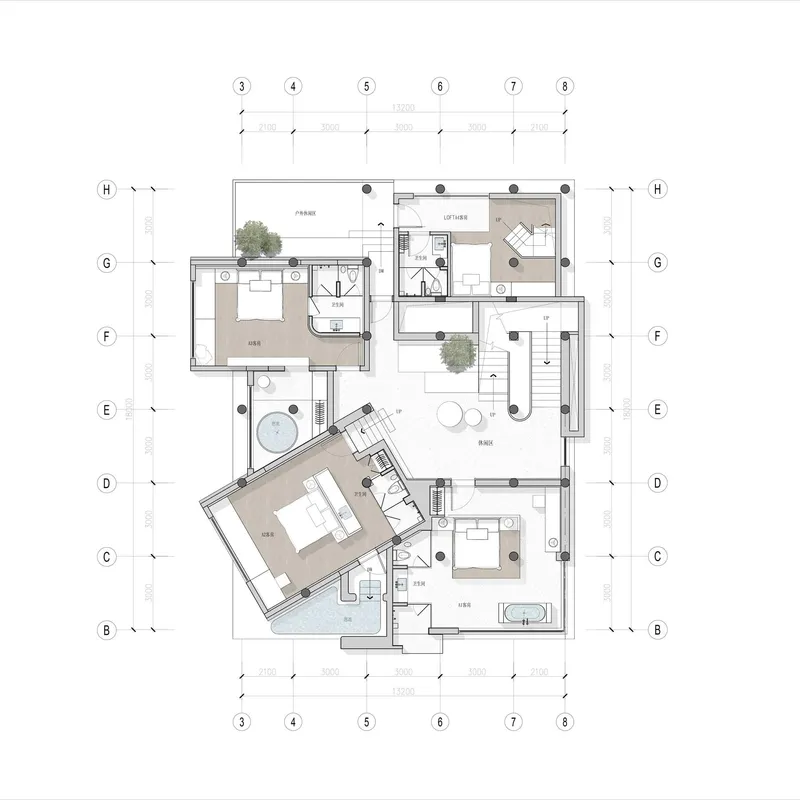


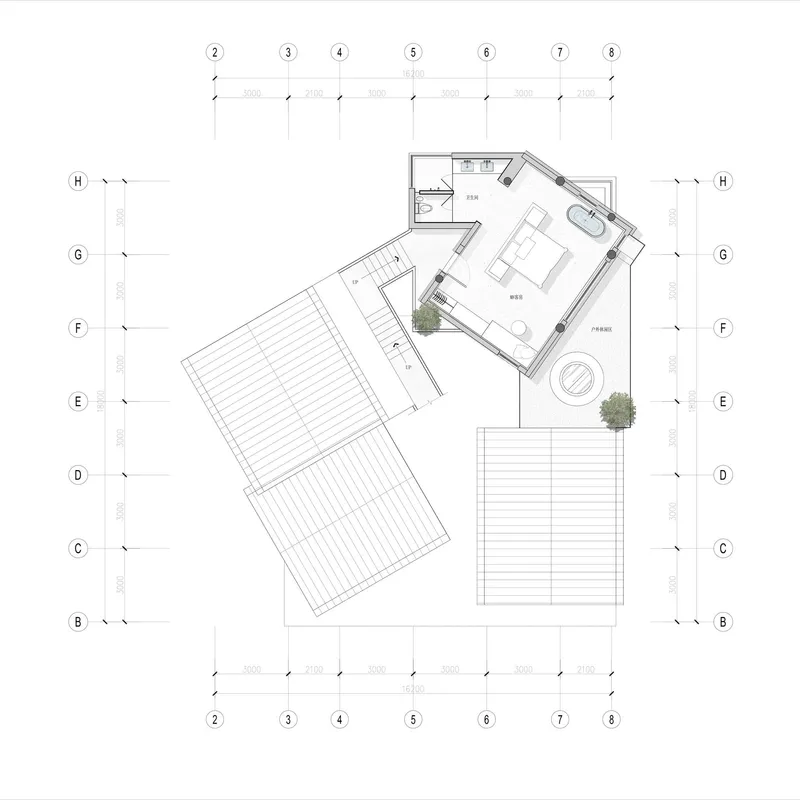
The plans reveal the organizational logic beneath the sculptural exterior. Living spaces cluster around a central spiral stair and pool terrace, while an angled volume containing living and dining areas extends toward planted courtyards. The bedroom wing on the upper floor wraps around an interior courtyard with trees, and the roof plan shows the circular feature and angled deck areas that read so strongly from the exterior. At basement level, an organic pool form sits beneath a gridded structural system, a contrast between free geometry and rational construction that characterizes the entire project.
What the drawings confirm is how tightly the plan is organized for a building of only 1,120 m². Every room has a specific relationship to landscape, water, or sky, and the circulation paths are designed to produce moments of spatial surprise as you move between levels. A rotating slide connects to the underground event space, an unexpected programmatic gesture that suggests the hotel is designed for engagement, not just contemplation.
Why This Project Matters
Miwo Hotel is a case study in how a small footprint can produce outsized spatial richness. With seven rooms and barely over a thousand square meters, AT DESIGN has built a hotel that feels expansive because of its sectional complexity and its deliberate manipulation of thresholds between inside and outside, solid and void, white surface and green landscape. The building earns its drama through discipline: the material palette is tight, the formal moves are few, and each one is pushed far enough to register.
More broadly, the project demonstrates that rural hospitality architecture in China does not need to default to either nostalgic timber construction or flashy parametric forms. There is a third path, one rooted in clear geometric logic and a genuine response to site, that produces buildings worth visiting for the architecture itself. AT DESIGN has built something that belongs on its mountaintop without pretending it grew there.
Miwo Hotel by AT DESIGN. Located in Lishui, China. 1,120 m². Completed in 2022. Photography by Yusong Zeng and Song Ye.
About the Studio
Share Your Own Work on uni.xyz
If projects like this are the kind of work you want to make, uni.xyz is a place to publish your own, find collaborators, and enter design competitions.


Popular Articles
Popular articles from the community

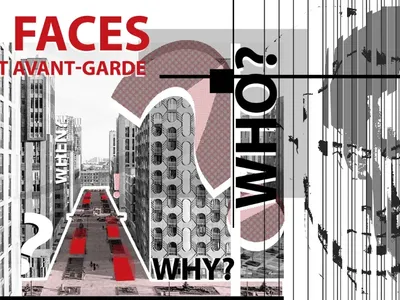
Faces of the Soviet Avant-Garde: Turning Moscow's Street Names into an Open-Air Museum
A network of sculptural installations across a Moscow residential district transforms forgotten architect names into spatial encounters with cultural memor

Manzana Morphosis: Stretching Barcelona's Grid into a Living Landscape for 2050
A radical reworking of the Eixample manzana turns density into a tool for generous public space, vertical ecology, and environmental performance.
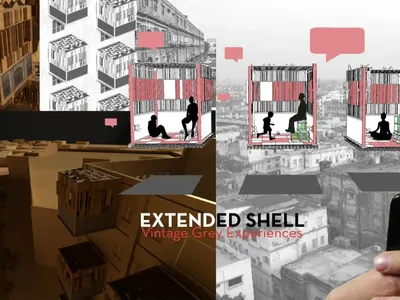
Extended Shell: Retrofitting Kolkata's Balconies as Living Urban Thresholds
A modular retrofit system recovers the social and environmental intelligence of Kolkata's historic verandas for contemporary Park Street residents.

Singing Woman: An Opera House That Performs Before the Curtain Rises
Ovidiu Cristian Pavel's conceptual opera house translates Estonia's choral identity into a sculpted waterfront landmark facing the Baltic Sea.

Similar Reads
You might also enjoy these articles

Pixel Gardens: One Repeated Module Stacked Into a Terraced Social Housing Tower for Famagusta
Salem Bader's shortlisted housing tower builds a vertical neighbourhood from one repeated module, offsetting units to carve terraces, light and air.

Bao Huynh Watercolor Atelier: A Serene Art Retreat in Hội An
Bao Huynh Watercolor Atelier in Hội An blends multifunctional art spaces, sustainable design, local materials, and family-friendly living in a serene environment.

Atelier Macri Concept Store Interior Design by CASE-REAL
Atelier Macri store features a "ko" counter, walnut wood details, cork displays, blending retail, gallery, and seamless customer experiences.

Manuel Vargas Izquierdo Stadium and High-Performance Sports Center: Architectural Excellence in Jalpa de Méndez
The Manuel Vargas Izquierdo Stadium blends sustainable design, inclusive sports facilities, and cultural-inspired architecture, revitalizing Jalpa de Méndez’s public spaces.

Explore Hospitality Building Competitions
Discover active competitions in this discipline

Challenge to reimagine the Iron Throne

Photograph architecture without architects

Illustrate the lost glory of Angkor Wat - Render Challenge

Design challenge to reuse E-waste
Comments (0)
Please login or sign up to add comments
No comments yet. Be the first to comment!