


Industrial Heritage
Adaptive reuse of factories, mills, and industrial sites, from museums and urban furniture to water treatment and mixed-use precincts.
Industrial heritage is the physical and social legacy of industry: the mills, mines, gasworks, warehouses, railways and machines left behind when production stops or moves elsewhere, together with the skills and communities that grew around them. For architects it is above all a design problem: deciding what to keep, what to change and how a former workplace can take on a new life without erasing the evidence of what happened there.
What is industrial heritage?
The working definition used by most conservation bodies comes from TICCIH, the international committee for the conservation of the industrial heritage. Its Nizhny Tagil Charter treats industrial heritage as the remains of industrial culture that carry historical, technological, social, architectural or scientific value. That covers far more than handsome brick factories. Machinery, workers' housing, transport networks, spoil heaps, archives and even the know-how of a trade all count.
The field sits between several others. Industrial building is the design of facilities for industry that is still working: warehouses, plants and logistics sheds built to a production brief. Industrial heritage starts from the other end, with a site whose original function has ended or is ending, and asks what it means and what it can become. It borrows its method from conservation architecture (survey, assessment of significance, minimum intervention) and most of its built outcomes from adaptive reuse, where an existing structure is fitted to a new program.
What makes industrial sites distinctive is their scale and their spatial logic. Halls were sized for machines, not people. Floors were designed for heavy loads, roofs for daylight, and whole districts were organised around rail sidings and water. Those qualities are the reason many former factories convert well into galleries, markets and workplaces, and also the reason they are hard to heat, to make accessible and to connect back into the city around them.
A short history of industrial heritage
The story usually starts in the Severn valley in England. The Iron Bridge, built in 1779 and opened to traffic on 1 January 1781, was the first major bridge in the world made of cast iron, with ironwork cast by Abraham Darby III. The bridge and the surrounding gorge were inscribed together as the Ironbridge Gorge World Heritage Site in 1986.

In Germany's Ruhr, the Zollverein Coal Mine Industrial Complex in Essen showed that a modern industrial site could also be a monument. Shaft XII, designed by Fritz Schupp and Martin Kremmer, opened in 1932. Mining there stopped on 23 December 1986, the coking plant closed in 1993, and the complex was inscribed as a World Heritage Site in 2001. Its former boiler house now holds the Red Dot design museum and the coal washery holds the Ruhr Museum.

The field gained its international text in 2003, when TICCIH presented the Nizhny Tagil Charter at its congress in Russia. The charter opens with a definition that is still quoted in most heritage assessments:
"Industrial heritage consists of the remains of industrial culture which are of historical, technological, social, architectural or scientific value."
TICCIH, The Nizhny Tagil Charter for the Industrial Heritage (2003)
Around the same time, a run of large conversions turned the idea into architecture that the public could visit. In Vienna, four brick gasholders built between 1896 and 1899 were converted between 1999 and 2001 by Jean Nouvel, Coop Himmelb(l)au, Manfred Wehdorn and Wilhelm Holzbauer into apartments, offices and shops, keeping only the historic outer walls and parts of the roofs. In London, Bankside Power Station, designed by Sir Giles Gilbert Scott and shut down in 1981, reopened as Tate Modern on 11 May 2000 after Herzog & de Meuron won the conversion competition. In New York, an elevated freight line fully operational by 1934 became the High Line: Friends of the High Line was founded in 1999 and the first section opened as a public park in 2009.
Key principles of industrial heritage
Establish significance before you design
Good projects begin with a survey of what the site actually holds: structure, machinery, traces of process, and the memories of the people who worked there. That assessment decides what is untouchable and what can change. Fahim Rezve's Rejuvenate Jute Culture, a Museum for Golden Fiber starts from exactly this position, proposing to conserve the existing structures and spaces of the Adamjee jute mill and to use them to tell the history of jute.
"The purpose of this project is to point out the possibility and importance to revitalize Adamjee jute mill as a heritage site."
Fahim Rezve, project statement for Rejuvenate Jute Culture on uni.xyz

Keep old and new legible
Most strong conversions let a visitor tell the original fabric from the new work. Sasha Pokidova's proposal for the former Bromley factory in Moscow, shortlisted in Public Architecture '20, keeps the brick hall as one structure and sets a reflective, drop-shaped museum beside it, so that neither absorbs the other.
Let the existing structure suggest the program
Big spans, heavy floors and tall volumes favour some uses over others. At Tate Modern, the sheer size of the former power station's Turbine Hall made it a space for giant commissioned works, starting with Louise Bourgeois when the museum opened in 2000. On a smaller scale, Polina Romanova's Thermal Pool "Depot" turns an abandoned steam engine house, once a "hospital" for trains, into a place for restoring the human body.

Open the closed site to the city
Factories were fenced and inward-looking. Reuse usually means cutting new routes through them. In Melbourne, Genton's Morris Moor strips a former cigarette factory back to its structure and uses corridors, courtyards and planted walkways to stitch the six-hectare campus into the streets around it.
Treat land and water as part of the heritage
Mines, quarries and processing plants leave altered ground behind. Sharron Clark's Sustainable Scars: Reanimated Region proposes permaculture to turn a scarred mining landscape green while preserving its history, and Filip Kostic's Aqualution Center sets out to honour a site's technological history while repaying the debt to nature depleted there.
Industrial heritage on uni.xyz
Members approach the subject at every scale, from street furniture to whole districts, and UNI journals track built conversions around the world.
1x1 Industrial Urban Furniture by Mykolas Šečkus and Antonio Gandolfo, a winning entry in the Urbanscape: Symbiosis competition, was conceived for Refshaleøen island in Copenhagen, a place proud of its industrial heritage. Its modules hang on a 3D grid of one-metre cubes framed by vertical pipes, borrowing the language of industrial piping for street furniture.

Empathy with Nassaji by Zahra Shirzadnia received the People's Choice Award in the Adaptive Reuse '22 competition. It takes on Ghaemshahr Textile Factory No. 1 in Mazandaran, described as one of the first and oldest textile factories in the country, a large site in the centre of the city with the main street on one side and the railway on the other.

Transformation of Industrial Territories by Анастасия Калинкина, a bachelor's graduate thesis and People's Choice Award winner in the UnIATA '22 competition, scales the question up to neighbourhood planning: multifunctional districts built on historicity, identifiability and connectivity, with varied building types, courtyards and landscaping.

Coaliving: A new post-mining agricultural typology by Dunja Dedic, a winning entry in the Transfarm competition, looks at life after extraction. Instead of farming alone, it asks whether small-scale processing of raw produce can sustain struggling rural communities. In a different landscape, Salinetorium by Zhenxiong Yang, Alan Fan and Chia-Chia Liu, an Editor's Choice in the Proximity Island 2019 competition, imagines a museum park and factory island that uses salt to slowly transform an offshore rig into a human habitat.
The journals add built precedent. Liugong Hui by CCTN Design reworks part of Beijing's Shougang steel mill, founded in 1919 and closed in 2005, as 11 standalone flagship buildings and a central shopping centre, each adapted from an existing industrial structure. Younghusband Woolstore by Woods Bagot keeps the saw-tooth roof, ghost signage and patina of an early twentieth-century woolstore in Melbourne while adding new uses with deliberate restraint. And Cidade BI4ALL Offices by Pedra Líquida converts two warehouses of a former sugar factory in East Lisbon into offices, keeping their volumetric scale and inserting self-supporting metal structures that touch the old fabric as little as possible.
Challenges and future directions
Industrial sites are rarely easy. Ground and structures may be contaminated, and bringing a building up to current standards for fire safety and access can threaten the very character that made it worth saving, a tension the Younghusband Woolstore project addresses directly. Some sites have almost nothing left to conserve: the Worcester Blackstone Visitor Center by designLAB architects was built where a fire had destroyed the last steel mill structure, so its design has to carry the history in form and material instead.

The larger risk is economic. Well-located industrial land attracts redevelopment that keeps a chimney as decoration and replaces everything else. Kacper Klaus frames this in his thesis journal on the former Hutmen site in Wrocław:
"Industrial areas often occupy strategically valuable locations within cities, yet many remain inaccessible, underused, and physically separated from surrounding neighbourhoods after production has ceased."
Kacper Klaus, The Spark (uni.xyz journal)
The direction of travel is toward smaller, earlier and more social interventions, like Klaus's activity centre that opens a site before large-scale redevelopment arrives, and toward counting reuse as climate policy. The Nizhny Tagil Charter already argued that continuing to adapt and use industrial buildings avoids wasting energy, and that argument has only grown stronger.
Industrial heritage for students and designers
Industrial sites make rich thesis material because they combine history, structure, landscape and social questions in one place. Useful angles include:
- Mapping a local factory, mill or depot and writing a statement of significance before drawing anything.
- Designing a minimal first phase that opens a closed site to the public, then a long-term plan around it.
- Testing how far an industrial structure can take new loads, floors or insulation without losing its character.
- Working with contaminated or post-mining land as a design material, not a blank slate.
Open briefs on reuse and regeneration appear regularly in uni.xyz competitions. For related reading, browse heritage renovation and regeneration.
Frequently asked questions
What counts as industrial heritage?
Anything that carries historical, technological, social, architectural or scientific value from industrial culture. That includes factories and mines, but also machinery, workers' housing, canals, railways, landscapes shaped by extraction, and records of how work was done.
What is the difference between industrial heritage and industrial architecture?
Industrial architecture is the design of buildings for industry, past or present. Industrial heritage is the subset of industrial places valued as historic evidence, usually discussed when their original use has ended and the question becomes conservation or reuse.
What is the Nizhny Tagil Charter?
It is TICCIH's founding text on industrial heritage, presented at its 2003 congress in Russia. It defines the field, sets out how to identify and record industrial sites, and accepts adaptation to a new use as a usual way of keeping them, with limits for the most significant sites.
What are famous examples of industrial heritage reuse?
Widely cited cases include Zollverein in Essen, Tate Modern in London, the Gasometers in Vienna and the High Line in New York. Ironbridge Gorge in England is a key example of conservation of an early industrial landscape.
Is reusing industrial buildings sustainable?
Generally yes, because the structure and much of its embodied energy are kept. The real performance depends on how much insulation, servicing and structural work the conversion needs.
References and further reading
- The Nizhny Tagil Charter for the Industrial Heritage, TICCIH
- The Iron Bridge, Wikipedia
- Zollverein Coal Mine Industrial Complex, Wikipedia
- History of Tate Modern, Tate
- Gasometer, Vienna, Wikipedia
- History of the High Line, Friends of the High Line


Popular projects
View all 53 projects


Latest journals
View all 101 journals
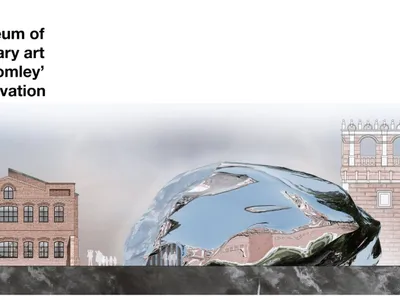
Renovation of the Former Bromley Factory: A Mirror Drop Museum Facing the Donskoy Monastery
Sasha Pokidova sets a reflective museum volume beside a Moscow brick factory, turning its surface into an archive of monastery, industry and city.

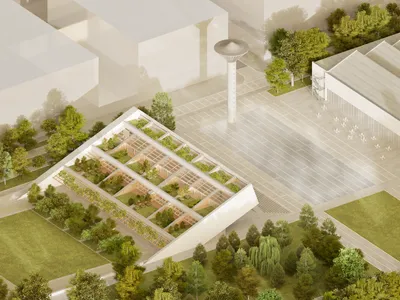
The Spark: Reimagining a Post-Industrial Landscape through Community, Nature and Adaptive Architecture
Where Industrial Heritage Meets Community and Nature.


Genton Converts a Sprawling 1950s Cigarette Factory in Moorabbin into a Mixed-Use Hospitality Precinct
Morris Moor transforms six hectares of Philip Morris industrial heritage into a lush commercial village on Melbourne's suburban edge.
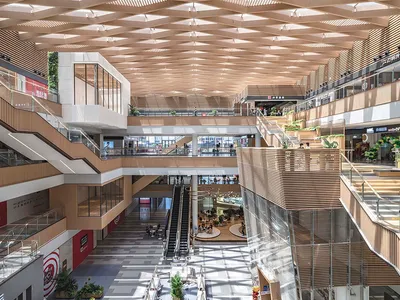
CCTN Design Converts a Century-Old Beijing Steel Mill into a 223,000 m² Lakeside Mall
Liugong Hui reimagines Shougang's industrial heritage between two lakes as a post-Olympic commercial campus in west Beijing.


