

Genton Converts a Sprawling 1950s Cigarette Factory in Moorabbin into a Mixed-Use Hospitality Precinct
Morris Moor transforms six hectares of Philip Morris industrial heritage into a lush commercial village on Melbourne's suburban edge.


For decades, the Philip Morris cigarette factory sat at the corner of two main roads in Moorabbin, a low-density suburb on the southern fringe of Melbourne. The cluster of modernist and brutalist warehouse buildings, erected from the 1950s onward, formed a familiar landmark, their red brick and concrete volumes standing apart from the surrounding prefab industrial sheds. When production ceased, the six-hectare site presented a question that suburban Australia increasingly faces: what do you do with an enormous industrial campus that a neighbourhood has grown up around?
Genton's answer with Morris Moor is neither demolition nor museum-grade preservation. Instead, the firm strips the buildings back to their original structural character, removes decades of ad hoc additions, and inserts a new programmatic life organized around a hospitality core. Offices, childcare, artisan studios, and e-commerce workspaces radiate outward from a central social precinct, while car parking disappears into existing warehouse shells. The real design move, though, is in the spaces between: interstitial corridors, courtyards, and planted walkways that crack open a formerly impermeable industrial campus and stitch it into the residential streets around it.
An Industrial Landmark Reframed


The most visible intervention is the dark perforated metal facade that wraps key corners of the precinct. At dusk, the screen reads as a sharp, almost theatrical counterpoint to the original brick masses behind it, its perforations catching light while the glass curtain wall beneath glows from within. From the air, this contemporary skin slots neatly among the warehouse rooflines, signaling that something has changed without pretending the industrial past never existed.
Genton uses black steel throughout these insertions as a deliberate material contrast. Where original red brick and poured concrete speak of mid-century manufacture, the new steel elements announce themselves as additions, not replicas. The honesty is welcome. Too many adaptive reuse projects blur the line between old and new until neither registers. Here, each era is legible.
The Courtyard as Civic Spine


The central courtyard sequence is the project's strongest proposition. Timber decking, vine-covered steel columns, and planters with native species create a layered outdoor room that feels genuinely inhabited. Families move through sunlit pathways beneath trellis canopies that will only improve as the planting matures. The scale is generous, broad enough to serve as a gathering space, narrow enough to feel sheltered by the flanking brick volumes.
These interstitial spaces were the key design focus, and it shows. By stripping away later additions that had sealed off gaps between buildings, Genton recovered a network of pedestrian corridors that now connect the precinct to its surrounding streets. In a suburb where the car dominates, carving out walkable green routes through a superblock-sized site is a quietly radical act.
Public Plazas and Art Anchors


Several plazas punctuate the precinct, each anchored by concrete plinths, seating steps, and a bright blue sculpture that injects a jolt of color against the brick and concrete palette. The oversized lettering on one brick facade leans into the site's identity without resorting to pastiche. It reads more as graphic branding than heritage signage, which suits a precinct that is clearly looking forward.
The planted beds and young trees in these public zones serve a dual purpose. They soften hardscape that could easily feel oppressive at this scale, and they tie into a broader rainwater reuse system that irrigates the native plantings across the entire site. The landscape strategy is modest in its individual gestures but significant in aggregate: lush native vegetation across six hectares begins to redefine an area that was once sealed concrete and asphalt.
Canopy Edges and Shopfront Life


Along the primary pedestrian routes, deep concrete canopies extend over shopfront glazing, providing weather protection and a strong horizontal datum that unifies buildings from different architectural eras. Genton's challenge here was cohesion: how do you make warehouse structures built over several decades read as a single precinct? The answer is a consistent language of canopy, paving, and planting that threads through the site without homogenizing the underlying architecture.
The effect at ground level is something closer to a European market street than a suburban shopping center. Families linger rather than pass through. The glazing is generous enough to activate the edges, and the canopy depth is calibrated to shade without darkening the interiors behind.
Interior Character: Lobby and Play


Inside, Genton lets the original structures do much of the work. The double-height lobby retains gridded concrete wall panels that could easily have been clad over; instead, they become the feature, set off by track lighting and timber banquettes beneath a cantilevered staircase. It is a restrained interior that respects the brutalist bones of the building while making the space warm enough for daily use.
The indoor play area is a more surprising inclusion. Exposed steel trusses soar overhead while artificial turf, planted beds, and timber columns create a soft landscape beneath. Childcare is embedded in the precinct's program, not bolted on as an afterthought. For a mixed-use development targeting a suburban family demographic, this is a smart integration of amenity and architecture.
The Warehouse Volumes
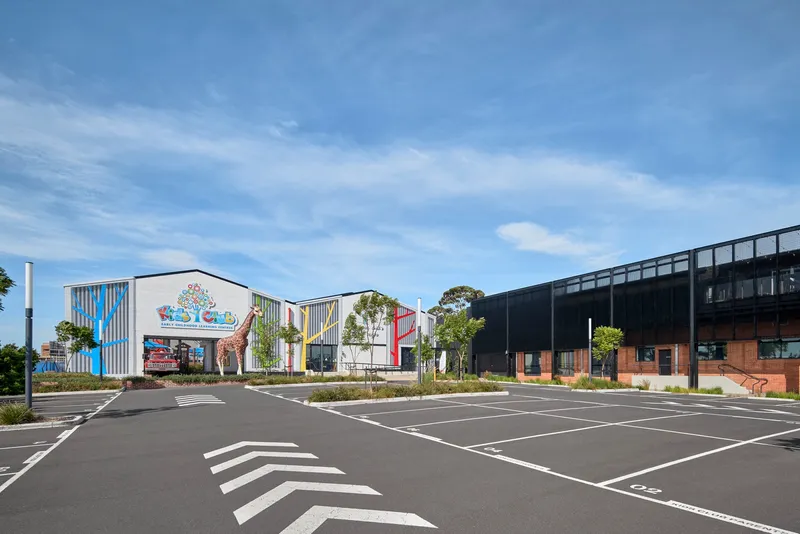
Not every building on the site receives the same level of architectural attention. The gabled warehouse cluster with corrugated metal cladding and colorful facade graphics reads more as functional backdrop than design statement. That is fine. Part of the intelligence of the masterplan is knowing where to invest design energy and where to let utilitarian structures remain utilitarian, now housing concealed car parking and back-of-house functions rather than tobacco processing.
Plans and Drawings

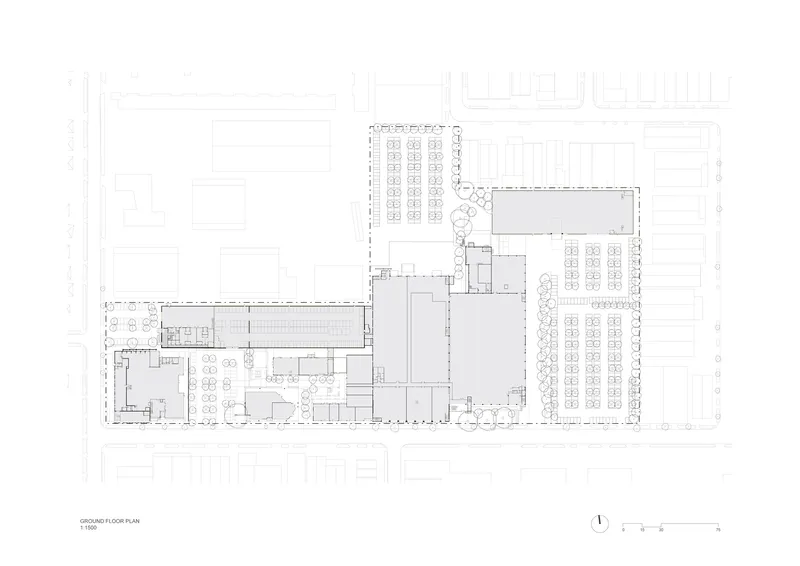
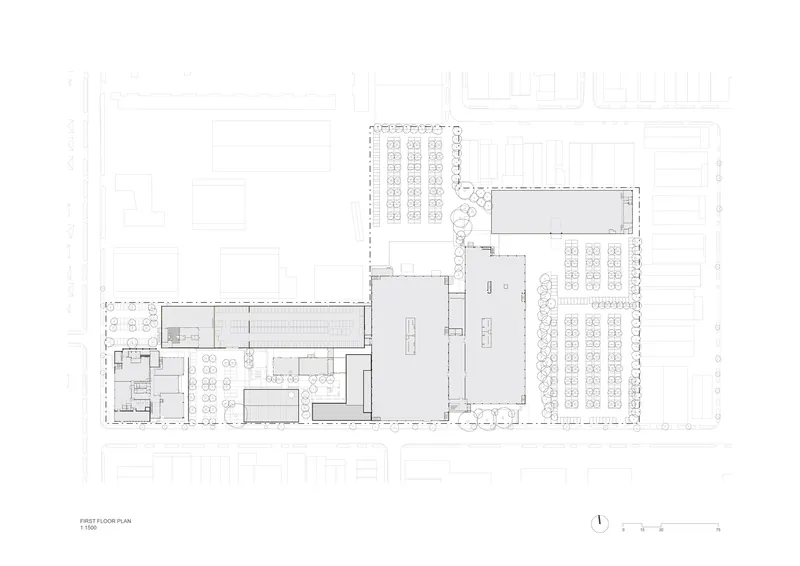
The site plan reveals the full scope of the operation: a dense cluster of building volumes surrounded by parking lots and tree-lined streets, with the hospitality precinct occupying the center of gravity. The L-shaped ground floor plan opens toward a sequence of outdoor spaces, while the first floor plan shows two large volumes connected by circulation zones, suggesting future flexibility in how the upper levels are tenanted.
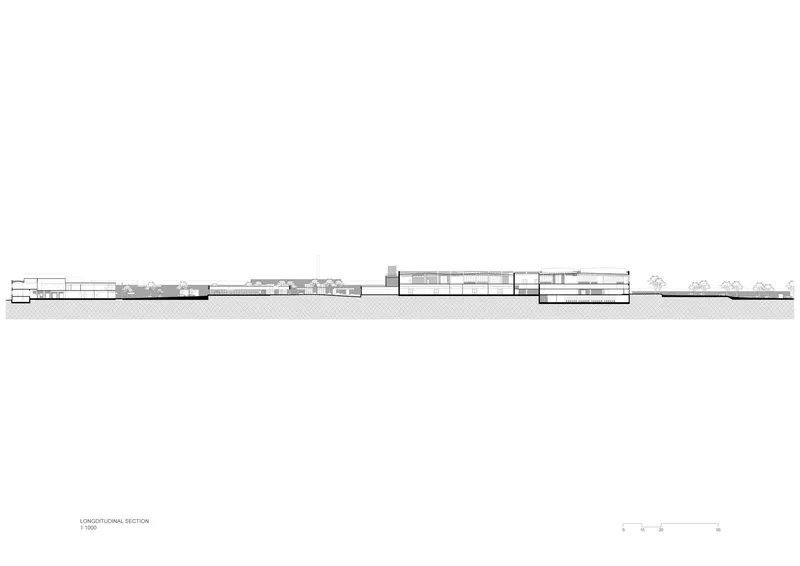
The longitudinal section confirms the low, horizontal massing that keeps the precinct deferential to its residential neighbours. Roof heights vary, reflecting the different eras of construction, but nothing breaks above the existing warehouse datum. Trees are drawn at mature height, a reminder that this project is designed to a longer timeline than its initial opening.
Why This Project Matters
Australian suburbs are full of sites like this: large-footprint industrial campuses from the postwar boom, sitting on land that is now too valuable and too well-located to remain vacant. The typical response is demolition followed by a masterplanned residential estate. Morris Moor offers a counter-model. By retaining the existing structures, Genton preserves embodied energy, maintains a sense of place that decades of local familiarity have built, and delivers a mixed-use program that the neighbourhood lacked.
The more interesting lesson is about the in-between. The buildings here are solid and characterful, but they are not the project's contribution. The courtyards, corridors, and planted thresholds that Genton carved from the gaps between structures are what transform a closed industrial compound into a permeable public precinct. In adaptive reuse, the space you remove can matter as much as the space you keep.
Morris Moor Commercial and Hospitality Precinct, designed by Genton, Moorabbin, Australia. 45,476 m². Completed 2022. Photography by Robyn Oliver.
About the Studio
Share Your Own Work on uni.xyz
If projects like this are the kind of work you want to make, uni.xyz is a place to publish your own, find collaborators, and enter design competitions.


Popular Articles
Popular articles from the community


David Macias Steps a Doorless Stone and Plaster House Down a Tropical Colombian Hillside
In the humid hills of Colombia, Threshold House replaces the front door with an open void and terraces its 850 m² down the slope instead of fighting it.

LT2A and OPEN Architectes Thread a Brick and Glass High School Through a Wooded Belgian Campus
In Braine-l'Alleud, a 3,000 m² wing for Collège Cardinal Mercier pairs pale brick with a glazed colonnade, deferring to a small chapel and a dense wood.

David Ortega Stacks a Two-Story Mexico City Penthouse Around a Steel Stair and a Pergola-Shaded Roof Terrace
In Colonia Roma, a 300 m² penthouse uses oak joinery, a planted steel stair and a slatted roof pergola to make a new-build apartment feel like a house.

GROUP A Strips a 1969 Rotterdam Harbor Headquarters to Its Frame and Wraps It in Timber Louvers
In Rotterdam's M4H harbor district, Ferro Offices reuses a 1969 frame, adds one timber storey and reaches BREEAM-NL Outstanding.

Similar Reads
You might also enjoy these articles


LAVA Architecten Gives Vocational Education a Sawtooth-Roofed Face on a Mechelen School Campus
In Mechelen, Belgium, a 2,053 m² STEM school on a 6×6 m grid turns workshops and classrooms into rooms that can be rearranged as teaching changes.

KEMA Studio Turns a Derelict Marvila Attic into a 60 m² Lighthouse Apartment Above Lisbon
In Lisbon's Marvila district, a rebuilt roof, four skylights and two plywood volumes turn an unlivable attic into a bright home facing the Tagus.

Pixel Gardens: One Repeated Module Stacked Into a Terraced Social Housing Tower for Famagusta
Salem Bader's shortlisted housing tower builds a vertical neighbourhood from one repeated module, offsetting units to carve terraces, light and air.

Bao Huynh Watercolor Atelier: A Serene Art Retreat in Hội An
Bao Huynh Watercolor Atelier in Hội An blends multifunctional art spaces, sustainable design, local materials, and family-friendly living in a serene environment.

Explore Public Building Competitions
Discover active competitions in this discipline

Challenge to design locus for the upliftment of human rights

Design challenge to reuse E-waste
Comments (0)
Please login or sign up to add comments
No comments yet. Be the first to comment!