
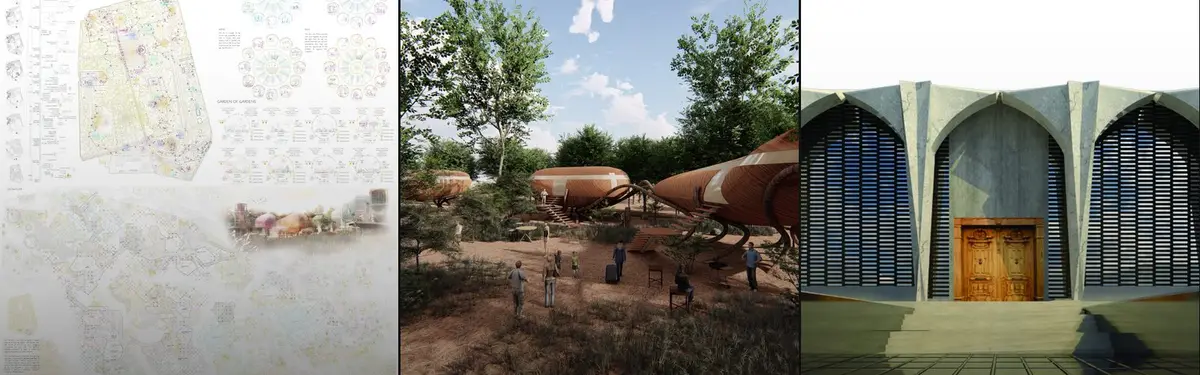


Interaction Design
Design of digital and physical systems that respond to user input and create meaningful experiences.
Interaction design is the practice of designing how people and products, systems or spaces act on each other: what a person can do, how the thing responds, and how both sides understand what is happening. It shapes behaviour over time rather than form alone, and it applies as much to a door, a playground or a museum room as to an app.
What is interaction design?
Interaction design, often shortened to IxD, deals with the dialogue between a person and something that answers back. The common definition calls it the practice of designing interactive digital products, environments, systems and services, and stresses that its main concern is behaviour, not appearance. An interaction designer asks what a person is trying to do, which actions are available, what the system says back, and how a mistake can be undone.
It overlaps with two neighbours that are often confused with it. UX design covers the whole experience of using a product or service, including research, content, service journeys and business goals. UI design is the visual layer of a screen: type, colour, layout and components. Interaction design sits between them. It specifies the moments of exchange, such as a tap, a gesture, a step on a sensor mat or a handle turned, and the feedback that follows. In practice one person often does all three, but the questions are different.
The field is not limited to screens. Physical products with buttons and dials, vehicles, medical devices and public kiosks all need interaction design. So do spaces. A station concourse tells people where to walk, an exhibition decides what a visitor touches first, and a play structure invites some movements and discourages others. This spatial side links IxD to architecture, product design and the growing work on immersive environments.
A short history of interaction design
Graphical interfaces at Xerox PARC. Much of what people now expect from a computer was first combined in the Xerox Alto, developed at Xerox's Palo Alto Research Center. The first machines were introduced in March 1973, and the Alto brought together a graphical user interface, a mouse and networking in one small computer. A 1979 visit by Steve Jobs and Apple staff to PARC is widely cited as a link between that research and the first mass-market graphical computers.

Naming the discipline. The term interaction design was coined by Bill Moggridge and Bill Verplank in the mid-1980s. Verplank saw it as an industrial design version of the computer science term user interface design. Moggridge preferred it to "soft-face", a word he had coined in 1984 for applying industrial design to products that contain software. The name took about a decade to catch on.
Affordances enter design. In 1988 Don Norman published The Design of Everyday Things, first titled The Psychology of Everyday Things. It borrowed the idea of affordance from the psychologist James J. Gibson and made the case for user-centred design: make things visible, get the mapping right, use constraints and design for error. The 2013 revised edition added signifiers to sharpen the idea.
Schools and institutes. Gillian Crampton Smith founded the Computer-Related Design MA at the Royal College of Art in London in 1990, and the first academic programme officially named Interaction Design opened at Carnegie Mellon University in 1994. The Interaction Design Institute Ivrea followed in 2001. Since then the field has spread from screens to services, connected objects and responsive environments.
Key principles of interaction design
Most interaction design guidance rests on a short list of ideas that Norman and others set out in the 1980s and 1990s. They hold for a phone screen and a public square alike.
Affordances and signifiers
An affordance is an action that is possible: a door can be pushed or pulled. A signifier is the cue that tells people which action to take: a flat plate for pushing, a bar for pulling. Norman later argued that designers had overused the first word and should focus on the second.
"Forget affordances: what people need, and what design must provide, are signifiers."
Don Norman, "Signifiers, not affordances", ACM Interactions (2008)
In the same essay he points to desire lines, the paths worn across grass by people's footsteps, as signifiers that planners can read. They show where people actually want to go.

Feedback
Every action needs a visible, audible or tactile response that arrives quickly and says whether it worked. A lift button that lights up, a turnstile that clicks and a floor that glows under a footstep all close the loop. Without feedback, people repeat the action or give up.
Mapping
Mapping is the relationship between controls and their effects. Four burners in a square should be controlled by four knobs laid out in the same square. In a building, a light switch panel that mirrors the room plan is good mapping, and a row of identical switches is not.
Constraints
Constraints limit what can be done so that the right action is the easy one. Physical constraints (a plug that fits one way), logical ones and cultural ones all reduce error. Play structures use them constantly. PLAY FOR ALL by Riham Faragallah, a People's Choice Award entry in the Playground - E | 2021 competition, frames its equipment as a setting in which children and parents interact while learning about their surroundings.

Consistency
Similar things should look and behave alike, inside one product and across a family of products. Consistent icons, gestures and signs let people transfer what they learned once. In wayfinding, the same colour or symbol for the same destination throughout a hospital is consistency at building scale.
Accessibility
An interaction that only works for some bodies or some senses is unfinished. The architect Ronald Mace coined universal design to describe products and environments usable by everyone, regardless of age or ability. For interaction designers that means more than one way to perceive and act: text and sound, touch and voice, steps and ramps.
Interaction design in architecture and space
When architects talk about interaction they usually mean one of four things. The first is responsive installations: rooms, pavilions and surfaces that sense presence and change light, sound or form. Buildings whose structure physically responds are covered in our article on interactive architecture; here the focus is the design of the exchange itself. The second is wayfinding, where signs, materials, light and sightlines tell people where they are and where to go next. The third is exhibitions, where curators and designers decide what visitors do, not only what they see. The fourth is play, where equipment is an open set of invitations.
Museums show the shift clearly. In REFRACTION, nehir Türk proposes an educational and cultural space at Odakule in Istanbul's Beyoğlu district, built around the art of stained glass. Light, spatial storytelling and interactive technology replace the vitrine.
"Rather than presenting stained glass as a historical artifact displayed behind glass, the project transforms it into a living experience where visitors actively discover its artistic, historical, and cultural value."
nehir Türk, REFRACTION, a uni.xyz journal

Not every responsive space needs a screen. OUR INFINITE CONSEQUENCE by roberta sinesio and Veronica Vacaro, a Runner-up in the Elevate 2019 competition, proposes an experience in which visitors see themselves in infinity and reflect on their own scale and actions. In the designers' words, the space exists only because of our presence: the visitor is not an audience for the work but its trigger. Where projection and sensors do the work, the same principles apply, and our media architecture article looks at screens and light at the scale of a facade.

Interaction design on uni.xyz
uni.xyz members approach interaction design through gaming, play, cinema, retail and the city. The projects and journals below show the range.
MetaPixels (MPX) by Ragd alharbat and Malak majed is the most liked project in the topic and a Runner-up in the Reboot competition. The designers describe it as a symbol of the process of creating a digital world, made by gamers for gamers. It is a building about interaction between players, and between players and the worlds they build.

Virtual Insanity, by Keerthigan Thavaseelan and Tyler Bakhtiari and shortlisted in the Cinema Futurismo competition, asks what a cinema can offer that a living room cannot. Its answer is a hybrid in which walls act as both structure and virtual scenery and moving through a room means moving through a story. It sits where interaction design meets AR and VR.
Play is the strongest thread. A-Maze! by ANTRA LODHA, entered in the Grassroots competition, is an Anganwadi built on three combined strands: spatial design, game design and educational design. The layout itself works as gameplay. Creative Board by Mengyang WU, shortlisted in Re-imagining Play 2020, offers children in refugee settlements a kit of standard parts that can be cut, folded, rotated and reconnected into seesaws, classroom walls or gathering rooms. Reclaiming Childhood by Paul Suendermann and Maja Leichtner uses a 2 x 2 x 2 metre timber module that children can climb, occupy and rearrange, leaving the users to decide what the structure is for.

At city scale, (pr)OpenCity by Shaurya Chauhan, a People's Choice Award entry in Habitats '20, treats a 300-acre framework in Delhi's Sarojini Nagar like open-source code that residents keep editing. User research, architecture and interiors feed one continuous loop, which is interaction design applied to planning. WEMAKEPARIS by Mikhail Skisov, shortlisted in the Salut Paris competition, organises the Petite Ceinture around fifteen stations named for human actions, and places a glass lift at the descent into the railway cutting so that the ring stays open to everyone.
Challenges and future directions
Dark patterns. The same skills that make an action easy can push people into actions they did not choose. The user experience designer Harry Brignull coined the term dark pattern in 2010 for interfaces built to trick users, such as subscriptions that are easy to start and hard to cancel.
"Deceptive patterns trick people into doing things they didn’t mean to."
Spaces can manipulate too. Retail layouts that hide exits, or queues that force a route past paid offers, follow the same logic.
Accessibility in practice. Touchscreens, gesture controls and voice interfaces can open doors for some people and close them for others. A kiosk without tactile or audio feedback is useless to a blind visitor. Testing with disabled users early, not after launch, is the only reliable fix.

Privacy in sensing spaces. Responsive rooms and smart buildings work by collecting data about the people inside them: movement, faces, voices, occupancy. Designers should be able to say what is sensed, where it is stored, who sees it and how a person can opt out. A space that responds to people should not quietly profile them.
What comes next. Mixed reality, spatial computing and AI agents are moving interaction off the flat screen and into rooms. The core questions stay the same: what can I do, what happened, and how do I undo it.
Interaction design for students and designers
For architecture and design students, interaction design offers strong thesis ground. Good angles include a museum or library where visitors act rather than look, a playground or learning space built around open-ended modules, wayfinding for a hospital or transit hub tested with people who have low vision, or a public space that responds to presence without collecting personal data. Prototype early: paper, cardboard and a phone camera are enough to test whether people understand what to do.
Build a portfolio that shows behaviour, not only form. Storyboards, journey maps and short videos of a prototype in use explain an interaction better than a final render. Design competitions are a good place to test ideas; see open briefs on uni.xyz competitions, and explore related work in game design, playground design and exhibition design.
Frequently asked questions
What is interaction design in simple words?
It is designing how people and things respond to each other. An interaction designer decides what a person can do with a product or space, how it reacts, and how the person knows what happened.
What is the difference between interaction design and UX design?
UX design covers the whole experience of a product or service, including research, content and business goals. Interaction design focuses on the moments of exchange within that experience: actions, feedback and states. Many designers practise both.
Who coined the term interaction design?
Bill Moggridge and Bill Verplank coined it in the mid-1980s. Moggridge had earlier used the word "soft-face" for industrial design applied to products containing software.
What are the main principles of interaction design?
The most cited are affordances and signifiers, feedback, mapping, constraints and consistency, many of them popularised by Don Norman's The Design of Everyday Things. Accessibility belongs on the same list, because an interaction that excludes people has failed.
Can architects work in interaction design?
Yes. Architects design how people move, wait, find their way and gather, which is interaction at building scale. Exhibition design, wayfinding, responsive installations and play spaces are common crossover areas.
References and further reading
- Interaction design, Wikipedia
- Xerox Alto, Computer History Museum
- The Design of Everyday Things, Wikipedia
- Signifiers, not affordances, Don Norman, jnd.org
- Universal design, Wikipedia
- Dark pattern, Wikipedia
- Deceptive Patterns, Harry Brignull


Popular projects
View all 153 projects


Latest journals
View all 86 journals
Virtual Insanity: Where Physical Architecture and VR Merge to Reinvent Cinema
A shortlisted Cinema Futurismo entry proposes hybrid spaces where built environments and virtual worlds become interdependent storytelling systems.

Creative Board: A Modular Kit That Turns Refugee Settlements into Playgrounds
Standardized components cut, fold, rotate and reconnect to produce play structures, learning spaces and communal gathering environments.

Reclaiming Childhood: Modular Play Architecture Designed for Refugee Camps
A 2x2x2 metre timber module that stacks, connects, and adapts to give displaced children agency over their own spaces for learning and play.


When Making Becomes Designing
Rethinking Craft in the Age of Digital Fabrication


